

Results of a feasibility cluster randomised controlled trial of a peer-led school-based intervention to increase the physical activity of adolescent girls (PLAN-A)
Open accessThe DOI matches its Crossref record; 44 of the 45 references it cites were found in a registry or an index.
Abstract
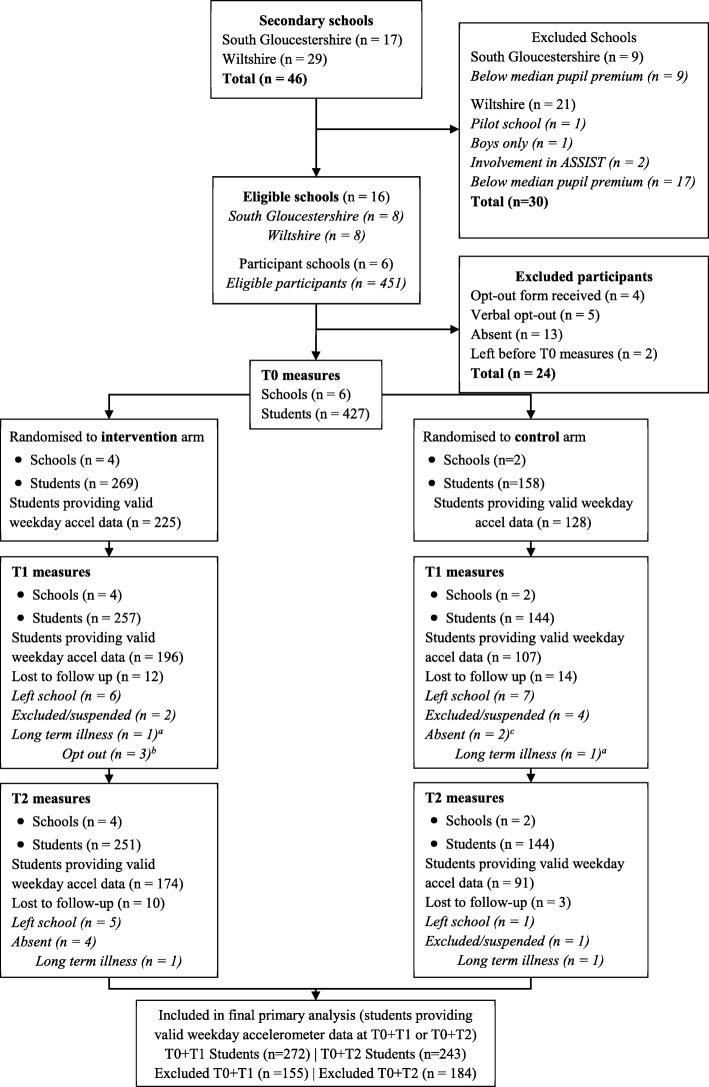
BACKGROUND: Most adolescent girls in the UK do not meet government physical activity recommendations and effective interventions are needed. This study reports the results of a feasibility trial of PLAN-A, a novel school-based peer-led physical activity intervention for adolescent girls. METHODS: A two-arm cluster randomised controlled feasibility study was conducted in six English secondary schools (4 intervention & 2 control). Year 8 (age 12-13) girls were eligible and randomisation was at school-level. The intervention involved training Year 8 girls (out of school for two consecutive days, plus one top-up day 5 weeks later), who were identified by their peers as influential, to provide informal support to their friends to increase their physical activity. Feasibility of the intervention and the research was examined, including: recruitment, training attendance and data provision rates, evidence of promise of the intervention to affect weekday moderate-to-vigorous physical activity (MVPA), intervention cost and estimation of the sample size for a definitive trial. Accelerometer and questionnaire data were collected at the beginning of Year 8 (Time 0), the end of Year 8 (10-weeks after peer-supporter training) and the beginning of Year 9 (Time 2). RESULTS: Four hundred twenty-seven girls were recruited (95% recruitment rate). 55 girls consented to be a peer-supporter and 53 peer-supporters were trained (97% of those invited). Accelerometer return rates exceeded 85% at each time point and wear time criteria was met by 83%, 71% and 62% participants at Time 0, 1 and 2 respectively. Questionnaire data were provided by >91% of participants at each time point. Complete-case adjusted linear regression analysis showed evidence of a 6.09 minute (95% CI = 1.43, 10.76) between-arms difference in weekday MVPA at Time 2 in favour of the intervention arm. On average PLAN-A cost £2685 per school to deliver (£37 per Year 8 girl). There were no adverse events. A trial involving 20 schools would be adequately powered to detect a between-arms difference in weekday MVPA of at least six minutes. CONCLUSIONS: The PLAN-A intervention adopts a novel peer-led approach, is feasible, and shows evidence of promise to positively affect girls' physical activity levels. A definitive trial is warranted. TRIAL REGISTRATION: ISCTRN, ISRCTN12543546, Registered on 28/7/2015, URL of registry record: http://www.isrctn.com/ISRCTN12543546.
Overview
The claims and statistics of this paper haven’t been checked yet.
Free: it reads the open-access text and checks the first 5 claims that cite a source we can check. Create a free account to check every claim.
Integrity signals
Registry
Cites
Statistics
Figures
Verification
Claims the paper makes
The claims and statistics of this paper haven’t been checked yet.
Free: it reads the open-access text and checks the first 5 claims that cite a source we can check. Create a free account to check every claim.
Self-check
Percentages, sums and reported differences re-computed from the paper’s own numbers.
The self-check needs the paper’s full text.
Citations
Cites
The "what" and "why" of goal pursuits: Human needs and the self-determination of behavior
Deci, E. L., & Ryan, R. M. (2000) · Psychological Inquiry · doi:10.1207/s15327965pli1104_01 · Cited by 34,210 · cited 4×
“Briefly, trainers were educated about core SDT principles such as developing girls’ autonomous versus controlled motivation, and peer-supporter training tasks targeted developing participants’ autonomy, competence and/or relatedness and in turn using these principles to support their friends’ physical activity.”
MethodInfluentialDeveloping and evaluating complex interventions: the new Medical Research Council guidance
Craig, P., Dieppe, P., Macintyre, S., Michie, S., Nazareth, I., & Petticrew, M. (2008) · BMJ · doi:10.1136/bmj.a1655 · Cited by 10,995 · cited 1×
“We therefore developed the PLAN-A intervention (Peer-Led physical Activity iNtervention) and in line with the UK Medical Research Council (MRC) framework on the development and evaluation of complex interventions [24], tested it in a feasibility trial [25, 26].”
MethodMultiple imputation using chained equations: Issues and guidance for practice
White, I. R., Royston, P., & Wood, A. M. (2011) · Statistics in Medicine · doi:10.1002/sim.4067 · Cited by 9,792 · cited 1×
“Firstly, where there were 5% or more missing MVPA measures, missing MVPA data were imputed for Time 1 and Time 2, in turn using Multiple Imputation by Chained Equations [39].”
MethodGlobal physical activity levels: surveillance progress, pitfalls, and prospects
Hallal, P. C., Andersen, L. B., Bull, F. C., Guthold, R., Haskell, W., & Ekelund, U. (2012) · The Lancet · doi:10.1016/s0140-6736(12)60646-1 · Cited by 5,711 · cited 1×
“The UK and US governments recommend that children and adolescents undertake 60 minutes of moderate-to-vigorous physical activity (MVPA) each day [4, 5], however, many adolescents do not meet this guideline [6].”
BackgroundJanssen, I., & LeBlanc, A. G. (2010) · International Journal of Behavioral Nutrition and Physical Activity · doi:10.1186/1479-5868-7-40 · Cited by 4,829
Evidence Based Physical Activity for School-age Youth
Strong, W. B., Malina, R. M., Blimkie, C. J. R., Daniels, S. R., Dishman, R. K., Gutin, B., Hergenroeder, A. C., Must, A., Nixon, P. A., Pivarnik, J. M., et al. (2005) · The Journal of Pediatrics · doi:10.1016/j.jpeds.2005.01.055 · Cited by 4,222
Exercise, physical activity, and self-determination theory: A systematic review
Teixeira, P. J., Carraça, E. V., Markland, D., Silva, M. N., & Ryan, R. M. (2012) · International Journal of Behavioral Nutrition and Physical Activity · doi:10.1186/1479-5868-9-78 · Cited by 2,963 · cited 4×
“Briefly, trainers were educated about core SDT principles such as developing girls’ autonomous versus controlled motivation, and peer-supporter training tasks targeted developing participants’ autonomy, competence and/or relatedness and in turn using these principles to support their friends’ physical activity.”
MethodInfluentialCalibration of two objective measures of physical activity for children
Evenson, K. R., Catellier, D. J., Gill, K., Ondrak, K. S., & McMurray, R. G. (2008) · Journal of Sports Sciences · doi:10.1080/02640410802334196 · Cited by 2,677 · cited 2×
“The Evenson cut-point (≥2296 counts per minute)[34] was used to estimate mean daily minutes of MVPA on weekdays and weekend day(s) as this threshold is the most accurate for adolescents [35].”
MethodDeveloping and evaluating complex interventions: the new Medical Research Council guidance
Craig, P., Dieppe, P., Macintyre, S., Michie, S., Nazareth, I., & Petticrew, M. (2013) · International Journal of Nursing Studies · doi:10.1016/j.ijnurstu.2012.09.010 · Cited by 1,658
Comparison of Accelerometer Cut Points for Predicting Activity Intensity in Youth
TROST, S. G., LOPRINZI, P. D., MOORE, R., & PFEIFFER, K. A. (2011) · Medicine & Science in Sports & Exercise · doi:10.1249/mss.0b013e318206476e · Cited by 1,360 · cited 1×
“The Evenson cut-point (≥2296 counts per minute)[34] was used to estimate mean daily minutes of MVPA on weekdays and weekend day(s) as this threshold is the most accurate for adolescents [35].”
Method
Research works printed but not linked: 1
- 29. Rogers, E.M., Diffusion of Innovations. 1983, NY: The Free Press.
Cited by
Neil-Sztramko, S. E., Caldwell, H., & Dobbins, M. (2021) · Cochrane Database of Systematic Reviews · doi:10.1002/14651858.cd007651.pub3 · Cited by 449
Peer social network processes and adolescent health behaviors: A systematic review
Montgomery, S. C., Donnelly, M., Bhatnagar, P., Carlin, A., Kee, F., & Hunter, R. F. (2020) · Preventive Medicine · doi:10.1016/j.ypmed.2019.105900 · Cited by 238
Becoming an object: A review of self-objectification in girls
Daniels, E. A., Zurbriggen, E. L., & Monique Ward, L. (2020) · Body Image · doi:10.1016/j.bodyim.2020.02.016 · Cited by 192
Dodd, S., Widnall, E., Russell, A. E., Curtin, E. L., Simmonds, R., Limmer, M., & Kidger, J. (2022) · BMC Public Health · doi:10.1186/s12889-022-14688-3 · Cited by 189
King, T., & Fazel, M. (2021) · PLOS ONE · doi:10.1371/journal.pone.0249553 · Cited by 81
“Pupil sample sizes ranged from 55 [83] to 372 [12] and the number of experimental schools evaluated per study ranged from one [77] to 22 [36].”
BackgroundInfluentialGreen teens: Understanding and promoting adolescents’ sustainable engagement
Thomaes, S. C. E., Grapsas, S., van de Wetering, J., Spitzer, J. E., & Poorthuis, A. M. G. (2023) · One Earth · doi:10.1016/j.oneear.2023.02.006 · Cited by 87
Reimers, A. K., Schmidt, S., Demetriou, Y., Marzi, I., & Wöll, A. (2019) · PLoS ONE · doi:10.1371/journal.pone.0223928 · Cited by 81
McHale, F., Ng, K., Taylor, S. L., Bengoechea, E. G., Norton, C., O'Shea, D. B., & Woods, C. B. (2021) · Health Education & Behavior · doi:10.1177/10901981211044988 · Cited by 75
“, 2017), peer-peer informal diffusion of messages about PA (Sebire et al., 2018), a tiered leadership system using older peers and in class peer leaders encouraging participation in PA through activities and a reward system (Corder et al.”
BackgroundMethodInfluentialA feasibility study of ‘The StepSmart Challenge’ to promote physical activity in adolescents
Corepal, R., Best, P., O’Neill, R., Kee, F., Badham, J., Dunne, L., Miller, S., Connolly, P., Cupples, M. E., van Sluijs, E. M. F., et al. (2019) · Pilot and Feasibility Studies · doi:10.1186/s40814-019-0523-5 · Cited by 58
Ayala, A. M. C., Parker, K. E., Mazzoli, E., Lander, N., Ridgers, N. D., Timperio, A. F., Lubans, D. R., Abbott, G., Koorts, H., & Salmon, J. (2024) · Sports Medicine - Open · doi:10.1186/s40798-024-00688-7 · Cited by 62
“%) used a randomised controlled trial design [33–39, 42, 44, 46–78], 15 studies (23.8”
MethodInfluentialvan Woudenberg, T. J., Bevelander, K. E., Burk, W. J., Smit, C. R., Buijs, L., & Buijzen, M. (2020) · Frontiers in Psychology · doi:10.3389/fpsyg.2019.02913 · Cited by 52
“The required sample size was based on the previous study by Sebire et al. (2018) that found an effect of the social network intervention in a study with 272 adolescents in the intervention and the control condition.”
BackgroundMethodInfluentialLawler, M., Heary, C., & Nixon, E. (2020) · Journal of Youth and Adolescence · doi:10.1007/s10964-019-01187-9 · Cited by 51
Fynn, J. F., Hardeman, W., Milton, K. E., MURPHY, J. J., & Jones, A. (2020) · International Journal of Behavioral Nutrition and Physical Activity · doi:10.1186/s12966-020-01013-7 · Cited by 49
Sebire, S. J., Banfield, K., Jago, R., Edwards, M. J., Campbell, R. M., Kipping, R., Blair, P. S., Kadir, B., Garfield, K., Matthews, J. A., et al. (2019) · BMC Public Health · doi:10.1186/s12889-019-7545-z · Cited by 45
Self-citationHulteen, R. M., Waldhauser, K. J., & Beauchamp, M. R. (2019) · Current Obesity Reports · doi:10.1007/s13679-019-00366-w · Cited by 45
van Woudenberg, T. J., Simoski, B., Araújo, E. F. D. M., Bevelander, K. E., Burk, W. J., Smit, C. R., Buijs, L., Klein, M. C. A., & Buijzen, M. (2019) · Journal of Medical Internet Research · doi:10.2196/12914 · Cited by 39
Lawler, M., Heary, C., Shorter, G. W., & Nixon, E. (2021) · International Journal of Sport and Exercise Psychology · doi:10.1080/1612197x.2021.1891118 · Cited by 42
“The finding demonstrates that peers can be utilised as significant agents of adolescent health behaviour change (Sebire et al., 2018).”
BackgroundEmm-Collison, L., Cross, R., González, M. G., Watson, D. L., Foster, C. E., & Jago, R. (2022) · International Journal of Environmental Research and Public Health · doi:10.3390/ijerph19073993 · Cited by 37
“There have been several recent interventions targeting physical activity in adolescents through peer relationships [51,52], and initial findings indicate that these strategies are effective [53,54].”
BackgroundSelf-citationJago, R., Tibbitts, B., Willis, K., Sanderson, E., Kandiyali, R., Reid, T., Kipping, R., Campbell, R. M., MacNeill, S., Hollingworth, W., et al. (2021) · International Journal of Behavioral Nutrition and Physical Activity · doi:10.1186/s12966-021-01133-8 · Cited by 32
“It is also important to reiterate that the intervention was co-developed with adolescent girls and built on a successful smoking cessation intervention and had shown considerable promise in a robustly-conducted feasibility study [10].”
BackgroundMethodResultSelf-citationChatterjee, P., & Nirgude, A. (2024) · Cureus · doi:10.7759/cureus.53127 · Cited by 26
“DOI 10.7759/cureus.53127 27, 28,31,32,34-36,38 ,40 ,42 ,43 ,51-54 51-54 Intervention duration is another important key feature that can affect the results of intervention programs.”
BackgroundMethodInfluentialZhou, Z., Li, X., & Zhang, Z. (2023) · International Journal of Environmental Research and Public Health · doi:10.3390/ijerph20032480 · Cited by 29
“Intervention research on adolescent physical activity has been carried out based on the social network of the peers of the class but has yielded inconsistent conclusions [25].”
BackgroundMotivating Social Influencers to Engage in Health Behavior Interventions
Smit, C. R., Bevelander, K. E., de Leeuw, R. N. H., & Buijzen, M. (2022) · Frontiers in Psychology · doi:10.3389/fpsyg.2022.885688 · Cited by 28
“, 2018), and physical activity among young adolescent girls (Sebire et al., 2018).”
BackgroundSmit, C. R., de Leeuw, R. N. H., Bevelander, K. E., Burk, W. J., Buijs, L., van Woudenberg, T. J., & Buijzen, M. (2020) · Public Health Nutrition · doi:10.1017/s1368980020004802 · Cited by 22
Emm-Collison, L., Lewis, S. J., Reid, T., Matthews, J. A., Sebire, S. J., Thompson, J. L., Salway, R., & Jago, R. (2019) · International Journal of Environmental Research and Public Health · doi:10.3390/ijerph16173174 · Cited by 22
“Interventions using peer-relationships to increase physical activity engagement have been shown to be beneficial, particularly for girls [40,41].”
BackgroundSelf-citationDeterminants of student’s physical activity: a 12-month follow-up study in Ningxia province
Huang, W., Shi, X., Wang, Y., Li, X., Gao, P., Lu, J., & Zhuang, J. (2021) · BMC Public Health · doi:10.1186/s12889-021-10525-1 · Cited by 19
Jago, R., Tibbitts, B., Sanderson, E., Bird, E. L., Porter, A., Metcalfe, C., Powell, J. E., Gillett, D., & Sebire, S. J. (2019) · International Journal of Environmental Research and Public Health · doi:10.3390/ijerph16010131 · Cited by 22
“There is a lack of reporting on the costs associated with children’s physical activity interventions, however the estimated costs of Action 3:30 are comparable to those that have been reported in recent years [25,30].”
ResultSelf-citationNg, K., Sainio, P., & Sit, C. H. P. (2019) · International Journal of Environmental Research and Public Health · doi:10.3390/ijerph16173156 · Cited by 22
Smit, C. R., de Leeuw, R. N. H., Bevelander, K. E., Burk, W. J., van Woudenberg, T. J., Buijs, L., & Buijzen, M. (2021) · BMC Public Health · doi:10.1186/s12889-021-10161-9 · Cited by 20
Aceves‐Martins, M., Llauradó, E., Tarro, L., Papell-Garcia, I., Prades‐Tena, J., Kettner-Høeberg, H., Puiggròs, F., Arola, L., Davies, A., Giralt, M., et al. (2022) · Childhood Obesity · doi:10.1089/chi.2021.0207 · Cited by 15
“51 The WISH study, a peer-led walking-in school intervention, shows limited effects on improving PA in adolescent girls in its pilot phase.”
Parker, K., Eddy, S., Nunns, M., Xiao, Z., Ford, T. J., Eldridge, S. M., & Ukoumunne, O. C. (2022) · Pilot and Feasibility Studies · doi:10.1186/s40814-022-01098-w · Cited by 15
“03, which provides useful information on plausible true values of the parameter despite those studies having only 6 [46] and 19 [39] clusters.”
BackgroundInfluentialLaVelle, M., Knopp, M., Gunther, C. W., & Hopkins, L. C. (2023) · Nutrients · doi:10.3390/nu15122658 · Cited by 16
“The Girls Active Project was a two-arm cluster randomized control in secondary state schools across the Midlands, United Kingdom.”
BackgroundMethodResultInfluentialWillis, K., Tibbitts, B., Sebire, S. J., Reid, T., MacNeill, S., Sanderson, E., Hollingworth, W., Kandiyali, R., Campbell, R. M., Kipping, R., et al. (2019) · BMC Public Health · doi:10.1186/s12889-019-7012-x · Cited by 15
“Table 2 shows the power calculations where the following parameters are fixed: cluster size = 70 (informed by feasibility study [33]), intra class correlation (ICC) on weekday MVPA = 0.”
Self-citationFeng, J., Huang, Y., Chen, Z., Jiao, J., Khan, A., Nisar, M., & Wong, S. H.-S. (2024) · Sports Medicine · doi:10.1007/s40279-024-02113-1 · Cited by 15
Feasibility Study of the Secondary Level Active School Flag Programme: Study Protocol
Ng, K., McHale, F., Cotter, K. D., O'Shea, D. B., & Woods, C. B. (2019) · Journal of Functional Morphology and Kinesiology · doi:10.3390/jfmk4010016 · Cited by 14
“Same-aged peers were also effective in promoting six minutes of daily MVPA through diffusion messages among girls during the entire school day [14].”
BackgroundLeduc, G., Gilbert, J., Ayotte, A., Moreau, N., Drapeau, V., Lemoyne, J., Monthuy‐Blanc, J., Tremblay, J., & Mathieu, M.-E. (2021) · BMC Public Health · doi:10.1186/s12889-021-10200-5 · Cited by 12
McQuinn, S., Belton, S., Staines, A. S., & Sweeney, M. R. (2022) · Pilot and Feasibility Studies · doi:10.1186/s40814-022-01149-2 · Cited by 11
“Using a parental/guardian, passive (opt-out) approach has allowed for greater recruitment of adolescents in previous low-risk, nonintrusive, school-based PA interventions [32, 34, 44, 74, 79], such as the Girls-Peer Activity (G-PACT) [32] (94% using passive consent vs 26% using active consent) and the GoActive program…”
MethodMoin, M., Farhan, Z., Naqvi, S. K., Lassi, Z. S., & Das, J. K. (2026) · Journal of Global Health · doi:10.7189/jogh.16.04112 · Cited by 11
Parker, A. G., Markulev, C., Rickwood, D., Mackinnon, A. J., Purcell, R., Álvarez‐Jiménez, M., Yung, A. R., McGorry, P. D., Hetrick, S. E., & Jorm, A. F. (2019) · BMJ Open · doi:10.1136/bmjopen-2019-034002 · Cited by 13
Iranian children with overweight and obesity: an internet-based interventional study
Khatami, F., Shariatpanahi, G., Barahimi, H., Hashemi, R., Khedmat, L., & Gheirati, M. (2021) · BMC Pediatrics · doi:10.1186/s12887-021-02684-2 · Cited by 10
“have recently reported the effectiveness of the peer-led school-based intervention in promoting physical activity in adolescent girls [43].”
BackgroundJago, R., Tibbitts, B., Porter, A., Sanderson, E., Bird, E. L., Powell, J. E., Metcalfe, C., & Sebire, S. J. (2019) · Public Health Research · doi:10.3310/phr07190 · Cited by 12
Self-citationBrandes, B., Sell, L., Buck, C., Busse, H., Zeeb, H., & Brandes, M. (2023) · International Journal of Behavioral Nutrition and Physical Activity · doi:10.1186/s12966-023-01497-z · Cited by 11
“Regarding participation in the DMT and provision of valid accelerometer data we received good response rates that are in line with those of similar studies while questionnaire data provision rates were lower in our study [31, 32].”
ResultOwen, M. B., Kerner, C., Taylor, S. L., Noonan, R. J., Newson, L., Kosteli, M., Curry, W. B., & Fairclough, S. J. (2018) · Children · doi:10.3390/children5090128 · Cited by 9
“Objectively measured accelerometry data from multiple continents suggests that among 5–17-year-old, only 9% of boys and 1.9% of girls achieved the recommended 60 min of MVPA [3].”
InfluentialCowley, E. S., Foweather, L., Watson, P. M., Belton, S., Thompson, A., Thijssen, D. H. J., & Wagenmakers, A. J. M. (2022) · International Journal of Environmental Research and Public Health · doi:10.3390/ijerph19020966 · Cited by 10
Youth voices creating healthy eating and physically active environments in schools
Shah, S., Liu, K. R., Lockett, C., & Sainsbury, E. (2023) · Health Education Journal · doi:10.1177/00178969231173266 · Cited by 8
“However, girls’ relationship with physical activity becomes exceedingly complex throughout their development due to its interaction with gender roles, societal norms and self-appearance (Sebire et al., 2018; Spencer et al., 2015).”
BackgroundVondung, C., Demetriou, Y., Reimers, A. K., Schlund, A., & Bucksch, J. (2020) · International Journal of Environmental Research and Public Health · doi:10.3390/ijerph17145231 · Cited by 8
Pacres, K. R., & Babiera, R. M. (2025) · Psychology and Education A Multidisciplinary Journal · doi:10.70838/pemj.340603 · Cited by 8
BLinG-Health: A Peer-Led Physical Activity Program for Black Adolescent Girls—A Pilot Study
Blackshear, T. B., & Baucum, T. (2024) · Women in Sport and Physical Activity Journal · doi:10.1123/wspaj.2023-0078 · Cited by 7
Physical activity and screen time among children and adolescents in Kazakhstan
Ng, K., Abdrakhmanova, S., & Adayeva, A. (2019) · Exercise and Quality of Life · doi:10.31382/eqol.191202 · Cited by 8
“…transition to secondary level education (De Meester, Van Dyck, De Bourdeaudhuij, Deforche, & Cardon, 2014), more social interaction through hobbies than prescribed activities organised by parents (Sebire et al., 2018) and sport activities become more competitive amongst others (Kokko, 2014).”
BackgroundPetro-Petro, J., Arango-Paternina, C. M., Villada, F. A. P., Villada, J. F. R., & Brownson, R. C. (2024) · BMC Public Health · doi:10.1186/s12889-024-18615-6 · Cited by 6
“Two studies were effective in increasing PA [29, 35], and one in increasing PA and reducing SB [34].”
BackgroundMethodInfluentialPolman, M. A. A., Beckers, D., Burk, W. J., Smit, C. R., Buijzen, M., Vink, J. M., van den Broek, N., & Larsen, J. K. (2023) · Psychology and Health · doi:10.1080/08870446.2023.2179084 · Cited by 5
“While some studies found that social network interventions improved children’s weight-related behaviors (Franken et al., 2018; Sebire et al., 2018; Smit et al., 2020; Smit et al., 2016), others found no intervention effects (Bell et al., 2017; van Woudenberg et al., 2018, 2020).”
Cowley, E. S., Watson, P. M., Paterson, C. A., Wagenmakers, A. J. M., Thompson, A., Belton, S., Thijssen, D. H. J., & Foweather, L. (2024) · BMC Public Health · doi:10.1186/s12889-024-19664-7 · Cited by 6
“Increasing adolescent girls’ PA levels is a difficult task, evidenced by the plethora of previous interventions resulting in no significant changes between baseline and postintervention [9, 12, 23, 58].”
BackgroundSalway, R., Sebire, S. J., Tibbitts, B., Sanderson, E., Kandiyali, R., Willis, K. J., MacNeill, S., & Jago, R. (2020) · International Journal of Environmental Research and Public Health · doi:10.3390/ijerph17217980 · Cited by 6
“Our formative work from a feasibility trial has shown that the PLAN-A intervention is acceptable and feasible with evidence of promise to impact on levels of physical activity [25,26].”
BackgroundSelf-citationThe Association between Social Isolation and Physical Activity among Korean Adolescents
Jang, S., & Park, N.-Y. (2024) · Children · doi:10.3390/children11081003 · Cited by 7
“These studies revealed that adolescents tend to engage in physical activities similar to those of their friends, demonstrating strong peer influence within these networks [10,11].”
BackgroundFeasibility and Preliminary Effectiveness of the INSPIRE Pilot Study for Adolescent Girls
Voskuil, V. R., Emmanuel, J., Magnuson, C., & Guidone, M. (2023) · Journal of Pediatric Health Care · doi:10.1016/j.pedhc.2023.09.001 · Cited by 4
Wang, Y., Wang, H., Zhang, P., Gu, J., Shen, F., Qiu, D., Yang, Y., Yang, S., Wang, M., Wu, Y., et al. (2025) · Med · doi:10.1016/j.medj.2025.100894 · Cited by 4
Makmon, K., Azman, F. I., Manaf, R. A., & Baharudin, M. R. (2026) · Scientific Reports · doi:10.1038/s41598-026-56110-7 · Cited by 2
Peer-led physical activity intervention for girls aged 13 to 14 years: PLAN-A cluster RCT
Jago, R., Tibbitts, B., Willis, K., Sanderson, E., Kandiyali, R., Reid, T., MacNeill, S., Kipping, R., Campbell, R. M., Sebire, S. J., et al. (2022) · Public Health Research · doi:10.3310/zjqw2587 · Cited by 3
Self-citationHealth Promotion in Children and Adolescents through Sport and Physical Activities—2nd Edition
Bianco, A. (2021) · MDPI eBooks · doi:10.3390/books978-3-0365-1196-2 · Cited by 2
Franken, S. C. M., Smit, C. R., de Moor, M. H. M., de Leeuw, R. N. H., & Buijzen, M. (2025) · Journal of Public Health · doi:10.1007/s10389-024-02386-w · Cited by 1
“…also contributes to the growing body of evidence on the effectiveness of SNIs in promoting healthy behaviors (Campbell et al. 2008; Chung et al. 2017; Cruwys et al. 2015; Kelly et al. 1991; Latkin and Knowlton 2015; Robinson et al. 2014; Sebire et al. 2018; Story et al. 2002; Valente et al. 2003).”
Morgan, K., Godwin, J. V., Cannings-John, R. L., Edwards, R. T., Granger, R., Hallingberg, B., Moore, G., Pell, B., van Sluijs, E. M. F., Whiteley, H., et al. (2025) · Pilot and Feasibility Studies · doi:10.1186/s40814-025-01615-7 · Cited by 1
“While demonstrating a recruitment rate of 98% among approached girls, similar to wider school-based studies [46, 47], a large proportion of girls did not have parent consent to participate in the study.”
Nally, S., Carlin, A., Gallagher, A. M., Wilson, J. J., Lahart, I. M., Salmon, J., & MURPHY, M. H. (2025) · PLoS ONE · doi:10.1371/journal.pone.0335933 · Cited by 1
“The high recruitment rates for the C-SLAMM intervention could be due to friend/peer involvement or support [61], due to small rewards or incentives (e.g., a pencil) [62] or children may have perceived the intervention to be fun [63].”
Gintel, D. L., Anselma, M., Ket, J. C. F., Fix, M., & Altenburg, T. M. (2026) · BMC Public Health · doi:10.1186/s12889-025-25618-4 · Cited by 2
“Nineteen interventions were developed specifically for girls [39, 42–47, 51, 52, 54, 58–60, 62, 66, 67, 69, 104, 108], and one intervention for boys [61].”
Petro-Petro, J., Arango-Paternina, C. M., & Villada, F. A. P. (2026) · Research Quarterly for Exercise and Sport · doi:10.1080/02701367.2026.2623652 · Cited by 1
“…in ST represent significant effects, considering the context of findings from previous studies, which have documented increases ranging from 6 (Sebire et al., 2018) to 14 minutes (Barr-Anderson et al., 2012) per day of PA, and reductions in ST of around 23 minutes per day (Sebire et al., 2018).”
InfluentialTiming of MVPA and psychosocial outcomes in adolescents with overweight/obesity
Pan, S., Wang, P., Tao, Y., Zhang, Z., Herold, F., Heath, M. D., Taylor, A., Farrahi, V., Lowe, C. J., Werneck, A. O., et al. (2026) · International Journal of Clinical and Health Psychology · doi:10.1016/j.ijchp.2026.100687 · Cited by 3
“In contrast, weekend MVPA may be more dependent on family resources (McMinn et al., 2013), neighborhood conditions (Stone et al., 2014), and peer inclusion (Sebire et al., 2018), leading to greater variability in the type, quality, and psychosocial “ meaning ” of the activity (Ortega et al., 2022).”
Health Promotion in Children and Adolescents through Sport and Physical Activities
Bianco, A. (2019) · MDPI eBooks · doi:10.3390/books978-3-03897-887-9 · Cited by 1
(2023) · Emerald Group Publishing Limited eBooks · doi:10.1108/978-1-80382-513-720231020 · Cited by 1
James, M. (2021) · Cronfa (Swansea University) · doi:10.23889/suthesis.56825
Peer-Led Physical Activity: Increasing Opportunities for Students to Engage
Blackshear, T. B. (2024) · Strategies · doi:10.1080/08924562.2024.2325848
“Empowering students to lead these programs fosters a sense of ownership and responsibility, potentially increasing participation and sustained engagement (Blacks-hear & Baucum, 2024; McHale et al., 2022; O’Kane et al., 2020; Owen et al., 2018; Sebire et al., 2018).”
BackgroundHuang, W., Shi, X., Wang, Y., Li, X., Gao, P., Lu, J., & Zhuang, J. (2021) · Figshare · doi:10.6084/m9.figshare.14228434
Leduc, G., Gilbert, J., Ayotte, A., Moreau, N., Drapeau, V., Lemoyne, J., Monthuy‐Blanc, J., Tremblay, J., & Mathieu, M.-E. (2021) · Figshare · doi:10.6084/m9.figshare.13662480
Brandes, B., Sell, L., Buck, C., Busse, H., Zeeb, H., & Brandes, M. (2024) · Figshare · doi:10.6084/m9.figshare.26611439
Brandes, B., Sell, L., Buck, C., Busse, H., Zeeb, H., & Brandes, M. (2024) · Figshare · doi:10.6084/m9.figshare.26611451
McQuinn, S., Belton, S., Staines, A., & Sweeney, M. R. (2022) · Figshare · doi:10.6084/m9.figshare.20745393
Petro-Petro, J., Arango-Paternina, C. M., Villada, F. A. P., Villada, J. F. R., & Brownson, R. C. (2024) · Figshare · doi:10.6084/m9.figshare.26709743
Leduc, G., Gilbert, J., Ayotte, A., Moreau, N., Drapeau, V., Lemoyne, J., Monthuy‐Blanc, J., Tremblay, J., & Mathieu, M.-E. (2021) · Figshare · doi:10.6084/m9.figshare.13662477
Jago, R., Tibbitts, B., Willis, K., Sanderson, E., Kandiyali, R., Reid, T., Kipping, R. R., Campbell, R., MacNeill, S., Hollingworth, W., et al. (2021) · Figshare · doi:10.6084/m9.figshare.14594529
Self-citationPetro-Petro, J., Arango-Paternina, C. M., Villada, F. A. P., Villada, J. F. R., & Brownson, R. C. (2024) · Figshare · doi:10.6084/m9.figshare.26709740
Parker, K., Eddy, S., Nunns, M., Xiao, Z., Ford, T. J., Eldridge, S. M., & Ukoumunne, O. C. (2022) · Figshare · doi:10.6084/m9.figshare.20222476
Cowley, E. S., Watson, P. M., Paterson, C., Wagenmakers, A. J. M., Thompson, A., Belton, S., Thijssen, D., & Foweather, L. (2024) · Figshare · doi:10.6084/m9.figshare.26490513
Brandes, B., Sell, L., Buck, C., Busse, H., Zeeb, H., & Brandes, M. (2024) · Figshare · doi:10.6084/m9.figshare.26611442
McQuinn, S., Belton, S., Staines, A., & Sweeney, M. R. (2022) · Figshare · doi:10.6084/m9.figshare.20745396
Brandes, B., Sell, L., Buck, C., Busse, H., Zeeb, H., & Brandes, M. (2024) · Figshare · doi:10.6084/m9.figshare.26611448
McQuinn, S., Belton, S., Staines, A., & Sweeney, M. R. (2022) · Figshare · doi:10.6084/m9.figshare.20745399
Brandes, B., Sell, L., Buck, C., Busse, H., Zeeb, H., & Brandes, M. (2024) · Figshare · doi:10.6084/m9.figshare.26611445
McQuinn, S., Belton, S., Staines, A., & Sweeney, M. R. (2022) · Figshare · doi:10.6084/m9.figshare.20745402
McQuinn, S. (2022) · Dublin City University Open Access Institutional Repository (Dublin City University)
Nudging strategies to increase youth physical activity
Suvi, K. (2025) · DSpace repository (University of Tartu)
Motivação no tratamento do diabetes tipo 2: revisão integrativa à luz da teoria da autodeterminação
Arruda, L. S. N. D. S., Araujo, R. R., Sousa, L. B. D. A., Sousa, F. W. D. S., Mota, M. D. S., Pereira, L. D. C., & BORGES, J. W. P. (2025) · Gestão & Cuidado em Saúde. · doi:10.70368/gecs.v2i1.15726
Petro-Petro, J., Arango-Paternina, C. M., & Villada, F. A. P. (2026) · International Journal of Sport and Exercise Psychology · doi:10.1080/1612197x.2026.2674615
Liu, Q., Xu, Z., Shao, X., Lian, Z., Cheng, W., & Wang, X. (2026) · BMC Public Health · doi:10.1186/s12889-026-28685-3
Grady, C. L., Murtagh, E., Ng, K., Bengoechea, E. G., & Woods, C. B. (2026) · Health Promotion International · doi:10.1093/heapro/daag110
“The 40% recruitment rate (6/15 schools) is consistent with other studies reporting one to seven schools (Jago et al. 2012, Corder et al. 2016, Owen et al. 2018, Sebire et al. 2018, Watkins et al. 2024).”
McNally, K., Murtagh, E., Ng, K., Grady, C. L., & Woods, C. B. (2026) · Journal of School Health · doi:10.1111/josh.70216
Metadata
- Authors
- Sebire, S. J., Jago, R., Banfield, K., Edwards, M. J., Campbell, R., Kipping, R., Blair, P. S., Kadir, B., Garfield, K., Matthews, J., Lyons, R. A., & Hollingworth, W.
- Affiliations
- University of Bristol (GB)
- University Hospitals Bristol NHS Foundation Trust (GB)
- Swansea University (GB)
- Corresponding author
- Sebire, Simon J.
- ORCID
- Venue
- International Journal of Behavioral Nutrition and Physical Activity
- Published
- 2018-06-07
- Volume
- 15
- Issue
- 1
- Pages
- 50-50
- ISSN
- 1479-5868 (ISSN-L)
- PMC
- PMC5992776
- OpenAlex
- W2806175554
- Semantic Scholar
- c095eba46b1a8e7e5dc27eacfb1bd2707b9852c6
- Cited by
- 89
- References
- 45
- Citations by year
- 2026: 7 · 2025: 6 · 2024: 16 · 2023: 8 · 2022: 13 · 2021: 15 · 2020: 7 · 2019: 15 · 2018: 1
- FWCI
- 6.53
- Type
- journal article
- Language
- en
- Open access
- gold
- doi.org
- Licence
- cc-by
- creativecommons.org/licenses/by/4.0/ (tdm)
- Locations
- International Journal of Behavioral Nutrition and Physical Activity (publishedVersion, cc-by)
- Europe PMC (PubMed Central) (publishedVersion, other-oa)
- PubMed Central (publishedVersion, cc-by)
- PubMed (publishedVersion)
- Explore Bristol Research (publishedVersion, cc-by)
- DOAJ (DOAJ: Directory of Open Access Journals) (submittedVersion)
- Bristol Research (University of Bristol) (submittedVersion, cc-by)
- Funders
- Public Health Research Programme (13/90/16)
- Wiltshire Council (n/a)
- South Gloucestershire Council (n/a)
- Topics
- Health Sciences › Medicine › Public Health, Environmental and Occupational Health › Physical Activity and Health
- Health Sciences › Medicine › Public Health, Environmental and Occupational Health › School Health and Nursing Education
- Health Sciences › Medicine › Public Health, Environmental and Occupational Health › Obesity, Physical Activity, Diet
- Keywords
- adolescent girls, physical activity, peer-led intervention, school-based intervention, peer supporters, moderate-to-vigorous physical activity, feasibility, intervention costs, sample size determination, high school students, accelerometer wear time, recruitment rate, sedentary behavior, health promotion, social support, intervention dissemination, intervention sustainability
- MeSH terms
- Adolescent, Adolescent Behavior, Feasibility Studies, Female, United Kingdom, Health Promotion, Humans, Peer Group, Surveys and Questionnaires, School Health Services, Program Evaluation, Exercise, Cluster Analysis
About these checks
Registry, retraction, Cites and statistics results are computed, not judged, with one exception: a printed reference that no index lists is read once by a model before it counts as a citation error. Claims are extracted by a model and kept only when their quote appears verbatim in the text; each cited source is then checked, with a model’s help, for whether it says what the claim relies on. Those verdicts can be wrong — read the claim’s quote and the cited source before relying on one.
Statistics and arithmetic are recomputed, not judged.
Confidence bands are shown only for fields calibrated on our annotated test set. None is calibrated yet, so no band is shown.
What counts as a claim ›How we measure confidence ›How we check this ›
Are you an author, or do you see a problem with this page? Request a review
Data sources
Bibliographic data: Semantic Scholar, OpenAlex, Crossref.
Contains information from the Semantic Scholar Academic Graph Datasets, made available under the ODC Attribution License (ODC-BY 1.0).
Semantic Scholar’s data is described in: Kinney, R., et al. (2023). The Semantic Scholar Open Data Platform. arXiv:2301.10140.
