

Results of a feasibility cluster randomised controlled trial of a peer-led school-based intervention to increase the physical activity of adolescent girls (PLAN-A)
Open accessThe DOI matches its Crossref record; 44 of the 45 references it cites were found in a registry or an index.
Abstract
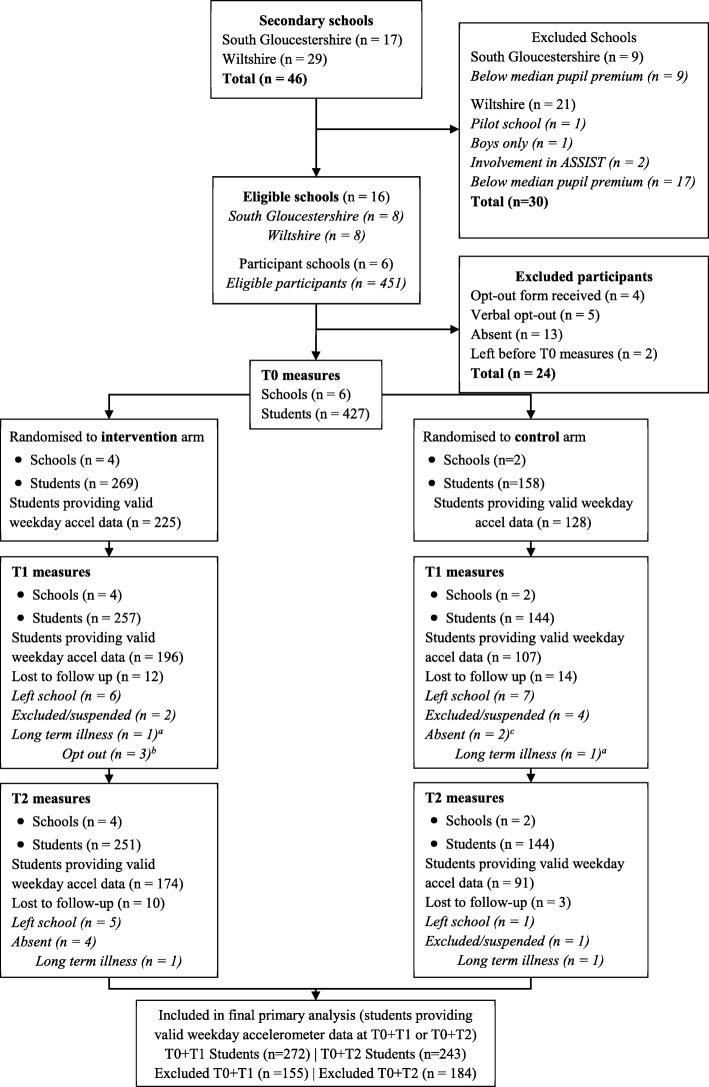
BACKGROUND: Most adolescent girls in the UK do not meet government physical activity recommendations and effective interventions are needed. This study reports the results of a feasibility trial of PLAN-A, a novel school-based peer-led physical activity intervention for adolescent girls. METHODS: A two-arm cluster randomised controlled feasibility study was conducted in six English secondary schools (4 intervention & 2 control). Year 8 (age 12-13) girls were eligible and randomisation was at school-level. The intervention involved training Year 8 girls (out of school for two consecutive days, plus one top-up day 5 weeks later), who were identified by their peers as influential, to provide informal support to their friends to increase their physical activity. Feasibility of the intervention and the research was examined, including: recruitment, training attendance and data provision rates, evidence of promise of the intervention to affect weekday moderate-to-vigorous physical activity (MVPA), intervention cost and estimation of the sample size for a definitive trial. Accelerometer and questionnaire data were collected at the beginning of Year 8 (Time 0), the end of Year 8 (10-weeks after peer-supporter training) and the beginning of Year 9 (Time 2). RESULTS: Four hundred twenty-seven girls were recruited (95% recruitment rate). 55 girls consented to be a peer-supporter and 53 peer-supporters were trained (97% of those invited). Accelerometer return rates exceeded 85% at each time point and wear time criteria was met by 83%, 71% and 62% participants at Time 0, 1 and 2 respectively. Questionnaire data were provided by >91% of participants at each time point. Complete-case adjusted linear regression analysis showed evidence of a 6.09 minute (95% CI = 1.43, 10.76) between-arms difference in weekday MVPA at Time 2 in favour of the intervention arm. On average PLAN-A cost £2685 per school to deliver (£37 per Year 8 girl). There were no adverse events. A trial involving 20 schools would be adequately powered to detect a between-arms difference in weekday MVPA of at least six minutes. CONCLUSIONS: The PLAN-A intervention adopts a novel peer-led approach, is feasible, and shows evidence of promise to positively affect girls' physical activity levels. A definitive trial is warranted. TRIAL REGISTRATION: ISCTRN, ISRCTN12543546, Registered on 28/7/2015, URL of registry record: http://www.isrctn.com/ISRCTN12543546.
Overview
The claims and statistics of this paper haven’t been checked yet.
Free: it reads the open-access text and checks the first 5 claims that cite a source we can check. Create a free account to check every claim.
Integrity signals
Registry
Cites
Statistics
Figures
Verification
Claims the paper makes
The claims and statistics of this paper haven’t been checked yet.
Free: it reads the open-access text and checks the first 5 claims that cite a source we can check. Create a free account to check every claim.
Self-check
Percentages, sums and reported differences re-computed from the paper’s own numbers.
The self-check needs the paper’s full text.
Citations
Cites
The "what" and "why" of goal pursuits: Human needs and the self-determination of behavior
Deci, E. L., & Ryan, R. M. (2000) · Psychological Inquiry · doi:10.1207/s15327965pli1104_01 · Cited by 34,210 · cited 4×
“Briefly, trainers were educated about core SDT principles such as developing girls’ autonomous versus controlled motivation, and peer-supporter training tasks targeted developing participants’ autonomy, competence and/or relatedness and in turn using these principles to support their friends’ physical activity.”
MethodInfluentialDeveloping and evaluating complex interventions: the new Medical Research Council guidance
Craig, P., Dieppe, P., Macintyre, S., Michie, S., Nazareth, I., & Petticrew, M. (2008) · BMJ · doi:10.1136/bmj.a1655 · Cited by 10,995 · cited 1×
“We therefore developed the PLAN-A intervention (Peer-Led physical Activity iNtervention) and in line with the UK Medical Research Council (MRC) framework on the development and evaluation of complex interventions [24], tested it in a feasibility trial [25, 26].”
MethodMultiple imputation using chained equations: Issues and guidance for practice
White, I. R., Royston, P., & Wood, A. M. (2011) · Statistics in Medicine · doi:10.1002/sim.4067 · Cited by 9,792 · cited 1×
“Firstly, where there were 5% or more missing MVPA measures, missing MVPA data were imputed for Time 1 and Time 2, in turn using Multiple Imputation by Chained Equations [39].”
MethodGlobal physical activity levels: surveillance progress, pitfalls, and prospects
Hallal, P. C., Andersen, L. B., Bull, F. C., Guthold, R., Haskell, W., & Ekelund, U. (2012) · The Lancet · doi:10.1016/s0140-6736(12)60646-1 · Cited by 5,711 · cited 1×
“The UK and US governments recommend that children and adolescents undertake 60 minutes of moderate-to-vigorous physical activity (MVPA) each day [4, 5], however, many adolescents do not meet this guideline [6].”
BackgroundJanssen, I., & LeBlanc, A. G. (2010) · International Journal of Behavioral Nutrition and Physical Activity · doi:10.1186/1479-5868-7-40 · Cited by 4,829
Evidence Based Physical Activity for School-age Youth
Strong, W. B., Malina, R. M., Blimkie, C. J. R., Daniels, S. R., Dishman, R. K., Gutin, B., Hergenroeder, A. C., Must, A., Nixon, P. A., Pivarnik, J. M., et al. (2005) · The Journal of Pediatrics · doi:10.1016/j.jpeds.2005.01.055 · Cited by 4,222
Exercise, physical activity, and self-determination theory: A systematic review
Teixeira, P. J., Carraça, E. V., Markland, D., Silva, M. N., & Ryan, R. M. (2012) · International Journal of Behavioral Nutrition and Physical Activity · doi:10.1186/1479-5868-9-78 · Cited by 2,963 · cited 4×
“Briefly, trainers were educated about core SDT principles such as developing girls’ autonomous versus controlled motivation, and peer-supporter training tasks targeted developing participants’ autonomy, competence and/or relatedness and in turn using these principles to support their friends’ physical activity.”
MethodInfluentialCalibration of two objective measures of physical activity for children
Evenson, K. R., Catellier, D. J., Gill, K., Ondrak, K. S., & McMurray, R. G. (2008) · Journal of Sports Sciences · doi:10.1080/02640410802334196 · Cited by 2,677 · cited 2×
“The Evenson cut-point (≥2296 counts per minute)[34] was used to estimate mean daily minutes of MVPA on weekdays and weekend day(s) as this threshold is the most accurate for adolescents [35].”
MethodDeveloping and evaluating complex interventions: the new Medical Research Council guidance
Craig, P., Dieppe, P., Macintyre, S., Michie, S., Nazareth, I., & Petticrew, M. (2013) · International Journal of Nursing Studies · doi:10.1016/j.ijnurstu.2012.09.010 · Cited by 1,658
Comparison of Accelerometer Cut Points for Predicting Activity Intensity in Youth
TROST, S. G., LOPRINZI, P. D., MOORE, R., & PFEIFFER, K. A. (2011) · Medicine & Science in Sports & Exercise · doi:10.1249/mss.0b013e318206476e · Cited by 1,360 · cited 1×
“The Evenson cut-point (≥2296 counts per minute)[34] was used to estimate mean daily minutes of MVPA on weekdays and weekend day(s) as this threshold is the most accurate for adolescents [35].”
MethodNational Institute for Health Research
Evans, R. (2014) · Nursing Standard · doi:10.7748/ns.28.49.32.s37 · Cited by 1,350
Physical activity change during adolescence: a systematic review and a pooled analysis
Dumith, S. C., Gigante, D. P., Domingues, M. R., & Kohl, H. W. (2011) · International Journal of Epidemiology · doi:10.1093/ije/dyq272 · Cited by 1,275 · cited 1×
“A consistent finding is that girls are less active than boys and that their physical activity declines at a faster rate than their male peers [7, 8].”
BackgroundEkelund, U. (2012) · JAMA · doi:10.1001/jama.2012.156 · Cited by 1,158
Manca, A., Hawkins, N., & Sculpher, M. J. (2005) · Health Economics · doi:10.1002/hec.944 · Cited by 1,024 · cited 1×
“Responses were mapped to a utility score (scores derived from adults were used in the absence of child specific scores [37]) at each time point and quality-adjusted life-years (QALYs) were estimated adjusting for baseline differences in utility scores [38].”
MethodBoyce, W., Torsheim, T., Currie, C., & Zambon, A. (2006) · Social Indicators Research · doi:10.1007/s11205-005-1607-6 · Cited by 906 · cited 1×
“Socio-economic position was estimated by: (1) an index of multiple deprivation (IMD) using home postcode and the English Indices of Deprivation [27] for each participant, (2) participant-reported receipt of free school meals and (3) the four-item family affluence scale [32].”
MethodDevelopment of the EQ-5D-Y: a child-friendly version of the EQ-5D
Wille, N., Badia, X., Bonsel, G., Burström, K., Cavrini, G., Devlin, N., Egmar, A.-C., Greiner, W., Gusi, N., Herdman, M., et al. (2010) · Quality of Life Research · doi:10.1007/s11136-010-9648-y · Cited by 872 · cited 5×
“Students’ quality of life was assessed using the EQ-5D-Y [36].”
MethodInfluentialA social tariff for EuroQol: results from a UK general population surveyPreprint
Dolan, P., Gudex, C. M., Kind, P., & Williams, A. (1995) · RePEc: Research Papers in Economics · Cited by 611
Campbell, R., Starkey, F., Holliday, J., Audrey, S., Bloor, M., Parry-Langdon, N., Hughes, R., & Moore, L. (2008) · The Lancet · doi:10.1016/s0140-6736(08)60692-3 · Cited by 583 · cited 1×
“In the ASSIST (A Stop Smoking in Schools Trial) intervention [23] an alternative peer-led approach was used which involved students in a secondary school year group nominating influential peers who were trained as peer-supporters to informally diffuse messages and provide support to help their friends stop or not star…”
MethodSelf-citationSmith, A. L. (2003) · Psychology of Sport and Exercise · doi:10.1016/s1469-0292(02)00015-8 · Cited by 369 · cited 1×
“Peer-influence, which increases as girls transition from childhood to adolescence [15], plays a role in girls’ physical activity [16, 17] and can comprise social support, presence of peers during physical activity, peer norms, friendship quality, changes to friendship groups, activity preferences of peers, affiliation…”
BackgroundFitzgerald, A., Fitzgerald, N., & Aherne, C. (2012) · Journal of Adolescence · doi:10.1016/j.adolescence.2012.01.002 · Cited by 320
Biddle, S. J. H., Whitehead, S. H., O’Donovan, T. M., & Nevill, M. E. (2005) · Journal of Physical Activity and Health · doi:10.1123/jpah.2.4.423 · Cited by 320 · cited 1×
“Correlates of girls’ physical activity include physical self-perceptions, self-efficacy, perceived competence and enjoyment [13].”
BackgroundPromoting Physical Activity in Middle School Girls
Webber, L. S., Catellier, D. J., Lytle, L. A., Murray, D. M., Pratt, C. A., Young, D. R., Elder, J. P., Lohman, T. G., Stevens, J., Jobe, J. B., et al. (2008) · American Journal of Preventive Medicine · doi:10.1016/j.amepre.2007.11.018 · Cited by 318
Owen, M. B., Curry, W. B., Kerner, C., Newson, L., & Fairclough, S. J. (2017) · Preventive Medicine · doi:10.1016/j.ypmed.2017.09.018 · Cited by 280
Ginis, K. A. M., Nigg, C. R., & Smith, A. L. (2013) · Translational Behavioral Medicine · doi:10.1007/s13142-013-0215-2 · Cited by 267 · cited 1×
“Despite being a key part of the complexity of girls’ physical activity, until recently peers have been relatively overlooked in many physical activity interventions [18].”
BackgroundValidity and Reproducibility of Motion Sensors in Youth: A Systematic Update
DE VRIES, S. I., VAN HIRTUM, H. W. J. E. M., BAKKER, I., HOPMAN-ROCK, M., HIRASING, R. A., & VAN MECHELEN, W. (2009) · Medicine & Science in Sports & Exercise · doi:10.1249/mss.0b013e31818e5819 · Cited by 201 · cited 1×
“Scores derived from ActiGraph accelerometers have been shown to provide reproducible and valid estimates of physical activity amongst adolescents [33].”
BackgroundUnderstanding gender norms, nutrition, and physical activity in adolescent girls: a scoping review
Spencer, R. A., Rehman, L., & Kirk, S. F. (2015) · International Journal of Behavioral Nutrition and Physical Activity · doi:10.1186/s12966-015-0166-8 · Cited by 200 · cited 1×
“Yet, girls’ relationship with physical activity is also described as complex, including being intertwined with gender roles, societal norms and self-presentation [14].”
BackgroundChange in Parent and Peer Support across Ages 9 to 15 yr and Adolescent Girls' Physical Activity
DAVISON, K. K., & JAGO, R. (2009) · Medicine & Science in Sports & Exercise · doi:10.1249/mss.0b013e3181a278e2 · Cited by 172 · cited 1×
“Peer-influence, which increases as girls transition from childhood to adolescence [15], plays a role in girls’ physical activity [16, 17] and can comprise social support, presence of peers during physical activity, peer norms, friendship quality, changes to friendship groups, activity preferences of peers, affiliation…”
BackgroundSelf-citationPeer-delivered health promotion for young people: A systematic review of different study designs
Harden, A., Oakley, A., & Oliver, S. (2001) · Health Education Journal · doi:10.1177/001789690106000406 · Cited by 154
Pearson, N., Braithwaite, R., & Biddle, S. J. H. (2015) · Academic Pediatrics · doi:10.1016/j.acap.2014.08.009 · Cited by 149 · cited 2×
“Larger effects were shown for interventions targeting girls only, were multi-component, based in schools, utilised theory and targeted sedentary behaviour as well as physical activity [10, 11].”
BackgroundThe Physical Activity 4 Everyone Cluster Randomized Trial
Sutherland, R. L., Campbell, E. M., Lubans, D. R., Morgan, P. J., Nathan, N. K., Wolfenden, L., Okely, A. D., Gillham, K. E., Hollis, J. L., Oldmeadow, C. J., et al. (2016) · American Journal of Preventive Medicine · doi:10.1016/j.amepre.2016.02.020 · Cited by 118
Corder, K., Sharp, S. J., Atkin, A. J., Andersen, L. B., Cardon, G., Page, A., Davey, R., Grøntved, A., Hallal, P. C., Janz, K. F., et al. (2016) · Preventive Medicine Reports · doi:10.1016/j.pmedr.2016.05.006 · Cited by 116 · cited 1×
“A consistent finding is that girls are less active than boys and that their physical activity declines at a faster rate than their male peers [7, 8].”
BackgroundCollings, P. J., Wijndaele, K., Corder, K., Westgate, K., Ridgway, C. L., Dunn, V., Goodyer, I., Ekelund, U., & Brage, S. (2014) · International Journal of Behavioral Nutrition and Physical Activity · doi:10.1186/1479-5868-11-23 · Cited by 106 · cited 1×
“These findings are similar to a recent UK accelerometer study which showed that 68% of adolescent girls performed less than 60 minutes MVPA per day [43] and support the present and future research efforts to increase girls’ physical activity.”
ResultJago, R., Edwards, M. J., Sebire, S. J., Tomkinson, K., Bird, E. L., Banfield, K., May, T., Kesten, J. M., Cooper, A. R., Powell, J. E., et al. (2015) · International Journal of Behavioral Nutrition and Physical Activity · doi:10.1186/s12966-015-0289-y · Cited by 94 · cited 1×
“As this gives an imprecise estimate in a study of this size, the data were compared with ICC estimates from other studies [12, 41, 42].”
ResultSelf-citationSutherland, R., Reeves, P., Campbell, E., Lubans, D. R., Morgan, P. J., Nathan, N., Wolfenden, L., Okely, A. D., Gillham, K., Davies, L., et al. (2016) · International Journal of Behavioral Nutrition and Physical Activity · doi:10.1186/s12966-016-0418-2 · Cited by 86 · cited 1×
“PLAN-A cost £37 per Year 8 girl and £6 per additional minute of weekday MVPA (based on the between-arms comparison at Time 2) which compares favourably, for example, to the multicomponent Physical Activity 4 Everyone trial [48] which had an intervention cost over 24 months of £240 per student and a difference in mean…”
MethodExploring the Adolescent Fall in Physical Activity: A 10-yr Cohort Study (EarlyBird 41)
METCALF, B. S., HOSKING, J., JEFFERY, A. N., HENLEY, W. E., & WILKIN, T. J. (2015) · Medicine & Science in Sports & Exercise · doi:10.1249/mss.0000000000000644 · Cited by 83 · cited 1×
“Late childhood to mid adolescence is a key period of physical activity decline [9].”
BackgroundCompliance With Wearing Physical Activity Accelerometers in High School Students
Sirard, J. R., & Slater, M. E. (2009) · Journal of Physical Activity and Health · doi:10.1123/jpah.6.s1.s148 · Cited by 72 · cited 1×
“Such strategies could include incentivising sufficient wear time rather than, or in addition to, monitor return [46, 47], amending the study design to reduce participant fatigue (i.”
BackgroundLessons from a peer-led obesity prevention programme in English schools
Bell, S. L., Audrey, S., Cooper, A. R., Noble, S., & Campbell, R. (2017) · Health Promotion International · doi:10.1093/heapro/dau008 · Cited by 62 · cited 1×
“Such strategies could include incentivising sufficient wear time rather than, or in addition to, monitor return [46, 47], amending the study design to reduce participant fatigue (i.”
BackgroundSelf-citationTymms, P. B., Curtis, S. E., Routen, A. C., Thomson, K. H., Bolden, D. S., Bock, S., Dunn, C. E., Cooper, A. R., Elliott, J. G., Moore, H. J., et al. (2016) · BMJ Open · doi:10.1136/bmjopen-2015-009318 · Cited by 51 · cited 2×
“[19] reported results of a cluster randomised controlled trial of “MOVE” in England.”
BackgroundSchool-Level Intraclass Correlation for Physical Activity in Sixth Grade Girls
MURRAY, D. M., STEVENS, J., HANNAN, P. J., CATELLIER, D. J., SCHMITZ, K. H., DOWDA, M., CONWAY, T. L., RICE, J. C., & YANG, S. (2006) · Medicine & Science in Sports & Exercise · doi:10.1249/01.mss.0000218188.57274.91 · Cited by 44 · cited 1×
“As this gives an imprecise estimate in a study of this size, the data were compared with ICC estimates from other studies [12, 41, 42].”
ResultEdwardson, C. L., Harrington, D. M., Yates, T. E., Bodicoat, D. H., Khunti, K., Gorely, T., Sherar, L. B., Edwards, R. T., Wright, C., Harrington, K., et al. (2015) · BMC Public Health · doi:10.1186/s12889-015-1886-z · Cited by 41 · cited 2×
“[19] and two ongoing studies [20, 21]) of peer-led physical activity interventions [22].”
BackgroundResultSebire, S. J., Edwards, M. J., Campbell, R. M., Jago, R., Kipping, R., Banfield, K., Tomkinson, K., Garfield, K., Lyons, R. A., Simon, J., et al. (2016) · Pilot and Feasibility Studies · doi:10.1186/s40814-015-0045-8 · Cited by 34 · cited 5×
“Further explanation of SDT, and detailed examples of how it was incorporated into the train-the-trainers and peer-supporter training are reported elsewhere [25].”
BackgroundMethodInfluentialSelf-citationBrown, H. E., Whittle, F., Jong, S. T., Croxson, C. H. D., Sharp, S. J., Wilkinson, P. O., Wilson, E., van Sluijs, E. M. F., Vignoles, A. F., & Corder, K. L. (2017) · BMJ Open · doi:10.1136/bmjopen-2016-014419 · Cited by 26 · cited 1×
“[19] and two ongoing studies [20, 21]) of peer-led physical activity interventions [22].”
BackgroundTibbitts, B., Porter, A., Sebire, S. J., Metcalfe, C., Bird, E. L., Powell, J. E., & Jago, R. (2017) · Pilot and Feasibility Studies · doi:10.1186/s40814-017-0213-0 · Cited by 8 · cited 1×
“persuasive pitch to school head teachers explaining the relatively low burden placed on school staff by PLAN-A, compared to other interventions [12, 21, 44, 45] to garner their support for off-site peer-supporter training.”
ResultSelf-citationSebire, S. J., Edwards, M. J., Campbell, R. M., Jago, R., Kipping, R., Banfield, K., Kadir, B., Garfield, K., Lyons, R. A., Blair, P. S., et al. (2016) · Pilot and Feasibility Studies · doi:10.1186/s40814-016-0110-y · Cited by 8 · cited 2×
“The study protocol was published in 2016 [25, 26] Sebire et al.”
MethodSelf-citation
Research works printed but not linked: 1
- 29. Rogers, E.M., Diffusion of Innovations. 1983, NY: The Free Press.
Cited by
Neil-Sztramko, S. E., Caldwell, H., & Dobbins, M. (2021) · Cochrane Database of Systematic Reviews · doi:10.1002/14651858.cd007651.pub3 · Cited by 449
Peer social network processes and adolescent health behaviors: A systematic review
Montgomery, S. C., Donnelly, M., Bhatnagar, P., Carlin, A., Kee, F., & Hunter, R. F. (2020) · Preventive Medicine · doi:10.1016/j.ypmed.2019.105900 · Cited by 238
Becoming an object: A review of self-objectification in girls
Daniels, E. A., Zurbriggen, E. L., & Monique Ward, L. (2020) · Body Image · doi:10.1016/j.bodyim.2020.02.016 · Cited by 192
Dodd, S., Widnall, E., Russell, A. E., Curtin, E. L., Simmonds, R., Limmer, M., & Kidger, J. (2022) · BMC Public Health · doi:10.1186/s12889-022-14688-3 · Cited by 189
King, T., & Fazel, M. (2021) · PLOS ONE · doi:10.1371/journal.pone.0249553 · Cited by 81
“Pupil sample sizes ranged from 55 [83] to 372 [12] and the number of experimental schools evaluated per study ranged from one [77] to 22 [36].”
BackgroundInfluential
Metadata
- Authors
- Sebire, S. J., Jago, R., Banfield, K., Edwards, M. J., Campbell, R., Kipping, R., Blair, P. S., Kadir, B., Garfield, K., Matthews, J., Lyons, R. A., & Hollingworth, W.
- Affiliations
- University of Bristol (GB)
- University Hospitals Bristol NHS Foundation Trust (GB)
- Swansea University (GB)
- Corresponding author
- Sebire, Simon J.
- ORCID
- Venue
- International Journal of Behavioral Nutrition and Physical Activity
- Published
- 2018-06-07
- Volume
- 15
- Issue
- 1
- Pages
- 50-50
- ISSN
- 1479-5868 (ISSN-L)
- PMC
- PMC5992776
- OpenAlex
- W2806175554
- Semantic Scholar
- c095eba46b1a8e7e5dc27eacfb1bd2707b9852c6
- Cited by
- 89
- References
- 45
- Citations by year
- 2026: 7 · 2025: 6 · 2024: 16 · 2023: 8 · 2022: 13 · 2021: 15 · 2020: 7 · 2019: 15 · 2018: 1
- FWCI
- 6.53
- Type
- journal article
- Language
- en
- Open access
- gold
- doi.org
- Licence
- cc-by
- creativecommons.org/licenses/by/4.0/ (tdm)
- Locations
- International Journal of Behavioral Nutrition and Physical Activity (publishedVersion, cc-by)
- Europe PMC (PubMed Central) (publishedVersion, other-oa)
- PubMed Central (publishedVersion, cc-by)
- PubMed (publishedVersion)
- Explore Bristol Research (publishedVersion, cc-by)
- DOAJ (DOAJ: Directory of Open Access Journals) (submittedVersion)
- Bristol Research (University of Bristol) (submittedVersion, cc-by)
- Funders
- Public Health Research Programme (13/90/16)
- Wiltshire Council (n/a)
- South Gloucestershire Council (n/a)
- Topics
- Health Sciences › Medicine › Public Health, Environmental and Occupational Health › Physical Activity and Health
- Health Sciences › Medicine › Public Health, Environmental and Occupational Health › School Health and Nursing Education
- Health Sciences › Medicine › Public Health, Environmental and Occupational Health › Obesity, Physical Activity, Diet
- Keywords
- adolescent girls, physical activity, peer-led intervention, school-based intervention, peer supporters, moderate-to-vigorous physical activity, feasibility, intervention costs, sample size determination, high school students, accelerometer wear time, recruitment rate, sedentary behavior, health promotion, social support, intervention dissemination, intervention sustainability
- MeSH terms
- Adolescent, Adolescent Behavior, Feasibility Studies, Female, United Kingdom, Health Promotion, Humans, Peer Group, Surveys and Questionnaires, School Health Services, Program Evaluation, Exercise, Cluster Analysis
About these checks
Registry, retraction, Cites and statistics results are computed, not judged, with one exception: a printed reference that no index lists is read once by a model before it counts as a citation error. Claims are extracted by a model and kept only when their quote appears verbatim in the text; each cited source is then checked, with a model’s help, for whether it says what the claim relies on. Those verdicts can be wrong — read the claim’s quote and the cited source before relying on one.
Statistics and arithmetic are recomputed, not judged.
Confidence bands are shown only for fields calibrated on our annotated test set. None is calibrated yet, so no band is shown.
What counts as a claim ›How we measure confidence ›How we check this ›
Are you an author, or do you see a problem with this page? Request a review
Data sources
Bibliographic data: Semantic Scholar, OpenAlex, Crossref.
Contains information from the Semantic Scholar Academic Graph Datasets, made available under the ODC Attribution License (ODC-BY 1.0).
Semantic Scholar’s data is described in: Kinney, R., et al. (2023). The Semantic Scholar Open Data Platform. arXiv:2301.10140.
