

Systematic review and meta-analysis of maintenance of physical activity behaviour change in cancer survivors
Open accessThe DOI matches its Crossref record; 73 of the 73 references it cites were found in a registry or an index.
Abstract
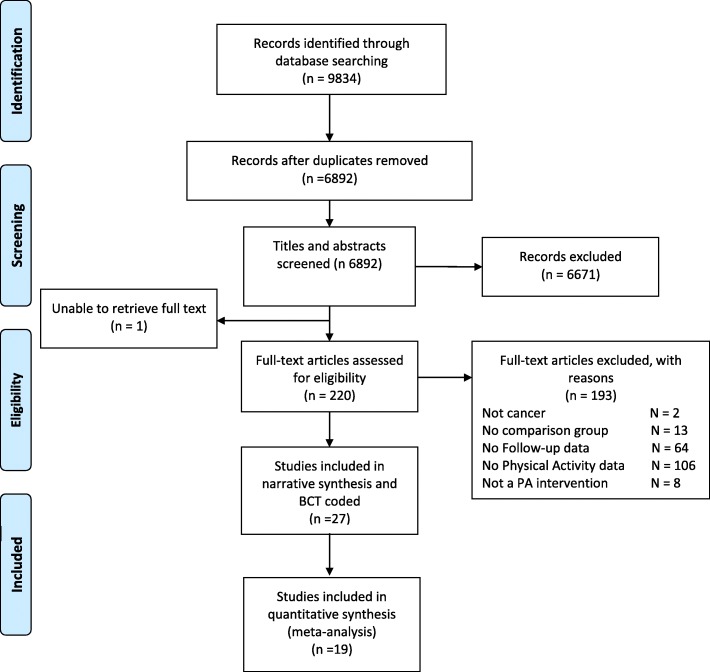
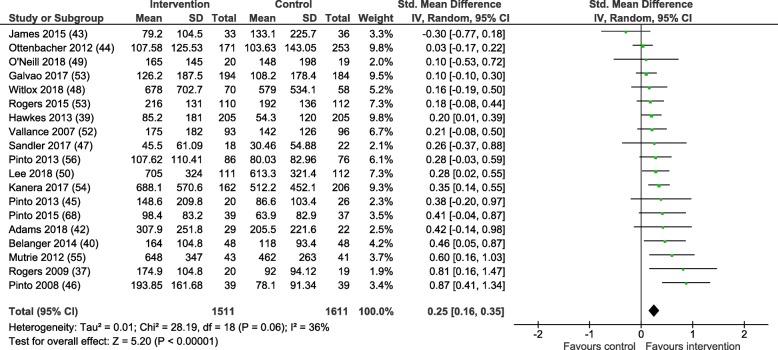
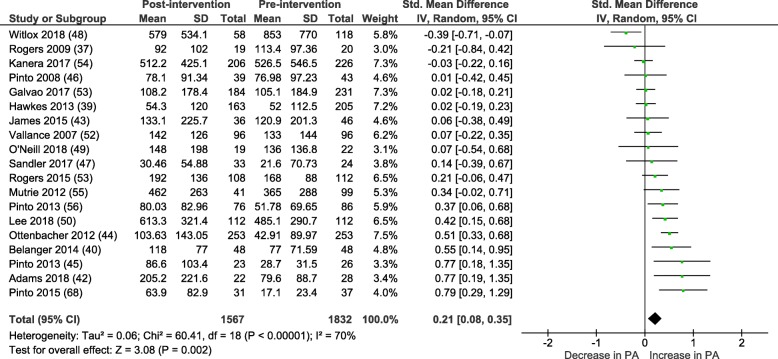
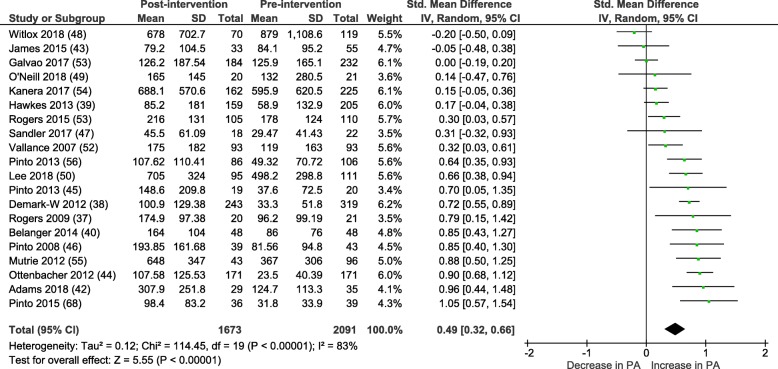
BACKGROUND: Physical activity can improve health and wellbeing after cancer and may reduce cancer recurrence and mortality. To achieve such long-term benefits cancer survivors must be habitually active. This review evaluates the effectiveness of interventions in supporting maintenance of physical activity behaviour change among adults diagnosed with cancer and explores which intervention components and contextual features are associated with effectiveness. METHODS: Relevant randomised controlled trials (RCTs) were identified by a search of Ovid Medline, Ovid Embase and PsychINFO. Trials including adults diagnosed with cancer, assessed an intervention targeting physical activity and reported physical activity behaviour at baseline and ≥ 3 months post-intervention were included. The behaviour change technique (BCT) taxonomy was used to identify intervention components and the Template for Intervention Description and Replication to capture contextual features. Random effect meta-analysis explored between and within group differences in physical activity behaviour. Standardised mean differences (SMD) describe effect size. RESULTS: Twenty seven RCTs were included, 19 were pooled in meta-analyses. Interventions were effective at changing long-term behaviour; SMD in moderate to vigorous physical activity (MVPA) between groups 0.25; 95% CI = 0.16-0.35. Within-group pre-post intervention analysis yielded a mean increase of 27.48 (95% CI = 11.48-43.49) mins/wk. of MVPA in control groups and 65.30 (95% CI = 45.59-85.01) mins/wk. of MVPA in intervention groups. Ineffective interventions tended to include older populations with existing physical limitations, had fewer contacts with participants, were less likely to include a supervised element or the BCTs of 'action planning', 'graded tasks' and 'social support (unspecified)'. Included studies were biased towards inclusion of younger, female, well-educated and white populations who were already engaging in some physical activity. CONCLUSIONS: Existing interventions are effective in achieving modest increases in physical activity at least 3 months post-intervention completion. Small improvements were also evident in control groups suggesting low-intensity interventions may be sufficient in promoting small changes in behaviour that last beyond intervention completion. However, study samples are not representative of typical cancer populations. Interventions should consider a stepped-care approach, providing more intensive support for older people with physical limitations and others less likely to engage in these interventions.
Overview
The claims and statistics of this paper haven’t been checked yet.
Free: it reads the open-access text and checks the first 5 claims that cite a source we can check. Create a free account to check every claim.
Integrity signals
Registry
Cites
Statistics
Figures
Verification
Claims the paper makes
The claims and statistics of this paper haven’t been checked yet.
Free: it reads the open-access text and checks the first 5 claims that cite a source we can check. Create a free account to check every claim.
Claims other papers make about this one
Each is checked against this paper’s own text: does it say what the citing paper says it does?
In the citing paper
“A synthesis of exercise programs that examined exercise maintenance (exercise assessed at least 3 months after program completion) revealed that graded tasks, social support, and action planning were used in studies that sustained significant behavior change.66”
From Exercise is medicine in oncology: Engaging clinicians to help patients move through cancer (2019) · cites this paper as [66]
Self-check
Percentages, sums and reported differences re-computed from the paper’s own numbers.
The self-check needs the paper’s full text.
Citations
Cites
Preferred Reporting Items for Systematic Reviews and Meta-Analyses: the PRISMA statement
Moher, D., Liberati, A., Tetzlaff, J., Altman, D. G., & for the PRISMA Group (2009) · BMJ · doi:10.1136/bmj.b2535 · Cited by 83,823
Preferred reporting items for systematic reviews and meta-analyses: the PRISMA Statement.
(2009) · PubMed Central · Cited by 44,859
The Cochrane Collaboration's tool for assessing risk of bias in randomised trials
Higgins, J. P. T., Altman, D. G., Gotzsche, P. C., Juni, P., Moher, D., Oxman, A. D., Savovic, J., Schulz, K. F., Weeks, L., Sterne, J. A. C., et al. (2011) · BMJ · doi:10.1136/bmj.d5928 · Cited by 33,817
Hoffmann, T. C., Glasziou, P. P., Boutron, I., Milne, R., Perera, R., Moher, D., Altman, D. G., Barbour, V., Macdonald, H., Johnston, M., et al. (2014) · BMJ · doi:10.1136/bmj.g1687 · Cited by 10,548
Michie, S., Richardson, M., Johnston, M., Abraham, C., Francis, J., Hardeman, W., Eccles, M. P., Cane, J., & Wood, C. E. (2013) · Annals of Behavioral Medicine · doi:10.1007/s12160-013-9486-6 · Cited by 7,629
Food, nutrition, physical activity, and the prevention of cancer: a global perspective
(2008) · Choice Reviews Online · doi:10.5860/choice.45-5024 · Cited by 5,350
Exercise and Physical Activity for Older Adults
Chodzko-Zajko, W. J., Proctor, D. N., Fiatarone Singh, M. A., Minson, C. T., Nigg, C. R., Salem, G. J., & Skinner, J. S. (2009) · Medicine & Science in Sports & Exercise · doi:10.1249/mss.0b013e3181a0c95c · Cited by 5,153
Systematic reviews: CRD's guidance for undertaking reviews in health care
Tacconelli, E. (2010) · The Lancet Infectious Diseases · doi:10.1016/s1473-3099(10)70065-7 · Cited by 3,245
American College of Sports Medicine Roundtable on Exercise Guidelines for Cancer Survivors
Schmitz, K. H., Courneya, K. S., Matthews, C., Demark-Wahnefried, W., GALVÃO, D. A., Pinto, B. M., IRWIN, M. L., WOLIN, K. Y., SEGAL, R. J., LUCIA, A., et al. (2010) · Medicine & Science in Sports & Exercise · doi:10.1249/mss.0b013e3181e0c112 · Cited by 2,781
Self-citationEffective techniques in healthy eating and physical activity interventions: A meta-regression.
Michie, S., Abraham, C., Whittington, C., McAteer, J., & Gupta, S. (2009) · Health Psychology · doi:10.1037/a0016136 · Cited by 2,229
Research works printed but not linked: 1
- Review Manager (RevMan) [computer program]. Version 5.3 Copenhagen: The Nordic Cochrane Centre, The Cochrane Collaboration, 2014.
Cited by
Exercise is medicine in oncology: Engaging clinicians to help patients move through cancer
Schmitz, K. H., Campbell, A. M., Stuiver, M. M., Pinto, B. M., Schwartz, A. L., Morris, G. S., Ligibel, J. A., Cheville, A., Galvão, D. A., Alfano, C. M., et al. (2019) · CA: A Cancer Journal for Clinicians · doi:10.3322/caac.21579 · Cited by 789
Self-citationPrevalence of Healthy Behaviors among Cancer Survivors in the United States: How Far Have We Come?
Arem, H. E., Mama, S. K., Duan, X., Rowland, J. H., Bellizzi, K. M., & Ehlers, D. K. (2020) · Cancer Epidemiology Biomarkers & Prevention · doi:10.1158/1055-9965.epi-19-1318 · Cited by 102
“Physical activity has also been associatedwith lower cancer (39) and mortality (40) risk in both the general population and in cancer survivors (41, 42).”
BackgroundCheung, D. S. T., Takemura, N., Lam, T., Ho, J., Deng, W., Smith, R. D., Yan, Y., Lee, A. W. M., & Lin, C. (2021) · Integrative Cancer Therapies · doi:10.1177/15347354211033352 · Cited by 93
Demmelmaier, I., Brooke, H. L., Henriksson, A., Mazzoni, A., Bjørke, A. C. H., Igelström, H., Ax, A., Sjövall, K., Hellbom, M., Pingel, R., et al. (2021) · Scandinavian Journal of Medicine and Science in Sports · doi:10.1111/sms.13930 · Cited by 95
“LMI endurance training 77 (28) 76 (27) 79 (26) 79 (22)”
Physical activity and nutrition interventions for older adults with cancer: a systematic review
Forbes, C. C., Swan, F., Greenley, S. L., Lind, M., & Johnson, M. J. (2020) · Journal of Cancer Survivorship · doi:10.1007/s11764-020-00883-x · Cited by 74
Hailey, V., Rojas‐García, A., & Kassianos, A. P. (2022) · Breast Cancer · doi:10.1007/s12282-021-01323-z · Cited by 55
“[2] was used to produce a narrative analysis of the quantitative results.”
BackgroundMethodResultInfluentialCampbell, K. L., Winters‐Stone, K. M., Patel, A. V., Gerber, L. H., Matthews, C. E., May, A. M., Stuiver, M. M., Stout, N. L., Schmitz, K. H., & Morris, G. S. (2019) · Rehabilitation Oncology · doi:10.1097/01.reo.0000000000000186 · Cited by 46
Clarkson, P., Stephenson, A., Grimmett, C., Cook, K., Clark, C., Muckelt, P. E., O’Gorman, P., Saynor, Z., Adams, J., Stokes, M., et al. (2022) · DIGITAL HEALTH · doi:10.1177/20552076221089778 · Cited by 43
“21,51 This included study characteristics such as design, location, setting, primary LTC (Table 1) and comorbidities of any kind, in addition to number, age and gender of participants.”
InfluentialSelf-citationEster, M., Eisele, M., Wurz, A. J., McDonough, M. H., McNeely, M. L., & Culos-Reed, S. N. (2021) · JMIR Cancer · doi:10.2196/28852 · Cited by 44
“The most commonly used BCTs in this review of eHealth PA interventions were goal setting and self-monitoring, which is similar to what has been reported in face-to-face PA interventions [20].”
BackgroundMethodResultInfluentialNakajima, H., Yokoyama, Y., Inoue, T., Nagaya, M., Mizuno, Y., Kayamoto, A., Nishida, Y., & Nagino, M. (2020) · Annals of Surgical Oncology · doi:10.1245/s10434-020-08218-x · Cited by 41
Salisbury, C. E., Hyde, M. K., Cooper, E. T., Stennett, R., Gomersall, S. R., & Skinner, T. L. (2023) · Journal of Cancer Survivorship · doi:10.1007/s11764-023-01377-2 · Cited by 50
“However, their review included multimodal interventions and only articles that reported physical activity in moderate-to-vigorous minutes per week were included in the review and subsequently, the metaanalysis [14].”
BackgroundMethodResultInfluentialExercise behavior change revisited: Affective-reflective theory
Brand, R., & Ekkekakis, P. (2021) · Society for Transparency, Openness, and Replication in Kinesiology eBooks · doi:10.51224/b1004 · Cited by 54
“Effect sizes are usually small across different meta-analyses (e.g., Compernolle et al., 2019; Grimmett et al., 2019; Ntoumanis et al., 2020; Romain et al. 2018).”
BackgroundGoldschmidt, S., Schmidt, M. E., & Steindorf, K. (2023) · Supportive Care in Cancer · doi:10.1007/s00520-022-07485-6 · Cited by 53
“Our findings are in line with a previous meta-analysis which concluded that interventions can increase MVPA behaviour of cancer survivors at least 3 months after completing the intervention [24].”
BackgroundResultNadal, I. P., Angkurawaranon, C., Singh, A., Choksomngam, Y., Sadana, V., Kock, L. S., Wattanapisit, A., Wiwatkunupakarn, N., & Kinra, S. (2024) · BMC Public Health · doi:10.1186/s12889-024-20612-8 · Cited by 53
“There was mixed evidence on the use of ‘Repetition and substitution’ as an effective BCT in targeting physical activity alone [44, 46, 47, 57].”
BackgroundRogers, L. Q., Courneya, K. S., Oster, R. A., Anton, P. M., Phillips, S. M., Ehlers, D. K., & McAuley, E. (2023) · Journal of Cancer Survivorship · doi:10.1007/s11764-022-01329-2 · Cited by 46
“Multiple interventions promoting physical activity in cancer survivors have been reported with variable results [11], and most physical activity behavior change randomized controlled trials in cancer survivors do not report follow-up data at 12 months or beyond [12–16].”
BackgroundResultInfluentialRodrigues, B., Carraça, E. V., Francisco, B. B., Nobre, I., Cortez‐Pinto, H., & Santos, I. (2023) · Journal of Cancer Survivorship · doi:10.1007/s11764-023-01390-5 · Cited by 43
“Although appearing effective [26, 27], these interventions remain scarce [28], and target mostly short-term adherence and outcomes [29].”
BackgroundGilchrist, H., Oliveira, J. S., Kwok, W. S., Sherrington, C., Pinheiro, M. B., Bauman, A. E., Tiedemann, A., & Hassett, L. M. (2024) · Annals of Behavioral Medicine · doi:10.1093/abm/kaad074 · Cited by 44
Mikkelsen, M. K., Juhl, C. B., Lund, C. M., Jarden, M., Vinther, A., & Nielsen, D. L. (2020) · European Review of Aging and Physical Activity · doi:10.1186/s11556-020-00250-w · Cited by 38
Mazzoni, A., Brooke, H. L., Berntsen, S., Nordin, K., & Demmelmaier, I. (2020) · Integrative Cancer Therapies · doi:10.1177/1534735420946834 · Cited by 33
“Age (years), mean (SD) 59 (13) 58 (12) 58 (11) 59 (12) Sex, n (%) Male 29 (20) 27 (19) 28 (19) 28 (19) Female 115 (80) 118 (81) 116 (81) 116 (81) Study site, n (%) Malmö/Lund 65 (45) 68 (47) 66 (46) 64 (45) Linköping 21 (15) 18 (12) 19 (13) 22 (15) Uppsala 58 (40) 59 (41) 59 (41) 58 (40) Education, n (%) Primary 16 (1…”
Gubler-Gut, B., Pöhlmann, J., Flatz, A., Schwenkglenks, M. M., & Rohrmann, S. (2021) · Journal of Cancer Survivorship · doi:10.1007/s11764-021-01002-0 · Cited by 39
Affective Response During Real-World Physical Activity as an Intervention Mediator
Dunton, G. F., Crosley‐Lyons, R., & Rhodes, R. E. (2023) · Exercise and Sport Sciences Reviews · doi:10.1249/jes.0000000000000321 · Cited by 36
Mazzoni, A., Brooke, H. L., Berntsen, S., Nordin, K., & Demmelmaier, I. (2021) · BMC Cancer · doi:10.1186/s12885-021-08996-x · Cited by 37
“On the other hand, self-regulatory BCTs such as action planning, goal-setting and self-monitoring are frequently used in interventions involving different adult populations and resulting in high PA maintenance [8, 13].”
BackgroundMethodResultInfluentialTollosa, D. N., Holliday, E. G., Hure, A. J., Tavener, M., & James, E. L. (2020) · Breast Cancer Research and Treatment · doi:10.1007/s10549-020-05704-4 · Cited by 33
Proposing an ontological shift from intervention to intravention in sport and exercise psychology
Camiré, M. (2022) · Psychology of sport and exercise · doi:10.1016/j.psychsport.2022.102342 · Cited by 30
Hartman, S. J., Chen, R., Tam, R. M., Narayan, H. K., Natarajan, L., & Liu, L. (2022) · JMIR mhealth and uhealth · doi:10.2196/37086 · Cited by 32
“This is consistent with previous studies in cancer survivors that have generally found that activity levels reduce from the end of the interventional period [9].”
BackgroundResultChamp, C. E., Carpenter, D. J., Diaz, A. K., Rosenberg, J., Ackerson, B. G., & Hyde, P. N. (2022) · Sports Medicine · doi:10.1007/s40279-022-01759-z · Cited by 34
“Direct observation of exercise programs is independently associated with enhanced strength gains, hypertrophy, and long-term regimen compliance [127, 128].”
BackgroundGrimmett, C., Bates, A. S., West, M. A., Leggett, S., Varkonyi-Sepp, J., Campbell, A., Davis, J., Wootton, S. A., Shaw, C., Barlow, R., et al. (2021) · BMJ Open · doi:10.1136/bmjopen-2020-048175 · Cited by 28
Self-citationPromoting physical activity among cancer survivors: an umbrella review of systematic reviews
Qiu, L., Ye, M., Tong, Y., & Jin, Y. (2023) · Supportive Care in Cancer · doi:10.1007/s00520-023-07760-0 · Cited by 29
“1 3 301 Page 4 of 18 cancer treatment or on remission phase in 10 reviews [9, 14, 15, 17-21, 23, 38], and the remaining reviews involved participants undergoing or completed cancer treatment [16, 22, 24-37].”
BackgroundMethodInfluentialEakin, E., Reeves, M. M., Goode, A. D., WINKLER, E. A. H., Vardy, J. L., Boyle, F. M., Haas, M. R., Hiller, J. E., Mishra, G. D., Jefford, M., et al. (2020) · BMC Cancer · doi:10.1186/s12885-020-07454-4 · Cited by 26
Weiner, L. S., Nagel, S., Su, H.-C. I., Hurst, S., Levy, S. S., Arredondo, E. M., Hekler, E. B., & Hartman, S. J. (2022) · Journal of Behavioral Medicine · doi:10.1007/s10865-022-00381-8 · Cited by 28
“…and thus were not considered adherent to completing this intervention component per our a priori definition, many participated in other ways that facilitated social support and behavior change techniques associated with success in a PA intervention (Finne et al., 2018; Grimmett et al., 2019).”
BackgroundSremanakova, J., Sowerbutts, A. M., Todd, C., Cooke, R., & Burden, S. (2021) · Nutrients · doi:10.3390/nu13020612 · Cited by 21
“For instance, exercise interventions for cancer survivors are conducted and reported reasonably consistently, and thus the metaanalyses with large numbers of studies have been conducted [22].”
BackgroundMethodResultInfluentialHardcastle, S. J., Maxwell‐Smith, C., Hince, D., Bulsara, M. K., Boyle, T., Tan, P., Levitt, M., Salama, P. R., Mohan, G. R., Salfinger, S. G., et al. (2021) · Journal of science and medicine in sport · doi:10.1016/j.jsams.2021.04.004 · Cited by 23
Hsueh, H., Pita-Grisanti, V., Gumpper, K., Lahooti, A., Chavez-Tomar, M., Schadler, K., & Cruz‐Monserrate, Z. (2021) · Pancreatology · doi:10.1016/j.pan.2021.10.004 · Cited by 20
Exercise in cancer care for people with lung cancer: A narrative synthesis
Toohey, K. L., Mizrahi, D., Hart, N. H., Singh, B., López, P., Hunter, M., Newton, R. U., Schmitz, K. H., Adams, D. H., Edbrooke, L., et al. (2024) · Journal of science and medicine in sport · doi:10.1016/j.jsams.2024.08.002 · Cited by 25
Lion, A., Backes, A., Duhem, C., Ries, F., Delagardelle, C., Urhausen, A. J. P., Vögele, C., Theisen, D., & Malisoux, L. (2020) · Integrative Cancer Therapies · doi:10.1177/1534735420914973 · Cited by 22
Sequeira, M., Pereira, C. R., & Alvarez, M. (2022) · International Journal of Behavioral Medicine · doi:10.1007/s12529-022-10140-3 · Cited by 22
“Recently, post-intentional and maintenance factors have proved essential in interventions for PA behavior change, even for cancer survivors [13], including the effect of several behavior change techniques on behavioral intention [14] derived from control theory [15], reinforcing the idea that sound…”
BackgroundFecher‐Jones, I., Grimmett, C., Edwards, M., Knight, J., Smith, J., Leach, H., Moyses, H. E., Jack, S., Grocott, M. P. W., & Levett, D. Z. H. (2021) · Anaesthesia · doi:10.1111/anae.15393 · Cited by 18
Self-citationTan, G. A., Peiris, C. L., & Dennett, A. M. (2022) · Journal of Cancer Survivorship · doi:10.1007/s11764-022-01322-9 · Cited by 21
Physical Activity Levels in People with Cancer Undergoing Chemotherapy: A Systematic Review
Cesnik, R., Toohey, K. L., Freene, N., Kunstler, B., & Semple, S. (2023) · Seminars in Oncology Nursing · doi:10.1016/j.soncn.2023.151435 · Cited by 20
Grimmett, C., Foster, C. L., Bradbury, K. J., Lally, P. J., May, C. R., Myall, M., Pinto, B. M., & Corbett, T. K. (2020) · BMJ Open · doi:10.1136/bmjopen-2020-037136 · Cited by 19
Self-citationBrown, M. C., Araújo‐Soares, V., Skinner, R., Glaser, A., Sarwar, N., Saxton, J., Montague, K., Hall, J. M., Burns, O., & Sharp, L. (2020) · BMJ Open · doi:10.1136/bmjopen-2020-041073 · Cited by 23
Kong, S., Lee, J. K., Kang, D., Kim, N., Shim, Y. M., Park, W., Choi, D., & Cho, J. (2021) · Cancers · doi:10.3390/cancers13112692 · Cited by 18
“According to a systematic review and meta-analysis of long-term PA behavior, on-site supervised, individual-support interventions can successfully increase PA in the short and medium term [54] and have a moderate impact at least 3 months post-intervention completion [55].”
BackgroundTrinh, L., Kramer, A. F., Rowland, K. M., Strom, D. A., Wong, J. N., & McAuley, E. (2020) · Journal of Behavioral Medicine · doi:10.1007/s10865-020-00185-8 · Cited by 18
Golsteijn, R. H. J., Bolman, C. A. W., Peels, D. A., Volders, E., de Vries, H., & Lechner, L. (2023) · Journal of sport and health science/Journal of Sport and Health Science · doi:10.1016/j.jshs.2023.08.002 · Cited by 17
“23 Therefore, we used a similar approach as Hardcastle et al. 34 and Pekmezi et al. 35 to exploratively examine whether PA was maintained during the 6 month follow-up period in which the experimental group no longer received the intervention (i.e., changes from 6 months to 12 months follow-up) and…”
BackgroundMethodResultInfluentialActivités physiques et cancers : des bénéfices prouvés pendant et après les traitements
Ninot, G., Flori, N., Huteau, M.-È., Stœbner-Delbarre, A., & Sénesse, P. (2020) · Bulletin du Cancer · doi:10.1016/j.bulcan.2019.11.017 · Cited by 22
Loughney, L. A., McGowan, R., O’Malley, K., McCaffrey, N., Furlong, B., & Walsh, D. M. J. (2021) · PLoS ONE · doi:10.1371/journal.pone.0253018 · Cited by 16
A survey of technology literacy and use in cancer survivors from the Alberta Cancer Exercise program
Ester, M., McNeely, M. L., McDonough, M. H., & Culos-Reed, S. N. (2021) · Digital Health · doi:10.1177/20552076211033426 · Cited by 18
“Unfortunately, the demographic biases seen herein are commonly reported in exercise oncology research.(39) Funding agencies and researchers must work together with communities to improve equity, diversity, and inclusivity, reaching underserved cancer populations who often experience worse health outcomes and may have…”
BackgroundWhat makes implementation intentions (in)effective for physical activity among older adults?
Warner, L. M., Fleig, L., Wolff, J. K., Keller, J., Schwarzer, R., Nyman, S. R., & Wurm, S. (2021) · British Journal of Health Psychology · doi:10.1111/bjhp.12563 · Cited by 19
Biskup, M., Macek, P., Terek-Derszniak, M., Žák, M., Król, H., Falana, K., & Góźdź, S. S. (2023) · Diagnostics · doi:10.3390/diagnostics13223447 · Cited by 19
“Numerous studies describe interventions aimed at increasing MVPA rates in cancer survivors [41–45].”
BackgroundCantwell, M., Walsh, D. M. J., Furlong, B., Moyna, N. M., McCaffrey, N., & Woods, C. B. (2020) · Cancer Control · doi:10.1177/1073274820906124 · Cited by 19
“As a result, the long-term impact of such interventions remains unclear.(12,15,21) In addition, many studies have used selfreport measures to assess PA levels, which can be subject to multifarious bias.”
BackgroundFecher‐Jones, I., Grimmett, C., Carter, F. J., Conway, D. H., Levett, D. Z. H., & Moore, J. A. (2021) · Perioperative Medicine · doi:10.1186/s13741-021-00188-2 · Cited by 14
“More intensive personalised support may be required in order to make and sustain lifestyle behaviour changes (Grimmett et al., 2019).”
BackgroundSelf-citationPrice, J., Barrett-Bernstein, M., Wurz, A. J., Karvinen, K. H., & Brunet, J. (2020) · Supportive Care in Cancer · doi:10.1007/s00520-020-05515-9 · Cited by 16
Self-citationPreliminary Effectiveness Study of a Community-Based Wellness Coaching for Cancer Survivors Program
Berzins, N. J., MacKenzie, M. J., Galantino, M. L., Pickles, N., Hebbel, S., Leonard, T., Beneck, D., & Peterson, M. (2022) · American Journal of Lifestyle Medicine · doi:10.1177/15598276221076040 · Cited by 14
“…setting, social support, and action planning are more likely to be successful at maintaining long-term results, all of which are inherent in HWC. 42 It was also noted that interventions involving older adults with physical limitations, those involving less contact with participants, and those…”
InfluentialSmith, S. K., Wiltshire, G., Brown, F. F., Dhillon, H. M., Osborn, M., Wexler, S., Beresford, M. J., Tooley, M. A., & Turner, J. E. (2022) · BMJ Open · doi:10.1136/bmjopen-2021-056132 · Cited by 17
Myeloma patients’ experiences of a supervised physical activity programme: a qualitative study
Land, J., Hackett, J., Sidhu, G., Heinrich, M., McCourt, O., Yong, K., Fisher, A., & Beeken, R. J. (2022) · Supportive Care in Cancer · doi:10.1007/s00520-022-07062-x · Cited by 16
“Participants did find the logbooks helped with self-monitoring and goal setting which have been identified as important aspects of successful maintenance of physical activity [23].”
BackgroundFeasibility of a Supervised Virtual Exercise Program for Women on Hormone Therapy for Breast Cancer
Myers, S. A., Weller, S., Schwartz, S., Patten, C. L. V., LeVasseur, N., Faulkner, G., & Campbell, K. L. (2022) · Translational Journal of the American College of Sports Medicine · doi:10.1249/tjx.0000000000000213 · Cited by 13
“The education component included instructionon self-regulatory behavior skills to assist in the long-term adoption of positive exercise behavior using the multiprocess action control framework (17,18).”
MethodEisele, M., Twomey, R., McDonough, M. H., McNeely, M. L., McNeely, M. L., Daun, J. T., Twomey, R., & Culos-Reed, S. N. (2023) · Pilot and Feasibility Studies · doi:10.1186/s40814-023-01316-z · Cited by 17
“However, the proportion of individuals meeting these guidelines remains low [10].”
BackgroundMethodEster, M., Wagoner, C. W., Dreger, J., Chen, G., McDonough, M. H., McNeely, M. L., & Culos-Reed, S. N. (2023) · JMIR Cancer · doi:10.2196/47187 · Cited by 15
“According to the transtheoretical model of behavior change, maintenance is defined as sustained behavior change for 6 months after adoption, with a recent review in exercise oncology suggesting that PA levels 3 months after the intervention provide a good indicator of PA maintenance [9,10].”
BackgroundMethodInfluentialPutting Exercise Into Oncology Practice: State-of-the-Science, Innovation, and Future Directions
Brown, J. C., & Ligibel, J. A. (2019) · The Cancer Journal · doi:10.1097/ppo.0000000000000397 · Cited by 13
Mazzoni, A., Bjørke, A. C. H., Stenling, A., Börjeson, S., Sjövall, K., Berntsen, S., Demmelmaier, I., & Nordin, K. (2023) · Integrative Cancer Therapies · doi:10.1177/15347354231178869 · Cited by 16
Have, J. D. V.-T., Winkels, R. M., Kampman, E., & Winkens, L. H. H. (2023) · International Journal of Behavioral Nutrition and Physical Activity · doi:10.1186/s12966-023-01524-z · Cited by 17
“As also acknowledged by others [65, 66], this makes it difficult to identify promising techniques and suggests that there might be other population or context characteristics that influence effectiveness [66].”
BackgroundDoré, I., Plante, A., Bedrossian, N., Montminy, S., St-Onge, K., St-Cyr, J., Pomey, M., Charpentier, D., Pettigrew, L., Brisson, I., et al. (2022) · PLoS ONE · doi:10.1371/journal.pone.0273145 · Cited by 15
Lally, P. J., Miller, N. E., Roberts, A., Beeken, R. J., Greenfield, D., POTTS, H. W. W., Counsell, N., Latimer, N. R., Thomas, C., Smith, L., et al. (2022) · Pilot and Feasibility Studies · doi:10.1186/s40814-022-01028-w · Cited by 9
“Many trials demonstrating the benefits of physical activity interventions after cancer are supervised by trained professionals, delivered in hospital or community settings, which can lead to high associated costs and limited accessibility [21].”
BackgroundAbaraogu, U. O., Dall, P., Seenan, C., Rhodes, S., Gorely, T., McParland, J. L., Brittenden, J., Anieto, E. M., Booth, L., Gormal, C., et al. (2024) · European Journal of Preventive Cardiology · doi:10.1093/eurjpc/zwae296 · Cited by 10
“For example, BCTs ‘goal setting’ and ‘feedback’ for cancer survivors 86 , and 'action planning', 'graded tasks,' and 'unspecified social support ’ in hospitalized patients were associated with interventions that increased PA. 87 This review did not identify any specific connections between…”
BackgroundOptimisation of the patient having oncological surgical through prehabilitation: a narrative review
Moore, J., Beaney, A., Humphreys, L. J., Merchant, Z., Parmar, K. M., & Levett, D. Z. H. (2025) · Anaesthesia · doi:10.1111/anae.16513 · Cited by 17
McCourt, O., Fisher, A., Land, J., Ramdharry, G. M., Roberts, A., Bekris, G., & Yong, K. (2023) · BMC Cancer · doi:10.1186/s12885-023-10799-1 · Cited by 12
“The most frequently coded BCTs from this qualitative study include those associated with interventions that support long-term PA behaviour change in cancer survivors [48].”
BackgroundHiensch, A. E., Peeters, P. H. M., Jansen, M., van der Wall, E., BACKX, F. J. G., Velthuis, M. J., & May, A. M. (2020) · PLoS ONE · doi:10.1371/journal.pone.0231663 · Cited by 10
“A recent meta-analysis of 19 interventions targeting physical activity in cancer survivors reported that the majority of included studies observed lower levels of moderate-to-vigorous total PA [35].”
BackgroundCarraça, E. V., Rodrigues, B., Franco, S. F., Nobre, I., Jerónimo, F., Ilharco, V., Gabriel, F., Ribeiro, L., Palmeira, A. L., & Silva, M. N. (2023) · BMC Cancer · doi:10.1186/s12885-023-11137-1 · Cited by 15
“, self-monitoring, goal setting or action planning) known to mediate longterm PA adherence [22], are effective in breast cancer survivors [23], but still scarce [24].”
BackgroundValle, C. G., Diamond, M. A., Heiling, H., Deal, A. M., Hales, D. P., Nezami, B. T., LaRose, J. G., Rini, C. K., Pinto, B. M., & Tate, D. F. (2023) · Cancer Medicine · doi:10.1002/cam4.6238 · Cited by 10
Self-citationSmith, S., Lally, P. J., Steptoe, A., Chavez‐Ugalde, Y., Beeken, R. J., & Fisher, A. (2024) · BMC Public Health · doi:10.1186/s12889-024-17797-3 · Cited by 12
“While physical activity interventions in oncology often include a social component and encourage social support [80, 81], a more targeted approach may be needed to address the subjective experience of loneliness.”
Background“Moving Forward”: Older Adult Motivations for Group-Based Physical Activity After Cancer Treatment
Lynch, K. A., Merdjanoff, A. A., Wilson, D., Chiarello, L., Hay, J. L., & Mao, J. J. J. (2021) · International Journal of Behavioral Medicine · doi:10.1007/s12529-021-10018-w · Cited by 10
Gale, N., Hopkinson, J. B., Wasley, D., & Byrne, A. (2023) · Journal of Cancer Survivorship · doi:10.1007/s11764-023-01376-3 · Cited by 9
“Behaviour Change Techniques (BCTs) have been associated with successful PA improvements in cancer but no studies in lung cancer were included, so specific BCTs have yet to be identified [12].”
BackgroundBarrett, S., Begg, S. J., O’Halloran, P., Breckon, J. D., Rodda, K., Barrett, G., & Kingsley, M. (2022) · BMJ Open · doi:10.1136/bmjopen-2021-057855 · Cited by 11
EXERT-BC: Prospective Study of an Exercise Regimen After Treatment for Breast Cancer
Champ, C. E., Peluso, C., Carenter, D. J., Rosenberg, J., Velasquez, F., Annichine, A., Matsko, K., Hyde, P. N., Diaz, A. K., Beriwal, S., et al. (2023) · Sports Medicine International Open · doi:10.1055/a-2193-0922 · Cited by 9
“Additionally, studies reveal that observed exercise programs lead to enhanced strength gains and hypertrophy [26], and successful exercise interventions tend to be those that involve direct supervision [27].”
BackgroundWeemaes, A. T. R., Beelen, M., Weijenberg, M. P., van Kuijk, S. M. J., & Lenssen, A. F. (2024) · International Journal of Behavioral Nutrition and Physical Activity · doi:10.1186/s12966-024-01561-2 · Cited by 13
“Although positive short-term effects of exercise on physical and psychosocial complaints in cancer survivors have been described extensively, few studies report on long-term effects and PA maintenance after completing a supervised exercise program [1, 4, 5].”
BackgroundGender as a Contextual Factor in Quality of Life of Cancer Survivors: A Literature Review
Göttgens, I., & Oertelt‐Prigione, S. (2024) · Oncology Research and Treatment · doi:10.1159/000543067 · Cited by 9
“A systematic review on physical activity among CS echoes this need, as many of the identi fi ed studies showed bias toward the inclusion of younger individuals, white and well-educated populations, and women [24].”
Howes, S. C., Stephenson, A., Grimmett, C., Argent, R., Clarkson, P., Khan, A., Lait, E., McDonough, L. R., Tanner, G., & McDonough, S. (2024) · Digital Health · doi:10.1177/20552076241299864 · Cited by 13
“31,32 While the duration varies for time-based de fi nitions, we previously included studies with a follow-up timepoint of at least three months after intervention ends in our scoping review.”
Self-citationRubio, M. A., Arbelaez, C. M. M., Wilches-Mogollon, M. A., Moreno, S., Finck, C., Rosas, L. G., Romero, S. A., Guevara, P., Cabas, S., Rubiano, O., et al. (2023) · Pilot and Feasibility Studies · doi:10.1186/s40814-023-01253-x · Cited by 12
Smit, E., Leenaars, K. E. F., Wagemakers, A., van der Velden, K., & Molleman, G. R. M. (2020) · Health Promotion International · doi:10.1093/heapro/daaa134 · Cited by 8
McGinnis, E. L., Rogers, L. Q., Fruhauf, C. A., Jankowski, C. M., Crisafio, M. E., & Leach, H. J. (2021) · International Journal of Environmental Research and Public Health · doi:10.3390/ijerph182312705 · Cited by 11
“To date, several studies have concluded that interventions utilizing a theoretical framework, such as the social cognitive theory [10], and behavior change techniques (BCT’s) such as goal setting, instruction on how to perform behavior, setting of graded tasks, social support, and self-monitoring, are effective for PA…”
BackgroundInfluentialRubio, M. A., Mosquera, D., Blanco, M., Montes, F., Finck, C., Duval, M., Trillos, C., Jaramillo, A. M., Rosas, L. G., King, A. C., et al. (2022) · Health Promotion International · doi:10.1093/heapro/daac073 · Cited by 8
Iwamoto, T., Kajiwara, Y., Kawada, K., Takabatake, D., Miyoshi, Y., Kubo, S., Suzuki, Y., Yamamoto, M., Ogasawara, Y., Hatono, M., et al. (2023) · Clinical Breast Cancer · doi:10.1016/j.clbc.2023.09.008 · Cited by 8
Wagoner, C. W., Dreger, J., Keats, M. R., McNeely, M. L., Cuthbert, C. A., Capozzi, L., Francis, G. J., Trinh, L., Campbell, K. L., Sibley, D., et al. (2024) · JSAMS Plus · doi:10.1016/j.jsampl.2024.100055 · Cited by 9
“Despite these guidelines and recommendations, physical activity levels and maintenance of physical activity behaviour for individuals diagnosed with cancer remain low [4,5].”
Cadmus‐Bertram, L., Solk, P., Agnew, M., Starikovsky, J., Schmidt, C., Morelli, W., Hodgson, V., Freeman, H., Muller, L., Mishory, A., et al. (2023) · Contemporary Clinical Trials · doi:10.1016/j.cct.2023.107187 · Cited by 8
Rogers, L. Q., Pekmezi, D., Schoenberger, Y., Fontaine, K. R., Ivankova, N. V., Kinsey, A. W., Hoenemeyer, T. W., Martin, M. Y., Pisu, M., Farrell, D. W., et al. (2023) · Digital Health · doi:10.1177/20552076231182805 · Cited by 12
Cheung, D. S. T., Kwok, T. W. H., Liu, S., Rhodes, R. E., Chiang, C., & Lin, C. (2024) · Internet Interventions · doi:10.1016/j.invent.2024.100730 · Cited by 6
“Randomized controlled trials (RCTs) aimed at increasing PA among cancer survivors ranged from light approaches such as solely providing written information to more intensive designs including supervised exercise sessions (Grimmett et al., 2019; Sheeran et al., 2019).”
BackgroundKennedy, F., Smith, S., Beeken, R. J., Buck, C., Williams, S. S., Martin, C., Lally, P. J., & Fisher, A. (2025) · JMIR Cancer · doi:10.2196/64747 · Cited by 9
Carpenter, D. J., Peluso, C., Hilton, C. J., Coopey, S. B., Gomez, J., Rosenberg, J., Beriwal, S., Hyde, P. N., & Champ, C. E. (2025) · JCO Oncology Practice · doi:10.1200/op-24-00954 · Cited by 9
Identification of Research Priorities in Exercise Oncology: A Consensus Study
Morris, M. A., Crank, H., Loosemore, M., & Stevinson, C. D. (2020) · Journal of Cancer · doi:10.7150/jca.42992 · Cited by 11
“A systematic review of 27 randomised controlled trials suggested that meaningful increases in exercise could be achieved through a range of intervention approaches (39).”
BackgroundPromotion of physical activities and healthy eating habits in Primary Care: maintenance of benefits
Meurer, S. T., Borges, L. J., Gerage, A. M., Lopes, A. C. S., & Benedetti, T. R. B. (2020) · Revista de Nutrição · doi:10.1590/1678-9865202033e190120 · Cited by 8
“Thus, there are gaps in knowledge about the characteristics necessary for an intervention to have lasting effects after its interruption [17,18].”
BackgroundChristopherson, U., Wells, S. J., Parker, N. H., Lyons, E., Swartz, M. D., Blozinski, A., Basen‐Engquist, K., Peterson, S., & Swartz, M. C. (2021) · Journal of Cancer Survivorship · doi:10.1007/s11764-021-01065-z · Cited by 11
“Behavior change techniques have also been used to produce positive effects on PA levels, long-termmaintenance of PA in cancer survivors [61, 62], and motivation to engage in PA.”
BackgroundOliveira, C. B., Christófaro, D. G. D., Maher, C. G., Franco, M. R., Tiedemann, A., Silva, F. G., Damato, T. M. D. M., Nicholas, M. K., & Pinto, R. Z. (2022) · Journal of Orthopaedic and Sports Physical Therapy · doi:10.2519/jospt.2022.10874 · Cited by 11
Blanco, M., Guerra, A. M., Rubio, M. A., Finck, C., King, A. C., Rosas, L. G., Sarmiento, O. L., & Montes, F. (2023) · Social Networks · doi:10.1016/j.socnet.2022.12.007 · Cited by 9
Howell, D., McGowan, P., Bryant‐Lukosius, D., Kirkby, R. L., Powis, M., Sherifali, D., Kukreti, V., Rask, S., & Krzyzanowska, M. K. (2023) · Cancers · doi:10.3390/cancers15061811 · Cited by 14
“Individuals with cancer require the knowledge, skills, and confidence to tailor their daily behaviors to manage dynamic disease and symptom fluctuations, reduce complications and late-effect risks, and optimize well-being and survival [7,8].”
BackgroundMeta-analysis of community-based interventions on fruits and vegetables consumption in adults
Jabbari, M., Namazi, N., Irandoost, P., Rezazadeh, L., Ramezani‐Jolfaie, N., Babashahi, M., Pourmoradian, S., & Barati, M. (2023) · Nutrition & Food Science · doi:10.1108/nfs-05-2023-0115 · Cited by 9
Beliefs and interests in physical activity programs of cancer survivors and their romantic partners
Ulrich, G. R., Callan, S., & Ranby, K. W. (2021) · Journal of Cancer Survivorship · doi:10.1007/s11764-021-00996-x · Cited by 8
Mihic-Góngora, L., Jiménez‐Fonseca, P., Membribes, S. C., Cruz‐Castellanos, P., Galán-Moral, R., Asensio, E., Palacín-Lois, M., Carmona‐Bayonas, A., Carames-Sanchez, C., & Calderón, C. (2024) · Brain Sciences · doi:10.3390/brainsci14060573 · Cited by 7
“Physical activity can improve cardiorespiratory fitness, bone density, and reduce physical and functional symptoms [8,17].”
BackgroundAgasi-Idenburg, C. S., Joosten, M. M. J., Hoedjes, M., Buffart, L. M., Kampshoff, C. S., & Stuiver, M. M. (2025) · Journal of Cancer Survivorship · doi:10.1007/s11764-025-01767-8 · Cited by 8
“Additionally, experiencing the positive effects of physical exercise training was mentioned as a motivational factor (Quote 14, Th1).”
InfluentialHoedjes, M., van Maldegem, S. J. M. V. C. –., Nimtz, C., van Loenen-Sarukhanyan, Z., van de Poll-Franse, L. V., Seidell, J. C., & Mols, F. (2025) · Health Psychology Review · doi:10.1080/17437199.2025.2539202 · Cited by 6
“Among cancer survivors, previous systematic reviews of the literature have reported on a variety of BCT’s associated with intervention effectiveness (Grimmett et al., 2019; Hoedjes et al., 2017; Perperidi et al., 2023).”
InfluentialVistad, I., Skorstad, M., Berntsen, S., Demmelmaier, I., Bjørge, L., van de Poll-Franse, L. V., Lindemann, K. Y., Nilsen, E. B., Haug, A. J., Bentzen, A. G., et al. (2025) · Cancer · doi:10.1002/cncr.70040 · Cited by 6
“25 Consequently, our intervention focused on promoting physical activity tailored to each patient's individual lifestyle and capabilities, encouraging an increase in physical activity levels.”
Metadata
- Authors
- Grimmett, C., Corbett, T., Brunet, J., Shepherd, J., Pinto, B. M., May, C. R., & Foster, C.
- Affiliations
- University of Southampton (GB)
- University of Ottawa (CA)
- University of South Carolina (US)
- London School of Hygiene & Tropical Medicine (GB)
- Corresponding author
- Grimmett, Chloe
- ORCID
- Venue
- International Journal of Behavioral Nutrition and Physical Activity
- Published
- 2019-04-27
- Volume
- 16
- Issue
- 1
- Pages
- 37-37
- ISSN
- 1479-5868 (ISSN-L)
- PMC
- PMC6486962
- OpenAlex
- W2939870446
- Cited by
- 234
- References
- 73
- Citations by year
- 2026: 21 · 2025: 28 · 2024: 42 · 2023: 41 · 2022: 28 · 2021: 34 · 2020: 34 · 2019: 6
- FWCI
- 2.43
- Type
- journal article
- Language
- en
- Open access
- gold
- doi.org
- Licence
- cc-by
- creativecommons.org/licenses/by/4.0/ (tdm)
- Locations
- International Journal of Behavioral Nutrition and Physical Activity (publishedVersion, cc-by)
- PubMed Central (publishedVersion, cc-by)
- PubMed (publishedVersion)
- Solent University Research Portal (Solent University) (publishedVersion, other-oa)
- ePrints Soton (University of Southampton) (acceptedVersion)
- LSHTM Research Online (London School of Hygiene and Tropical Medicine) (acceptedVersion)
- DOAJ (DOAJ: Directory of Open Access Journals) (submittedVersion, cc-by-sa)
- uO Research (University of Ottawa) (submittedVersion, public-domain)
- Funders
- National Institute for Health Research (PDF 2016 09 025)
- Topics
- Health Sciences › Medicine › Oncology › Cancer survivorship and care
- Health Sciences › Medicine › Public Health, Environmental and Occupational Health › Physical Activity and Health
- Social Sciences › Psychology › Applied Psychology › Behavioral Health and Interventions
- Keywords
- cancer survivors, physical activity, behavior maintenance, exercise intervention, moderate-to-vigorous physical activity, behaviour change techniques, intervention effectiveness, stepped care, social support, action planning
- MeSH terms
- Cancer Survivors, Behavior Therapy, Humans, Exercise
About these checks
Registry, retraction, Cites and statistics results are computed, not judged, with one exception: a printed reference that no index lists is read once by a model before it counts as a citation error. Claims are extracted by a model and kept only when their quote appears verbatim in the text; each cited source is then checked, with a model’s help, for whether it says what the claim relies on. Those verdicts can be wrong — read the claim’s quote and the cited source before relying on one.
Statistics and arithmetic are recomputed, not judged.
Confidence bands are shown only for fields calibrated on our annotated test set. None is calibrated yet, so no band is shown.
What counts as a claim ›How we measure confidence ›How we check this ›
Are you an author, or do you see a problem with this page? Request a review
Data sources
Bibliographic data: Semantic Scholar, OpenAlex, Crossref.
Contains information from the Semantic Scholar Academic Graph Datasets, made available under the ODC Attribution License (ODC-BY 1.0).
Semantic Scholar’s data is described in: Kinney, R., et al. (2023). The Semantic Scholar Open Data Platform. arXiv:2301.10140.
