

Systematic review and meta-analysis of maintenance of physical activity behaviour change in cancer survivors
Open accessThe DOI matches its Crossref record; 73 of the 73 references it cites were found in a registry or an index.
Abstract
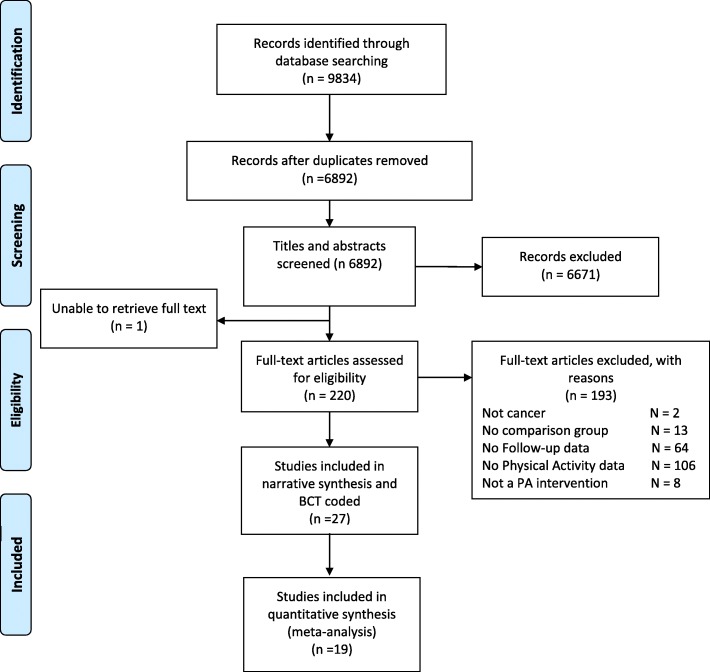
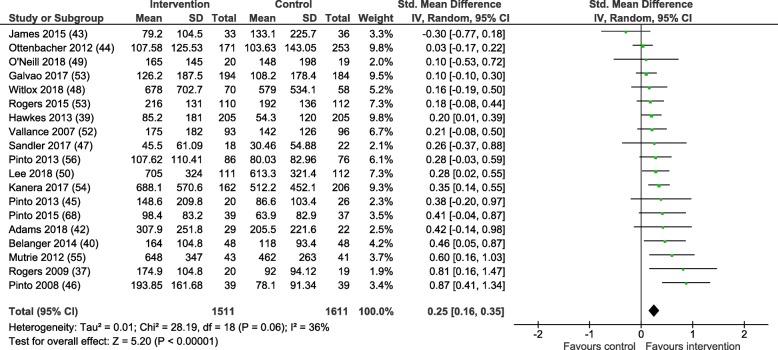
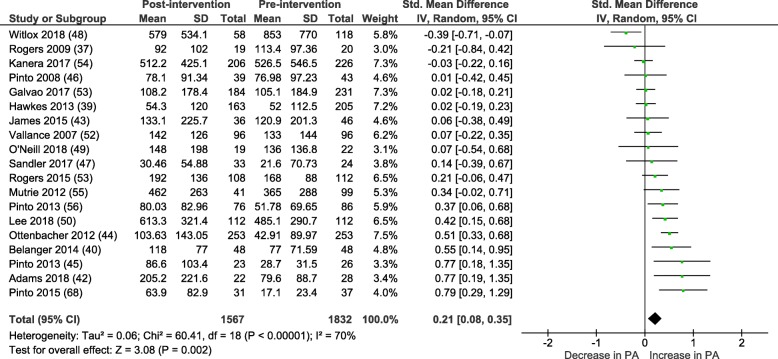
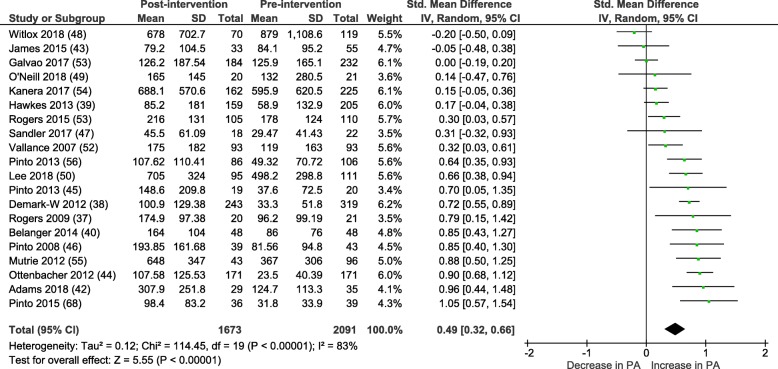
BACKGROUND: Physical activity can improve health and wellbeing after cancer and may reduce cancer recurrence and mortality. To achieve such long-term benefits cancer survivors must be habitually active. This review evaluates the effectiveness of interventions in supporting maintenance of physical activity behaviour change among adults diagnosed with cancer and explores which intervention components and contextual features are associated with effectiveness. METHODS: Relevant randomised controlled trials (RCTs) were identified by a search of Ovid Medline, Ovid Embase and PsychINFO. Trials including adults diagnosed with cancer, assessed an intervention targeting physical activity and reported physical activity behaviour at baseline and ≥ 3 months post-intervention were included. The behaviour change technique (BCT) taxonomy was used to identify intervention components and the Template for Intervention Description and Replication to capture contextual features. Random effect meta-analysis explored between and within group differences in physical activity behaviour. Standardised mean differences (SMD) describe effect size. RESULTS: Twenty seven RCTs were included, 19 were pooled in meta-analyses. Interventions were effective at changing long-term behaviour; SMD in moderate to vigorous physical activity (MVPA) between groups 0.25; 95% CI = 0.16-0.35. Within-group pre-post intervention analysis yielded a mean increase of 27.48 (95% CI = 11.48-43.49) mins/wk. of MVPA in control groups and 65.30 (95% CI = 45.59-85.01) mins/wk. of MVPA in intervention groups. Ineffective interventions tended to include older populations with existing physical limitations, had fewer contacts with participants, were less likely to include a supervised element or the BCTs of 'action planning', 'graded tasks' and 'social support (unspecified)'. Included studies were biased towards inclusion of younger, female, well-educated and white populations who were already engaging in some physical activity. CONCLUSIONS: Existing interventions are effective in achieving modest increases in physical activity at least 3 months post-intervention completion. Small improvements were also evident in control groups suggesting low-intensity interventions may be sufficient in promoting small changes in behaviour that last beyond intervention completion. However, study samples are not representative of typical cancer populations. Interventions should consider a stepped-care approach, providing more intensive support for older people with physical limitations and others less likely to engage in these interventions.
Overview
The claims and statistics of this paper haven’t been checked yet.
Free: it reads the open-access text and checks the first 5 claims that cite a source we can check. Create a free account to check every claim.
Integrity signals
Registry
Cites
Statistics
Figures
Verification
Claims the paper makes
The claims and statistics of this paper haven’t been checked yet.
Free: it reads the open-access text and checks the first 5 claims that cite a source we can check. Create a free account to check every claim.
Claims other papers make about this one
Each is checked against this paper’s own text: does it say what the citing paper says it does?
In the citing paper
“A synthesis of exercise programs that examined exercise maintenance (exercise assessed at least 3 months after program completion) revealed that graded tasks, social support, and action planning were used in studies that sustained significant behavior change.66”
From Exercise is medicine in oncology: Engaging clinicians to help patients move through cancer (2019) · cites this paper as [66]
Self-check
Percentages, sums and reported differences re-computed from the paper’s own numbers.
The self-check needs the paper’s full text.
Citations
Cites
Preferred Reporting Items for Systematic Reviews and Meta-Analyses: the PRISMA statement
Moher, D., Liberati, A., Tetzlaff, J., Altman, D. G., & for the PRISMA Group (2009) · BMJ · doi:10.1136/bmj.b2535 · Cited by 83,823
Preferred reporting items for systematic reviews and meta-analyses: the PRISMA Statement.
(2009) · PubMed Central · Cited by 44,859
The Cochrane Collaboration's tool for assessing risk of bias in randomised trials
Higgins, J. P. T., Altman, D. G., Gotzsche, P. C., Juni, P., Moher, D., Oxman, A. D., Savovic, J., Schulz, K. F., Weeks, L., Sterne, J. A. C., et al. (2011) · BMJ · doi:10.1136/bmj.d5928 · Cited by 33,817
Hoffmann, T. C., Glasziou, P. P., Boutron, I., Milne, R., Perera, R., Moher, D., Altman, D. G., Barbour, V., Macdonald, H., Johnston, M., et al. (2014) · BMJ · doi:10.1136/bmj.g1687 · Cited by 10,548
Michie, S., Richardson, M., Johnston, M., Abraham, C., Francis, J., Hardeman, W., Eccles, M. P., Cane, J., & Wood, C. E. (2013) · Annals of Behavioral Medicine · doi:10.1007/s12160-013-9486-6 · Cited by 7,629
Food, nutrition, physical activity, and the prevention of cancer: a global perspective
(2008) · Choice Reviews Online · doi:10.5860/choice.45-5024 · Cited by 5,350
Exercise and Physical Activity for Older Adults
Chodzko-Zajko, W. J., Proctor, D. N., Fiatarone Singh, M. A., Minson, C. T., Nigg, C. R., Salem, G. J., & Skinner, J. S. (2009) · Medicine & Science in Sports & Exercise · doi:10.1249/mss.0b013e3181a0c95c · Cited by 5,153
Systematic reviews: CRD's guidance for undertaking reviews in health care
Tacconelli, E. (2010) · The Lancet Infectious Diseases · doi:10.1016/s1473-3099(10)70065-7 · Cited by 3,245
American College of Sports Medicine Roundtable on Exercise Guidelines for Cancer Survivors
Schmitz, K. H., Courneya, K. S., Matthews, C., Demark-Wahnefried, W., GALVÃO, D. A., Pinto, B. M., IRWIN, M. L., WOLIN, K. Y., SEGAL, R. J., LUCIA, A., et al. (2010) · Medicine & Science in Sports & Exercise · doi:10.1249/mss.0b013e3181e0c112 · Cited by 2,781
Self-citationEffective techniques in healthy eating and physical activity interventions: A meta-regression.
Michie, S., Abraham, C., Whittington, C., McAteer, J., & Gupta, S. (2009) · Health Psychology · doi:10.1037/a0016136 · Cited by 2,229
Research works printed but not linked: 1
- Review Manager (RevMan) [computer program]. Version 5.3 Copenhagen: The Nordic Cochrane Centre, The Cochrane Collaboration, 2014.
Cited by
Items 101–200 of 233
Rammant, E., Bultijnck, R., Caperchione, C. M., & Trinh, L. (2021) · Seminars in Oncology Nursing · doi:10.1016/j.soncn.2020.151109 · Cited by 10
Ester, M., McNeely, M. L., McDonough, M. H., Dreger, J., & Culos-Reed, S. N. (2021) · Contemporary Clinical Trials · doi:10.1016/j.cct.2021.106474 · Cited by 7
Cigarroa, I., Díaz, E., Ortiz, C., Otero, R., Cantarero, I., Petermann-Rocha, F. E., Parra-Soto, S. L., Zapata‐Lamana, R., & Toloza–Ramirez, D. (2021) · Retos · doi:10.47197/retos.v44i0.90843 · Cited by 6
“…with various adverse effects caused by cancer treatment, both for mental health, cognitive Retos, número 44, 2022 (2º trimestre)- 378 - function and physical well-being, and for the deterioration of operation associated with aging (Grimmett et al., 2019) and cancer survivors (Palesh et al., 2018).”
BackgroundShehu, E., Roggendorf, S., Golla, A., Koenig, A., Stangl, G. I., Diestelhorst, A., Medenwald, D., Vordermark, D., Steckelberg, A., & Schmidt, H. (2022) · Cancers · doi:10.3390/cancers14112599 · Cited by 6
“The intervention addresses research gaps identified in recent reviews regarding tailored nutritional advice and PA interventions, also considering the issue of behavioral change [15] and low-intensity interventions and intensified support for older people with physical limitations [49].”
BackgroundCopeland, R. J., Campbell, A., Danjoux, G. R., Grimmett, C., Hyman, P., Humphreys, L. J., Roberts, A., Rosario, D. J., & Simcock, R. (2020) · OSF Preprints (OSF Preprints) · doi:10.31219/osf.io/bt5qa · Cited by 7
Self-citationCaudroit, J., Lapointe, J., Comtois, Romain, A. J., & Bernard, P. (2024) · PsyArXiv (OSF Preprints) · doi:10.31234/osf.io/zyh36 · Cited by 5
Gavin, J. P., Holt, L. C., Muckelt, P. E., Sadler, E., McDonough, S., & Barker, M. E. (2025) · International Journal of Behavioral Nutrition and Physical Activity · doi:10.1186/s12966-025-01802-y · Cited by 9
“Programs to support longer-term physical activity adherence have little or no effectiveness, small effect sizes which decline over time, and fail to assess maintenance outcomes [14, 19, 20].”
Sustainability capacity of a vegetable gardening intervention for cancer survivors
Cases, M. G., Blair, C. K., Hendricks, P. S., Smith, K. P., Snyder, S., & Demark‐Wahnefried, W. (2022) · BMC Public Health · doi:10.1186/s12889-022-13644-5 · Cited by 5
“Additionally, many studies include circumscribed samples that are largely comprised of younger White women with breast cancer [6, 8], and hence ungeneralizable to the larger population of survivors of whom 60% are age 65 and older [1].”
BackgroundGrimmett, C., Corbett, T. K., Bradbury, K. J., Morton, K., May, C. R., Pinto, B. M., & Foster, C. L. (2023) · Journal of Cancer Survivorship · doi:10.1007/s11764-023-01434-w · Cited by 7
“There is some evidence of modest maintenance effects [12] in people with cancer but activity levels typically regress towards baseline as the time from end of intervention increases [13].”
InfluentialSelf-citationCrisafio, M. E., Anderson, H. A. L., Thraen-Borowski, K. M., Schmitz, K. H., & Leach, H. J. (2024) · Translational Journal of the American College of Sports Medicine · doi:10.1249/tjx.0000000000000250 · Cited by 6
Orban, E., Jung, A. Y., Möhl, A., Behrens, S., Becher, H., Obi, N., & Chang-Claude, J. C. (2020) · Cancer Epidemiology · doi:10.1016/j.canep.2020.101852 · Cited by 5
Physical activity for the management of cancer-related fatigue in adults
Janjua, S., Brown, M., Parker, R., Prue, G., Closier, P., & Cramp, F. L. (2022) · Cochrane Database of Systematic Reviews · doi:10.1002/14651858.cd015348 · Cited by 5
Aguirre-Elordui, S., Fernández-Landa, J., Olasagasti-Ibargoien, J., & Castañeda-Babarro, A. (2024) · Journal of Cancer Survivorship · doi:10.1007/s11764-024-01654-8 · Cited by 8
“Studies with lower means obtained wider ranges (2–13 BCT [23], 2–20 BCT [24]) than those found in this SRM (15–19 BCT) with a higher mean.”
InfluentialPugh, G., Petrella, A. R., Fisher, A., Reynolds, J., & Epstone, S. (2019) · Journal of Adolescent and Young Adult Oncology · doi:10.1089/jayao.2019.0108 · Cited by 6
Peng, S., Yuan, F., Yang, H., Li, M., & Yang, X. (2025) · Behavioral Sciences · doi:10.3390/bs15111448 · Cited by 4
“…of PA interventions for cancer survivors or patients (Agirre-Elordui et al., 2024; Cooper et al., 2023; Ester et al., 2021; Finne et al., 2018; Grimmett et al., 2019; Hailey et al., 2022; Hallward et al., 2020; Mbous et al., 2020; Meyer-Schwickerath et al., 2022), with five conducting…”
InfluentialGoldschmidt, S., Schmidt, M. E., Rosenberger, F., Wiskemann, J., & Steindorf, K. (2023) · Journal of Physical Activity and Health · doi:10.1123/jpah.2023-0054 · Cited by 6
Ax, A., Stenling, A., Berntsen, S., Börjeson, S., Nordin, K., Demmelmaier, I., & Mazzoni, A. (2025) · Integrative Cancer Therapies · doi:10.1177/15347354251362447 · Cited by 5
“15,16 Research on long-term physical activity ( ≥ 5 years post-intervention) in cancer survivors is limited, 14,17,18 and has primarily focused on finding an average pattern of MVPA change over time rather than identifying differences in patterns of change within the population.”
Faithfull, S., Lemańska, A., Poole, K., Aning, J. J., MANDERS, R. J. F., Marshall, J., Saxton, J., Turner, L., & Griffin, B. A. (2021) · European Journal of Cancer Care · doi:10.1111/ecc.13476 · Cited by 4
“In a review of 27 RCTs, including a meta- analysis of 19 pooled studies on physical activity in cancer survivors, Grimmett et al. (Grimmett et al., 2019) found that existing data suggest that exercise interventions are effective in achieving only modest increases in physical activity at least 3 months post- interventi…”
BackgroundHardcastle, S. J., Douglass, E., Wilson, B., & Maxwell‐Smith, C. (2023) · Supportive Care in Cancer · doi:10.1007/s00520-023-08137-z · Cited by 9
“Self-monitoring was the primary technique used to sustain motivation and PA. Reviews also support the role of self-monitoring for PABC [26–28] in addition to goal-setting [27, 28] and action-planning [26, 29, 30] in cancer survivors.”
MethodPrice, J., & Brunet, J. (2021) · Supportive Care in Cancer · doi:10.1007/s00520-021-06529-7 · Cited by 18
Self-citationMelhem, A. J., Cordeiro, G. R., Mascarenhas, L. P. G., & Figueiredo, D. L. A. (2021) · Estudos Interdisciplinares sobre o Envelhecimento · doi:10.22456/2316-2171.99077 · Cited by 4
Hardcastle, S. J., Maxwell‐Smith, C., Cavalheri, V., Boyle, T., Román, M. L., Platell, C. F. E., Levitt, M., Saunders, C. M., Sardelic, F., Nightingale, S. S., et al. (2024) · Scandinavian Journal of Medicine and Science in Sports · doi:10.1111/sms.14572 · Cited by 6
“7 Remotely delivered interventions using wearables such as PPARCS are attractive because they integrate BCTs that demonstrate promise in the maintenance of PA (e.g., self-monitoring of behavior and feedback on performance), tend to be of a lower-intensity (i.e., less contact time), and thus are…”
BackgroundMethodCaudroit, J., Lapointe, J., Comtois, A. S., Romain, A. J., & Bernard, P. (2025) · Disability and Rehabilitation · doi:10.1080/09638288.2025.2488041 · Cited by 6
Ezenwankwo, E. F., Ezeukwu, A. O., & Abaraogu, U. O. (2021) · European Journal of Physiotherapy · doi:10.1080/21679169.2021.1933586 · Cited by 4
Ciuró, A. H., Raya-Benítez, J., Mateo, A. C., Núñez, J. M., Martos, I. C., López‐López, L., & Valenza, M. C. (2024) · Patient Education and Counseling · doi:10.1016/j.pec.2024.108454 · Cited by 4
Cheung, D. S. T., Chan, C. K., Rhodes, R. E., Chau, P. H., Chiang, C., Tse, M. A., Wang, M. P., Yu, D. S. F., & Lin, C. (2024) · European Journal of Oncology Nursing · doi:10.1016/j.ejon.2024.102774 · Cited by 4
van Maldegem, S. J. M. V. C. –., Mols, F., Seidell, J. C., de Kruif, A. J. T. C. M., van de Poll-Franse, L. V., & Hoedjes, M. (2023) · Annals of Behavioral Medicine · doi:10.1093/abm/kaad049 · Cited by 3
“These BCTs have been related to maintenance of behavior change in previous studies [29, 47, 50, 51].”
BackgroundResultBinyam, D., Naaktgeboren, W. R., Groen, W. G., Aaronson, N. K., Hiensch, A. E., van Harten, W. H., Stuiver, M. M., & May, A. M. (2024) · Journal of Cancer Survivorship · doi:10.1007/s11764-024-01640-0 · Cited by 5
“…investigate the effectiveness of exercise programmes that extend over a longer period and that include more elaborate cognitive behavioural intervention components that provide participants with the necessary tools to maintain their increased level of physical exercise after trial completion [30].”
What Do We Know About Group Health Coaching and Cancer Survivorship? A Scoping Review
Berzins, N. J., Orsega-Smith, E. M., MacKenzie, M. J., Galantino, M. L., Culos-Reed, N. S., Leonard, T., & Narducci, E. (2024) · American Journal of Lifestyle Medicine · doi:10.1177/15598276241303444 · Cited by 5
Champ, C. E., Rosenberg, J., Peluso, C., Hilton, C. J., Krause, R., Diaz, A. K., & Carpenter, D. J. (2025) · Journal of Functional Morphology and Kinesiology · doi:10.3390/jfmk10020165 · Cited by 4
“…analyzing 27 randomized controlled trials analyzing an exercise intervention in adults with cancer, which revealed that several factors are associated with exercise adherence, including contact with other participants, a supervised element, social support, and an exercise prescription [23].”
Ulrich, G. R., Nogg, K. A., Freeman, S. Z., & Ranby, K. W. (2022) · Translational Behavioral Medicine · doi:10.1093/tbm/ibac024 · Cited by 3
Hackshaw‐McGeagh, L., Robles, L. A., Persad, R. A., Rowe, E., Bahl, A. K., Aning, J. J., Koupparis, A. J., Abrams, P., Perks, C. M., Holly, J. M. P., et al. (2022) · Pilot and Feasibility Studies · doi:10.1186/s40814-022-01136-7 · Cited by 3
“Physical activity interventions guided by behaviour change theory [18] and incorporating wearable technology can increase motivation and engagement in physical activity of cancer survivors [19].”
BackgroundTam, S., Kumar, R., Lopez, P., Mattsson, J., Alibhai, S. M. H., Atenafu, E. G., Bernstein, L. J., Chang, E. B., Clarke, S., Langelier, D. M., et al. (2023) · PLoS ONE · doi:10.1371/journal.pone.0285420 · Cited by 6
Roach, J., Tabaczynski, A., Goodman, W., & Trinh, L. (2024) · Cancer Causes & Control · doi:10.1007/s10552-024-01875-3 · Cited by 3
“However, less is known about how to target the long-term maintenance of these changed exercise behaviors [5].”
Trinh, L., Rhodes, R. E., Alibhai, S. M. H., Campbell, K. L., Langelier, D. M., Chang, E. B., Colella, T. J. F., Chan, B., Mina, D. S., OH, P. I., et al. (2025) · BMC Cancer · doi:10.1186/s12885-025-13904-8 · Cited by 2
“Theoretical approaches to identifying key motivational outcomes to facilitate the adoption and maintenance of PA are limited [15, 23–25].”
InfluentialCoffman, E. M., Choi, S. M., Smitherman, A. B., Willis, E. A., Martin, S., Tate, D. F., & Valle, C. G. (2025) · Journal of Cancer Survivorship · doi:10.1007/s11764-025-01836-y · Cited by 5
“The results show an overall significant positive effect on PA, similar in the magnitude of effect sizes of other meta-analyses for PA in cancer survivors that reported effect sizes of 0.25–0.33 [32, 59, 60].”
InfluentialThe Application of the 24-Hour Movement Paradigm in People Diagnosed With Cancer: A Scoping Review
Smith, S. L., Brocklebank, L. A., Kennedy, F., Hamer, M., & Fisher, A. (2025) · Journal of Physical Activity and Health · doi:10.1123/jpah.2025-0062 · Cited by 2
Short, C. E., Edbrooke, L., Abo, S., Jones, T., Khot, A. S., Mahar, R. K., Lee, J., Crowe, J., Stratulate, S., Granger, C. L., et al. (2025) · BMC Cancer · doi:10.1186/s12885-025-15027-6 · Cited by 2
“Intervention Package [41–43] and theory [44–47] it provides guidance on overcoming barriers to exercise and additional behaviour change advice for adhering to exercise programs, such as how to establish an exercise habit.”
Gentile, A., Ficarra, S., Ortega‐Gómez, S., Jiménez‐Pavón, D., Asimakopoulou, Z., Vantarakis, A., Tavares, P., Vaz, V., Thaller, J., Papakonstantinou, S., et al. (2023) · Acta Oncologica · doi:10.1080/0284186x.2023.2270154 · Cited by 2
“Secondly, combining nutrition and PA supports young cancer survivors behavioral change and enhances the maintenance of a healthy lifestyle [17,18].”
BackgroundVoss, M. L., Brick, R. S., Padgett, L. S., WECHSLER, S., JOSHI, Y., Tomé, G. A., Arbid, S., Campbell, G. B., Campbell, K. L., Hassanieh, D. E., et al. (2024) · European Journal of Physical and Rehabilitation Medicine · doi:10.23736/s1973-9087.24.08452-1 · Cited by 4
“…of the most frequently used theories. these bcts have been found to be effective in other reviews with cancer survivors and physical activity 25, 200-206 and focus on enabling individuals who are motivated to make a conscious effort to self-regulate their thoughts, feelings and behaviors in…”
Peng, S., Khairani, A. Z., Yuan, F., Uba, A. R., & Yang, X. (2024) · Behavioral Sciences · doi:10.3390/bs14121143 · Cited by 5
Huizinga, F., Westerink, N.-D. L., Walenkamp, A., Berendsen, A. J., Greef, M. H. G. D., de Boer, M. R., de Bock, G. H., Berger, M. Y., & Brandenbarg, D. (2025) · British Journal of General Practice · doi:10.3399/bjgp.2024.0558 · Cited by 2
“14,67,72,73 Coaching strategies like self-monitoring, problem solving, and fostering autonomy and motivation add to PA maintenance, 74,75 which is often limited when relying solely on activity trackers.”
Multidisciplinary perspectives in exercise oncology across the translational research continuum
Courneya, K. S., Lucía, A., May, A. M., Rundqvist, H., & Rogers, L. Q. (2025) · JNCI Monographs · doi:10.1093/jncimonographs/lgaf032 · Cited by 3
Cancer Survivors Becoming and Staying Physically Active: Challenges of Behavior Change
Pinto, B. M., Kindred, M. M., & Grimmett, C. (2020) · Springer eBooks · doi:10.1007/978-3-030-42011-6_17 · Cited by 4
Self-citationBalance Confidence and Falls Self-Efficacy in Older Breast Cancer Survivors
Blackwood, J., & Rybicki, K. (2021) · Rehabilitation Nursing · doi:10.1097/rnj.0000000000000316 · Cited by 4
“This may, perhaps, bemore concerning for cancer survivors, as physical inactivity may exacerbate the negative sequelae of survivorship May/June 2021 s. Unauthorized reproduction of this article is prohibited. and increase the risk of developing additional comorbidities (Grimmett et al., 2019).”
BackgroundClarkson, P., Adams, J., Muckelt, P. E., Grimmett, C., Everitt, H., Clark, C., SAYNOR, Z. L., Cook, K., Stephenson, A., & McDonough, S. (2020) · doi:10.17504/protocols.io.bf7gjrjw · Cited by 2
“Of these, only Grimmett et al (2019) reported effective maintenance at >3 months post-intervention (9).”
BackgroundSelf-citationGale, N., Jones, U., Rees, T., Hicks, A., Davies, J., Holliday, S., & Hopkinson, J. B. (2023) · Journal of Clinical Nursing · doi:10.1111/jocn.16931 · Cited by 1
“Behaviour Change Techniques have been associated with successful physical activity improvements in cancer (Grimmett et al., 2019 ).”
BackgroundValle, C. G., Heiling, H., Deal, A. M., Diamond, M. A., Hales, D. P., Nezami, B. T., Rini, C. K., Pinto, B. M., LaRose, J. G., & Tate, D. F. (2024) · Journal of Cancer Survivorship · doi:10.1007/s11764-024-01577-4 · Cited by 5
“…have been underrepresented in studies of PA behavior among YACS [7, 52] and in behavior change intervention trials in cancer survivors in general [53], mHealth strategies show potential to improve PA among these subgroups and future interventions should work to address the unique needs and…”
Self-citationBaudot, A., Fayolle, E., Garros, M., Barth, N., Colin, F., Presles, É., Oriol, M., Collange, F., Chauvin, F., Bourmaud, A., et al. (2024) · BMJ Open Sport & Exercise Medicine · doi:10.1136/bmjsem-2024-002344 · Cited by 1
“Third, we analysed the behaviour change techniques used in interventions found in both the literature (interventions that have demonstrated their effectiveness in increasing PA practice) 21 and the support of DAPAP in the French region of Auvergne Rhône-Alpes.”
Franco, S. F., Carraça, E. V., Nobre, I., Rodrigues, B., Ilharco, V., Kahlert, L., & Silva, M. N. (2025) · Pilot and Feasibility Studies · doi:10.1186/s40814-024-01587-0 · Cited by 2
“Brief interventions have been shown to be sufficient in promoting small changes in PA behavior that last beyond intervention completion in cancer survivors [13], indicating promising PA outcomes of brief counseling interventions in this population.”
Abaraogu, U. O., Dall, P., Seenan, C., Rhodes, S., Gorely, T., McParland, J. L., Brittenden, J., Anieto, E. M., Booth, L., Gormal, C., et al. (2025) · Health Technology Assessment · doi:10.3310/zbng5240 · Cited by 1
Unick, J. L., Duffy, C., Dizon, D. S., Fenton, M. A., Cao, Z., Oselinsky, K. M., Tobin, S. Y., & Wing, R. R. (2025) · JMIR Cancer · doi:10.2196/79610 · Cited by 3
“While this recidivism is disappointing, these findings are consistent with the broader PA literature, which demonstrates the challenge of maintaining PA following an unsupervised exercise program [42,43].”
Carraça, E. V., Rodrigues, B., Franco, S. F., Nobre, I., Jerónimo, F., Ilharco, V., Silva, P. F., Palmeira, A. L., & Silva, M. N. (2026) · International Journal of Behavioral Nutrition and Physical Activity · doi:10.1186/s12966-026-01873-5 · Cited by 3
“…techniques (e.g., self-monitoring, adding objects to the environment, goal setting or action planning) known to be linked to long-term PA outcomes [18, 19], to foster self-deter-mined choices and the development of self-regulatory skills, seem to increase PA and well-being in general populations…”
Garcia, A. D., Mullan, B. A., Hill, K., Breen, L. J., & Maxwell‐Smith, C. (2026) · Breast Cancer · doi:10.1007/s12282-026-01859-y · Cited by 2
“However, this level of heterogeneity is consistent with systematic reviews of physical activity interventions [ 9 , 11, 14 ] and likely reflects true variation in intervention characteristics, such as duration, delivery modality, participant populations, breast cancer stage and treatment status,…”
InfluentialExercise Interventions During Hospitalization for Stem Cell Transplantation: An Integrative Review
Tlusty, G. C., Alonso, W., & Berger, A. M. (2022) · Western Journal of Nursing Research · doi:10.1177/01939459221124433 · Cited by 2
“Graded tasks were the only consistent technique associated with higher adherence in previous studies in the general oncology population (Finne et al., 2018; Grimmett et al., 2019).”
BackgroundMethodBourne, J. E., Kelly, P., & Armstrong, M. E. G. (2024) · JMIR Cancer · doi:10.2196/54785 · Cited by 1
Price, J. (2019) · uO Research (University of Ottawa) · doi:10.20381/ruor-23804
Developing healthcare professional training to promote exercise in prostate cancer patients
Turner, R. R. (2020) · Sheffield Hallam University · doi:10.7190/shu-thesis-00335 · Cited by 1
Smit, E., Leenaars, K. E. F., Wagemakers, A., van der Velden, K., & Molleman, G. R. M. (2021) · TSG - Tijdschrift voor gezondheidswetenschappen · doi:10.1007/s12508-021-00299-7 · Cited by 1
Lally, P. J., Miller, N. E., Roberts, A., Beeken, R. J., Greenfield, D., POTTS, H. W. W., Counsell, N., Latimer, N. R., Thomas, C., Smith, L., et al. (2021) · Research Square · doi:10.21203/rs.3.rs-895677/v1
Eisele, M., Twomey, R., Pohl, A. J., McDonough, M. H., McNeely, M. L., Ester, M., Daun, J. T., & Culos-Reed, S. N. (2021) · medRxiv · doi:10.1101/2021.11.29.21266169
Stepping stones to implement exercise as integral part of cancer care
Hiensch, A. E. (2022) · Utrecht University Repository (Utrecht University) · doi:10.33540/988 · Cited by 1
Synthesis of data from trials of interventions designed to change health behaviour; a case studyPreprint
Rhodes, S., Dias, S., Wilkinson, J., & Cotterill, S. (2021) · doi:10.22541/au.163256037.77153698/v1
Dent, S. F., Kikuchi, R., Gilchrist, S. C., & Melloni, C. (2021) · Springer eBooks · doi:10.1007/978-3-030-75377-1_16
Kiemeney, L. A. L. M., Assendelft, W. J., Vrieling, A., de Bruin, M., & Buffart, L. M. (2020) · Bohn Stafleu van Loghum eBooks · doi:10.1007/978-90-368-2449-1_42
Enfermeros en la prevención del cáncer: cómo llegar a los que no se llega
de la Serna, C. D. D. L. R., & Fernández‐Ortega, P. (2022) · Magna Scientia UCEVA · doi:10.54502/msuceva.v2n1a8
Ali, D. (2022) · Queensland University of Technology · doi:10.5204/thesis.eprints.233465
Is Breast Conserving Surgery A Suitable Approach for Early Breast Carcinoma? A Multicenter Study
Sultan, A. I., & Habash, M. M. (2022) · Pakistan Journal of Medical and Health Sciences · doi:10.53350/pjmhs22166619
Kidane, A., & Xue-feng, Z. (2022) · International Journal of Research in Business and Social Science (2147-4478) · doi:10.20525/ijrbs.v11i9.2226
Postcancer treatment support programme: an evaluation
Murray, C., Makinson, J., Brown, L., & Allan, J. (2023) · BMJ Supportive & Palliative Care · doi:10.1136/spcare-2023-004188
Dulai-Piper, A. E. (2023) · Research Square · doi:10.21203/rs.3.rs-3331400/v1
Dulai-Piper, A. E., Devonport, T. J., Fenton, S. A. M., Shanley, H. A., Mawn, R. G., Thorp, S. L., Metsios, G. S., Morrissey, H., Blake, M., & Lahart, I. M. (2023) · Research Square · doi:10.21203/rs.3.rs-3331400/v2
Campione, E., Irwin, K. E., Chladek, N., Kaplan, L., & Murphy, B. (2024) · Rehabilitation Oncology · doi:10.1097/01.reo.0000000000000357
“27,62 Some limitations of this systematic review need to be taken into consideration.”
BackgroundFujita, R. A., Tinker, A. V., Fujisawa, N., Holmes, A., Hanley, G. E., Mackey, D. C., Trinh, L., Lesser, I., Mackenzie, K. A., Larnder, A., et al. (2024) · Rehabilitation Oncology · doi:10.1097/01.reo.0000000000000361 · Cited by 2
“…included instruction on reflective (eg, benefits of physical activity) and self-regulatory processes (ie, goal setting, self-monitoring, action planning, overcoming barriers) from the multi-process action control framework 13,14 to assist in the long-term adoption of positive exercise behavior.”
BackgroundEffect of Exercise on Malaria and some Biochemical Parameters
(2023) · Arid-zone Journal of Basic & Applied Research · doi:10.55639/607.515049
Special Edition on Psycho-Oncology, Indian Journal of Medical and Paediatric Oncology
Butow, P. N. (2024) · Indian Journal of Medical and Paediatric Oncology · doi:10.1055/s-0044-1787724
McDonough, S., Stephenson, A., Grimmett, C., Bennett, K., Coyle, N., Grealis, S., Kinneavy, C., FitzGerald, O., French, H., Stokes, M. J., et al. (2024) · HRB Open Research · doi:10.12688/hrbopenres.14002.1 · Cited by 2
“Time based definitions focus on the duration since the behaviour was initiated at a volume that differs from base-line PA e.g. regular activity or statistically significant change in behaviour over one to 12 months 22,23,26 .”
InfluentialSelf-citationFei, W., Abdullah, H. B., Zaremohzzabieh, Z., Li, Y., & Hongjuan, Z. (2024) · Journal of Ecohumanism · doi:10.62754/joe.v3i8.5219 · Cited by 1
“Tailored strategies that consider their caregiving burdens, energy constraints, and psychological stressors are urgently needed (Grimmett et al., 2019).”
Ciuró, A. H., Núñez, J. M., Navas‐Otero, A., Mateo, A. C., Torres‐Sánchez, I., Santiago, M. G., & Valenza, M. C. (2025) · Cancer Nursing · doi:10.1097/ncc.0000000000001465 · Cited by 2
Fessler, L., Malatgliati, S., Meyer, P., Finckh, A., Cullati, S., Sander, D., Friese, M., Wiers, R. W. H. J., Farajzadeh, A., Luthy, C., et al. (2025) · medRxiv · doi:10.1101/2025.02.27.25323019
Wagoner, C. W., Daun, J. T., Cannon, J., Danyluk, J. M., Langelier, D. M., Francis, G. J., Culos-Reed, S. N., & Perry, S. (2025) · PM&R · doi:10.1002/pmrj.13351 · Cited by 3
Kiemeney, L. A. L. M., Assendelft, W. J., Vrieling, A., de Bruin, M., & Buffart, L. M. (2025) · doi:10.1007/978-90-368-3138-3_39
Núñez, J. M., Ciuró, A. H., Mateo, A. C., López‐López, L., Navas‐Otero, A., Santiago, M. G., & Valenza, M. C. (2025) · Patient Education and Counseling · doi:10.1016/j.pec.2025.109312
Caudroit, J., Lapointe, J., Comtois, A. S., Romain, A. J., & Bernard, P. (2025) · Single Case in the Social Sciences · doi:10.15763/issn.1936-9298.2025.2.3.1-14
Swain, C. T. V., Bergin, R. J., Moore, M. M., D’Souza, M., Ashley, C., Lynch, B. M., Koorts, H., Denehy, L., & Klaic, M. (2025) · Journal of Physical Activity and Health · doi:10.1123/jpah.2025-0076
Brunet, J., Price, J., Gillison, F., Standage, M., Taljaard, M., Beauchamp, M. R., Reed, J. L., & Srikanthan, A. (2025) · Pilot and Feasibility Studies · doi:10.1186/s40814-025-01701-w
“Together, this one-to-one approach may facilitate and maintain PA behavior change [28].”
Self-citationEakin, E., Reeves, M. M., Goode, A. D., WINKLER, E. A. H., Vardy, J. L., Boyle, F. M., Haas, M. R., Hiller, J. E., Mishra, G. D., Jefford, M., et al. (2020) · Figshare · doi:10.6084/m9.figshare.13059182
Eakin, E., Reeves, M. M., Goode, A. D., WINKLER, E. A. H., Vardy, J. L., Boyle, F. M., Haas, M. R., Hiller, J. E., Mishra, G. D., Jefford, M., et al. (2020) · Figshare · doi:10.6084/m9.figshare.13059176
Eisele, M., Pohl, A. J., McDonough, M. H., McNeely, M. L., Ester, M., Daun, J. T., Twomey, R., & Culos-Reed, S. N. (2024) · Figshare · doi:10.6084/m9.figshare.26589051
Eisele, M., Pohl, A. J., McDonough, M. H., McNeely, M. L., Ester, M., Daun, J. T., Twomey, R., & Culos-Reed, S. N. (2024) · Figshare · doi:10.6084/m9.figshare.26589057
Eakin, E., Reeves, M. M., Goode, A. D., WINKLER, E. A. H., Vardy, J. L., Boyle, F. M., Haas, M. R., Hiller, J. E., Mishra, G. D., Jefford, M., et al. (2020) · Figshare · doi:10.6084/m9.figshare.13059167
Smith, S., Lally, P. J., Steptoe, A., Chavez‐Ugalde, Y., Beeken, R. J., & Fisher, A. (2024) · Figshare · doi:10.6084/m9.figshare.26686869
Rubio, M. A., Mejía-Arbelaez, C., Wilches-Mogollon, M. A., Moreno, S., Finck, C., Rosas, L. G., Romero, S. A., Guevara, P., Cabas, S., Rubiano, O., et al. (2024) · Figshare · doi:10.6084/m9.figshare.26571856
Eisele, M., Pohl, A. J., McDonough, M. H., McNeely, M. L., Ester, M., Daun, J. T., Twomey, R., & Culos-Reed, S. N. (2024) · Figshare · doi:10.6084/m9.figshare.26589054
Eakin, E., Reeves, M. M., Goode, A. D., WINKLER, E. A. H., Vardy, J. L., Boyle, F. M., Haas, M. R., Hiller, J. E., Mishra, G. D., Jefford, M., et al. (2020) · Figshare · doi:10.6084/m9.figshare.13059161
Eakin, E., Reeves, M. M., Goode, A. D., WINKLER, E. A. H., Vardy, J. L., Boyle, F. M., Haas, M. R., Hiller, J. E., Mishra, G. D., Jefford, M., et al. (2020) · Figshare · doi:10.6084/m9.figshare.13059179
de Vries-ten Have, J., Winkels, R. M., Kampman, E., & Winkens, L. H. H. (2023) · Figshare · doi:10.6084/m9.figshare.24309922
Eisele, M., Pohl, A. J., McDonough, M. H., McNeely, M. L., Ester, M., Daun, J. T., Twomey, R., & Culos-Reed, S. N. (2024) · Figshare · doi:10.6084/m9.figshare.26589066
Eakin, E., Reeves, M. M., Goode, A. D., WINKLER, E. A. H., Vardy, J. L., Boyle, F. M., Haas, M. R., Hiller, J. E., Mishra, G. D., Jefford, M., et al. (2020) · Figshare · doi:10.6084/m9.figshare.13059158
Metadata
- Authors
- Grimmett, C., Corbett, T., Brunet, J., Shepherd, J., Pinto, B. M., May, C. R., & Foster, C.
- Affiliations
- University of Southampton (GB)
- University of Ottawa (CA)
- University of South Carolina (US)
- London School of Hygiene & Tropical Medicine (GB)
- Corresponding author
- Grimmett, Chloe
- ORCID
- Venue
- International Journal of Behavioral Nutrition and Physical Activity
- Published
- 2019-04-27
- Volume
- 16
- Issue
- 1
- Pages
- 37-37
- ISSN
- 1479-5868 (ISSN-L)
- PMC
- PMC6486962
- OpenAlex
- W2939870446
- Cited by
- 234
- References
- 73
- Citations by year
- 2026: 21 · 2025: 28 · 2024: 42 · 2023: 41 · 2022: 28 · 2021: 34 · 2020: 34 · 2019: 6
- FWCI
- 2.43
- Type
- journal article
- Language
- en
- Open access
- gold
- doi.org
- Licence
- cc-by
- creativecommons.org/licenses/by/4.0/ (tdm)
- Locations
- International Journal of Behavioral Nutrition and Physical Activity (publishedVersion, cc-by)
- PubMed Central (publishedVersion, cc-by)
- PubMed (publishedVersion)
- Solent University Research Portal (Solent University) (publishedVersion, other-oa)
- ePrints Soton (University of Southampton) (acceptedVersion)
- LSHTM Research Online (London School of Hygiene and Tropical Medicine) (acceptedVersion)
- DOAJ (DOAJ: Directory of Open Access Journals) (submittedVersion, cc-by-sa)
- uO Research (University of Ottawa) (submittedVersion, public-domain)
- Funders
- National Institute for Health Research (PDF 2016 09 025)
- Topics
- Health Sciences › Medicine › Oncology › Cancer survivorship and care
- Health Sciences › Medicine › Public Health, Environmental and Occupational Health › Physical Activity and Health
- Social Sciences › Psychology › Applied Psychology › Behavioral Health and Interventions
- Keywords
- cancer survivors, physical activity, behavior maintenance, exercise intervention, moderate-to-vigorous physical activity, behaviour change techniques, intervention effectiveness, stepped care, social support, action planning
- MeSH terms
- Cancer Survivors, Behavior Therapy, Humans, Exercise
About these checks
Registry, retraction, Cites and statistics results are computed, not judged, with one exception: a printed reference that no index lists is read once by a model before it counts as a citation error. Claims are extracted by a model and kept only when their quote appears verbatim in the text; each cited source is then checked, with a model’s help, for whether it says what the claim relies on. Those verdicts can be wrong — read the claim’s quote and the cited source before relying on one.
Statistics and arithmetic are recomputed, not judged.
Confidence bands are shown only for fields calibrated on our annotated test set. None is calibrated yet, so no band is shown.
What counts as a claim ›How we measure confidence ›How we check this ›
Are you an author, or do you see a problem with this page? Request a review
Data sources
Bibliographic data: Semantic Scholar, OpenAlex, Crossref.
Contains information from the Semantic Scholar Academic Graph Datasets, made available under the ODC Attribution License (ODC-BY 1.0).
Semantic Scholar’s data is described in: Kinney, R., et al. (2023). The Semantic Scholar Open Data Platform. arXiv:2301.10140.
