

Systematic review and meta-analysis of maintenance of physical activity behaviour change in cancer survivors
Open accessThe DOI matches its Crossref record; 73 of the 73 references it cites were found in a registry or an index.
Abstract
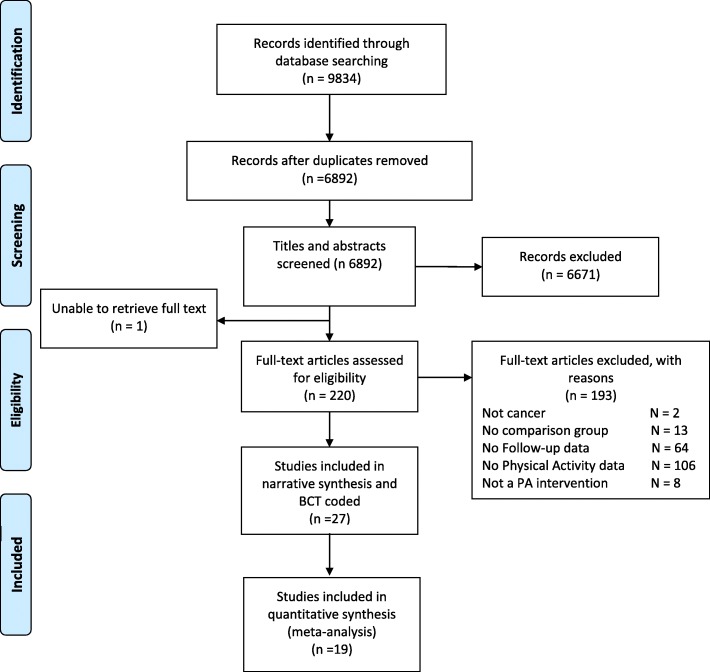
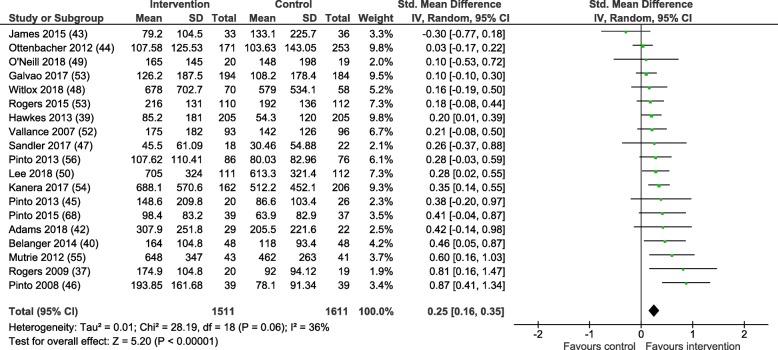
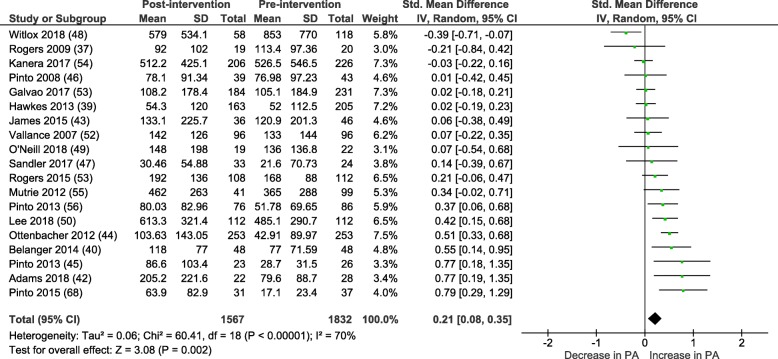
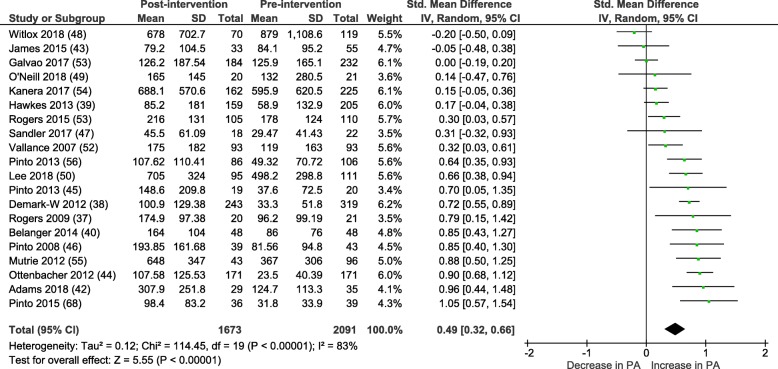
BACKGROUND: Physical activity can improve health and wellbeing after cancer and may reduce cancer recurrence and mortality. To achieve such long-term benefits cancer survivors must be habitually active. This review evaluates the effectiveness of interventions in supporting maintenance of physical activity behaviour change among adults diagnosed with cancer and explores which intervention components and contextual features are associated with effectiveness. METHODS: Relevant randomised controlled trials (RCTs) were identified by a search of Ovid Medline, Ovid Embase and PsychINFO. Trials including adults diagnosed with cancer, assessed an intervention targeting physical activity and reported physical activity behaviour at baseline and ≥ 3 months post-intervention were included. The behaviour change technique (BCT) taxonomy was used to identify intervention components and the Template for Intervention Description and Replication to capture contextual features. Random effect meta-analysis explored between and within group differences in physical activity behaviour. Standardised mean differences (SMD) describe effect size. RESULTS: Twenty seven RCTs were included, 19 were pooled in meta-analyses. Interventions were effective at changing long-term behaviour; SMD in moderate to vigorous physical activity (MVPA) between groups 0.25; 95% CI = 0.16-0.35. Within-group pre-post intervention analysis yielded a mean increase of 27.48 (95% CI = 11.48-43.49) mins/wk. of MVPA in control groups and 65.30 (95% CI = 45.59-85.01) mins/wk. of MVPA in intervention groups. Ineffective interventions tended to include older populations with existing physical limitations, had fewer contacts with participants, were less likely to include a supervised element or the BCTs of 'action planning', 'graded tasks' and 'social support (unspecified)'. Included studies were biased towards inclusion of younger, female, well-educated and white populations who were already engaging in some physical activity. CONCLUSIONS: Existing interventions are effective in achieving modest increases in physical activity at least 3 months post-intervention completion. Small improvements were also evident in control groups suggesting low-intensity interventions may be sufficient in promoting small changes in behaviour that last beyond intervention completion. However, study samples are not representative of typical cancer populations. Interventions should consider a stepped-care approach, providing more intensive support for older people with physical limitations and others less likely to engage in these interventions.
Overview
The claims and statistics of this paper haven’t been checked yet.
Free: it reads the open-access text and checks the first 5 claims that cite a source we can check. Create a free account to check every claim.
Integrity signals
Registry
Cites
Statistics
Figures
Verification
Claims the paper makes
The claims and statistics of this paper haven’t been checked yet.
Free: it reads the open-access text and checks the first 5 claims that cite a source we can check. Create a free account to check every claim.
Claims other papers make about this one
Each is checked against this paper’s own text: does it say what the citing paper says it does?
In the citing paper
“A synthesis of exercise programs that examined exercise maintenance (exercise assessed at least 3 months after program completion) revealed that graded tasks, social support, and action planning were used in studies that sustained significant behavior change.66”
From Exercise is medicine in oncology: Engaging clinicians to help patients move through cancer (2019) · cites this paper as [66]
Self-check
Percentages, sums and reported differences re-computed from the paper’s own numbers.
The self-check needs the paper’s full text.
Citations
Cites
Preferred Reporting Items for Systematic Reviews and Meta-Analyses: the PRISMA statement
Moher, D., Liberati, A., Tetzlaff, J., Altman, D. G., & for the PRISMA Group (2009) · BMJ · doi:10.1136/bmj.b2535 · Cited by 83,823
Preferred reporting items for systematic reviews and meta-analyses: the PRISMA Statement.
(2009) · PubMed Central · Cited by 44,859
The Cochrane Collaboration's tool for assessing risk of bias in randomised trials
Higgins, J. P. T., Altman, D. G., Gotzsche, P. C., Juni, P., Moher, D., Oxman, A. D., Savovic, J., Schulz, K. F., Weeks, L., Sterne, J. A. C., et al. (2011) · BMJ · doi:10.1136/bmj.d5928 · Cited by 33,817
Hoffmann, T. C., Glasziou, P. P., Boutron, I., Milne, R., Perera, R., Moher, D., Altman, D. G., Barbour, V., Macdonald, H., Johnston, M., et al. (2014) · BMJ · doi:10.1136/bmj.g1687 · Cited by 10,548
Michie, S., Richardson, M., Johnston, M., Abraham, C., Francis, J., Hardeman, W., Eccles, M. P., Cane, J., & Wood, C. E. (2013) · Annals of Behavioral Medicine · doi:10.1007/s12160-013-9486-6 · Cited by 7,629
Food, nutrition, physical activity, and the prevention of cancer: a global perspective
(2008) · Choice Reviews Online · doi:10.5860/choice.45-5024 · Cited by 5,350
Exercise and Physical Activity for Older Adults
Chodzko-Zajko, W. J., Proctor, D. N., Fiatarone Singh, M. A., Minson, C. T., Nigg, C. R., Salem, G. J., & Skinner, J. S. (2009) · Medicine & Science in Sports & Exercise · doi:10.1249/mss.0b013e3181a0c95c · Cited by 5,153
Systematic reviews: CRD's guidance for undertaking reviews in health care
Tacconelli, E. (2010) · The Lancet Infectious Diseases · doi:10.1016/s1473-3099(10)70065-7 · Cited by 3,245
American College of Sports Medicine Roundtable on Exercise Guidelines for Cancer Survivors
Schmitz, K. H., Courneya, K. S., Matthews, C., Demark-Wahnefried, W., GALVÃO, D. A., Pinto, B. M., IRWIN, M. L., WOLIN, K. Y., SEGAL, R. J., LUCIA, A., et al. (2010) · Medicine & Science in Sports & Exercise · doi:10.1249/mss.0b013e3181e0c112 · Cited by 2,781
Self-citationEffective techniques in healthy eating and physical activity interventions: A meta-regression.
Michie, S., Abraham, C., Whittington, C., McAteer, J., & Gupta, S. (2009) · Health Psychology · doi:10.1037/a0016136 · Cited by 2,229
Research works printed but not linked: 1
- Review Manager (RevMan) [computer program]. Version 5.3 Copenhagen: The Nordic Cochrane Centre, The Cochrane Collaboration, 2014.
Cited by
Items 201–233 of 233
Eakin, E., Reeves, M. M., Goode, A. D., WINKLER, E. A. H., Vardy, J. L., Boyle, F. M., Haas, M. R., Hiller, J. E., Mishra, G. D., Jefford, M., et al. (2020) · Figshare · doi:10.6084/m9.figshare.13059170
Mikkelsen, M. K., Juhl, C. B., Lund, C. M., Jarden, M., Vinther, A., & Nielsen, D. L. (2020) · Figshare · doi:10.6084/m9.figshare.13114676
Weemaes, A. T. R., Beelen, M., Weijenberg, M. P., van Kuijk, S. M. J., & Lenssen, A. F. (2024) · Figshare · doi:10.6084/m9.figshare.26673030
Eakin, E., Reeves, M. M., Goode, A. D., WINKLER, E. A. H., Vardy, J. L., Boyle, F. M., Haas, M. R., Hiller, J. E., Mishra, G. D., Jefford, M., et al. (2020) · Figshare · doi:10.6084/m9.figshare.13059173
McCourt, O., Fisher, A., Land, J., Ramdharry, G. M., Roberts, A., Bekris, G., & Yong, K. (2023) · Figshare · doi:10.6084/m9.figshare.22649210
Weemaes, A. T. R., Beelen, M., Weijenberg, M. P., van Kuijk, S. M. J., & Lenssen, A. F. (2024) · Figshare · doi:10.6084/m9.figshare.26673027
Weemaes, A. T. R., Beelen, M., Weijenberg, M. P., van Kuijk, S. M. J., & Lenssen, A. F. (2024) · Figshare · doi:10.6084/m9.figshare.26673024
Carraça, E. V., Rodrigues, B., Franco, S. F., Nobre, I., Jerónimo, F., Ilharco, V., Gabriel, F., Ribeiro, L., Palmeira, A. L., & Silva, M. N. (2023) · Figshare · doi:10.6084/m9.figshare.23632548
Fecher‐Jones, I., Grimmett, C., Carter, F. J., Conway, D. H., Levett, D. Z. H., & Moore, J. A. (2021) · Figshare · doi:10.6084/m9.figshare.14782473
Self-citationRubio, M. A., Mejía-Arbelaez, C., Wilches-Mogollon, M. A., Moreno, S., Finck, C., Rosas, L. G., Romero, S. A., Guevara, P., Cabas, S., Rubiano, O., et al. (2023) · Figshare · doi:10.6084/m9.figshare.26571853
Mikkelsen, M. K., Juhl, C. B., Lund, C. M., Jarden, M., Vinther, A., & Nielsen, D. L. (2020) · Figshare · doi:10.6084/m9.figshare.13114673
Smith, S., Lally, P. J., Steptoe, A., Chavez‐Ugalde, Y., Beeken, R. J., & Fisher, A. (2024) · Figshare · doi:10.6084/m9.figshare.26686866
Eisele, M., Pohl, A. J., McDonough, M. H., McNeely, M. L., Ester, M., Daun, J. T., Twomey, R., & Culos-Reed, S. N. (2024) · Figshare · doi:10.6084/m9.figshare.26589060
Eisele, M., Pohl, A. J., McDonough, M. H., McNeely, M. L., Ester, M., Daun, J. T., Twomey, R., & Culos-Reed, S. N. (2024) · Figshare · doi:10.6084/m9.figshare.26589063
Jankaew, A., Chen, P. S., & Lin, C. (2026) · Journal of Physical Activity and Health · doi:10.1123/jpah.2025-0442
Liu, M., Kilbreath, S. L., Yee, J., Beith, J. M., & Dylke, E. S. (2026) · Cancers · doi:10.3390/cancers18020338 · Cited by 2
“Home-based unsupervised interventions can be effective [8] but require consideration as the reduced contact can be insufficient for impacting outcomes [9].”
Freeman, N., Leske, M., Koczwara, B., Morris, J., Daly, A., & Beatty, L. (2026) · Supportive Care in Cancer · doi:10.1007/s00520-025-10263-9
“However, improving health behaviors can be difficult to enact and sustain due to factors such as low motivation and post-treatment fatigue [8].”
Smith-Morris, C. M., Ponton, M., Patterson, S., Hong, A. S., Taylor, L. L., Hahm, K. J., Kim, D., & Zaha, V. G. (2026) · Research Square · doi:10.21203/rs.3.rs-8670497/v1 · Cited by 1
Cesnik, R., Kunstler, B., Toohey, K. L., Freene, N., & Semple, S. (2026) · European Journal of Oncology Nursing · doi:10.1016/j.ejon.2026.103140 · Cited by 1
Nakfoor, B., Parker, H., Leach, J. H., & Fairman, C. M. (2026) · Supportive Care in Cancer · doi:10.1007/s00520-026-10637-7
“This selection bias, commonly observed in exercise oncology studies [69], limits the applicability of our findings to broader populations.”
Exploring Cancer Survivors’ Preferences for a Physical Activity Maintenance Program
Anderson, H. A. L., Lancioni, E. M., Crisafio, M. E., Faro, J. M., Fruhauf, C. A., & Leach, H. J. (2026) · Translational Journal of the American College of Sports Medicine · doi:10.1249/tjx.0000000000000356
Skeletal muscle as an endocrine and paracrine organ in breast cancer biology: a narrative review
Carpenter, D. J., Peluso, C., Xiao, K., Rosenberg, J., Lee, P. L., & Champ, C. E. (2026) · Discover Oncology · doi:10.1007/s12672-026-05027-8
“Additionally, a large meta-analysis of breast cancer exercise studies revealed that exercise adherence was strongly associated with contacts with other participants, a supervised element, an exercise prescription, and social support [31].”
Franco-García, J. M., Pereira-Payo, D., Denche-Zamorano, Á. M., & Salas-Gómez, D. (2026) · Journal of Public Health · doi:10.1007/s10389-026-02773-5
Woodard, N., Xu, J., Perreault, T.-A., Lopez, N., Conklin, J. L., Hoover, R. L., & Hirschey, R. (2026) · American Journal of Lifestyle Medicine · doi:10.1177/15598276261451750
Merifield, L. E., Toyama, M., Gooman, A., Teranishi-Hashimoto, C., Lim, E., Yamada, P. M., & Fukui, J. A. (2026) · Healthcare · doi:10.3390/healthcare14111556
“Furthermore, meta-analyses suggest that successful maintenance interventions typically involve supervised elements, action planning, and social support [22].”
Remotely delivered resistance training program in adult sarcoma survivors: a pilot study
Davis, L. E., Austin, S. C., Hayden, J. B., Doung, Y.-C., Gundle, K. R., Ryan, C. W., Stoyles, S. A., & Winters‐Stone, K. M. (2026) · BMC Cancer · doi:10.1186/s12885-026-16399-z
“Previous research has established that supervised programs lead to better outcomes than unsupervised exercise, which may be attributable to better exercise adherence and motivation [66, 67].”
Liu, F., Fei, Y., Ding, X., 鲁冰清, & Xu, H. (2026) · International Journal of Nursing Sciences · doi:10.1016/j.ijnss.2026.08.006
Garcia, A. D., Mullan, B. A., Hill, K., Breen, L. J., & Maxwell‐Smith, C. (2026) · Cancer Survivorship Research & Care · doi:10.1080/28352610.2026.2721095
Yun, S., Lee, S., Lee, E. Y., & Kim, K. (2026) · Preventive Nutrition and Food Science · doi:10.3746/pnf.2026.063
“First, the relatively short intervention period was insufficient to confirm long-term dietary behavior changes (Nigg and Long, 2012; Grimmett et al., 2019; Buyl et al., 2020).”
Zhou, A., Dhillon, H. M., Koh, C., Smith, A. B., Mohan, H. M., Carey, S., Smith, S., Poulton, T. E., Patton, V. E., White, K., et al. (2026) · Disability and Rehabilitation · doi:10.1080/09638288.2026.2720764
A bridge over the river of sedentary behaviour: Passive exercise as a path to better health
Tari, B., Heath, M. D., Rattley, C. A., Ronca, F., Zou, L., & Herold, F. (2026) · Advanced Exercise and Health Science · doi:10.1016/j.aehs.2026.07.003
Leach, H., Lancioni, E. M., Parker, H., Anderson, H. A. L., Fruhauf, C., Smith, D., Portz, J. D., Lyden, K., Bryan, A. D., Culos-Reed, S. N., et al. (2026) · Contemporary Clinical Trials · doi:10.1016/j.cct.2026.108483
Rådman, L., Zetterlund, J., Wågert, P. V. H., & Henriksson, A. (2026) · BMJ Open · doi:10.1136/bmjopen-2026-125120
“23 25 Behaviour change interventions grounded in social cognitive theory may further strengthen these strategies, providing information, offering social support, delivering feedback, facilitating self-monitoring and establishing outcome goals.”
Metadata
- Authors
- Grimmett, C., Corbett, T., Brunet, J., Shepherd, J., Pinto, B. M., May, C. R., & Foster, C.
- Affiliations
- University of Southampton (GB)
- University of Ottawa (CA)
- University of South Carolina (US)
- London School of Hygiene & Tropical Medicine (GB)
- Corresponding author
- Grimmett, Chloe
- ORCID
- Venue
- International Journal of Behavioral Nutrition and Physical Activity
- Published
- 2019-04-27
- Volume
- 16
- Issue
- 1
- Pages
- 37-37
- ISSN
- 1479-5868 (ISSN-L)
- PMC
- PMC6486962
- OpenAlex
- W2939870446
- Cited by
- 234
- References
- 73
- Citations by year
- 2026: 21 · 2025: 28 · 2024: 42 · 2023: 41 · 2022: 28 · 2021: 34 · 2020: 34 · 2019: 6
- FWCI
- 2.43
- Type
- journal article
- Language
- en
- Open access
- gold
- doi.org
- Licence
- cc-by
- creativecommons.org/licenses/by/4.0/ (tdm)
- Locations
- International Journal of Behavioral Nutrition and Physical Activity (publishedVersion, cc-by)
- PubMed Central (publishedVersion, cc-by)
- PubMed (publishedVersion)
- Solent University Research Portal (Solent University) (publishedVersion, other-oa)
- ePrints Soton (University of Southampton) (acceptedVersion)
- LSHTM Research Online (London School of Hygiene and Tropical Medicine) (acceptedVersion)
- DOAJ (DOAJ: Directory of Open Access Journals) (submittedVersion, cc-by-sa)
- uO Research (University of Ottawa) (submittedVersion, public-domain)
- Funders
- National Institute for Health Research (PDF 2016 09 025)
- Topics
- Health Sciences › Medicine › Oncology › Cancer survivorship and care
- Health Sciences › Medicine › Public Health, Environmental and Occupational Health › Physical Activity and Health
- Social Sciences › Psychology › Applied Psychology › Behavioral Health and Interventions
- Keywords
- cancer survivors, physical activity, behavior maintenance, exercise intervention, moderate-to-vigorous physical activity, behaviour change techniques, intervention effectiveness, stepped care, social support, action planning
- MeSH terms
- Cancer Survivors, Behavior Therapy, Humans, Exercise
About these checks
Registry, retraction, Cites and statistics results are computed, not judged, with one exception: a printed reference that no index lists is read once by a model before it counts as a citation error. Claims are extracted by a model and kept only when their quote appears verbatim in the text; each cited source is then checked, with a model’s help, for whether it says what the claim relies on. Those verdicts can be wrong — read the claim’s quote and the cited source before relying on one.
Statistics and arithmetic are recomputed, not judged.
Confidence bands are shown only for fields calibrated on our annotated test set. None is calibrated yet, so no band is shown.
What counts as a claim ›How we measure confidence ›How we check this ›
Are you an author, or do you see a problem with this page? Request a review
Data sources
Bibliographic data: Semantic Scholar, OpenAlex, Crossref.
Contains information from the Semantic Scholar Academic Graph Datasets, made available under the ODC Attribution License (ODC-BY 1.0).
Semantic Scholar’s data is described in: Kinney, R., et al. (2023). The Semantic Scholar Open Data Platform. arXiv:2301.10140.
