

The effect of a school-based intervention on physical activity, cardiorespiratory fitness and muscle strength: the School in Motion cluster randomized trial
Open accessThe DOI matches its Crossref record; 37 of the 38 references it cites were found in a registry or an index.
Abstract
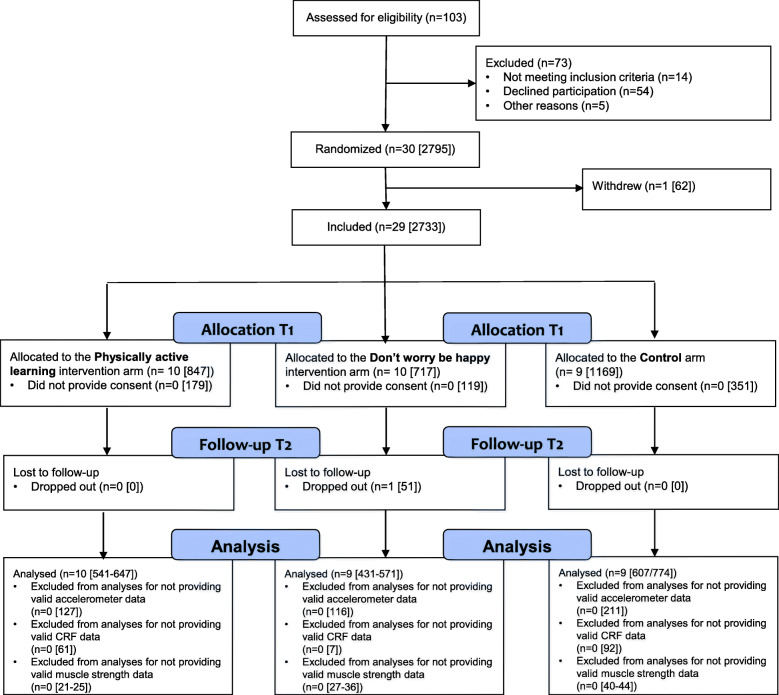
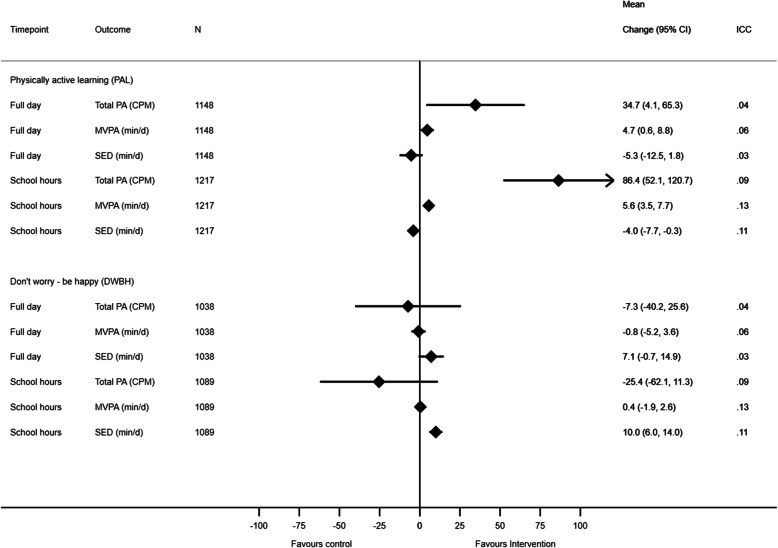
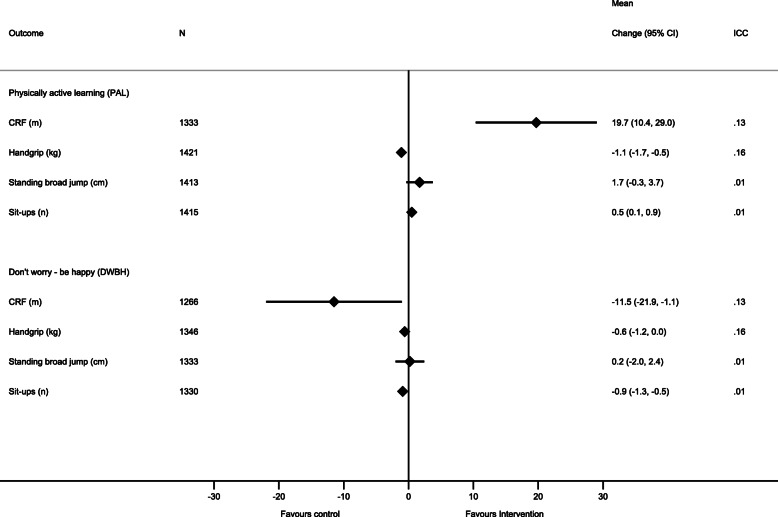
Background: Physical activity (PA) declines throughout adolescence, therefore PA promotion during this period is important. We analyzed the effect of two school-based PA interventions on daily PA levels, cardiorespiratory fitness (CRF) and muscle strength among adolescents. Methods: For the nine-month School in Motion intervention study (ScIM), we cluster-randomized 30 Norwegian secondary schools (N = 2084, mean age [SD] = 14 [0.3] years) to one of three study arms. The physically active learning (PAL) intervention included 30 min physically active learning, 30 min PA and a 60 min physical education (PE) lesson per week. The Don’t worry-Be happy (DWBH) intervention included a 60 min PA lesson and a 60 min PE lesson per week, both tailored to promote friendships and wellbeing. Both intervention arms were designed to engage the adolescents in 120 min of PA per week in addition to recess and mandatory PE lessons. The control group continued as per usual, including the standard amount of mandatory PE. PA (main outcome) was assessed by accelerometers, CRF and muscle strength (secondary outcomes) were assessed by an intermittent running test and selected tests from the Eurofit test battery. Results: Daily PA and time spent in moderate- to vigorous-intensity PA (MVPA) decreased in all groups throughout the intervention. The mean difference in PA level and MVPA for participants in the PAL-intervention arm was 34.7 cpm (95% CI: 4.1, 65.3) and 4.7 min/day (95% CI: 0.6, 8.8) higher, respectively, compared to the control arm. There were no significant intervention effects on daily PA level, MVPA or time spent sedentary for adolescents in the DWBH-intervention arm. Adolescents in the PAL-intervention arm increased distance covered in the running test compared to controls (19.8 m, 95% CI: 10.4, 29.1), whilst a negative intervention effect was observed among adolescents in the DWBH-intervention arm (− 11.6 m, 95% CI: − 22.0, − 1.1). Conclusion: The PAL-intervention resulted in a significantly smaller decrease in daily PA level, time spent in MVPA, and increased CRF compared to controls. Our results indicate that a teacher-led intervention, including three unique intervention components, is effective in curbing the decline in PA observed across our cohort and improving CRF. Trial registration: ClinicalTrials.gov ID nr: NCT03817047. Registered 01/25/2019 ‘retrospectively registered’.
Overview
The claims and statistics of this paper haven’t been checked yet.
Free: it reads the open-access text and checks the first 5 claims that cite a source we can check. Create a free account to check every claim.
Integrity signals
Registry
Cites
Statistics
Figures
Verification
Claims the paper makes
The claims and statistics of this paper haven’t been checked yet.
Free: it reads the open-access text and checks the first 5 claims that cite a source we can check. Create a free account to check every claim.
Claims other papers make about this one
Each is checked against this paper’s own text: does it say what the citing paper says it does?
The cited source says what the claim attributes to it.
In the citing paper
“Third, the PAL intervention resulted in better daily PA development over time than the control group [14].”
The cited source says what the claim attributes to it.
In the citing paper
“We recently reported a favourable effect on the daily PA level and the time spent in moderate-to-vigorous intensity physical activity (MVPA) among adolescents in one of the intervention arms compared with controls [14].”
Self-check
Percentages, sums and reported differences re-computed from the paper’s own numbers.
The self-check needs the paper’s full text.
Citations
Cites
An ecological perspective on health promotion programs
McLeroy, K. R., Bibeau, D., Steckler, A., & Glanz, K. (1988) · Health Education Quarterly · doi:10.1177/109019818801500401 · Cited by 8,502
Janssen, I., & LeBlanc, A. G. (2010) · International Journal of Behavioral Nutrition and Physical Activity · doi:10.1186/1479-5868-7-40 · Cited by 4,829
Consort 2010 statement: extension to cluster randomised trials
Campbell, M. K., Piaggio, G., Elbourne, D. R., Altman, D. G., & for the CONSORT Group (2012) · BMJ · doi:10.1136/bmj.e5661 · Cited by 3,510
Growth, Maturation, and Physical Activity
Malina, R. M., Bouchard, C., & Bar-Or, O. (2004) · Human Kinetics eBooks · doi:10.5040/9781492596837 · Cited by 3,277
(2002) · Cited by 3,047
CONSORT statement: extension to cluster randomised trials
Campbell, M. K., Elbourne, D. R., & Altman, D. G. (2004) · BMJ · doi:10.1136/bmj.328.7441.702 · Cited by 2,557
Effectance Motivation Reconsidered. Toward a Developmental Model
Harter, S. (2009) · Human Development · doi:10.1159/000271574 · Cited by 1,599
Dobbins, M., Husson, H., DeCorby, K., & LaRocca, R. L. (2013) · Cochrane Database of Systematic Reviews · doi:10.1002/14651858.cd007651.pub2 · Cited by 1,358
van Sluijs, E. M. F., McMinn, A. M., & Griffin, S. J. (2007) · BMJ · doi:10.1136/bmj.39320.843947.be · Cited by 1,120
Tracking of Physical Activity from Childhood to Adulthood: A Review
Telama, R. (2009) · Obesity Facts · doi:10.1159/000222244 · Cited by 989
Research works printed but not linked: 2
- 25. Bandura A. Social foundations of thought and action: a social cognitive theory. New Jersey: Englewood Cliffs; 1986.
- 32. Council of Europe. Committee of Experts on Sports Research. Eurofit: handbook for the Eurofit tests of physical fitness. Strasbourg: Council of Europe, Committee for the Development of Sport; 1993.
Cited by
Kuzik, N., da Costa, B. G. G., Hwang, Y., Verswijveren, S. J. J. M., Rollo, S., Tremblay, M. S., Bélanger, S. A., Carson, V., Davis, M. J., Hornby, S., et al. (2022) · International Journal of Behavioral Nutrition and Physical Activity · doi:10.1186/s12966-022-01258-4 · Cited by 118
“[50, 125, 130] Recess/PE: • 1/1 studies reported null findings [51] Standing Desk: • 1/3 studies reported null findings [52, 132] • 2/3 studies reported mixed findings • 1: More sedentary behaviour null and unfavourable for health [131] Low”
BackgroundResultInfluentialSteene‐Johannessen, J., Anderssen, S. A., Kolle, E., Hansen, B. H., Bratteteig, M., Dalhaug, E. M., Andersen, L. B., Nystad, W., Ekelund, U., & Dalene, K. E. (2021) · International Journal of Behavioral Nutrition and Physical Activity · doi:10.1186/s12966-021-01120-z · Cited by 72
“Such strategies are supported by evidence from a large systematic review revealing that active school travellers were more physically active and that active school transport interventions lead to increase in PA [36], and likewise a recent school-based cluster randomized PA intervention showed to be effective in curbin…”
BackgroundSelf-citationSolberg, R. B., Steene-Johannessen, J., Anderssen, S. A., Ekelund, U., Säfvenbom, R., Haugen, T., Berntsen, S., Åvitsland, A., Lerum, Ø., Resaland, G. K., et al. (2021) · BMC Public Health · doi:10.1186/s12889-021-10901-x · Cited by 37
“development over time than the control group [14].”
BackgroundSelf-citationAyala, A. M. C., Parker, K. E., Mazzoli, E., Lander, N., Ridgers, N. D., Timperio, A. F., Lubans, D. R., Abbott, G., Koorts, H., & Salmon, J. (2024) · Sports Medicine - Open · doi:10.1186/s40798-024-00688-7 · Cited by 62
“Positive effects on cardiorespiratory fitness (e.g. increase distance run) [44, 48, 65, 72, 87, 92, 99], and muscular fitness (e.g. muscular endurance strength) were found [69, 70, 83, 87, 99].”
BackgroundFeig, E. H., Madva, E. N., Millstein, R. A., Zambrano, J., Amonoo, H. L., Longley, R. M., Okoro, F., Huffman, J. C., Celano, C. M., & Hoeppner, B. B. (2022) · Preventive Medicine · doi:10.1016/j.ypmed.2022.107214 · Cited by 43
Dalene, K. E., Kolle, E., Steene-Johannessen, J., Hansen, B. H., Ekelund, U., Grydeland, M., Anderssen, S. A., & Tarp, J. (2022) · International Journal of Epidemiology · doi:10.1093/ije/dyac063 · Cited by 27
Self-citationRocliffe, P., O’Keeffe, B. T., Walsh, L., Stylianou, M., Woodforde, J., García‐González, L., O’Brien, W., Coppinger, T. C., Sherwin, I., McNamara, P., et al. (2023) · Adolescent Research Review · doi:10.1007/s40894-022-00200-w · Cited by 23
“Additionally, policy recognizing the provision of physical education as a school curriculum requirement is evident in 77% of countries globally with the highest proportion of those identified in Europe (92%), USA (90.2”
BackgroundMethodInfluentialFitness Level Differences between Students in Kosovo and Montenegro
Morina, B., Miftari, F., & Bădău, D. (2021) · Education Sciences · doi:10.3390/educsci11030140 · Cited by 23
Zhao, M., Liu, S., Han, X., Li, Z., Liu, B., Chen, J., & Li, X. (2022) · BioMed Research International · doi:10.1155/2022/7464815 · Cited by 37
“Although recent studies have shown that comprehensive school-based PA interventions are efficiently to improve the cardiorespiratory fitness, muscle strength, and PA[41, 42], the effects of comprehensive school-based strength training interventions on muscular fitness and perceived physical competence of adolescent bo…”
Burchartz, A., Oriwol, D., Kolb, S., Schmidt, S., von Haaren‐Mack, B., Niessner, C., & Wöll, A. (2022) · German Journal of Exercise and Sport Research · doi:10.1007/s12662-022-00811-4 · Cited by 28
Manojlović, M., Roklicer, R., Trivić, T., Milic, R., Maksimovic, N., Tabakov, R., Sekulić, D., Bianco, A., & Drid, P. (2023) · Frontiers in Physiology · doi:10.3389/fphys.2023.1180639 · Cited by 33
“Various types of physical activity interventions carried out in school surroundingwere efficient in enhancing cardiorespiratory fitness (Kriemler et al., 2010; Meyer et al., 2014; García-Hermoso et al., 2020; Kolle et al., 2020), muscular fitness (Martínez-Vizcaíno et al.”
BackgroundGuo, L., He, H., & Wang, C. (2025) · Frontiers in Pediatrics · doi:10.3389/fped.2025.1532035 · Cited by 26
Feng, J., Huang, Y., Chen, Z., Jiao, J., Khan, A., Nisar, M., & Wong, S. H.-S. (2024) · Sports Medicine · doi:10.1007/s40279-024-02113-1 · Cited by 15
Solberg, R. B., Steene‐Johannessen, J., Fagerland, M. W., Anderssen, S. A., Berntsen, S., Resaland, G. K., van Sluijs, E. M. F., Ekelund, U., & Kolle, E. (2021) · Preventive Medicine Reports · doi:10.1016/j.pmedr.2021.101648 · Cited by 23
“The methodology and main effects of the ScIM study have been described in detail elsewhere (Kolle et al., 2020).”
BackgroundMethodSelf-citationTeaching health in physical education: An action research project
Mong, H. H., & Standal, Ø. F. (2022) · European Physical Education Review · doi:10.1177/1356336x221078319 · Cited by 18
“Research has documented that increased levels of physical activity in the school setting have benefits beyond those for physical health (Kolle et al., 2020; McKenzie et al., 2004; Resaland et al., 2011).”
BackgroundNqweniso, S., Walter, C., du Randt, R., Adams, L., Beckmann, J., Degen, J., Gall, S., Joubert, N., Lang, C., Long, K. Z., et al. (2021) · International Journal of Environmental Research and Public Health · doi:10.3390/ijerph18042080 · Cited by 16
“The evidence suggests that there are differences regarding PA [18,19] and CRF levels [20] between boys and girls.”
BackgroundZimu, P. M., van Heerden, H. J., & Grace, J. M. (2024) · Journal of Primary Care & Community Health · doi:10.1177/21501319241278849 · Cited by 9
“58,69,70 These findings suggest that a combination of strategies, including community and school-based interventions, may be necessary for sustained behavior change.”
BackgroundMoin, M., Farhan, Z., Naqvi, S. K., Lassi, Z. S., & Das, J. K. (2026) · Journal of Global Health · doi:10.7189/jogh.16.04112 · Cited by 11
van der Wurff, I. S. M., Kirschner, M., Golsteijn, R. H. J., de Jonge, M., Berendsen, B., Singh, A. S., Savelberg, H. H. C. M., & de Groot, R. H. M. (2024) · Preventive Medicine · doi:10.1016/j.ypmed.2024.107925 · Cited by 9
Aly, M., Ammar, A., Trabelsi, K., Masmoudi, L., El-Gyar, N., Shalaby, A. M., & Abdelkarim, O. (2025) · Frontiers in Public Health · doi:10.3389/fpubh.2025.1603043 · Cited by 11
Malnes, L., Haugen, T., Nordbø, E. C. A., Ivarsson, A., Kolle, E., Resaland, G. K., Solberg, R. B., Åvitsland, A., & Berntsen, S. (2025) · International Journal of Behavioral Nutrition and Physical Activity · doi:10.1186/s12966-025-01727-6 · Cited by 5
“The design and methods for the main project have been reported elsewhere [26, 27].”
Self-citationRelationship between health-related quality of life and physical fitness in Norwegian adolescents
Leibinger, É., Åvitsland, A., Resaland, G. K., Solberg, R. B., Kolle, E., & Dyrstad, S. M. (2022) · Quality of Life Research · doi:10.1007/s11136-022-03309-6 · Cited by 6
Self-citationThe Impact of an Acrobatics-Based Curriculum on Motor Fitness in Adolescents
Veličković, S., Kolar, E., Paunović, M., Veličković, P., Pantelić, S., Bubanj, S., Ilić, I., Bjelica, B., Gašić, T., Preljević, A., et al. (2025) · Life · doi:10.3390/life15050778 · Cited by 5
“Innovative approaches, such as physically active learning models, have also been effective in counteracting declining PA levels and improving cardiorespiratory fitness in adolescents [12].”
School-Based Physical Activity Programmes: An Integrative Review of Health-Related Research
Silva, A. M., Graça, A., MacPhail, A., & Batista, P. (2025) · Studia sportiva · doi:10.5817/sts2025-1-8 · Cited by 5
Peng, J., Yu, W., Wang, W., Wang, L., Shan, W., & Ren, H. C. (2025) · Frontiers in Psychology · doi:10.3389/fpsyg.2025.1572826 · Cited by 3
González-Pérez, M., Camiletti‐Moirón, D., Hermosa, A. R., Martín‐Acosta, F., Grao‐Cruces, A., & Sánchez‐Oliva, D. (2026) · BMC Public Health · doi:10.1186/s12889-026-26814-6 · Cited by 2
“Regarding overall PA, most studies evaluated multi-component interventions that incorporate PAL in conjunction with other components such as active breaks or active recess [23, 24].”
InfluentialA Development of Counseling Competency for Academic Advisors in Higher Education
Choompunuch, B., Lebkhao, D., Suksatan, W., & Suk-erb, W. (2022) · Sustainability · doi:10.3390/su14169907 · Cited by 5
“Years of Academic Advising Experience [32] 0–5 229 91.”
BackgroundMalnes, L., Berntsen, S., Kolle, E., Ivarsson, A., Dyrstad, S. M., Resaland, G. K., Solberg, R. B., & Haugen, T. (2023) · International Journal of Behavioral Nutrition and Physical Activity · doi:10.1186/s12966-023-01534-x · Cited by 5
“Moreover, health related fit - ness can be a strong predictor for future physical activity level [14], and health related fitness did increase in one of the two-arm intervention group in the ScIM project, as reported elsewhere [19].”
BackgroundMethodInfluentialSelf-citationPirrie, M., Carson, V., Dubin, J. A., & Leatherdale, S. T. (2021) · International Journal of Environmental Research and Public Health · doi:10.3390/ijerph182312761 · Cited by 2
Nqweniso, S., Walter, C., du Randt, R., Adams, L., Beckmann, J., Dolley, D., Joubert, N., Long, K. Z., Müller, I., Pühse, U., et al. (2025) · Children · doi:10.3390/children12101352 · Cited by 1
“However, in a recent 9-month school-based intervention (120 min of PA per week) involving adolescents from Norway, time spent in MVPA decreased in both the intervention and control groups, but the reduction was significantly smaller in the intervention group (2 vs. 6 min/day) [19].”
InfluentialWan, J., Li, Z., Sun, R., Gu, J., Yu-zhang, L., & Zhang, Q. (2025) · BMC Sports Science Medicine and Rehabilitation · doi:10.1186/s13102-025-01351-8 · Cited by 8
“In order to better enhance physical activity levels and physical fitness in children and adolescents, many school programs have been implemented, including additional physical activity lesson, longer PE lesson [46], physical activity in class [47] and school break times [48].”
Waterworth, S., McManus, C., Chung, H. C., Jones, B., Aljuhani, O. E., & Schoenmakers, P. P. J. M. (2026) · Journal of Physical Activity and Health · doi:10.1123/jpah.2025-0576 · Cited by 1
Danielsen, K. H., Vårnes, T. K., Sagelv, E. H., Heitmann, K. A., & Mathisen, G. E. (2021) · International Journal of Circumpolar Health · doi:10.1080/22423982.2021.2004688 · Cited by 2
Malnes, L., Berntsen, S., Kolle, E., Ivarsson, A., Dyrstad, S. M., Resaland, G. K., Solberg, R. B., & Haugen, T. (2023) · Figshare · doi:10.6084/m9.figshare.24603599
Self-citationAmmar, A., Aly, M., Trabelsi, K., Mera, T. A., Masmoudi, L., El-Gyar, N., Shalaby, A. M., Jahrami, H., Husain, W., Żmijewski, P., et al. (2025) · Frontiers in Public Health · doi:10.3389/fpubh.2025.1675893 · Cited by 1
Malnes, L., Berntsen, S., Kolle, E., Ivarsson, A., Dyrstad, S. M., Resaland, G. K., Solberg, R., & Haugen, T. (2024) · Figshare · doi:10.6084/m9.figshare.24604022
Self-citationSteene-Johannessen, J., Anderssen, S. A., Kolle, E., Hansen, B. H., Bratteteig, M., Dalhaug, E. M., Andersen, L. B., Nystad, W., Ekelund, U., & Dalene, K. E. (2021) · Figshare · doi:10.6084/m9.figshare.14490575
Self-citationSteene-Johannessen, J., Anderssen, S. A., Kolle, E., Hansen, B. H., Bratteteig, M., Dalhaug, E. M., Andersen, L. B., Nystad, W., Ekelund, U., & Dalene, K. E. (2021) · Figshare · doi:10.6084/m9.figshare.14490578
Self-citationSteene-Johannessen, J., Anderssen, S. A., Kolle, E., Hansen, B. H., Bratteteig, M., Dalhaug, E. M., Andersen, L. B., Nystad, W., Ekelund, U., & Dalene, K. E. (2021) · Figshare · doi:10.6084/m9.figshare.14490572
Self-citationSteene-Johannessen, J., Anderssen, S. A., Kolle, E., Hansen, B. H., Bratteteig, M., Dalhaug, E. M., Andersen, L. B., Nystad, W., Ekelund, U., & Dalene, K. E. (2021) · Figshare · doi:10.6084/m9.figshare.14490569
Self-citationGintel, D. L., Anselma, M., Ket, J. C. F., Fix, M., & Altenburg, T. M. (2026) · BMC Public Health · doi:10.1186/s12889-025-25618-4 · Cited by 2
“Eight studies evaluated more than one intervention [48, 55, 69, 71, 75, 77, 81, 98], and five interventions were evaluated in more than one study [59, 60, 62–64, 72, 73, 85–90].”
Liu, Q., Xu, Z., Shao, X., Lian, Z., Cheng, W., & Wang, X. (2026) · BMC Public Health · doi:10.1186/s12889-026-28685-3
“This type of system-level design may help expand intervention reach and support the maintenance of PA behaviors [43, 44].”
Metadata
- Authors
- Kolle, E., Solberg, R. B., Säfvenbom, R., Dyrstad, S. M., Berntsen, S., Resaland, G. K., Ekelund, U., Anderssen, S. A., Steene-Johannessen, J., & Grydeland, M.
- Affiliations
- Norwegian School of Sport Sciences (NO)
- University of Stavanger (NO)
- University of Agder (NO)
- Western Norway University of Applied Sciences (NO)
- Corresponding author
- Kolle, Elin
- ORCID
- Venue
- International Journal of Behavioral Nutrition and Physical Activity
- Published
- 2020-11-26
- Volume
- 17
- Issue
- 1
- Pages
- 154-154
- ISSN
- 1479-5868 (ISSN-L)
- PMC
- PMC7690135
- OpenAlex
- W3108981481
- Semantic Scholar
- 1234da632d219e5fa23dfcd87cf9a473f3b6bdd7
- Cited by
- 41
- References
- 38
- Citations by year
- 2026: 5 · 2025: 9 · 2024: 5 · 2023: 3 · 2022: 8 · 2021: 11
- FWCI
- 3.46
- Type
- journal article
- Language
- en
- Open access
- gold
- doi.org
- Licence
- cc-by
- creativecommons.org/licenses/by/4.0/ (tdm)
- creativecommons.org/licenses/by/4.0/ (vor)
- Locations
- International Journal of Behavioral Nutrition and Physical Activity (publishedVersion, cc-by)
- PubMed Central (publishedVersion, cc-by)
- PubMed (publishedVersion)
- DOAJ (DOAJ: Directory of Open Access Journals) (submittedVersion, cc-by-sa)
- NORA - Norwegian Open Research Archives (submittedVersion, cc-by)
- Funders
- Utdanningsdirektoratet
- Topics
- Health Sciences › Medicine › Public Health, Environmental and Occupational Health › Physical Activity and Health
- Social Sciences › Education › Physical Education and Pedagogy
- Health Sciences › Medicine › Public Health, Environmental and Occupational Health › School Health and Nursing Education
- Keywords
- school-based physical activity intervention, adolescents, physical activity promotion, cardiorespiratory fitness, muscle strength, physically active learning, physical education, moderate-to-vigorous physical activity, sedentary behavior, teacher-led intervention, well-being, secondary schools, Eurofit test battery, accelerometer-measured activity, recess physical activity
- MeSH terms
- Cardiorespiratory Fitness, Adolescent, Female, Humans, Male, Norway, Physical Education and Training, Schools, Students, Exercise, Muscle Strength, Accelerometry
About these checks
Registry, retraction, Cites and statistics results are computed, not judged, with one exception: a printed reference that no index lists is read once by a model before it counts as a citation error. Claims are extracted by a model and kept only when their quote appears verbatim in the text; each cited source is then checked, with a model’s help, for whether it says what the claim relies on. Those verdicts can be wrong — read the claim’s quote and the cited source before relying on one.
Statistics and arithmetic are recomputed, not judged.
Confidence bands are shown only for fields calibrated on our annotated test set. None is calibrated yet, so no band is shown.
What counts as a claim ›How we measure confidence ›How we check this ›
Are you an author, or do you see a problem with this page? Request a review
Data sources
Bibliographic data: Semantic Scholar, OpenAlex, Crossref.
Contains information from the Semantic Scholar Academic Graph Datasets, made available under the ODC Attribution License (ODC-BY 1.0).
Semantic Scholar’s data is described in: Kinney, R., et al. (2023). The Semantic Scholar Open Data Platform. arXiv:2301.10140.
