

Matrix stiffness affects tumor-associated macrophage functional polarization and its potential in tumor therapy
Open accessThe DOI matches its Crossref record; 202 of the 202 references it cites were found in a registry or an index.
Abstract
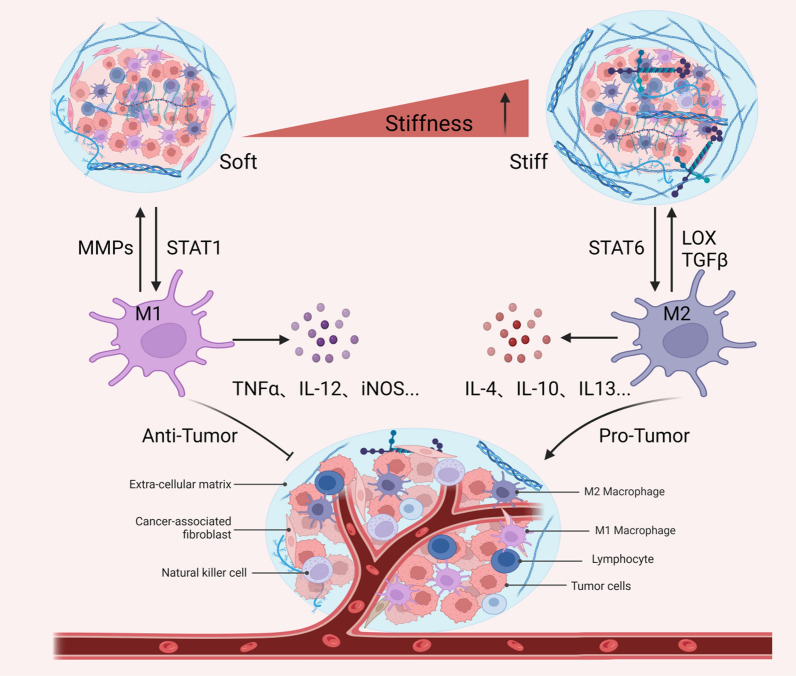
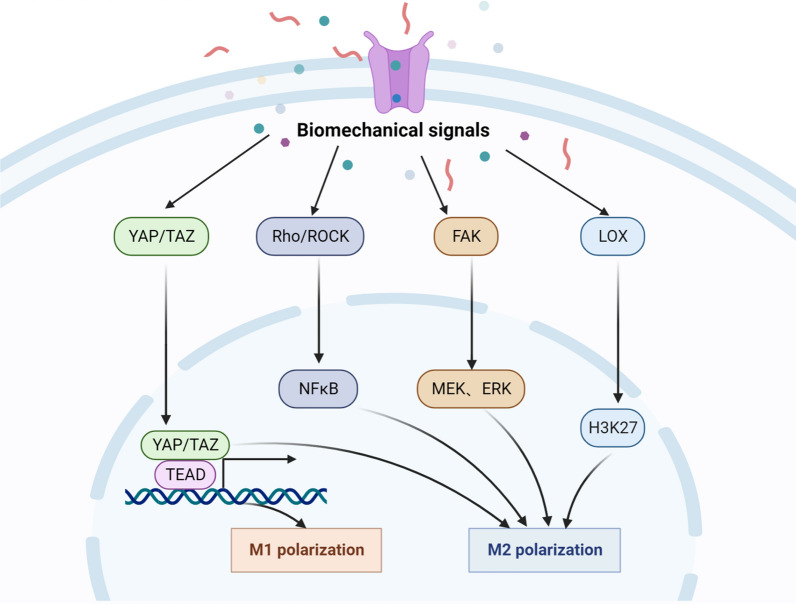
The extracellular matrix (ECM) plays critical roles in cytoskeletal support, biomechanical transduction and biochemical signal transformation. Tumor-associated macrophage (TAM) function is regulated by matrix stiffness in solid tumors and is often associated with poor prognosis. ECM stiffness-induced mechanical cues can activate cell membrane mechanoreceptors and corresponding mechanotransducers in the cytoplasm, modulating the phenotype of TAMs. Currently, tuning TAM polarization through matrix stiffness-induced mechanical stimulation has received increasing attention, whereas its effect on TAM fate has rarely been summarized. A better understanding of the relationship between matrix stiffness and macrophage function will contribute to the development of new strategies for cancer therapy. In this review, we first introduced the overall relationship between macrophage polarization and matrix stiffness, analyzed the changes in mechanoreceptors and mechanotransducers mediated by matrix stiffness on macrophage function and tumor progression, and finally summarized the effects of targeting ECM stiffness on tumor prognosis to provide insight into this new field.
Overview
The claims and statistics of this paper haven’t been checked yet.
Free: it reads the open-access text and checks the first 5 claims that cite a source we can check. Create a free account to check every claim.
Integrity signals
Registry
Cites
Statistics
Figures
Verification
Claims the paper makes
The claims and statistics of this paper haven’t been checked yet.
Free: it reads the open-access text and checks the first 5 claims that cite a source we can check. Create a free account to check every claim.
Claims other papers make about this one
Each is checked against this paper’s own text: does it say what the citing paper says it does?
In the citing paper
“M2 macrophages secrete TGF-b1, which can activate fibroblasts to produce LOX, thereby promoting collagen crosslinking and matrix stiffening (68).”
From The mechanotransduction-immune axis in organ fibrosis: dual regulatory mechanisms and translational therapeutic perspectives (2025) · doi:10.3389/fimmu.2025.1670213 · cites this paper as [68]
Self-check
Percentages, sums and reported differences re-computed from the paper’s own numbers.
The self-check needs the paper’s full text.
Citations
Cites
Items 201–202 of 202
Sagara, A., Miura, S., Kobinata, A., Naganawa, R., Yaginuma, S., Saito, S., Saito, R., Kominato, H., Yumoto, T., & Sato, F. (2022) · Biochemical and Biophysical Research Communications · doi:10.1016/j.bbrc.2022.12.046 · Cited by 15 · cited 1×
“…were designed based on the theory that ECM provides a biological barrier preventing endothelial cell migration or tumor cell invasion, and activated MMPs can degrade ECM, helping cancer cells break through the matrix barrier and promoting the invasion and metastasis of malignant tumors [134, 135].”
BackgroundPhase 2 Study of Neoadjuvant FGFR Inhibition and Androgen Deprivation Therapy Prior to Prostatectomy
Liow, E. C. H., Howard, N., Jung, C.-H., Pope, B. J., Campbell, B. K., Nguyen, A., Kerger, M., Ruddle, J. B., Anton, A., Thomas, B., et al. (2022) · Clinical Genitourinary Cancer · doi:10.1016/j.clgc.2022.05.007 · Cited by 9 · cited 1×
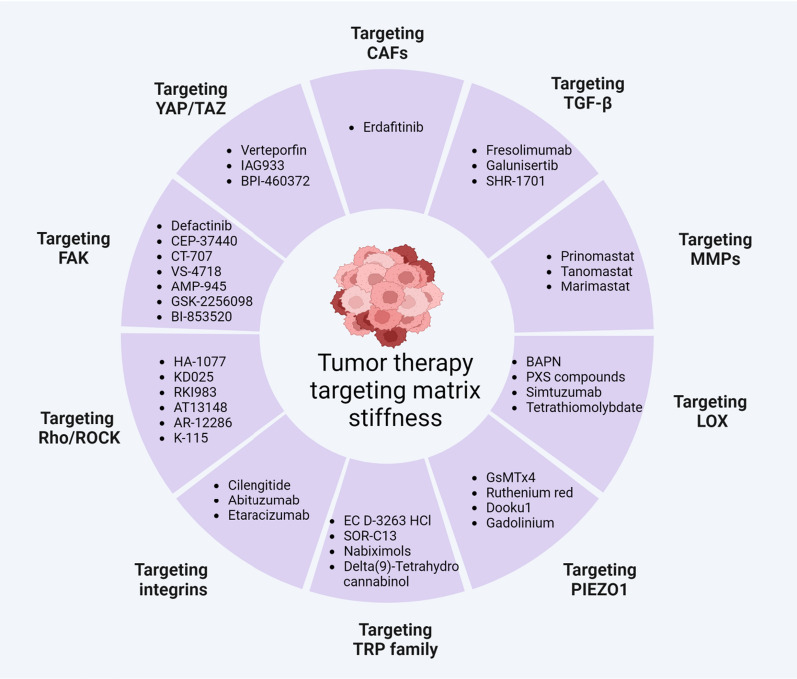
“However, erdafitinib has obvious adverse events in clinical trials with poor tolerability, and the antitumor effect of erdafitinib should be further anticipated in subsequent studies [116, 117].”
Background
Research works printed but not linked: 1
- Schilling T, Miralles F, Eder C. TRPM7 regulates proliferation and polarisa- tion of macrophages. J Cell Sci. 2014;127:4561-6.
Cited by
Extracellular matrix: unlocking new avenues in cancer treatment
Lee, J. J., Ng, K. Y., & Bakhtiar, A. (2025) · Biomarker Research · doi:10.1186/s40364-025-00757-3 · Cited by 100
Yu, S., Wang, S., Wang, X., & Xu, X. (2024) · Cancer Cell International · doi:10.1186/s12935-024-03518-8 · Cited by 80
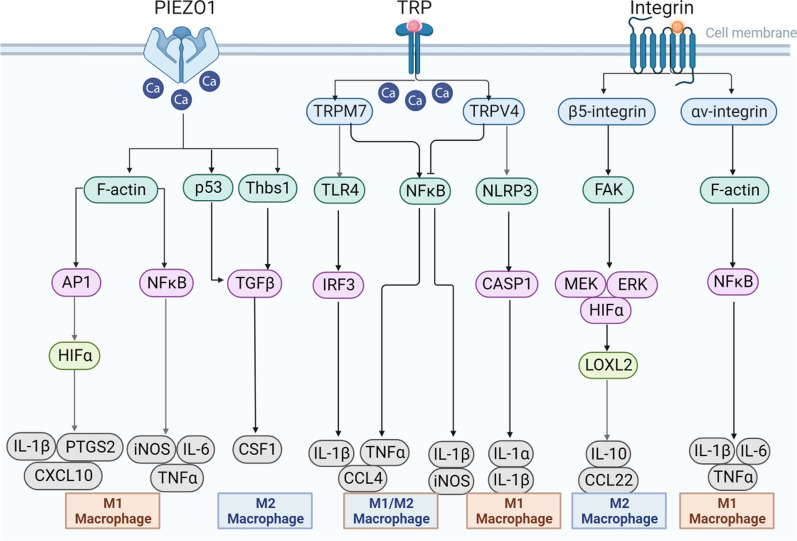
“Currently, Piezo1, transient receptor potential (TRP) ion channels, and integrins are the primary mechanoreceptors on TAMs that are regulated by matrix stiffness or mechanical stimulation, and their interactions are complex [62].”
BackgroundGong, P., Wang, F., Hua, Y., Ying, J., Chen, J., & Qiao, Y. (2025) · Journal of Nanobiotechnology · doi:10.1186/s12951-025-03815-y · Cited by 65
“Tumor tissues typically exhibit elevated ECM stiffness compared to normal tissues, which promotes malignant behavior through mechanotransduction pathways such as the Hippo signaling cascade [7].”
Zhu, Y., Chen, J., Chen, C., Tang, R., Xu, J., Shi, S., & Yu, X. (2025) · Biomarker Research · doi:10.1186/s40364-025-00727-9 · Cited by 50
Age-related meningeal extracellular matrix remodeling compromises CNS lymphatic function
Romero, K. H., Stevenson, T. J., Smyth, L. C. D., Watkin, B., McCullough, S. J. C., Vinnell, L., Smith, A. M., Schweder, P. M., Correia, J. A., Kipnis, J., et al. (2025) · Journal of Neuroinflammation · doi:10.1186/s12974-025-03436-0 · Cited by 50
“…is predominantly intracellular in these phagocytes, it is unclear whether these findings reflect attenuated uptake of CSF tracers by dural immune cells, or altered CSF access, but fibrosis and tissue stiffening has been previously observed to disrupt macrophage phagocytic capacity [33, 34].”
Metadata
- Authors
- Xiong, J., Xiao, R., Zhao, J., Zhao, Q., Luo, M., Li, F., Zhang, W., & Wu, M.
- Affiliations
- Zhongnan Hospital of Wuhan University (CN)
- Wuhan University (CN)
- Tongji Hospital (CN)
- Corresponding author
- Li, Feng
- Zhang, Wei
- Wu, Meng
- Venue
- Journal of Translational Medicine
- Published
- 2024-01-21
- Volume
- 22
- Issue
- 1
- Pages
- 85-85
- ISSN
- 1479-5876 (ISSN-L)
- PMC
- PMC10800063
- OpenAlex
- W4391067047
- Cited by
- 79
- References
- 200
- Citations by year
- 2026: 33 · 2025: 30 · 2024: 16
- FWCI
- 4.17
- Type
- journal article
- Language
- en
- Open access
- gold
- doi.org
- Licence
- cc-by
- creativecommons.org/licenses/by/4.0 (tdm)
- creativecommons.org/licenses/by/4.0 (vor)
- Locations
- Journal of Translational Medicine (publishedVersion, cc-by)
- PubMed Central (publishedVersion, cc-by)
- PubMed (publishedVersion)
- DOAJ (DOAJ: Directory of Open Access Journals) (submittedVersion, cc-by-sa)
- Funders
- Key Technologies Research and Development Program (2021YFC2009105, 2022YFC2704100)
- National Natural Science Foundation of China (82001514, 82303671)
- Zhongnan Hospital of Wuhan University (ZNYB2023005)
- Topics
- Life Sciences › Biochemistry, Genetics and Molecular Biology › Cell Biology › Cellular Mechanics and Interactions
- Life Sciences › Immunology and Microbiology › Immunology › Immune cells in cancer
- Life Sciences › Biochemistry, Genetics and Molecular Biology › Molecular Biology › TGF-β signaling in diseases
- Keywords
- extracellular matrix stiffness, tumor-associated macrophages, macrophage polarization, mechanotransduction, mechanoreceptors, tumor microenvironment, tumor progression, cancer therapy
- MeSH terms
- Tumor-Associated Macrophages, Cell Membrane, Cytoplasm, Extracellular Matrix, Macrophages
About these checks
Registry, retraction, Cites and statistics results are computed, not judged, with one exception: a printed reference that no index lists is read once by a model before it counts as a citation error. Claims are extracted by a model and kept only when their quote appears verbatim in the text; each cited source is then checked, with a model’s help, for whether it says what the claim relies on. Those verdicts can be wrong — read the claim’s quote and the cited source before relying on one.
Statistics and arithmetic are recomputed, not judged.
Confidence bands are shown only for fields calibrated on our annotated test set. None is calibrated yet, so no band is shown.
What counts as a claim ›How we measure confidence ›How we check this ›
Are you an author, or do you see a problem with this page? Request a review
Data sources
Bibliographic data: Semantic Scholar, OpenAlex, Crossref.
Contains information from the Semantic Scholar Academic Graph Datasets, made available under the ODC Attribution License (ODC-BY 1.0).
Semantic Scholar’s data is described in: Kinney, R., et al. (2023). The Semantic Scholar Open Data Platform. arXiv:2301.10140.
