

Childhood scurvy: an unusual cause of refusal to walk in a child
Open accessThe DOI matches its Crossref record; 13 of the 13 references it cites were found in a registry or an index.
Abstract
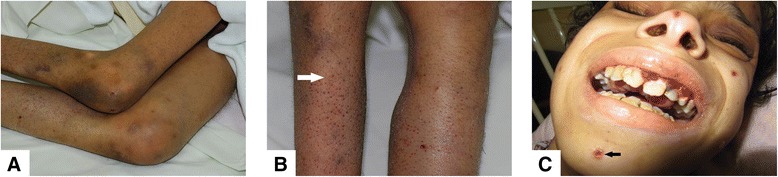
Scurvy, or vitamin C deficiency, is rarely presented to a rheumatology clinic. It can mimic several rheumatologic disorders. Although uncommon, it may present as pseudovasculitis or chronic arthritis. Scurvy still exists today within certain populations, particularly in patients with neurodevelopmental disabilities, psychiatric illness or unusual dietary habits.Scurvy presentation to the rheumatologist varies from aches and mild pains to excruciating bone pain or arthritis. Musculoskeletal and mucocutaneous features of scurvy are often what prompts referrals to pediatric rheumatology clinics. Unless health care providers inquire about nutritional habits and keep in mind the risk of nutritional deficiency, it will be easy to miss the diagnosis of scurvy. Rarity of occurrence as compared to other nutritional deficiencies, combined with a lack of understanding about modern-day risk factors for nutritional deficiency, frequently leads to delayed recognition of vitamin C deficiency. We report a case of scurvy in a mentally handicapped Saudi child, who presented with new onset inability to walk with diffuse swelling and pain in the left leg. Skin examination revealed extensive ecchymoses, hyperkeratosis and follicular purpura with corkscrew hairs, in addition to gingival swelling with bleeding. Clinical diagnosis of scurvy was rendered and confirmed by low serum vitamin C level. The patient did extremely well with proper nutritional support and vitamin C supplementation. It has been noticed lately that there is increased awareness about scurvy in rheumatology literature. A high index of suspicion, together with taking a thorough history and physical examination, is required for diagnosis of scurvy in patient who presents with musculoskeletal symptoms. Nutritional deficiency should also be considered by the rheumatologist formulating differential diagnosis for musculoskeletal or mucocutaneous complaints in children, particularly those at risk.
Overview
The claims and statistics of this paper haven’t been checked yet.
Free: it reads the open-access text and checks the first 5 claims that cite a source we can check. Create a free account to check every claim.
Integrity signals
Registry
Cites
Statistics
Figures
Verification
Claims the paper makes
The claims and statistics of this paper haven’t been checked yet.
Free: it reads the open-access text and checks the first 5 claims that cite a source we can check. Create a free account to check every claim.
Claims other papers make about this one
Each is checked against this paper’s own text: does it say what the citing paper says it does?
The source backs part of the claim, not all of it — or backs it for a different population, condition or comparison.
In the citing paper
“Vitamins, as skin antioxidant defense ingredients, are mostly taken from food, so the content of vitamins in the diet is closely related to skin antioxidant capacity and physiological functions [68,69,70].”
From Diet and Skin Aging—From the Perspective of Food Nutrition (2020) · cites this paper as [68]
Experimental — accuracy not yet measuredThe source backs part of the claim, not all of it — or backs it for a different population, condition or comparison.
In the citing paper
“The vitamin C deficiency disease scurvy is characterised by skin fragility, bleeding gums and corkscrew hairs as well as impaired wound healing [11,12,13,14,15,16,17,18].”
From The Roles of Vitamin C in Skin Health. (2017) · cites this paper as [13]
Experimental — accuracy not yet measuredIn the citing paper
“Vitamin deficiency affects skin health. The lack of vitamins in the body can cause skin disorders. For example, lack of vitamin C causes the symptoms of scurvy such as fragile skin and impaired wound healing.”
From Diet and Skin Aging—From the Perspective of Food Nutrition (2020) · cites this paper as [68]
Self-check
Percentages, sums and reported differences re-computed from the paper’s own numbers.
The self-check needs the paper’s full text.
Citations
Cites
(1976) · Medical Journal of Australia · doi:10.5694/j.1326-5377.1976.tb115280.x · Cited by 5,237
New Concepts in the Biology and Biochemistry of Ascorbic Acid
Flier, J. S., Underhill, L. H., & Levine, M. (1986) · New England Journal of Medicine · doi:10.1056/nejm198604033141407 · Cited by 645 · cited 2×
“The daily intake of vitamin C must be no lower than 10 mg/day and the body pool no smaller than 350 mg to avoid scurvy [2].”
BackgroundAn Orange a Day Keeps the Doctor Away: Scurvy in the Year 2000
Weinstein, M., Babyn, P., & Zlotkin, S. (2001) · Pediatrics · doi:10.1542/peds.108.3.e55 · Cited by 268 · cited 1×
“flammation and bleeding, alopecia, and bone pain, skeletal muscle degeneration, and arthritis [4].”
BackgroundMusculoskeletal manifestations of scurvy
Fain, O. (2005) · Joint Bone Spine · doi:10.1016/j.jbspin.2004.01.007 · Cited by 225 · cited 3×
“Intramuscular hematomas may cause compartment syndrome [9].”
BackgroundInfluentialScurvy: a disease almost forgotten
Olmedo, J. M., Yiannias, J. A., Windgassen, E. B., & Gornet, M. K. (2006) · International Journal of Dermatology · doi:10.1111/j.1365-4632.2006.02844.x · Cited by 184 · cited 2×
“Humans lack the ability to synthesize vitamin C, because of mutation in the gene coding for l-gulonolactone oxidase, the enzyme required for the biosynthesis of vitamin C [6].”
BackgroundScurvy in pediatric patients: a review of 28 cases
Ratanachu-Ek, S., Sukswai, P., Jeerathanyasakun, Y., & Wongtapradit, L. (2003) · PubMed · doi:10.5281/zenodo.7756608 · Cited by 79
Scurvy Presenting as Painful Gait With Bruising in a Young Boy
Tamura, Y., Welch, D. C., Zic, J. A., Cooper, W. O., Stein, S. M., & Hummell, D. S. (2000) · Archives of Pediatrics & Adolescent Medicine · doi:10.1001/archpedi.154.7.732 · Cited by 76 · cited 2×
“An elevated erythrocyte sedimentation rate and C-reactive protein level can be seen in some cases [12].”
BackgroundScurvy and Rickets Masked by Chronic Neurologic Illness: Revisiting “Psychologic Malnutrition”
Noble, J. M., Mandel, A., & Patterson, M. C. (2007) · Pediatrics · doi:10.1542/peds.2006-1071 · Cited by 51
Heymann, W. R. (2007) · Journal of the American Academy of Dermatology · doi:10.1016/j.jaad.2007.03.008 · Cited by 34 · cited 1×
“Ascorbic acid is involved in the hydroxylation of collagen, the biosynthesis of carnitine and norepinephrine, the metabolism of tyrosine, and the amidation of peptide hormones [3].”
BackgroundHemarthrosis as initial presentation of scurvy.
Pangan, A. L., & Robinson, D. (2001) · PubMed · Cited by 34
Research works printed but not linked: 2
- Lind JA. A treatise on the scurvy. Stewart CP,Cuthrie D,eds.Edinburgh, Scotland: Edinburgh University Press; 1753
- Food and Nutrition Board, Institute of Medicine Vitamin C. Dietary reference intakes for vitamin C, vitamin E, selenium, and carotenoids 2000 Washington DC National Academy Press 95 185
Cited by
The Roles of Vitamin C in Skin Health.
Pullar, J., Carr, A., & Vissers, M. (2017) · Nutrients · doi:10.3390/nu9080866 · Cited by 756
Diet and Skin Aging—From the Perspective of Food Nutrition
Cao, C., Xiao, Z., Wu, Y., & Ge, C. (2020) · Nutrients · doi:10.3390/nu12030870 · Cited by 231
Nutraceuticals for Skin Care: A Comprehensive Review of Human Clinical Studies
Pérez-Sánchez, A., Barrajón-Catalán, E., Herranz-López, M., & Micol, V. (2018) · Nutrients · doi:10.3390/nu10040403 · Cited by 181
Modern American scurvy — experience with vitamin C deficiency at a large children’s hospital
Golriz, F., Donnelly, L. F., Devaraj, S., & Krishnamurthy, R. (2016) · Pediatric Radiology · doi:10.1007/s00247-016-3726-4 · Cited by 132
A Narrative Review on Pediatric Scurvy: The Last Twenty Years
Trapani, S., Rubino, C., Indolfi, G., & Lionetti, P. (2022) · Nutrients · doi:10.3390/nu14030684 · Cited by 119
“Concomitant micronutrient deficiencies other than vitamin C deficiency may accompany scurvy; therefore, the clinicians should also check for levels of zinc, iron, folate and the vitamin B group [69].”
Background
Metadata
- Authors
- Alqanatish, J. T., Alqahtani, F., Alsewairi, W. M., & Al-kenaizan, S.
- Affiliations
- King Saud bin Abdulaziz University for Health Sciences (SA)
- Corresponding author
- Alqanatish, J. T.
- ORCID
- Alqanatish, J. T.
- Venue
- Pediatric Rheumatology
- Published
- 2015-06-11
- Volume
- 13
- Issue
- 1
- Pages
- 23-23
- ISSN
- 1546-0096 (ISSN-L)
- PMC
- PMC4462115
- OpenAlex
- W2168225524
- Cited by
- 74
- References
- 13
- Citations by year
- 2026: 2 · 2025: 10 · 2024: 9 · 2023: 6 · 2022: 14 · 2021: 4 · 2020: 10 · 2019: 7 · 2018: 6 · 2017: 2 · 2016: 4
- FWCI
- 3.85
- Type
- journal article
- Language
- en
- Open access
- gold
- doi.org
- Locations
- Pediatric Rheumatology (publishedVersion, cc-by)
- PubMed Central (publishedVersion, cc-by)
- PubMed (publishedVersion)
- Topics
- Health Sciences › Nursing › Nutrition and Dietetics › Vitamin C and Antioxidants Research
- Life Sciences › Biochemistry, Genetics and Molecular Biology › Genetics › Connective tissue disorders research
- Health Sciences › Medicine › Biochemistry (medical) › Antioxidant Activity and Oxidative Stress
- Keywords
- scurvy, refusal to walk, ecchymoses, gingival bleeding, corkscrew hairs, intellectual disability, delayed diagnosis, vitamin C supplementation, nutritional deficiency, differential diagnosis
- MeSH terms
- Arthritis, Ascorbic Acid, Ascorbic Acid Deficiency, Child, Chronic Disease, Humans, Male, Pain, Scurvy, Walking, Treatment Outcome, Dietary Supplements, Refusal to Participate
About these checks
Registry, retraction, Cites and statistics results are computed, not judged, with one exception: a printed reference that no index lists is read once by a model before it counts as a citation error. Claims are extracted by a model and kept only when their quote appears verbatim in the text; each cited source is then checked, with a model’s help, for whether it says what the claim relies on. Those verdicts can be wrong — read the claim’s quote and the cited source before relying on one.
Statistics and arithmetic are recomputed, not judged.
Confidence bands are shown only for fields calibrated on our annotated test set. None is calibrated yet, so no band is shown.
What counts as a claim ›How we measure confidence ›How we check this ›
Are you an author, or do you see a problem with this page? Request a review
How to cite
Cite CoChat for the checks on this page, and the paper for its own findings.
- This page
- CoChat. (2026). Citation check: Childhood scurvy: an unusual cause of refusal to walk in a child. https://app.cochat.ai/papers/10.1186/s12969-015-0020-1
- The paper
- Alqanatish, J. T., Alqahtani, F., Alsewairi, W. M., & Al-kenaizan, S. (2015). Childhood scurvy: an unusual cause of refusal to walk in a child. Pediatric Rheumatology. https://doi.org/10.1186/s12969-015-0020-1
Data sources
Bibliographic data: Semantic Scholar, OpenAlex, Crossref.
Contains information from the Semantic Scholar Academic Graph Datasets, made available under the ODC Attribution License (ODC-BY 1.0).
Semantic Scholar’s data is described in: Kinney, R., et al. (2023). The Semantic Scholar Open Data Platform. arXiv:2301.10140.
