

The DOI matches its Crossref record; 373 of the 373 references it cites were found in a registry or an index.
Neuroinflammation as an etiological trigger for depression comorbid with inflammatory bowel disease
Open accessAbstract
Patients with inflammatory bowel disease (IBD) suffer from depression at higher rates than the general population. An etiological trigger of depressive symptoms is theorised to be inflammation within the central nervous system. It is believed that heightened intestinal inflammation and dysfunction of the enteric nervous system (ENS) contribute to impaired intestinal permeability, which facilitates the translocation of intestinal enterotoxins into the blood circulation. Consequently, these may compromise the immunological and physiological functioning of distant non-intestinal tissues such as the brain. In vivo models of colitis provide evidence of increased blood–brain barrier permeability and enhanced central nervous system (CNS) immune activity triggered by intestinal enterotoxins and blood-borne inflammatory mediators. Understanding the immunological, physiological, and structural changes associated with IBD and neuroinflammation may aid in the development of more tailored and suitable pharmaceutical treatment for IBD-associated depression.
Overview
The claims and statistics of this paper haven’t been checked yet.
Run the check — free, no account needed. It reads the open-access text and checks the sources it cites.
Integrity signals
Registry
Cites
Statistics
Figures
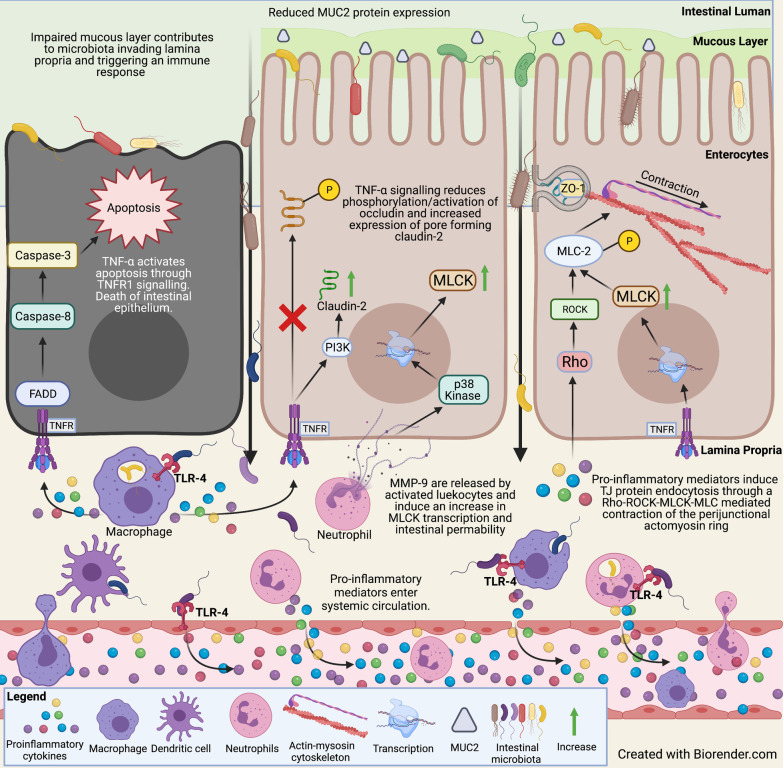
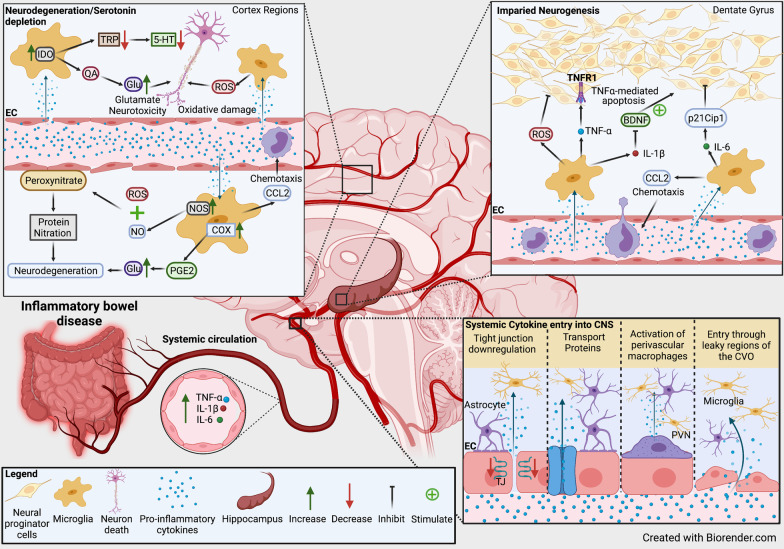
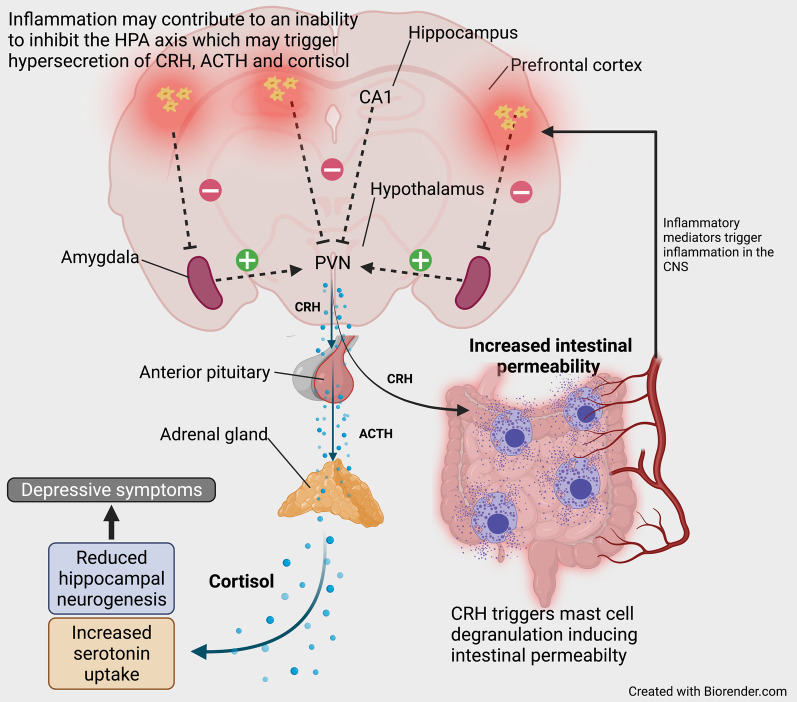
Verification
Claims the paper makes
The claims and statistics of this paper haven’t been checked yet.
Run the check — free, no account needed. It reads the open-access text and checks the sources it cites.
Claims other papers make about this one
Each is checked against this paper’s own text: does it say what the citing paper says it does?
In the citing paper
“Recent studies indicate that the relationship between IBD and mental illness can be bidirectional, evoking the systemic inflammation that damages the body’s immune and nervous systems and is a possible mechanism for both IBD and mental illness, as well as complex gut–brain interactions [46,47,48,49].”
From Association between Childhood Onset Inflammatory Bowel Disease and Psychiatric Comorbidities in Adulthood (2023) · cites this paper as [46]
Self-check
Percentages, sums and reported differences re-computed from the paper’s own numbers.
The self-check needs the paper’s full text.
Citations
Cites
1 retracted
Colzato, L. S., Jongkees, B. J., de Wit, M., van der Molen, M. J. W., & Steenbergen, L. (2018) · Cognitive Affective & Behavioral Neuroscience · doi:10.3758/s13415-018-0600-x · Cited by 84
RetractedMolecular Mechanisms of Depression: Perspectives on New Treatment Strategies
Lang, U. E., & Borgwardt, S. (2013) · Cellular Physiology and Biochemistry · doi:10.1159/000350094 · Cited by 8,526
From inflammation to sickness and depression: when the immune system subjugates the brain
Dantzer, R., O'Connor, J. C., Freund, G. G., Johnson, R. W., & Kelley, K. W. (2008) · Nature Reviews Neuroscience · doi:10.1038/nrn2297 · Cited by 7,395
CDK inhibitors: positive and negative regulators of G1-phase progression
Sherr, C. J., & Roberts, J. M. (1999) · Genes & Development · doi:10.1101/gad.13.12.1501 · Cited by 6,115
Iliff, J. J., Wang, M., Liao, Y., Plogg, B. A., Peng, W., Gundersen, G. A., Benveniste, H., Vates, G. E., Deane, R., Goldman, S. A., et al. (2012) · Science Translational Medicine · doi:10.1126/scitranslmed.3003748 · Cited by 5,824 · cited 28×
“However, in animals administered with LPS, prostaglandins show varying effects including blocking, enhancing, or having no effect on the actions of LPS on BBB permeability [190,191,192].”
BackgroundInfluentialMolecular characterization of a peripheral receptor for cannabinoids
Munro, S., Thomas, K. L., & Abu-Shaar, M. (1993) · Nature · doi:10.1038/365061a0 · Cited by 5,092
The NLRP3 inflammasome: molecular activation and regulation to therapeutics
Swanson, K. V., Deng, M., & Ting, J. P.-Y. (2019) · Nature Reviews Immunology · doi:10.1038/s41577-019-0165-0 · Cited by 4,884
A Meta-Analysis of Cytokines in Major Depression
Dowlati, Y., Herrmann, N., Swardfager, W., Liu, H., Sham, L., Reim, E. K., & Lanctôt, K. L. (2010) · Biological Psychiatry · doi:10.1016/j.biopsych.2009.09.033 · Cited by 4,729
Vale, W., Spiess, J., Rivier, C., & Rivier, J. (1981) · Science · doi:10.1126/science.6267699 · Cited by 3,965
Inflammasomes: mechanism of action, role in disease, and therapeutics
Guo, H., Callaway, J. B., & Ting, J. P.-Y. (2015) · Nature Medicine · doi:10.1038/nm.3893 · Cited by 3,340
Research works printed but not linked: 2
- Koo JW, Duman RS. IL-1β is an essential mediator of the antineurogenic and anhedonic effects of stress. Proc Natl Acad Sci. 2008;105(2):751. · DOI · Paper page
- Walker JR, Ediger JP, Graff LA, Greenfeld JM, Clara I, Lix L, et al. The Manitoba IBD Cohort Study: A Population-Based Study of the Prevalence of Lifetime and 12-Month Anxiety and Mood Disorders. Official journal of the American College of Gastroenterology | ACG. 2008;103(8). · DOI · Paper page
Cited by
Sorted by citations
Sun, Y., Koyama, Y., & Shimada, S. (2022) · Frontiers in Aging Neuroscience · doi:10.3389/fnagi.2022.903455 · Cited by 304
Ge, L., Liu, S., Li, S., Yang, J., Hu, G., Xu, C., & Song, W. (2022) · Frontiers in Immunology · doi:10.3389/fimmu.2022.1016578 · Cited by 187
Kim, S., Jung, U. J., & Kim, S. R. (2025) · Journal of Clinical Medicine · doi:10.3390/jcm14020386 · Cited by 129
Sharma, S., Chawla, S., Kumar, P., Ahmad, R., & Verma, P. K. (2024) · Brain Research · doi:10.1016/j.brainres.2024.149123 · Cited by 103
Liu, H., Zhang, X., Shi, P., Yuan, J., Jia, Q., Pi, C., Chen, T., Xiong, L., Chen, J., Tang, J., et al. (2023) · Journal of Neuroinflammation · doi:10.1186/s12974-023-02768-z · Cited by 88
Metadata
- Authors
- Craig, C. F., Filippone, R. T., Stavely, R., Bornstein, J. C., Apostolopoulos, V., & Nurgali, K.
- Affiliations
- Sunshine Hospital (AU)
- Harvard University (US)
- The University of Melbourne (AU)
- Australian Institute for Musculoskeletal Science (AU)
- Corresponding author
- Nurgali, Kulmira
- Venue
- Journal of Neuroinflammation
- Published
- 2022-01-04
- Volume
- 19
- Issue
- 1
- Pages
- 4-4
- ISSN
- 1742-2094 (ISSN-L)
- PMC
- PMC8729103
- OpenAlex
- W4206422593
- Cited by
- 124
- References
- 373
- Citations by year
- 2026: 26 · 2025: 39 · 2024: 30 · 2023: 20 · 2022: 9
- FWCI
- 1.85
- Type
- journal article
- Language
- en
- Open access
- gold
- doi.org
- Locations
- Journal of Neuroinflammation (publishedVersion, cc-by)
- PubMed Central (publishedVersion, cc-by)
- PubMed (publishedVersion)
- Victoria University Research Repository (Victoria University) (submittedVersion, cc-by)
- DOAJ (DOAJ: Directory of Open Access Journals) (submittedVersion, cc-by-sa)
- Minerva Access (University of Melbourne) (submittedVersion, cc-by)
- Funders
- Victoria University
- National Health and Medical Research Council (1158952)
- Topics
- Life Sciences › Neuroscience › Biological Psychiatry › Tryptophan and brain disorders
- Health Sciences › Medicine › Gastroenterology › Inflammatory Bowel Disease
- Life Sciences › Neuroscience › Neurology › Neuroinflammation and Neurodegeneration Mechanisms
- Keywords
- neuroinflammation, depression, inflammatory bowel disease, intestinal permeability, enterotoxin, blood-brain barrier permeability, enteric nervous system, colitis, gut-brain axis
- MeSH terms
- Brain-Gut Axis, Neuroinflammatory Diseases, Depression, Humans, Inflammatory Bowel Diseases
About these checks
Registry, retraction, Cites and statistics results are computed, not judged, with one exception: a printed reference that no index lists is read once by a model before it counts as a citation error. Claims are extracted by a model and kept only when their quote appears verbatim in the text; each cited source is then checked, with a model’s help, for whether it says what the claim relies on. Those verdicts can be wrong — read the claim’s quote and the cited source before relying on one.
Statistics and arithmetic are recomputed, not judged.
Confidence bands are shown only for fields calibrated on our annotated test set. None is calibrated yet, so no band is shown.
What counts as a claim ›How we measure confidence ›How we check this ›
Are you an author, or do you see a problem with this page? Request a review
