

Mobile Technology for Improved Family Planning (MOTIF): the development of a mobile phone-based (mHealth) intervention to support post-abortion family planning (PAFP) in Cambodia
Open accessThe DOI matches its Crossref record; 27 of the 29 references it cites were found in a registry or an index, and 2 are not checked yet; 2 of the 36 sources its claims cite were checked for support.
Abstract
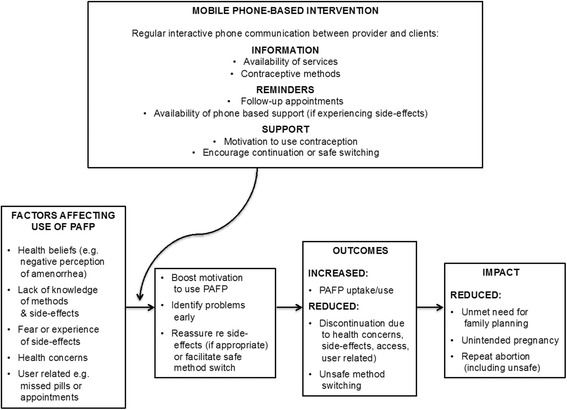
BACKGROUND: The objective of this paper is to outline the formative research process used to develop the MOTIF mobile phone-based (mHealth) intervention to support post-abortion family planning in Cambodia. METHODS: The formative research process involved literature reviews, interviews and focus group discussions with clients, and consultation with clinicians and organisations implementing mHealth activities in Cambodia. This process led to the development of a conceptual framework and the intervention. RESULTS: Key findings from the formative research included identification of the main reasons for non-use of contraception and patterns of mobile phone use in Cambodia. We drew on components of existing interventions and behaviour change theory to develop a conceptual framework. A multi-faceted voice-based intervention was designed to address health concerns and other key determinants of contraception use. CONCLUSIONS: Formative research was essential in order to develop an appropriate mHealth intervention to support post-abortion contraception in Cambodia. Each component of the formative research contributed to the final intervention design.
Verified 2026-10-05 · 2 references not checked yet
Overview
CoChat Summary
TL;DR
This paper describes the formative research used to develop MOTIF, a voice-based mHealth intervention to support post-abortion family planning in Cambodia. It combined literature reviews, a case note review, client interviews, focus group discussions, and stakeholder consultation to design a semi-automated six-message voice intervention with counsellor callbacks.
Key findings
- A case note review of 100 MSIC abortion clients found 40% (n = 40) uptake of effective post-abortion family planning immediately or at two-week follow-up; over 50% did not return to the MSIC clinic within 12 months; 4% returned for repeat abortion and 8% with repeat pregnancy within 12 months; over 80% provided a mobile phone number.
- Literature review identified health concerns as the commonest reason for contraceptive non-use globally and accounting for almost 50% of non-use in Cambodia; other reasons included access, cost, and autonomy.
- Interviews and FGDs found clients mainly sought abortion for economic or health reasons, many reported past contraceptive side-effects, most preferred phone calls over text messages, most could not read or had never used text messaging, but most listened to voice messages; all clients were positive about the proposed intervention, and privacy was not mentioned as a particular concern despite phone sharing.
- The final MOTIF intervention comprised six automated Khmer-language voice messages over three months, first within one week and then every two weeks, with options to request a callback, decline further messages, or continue; counsellors made follow-up calls, and clients choosing oral contraceptives or injectables could opt for method-specific reminders.
Methods
- Formative research at four Marie Stopes International Cambodia clinics (two urban around Phnom Penh; two rural in Battambang and Siem Reap) included literature reviews, a case note review of 100 abortion clients using routinely collected data (October–November 2012), 15 semi-structured client interviews (December 2013–January 2014), four FGDs (January–February 2014), consultation with clinicians and mHealth organisations, and message testing with 11 interview/FGD participants.
- The case note review identified the first 25 clients seeking abortion services at each clinic attending sequentially from 1 September 2011 and reviewed repeat attendances over 12 months; data were summarised using simple statistics.
- Interviews and FGDs were transcribed into English and read by one author to identify key themes; findings guided development of a conceptual framework and the final intervention.
Limitations
- Stated in the paper: time and resource constraints; analysis of interviews and FGDs was not undertaken by a second coder; literature searches were not systematic.
- Evident from the text: the case note review was limited to 100 clients at four MSIC clinics and could not determine whether clients used other providers to obtain contraception; findings may not generalise beyond this provider population.
Model-written summary. Check it against the paper before relying on it.
Integrity signals
Registry
Cites
Statistics
Figures
Verification
Claims the paper makes
2 Valid · 0 Not valid · 30 Not checked · 26 Own results and interpretations
A result the paper reports from its own data — it cites no other source for it, so there is none to check. The quote shows it is in the paper.
In the paper
“Regarding the proposed mHealth intervention, most clients said they preferred to make phone calls over text-message.”
- Also stated in: § Discussion and conclusions · boosted
“Clients also stated a clear preference for a voice-based intervention.”
§ Mobile Technology for Improved Family Planning (MOTIF): the development of a mobile phone-based (mHealth) intervention to support post-abortion family planning (PAFP) in Cambodia > Results > Findings from the interviews and FGDs (Table 1)
boosted- Asserted: passes — The authors put it forward as true.
- Checkable: passes — It can be checked against evidence.
- Load-bearing: passes — The paper’s conclusions depend on it.
- Based: passes — The paper gives a reason why it holds.
- Also stated in: § Discussion and conclusions · boosted
A result the paper reports from its own data — it cites no other source for it, so there is none to check. The quote shows it is in the paper.
In the paper
“Most women disclosed the abortion to their husband or partner.”
§ Mobile Technology for Improved Family Planning (MOTIF): the development of a mobile phone-based (mHealth) intervention to support post-abortion family planning (PAFP) in Cambodia > Results > Findings from the interviews and FGDs (Table 1)
plain- Asserted: passes — The authors put it forward as true.
- Checkable: passes — It can be checked against evidence.
- Load-bearing: unclear — It is unclear whether the paper’s conclusions depend on it.
- Based: passes — The paper gives a reason why it holds.
A result the paper reports from its own data — it cites no other source for it, so there is none to check. The quote shows it is in the paper.
In the paper
“All clients were positive about the proposed new MOTIF intervention.”
§ Mobile Technology for Improved Family Planning (MOTIF): the development of a mobile phone-based (mHealth) intervention to support post-abortion family planning (PAFP) in Cambodia > Results > Findings from the interviews and FGDs (Table 1)
plain- Asserted: passes — The authors put it forward as true.
- Checkable: passes — It can be checked against evidence.
- Load-bearing: passes — The paper’s conclusions depend on it.
- Based: passes — The paper gives a reason why it holds.
A result the paper reports from its own data — it cites no other source for it, so there is none to check. The quote shows it is in the paper.
In the paper
“Over 80 % of clients provided a mobile phone number.”
§ Mobile Technology for Improved Family Planning (MOTIF): the development of a mobile phone-based (mHealth) intervention to support post-abortion family planning (PAFP) in Cambodia > Results > Findings from the case note review
plain- Asserted: passes — The authors put it forward as true.
- Checkable: passes — It can be checked against evidence.
- Load-bearing: passes — The paper’s conclusions depend on it.
- Based: passes — The paper gives a reason why it holds.
A result the paper reports from its own data — it cites no other source for it, so there is none to check. The quote shows it is in the paper.
In the paper
“Most clients stated that messages sent to their phones should mention the terms ‘Marie Stopes’ and ‘contraception’ so they would know the topic of the message and who it was from.”
§ Mobile Technology for Improved Family Planning (MOTIF): the development of a mobile phone-based (mHealth) intervention to support post-abortion family planning (PAFP) in Cambodia > Results > Findings from the interviews and FGDs (Table 1)
plain- Asserted: passes — The authors put it forward as true.
- Checkable: passes — It can be checked against evidence.
- Load-bearing: unclear — It is unclear whether the paper’s conclusions depend on it.
- Based: passes — The paper gives a reason why it holds.
20 more claims
Create a free account to see all 58 claims and to verify the 34 references still open.
- Probably not a substantial claim. 16
- The quote only partly states this claim. 1
- It may state two separate claims as one. 20
Claims other papers make about this one
Each is checked against this paper’s own text: does it say what the citing paper says it does?
In the citing paper
“When HCPs used mHealth communication, clients in Cambodia reported improved self-efficacy in using contraception [51].”
From mHealth communication to strengthen postnatal care in rural areas: a systematic review (2019) · cites this paper as [51]
Citations
Cites
Michie, S., van Stralen, M. M., & West, R. (2011) · Implementation Science · doi:10.1186/1748-5908-6-42 · Cited by 13,697 · cited 3×
“Furthermore, existing behaviour or theoretically predicted mechanisms of action are not fully described [8, 17].”
BackgroundDeveloping and evaluating complex interventions: the new Medical Research Council guidance
Craig, P., Dieppe, P., Macintyre, S., Michie, S., Nazareth, I., & Petticrew, M. (2008) · BMJ · doi:10.1136/bmj.a1655 · Cited by 10,995
Update on Key Emerging Challenges in Cystic Fibrosis
Jennings, M. T., Riekert, K. A., & Boyle, M. P. (2014) · Medical Principles and Practice · doi:10.1159/000357646 · Cited by 3,648
Interventions for enhancing medication adherence
Nieuwlaat, R., Wilczynski, N., Navarro, T., Hobson, N., Jeffery, R., Keepanasseril, A., Agoritsas, T., Mistry, N., Iorio, A., Jack, S., et al. (2014) · Cochrane Database of Systematic Reviews · doi:10.1002/14651858.cd000011.pub4 · Cited by 2,945
Free, C., Phillips, G., Galli, L., Watson, L., Felix, L., Edwards, P., Patel, V., & Haines, A. (2013) · PLoS Medicine · doi:10.1371/journal.pmed.1001362 · Cited by 1,766 · cited 1×
“restrict access to in-person services [6].”
Self-citationLester, R. T., Ritvo, P., Mills, E. J., Kariri, A., Karanja, S., Chung, M. H., Jack, W., Habyarimana, J., Sadatsafavi, M., Najafzadeh, M., et al. (2010) · The Lancet · doi:10.1016/s0140-6736(10)61997-6 · Cited by 1,278 · cited 2×
“, we developed a semi-automated intervention, which sought to identify clients most in-need of counsellor delivered support [21].”
BackgroundMethodInterventions for enhancing medication adherence
Haynes, R. B., Ackloo, E., Sahota, N., McDonald, H. P., & Yao, X. (2008) · Cochrane Database of Systematic Reviews · doi:10.1002/14651858.cd000011.pub3 · Cited by 1,244
Free, C., Knight, R., Robertson, S., Whittaker, R., Edwards, P., Zhou, W., Rodgers, A., Cairns, J., Kenward, M. G., & Roberts, I. (2011) · The Lancet · doi:10.1016/s0140-6736(11)60701-0 · Cited by 728 · cited 1×
“Multi-faceted mHealth interventions have been shown to increase smoking cessation in a high-income setting and adherence to HIV medication in a low-income setting [19, 20].”
BackgroundSelf-citationKällander, K., Tibenderana, J. K., Akpogheneta, O. J., Strachan, D. L., Hill, Z., ten Asbroek, A. H. A., Conteh, L., Kirkwood, B. R., & Meek, S. R. (2013) · Journal of Medical Internet Research · doi:10.2196/jmir.2130 · Cited by 653 · cited 1×
“and smartphone applications and may involve onedirection or two-way (interactive) communication [5].”
BackgroundHorvath, T., Azman, H., Kennedy, G. E., & Rutherford, G. W. (2012) · Cochrane Database of Systematic Reviews · doi:10.1002/14651858.cd009756 · Cited by 428 · cited 1×
“Multi-faceted mHealth interventions have been shown to increase smoking cessation in a high-income setting and adherence to HIV medication in a low-income setting [19, 20].”
Background
Research works printed but not linked: 3
- Fetters T Samandari G An estimate of safe and unsafely induced abortion in Cambodia 2009 Marrakech, Morocco XXVI International Population Conference of the IUSSP
- World Health Organization Department of Reproductive Health and Research (WHO/RHR) and Johns Hopkins Bloomberg School of Public Health/Centre for Communications Programs (CCP) Knowledge for Health Project Family Planning: A Global Handbook for Providers (2011 update) 2011 Baltimore and Geneva CCP and WHO
- Bullen P Operational Challenges in the Cambodian mHealth revolvution J Mob Technol Med [Internet] 2013 2 2 20 3
Cited by
A global view of severe maternal morbidity: moving beyond maternal mortality
Geller, S. E., Koch, A. R., Garland, C. E., MacDonald, E. J., Storey, F., & Lawton, B. (2018) · Reproductive Health · doi:10.1186/s12978-018-0527-2 · Cited by 380
The global prevalence of postpartum psychosis: a systematic review
on behalf of the Maternal Morbidity Working Group, VanderKruik, R., Barreix, M., Chou, D., Allen, T., Say, L., & Cohen, L. S. (2017) · BMC Psychiatry · doi:10.1186/s12888-017-1427-7 · Cited by 238
Savage, V., & Castro, A. (2017) · Reproductive Health · doi:10.1186/s12978-017-0403-5 · Cited by 201
da Silveira, M. F., Mesenburg, M. A., Bertoldi, A. D., de Mola, C. L., Bassani, D. G., Domingues, M. R., Stein, A. L., & Coll, C. V. N. (2019) · Journal of Affective Disorders · doi:10.1016/j.jad.2019.06.016 · Cited by 161
Mobile phone-based interventions for improving contraception use
Smith, C., Gold, J., Ngo, T. D., Sumpter, C., & Free, C. (2015) · Cochrane Database of Systematic Reviews · doi:10.1002/14651858.cd011159.pub2 · Cited by 136
Self-citationBibliometric analysis of peer-reviewed literature in transgender health (1900 – 2017)
Sweileh, W. M. (2018) · BMC International Health and Human Rights · doi:10.1186/s12914-018-0155-5 · Cited by 146
Cata-Preta, B. O., Santos, T. M., Mengistu, T., Hogan, D. R., Barros, A. J. D., & Victora, C. G. (2021) · Vaccine · doi:10.1016/j.vaccine.2021.02.072 · Cited by 129
Makanga, P. T., Schuurman, N., Sacoor, C. N., Boene, H. E., Vilanculo, F. C., Vidler, M., Magee, L. A., von Dadelszen, P., Sevene, E., Munguambe, K., et al. (2017) · International Journal of Health Geographics · doi:10.1186/s12942-016-0074-4 · Cited by 132
Disparities in caesarean section prevalence and determinants across sub-Saharan Africa countries
Yaya, S., Uthman, O. A., Amouzou, A., & Bishwajit, G. (2018) · Global Health Research and Policy · doi:10.1186/s41256-018-0074-y · Cited by 133
Knop, M. R., Hayashi, M., Lin, R., Saing, C. H., Ung, M., Oy, S., Yam, E. L. Y., Zahari, M., & Yi, S. (2024) · BMC Medicine · doi:10.1186/s12916-024-03417-9 · Cited by 167
Matovu, J. K. B., Makumbi, F. E., Wanyenze, R. K., & Serwadda, D. (2017) · Reproductive Health · doi:10.1186/s12978-016-0272-3 · Cited by 104
Betron, M. L., McClair, T. L., Currie, S., & Banerjee, J. (2018) · Reproductive Health · doi:10.1186/s12978-018-0584-6 · Cited by 128
Ames, H. M., Glenton, C., Lewin, S. A., Tamrat, T., Akama, E., & Leon, N. (2019) · Cochrane Database of Systematic Reviews · doi:10.1002/14651858.cd013447 · Cited by 116
“Smith 2015 {published data only} Smith C, Vannak U, Sokhey L, Ngo TD, Gold J, Free C. Mobile technology for improved family planning (MOTIF): the development of a mobile phone-based (mHealth) intervention to support post-abortion family planning (PAFP) in Cambodia.”
BackgroundInfluentialExposure to non-persistent chemicals in consumer products and fecundability: a systematic review
Hipwell, A. E., Kahn, L. G., Factor-Litvak, P. R., Porucznik, C. A., Siegel, E., Fichorova, R. N., Hamman, R. F., Klein‐Fedyshin, M., Harley, K. G., & Outcomes, P. C. F. E. I. O. C. H. (2018) · Human Reproduction Update · doi:10.1093/humupd/dmy032 · Cited by 99
Defining preconception: exploring the concept of a preconception population
Hill, B., Hall, J., Skouteris, H., & Currie, S. (2020) · BMC Pregnancy and Childbirth · doi:10.1186/s12884-020-02973-1 · Cited by 95
Smith, C., Ngo, T. D., Gold, J., Edwards, P., Vannak, U., Sokhey, L., Machiyama, K., Slaymaker, E., Warnock, R., McCarthy, O., et al. (2015) · Bulletin of the World Health Organization · doi:10.2471/blt.15.160267 · Cited by 82
Self-citationRaj, A., Silverman, J. G., Klugman, J., Saggurti, N., Donta, B., & Shakya, H. B. (2017) · Social Science & Medicine · doi:10.1016/j.socscimed.2017.11.042 · Cited by 94
Incidence and trend of preterm birth in China, 1990–2016: a systematic review and meta-analysis
Jing, S., Chen, G., Gan, Y., Vogel, J. P., & Zhang, J. (2020) · BMJ Open · doi:10.1136/bmjopen-2020-039303 · Cited by 88
Garavand, A., Samadbeik, M., Nadri, H., Rahimi, B., & Asadi, H. (2019) · Methods of Information in Medicine · doi:10.1055/s-0040-1701607 · Cited by 86
Gashaye, K. T., Tsegaye, A. T., Shiferaw, G., Worku, A. G., & Abebe, S. M. (2019) · PLoS ONE · doi:10.1371/journal.pone.0210693 · Cited by 73
Yitbarek, K., Abraham, G., & Sudhakar, M. (2019) · BMJ Open · doi:10.1136/bmjopen-2018-025937 · Cited by 77
Shah, R., Watson, J., & Free, C. (2019) · BMC Public Health · doi:10.1186/s12889-019-6899-6 · Cited by 75
Self-citationLegal Consciousness: A Systematic Review of its Conceptualization and Measurement Methods1
Horák, F., Lacko, D., & Klocek, A. (2020) · Anuario de Psicología Jurídica · doi:10.5093/apj2021a2 · Cited by 87
Agnche, Z., Yeshita, H. Y., & Gonete, K. A. (2020) · Infection and Drug Resistance · doi:10.2147/idr.s276678 · Cited by 61
Ariho, P., & Kabagenyi, A. (2020) · BMC Women s Health · doi:10.1186/s12905-020-0881-4 · Cited by 66
mHealth communication to strengthen postnatal care in rural areas: a systematic review
Mbuthia, F., Reid, M., & Fichardt, A. (2019) · BMC Pregnancy and Childbirth · doi:10.1186/s12884-019-2531-0 · Cited by 57
Promising role of medicinal plants in the regulation and management of male erectile dysfunction
Masuku, N. P., Unuofin, J. O., & Lebelo, S. L. (2020) · Biomedicine & Pharmacotherapy · doi:10.1016/j.biopha.2020.110555 · Cited by 61
Asefa, F., Cummins, A. M., Dessie, Y., Hayen, A. D., & Foureur, M. J. (2020) · PLoS ONE · doi:10.1371/journal.pone.0231889 · Cited by 66
Shakya, H. B., Dasgupta, A., Ghule, M., Battala, M., Saggurti, N., Donta, B., Nair, S., Silverman, J. G., & Raj, A. (2018) · BMC Women s Health · doi:10.1186/s12905-018-0636-7 · Cited by 58
Mekie, M., Addisu, D., Bezie, M., Melkie, A., Feleke, D. G., Bayih, W. A., & Taklual, W. (2021) · BMC Pregnancy and Childbirth · doi:10.1186/s12884-021-03647-2 · Cited by 67
Factors affecting access to primary health care services in Pakistan: a gender-based analysis
Panezai, S., Ahmad, M. M., & Saqib, S. E. (2017) · Development in Practice · doi:10.1080/09614524.2017.1344188 · Cited by 61
INPAC group, Che, Y., Richards, E., Wu, S., Jiang, Y., Dong, X., Li, J., Zhang, W., Temmerman, M., & Tolhurst, R. (2017) · BMC Women s Health · doi:10.1186/s12905-017-0458-z · Cited by 53
Lucas, G., Olander, E. K., Ayers, S., & Salmon, D. (2019) · BMC Women s Health · doi:10.1186/s12905-019-0848-5 · Cited by 59
Nsereko, E., Uwase, A., Mukabutera, A., Muvunyi, C. M., Rulisa, S., Ntirushwa, D., Moreland, P. J., Corwin, E. J., Santos, N., Nzayirambaho, M., et al. (2020) · BMC Pregnancy and Childbirth · doi:10.1186/s12884-020-03037-0 · Cited by 47
Trend of preventable neonatal mortality in the States of Brazil
Prezotto, K. H., de Oliveira, R. R., Pelloso, S. M., & Fernandes, C. A. M. (2021) · Revista Brasileira de Saúde Materno Infantil · doi:10.1590/1806-93042021000100015 · Cited by 41
Yaya, S., Okonofua, F. E., Ntoimo, L. F. C., Udenigwe, O., & Bishwajit, G. (2019) · Reproductive Health · doi:10.1186/s12978-019-0752-3 · Cited by 54
Salih, Y., Nasr, A. M., Ahmed, A. B. A., Sharif, M. E., & Adam, I. (2020) · BMC Research Notes · doi:10.1186/s13104-020-04998-3 · Cited by 54
Reproductive Health Literacy and Fertility Awareness Among Polish Female Students
Chawłowska, E., Lipiak, A., Krzysztoszek, J., Krupa, B., & Staszewski, R. (2020) · Frontiers in Public Health · doi:10.3389/fpubh.2020.00499 · Cited by 49
the Brazilian Network for Surveillance of Severe Maternal Morbidity Study Group, Zanardi, D. M. T., Parpinelli, M. Â., Haddad, S. M., Costa, M. L., Sousa, M. H., Leite, D. F. B., & Cecatti, J. G. (2018) · Archives of Gynecology and Obstetrics · doi:10.1007/s00404-018-5004-1 · Cited by 43
Factors Influencing Unintended Pregnancies amongst Adolescent Girls and Young Women in Cambodia
Rizvi, F., Williams, J. W., & Hoban, E. (2019) · International Journal of Environmental Research and Public Health · doi:10.3390/ijerph16204006 · Cited by 47
“Smith et al (2015) suggest that as a woman’s fertility can return within two–three weeks post abortion, it is imperative for women to start contraception soon after an abortion to prevent any future UIPs [28].”
BackgroundValdebenito, S., Murray, A. L., Hughes, C. H., Băban, A., Fernando, A. D., Madrid, B. J., Ward, C. L., Osafo, J., Dunne, M. P., Sikander, S., et al. (2020) · BMJ Open · doi:10.1136/bmjopen-2019-034986 · Cited by 34
Reiss, K., Andersen, K. L., Pearson, E., Biswas, K. K., Taleb, F., Ngo, T. D., Hossain, A., Barnard, S., Smith, C., Carpenter, J. R., et al. (2019) · Global Health Science and Practice · doi:10.9745/ghsp-d-19-00015 · Cited by 33
“There was no evidence in crude or adjusted models that the intervention had an effect on self-reported sexual IPV (47 [12”
Self-citationBrody, C., Tuot, S., Chhoun, P., Swendenman, D., Kaplan, K. C., & Yi, S. (2018) · Trials · doi:10.1186/s13063-018-2614-7 · Cited by 32
Colley, S., Kao, C., Gau, M., & Cheng, S.-F. (2018) · BMC Pregnancy and Childbirth · doi:10.1186/s12884-018-2025-5 · Cited by 29
Ovarian tissue transportation: a systematic review
Vilela, J. D. M. V., Dolmans, M., & Amorim, C. A. (2020) · Reproductive BioMedicine Online · doi:10.1016/j.rbmo.2020.11.001 · Cited by 28
Abebe, H., Shitu, S., Workye, H., & Mose, A. (2021) · PLoS ONE · doi:10.1371/journal.pone.0249865 · Cited by 28
Transcriptomic analysis of fetal membranes reveals pathways involved in preterm birth
Pereyra, S., Sosa, C., Bertoni, B., & Sapiro, R. (2019) · BMC Medical Genomics · doi:10.1186/s12920-019-0498-3 · Cited by 29
Strong, J., Lattof, S. R., Maliqi, B., & Yaqub, N. O. (2021) · BMC Health Services Research · doi:10.1186/s12913-021-06905-3 · Cited by 30
Socio-economic predictors of stillbirths in Nepal (2001-2011)
Ghimire, P. R., Agho, K., Renzaho, A. M. N., Christou, A., Nisha, M. K., Dibley, M. J., & Raynes‐Greenow, C. H. (2017) · PLoS ONE · doi:10.1371/journal.pone.0181332 · Cited by 29
Contraceptive nonuse among women in Uganda: a comparative assessment of predictors across regions
Otim, J. (2020) · BMC Women s Health · doi:10.1186/s12905-020-01148-6 · Cited by 25
Islam, M. A., & Biswas, B. (2021) · Clinical Epidemiology and Global Health · doi:10.1016/j.cegh.2021.100801 · Cited by 29
Gill, R. K., Ogilvie, G. S., Norman, W. V., Fitzsimmons, B. P., Maher, C., & Renner, R. (2019) · Journal of Medical Internet Research · doi:10.2196/13387 · Cited by 29
“Studies utilizing hotlines, text messaging, and mobile apps in Cambodia, Indonesia, and South Africa are just a few examples of how digital health is being utilized to improve the abortion experience for women who face barriers to abortion care globally [14,20,26,27].”
BackgroundInfluentialRana, J., Sen, K. K., Sultana, T., Hossain, M. B., & Islam, R. M. (2019) · Reproductive Health · doi:10.1186/s12978-019-0785-7 · Cited by 25
Associations of intimate partner violence with postnatal health practices in Bihar, India
Boyce, S. C., McDougal, L., Silverman, J. G., Atmavilas, Y., Dhar, D., Hay, K., & Raj, A. (2017) · BMC Pregnancy and Childbirth · doi:10.1186/s12884-017-1577-0 · Cited by 26
Galle, A., de Melo, M. S. I., Griffin, S., Osman, N. B., Roelens, K., & Degomme, O. (2020) · BMC Pregnancy and Childbirth · doi:10.1186/s12884-020-03265-4 · Cited by 30
Laqqan, M. M., & Yassin, M. M. (2021) · Environmental Science and Pollution Research · doi:10.1007/s11356-021-17786-8 · Cited by 24
Late booking amongst African women in a London borough, England: implications for health promotion
Chinouya, M. J., & Madziva, C. (2017) · Health Promotion International · doi:10.1093/heapro/dax069 · Cited by 26
Müller, N., McMahon, S. A., Neve, J. D., Funke, A., Bärnighausen, T., Rajemison, E. N., Lacroze, E., Emmrich, J., & Knauß, S. (2020) · PLoS ONE · doi:10.1371/journal.pone.0228017 · Cited by 24
Jochim, J., Cluver, L. D., & Meinck, F. (2021) · International Journal of Educational Development · doi:10.1016/j.ijedudev.2021.102484 · Cited by 32
Shakya, H. B., Fleming, P. J., Saggurti, N., Donta, B., Silverman, J. G., & Raj, A. (2017) · Social Science & Medicine · doi:10.1016/j.socscimed.2017.02.032 · Cited by 23
Asamoah, B. O., & Agardh, A. (2017) · Archives of Sexual Behavior · doi:10.1007/s10508-017-0978-5 · Cited by 25
Gill, R. K., Ogilvie, G. S., Norman, W. V., Fitzsimmons, B. P., Maher, C., & Renner, R. (2019) · JMIR Human Factors · doi:10.2196/14558 · Cited by 25
“Similar studies have successfully demonstrated that using this approach leads to a higher likelihood of implementation and scalability [3,27-29].”
Whitehouse, K., Blaylock, R., Makleff, S., & Lohr, P. A. (2021) · Reproductive Health · doi:10.1186/s12978-021-01270-0 · Cited by 26
Jadhav, A., & Weis, J. (2019) · Contraception · doi:10.1016/j.contraception.2019.10.004 · Cited by 21
Mesfin, S., Dheresa, M., Fage, S. G., & Tura, A. K. (2021) · International Journal of Women s Health · doi:10.2147/ijwh.s300143 · Cited by 28
Smith, C., Sokhey, L., Vannak, U., Warnock, R., & Free, C. (2017) · Reproductive Health · doi:10.1186/s12978-017-0329-y · Cited by 23
“The MOTIF trial protocol, results and description of the intervention development are reported elsewhere [5, 10, 11].”
MethodSelf-citationCamara, B. S., Délamou, A., Grovogui, F. M., de Kok, B. C., Beňová, L., Ayadi, A. M. E., Gerrets, R. P., Grietens, K. P., & Delvaux, T. (2021) · Reproductive Health · doi:10.1186/s12978-021-01072-4 · Cited by 26
Dewau, R., Angaw, D. A., Kassa, G. M., Dagnew, B., Yeshaw, Y., Muche, A., Feleke, D. G., Alemu, E. M., Yehuala, E. D., Tadesse, S. E., et al. (2021) · PLoS ONE · doi:10.1371/journal.pone.0255094 · Cited by 20
Shapira, G., Kalisa, I., Condo, J. U., Humuza, J., Mugeni, C., Nkunda, D., & Walldorf, J. (2018) · Health Economics · doi:10.1002/hec.3822 · Cited by 27
Okedo‐Alex, I. N., Akamike, I. C., & Okafor, L. C. (2020) · Women and Birth · doi:10.1016/j.wombi.2020.09.015 · Cited by 25
Bazid, H. A. S., Attia, A. M., Yousef, A. M. A., Fawal, A. N., & Mostafa, M. I. (2021) · Biological Trace Element Research · doi:10.1007/s12011-021-02720-3 · Cited by 20
Nicolosi, B. F., Souza, R. T., Mayrink, J., Feitosa, F. E. D. L., Filho, E. A. R., Leite, D. F. B., Vettorazzi, J., de Sousa, M. H., Costa, M. L., Baker, P. N., et al. (2020) · PLoS ONE · doi:10.1371/journal.pone.0232664 · Cited by 22
Freeman, T., Miles, L., Ying, K., Yasin, S. M., & Lai, W. (2021) · Sociology of Health and Illness · doi:10.1111/1467-9566.13323 · Cited by 14
Mose, A., & Abebe, H. (2021) · Archives of Public Health · doi:10.1186/s13690-021-00682-5 · Cited by 23
Vizeshfar, F., Momennasab, M., Yektatalab, S., & Iman, M. T. (2021) · BMC Public Health · doi:10.1186/s12889-021-10878-7 · Cited by 21
Bayo, P., Belaid, L., Tahir, E. O., Ochola, E., Dimiti, A., Greco, D., & Zarowsky, C. (2020) · BMC Pregnancy and Childbirth · doi:10.1186/s12884-020-02910-2 · Cited by 21
Denhard, L., Kaviany, P., Chicumbe, S., Muianga, C., Laisse, G., Aune, K. T., & Sheffel, A. (2021) · International Journal for Equity in Health · doi:10.1186/s12939-021-01403-8 · Cited by 19
Oluoch-Aridi, J., Afulani, P. A., Guzman, D. B., Makanga, C., & Miller‐Graff, L. E. (2021) · Reproductive Health · doi:10.1186/s12978-021-01129-4 · Cited by 23
Ali, M., Azmat, S. K., & Hamza, H. B. (2018) · BMC Health Services Research · doi:10.1186/s12913-018-3156-0 · Cited by 17
Muheirwe, F., & Nuhu, S. (2018) · The International Journal of Health Planning and Management · doi:10.1002/hpm.2627 · Cited by 17
Birabwa, C., Chemonges, D., Tetui, M., Baroudi, M., Namatovu, F., Akuze, J., Makumbi, F. E., Ssekamatte, T., Atuyambe, L. M., Hernández, A., et al. (2021) · Frontiers in Global Women s Health · doi:10.3389/fgwh.2021.650538 · Cited by 17
“The duration and frequency of the messages as well as content should be tailored to the targeted population to improve usefulness or effectiveness, including use of translated voice messages (56).”
BackgroundMizerero, S. A., Wilunda, C., Musumari, P. M., Ono‐Kihara, M., Mubungu, G. L., Kihara, M., & Nakayama, T. (2021) · Conflict and Health · doi:10.1186/s13031-021-00395-0 · Cited by 21
Illness recognition and care-seeking for maternal and newborn complications in rural eastern Uganda
Okuga, M., Waiswa, P., Mandu, R., Wachira, J., Hanson, C., & Manzi, F. (2017) · Journal of Health Population and Nutrition · doi:10.1186/s41043-017-0125-x · Cited by 19
Marra, E., Meijer, S., & de Graaf, H. (2020) · Genus · doi:10.1186/s41118-020-00078-3 · Cited by 19
Thapa, N. R., Adhikari, S. C., & Budhathoki, P. K. (2019) · PLoS ONE · doi:10.1371/journal.pone.0216587 · Cited by 15
Camellia, S., Rommes, E. W. M., & Jansen, W. (2020) · Global Public Health · doi:10.1080/17441692.2020.1751862 · Cited by 21
Silesh, M., & Demisse, T. L. (2021) · PLoS ONE · doi:10.1371/journal.pone.0260710 · Cited by 19
Mobile phone use among female entertainment workers in Cambodia: an observation study
Brody, C., Tatomir, B., Tuot, S., Pal, K., Mengsrun, S., Dionosio, J., Luong, M.-A., & Yi, S. (2017) · mHealth · doi:10.21037/mhealth.2017.01.01 · Cited by 17
“Findings also support the transfer of face-to-face health behavior change technologies unto mobile phones in developed countries (24).”
BackgroundUnderstanding ‘missed appointments’ for pills and injectables: a mixed methods study in Senegal
Cavallaro, F. L., Duclos, D., Cresswell, J. A., Faye, S. L., Macleod, D., Faye, A., & Lynch, C. A. (2018) · BMJ Global Health · doi:10.1136/bmjgh-2018-000975 · Cited by 13
Sivahikyako, S. A., Owaraganise, A., Tibaijuka, L., Agaba, D. C., Kayondo, M., Ngonzi, J. N. J., Mugisha, J., & Kanyesigye, H. (2021) · BMC Pregnancy and Childbirth · doi:10.1186/s12884-021-04157-x · Cited by 14
Pandit, S., Thasineku, O. C., Karki, S., & Sharma, S. (2025) · BMJ Open · doi:10.1136/bmjopen-2024-090209 · Cited by 15
Misgina, K. H., Boezen, H. M., van der Beek, E. M., Mulugeta, A., & Groen, H. (2021) · BMJ Open · doi:10.1136/bmjopen-2020-043484 · Cited by 15
Acceptance of mobile health in medical sciences students: Applying technology acceptance model
Samadbeik, M., Aslani, N., Maleki, M., & Garavand, A. (2023) · Informatics in Medicine Unlocked · doi:10.1016/j.imu.2023.101290 · Cited by 23
Reiss, K., Andersen, K. L., Barnard, S., Ngo, T. D., Biswas, K. K., Smith, C., Carpenter, J. R., Church, K., Nuremowla, S., & Pearson, E. (2017) · BMC Public Health · doi:10.1186/s12889-017-4703-z · Cited by 14
“At the time of procedure, women ’ s focus may be on the MR rather than on family planning; in Cambodia women have said they find it difficult to make a decision on the day of procedure [19].”
BackgroundSelf-citationAninanya, G. A., Otupiri, E., & Howard, N. (2021) · PLoS ONE · doi:10.1371/journal.pone.0249778 · Cited by 15
Gizaw, W., Feyisa, M., Hailu, D., & Nigussie, T. (2021) · Heliyon · doi:10.1016/j.heliyon.2021.e07070 · Cited by 16
Olsen, P., Plourde, K. F., Lasway, C., & van Praag, E. (2018) · JMIR mhealth and uhealth · doi:10.2196/10190 · Cited by 14
“Information on use patterns alone does not paint a full picture of engagement [10].”
Ahinkorah, B. O., Perry, L., Brooks, F. M., & Kang, M. S. (2022) · BMJ Open · doi:10.1136/bmjopen-2021-060576 · Cited by 15
Saing, C. H., Ung, M., Suy, S., Oy, S., Dary, C., Yam, E. L. Y., Chhorn, S., Hayashi, M., Khuon, D., Mam, S., et al. (2023) · Trials · doi:10.1186/s13063-023-07724-z · Cited by 11
“Mobile technology has been used to improve community-based health interventions to bridge the gaps [53, 54], along with adopting digital health innovations in solving other public health problems in the country [55].”
BackgroundMaitra, S., Schensul, S. L., Hallowell, B. D., Brault, M. A., & Nastasi, B. K. (2017) · Journal of Marital and Family Therapy · doi:10.1111/jmft.12248 · Cited by 13
Metadata
- Authors
- Smith, C., Vannak, U., Sokhey, L., Ngo, T. D., Gold, J., & Free, C.
- Affiliations
- London School of Hygiene & Tropical Medicine (GB)
- Marie Stopes International (GB)
- Corresponding author
- Smith, Chris
- Venue
- Reproductive Health
- Published
- 2015-12
- Volume
- 13
- Issue
- 1
- Pages
- 1-1
- ISSN
- 1742-4755 (ISSN-L)
- PMC
- PMC4700587
- OpenAlex
- W2222321133
- Cited by
- 179
- References
- 29
- Citations by year
- 2026: 1 · 2025: 2 · 2024: 12 · 2023: 7 · 2022: 4 · 2021: 42 · 2020: 33 · 2019: 28 · 2018: 19 · 2017: 25 · 2016: 3 · 2015: 3
- FWCI
- 30.47
- Type
- journal article
- Language
- en
- Open access
- gold
- doi.org
- Licence
- Locations
- Reproductive Health (publishedVersion, cc-by)
- PubMed Central (publishedVersion, cc-by)
- PubMed (publishedVersion)
- LSHTM Research Online (London School of Hygiene and Tropical Medicine) (acceptedVersion)
- Funders
- London School of Hygiene and Tropical Medicine
- University of Cape Town
- Medical Research Council (MR/L012251/1)
- Topics
- Health Sciences › Health Professions › General Health Professions › Mobile Health and mHealth Applications
- Health Sciences › Medicine › Public Health, Environmental and Occupational Health › Reproductive Health and Contraception
- Physical Sciences › Computer Science › Information Systems › Mobile Learning in Education
- Keywords
- post-abortion family planning, mobile health, mobile phone intervention, contraceptive use, behaviour change theory, conceptual framework, formative research, Cambodia
- MeSH terms
- Abortion, Induced, Adult, Cambodia, Contraception Behavior, Developing Countries, Family Planning Services, Female, Humans, Models, Psychological, Patient Education as Topic, Postoperative Period, Poverty Areas, Pregnancy, Pregnancy, Unwanted, Research Design, Focus Groups, Telemedicine, Behavioral Research, Cell Phone, Self Report
About these checks
Registry, retraction, Cites and statistics results are computed, not judged, with one exception: a printed reference that no index lists is read once by a model before it counts as a citation error. Claims are extracted by a model and kept only when their quote appears verbatim in the text; each cited source is then checked, with a model’s help, for whether it says what the claim relies on. Those verdicts can be wrong — read the claim’s quote and the cited source before relying on one.
A language model drew the claims from the paper on 2026-10-05, under version 3 of the claim definition (model deepseek-v4.1-flash, prompt extract-v3).
A second model labelled each claim on 2026-10-05 (model jev-1.13-20260917, definition revision gold-guideline-v0.2).
Statistics and arithmetic are recomputed, not judged.
Confidence bands are shown only for fields calibrated on our annotated test set. None is calibrated yet, so no band is shown.
What counts as a claim ›How we measure confidence ›How we check this ›
Are you an author, or do you see a problem with this page? Request a review
Data sources
Bibliographic data: Semantic Scholar, OpenAlex, Crossref.
Contains information from the Semantic Scholar Academic Graph Datasets, made available under the ODC Attribution License (ODC-BY 1.0).
Semantic Scholar’s data is described in: Kinney, R., et al. (2023). The Semantic Scholar Open Data Platform. arXiv:2301.10140.
