

Mobile Technology for Improved Family Planning (MOTIF): the development of a mobile phone-based (mHealth) intervention to support post-abortion family planning (PAFP) in Cambodia
Open accessThe DOI matches its Crossref record; 27 of the 29 references it cites were found in a registry or an index, and 2 are not checked yet; 2 of the 36 sources its claims cite were checked for support.
Abstract
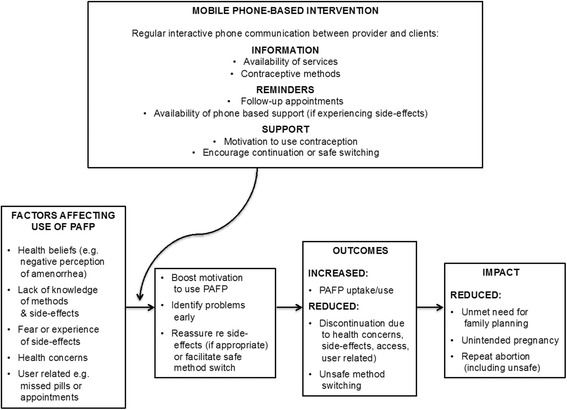
BACKGROUND: The objective of this paper is to outline the formative research process used to develop the MOTIF mobile phone-based (mHealth) intervention to support post-abortion family planning in Cambodia. METHODS: The formative research process involved literature reviews, interviews and focus group discussions with clients, and consultation with clinicians and organisations implementing mHealth activities in Cambodia. This process led to the development of a conceptual framework and the intervention. RESULTS: Key findings from the formative research included identification of the main reasons for non-use of contraception and patterns of mobile phone use in Cambodia. We drew on components of existing interventions and behaviour change theory to develop a conceptual framework. A multi-faceted voice-based intervention was designed to address health concerns and other key determinants of contraception use. CONCLUSIONS: Formative research was essential in order to develop an appropriate mHealth intervention to support post-abortion contraception in Cambodia. Each component of the formative research contributed to the final intervention design.
Verified 2026-10-05 · 2 references not checked yet
Overview
CoChat Summary
TL;DR
This paper describes the formative research used to develop MOTIF, a voice-based mHealth intervention to support post-abortion family planning in Cambodia. It combined literature reviews, a case note review, client interviews, focus group discussions, and stakeholder consultation to design a semi-automated six-message voice intervention with counsellor callbacks.
Key findings
- A case note review of 100 MSIC abortion clients found 40% (n = 40) uptake of effective post-abortion family planning immediately or at two-week follow-up; over 50% did not return to the MSIC clinic within 12 months; 4% returned for repeat abortion and 8% with repeat pregnancy within 12 months; over 80% provided a mobile phone number.
- Literature review identified health concerns as the commonest reason for contraceptive non-use globally and accounting for almost 50% of non-use in Cambodia; other reasons included access, cost, and autonomy.
- Interviews and FGDs found clients mainly sought abortion for economic or health reasons, many reported past contraceptive side-effects, most preferred phone calls over text messages, most could not read or had never used text messaging, but most listened to voice messages; all clients were positive about the proposed intervention, and privacy was not mentioned as a particular concern despite phone sharing.
- The final MOTIF intervention comprised six automated Khmer-language voice messages over three months, first within one week and then every two weeks, with options to request a callback, decline further messages, or continue; counsellors made follow-up calls, and clients choosing oral contraceptives or injectables could opt for method-specific reminders.
Methods
- Formative research at four Marie Stopes International Cambodia clinics (two urban around Phnom Penh; two rural in Battambang and Siem Reap) included literature reviews, a case note review of 100 abortion clients using routinely collected data (October–November 2012), 15 semi-structured client interviews (December 2013–January 2014), four FGDs (January–February 2014), consultation with clinicians and mHealth organisations, and message testing with 11 interview/FGD participants.
- The case note review identified the first 25 clients seeking abortion services at each clinic attending sequentially from 1 September 2011 and reviewed repeat attendances over 12 months; data were summarised using simple statistics.
- Interviews and FGDs were transcribed into English and read by one author to identify key themes; findings guided development of a conceptual framework and the final intervention.
Limitations
- Stated in the paper: time and resource constraints; analysis of interviews and FGDs was not undertaken by a second coder; literature searches were not systematic.
- Evident from the text: the case note review was limited to 100 clients at four MSIC clinics and could not determine whether clients used other providers to obtain contraception; findings may not generalise beyond this provider population.
Model-written summary. Check it against the paper before relying on it.
Integrity signals
Registry
Cites
Statistics
Figures
Verification
Claims the paper makes
2 Valid · 0 Not valid · 30 Not checked · 26 Own results and interpretations
A result the paper reports from its own data — it cites no other source for it, so there is none to check. The quote shows it is in the paper.
In the paper
“Regarding the proposed mHealth intervention, most clients said they preferred to make phone calls over text-message.”
- Also stated in: § Discussion and conclusions · boosted
“Clients also stated a clear preference for a voice-based intervention.”
§ Mobile Technology for Improved Family Planning (MOTIF): the development of a mobile phone-based (mHealth) intervention to support post-abortion family planning (PAFP) in Cambodia > Results > Findings from the interviews and FGDs (Table 1)
boosted- Asserted: passes — The authors put it forward as true.
- Checkable: passes — It can be checked against evidence.
- Load-bearing: passes — The paper’s conclusions depend on it.
- Based: passes — The paper gives a reason why it holds.
- Also stated in: § Discussion and conclusions · boosted
A result the paper reports from its own data — it cites no other source for it, so there is none to check. The quote shows it is in the paper.
In the paper
“Most women disclosed the abortion to their husband or partner.”
§ Mobile Technology for Improved Family Planning (MOTIF): the development of a mobile phone-based (mHealth) intervention to support post-abortion family planning (PAFP) in Cambodia > Results > Findings from the interviews and FGDs (Table 1)
plain- Asserted: passes — The authors put it forward as true.
- Checkable: passes — It can be checked against evidence.
- Load-bearing: unclear — It is unclear whether the paper’s conclusions depend on it.
- Based: passes — The paper gives a reason why it holds.
A result the paper reports from its own data — it cites no other source for it, so there is none to check. The quote shows it is in the paper.
In the paper
“All clients were positive about the proposed new MOTIF intervention.”
§ Mobile Technology for Improved Family Planning (MOTIF): the development of a mobile phone-based (mHealth) intervention to support post-abortion family planning (PAFP) in Cambodia > Results > Findings from the interviews and FGDs (Table 1)
plain- Asserted: passes — The authors put it forward as true.
- Checkable: passes — It can be checked against evidence.
- Load-bearing: passes — The paper’s conclusions depend on it.
- Based: passes — The paper gives a reason why it holds.
A result the paper reports from its own data — it cites no other source for it, so there is none to check. The quote shows it is in the paper.
In the paper
“Over 80 % of clients provided a mobile phone number.”
§ Mobile Technology for Improved Family Planning (MOTIF): the development of a mobile phone-based (mHealth) intervention to support post-abortion family planning (PAFP) in Cambodia > Results > Findings from the case note review
plain- Asserted: passes — The authors put it forward as true.
- Checkable: passes — It can be checked against evidence.
- Load-bearing: passes — The paper’s conclusions depend on it.
- Based: passes — The paper gives a reason why it holds.
A result the paper reports from its own data — it cites no other source for it, so there is none to check. The quote shows it is in the paper.
In the paper
“Most clients stated that messages sent to their phones should mention the terms ‘Marie Stopes’ and ‘contraception’ so they would know the topic of the message and who it was from.”
§ Mobile Technology for Improved Family Planning (MOTIF): the development of a mobile phone-based (mHealth) intervention to support post-abortion family planning (PAFP) in Cambodia > Results > Findings from the interviews and FGDs (Table 1)
plain- Asserted: passes — The authors put it forward as true.
- Checkable: passes — It can be checked against evidence.
- Load-bearing: unclear — It is unclear whether the paper’s conclusions depend on it.
- Based: passes — The paper gives a reason why it holds.
20 more claims
Create a free account to see all 58 claims and to verify the 34 references still open.
- Probably not a substantial claim. 16
- The quote only partly states this claim. 1
- It may state two separate claims as one. 20
Claims other papers make about this one
Each is checked against this paper’s own text: does it say what the citing paper says it does?
In the citing paper
“When HCPs used mHealth communication, clients in Cambodia reported improved self-efficacy in using contraception [51].”
From mHealth communication to strengthen postnatal care in rural areas: a systematic review (2019) · cites this paper as [51]
Citations
Cites
Michie, S., van Stralen, M. M., & West, R. (2011) · Implementation Science · doi:10.1186/1748-5908-6-42 · Cited by 13,697 · cited 3×
“Furthermore, existing behaviour or theoretically predicted mechanisms of action are not fully described [8, 17].”
BackgroundDeveloping and evaluating complex interventions: the new Medical Research Council guidance
Craig, P., Dieppe, P., Macintyre, S., Michie, S., Nazareth, I., & Petticrew, M. (2008) · BMJ · doi:10.1136/bmj.a1655 · Cited by 10,995
Update on Key Emerging Challenges in Cystic Fibrosis
Jennings, M. T., Riekert, K. A., & Boyle, M. P. (2014) · Medical Principles and Practice · doi:10.1159/000357646 · Cited by 3,648
Interventions for enhancing medication adherence
Nieuwlaat, R., Wilczynski, N., Navarro, T., Hobson, N., Jeffery, R., Keepanasseril, A., Agoritsas, T., Mistry, N., Iorio, A., Jack, S., et al. (2014) · Cochrane Database of Systematic Reviews · doi:10.1002/14651858.cd000011.pub4 · Cited by 2,945
Free, C., Phillips, G., Galli, L., Watson, L., Felix, L., Edwards, P., Patel, V., & Haines, A. (2013) · PLoS Medicine · doi:10.1371/journal.pmed.1001362 · Cited by 1,766 · cited 1×
“restrict access to in-person services [6].”
Self-citationLester, R. T., Ritvo, P., Mills, E. J., Kariri, A., Karanja, S., Chung, M. H., Jack, W., Habyarimana, J., Sadatsafavi, M., Najafzadeh, M., et al. (2010) · The Lancet · doi:10.1016/s0140-6736(10)61997-6 · Cited by 1,278 · cited 2×
“, we developed a semi-automated intervention, which sought to identify clients most in-need of counsellor delivered support [21].”
BackgroundMethodInterventions for enhancing medication adherence
Haynes, R. B., Ackloo, E., Sahota, N., McDonald, H. P., & Yao, X. (2008) · Cochrane Database of Systematic Reviews · doi:10.1002/14651858.cd000011.pub3 · Cited by 1,244
Free, C., Knight, R., Robertson, S., Whittaker, R., Edwards, P., Zhou, W., Rodgers, A., Cairns, J., Kenward, M. G., & Roberts, I. (2011) · The Lancet · doi:10.1016/s0140-6736(11)60701-0 · Cited by 728 · cited 1×
“Multi-faceted mHealth interventions have been shown to increase smoking cessation in a high-income setting and adherence to HIV medication in a low-income setting [19, 20].”
BackgroundSelf-citationKällander, K., Tibenderana, J. K., Akpogheneta, O. J., Strachan, D. L., Hill, Z., ten Asbroek, A. H. A., Conteh, L., Kirkwood, B. R., & Meek, S. R. (2013) · Journal of Medical Internet Research · doi:10.2196/jmir.2130 · Cited by 653 · cited 1×
“and smartphone applications and may involve onedirection or two-way (interactive) communication [5].”
BackgroundHorvath, T., Azman, H., Kennedy, G. E., & Rutherford, G. W. (2012) · Cochrane Database of Systematic Reviews · doi:10.1002/14651858.cd009756 · Cited by 428 · cited 1×
“Multi-faceted mHealth interventions have been shown to increase smoking cessation in a high-income setting and adherence to HIV medication in a low-income setting [19, 20].”
Background
Research works printed but not linked: 3
- Fetters T Samandari G An estimate of safe and unsafely induced abortion in Cambodia 2009 Marrakech, Morocco XXVI International Population Conference of the IUSSP
- World Health Organization Department of Reproductive Health and Research (WHO/RHR) and Johns Hopkins Bloomberg School of Public Health/Centre for Communications Programs (CCP) Knowledge for Health Project Family Planning: A Global Handbook for Providers (2011 update) 2011 Baltimore and Geneva CCP and WHO
- Bullen P Operational Challenges in the Cambodian mHealth revolvution J Mob Technol Med [Internet] 2013 2 2 20 3
Cited by
Items 101–180 of 180
Eckersberger, E., Pearson, E., Andersen, K. L., Hossain, A., Footman, K., Biswas, K. K., Nuremowla, S., & Reiss, K. (2017) · JMIR mhealth and uhealth · doi:10.2196/mhealth.6969 · Cited by 11
“Regardless of quality of care and counseling, some women may not want to make a decision about family planning on the day of the procedure [16]. mHealth offers an opportunity to reach women with information about family planning after they have left the clinic; however, evidence for the…”
BackgroundHu, Y., Huang, R., Bishwajit, G., & Tang, S. (2020) · BMC Medical Informatics and Decision Making · doi:10.1186/s12911-020-01228-5 · Cited by 13
“Although comparatively less common, mobile health-based family planning services such as contraceptive counselling, menstrual regulation [12], selection of methods, reminder messages, implant and providing support for side-effects are becoming increasingly popular [26, 27].”
BackgroundThet, M. M., Richards, L.-M., Sudhinaraset, M., Paw, N. W. K., & Diamond‐Smith, N. (2016) · Maternal and Child Health Journal · doi:10.1007/s10995-016-1968-2 · Cited by 11
Smith, C., Sokhey, L., Vannak, U., Warnock, R., Edwards, P., & Free, C. (2017) · Contraception and Reproductive Medicine · doi:10.1186/s40834-017-0043-8 · Cited by 12
Self-citationUse of Focus Groups in Developing Behavioural mHealth Interventions: A Critical Review
Eborall, H., & Morton, K. (2017) · Palgrave Macmillan UK eBooks · doi:10.1057/978-1-137-58614-8_6 · Cited by 11
Gilano, G., Dekker, A. L. A. J., & Fijten, R. (2024) · Clinical Nutrition Open Science · doi:10.1016/j.nutos.2024.02.002 · Cited by 12
Chhoun, P., Kaplan, K. C., Wieten, C. W., Jelveh, I., Lienemann, M., Tuot, S., Yi, S., & Brody, C. (2019) · mHealth · doi:10.21037/mhealth.2019.07.02 · Cited by 11
“Also in Cambodia, organizations are using mobile phones to reach hard-to-reach populations with health messages and service linkages such as post-abortion family planning (10).”
BackgroundBoku, G., Abeya, S. G., Ayers, N., & Wordofa, M. A. (2024) · Adolescent Health Medicine and Therapeutics · doi:10.2147/ahmt.s441957 · Cited by 14
Shaaban, O. M., Saber, T., Youness, E., Farouk, M., & Abbas, A. M. (2020) · The European Journal of Contraception & Reproductive Health Care · doi:10.1080/13625187.2020.1764528 · Cited by 10
“[14] evaluated the development of a mobile phone-based intervention to support post-abortion contraception but found limited evidence to support improved post-abortion contraceptive use for this intervention: the uptake of effective post-abortion contraception either immediately after abortion or at 2 week follow-up w…”
BackgroundRetractedSundberg, L. R., Christianson, M., Wiklund, M., Hurtig, A., & Goicolea, I. (2021) · BMJ Open · doi:10.1136/bmjopen-2021-048922 · Cited by 12
Jiang, W., & Ha, L. S. (2019) · Sex Education · doi:10.1080/14681811.2019.1672041 · Cited by 13
Societal awareness on neonatal hyperbilirubinemia: A systematic review and meta-analysis
Farouk, Z. L., Usman, F., Musa, B. M., Ezeaka, C., & Okolo, A. A. (2020) · Seminars in Perinatology · doi:10.1016/j.semperi.2020.151361 · Cited by 14
Magaço, A., Munguambe, K., Nhacolo, A., Ambrósio, C., Nhacolo, F., Cossa, S., Macete, E., & Mandomando, I. (2020) · Global Public Health · doi:10.1080/17441692.2020.1839933 · Cited by 14
Taddele, T., Getachew, T., Taye, G., Getnet, M., Defar, A., Teklie, H., Gonfa, G., Humnessa, S., Teshome, A., Akale, Z., et al. (2019) · BMC Health Services Research · doi:10.1186/s12913-019-4857-8 · Cited by 9
Mbuthia, F. W., Reid, M., & Fichardt, A. (2021) · International Journal of Africa Nursing Sciences · doi:10.1016/j.ijans.2021.100304 · Cited by 11
Kim, C. S., Erim, D., Natiq, K., Salehi, A. S., & Zeng, W. (2020) · Frontiers in Global Women s Health · doi:10.3389/fgwh.2020.571055 · Cited by 13
Surgical management of female genital mutilation-related morbidity: A scoping review
Chappell, A. G., Sood, R., Hu, A., Folsom, S. M., Wafford, Q. E., Bowen, D. K., Post, L. A., & Jordan, S. W. (2021) · Journal of Plastic Reconstructive & Aesthetic Surgery · doi:10.1016/j.bjps.2021.05.022 · Cited by 9
Shokoohi, M., Khezri, M., Karamouzian, M., & Mirzazadeh, A. (2021) · Sexuality & Culture · doi:10.1007/s12119-021-09918-6 · Cited by 8
Perceptions of the use of mobile phones to access reproductive health care services in Tamale, Ghana
Agbenyo, J. S., Nzengya, D. M., & Mwangi, S. K. (2022) · Frontiers in Public Health · doi:10.3389/fpubh.2022.1026393 · Cited by 8
Shitu, K., Kassie, A., & Wolde, M. (2023) · International Journal of Reproductive Medicine · doi:10.1155/2023/6643797 · Cited by 8
Gill, R. K., Ogilvie, G. S., Norman, W. V., Fitzsimmons, B. P., Maher, C., & Renner, R. (2023) · JMIR Formative Research · doi:10.2196/46284 · Cited by 9
“Furthermore, Smith et al [13,14] explored women’s needs in Cambodia to develop a mobile phone–based intervention to support postabortion family planning, specifically contraceptive adherence.”
BackgroundCalderón, T. A., Martin, H., Volpicelli, K., Frasso, R., Arroyo, E. C. D., Gozzer, E., & Buttenheim, A. M. (2017) · mHealth · doi:10.21037/mhealth.2017.04.03 · Cited by 9
“A formative evaluation of an mHealth intervention to support post-abortion family planning in Cambodia did not find evidence of privacy concerns, while the importance of privacy and confidentiality was emphasized in a HIV medication adherence trial in Kenya (20,22).”
BackgroundHayrumyan, V., Grigoryan, Z., Sargsyan, Z., Sahakyan, S., Aslanyan, L., & Harutyunyan, A. (2020) · International Journal of Public Health · doi:10.1007/s00038-020-01499-9 · Cited by 8
Chauhan, B. G., & Prasad, J. B. (2021) · Children and Youth Services Review · doi:10.1016/j.childyouth.2020.105920 · Cited by 10
Cahyanti, R. D., Widyawati, W., & Hakimi, M. (2021) · BMC Pregnancy and Childbirth · doi:10.1186/s12884-021-03840-3 · Cited by 13
García‐Prado, A. (2019) · The World Bank Research Observer · doi:10.1093/wbro/lky008 · Cited by 9
A Critical Understanding of Resistance to Criminalization of Female Genital Mutilation in Kenya
Bunei, E. K., & Rono, J. K. (2018) · Springer eBooks · doi:10.1007/978-3-319-65021-0_43 · Cited by 10
BMC reproductive health: family planning global conference series
Mbizvo, M. T., & Burke, A. E. (2015) · Reproductive Health · doi:10.1186/s12978-016-0116-1 · Cited by 8
Garcia Vilaplana, E., Petignat, P., Benski, A.-C., Soaroby, A., Sormani, J., Vassilakos, P., & Schmidt, N. C. (2020) · International Journal of Women's Health · doi:10.2147/ijwh.s260894 · Cited by 7
Duah, J. E., Lu, X. B., McGivern, P., & Jing, Y. (2024) · International Conference on Big Data and Education (ICBDE) · doi:10.1145/3704289.3704293 · Cited by 10
Odira, F. H., Mpambije, C. J., & Kachenje, Y. E. (2025) · BMC Health Services Research · doi:10.1186/s12913-025-12467-5 · Cited by 7
Women’s sexual health six months after a severe maternal morbidity event
Alves, L. C., da Costa, J. R., Monteiro, J. C. D. S., & Gomes-Sponholz, F. A. (2020) · Revista Latino-Americana de Enfermagem · doi:10.1590/1518-8345.3500.3293 · Cited by 7
Acharya, D., Adhikari, R., & Kreps, G. L. (2021) · The International Journal of Health Planning and Management · doi:10.1002/hpm.3285 · Cited by 9
Mulatu, A., Oridanigo, E. M., & Markos, M. (2023) · Open Access Journal of Contraception · doi:10.2147/oajc.s382973 · Cited by 7
Abrejo, F. G., Iqbal, R., & Saleem, S. (2022) · BMC Women s Health · doi:10.1186/s12905-022-02086-1 · Cited by 9
“[7], iMACC (Mobile Application for Contraceptive Choice) in Kenya[8], and in Sierra Leone for connecting the young population to family planning services are among those successful interventions.”
BackgroundAyanore, M. A., Pavlova, M., Biesma, R. G., & Groot, W. N. J. (2017) · PLoS ONE · doi:10.1371/journal.pone.0186908 · Cited by 7
Smith, C. E., Scott, R. H., Free, C., & Edwards, T. (2019) · Contraception and Reproductive Medicine · doi:10.1186/s40834-019-0086-0 · Cited by 7
Self-citationEffects of infertility prevention programme on college students
Öztürk, B., Siyez, D. M., Esen, E., & Kağnıcı, D. Y. (2019) · Sex Education · doi:10.1080/14681811.2019.1697662 · Cited by 9
Ong, K. K. X., Ng, J. S., Om, C., Chhoun, P., Tuot, S., & Yi, S. (2020) · mHealth · doi:10.21037/mhealth.2020.04.01 · Cited by 8
“This has been recognized as a challenge for mobile phone-based interventions in Cambodia and other countries (28-31).”
BackgroundLorenzetti, L., Plourde, K. F., Rastagar, S. H., Afzali, A. S., Sultani, A. S., Khalil, A. K., Adeeb, A. W., Hemat, S., & Todd, C. S. (2022) · Digital Health · doi:10.1177/20552076221089801 · Cited by 7
Zolfaqari, Z., Ayatollahi, H., Ranjbar, F., & Abasi, A. (2024) · BMC Pregnancy and Childbirth · doi:10.1186/s12884-024-06253-0 · Cited by 7
“Technical challenges, such as infrastructure limitations and design complexity, pose significant hurdles [17, 19, 20, 35, 39–41, 43, 45, 48].”
BackgroundResultInfluentialGupta, A., & Bhagia, S. (2018) · Journal of South Asian Federation of Obstetrics and Gynaecology · doi:10.5005/jp-journals-10006-1564 · Cited by 6
Alemu, A. A., & Zeleke, L. B. (2020) · Open Access Surgery · doi:10.2147/oas.s254758 · Cited by 9
Castle, S., & Silva, M. (2019) · doi:10.31899/rh14.1115 · Cited by 14
Oluoch-Aridi, J., Wafula, F., Kokwaro, G. O., McAlhaney, M., & Adam, M. B. (2021) · Maternal and Child Health Journal · doi:10.1007/s10995-021-03214-3 · Cited by 5
Joshi, B. N., Girase, B., Shetty, S. S., Verma, V. K., Acharya, S. M., Deoraj, P., Kulkarni, R. N., & Begum, S. (2021) · Contraception and Reproductive Medicine · doi:10.1186/s40834-021-00159-4 · Cited by 5
Hunie, M., Fenta, E., Kibret, S., & Teshome, D. (2021) · BMC Anesthesiology · doi:10.1186/s12871-021-01478-4 · Cited by 5
Zerfu, T. A., Ayele, H. T., & Nigatu, T. (2018) · Studies in Family Planning · doi:10.1111/sifp.12054 · Cited by 6
Re-evaluation of gestational age as a predictor for subsequent preterm birth
Pereira, E., Tessema, G. A., Gissler, M., Regan, A. K., & Pereira, G. F. (2021) · PLoS ONE · doi:10.1371/journal.pone.0245935 · Cited by 7
Badia, T., Moustafa, M., Shaaban, O. M., & Youness, E. (2019) · Assiut Scientific Nursing Journal · doi:10.21608/asnj.2019.56818 · Cited by 5
Shahrokhi, S. N., Salmani, H., & Ahmadi, M. (2023) · Iranian Journal of Nursing and Midwifery Research · doi:10.4103/ijnmr.ijnmr_312_20 · Cited by 7
What Do Married Couples Think About Induced Abortion?
Dönmez, S., & Kısa, S. (2016) · Journal of Sex & Marital Therapy · doi:10.1080/0092623x.2016.1263704 · Cited by 5
Perceptions of social capital and sexual behaviour among youth in South Africa
Odimegwu, C. O., Wet, N. D., & Somefun, O. D. (2017) · Journal of Child and Adolescent Mental Health · doi:10.2989/17280583.2017.1388246 · Cited by 5
m-Health in Public Health Practice
Abdulrahman, S. A., & Ganasegeran, K. (2019) · Elsevier eBooks · doi:10.1016/b978-0-12-816948-3.00011-8 · Cited by 6
“Despite these evidences, not much is known regarding the potential efficacy of m-Health interventions on post-abortion family planning (PAFB) [23], an area requiring more systematic approaches and studies to establish its efficacy or otherwise [24].”
Maviso, M. K., Aines, P. Z., Potjepat, G., Geregl, N., Mola, G., & Bolnga, J. W. (2024) · PLoS ONE · doi:10.1371/journal.pone.0309913 · Cited by 4
“This finding is contrary to previous studies [51–53], indicating that mobile phones in health (mHealth) have been shown to influence women’s perceptions and decisions on pregnancy and abortion services and improve post-abortion care, including family planning.”
ResultCleverley, K., Sergeant, A., Zamberlín, N., Medina, S., Tam, G., & Gill, R. K. (2024) · Frontiers in Global Women s Health · doi:10.3389/fgwh.2024.1401779 · Cited by 4
Spatial Variations in Fertility Desire in West Africa
Gayawan, E., Dake, F. A. A., Dansou, J., & Ewemooje, O. S. (2021) · Spatial Demography · doi:10.1007/s40980-021-00088-5 · Cited by 4
Smith, C. E., Sokhey, L., Tijamo, C., McLaren, M., Free, C., Watkins, J., Ou, A., Masuda, C., & Oreglia, E. (2021) · BMJ Open · doi:10.1136/bmjopen-2021-049254 · Cited by 4
Self-citationInternal Migration as a Social Determinant of Occupational Health and WASH Access in Myanmar
West, H., Than, M., Win, T., Oo, K. T., Khaing, K., Aye, T. T., Yi, S. M., Myo, S. Y., Toe, S. Y., Miłkowska, M., et al. (2021) · Annals of Global Health · doi:10.5334/aogh.3381 · Cited by 5
Mobile Health Application to Strengthen Postnatal Care: A Case of Tanzania
Kullian, N. C., Ally, J. S., & Magemo, A. (2023) · East African Journal of Information Technology · doi:10.37284/eajit.6.1.1121 · Cited by 3
Tran, N. T., Mugerwa, K. Y., Ochan, A. W., Muwanguzi, S., Sake, J., Mwesigwa, R., Sukere, O., & Schulte‐Hillen, C. (2024) · International Journal of Maternal and Child Health and AIDS · doi:10.25259/ijma_7_2023 · Cited by 3
On the Use of Mobile-Based Notification Systems for Medication Adherence: A Systematic Review
Okuboyejo, S. R., Oshunmakinde, B., Ayo, C. K., & Mbarika, V. W. A. (2017) · Indian Journal of Science and Technology · doi:10.17485/ijst/2017/v10i20/109154 · Cited by 3
Sripad, P., Arnoff, E., Warren, C., & Tripathi, V. (2021) · BMC Women s Health · doi:10.1186/s12905-021-01288-3 · Cited by 2
Cox, C., Potterton, J. L., & Rosie, S. (2020) · South African Journal of Physiotherapy · doi:10.4102/sajp.v76i1.1401 · Cited by 3
Nkole, T., Silumbwe, A., Munakampe, M. N., Cordero, J. P., Milford, C., Zulu, J. M., & Steyn, P. S. (2021) · Sexual and Reproductive Health Matters · doi:10.1080/26410397.2021.1985945 · Cited by 2
Fiseha, F., Assefa, G., Tekalign, T., Nima, L., Kidane, H., Melkam, B., Dadi, H. H., Yimer, Y., Tessema, Y. N., Gebeyehu, N. A., et al. (2026) · BMJ Open · doi:10.1136/bmjopen-2025-109077 · Cited by 1
Family planning KAP survey in the Southern Region of Saudi Arabia
Dhaher, E. A. (2017) · International Journal of Reproduction Contraception Obstetrics and Gynecology · doi:10.18203/2320-1770.ijrcog20174990 · Cited by 1
Shaaban, O. M., Abbas, A. M., Saber, T., Youness, E., & Farouk, M. (2019) · Fertility and Sterility · doi:10.1016/j.fertnstert.2019.07.160 · Cited by 1
“In disagreement of these findings (Smith et al., 2016) who evaluated the using of a telephone-based (mHealth) intervention to improve initiation of PostAbortion Family Planning (PAFP) in Cambodia, they found that there was no significant difference for interventions to improve contraception use and…”
BackgroundThe Pill at 56 and Counting: Still Contracepting After All These Years
Côté-Leduc, M., & Roy, G. (2016) · Current Obstetrics and Gynecology Reports · doi:10.1007/s13669-016-0143-5
Need for better indicators of contraception after abortion
Smith, C. E. (2018) · BMJ Sexual & Reproductive Health · doi:10.1136/bmjsrh-2018-200246
Self-citationFaktor Risiko Dropout Kontrasepsi Suntik Progesteron
Laila, N., Budiono, B., Sunarsih, S., & ADITIAWARMAN, A. (2019) · Pediomaternal Nursing Journal · doi:10.20473/pmnj.v5i2.13550 · Cited by 2
Magnusen, K. L. (2019) · Arts, research, innovation and society · doi:10.1007/978-3-030-30102-6_3
Development of an Intervention to Support Reproductive Health of Garment Factory Workers in CambodiaPreprint
Smith, C. E., Sokhey, L., Tijamo, C., McLaren, M., Free, C., Watkins, J., Ou, A., Masuda, C., Williamson, A., & Oreglia, E. (2020) · Research Square · doi:10.21203/rs.3.rs-126032/v1
Self-citationSheilla, N. (2023) · IDOSR JOURNAL OF SCIENTIFIC RESEARCH · doi:10.59298/idosrjsr/2023/00.6.6000
“The cross-sectional method was chosen because it is not costly to perform, captures a specific point in time and does not require a lot of time [22].”
MethodSaing, C. H., Ung, M., Suy, S., Oy, S., Dary, C., Yam, E. L. Y., Chhorn, S., Nagashima-Hayashi, M., Khuon, D., Mam, S., et al. (2024) · Figshare · doi:10.6084/m9.figshare.26632351
Strong, J., Lattof, S. R., Maliqi, B., & Yaqub, N. O. (2021) · Figshare · doi:10.6084/m9.figshare.17132818
Saing, C. H., Ung, M., Suy, S., Oy, S., Dary, C., Yam, E. L. Y., Chhorn, S., Nagashima-Hayashi, M., Khuon, D., Mam, S., et al. (2024) · Figshare · doi:10.6084/m9.figshare.26632342
Saing, C. H., Ung, M., Suy, S., Oy, S., Dary, C., Yam, E. L. Y., Chhorn, S., Nagashima-Hayashi, M., Khuon, D., Mam, S., et al. (2024) · Figshare · doi:10.6084/m9.figshare.26632336
Saing, C. H., Ung, M., Suy, S., Oy, S., Dary, C., Yam, E. L. Y., Chhorn, S., Nagashima-Hayashi, M., Khuon, D., Mam, S., et al. (2024) · Figshare · doi:10.6084/m9.figshare.26632339
Onuoha, C. F. (2026) · INTERNATIONAL JOURNAL OF HEALTH AND PHARMACEUTICAL RESEARCH · doi:10.56201/ijhpr.vol.10.no4.2025.pg1.14
Metadata
- Authors
- Smith, C., Vannak, U., Sokhey, L., Ngo, T. D., Gold, J., & Free, C.
- Affiliations
- London School of Hygiene & Tropical Medicine (GB)
- Marie Stopes International (GB)
- Corresponding author
- Smith, Chris
- Venue
- Reproductive Health
- Published
- 2015-12
- Volume
- 13
- Issue
- 1
- Pages
- 1-1
- ISSN
- 1742-4755 (ISSN-L)
- PMC
- PMC4700587
- OpenAlex
- W2222321133
- Cited by
- 179
- References
- 29
- Citations by year
- 2026: 1 · 2025: 2 · 2024: 12 · 2023: 7 · 2022: 4 · 2021: 42 · 2020: 33 · 2019: 28 · 2018: 19 · 2017: 25 · 2016: 3 · 2015: 3
- FWCI
- 30.47
- Type
- journal article
- Language
- en
- Open access
- gold
- doi.org
- Licence
- Locations
- Reproductive Health (publishedVersion, cc-by)
- PubMed Central (publishedVersion, cc-by)
- PubMed (publishedVersion)
- LSHTM Research Online (London School of Hygiene and Tropical Medicine) (acceptedVersion)
- Funders
- London School of Hygiene and Tropical Medicine
- University of Cape Town
- Medical Research Council (MR/L012251/1)
- Topics
- Health Sciences › Health Professions › General Health Professions › Mobile Health and mHealth Applications
- Health Sciences › Medicine › Public Health, Environmental and Occupational Health › Reproductive Health and Contraception
- Physical Sciences › Computer Science › Information Systems › Mobile Learning in Education
- Keywords
- post-abortion family planning, mobile health, mobile phone intervention, contraceptive use, behaviour change theory, conceptual framework, formative research, Cambodia
- MeSH terms
- Abortion, Induced, Adult, Cambodia, Contraception Behavior, Developing Countries, Family Planning Services, Female, Humans, Models, Psychological, Patient Education as Topic, Postoperative Period, Poverty Areas, Pregnancy, Pregnancy, Unwanted, Research Design, Focus Groups, Telemedicine, Behavioral Research, Cell Phone, Self Report
About these checks
Registry, retraction, Cites and statistics results are computed, not judged, with one exception: a printed reference that no index lists is read once by a model before it counts as a citation error. Claims are extracted by a model and kept only when their quote appears verbatim in the text; each cited source is then checked, with a model’s help, for whether it says what the claim relies on. Those verdicts can be wrong — read the claim’s quote and the cited source before relying on one.
A language model drew the claims from the paper on 2026-10-05, under version 3 of the claim definition (model deepseek-v4.1-flash, prompt extract-v3).
A second model labelled each claim on 2026-10-05 (model jev-1.13-20260917, definition revision gold-guideline-v0.2).
Statistics and arithmetic are recomputed, not judged.
Confidence bands are shown only for fields calibrated on our annotated test set. None is calibrated yet, so no band is shown.
What counts as a claim ›How we measure confidence ›How we check this ›
Are you an author, or do you see a problem with this page? Request a review
Data sources
Bibliographic data: Semantic Scholar, OpenAlex, Crossref.
Contains information from the Semantic Scholar Academic Graph Datasets, made available under the ODC Attribution License (ODC-BY 1.0).
Semantic Scholar’s data is described in: Kinney, R., et al. (2023). The Semantic Scholar Open Data Platform. arXiv:2301.10140.
