

Transtheoretical model-based mobile health application for PCOS
Open accessThe DOI matches its Crossref record; 46 of the 46 references it cites were found in a registry or an index.
Abstract
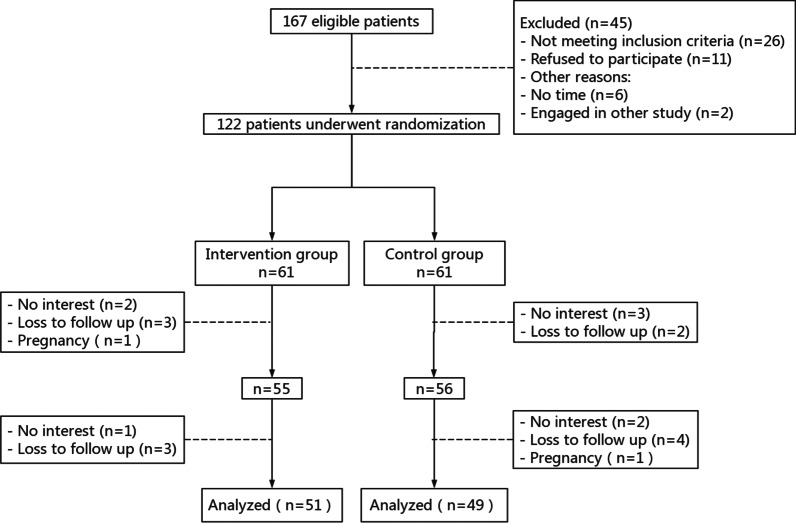
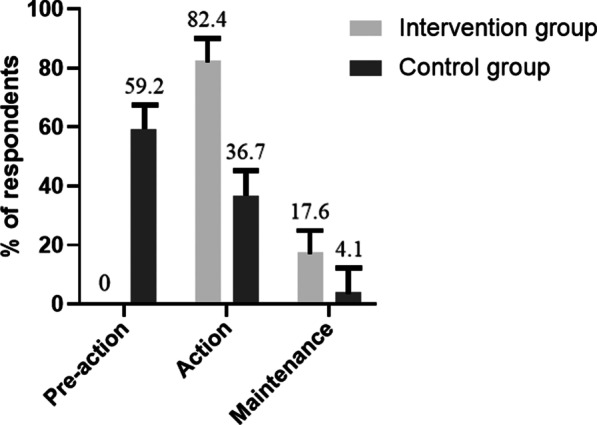
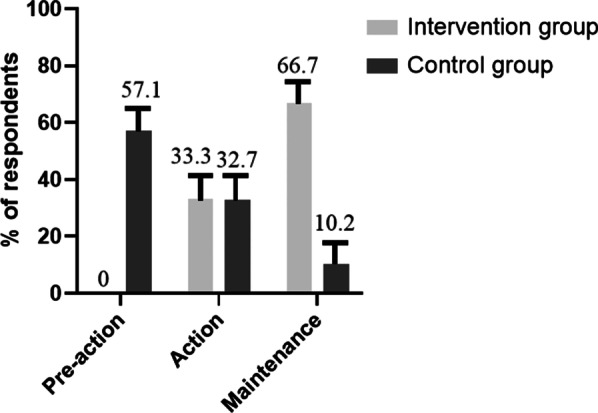
Background: Lifestyle modification (diet, exercise, and behavioral interventions) is the first-line treatment for polycystic ovary syndrome (PCOS). The benefits of face-to-face lifestyle modification intervention in a short time have been demonstrated. However, few studies have investigated the mobile technology effects on lifestyle modification in PCOS. Therefore, we examined the effect of transtheoretical model-based mobile health application intervention program for PCOS. Methods: A randomised controlled, single-blind trial, was carried out from October 2018 to March 2019, which included 122 participants recruited from gynecology outpatient clinics of affiliated Hospital of Zunyi Medical University in Guizhou. The study participants were randomised into intervention (n = 61) and control groups (n = 61). Participants in the intervention group undertook a TTM-based mobile health application program in addition to routine care, and participants in the control group received only routine care. Results: Fifty-one participants in the intervention group and 49 in the control group completed the study. Compared to the control group, participants in the intervention group showed statistically significant decrease for BMI (P < 0.05), WC (P < 0.05), SAS (P < 0.05), and SDS (P < 0.05) scores at 6-month and 12-month, respectively. Behavior stage change of exercise and diet among paticipants with PCOS was significant at 6 months (c 2 = 43.032, P < 0.05) and 12th months (c 2 = 49.574, P < 0.05) between the intervention and control groups. Conclusions: This study showed that the TTM-based mobile health application program can decrease BMI, WC, anxiety, and depression, and improve exercise and diet adherence in patients with PCOS in the long term. The TTM-based mobile health application program can be applied for lifestyle modification in women with PCOS. Trial registration This study was approved by the ethics committee NO.[2019]1-028 in March 2018 and was registered at the Chinese Clinical Trial Registry (website: www.chictr.org.cn , registry number: ChiCTR2000034572)
Overview
The claims and statistics of this paper haven’t been checked yet.
Free: it reads the open-access text and checks the first 5 claims that cite a source we can check. Create a free account to check every claim.
Integrity signals
Registry
Cites
Statistics
Figures
Verification
Claims the paper makes
The claims and statistics of this paper haven’t been checked yet.
Free: it reads the open-access text and checks the first 5 claims that cite a source we can check. Create a free account to check every claim.
Claims other papers make about this one
Each is checked against this paper’s own text: does it say what the citing paper says it does?
The cited source says what the claim attributes to it.
In the citing paper
“Findings by researchers in 2 studies about the use of apps featuring lifestyle modification revealed positive outcomes such as decreased waist circumference [28]”
From Availability and Use of Digital Technology Among Women With Polycystic Ovary Syndrome: Scoping Review (2025) · cites this paper as [28]
The cited source says what the claim attributes to it.
In the citing paper
“Studies from China [57] and Korea [42] showed how the use of mobile apps contributed to decreased body weight/BMI, waist circumference, anxiety, and depression scores.”
From Polycystic Ovary Syndrome and the Internet of Things: A Scoping Review (2024) · cites this paper as [57]
Self-check
Percentages, sums and reported differences re-computed from the paper’s own numbers.
The self-check needs the paper’s full text.
Citations
Cites
A self-rating depression scale
ZUNG, W. W. K. (1965) · Archives of General Psychiatry · doi:10.1001/archpsyc.1965.01720310065008 · Cited by 9,813
(2004) · Fertility and Sterility · doi:10.1016/j.fertnstert.2003.10.004 · Cited by 9,050 · cited 1×
“Participants included in the study (1) fulfilled at least two of the three Rotterdam Criteria for the diagnosis of PCOS (including oligo-ovulation or anovulation, hyperandrogenism, and polycystic ovaries that were confirmed via ultrasound) [29]; (2) were aged 18 years or above and had a BMI that was greater than or eq…”
MethodA Rating Instrument For Anxiety Disorders
Zung, W. W. K. (1971) · Psychosomatics · doi:10.1016/s0033-3182(71)71479-0 · Cited by 4,578
Transtheoretical therapy: Toward a more integrative model of change.
Prochaska, J. O., & DiClemente, C. C. (1982) · Psychotherapy: Theory, Research & Practice · doi:10.1037/h0088437 · Cited by 3,922 · cited 1×
“This model suggests that behavioral change is a dynamic process, comprising the following five stages [16]: (1) pre-contemplation, which refers to the intention to take action in the following 6 months; (2) contemplation, which refers to the intention to engage in healthy behaviors within the following 6 months; (3) p…”
BackgroundFauser, B. C. J. M., Tarlatzis, B. C., Rebar, R. W., Legro, R. S., Balen, A. H., Lobo, R., Carmina, E., Chang, J., Yildiz, B. O., Laven, J. S. E., et al. (2012) · Fertility and Sterility · doi:10.1016/j.fertnstert.2011.09.024 · Cited by 1,976 · cited 1×
“Women with PCOS experience a variety of symptoms including polycystic ovaries, hyperandrogenism, and menstrual disturbances; more than 80% of women with PCOS are obese or overweight [3, 4].”
BackgroundTeede, H. J., Misso, M. L., Costello, M. F., Dokras, A., Laven, J., Moran, L., Piltonen, T., Norman, R. J., & the International PCOS Network (2018) · Clinical Endocrinology · doi:10.1111/cen.13795 · Cited by 1,823
Teede, H. J., Misso, M. L., Costello, M. F., Dokras, A., Laven, J., Moran, L., Piltonen, T., Norman, R. J., International PCOS Network, Andersen, M., et al. (2018) · Human Reproduction · doi:10.1093/humrep/dey256 · Cited by 1,593
Bozdag, G., Mumusoglu, S., Zengin, D., Karabulut, E., & Yildiz, B. O. (2016) · Human Reproduction · doi:10.1093/humrep/dew218 · Cited by 1,526 · cited 2×
“Introduction Polycystic ovary syndrome (PCOS) is the most common endocrine disorder among women of reproductive age; its prevalence varies from 5 to 20% [1, 2].”
BackgroundSystems of psychotherapy a transtheoretical analysis
Prochaska, J. O., & Norcross, J. C. (2010) · Cited by 1,487
Teede, H. J., Misso, M. L., Costello, M. F., Dokras, A., Laven, J., Moran, L., Piltonen, T., Norman, R. J., Andersen, M., Azziz, R., et al. (2018) · Fertility and Sterility · doi:10.1016/j.fertnstert.2018.05.004 · Cited by 1,325
Research works printed but not linked: 4
- WHO World Health Organizations zero draft: global action plan for the prevention and control of noncommunicable diseases 2013–2020 2012 Geneva World Health Organisation 6
- Rotterdam EA-SPCWG Revised 2003 consensus on diagnostic criteria and long-term health risks related to polycystic ovary syndrome Fertil Steril 2004 81 1 19 25 10.1016/j.fertnstert.2003.10.004 14711538 · DOI · Paper page
- Pekcan G. In: Baysal A, Aksoy M, Besler HJ, editors. ve arkBeslenme Durumunun Saptanmasi. İçinde: Diyet El kitabı. Yenilenmis 6. Baski. Ankara: Hatipoglu Yayinlari. 2011. pp. 67–143. (In Turkish).
- Kite C Lahart IM Afzal I Exercise, or exercise and diet for the management of polycystic ovary syndrome: a systematic review and meta-analysis Syst Rev 2019 8 1 51 10.1186/s13643-019-0962-3 30755271 PMC6371542 · DOI · Paper page
Cited by
The Role of Lifestyle Interventions in PCOS Management: A Systematic Review
Gautam, R., Maan, P., Jyoti, A., Kumar, A., Malhotra, N., & Arora, T. (2025) · Nutrients · doi:10.3390/nu17020310 · Cited by 115
Depression in polycystic ovary syndrome: Focusing on pathogenesis and treatment
Xing, L., Xu, J., Wei, Y., Chen, Y., Zhuang, H., Tang, W., Yu, S., Zhang, J., Yin, G., Wang, R., et al. (2022) · Frontiers in Psychiatry · doi:10.3389/fpsyt.2022.1001484 · Cited by 93
Almhmoud, H., Alatassi, L., Baddoura, M., Sandouk, J., Alkayali, M. Z., Najjar, H., & Zaino, B. (2024) · Medicine · doi:10.1097/md.0000000000038647 · Cited by 91
“[121] New treatments for mental health issues in PCOS require continuous research to optimize the best care for these patients with such chronic diseases.”
BackgroundBrinsley, J., O'Connor, E. J., Singh, B., McKeon, G., Curtis, R., Ferguson, T., Gosse, G., Willems, I., Marent, P.-J., Szeto, K., et al. (2025) · Journal of Medical Internet Research · doi:10.2196/56975 · Cited by 47
Sun, X., Jiang, Y., Wang, J., Fan, S., Fu, X., An, Z., Zhu, X., & Wu, Y. (2024) · BMC Medicine · doi:10.1186/s12916-024-03652-0 · Cited by 35
“We have therefore improved our study by incorporating a sound theoretical rationale at the design stage, which provides more solid theoretical support and practical evidence for the [42].”
Background
Metadata
- Authors
- Wang, L., Liu, Y., Tan, H., & Huang, S.
- Affiliations
- Zunyi Medical University (CN)
- Corresponding author
- Huang, Shiming
- Venue
- Reproductive Health
- Published
- 2022-05-12
- Volume
- 19
- Issue
- 1
- Pages
- 117-117
- ISSN
- 1742-4755 (ISSN-L)
- PMC
- PMC9097413
- OpenAlex
- W4280609242
- Cited by
- 38
- References
- 46
- Citations by year
- 2026: 9 · 2025: 13 · 2024: 10 · 2023: 4 · 2022: 2
- FWCI
- 8.32
- Type
- journal article
- Language
- en
- Open access
- gold
- doi.org
- Licence
- cc-by
- creativecommons.org/licenses/by/4.0 (tdm)
- creativecommons.org/licenses/by/4.0 (vor)
- Locations
- Reproductive Health (publishedVersion, cc-by)
- PubMed Central (publishedVersion, cc-by)
- PubMed (publishedVersion)
- DOAJ (DOAJ: Directory of Open Access Journals) (submittedVersion)
- Funders
- the health commission of Guizhou Province, China (Grant No. Gzwjkj2019-1-018)
- the science and technology department of Guizhou Province, China (Grant No.Qian Ke He [2017]5733-076)
- Zunyi Science and Technology Planning Project (Zun Kehe HZ Zi (2021) No. 21)
- Postgraduate Research Fund of Zunyi Medical University (ZYK023)
- Topics
- Health Sciences › Health Professions › General Health Professions › Mobile Health and mHealth Applications
- Health Sciences › Medicine › Reproductive Medicine › Ovarian function and disorders
- Physical Sciences › Computer Science › Information Systems › Mobile Learning in Education
- Keywords
- polycystic ovary syndrome, mobile health apps, transtheoretical model, lifestyle modification, exercise adherence, dietary adherence, body mass index, waist circumference, anxiety, depression
- MeSH terms
- Transtheoretical Model, Female, Humans, Polycystic Ovary Syndrome, Exercise, Single-Blind Method, Telemedicine
About these checks
Registry, retraction, Cites and statistics results are computed, not judged, with one exception: a printed reference that no index lists is read once by a model before it counts as a citation error. Claims are extracted by a model and kept only when their quote appears verbatim in the text; each cited source is then checked, with a model’s help, for whether it says what the claim relies on. Those verdicts can be wrong — read the claim’s quote and the cited source before relying on one.
Statistics and arithmetic are recomputed, not judged.
Confidence bands are shown only for fields calibrated on our annotated test set. None is calibrated yet, so no band is shown.
What counts as a claim ›How we measure confidence ›How we check this ›
Are you an author, or do you see a problem with this page? Request a review
Data sources
Bibliographic data: Semantic Scholar, OpenAlex, Crossref.
Contains information from the Semantic Scholar Academic Graph Datasets, made available under the ODC Attribution License (ODC-BY 1.0).
Semantic Scholar’s data is described in: Kinney, R., et al. (2023). The Semantic Scholar Open Data Platform. arXiv:2301.10140.
