

The DOI matches its Crossref record; 44 of the 44 references it cites were found in a registry or an index.
Cytomegalovirus viral load within blood increases markedly in healthy people over the age of 70 years
Open accessAbstract
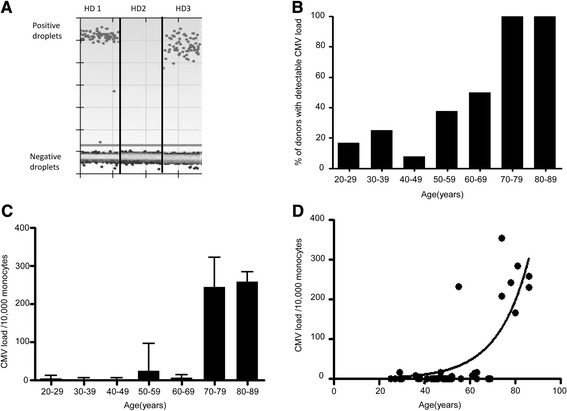
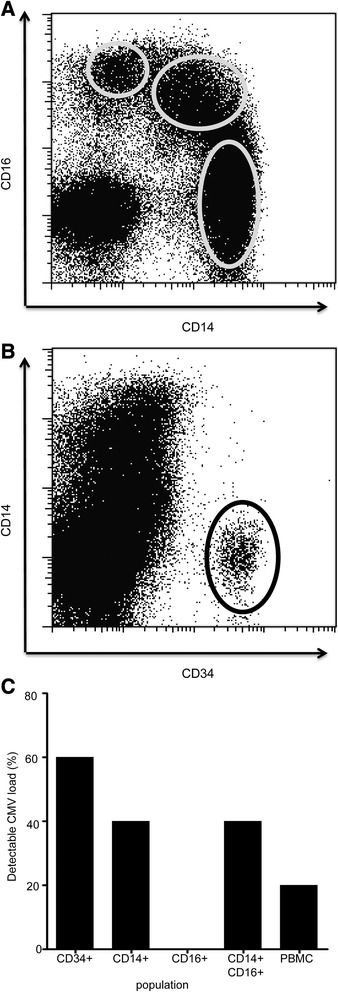
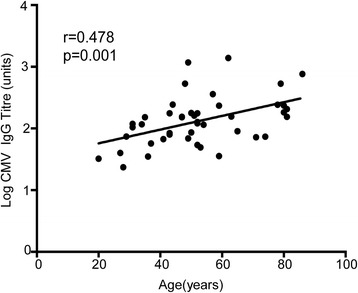
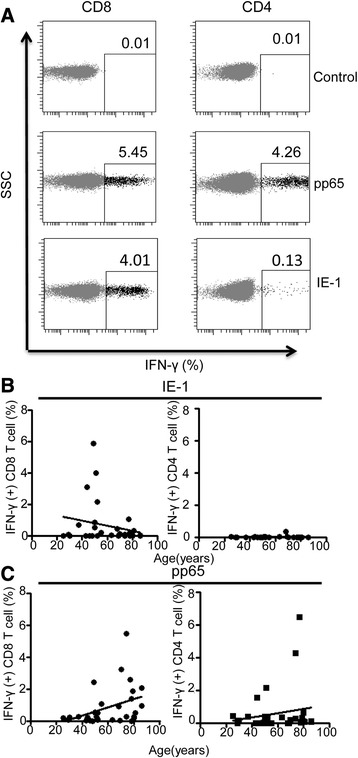
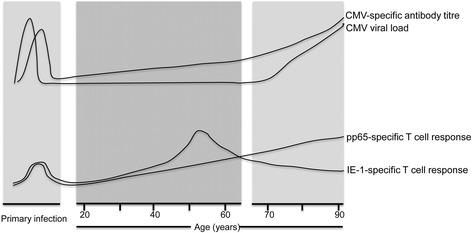
BACKGROUND: Cytomegalovirus (CMV) is a highly prevalent herpesvirus, which maintains lifelong latency and places a significant burden on host immunity. Infection is associated with increased rates of vascular disease and overall mortality in the elderly and there is an urgent need for improved understanding of the viral-host balance during ageing. CMV is extremely difficult to detect in healthy donors, however, using droplet digital PCR of DNA from peripheral blood monocytes, we obtained an absolute quantification of viral load in 44 healthy donors across a range of ages. RESULTS: Viral DNA was detected in 24 % (9/37) of donors below the age of 70 but was found in all individuals above this age. Furthermore, the mean CMV load was only 8.6 copies per 10,000 monocytes until approximately 70 years of age when it increased by almost 30 fold to 249 copies in older individuals (p < 0.0001). CMV was found within classical CD14+ monocytes and was not detectable within the CD14-CD16+ subset. The titre of CMV-specific IgG increased inexorably with age indicating that loss of humoral immunity is not a determinant of the increased viral load. In contrast, although cellular immunity to the structural late protein pp65 increased with age, the T cell response to the immediate early protein IE1 decreased in older donors. CONCLUSION: These data reveal that effective control of CMV is impaired during healthy ageing, most probably due to loss of cellular control of early viral reactivation. This information will be of value in guiding efforts to reduce CMV-associated health complications in the elderly.
Overview
The claims and statistics of this paper haven’t been checked yet.
Run the check — free, no account needed. It reads the open-access text and checks the sources it cites.
Integrity signals
Registry
Cites
Statistics
Figures
Verification
Claims the paper makes
The claims and statistics of this paper haven’t been checked yet.
Run the check — free, no account needed. It reads the open-access text and checks the sources it cites.
Claims other papers make about this one
Each is checked against this paper’s own text: does it say what the citing paper says it does?
In the citing paper
“However, there may be a slight loss of control of HCMV replication in older compared with younger people.”
From Immunosenescence and Its Hallmarks: How to Oppose Aging Strategically? A Review of Potential Options for Therapeutic Intervention (2019) · cites this paper as [53]
In the citing paper
“In fact, HCMV load in blood markedly increases in healthy people over the age of 70 years (53).”
From Immunosenescence and Its Hallmarks: How to Oppose Aging Strategically? A Review of Potential Options for Therapeutic Intervention (2019) · cites this paper as [53]
Self-check
Percentages, sums and reported differences re-computed from the paper’s own numbers.
The self-check needs the paper’s full text.
Citations
Cites
Nomenclature of monocytes and dendritic cells in blood
Ziegler‐Heitbrock, L., Ancuța, P., Crowe, S. M., Dalod, M., Grau, V., Hart, D. N. J., Leenen, P. J. M., Liu, Y.-J., MacPherson, G. G., Randolph, G. J., et al. (2010) · Blood · doi:10.1182/blood-2010-02-258558 · Cited by 2,436
Seroprevalence of Cytomegalovirus Infection in the United States, 1988-1994
Staras, S. A. S., Dollard, S. C., Radford, K. W., Flanders, W. D., Pass, R. F., & Cannon, M. J. (2006) · Clinical Infectious Diseases · doi:10.1086/508173 · Cited by 1,008
Khan, N., Shariff, N., Cobbold, M., Bruton, R., Ainsworth, J. A., Sinclair, A. J., Nayak, L., & Moss, P. A. H. (2002) · The Journal of Immunology · doi:10.4049/jimmunol.169.4.1984 · Cited by 754
Self-citationTaylor‐Wiedeman, J., Sissons, J. G. P., Borysiewicz, L. K., & Sinclair, J. H. (1991) · Journal of General Virology · doi:10.1099/0022-1317-72-9-2059 · Cited by 700
Cytomegalovirus remains latent in a common precursor of dendritic and myeloid cells
Hahn, G., Jores, R. D., & Mocarski, E. S. (1998) · Proceedings of the National Academy of Sciences · doi:10.1073/pnas.95.7.3937 · Cited by 514
Wikby, A. (2002) · Experimental Gerontology · doi:10.1016/s0531-5565(01)00212-1 · Cited by 414
Reeves, M. B., MacAry, P. A., Lehner, P. J., Sissons, J. G. P., & Sinclair, J. H. (2005) · Proceedings of the National Academy of Sciences · doi:10.1073/pnas.0408994102 · Cited by 360
Human cytomegalovirus latent infection of granulocyte-macrophage progenitors.
Kondo, K., Kaneshima, H., & Mocarski, E. S. (1994) · Proceedings of the National Academy of Sciences · doi:10.1073/pnas.91.25.11879 · Cited by 355
Human T Cell Aging and the Impact of Persistent Viral Infections
Fülöp, T., Larbi, A., & Pawelec, G. (2013) · Frontiers in Immunology · doi:10.3389/fimmu.2013.00271 · Cited by 347
Roberts, E. T., Haan, M. N., Dowd, J. B., & Aiello, A. E. (2010) · American Journal of Epidemiology · doi:10.1093/aje/kwq177 · Cited by 281
Cited by
Sorted by citations
Aiello, A., Farzaneh, F., Candore, G., Caruso, C., Davinelli, S., Gambino, C. M., Ligotti, M. E., Zareian, N., & Accardi, G. (2019) · Frontiers in Immunology · doi:10.3389/fimmu.2019.02247 · Cited by 693
Lymphopenia in severe coronavirus disease-2019 (COVID-19): systematic review and meta-analysis
Huang, I., & Pranata, R. (2020) · Journal of Intensive Care · doi:10.1186/s40560-020-00453-4 · Cited by 662
T cell responses to cytomegalovirus
Klenerman, P., & Oxenius, A. (2016) · Nature Reviews Immunology · doi:10.1038/nri.2016.38 · Cited by 483
Droplet digital PCR of viral DNA/RNA, current progress, challenges, and future perspectives
Kojabad, A. A., Farzanehpour, M., Galeh, H. E. G., Dorostkar, R., Jafarpour, A., Bolandian, M., & Nodooshan, M. M. (2021) · Journal of Medical Virology · doi:10.1002/jmv.26846 · Cited by 307
Cytomegalovirus Latency and Reactivation: An Intricate Interplay With the Host Immune Response
Forte, E., Zhang, Z., Thorp, E. B., & Hummel, M. (2020) · Frontiers in Cellular and Infection Microbiology · doi:10.3389/fcimb.2020.00130 · Cited by 284
Metadata
- Authors
- Parry, H. M., Zuo, J., Frumento, G., Mirajkar, N., Inman, C., Edwards, E., Griffiths, M., Pratt, G., & Moss, P.
- Affiliations
- University of Birmingham (GB)
- Birmingham Women's Hospital (GB)
- University Hospitals Birmingham NHS Foundation Trust (GB)
- Corresponding author
- Parry, Helen M.
- Venue
- Immunity & Ageing
- Published
- 2016-01-05
- Volume
- 13
- Issue
- 1
- Pages
- 1-1
- ISSN
- 1742-4933 (ISSN-L)
- PMC
- PMC4700608
- OpenAlex
- W2222815228
- Cited by
- 125
- References
- 44
- Citations by year
- 2026: 5 · 2025: 7 · 2024: 8 · 2023: 7 · 2022: 2 · 2021: 24 · 2020: 14 · 2019: 21 · 2018: 10 · 2017: 19 · 2016: 8
- FWCI
- 18.12
- Type
- journal article
- Language
- en
- Open access
- gold
- doi.org
- Licence
- cc-by
- Locations
- Immunity & Ageing (publishedVersion, cc-by)
- PubMed Central (publishedVersion, cc-by)
- PubMed (publishedVersion)
- Worcester Research and Publications (University of Worcester) (acceptedVersion)
- University of Birmingham Research Portal (University of Birmingham) (submittedVersion, cc-by)
- Funders
- Wellcome Trust
- Topics
- Health Sciences › Medicine › Epidemiology › Cytomegalovirus and herpesvirus research
- Health Sciences › Medicine › Infectious Diseases › Herpesvirus Infections and Treatments
- Health Sciences › Medicine › Oncology › Viral-associated cancers and disorders
- Keywords
- cytomegalovirus, viral load, aging, healthy older adults, peripheral blood monocytes, CD14+ monocytes, viral latency, viral reactivation, pp65, IE1, T cell response, humoral immunity, cell-mediated immunity, herpesvirus
About these checks
Registry, retraction, Cites and statistics results are computed, not judged, with one exception: a printed reference that no index lists is read once by a model before it counts as a citation error. Claims are extracted by a model and kept only when their quote appears verbatim in the text; each cited source is then checked, with a model’s help, for whether it says what the claim relies on. Those verdicts can be wrong — read the claim’s quote and the cited source before relying on one.
Statistics and arithmetic are recomputed, not judged.
Confidence bands are shown only for fields calibrated on our annotated test set. None is calibrated yet, so no band is shown.
What counts as a claim ›How we measure confidence ›How we check this ›
Are you an author, or do you see a problem with this page? Request a review
