

The DOI matches its Crossref record; 64 of the 64 references it cites were found in a registry or an index.
Interleukin-6 and C-reactive protein, successful aging, and mortality: the PolSenior study
Open accessAbstract
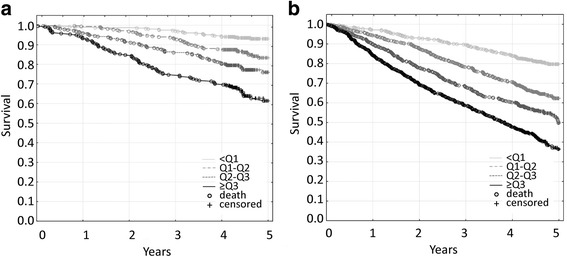
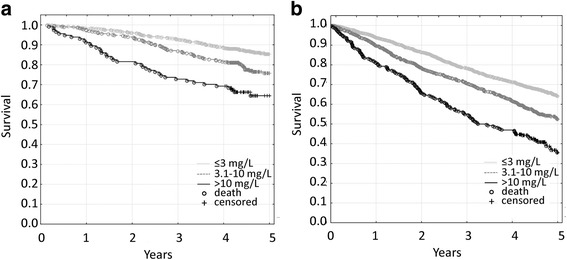
BACKGROUND: In the elderly, chronic low-grade inflammation (inflammaging) is a risk factor for the development of aging-related diseases and frailty. Using data from several thousand Eastern Europeans aged 65 years and older, we investigated whether the serum levels of two proinflammatory factors, interleukin-6 (IL-6) and C-reactive protein (CRP), were associated with physical and cognitive performance, and could predict mortality in successfully aging elderly. RESULTS: IL-6 and CRP levels systematically increased in an age-dependent manner in the entire study group (IL-6: n = 3496 individuals, p < 0.001 and CRP: n = 3632, p = 0.003), and in the subgroup of successfully aging individuals who had never been diagnosed with cardiovascular disease, myocardial infarction, stroke, type 2 diabetes, or cancer, and had a Mini Mental State Examination (MMSE) score ≥24 and a Katz Activities of Daily Living (ADL) score ≥5 (IL-6: n = 1258, p < 0.001 and CRP: n = 1312, p < 0.001). In the subgroup of individuals suffering from aging-related diseases/disability, only IL-6 increased with age (IL-6: n = 2238, p < 0.001 and CRP: n = 2320, p = 0.249). IL-6 and CRP levels were lower in successfully aging individuals than in the remaining study participants (both p < 0.001). Higher IL-6 and CRP levels were associated with poorer physical performance (lower ADL score) and poorer cognitive performance (lower MMSE score) (both p < 0.001). This association remained significant after adjusting for age, gender, BMI, lipids, estimated glomerular filtration rate, and smoking status. Longer survival was associated with lower concentrations of IL-6 and CRP not only in individuals with aging-related diseases/disability (HR = 1.063 per each pg/mL, 95 % CI: 1.052-1.074, p < 0.001 and HR = 1.020 per each mg/L, 95 % CI: 1.015-1.025, p < 0.001, respectively) but also in the successfully aging subgroup (HR = 1.163 per each pg/mL, 95 % CI: 1.128-1.199, p < 0.001 and HR = 1.074 per each mg/L, 95 % CI: 1.047-1.100, p < 0.001, respectively). These associations remained significant after adjusting for age, gender, BMI, lipids and smoking status. The Kaplan-Meier survival curves showed similar results (all p < 0.001). CONCLUSIONS: Both IL-6 and CRP levels were good predictors of physical and cognitive performance and the risk of mortality in both the entire elderly population and in successfully aging individuals.
Overview
The claims and statistics of this paper haven’t been checked yet.
Run the check — free, no account needed. It reads the open-access text and checks the sources it cites.
Integrity signals
Registry
Cites
Statistics
Figures
Verification
Claims the paper makes
The claims and statistics of this paper haven’t been checked yet.
Run the check — free, no account needed. It reads the open-access text and checks the sources it cites.
Claims other papers make about this one
Each is checked against this paper’s own text: does it say what the citing paper says it does?
The source backs part of the claim, not all of it — or backs it for a different population, condition or comparison.
In the citing paper
“In the serum of healthy adults, IL-6 is normally lower than 2 pg/mL or undetectable, while a gradual increment of serum IL-6 amounts with advancing ages (Fig. 3) [39, 40].”
From The double-edged effects of IL-6 in liver regeneration, aging, inflammation, and diseases (2024) · cites this paper as [39]
Experimental — accuracy not yet measuredIn the citing paper
“This leads to an increased production of pro-inflammatory cytokines and acute phase proteins (59, 60).”
From Immunosenescence and Its Hallmarks: How to Oppose Aging Strategically? A Review of Potential Options for Therapeutic Intervention (2019) · cites this paper as [59]
In the citing paper
“Chronic and low-grade inflammation can lead to tissue dysfunction and degeneration.”
From Immunosenescence and Its Hallmarks: How to Oppose Aging Strategically? A Review of Potential Options for Therapeutic Intervention (2019) · cites this paper as [59]
In the citing paper
“In the course of aging, there is a reduction in the ability to endure consequences of antigenic, chemical, physical, and nutritional triggers of inflammation.”
From Immunosenescence and Its Hallmarks: How to Oppose Aging Strategically? A Review of Potential Options for Therapeutic Intervention (2019) · cites this paper as [59]
Self-check
Percentages, sums and reported differences re-computed from the paper’s own numbers.
The self-check needs the paper’s full text.
Citations
Cites
Folstein, M. F., Folstein, S. E., & McHugh, P. R. (1975) · Journal of Psychiatric Research · doi:10.1016/0022-3956(75)90026-6 · Cited by 88,282
Hirono, N., Mori, E., Ikejiri, Y., Imamura, T., Shimomura, T., Hashimoto, M., Yamashita, H., & Ikeda, M. (1997) · PubMed · Cited by 21,012
Kok, J. S., Berg, I. J., & Scherder, E. J. A. (2013) · Dementia and Geriatric Cognitive Disorders Extra · doi:10.1159/000353441 · Cited by 20,589
Older Adults' Reasons for Using Technology while Aging in Place
Peek, S. T. M., Luijkx, K. G., Rijnaard, M. D., Nieboer, M. E., van der Voort, C. S., Aarts, S., van Hoof, J., Vrijhoef, H. J., & Wouters, E. (2015) · Gerontology · doi:10.1159/000430949 · Cited by 19,852
Sensitivity and False Alarm Rate of a Fall Sensor in Long-Term Fall Detection in the Elderly
Kangas, M., Korpelainen, R., Vikman, I., Nyberg, L., & Jämsä, T. J. (2014) · Gerontology · doi:10.1159/000362720 · Cited by 19,007
Xu, H., Barnes, G. T., Yang, Q., Tan, G., Yang, D., Chou, C. J., Sole, J., Nichols, A., Ross, J. S., Tartaglia, L. A., et al. (2003) · Journal of Clinical Investigation · doi:10.1172/jci200319451 · Cited by 6,760
Katz, S. (1963) · JAMA · doi:10.1001/jama.1963.03060120024016 · Cited by 2,421
Fatty acid–induced NLRP3-ASC inflammasome activation interferes with insulin signaling
Wen, H., Gris, D., Lei, Y., Jha, S., Zhang, L., Huang, M. T.-H., Brickey, W. J., & Ting, J. P.-Y. (2011) · Nature Immunology · doi:10.1038/ni.2022 · Cited by 1,698
Through Ageing, and Beyond: Gut Microbiota and Inflammatory Status in Seniors and Centenarians
Biagi, E., Nylund, L., Candela, M., Ostan, R., Bucci, L., Pini, E., Nikkïla, J., Monti, D., Satokari, R., Franceschi, C., et al. (2010) · PLoS ONE · doi:10.1371/journal.pone.0010667 · Cited by 1,483
Vasan, R. S., SULLIVAN, L. M., Roubenoff, R., Dinarello, C. A., Harris, T. B., Benjamin, E. J., Sawyer, D. B., Levy, D. A., Wilson, P. W. F., & D’Agostino, R. B. (2003) · Circulation · doi:10.1161/01.cir.0000057810.48709.f6 · Cited by 763
Cited by
Sorted by citations
Age and Age-Related Diseases: Role of Inflammation Triggers and Cytokines
Rea, I. M., Gibson, D. S., McGilligan, V., McNerlan, S. E., Alexander, H. D., & Ross, O. A. (2018) · Frontiers in Immunology · doi:10.3389/fimmu.2018.00586 · Cited by 1,267
Antioxidant and Oxidative Stress: A Mutual Interplay in Age-Related Diseases
Tan, B. L., Norhaizan, M. E., Liew, W.-P.-P., & Rahman, H. S. (2018) · Frontiers in Pharmacology · doi:10.3389/fphar.2018.01162 · Cited by 1,221
Immunosenescence: molecular mechanisms and diseases
Liu, Z., Liang, Q., Ren, Y., Guo, C., Ge, X., Wang, L., Cheng, Q., Luo, P., Zhang, Y., & Han, X. (2023) · Signal Transduction and Targeted Therapy · doi:10.1038/s41392-023-01451-2 · Cited by 1,082
Aiello, A., Farzaneh, F., Candore, G., Caruso, C., Davinelli, S., Gambino, C. M., Ligotti, M. E., Zareian, N., & Accardi, G. (2019) · Frontiers in Immunology · doi:10.3389/fimmu.2019.02247 · Cited by 693
The Role of Inflammation in Age-Related Sarcopenia
Dalle, S., Rossmeislova, L., & Koppo, K. (2017) · Frontiers in Physiology · doi:10.3389/fphys.2017.01045 · Cited by 668
Metadata
- Authors
- Puzianowska-Kuźnicka, M., Owczarz, M., Wieczorowska-Tobis, K., Nadrowski, P., Chudek, J., Slusarczyk, P., Skalska, A., Jonas, M., Franek, E., & Mossakowska, M.
- Affiliations
- International Institute of Molecular and Cell Biology (PL)
- Medical University of Silesia (PL)
- Jagiellonian University (PL)
- Mossakowski Medical Research Institute, Polish Academy of Sciences (PL)
- Venue
- Immunity & Ageing
- Published
- 2016-06-03
- Volume
- 13
- Issue
- 1
- Pages
- 21-21
- ISSN
- 1742-4933 (ISSN-L)
- PMC
- PMC4891873
- OpenAlex
- W2416122254
- Cited by
- 445
- References
- 64
- Citations by year
- 2026: 27 · 2025: 53 · 2024: 61 · 2023: 63 · 2022: 62 · 2021: 55 · 2020: 41 · 2019: 28 · 2018: 32 · 2017: 19 · 2016: 4
- FWCI
- 48.26
- Type
- journal article
- Language
- en
- Open access
- gold
- doi.org
- Licence
- cc-by
- Locations
- Immunity & Ageing (publishedVersion, cc-by)
- PubMed Central (publishedVersion, cc-by)
- PubMed (publishedVersion)
- Jagiellonian University Repository (Jagiellonian University) (submittedVersion, cc-by-nc-nd)
- Jagiellonian University Repository (Jagiellonian University) (submittedVersion, other-oa)
- Homo Politicus (Academy of Humanities and Economics in Lodz) (submittedVersion, cc-by-nc-nd)
- Funders
- Polish Ministry of Science and Higher Education (PBZ-MEiN-9/2/2006 – K143/P01/2007/1)
- Topics
- Social Sciences › Psychology › Developmental and Educational Psychology › Aging and Gerontology Research
- Health Sciences › Medicine › Geriatrics and Gerontology › Frailty in Older Adults
- Life Sciences › Biochemistry, Genetics and Molecular Biology › Aging › Genetics, Aging, and Longevity in Model Organisms
- Keywords
- interleukin-6, C-reactive protein, inflammaging, successful aging, mortality, older adults, physical performance, activities of daily living, cognitive performance, Mini-Mental State Examination, frailty, age-related diseases, Eastern Europe, aging biomarkers, cardiovascular disease, type 2 diabetes, cancer, smoking, glomerular filtration rate, body mass index
About these checks
Registry, retraction, Cites and statistics results are computed, not judged, with one exception: a printed reference that no index lists is read once by a model before it counts as a citation error. Claims are extracted by a model and kept only when their quote appears verbatim in the text; each cited source is then checked, with a model’s help, for whether it says what the claim relies on. Those verdicts can be wrong — read the claim’s quote and the cited source before relying on one.
Statistics and arithmetic are recomputed, not judged.
Confidence bands are shown only for fields calibrated on our annotated test set. None is calibrated yet, so no band is shown.
What counts as a claim ›How we measure confidence ›How we check this ›
Are you an author, or do you see a problem with this page? Request a review
