

Benefits of virtual reality based cognitive rehabilitation through simulated activities of daily living: a randomized controlled trial with stroke patients
Open accessThe DOI matches its Crossref record; 58 of the 59 references it cites were found in a registry or an index.
Abstract
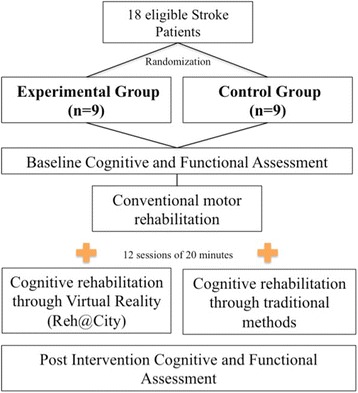
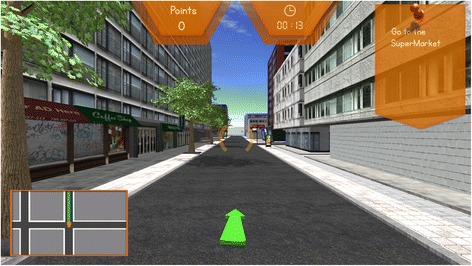
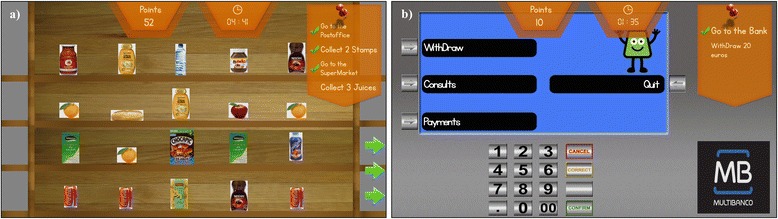
BACKGROUND: Stroke is one of the most common causes of acquired disability, leaving numerous adults with cognitive and motor impairments, and affecting patients' capability to live independently. There is substancial evidence on post-stroke cognitive rehabilitation benefits, but its implementation is generally limited by the use of paper-and-pencil methods, insufficient personalization, and suboptimal intensity. Virtual reality tools have shown potential for improving cognitive rehabilitation by supporting carefully personalized, ecologically valid tasks through accessible technologies. Notwithstanding important progress in VR-based cognitive rehabilitation systems, specially with Activities of Daily Living (ADL's) simulations, there is still a need of more clinical trials for its validation. In this work we present a one-month randomized controlled trial with 18 stroke in and outpatients from two rehabilitation units: 9 performing a VR-based intervention and 9 performing conventional rehabilitation. METHODS: The VR-based intervention involved a virtual simulation of a city - Reh@City - where memory, attention, visuo-spatial abilities and executive functions tasks are integrated in the performance of several daily routines. The intervention had levels of difficulty progression through a method of fading cues. There was a pre and post-intervention assessment in both groups with the Addenbrooke Cognitive Examination (primary outcome) and the Trail Making Test A and B, Picture Arrangement from WAIS III and Stroke Impact Scale 3.0 (secondary outcomes). RESULTS: A within groups analysis revealed significant improvements in global cognitive functioning, attention, memory, visuo-spatial abilities, executive functions, emotion and overall recovery in the VR group. The control group only improved in self-reported memory and social participation. A between groups analysis, showed significantly greater improvements in global cognitive functioning, attention and executive functions when comparing VR to conventional therapy. CONCLUSIONS: Our results suggest that cognitive rehabilitation through the Reh@City, an ecologically valid VR system for the training of ADL's, has more impact than conventional methods. TRIAL REGISTRATION: This trial was not registered because it is a small sample study that evaluates the clinical validity of a prototype virtual reality system.
Overview
The claims and statistics of this paper haven’t been checked yet.
Free: it reads the open-access text and checks the first 5 claims that cite a source we can check. Create a free account to check every claim.
Integrity signals
Registry
Cites
Statistics
Figures
Verification
Claims the paper makes
The claims and statistics of this paper haven’t been checked yet.
Free: it reads the open-access text and checks the first 5 claims that cite a source we can check. Create a free account to check every claim.
Claims other papers make about this one
Each is checked against this paper’s own text: does it say what the citing paper says it does?
The source backs part of the claim, not all of it — or backs it for a different population, condition or comparison.
In the citing paper
“Furthermore, VR’s immersive nature promotes participant engagement and naturalistic behavior, potentially improving assessment accuracy [12].”
From Enhancing Ecological Validity: Virtual Reality Assessment of Executive Functioning in Children and Adolescents with ADHD (2024) · cites this paper as [12]
Experimental — accuracy not yet measured
Self-check
Percentages, sums and reported differences re-computed from the paper’s own numbers.
The self-check needs the paper’s full text.
Citations
Cites
Folstein, M. F., Folstein, S. E., & McHugh, P. R. (1975) · Journal of Psychiatric Research · doi:10.1016/0022-3956(75)90026-6 · Cited by 88,282
Hirono, N., Mori, E., Ikejiri, Y., Imamura, T., Shimomura, T., Hashimoto, M., Yamashita, H., & Ikeda, M. (1997) · Brain and nerve · Cited by 21,039
Kok, J. S., Berg, I. J., & Scherder, E. J. A. (2013) · Dementia and Geriatric Cognitive Disorders Extra · doi:10.1159/000353441 · Cited by 20,589
Older Adults' Reasons for Using Technology while Aging in Place
Peek, S. T. M., Luijkx, K. G., Rijnaard, M. D., Nieboer, M. E., van der Voort, C. S., Aarts, S., van Hoof, J., Vrijhoef, H. J. M., & Wouters, E. J. M. (2016) · Gerontology · doi:10.1159/000430949 · Cited by 19,690
Sensitivity and False Alarm Rate of a Fall Sensor in Long-Term Fall Detection in the Elderly
Kangas, M., Korpelainen, R., Vikman, I., Nyberg, L., & Jämsä, T. (2015) · Gerontology · doi:10.1159/000362720 · Cited by 18,909
SUS: A 'Quick and Dirty' Usability Scale
(1996) · Usability Evaluation In Industry · doi:10.1201/9781498710411-35 · Cited by 8,989
Validity of the Trail Making Test as an Indicator of Organic Brain Damage
Reitan, R. M. (1958) · Perceptual and Motor Skills · doi:10.2466/pms.1958.8.3.271 · Cited by 7,928
An Empirical Evaluation of the System Usability Scale
Bangor, A., Kortum, P. T., & Miller, J. T. (2008) · International Journal of Human–Computer Interaction · doi:10.1080/10447310802205776 · Cited by 5,181 · cited 1×
“Final scores for the SUS can range from 0 to 100, where higher scores indicate better usability: 90s is exceptional, 80s is good and 70s is acceptable [50].”
BackgroundWechsler Adult Intelligence Scale-III
Ryan, J. J., & Lopez, S. J. (2001) · Understanding Psychological Assessment · doi:10.1007/978-1-4615-1185-4_2 · Cited by 3,731
Trail Making Test A and B: normative data stratified by age and education
Tombaugh, T. (2004) · Archives of Clinical Neuropsychology · doi:10.1016/s0887-6177(03)00039-8 · Cited by 3,239 · cited 1×
“The fact that this test is highly influenced by schooling [54] and that our sample had few years of education might explain the persistence of low performance in this test from pre to post assessment.”
Background
Research works printed but not linked: 4
- Kizony R Korman M Sinoff G Klinger E Josman N Using a virtual supermarket as a tool for training executive functions in people with mild cognitive impairment 2012 Laval 9th ICDVRAT
- Chirivella J del Barco A Blasco S Penades V Mas G Gagliardo P Neuro@ home [ii]: A software platform of clinically designed videogames designed for the cognitive rehabilitation of stroke patients Brain Injury 2014 517 878
- Guerreiro M Silva AP Botelho MA Leitão O Castro-Caldas A Garcia C Adaptação à população portuguesa da tradução do Mini Mental State Examination (MMSE) Revista Portuguesa de Neurologia 1994 1 9 9 10
- Research Randomizer [Internet] Research randomizer 2016
Cited by
Items 301–374 of 374
The use of eHealth in rehabilitation after stroke
Wentink, M. M. (2019) · Leiden Repository (Leiden University)
Alvarez, A. G. (2020) · RUC (Universidade Da Coruña)
Non-immersive virtual reality therapy in post-stroke patients a quick review
Roman, N. A. (2020) · Sciendo eBooks · doi:10.2478/9788395815065-035
Li, Z., Hu, Z., Jiang, Y., Zhang, X., & He, H. (2021) · International Conference on Virtual Reality · doi:10.1109/icvr51878.2021.9483816
Cognitive Performance in Immersive Environments After Acquired Brain Injury
van der Ham, I. J. M. (2021) · Advances in medical technologies and clinical practice book series · doi:10.4018/978-1-7998-7430-0.ch012
Technologies for the Rehabilitation of People Affected with CVM: A State-of-the-Art Report
Sarkar, A. R., Sanyal, G., & Majumder, S. (2021) · Springer eBooks · doi:10.1007/978-3-030-77070-9_7
(2019) · Asia-Pacific Biotech News · doi:10.1142/s0219030319000521
Li, S., Sun, B., Wei, N., Shen, Z., Jin, K., Zhao, H., Chen, Y., Huang, M., & Xu, Y. (2020) · Research Square · doi:10.21203/rs.3.rs-49234/v1
Influence of inherent parameters within virtual systems on cognitive rehabilitation
Santamaría, M., Aldás, J. V., & Palacios-Navarro, G. (2022) · Congreso de Tecnología, Aprendizaje y Enseñanza de la Electrónica (TAEE) · doi:10.1109/taee54169.2022.9840719
Yu, Z. Y. (2022) · International Journal of Applied Research on Public Health Management · doi:10.4018/ijarphm.315610
Identifying applications of virtual reality to benefit the stroke translational pipeline
Bone, M., Malik, M., & Crilly, S. (2023) · Brain and Neuroscience Advances · doi:10.1177/23982128231182506
Shellfish Catchers’ Health in Relation to Their Biological Cycles
García, M. D. R. (2023) · University of Maribor, University Press eBooks · doi:10.18690/um.4.2023.50
Teixeira, I., Branco, D., & Badia, S. B. I. (2024) · Procedia Computer Science · doi:10.1016/j.procs.2024.06.327
CARRASCOSA, M. L. R., Rocha, L. A., Fernandes, V. N. M., Gomes, E. C., Leite, A. P. M. C., Dissenha, L. F. P., COELHO, M. E. G., & da Silva, T. G. F. (2024) · Revista Contemporânea · doi:10.56083/rcv4n8-109
Lorenzo, V. D., Famulari, R., & Ussorio, D. (2024) · RIVISTA SPERIMENTALE DI FRENIATRIA · doi:10.3280/rsf2024-003002
Hemşirelik Eğitiminde Sanal Gerçeklik
Taşçı, Ö. (2024) · Bidge Yayınları eBooks · doi:10.70269/10.70269/9153783917
The Clinical Case of Baby Joseph: Embrace and Nurture Social Skills in Autism in a Pos Pandemic Era
Soares, L. (2023) · Journal of pharmacology & clinical research · doi:10.19080/jpcr.2023.09.555770
Self-citationFox, S., Fisk, A., & Blustein, D. H. (2025) · PsyArXiv (OSF Preprints) · doi:10.31234/osf.io/mafrs_v1
Janavičiūtė, J., Paulauskas, A., & Šinkariova, L. (2026) · Journal of Cognitive Enhancement · doi:10.1007/s41465-026-00362-8
Fox, S., Blustein, D. H., & Fisk, A. (2025) · PsyArXiv (OSF Preprints) · doi:10.31234/osf.io/mafrs_v2
A Serious Game with Leap Motion for Hand Motor Function Assessment
Shan, X., Liu, T., & Liu, Z. (2025) · International Conference on Applied Mathematics, Modelling and Intelligent Computing (CAMMIC) · doi:10.1145/3745533.3745622
Daniswari, A., Azam, M., & Rahayu, S. R. (2025) · Public Health Perspective Journal · doi:10.15294/phpj.v9i1.19981
Benn, Y., Kountouriotis, G. K., Christin-Pavel, V., Hussain, M., Dibley, T., Jayes, M., & Cetinkaya, B. (2026) · Brain Sciences · doi:10.3390/brainsci16090940
Zhao, Q., Wang, X., Wang, T., Dmytriw, A. A., Zhang, X., Yang, K., Luo, J., Bai, X., Jiang, N., Yang, B., et al. (2021) · Figshare · doi:10.6084/m9.figshare.14168578
Zhao, Q., Wang, X., Wang, T., Dmytriw, A. A., Zhang, X., Yang, K., Luo, J., Bai, X., Jiang, N., Yang, B., et al. (2021) · Figshare · doi:10.6084/m9.figshare.14168572
Johansen, T., Matre, M., Løvstad, M., Lund, A., Martinsen, A. C., Olsen, A., Becker, F., Brunborg, C., Ponsford, J., Spikman, J., et al. (2024) · Figshare · doi:10.6084/m9.figshare.25884993
Zhao, Q., Wang, X., Wang, T., Dmytriw, A. A., Zhang, X., Yang, K., Luo, J., Bai, X., Jiang, N., Yang, B., et al. (2021) · Figshare · doi:10.6084/m9.figshare.14168566
Zhao, Q., Wang, X., Wang, T., Dmytriw, A. A., Zhang, X., Yang, K., Luo, J., Bai, X., Jiang, N., Yang, B., et al. (2021) · Figshare · doi:10.6084/m9.figshare.14168557
Endresen, M. (2019) · NVA (Nasjonalt vitenarkiv)
VR-teknologi og slagrehabilitering
10015, 1. (2019) · NORA - Norwegian Open Research Archives
Harrison, B. A., Preissler, A. A., Rogers, E., & Singh, A. D. (2023) · DigitalCommons@UNMC
Faria, A. L. D. S. (2020) · Portuguese National Funding Agency for Science, Research and Technology (RCAAP Project by FCT)
Self-citationdisseny i desenvolupament d'un programa d'exercicis de realitat virtual en l'àmbit geriàtric
Perez Mesquida, M. E. (2024) · Tesis Doctorals en Xarxa (Consorci de Serveis Universitaris de Catalunya)
Фізична терапія пацієнтів похилого віку з ішемічним інсультом у довготривалому періоді
Коваленко, А. М. (2024) · Electronic Sumy State University Institutional Repository (Sumy State University)
Altunok, M. K., Kurt, A. K., Aydın, S., Göçen, H. B., Albayrak, H. E., Kethüdaoğlu, M. O., & Özmen, S. (2024) · Journal of Experimental and Clinical Medicine
Delin, S., & Strandberg, E. (2025) · DiVA (Digitala Vetenskapliga Arkivet)
Sellner, T. (2025) · heiDOK (Heidelberg University) · doi:10.11588/heidok.00037383
Development of Biofeedback-based Virtual Reality Therapies, Research of Efficiency and Presence
Szabó, P. (2025) · REAL-PhD (Hungarian Academy of Sciences) · doi:10.18136/pe.2025.953
Buele León, J. L., & Palacios Navarro, G. (2025) · Zaguan (University of Zaragoza Repository)
Ayuso, D. M. R., Vidal-Ramírez, C., Pérez-Rodríguez, S., del Pino, A., Triviño-Juárez, J. M., Celdrán, F. J., & González, P. (2025) · Disability and Rehabilitation Assistive Technology · doi:10.1080/17483107.2025.2607061
Matczak, S., Namysł, M., Woźniak, K., Bieniek, M., Dachowska, S., Haraj, J., Sobkowiak, M., & Fałczyńska, A. (2026) · Journal of Education Health and Sport · doi:10.12775/jehs.2026.87.67605
Virtual Reality as a Potential Cornerstone for Remote Rehabilitative Therapies
Nataraj, R. (2026) · Encyclopedia · doi:10.3390/encyclopedia6020037
Rodrigues, M. G. (2025) · Portuguese National Funding Agency for Science, Research and Technology (RCAAP Project by FCT)
Alnaaim, S. (2025) · Journal of Carcinogenesis · doi:10.64149/j.carcinog.24.5s.334-357
Baltaduonienė, D. (2019) · Lithuanian University of Health Sciences
Effect of robot-assisted training on cognitive function in post-stroke patients: a meta-analysis
Wang, J., Ding, M., Weng, C., & Cai, H. (2026) · Frontiers in Neurology · doi:10.3389/fneur.2026.1725457
Chen, Y., & Blasch, E. (2024) · Directory of Open access Books (OAPEN Foundation)
Designing Virtual Reality Grocery Shopping Services for Older Adults: An Exploratory Study
Yin, Y., Wei, X., Li, Y., Yao, S., Bian, J., Niu, J., & Pan, L. (2025) · International Association of Societies of Design Research Congress (IASDR) · doi:10.21606/iasdr.2025.644
Virtual Based Physiotheraphy – A Software Driven Appoarch to Rehabilitation
Mankar, B., Madireddy, L., Kinkar, V., Tadas, N., & Gulhane, D. S. D. (2026) · International Conference on Emerging Trends and Innovations in ICT (ICEI) · doi:10.1109/icei65890.2026.11448082
VRN-Back: An Immersive Music Rhythm Game for Working Memory Training in Virtual Reality
Jiang, H., Luo, L., Guo, J., Liu, Z., Zhu, W., Weng, D., Song, W., & Duh, H. B. (2026) · IEEE Transactions on Visualization and Computer Graphics · doi:10.1109/tvcg.2026.3680633
Use of Virtual Reality for Vocational and Cognitive Rehabilitation after Breast Cancer
Hummel, E. (2024) · theses.fr (ABES) · doi:10.70675/31718e92zc9bbz431eza61az7daaa34a6a0e
Lebely, C. (2024) · theses.fr (ABES) · doi:10.70675/1553fb2azddb4z417az9074z08786663336b
Virtual Reality Therapy and Virtual Reality Mirror Therapy in Post-stroke Rehabilitation: A Review
Neal, C. (2026) · Archives of Physical Medicine and Rehabilitation · doi:10.1016/j.apmr.2026.02.255
Emotional Daily Life Library (E-DLL): Validation of a database of 3D objects for emotion elicitation
Branco, D., Fernandes, M. C., Badia, S. B. I., & Faria, A. L. D. (2026) · International Journal of Clinical and Health Psychology · doi:10.1016/j.ijchp.2026.100690
Self-citationJin, W., Niu, X., Liu, Y., Zhu, Z., Gao, Z., Wang, S., Meng, D., Zhu, X., Wang, H., Wang, L., et al. (2026) · Frontiers in Neurology · doi:10.3389/fneur.2026.1880696
Sun, Q., Wang, C., Zhang, Q., & Bai, Y. (2026) · Healthcare and Rehabilitation · doi:10.1016/j.hcr.2026.100080
Choi, Y., Lim, J.-S., Kim, B. J., Chang, J. Y., Choi, H., Park, I., Kwon, S. U., & Kang, D. (2026) · Scientific Reports · doi:10.1038/s41598-026-60530-w
Sainz, J. G. (2026) · Academica-e (Universidad Pública de Navarra)
Нефармакологична неврорехабилитация след мозъчен инсулт
Масларов, Д., Drenska, D., Масларова-Гелов, Ж., & Gelov, I. (2023) · Българска неврология · doi:10.67667/neu.v24i3.122
Falla, S. A. P., Clavijo-Ruiz, J., Collado, L. T., Verónica Company Devesa, de la Hera, M. G., & Gabucio, L. M. C. (2026) · Brain Sciences · doi:10.3390/brainsci16111245
Catinari, L. (2026) · AMS Dottorato Institutional Doctoral Theses Repository (University of Bologna) · doi:10.48676/unibo/amsdottorato/12965
Hildebrandt, H., Turgut, N., & Holland-Letz, M. (2026) · Elsevier eBooks · doi:10.1016/b978-0-443-45450-9.00009-6
Ahmed, J., & Sharma, M. R. (2026) · World Journal of Biology Pharmacy and Health Sciences · doi:10.30574/wjbphs.2026.27.3.0454
Perna, P. (n.d.) · Institutional Research Information System University of Turin (University of Turin)
Hokkanen, L. (2021) · Neuropsy Open: kliinisen neuropsykologian verkkojulkaisu
Li, K., Zhu, L., Zhang, L., Jiang, X., Liang, G., & Ding, Q. (2026) · Journal of Family Medicine and Primary Care · doi:10.4103/jfmpc.jfmpc_614_26
Usages des jeux sérieux et de la simulation dans le domaine de la santé
Mendoza, G. A. A. (2018) · R-libre (Université Téluq)
The Experience of Using Virtual Reality in ABI Rehabilitation: A Qualitative Study
Grewal, J., Turcott, A., Eng, J. J., Sakakibara, B. M., & Schmidt, J. (2026) · Canadian Journal of Occupational Therapy · doi:10.1177/00084174261499999
Silva, R. J. N. (2020) · Portuguese National Funding Agency for Science, Research and Technology (RCAAP Project by FCT)
Cogni Party: Intelligent Agents in a Multiplayer Serious Game for Cognitive Rehabilitation
Pinto, D. M. R. D. C. (2026) · Portuguese National Funding Agency for Science, Research and Technology (RCAAP Project by FCT)
Faria, A. L., Almeida, Y., Branco, D., Câmara, J., Cameirão, M., Ferreira, L., Moreira, A., Paulino, T., Rodrigues, P., Spinola, M., et al. (2024) · doi:10.3389/fneur.2023.1258323.s001
Self-citationGao, Y., Ma, L., Lin, C., Zhu, S., Yao, L., Fan, H., Gong, J., Yan, X., & Wang, T. (2021) · doi:10.3389/fnagi.2021.766525.s001
Metadata
- Authors
- Faria, A. L., Andrade, A., Soares, L., & i Badia, S. B.
- Affiliations
- University of Coimbra (PT)
- Universidade da Madeira (PT)
- Corresponding author
- Faria, Ana Lúcia
- Venue
- Journal of NeuroEngineering and Rehabilitation
- Published
- 2016-11-02
- Volume
- 13
- Issue
- 1
- Pages
- 96-96
- ISSN
- 1743-0003 (ISSN-L)
- PMC
- PMC5094135
- OpenAlex
- W2546450171
- Cited by
- 307
- References
- 59
- Citations by year
- 2026: 16 · 2025: 42 · 2024: 37 · 2023: 37 · 2022: 46 · 2021: 43 · 2020: 29 · 2019: 31 · 2018: 15 · 2017: 10
- FWCI
- 19.97
- Type
- journal article
- Language
- en
- Open access
- gold
- doi.org
- Licence
- cc-by
- Locations
- Journal of NeuroEngineering and Rehabilitation (publishedVersion, cc-by)
- PubMed Central (publishedVersion, cc-by)
- PubMed (publishedVersion)
- Acceda (Universidad de Las Palmas de Gran Canaria) (submittedVersion)
- Portuguese National Funding Agency for Science, Research and Technology (RCAAP Project by FCT) (submittedVersion, cc-by)
- Funders
- European Commission (BE) (303891 RehabNet FP7-PEOPLE-2011-CIG)
- Fundação para a Ciência e a Tecnologia (PT) (LARSyS UID/EEA/50009/2013)
- Agência Regional para o Desenvolvimento da Investigação, Tecnologia e Inovação
- Topics
- Health Sciences › Medicine › Rehabilitation › Stroke Rehabilitation and Recovery
- Social Sciences › Psychology › Experimental and Cognitive Psychology › Cognitive Functions and Memory
- Physical Sciences › Computer Science › Human-Computer Interaction › Virtual Reality Applications and Impacts
- Keywords
- virtual reality, cognitive rehabilitation, stroke, activities of daily living, executive function, attention, memory, visuospatial ability, conventional rehabilitation comparison, post-stroke cognitive impairment
- MeSH terms
- Stroke Rehabilitation, Activities of Daily Living, Aged, Attention, Cognition Disorders, Computer Simulation, Female, Health Status, Humans, Male, Memory, Middle Aged, Neuropsychological Tests, Space Perception, User-Computer Interface, Treatment Outcome, Stroke, Executive Function
About these checks
Registry, retraction, Cites and statistics results are computed, not judged, with one exception: a printed reference that no index lists is read once by a model before it counts as a citation error. Claims are extracted by a model and kept only when their quote appears verbatim in the text; each cited source is then checked, with a model’s help, for whether it says what the claim relies on. Those verdicts can be wrong — read the claim’s quote and the cited source before relying on one.
Statistics and arithmetic are recomputed, not judged.
Confidence bands are shown only for fields calibrated on our annotated test set. None is calibrated yet, so no band is shown.
What counts as a claim ›How we measure confidence ›How we check this ›
Are you an author, or do you see a problem with this page? Request a review
Data sources
Bibliographic data: Semantic Scholar, OpenAlex, Crossref.
Contains information from the Semantic Scholar Academic Graph Datasets, made available under the ODC Attribution License (ODC-BY 1.0).
Semantic Scholar’s data is described in: Kinney, R., et al. (2023). The Semantic Scholar Open Data Platform. arXiv:2301.10140.
