

The DOI matches its Crossref record; 133 of the 133 references it cites were found in a registry or an index.
What do randomized controlled trials say about virtual rehabilitation in stroke? A systematic literature review and meta-analysis of upper-limb and cognitive outcomes
Open accessAbstract
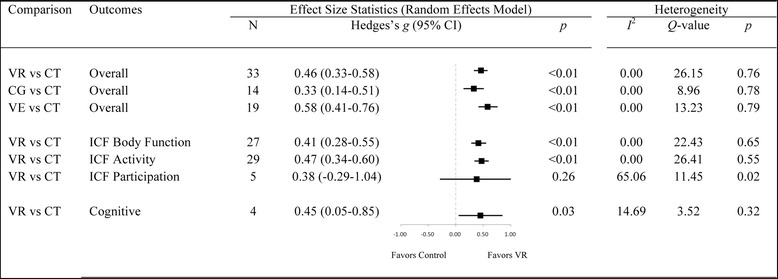
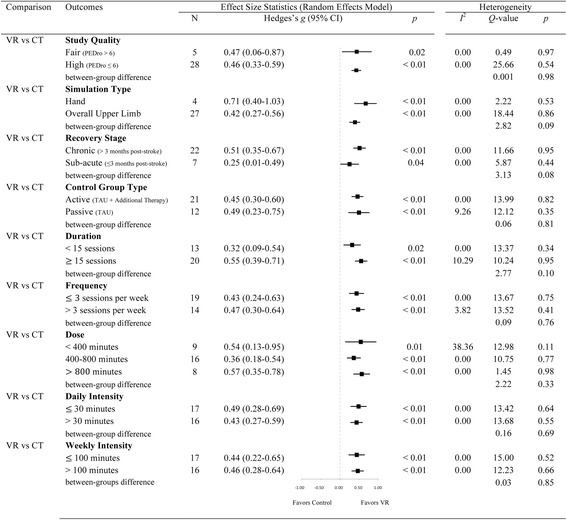
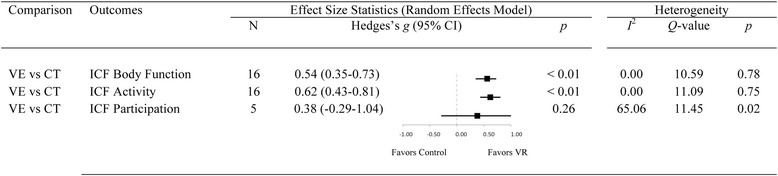
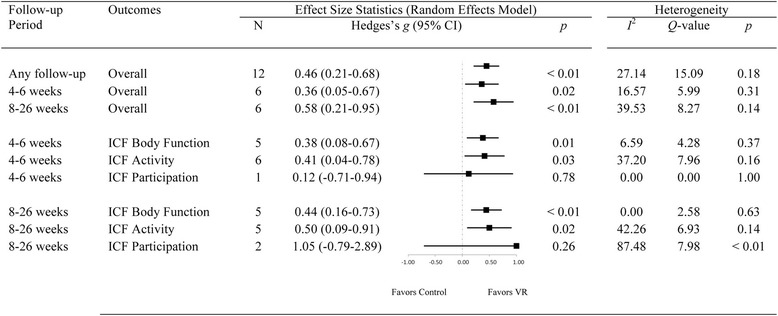
BACKGROUND: Virtual-reality based rehabilitation (VR) shows potential as an engaging and effective way to improve upper-limb function and cognitive abilities following a stroke. However, an updated synthesis of the literature is needed to capture growth in recent research and address gaps in our understanding of factors that may optimize training parameters and treatment effects. METHODS: Published randomized controlled trials comparing VR to conventional therapy were retrieved from seven electronic databases. Treatment effects (Hedge's g) were estimated using a random effects model, with motor and functional outcomes between different protocols compared at the Body Structure/Function, Activity, and Participation levels of the International Classification of Functioning. RESULTS: Thirty-three studies were identified, including 971 participants (492 VR participants). VR produced small to medium overall effects (g = 0.46; 95% CI: 0.33-0.59, p < 0.01), above and beyond conventional therapies. Small to medium effects were observed on Body Structure/Function (g = 0.41; 95% CI: 0.28-0.55; p < 0.01) and Activity outcomes (g = 0.47; 95% CI: 0.34-0.60, p < 0.01), while Participation outcomes failed to reach significance (g = 0.38; 95% CI: -0.29-1.04, p = 0.27). Superior benefits for Body Structure/Function (g = 0.56) and Activity outcomes (g = 0.62) were observed when examining outcomes only from purpose-designed VR systems. Preliminary results (k = 4) suggested small to medium effects for cognitive outcomes (g = 0.41; 95% CI: 0.28-0.55; p < 0.01). Moderator analysis found no advantage for higher doses of VR, massed practice training schedules, or greater time since injury. CONCLUSION: VR can effect significant gains on Body Structure/Function and Activity level outcomes, including improvements in cognitive function, for individuals who have sustained a stroke. The evidence supports the use of VR as an adjunct for stroke rehabilitation, with effectiveness evident for a variety of platforms, training parameters, and stages of recovery.
Overview
The claims and statistics of this paper haven’t been checked yet.
Run the check — free, no account needed. It reads the open-access text and checks the sources it cites.
Integrity signals
Registry
Cites
Statistics
Figures
Verification
Claims the paper makes
The claims and statistics of this paper haven’t been checked yet.
Run the check — free, no account needed. It reads the open-access text and checks the sources it cites.
Claims other papers make about this one
Each is checked against this paper’s own text: does it say what the citing paper says it does?
The cited source says what the claim attributes to it.
In the citing paper
“VR-assisted therapies offer numerous benefits, both for the clinician and the patient, highlighted by most authors cited in this paper, such as: availability, the potential of being used in a more ecological way, and the possibility of molding the virtual environment according to the specific pathology and needs of the patient (Aminov et al., 2018; Botella et al., 2015; Clu”
From Virtual reality and psychedelics for the treatment of psychiatric disease: A systematic literature review (2020) · cites this paper as Aminov et al., 2018
Self-check
Percentages, sums and reported differences re-computed from the paper’s own numbers.
The self-check needs the paper’s full text.
Citations
Cites
1 retracted
RETRACTED: Value and application of the ICF in rehabilitation medicine
Stucki, G., Ewert, T., & Cieza, A. (2002) · Disability and Rehabilitation · doi:10.1080/09638280110070221 · Cited by 174
RetractedStatistical Power Analysis for the Behavioral Sciences
Muller, K. E., & Cohen, J. (1989) · Technometrics · doi:10.2307/1270020 · Cited by 99,603
Statistical power analysis for the behavioral sciences
Cohen, J. (1990) · Computers Environment and Urban Systems · doi:10.1016/0198-9715(90)90050-4 · Cited by 65,417
Bias in meta-analysis detected by a simple, graphical test
Egger, M., Smith, G. D., Schneider, M., & Minder, C. (1997) · BMJ · doi:10.1136/bmj.315.7109.629 · Cited by 56,722
Statistical Power Analysis for the Behavioral Sciences (2nd ed.).
Lachenbruch, P. A., & Cohen, J. (1989) · Journal of the American Statistical Association · doi:10.2307/2290095 · Cited by 37,421
Liberati, A., Altman, D. G., Tetzlaff, J., Mulrow, C., Gøtzsche, P. C., Ioannidis, J. P. A., Clarke, M., Devereaux, P. J., Kleijnen, J., & Moher, D. (2009) · PLoS Medicine · doi:10.1371/journal.pmed.1000100 · Cited by 28,164
Hao (2015) · doi:10.1002/14651858 · Cited by 11,321
The file drawer problem and tolerance for null results.
Rosenthal, R. (1979) · Psychological Bulletin · doi:10.1037/0033-2909.86.3.638 · Cited by 9,068 · cited 1×
“The current review specifically focused on published, peer-review articles to ensure the high quality of included data, but performed a fail-safe N [119] calculation to account for missing studies and grey literature.”
MethodGlobal status report on noncommunicable diseases 2010.
Alwan, A. (2011) · Cited by 8,494
Reliability of the PEDro Scale for Rating Quality of Randomized Controlled Trials
Maher, C. G., Sherrington, C., Herbert, R. D., Moseley, A. M., & Elkins, M. (2003) · Physical Therapy · doi:10.1093/ptj/83.8.713 · Cited by 4,808
Research works printed but not linked: 1
- Howick J, Chalmers I, Glasziou P, Greenhalgh T, Heneghan C, Liberati A, Moschetti I, Phillips B, Thornton H. Explanation of the 2011 Oxford Centre for Evidence-Based Medicine (OCEBM) levels of evidence Oxford center for Evidence-Based Medicine 2011.
Cited by
Sorted by citations
Items 101–200 of 237
End-user adaptable technologies for rehabilitation: a systematic literature review
Palomares-Pecho, J. M., Silva-Calpa, G. F. M., & Raposo, A. B. (2020) · Universal Access in the Information Society · doi:10.1007/s10209-020-00720-z · Cited by 14
Liu, S., Li, M., Ding, J., Ji, Q., Niu, Y., Yang, X. Y., Ai, S., & Li, S. (2025) · Archives of Physical Medicine and Rehabilitation · doi:10.1016/j.apmr.2025.07.004 · Cited by 13
He, Y., Yang, T., Bao, Y., Xiao, T., Wu, T., & Wu, J. (2021) · Scientific Reports · doi:10.1038/s41598-021-03620-1 · Cited by 13
Hegazy, R. M., Alkhateeb, A. M., & Abdelmohsen, A. M. (2022) · Physiotherapy Quarterly · doi:10.5114/pq.2021.111210 · Cited by 13
Manser, P., Michels, L., Schmidt, A., Barinka, F., & de Bruin, E. D. (2023) · JMIR Research Protocols · doi:10.2196/41173 · Cited by 14
Virtual Reality for Motor and Cognitive Rehabilitation
Darekar, A. (2023) · Current topics in behavioral neurosciences · doi:10.1007/7854_2023_418 · Cited by 15
Lee, S.-A., Heo, S., Kim, S., Park, C., Jung, Y., Ji, G., Lee, H.-A., Kim, K., Kim, S., Kim, B., et al. (2023) · Psychiatry Investigation · doi:10.30773/pi.2022.0337 · Cited by 16
Tran, J., Fowler, C. A., Delikat, J., Kaplan, H. M., Merzier, M. M., Schlesinger, M., Litzenberger, S., Marszalek, J. M., Scott, S., & Winkler, S. (2021) · JMIR Research Protocols · doi:10.2196/26133 · Cited by 13
Li, Y., Huang, J., Li, X., Qiao, J., Huang, X., Yang, L., & Yu, H. (2021) · Archives of Physical Medicine and Rehabilitation · doi:10.1016/j.apmr.2021.09.003 · Cited by 13
Design and Validation of Virtual Reality Task for Neuro-Rehabilitation of Distal Upper Extremities
Nath, D., Singh, N., Saini, M., Srivastava, M. V. P., & Mehndiratta, A. (2022) · International Journal of Environmental Research and Public Health · doi:10.3390/ijerph19031442 · Cited by 14
Gómez-Busto, F. J., & Ortiz, M. I. (2020) · PubMed Central · doi:10.36131/cnfioritieditore20200606 · Cited by 12
“…in this paper, such as: availability, the potential of being used in a more ecological way, and the possibility of molding the virtual environment according to the specific pathology and needs of the patient (Aminov et al., 2018; Botella et al., 2015; Clus et al., 2018; de Carvalho et al., 2017).”
BackgroundKorkusuz, S., Taşkın, G., Korkusuz, B. S., Özen, M. S., & Yürük, Z. Ö. (2024) · Neurological Sciences · doi:10.1007/s10072-024-07830-z · Cited by 12
Isbel, S. T., Holloway, H., Greber, C., Nguyen, K. K., Frost, J. S., Pearce, C., & D'Cunha, N. M. (2024) · Digital Health · doi:10.1177/20552076241251634 · Cited by 17
Extended reality for biomedicine
Yuan, J., Hassan, S. S., Wu, J., Koger, C. R., Packard, R. R. S., Shi, F., Fei, B., & Ding, Y. (2023) · Nature Reviews Methods Primers · doi:10.1038/s43586-023-00208-z · Cited by 13
Management of Cognitive Impairment After Stroke
Jerdi, S. A., Aleyadeh, R., & Imam, Y. Z. B. (2020) · Current Treatment Options in Neurology · doi:10.1007/s11940-020-00627-3 · Cited by 10
Prognosis of stroke upper limb recovery with physiological variables using regression tree ensembles
Carino-Escobar, R. I., Valdés-Cristerna, R., Carrillo-Mora, P. U., Rodríguez-Barragán, M. A., Hernández-Arenas, C., Quinzaños-Fresnedo, J., Arias-Carrión, Ó., & Cantillo-Negrete, J. (2021) · Journal of Neural Engineering · doi:10.1088/1741-2552/abfc1e · Cited by 10
Paulino, T., Faria, A. L., & Badia, S. B. I. (2019) · Experiment@International Conference · doi:10.1109/expat.2019.8876539 · Cited by 10
The Utility of Virtual Reality in Ophthalmology: A Review
Ahuja, A. S., Paredes, A. A., Eisel, M. L. S., Ahuja, S., Wagner, I. V., Vasu, P., Dorairaj, S. K., Miller, D. D., & Abubaker, Y. (2025) · Clinical ophthalmology · doi:10.2147/opth.s517974 · Cited by 10
Huber, S. K., Manser, P., & de Bruin, E. D. (2024) · Frontiers in Sports and Active Living · doi:10.3389/fspor.2024.1397949 · Cited by 12
Fusco, F. R., Iosa, M., Fusco, A., Paolucci, S., & Morone, G. (2018) · Neurocase · doi:10.1080/13554794.2018.1499938 · Cited by 9
Zhang, J., Jiang, X., Xu, Q., Cai, E., & Ding, H. (2024) · Journal of Integrative Neuroscience · doi:10.31083/j.jin2312225 · Cited by 8
Canto, Y. E., Pizarro-Mena, R. A., Ludueña-Hernández, K., Alexandre-Vergara, K., Riveros-Basoalto, G., & Dresdner-Figueroa, A. (2025) · Physical Therapy · doi:10.1093/ptj/pzaf103 · Cited by 10
Hernández‐Martínez, A., Fernández-Escabías, M., Amaya‐Pascasio, L., Carrilho-Candeias, S., Ramos-Teodoro, M., Gil-Rodríguez, M., Orellana-Jaen, A., Martínez‐Rosales, E., Ruiz‐González, D., Esteban‐Simón, A., et al. (2024) · BMJ Open Sport & Exercise Medicine · doi:10.1136/bmjsem-2024-002123 · Cited by 11
Ali, A. S., Arumugam, A., Gururaj, S., Sardesai, S., & Senthil Kumaran, D. (2025) · Virtual Reality · doi:10.1007/s10055-025-01155-8 · Cited by 8
Tian, M.-Y., Lee, M.-H., Kim, J.-H., & Kim, M.-K. (2025) · Medicina · doi:10.3390/medicina62010090 · Cited by 7
Rogers, J. M., Mumford, N., Caeyenberghs, K., Richards, H., Nuijen, N. B., Steenbergen, B., Williams, G. P., Shum, D., Duckworth, J., Amos, N., et al. (2020) · Virtual Reality · doi:10.1007/s10055-020-00486-y · Cited by 7
Self-citationParavlic, A. H., Šlosar, L., Abazović, E., & Marušič, U. (2023) · Annals of Medicine · doi:10.1080/07853890.2023.2230886 · Cited by 7
What is the cost of including virtual reality in neurological rehabilitation? A scoping review
Aliprandi, M., Pan, Y., Mosley, C., & Gough, S. (2022) · Physical Therapy Reviews · doi:10.1080/10833196.2022.2094102 · Cited by 8
AI-Driven Haptic Technologies Revolutionizing Patient Rehabilitation
Kishor, I., Goyal, P., Gantla, H. R., Goyal, P., & Mamodiya, U. (2025) · Advances in computational intelligence and robotics book series · doi:10.4018/979-8-3373-2307-7.ch003 · Cited by 6
Sulfikar Ali, A., Arumugam, A., Gururaj, S., & Senthil Kumaran, D. (2021) · JBI Evidence Synthesis · doi:10.11124/jbies-20-00349 · Cited by 7
Huber, S. K., Knols, R. H., Held, J. P. O., Betschart, M., & de Bruin, E. D. (2024) · Trials · doi:10.1186/s13063-024-08283-7 · Cited by 11
A review of upper limb robot assisted therapy techniques and virtual reality applications
Ibrahim, H. A., Ammar, H. H., & Shalaby, R. (2022) · IAES International Journal of Artificial Intelligence · doi:10.11591/ijai.v11.i2.pp613-623 · Cited by 6
Kostenko, E. G., Петрова, Л. В., Pogonchenkova, I. V., Neprintseva, N. V., Shurupova, S. T., Kopasheva, V. D., & Rylsky, A. V. (2022) · Problems of Balneology Physiotherapy and Exercise Therapy · doi:10.17116/kurort20229906167 · Cited by 6
Everard, G. J., Lejeune, T. M., & Batcho, C. S. (2023) · International Journal of Rehabilitation Research · doi:10.1097/mrr.0000000000000588 · Cited by 6
Proposed Conceptual Design Model of Persuasive Game for Upper limb for Stroke Rehabilitation
Omar, M. Y. B., Rambli, D. R. A., Sulaiman, S. B., Shiratuddin, M. F., Merienne, F., & Vanhalle, D. (2019) · doi:10.1109/game47560.2019.8980789 · Cited by 6
Meziani, Y., Morère, Y., Hadj-Abdelkader, A., Benmansour, M., & Bourhis, G. (2021) · Control Engineering Practice · doi:10.1016/j.conengprac.2021.104804 · Cited by 6
Goumopoulos, C., Danousis, M., & Drakakis, E. (2025) · International Journal of Human-Computer Interaction · doi:10.1080/10447318.2025.2528146 · Cited by 5
Xinming, X. U., Haoxuan, L. I., Guan, Z., Dian, Z. E. N. G., ZHENG, Q., Qin, Y., Yang, W. E. N., Li, H., Lim, C. T., Wong, T. Y., et al. (2025) · Virtual Reality & Intelligent Hardware · doi:10.1016/j.vrih.2025.08.001 · Cited by 6
Prognostic factors of first-ever stroke patients in suburban Malaysia by comparing regression models
Wan‐Arfah, N., Mustapha, M., Naing, N. N., Subramaniyan, V., Wong, L. S., & Selvaraj, S. (2023) · Electronic Journal of General Medicine · doi:10.29333/ejgm/13717 · Cited by 5
Meta-analyzability Concerns in Meta-analyses
Hsu, C., & Lin, Y.-N. (2019) · Archives of Physical Medicine and Rehabilitation · doi:10.1016/j.apmr.2019.01.002 · Cited by 5
Ji, E. K., & Kwon, J. S. (2022) · Journal of Stroke and Cerebrovascular Diseases · doi:10.1016/j.jstrokecerebrovasdis.2022.106921 · Cited by 5
Immersive virtual reality enhanced reinforcement induced physical therapy (EVEREST)
Altukhaim, S., Sakabe, N., Nagaratnam, K., Mannava, N., Kondo, T., & Hayashi, Y. (2025) · Displays · doi:10.1016/j.displa.2024.102962 · Cited by 6
Vandael, K., Stanton, T. R., & Meulders, A. (2021) · PeerJ · doi:10.7717/peerj.11301 · Cited by 5
Norouzi‐Ghazbi, S., Mirbaha, S., Li, Z., Andrysek, J., Goldstein, R. S., & Hitzig, S. L. (2025) · PLoS ONE · doi:10.1371/journal.pone.0326705 · Cited by 4
McNally, S. T., Joseph, C. W., & Milne, S. (2025) · Clinical Rehabilitation · doi:10.1177/02692155251322999 · Cited by 4
Comparing virtual reality with traditional methods in cognitive rehabilitation in PICS syndrome
Despoti, A., Patsaki, I., Alexandropoulou, A., Magkouti, E., Tzoumi, D., Leventakis, N., Roussou, G., Papathanasiou, A., Dimitriadi, N., Presvelou, P., et al. (2025) · Applied Neuropsychology Adult · doi:10.1080/23279095.2025.2477184 · Cited by 4
How to Improve Cognitive Flexibility: Evidence From Noninvasive Neuromodulation Techniques
Akbari‐Gharalari, N., Fallahi, S., Nakhjiri, E., Hosseini, L., Pakkhou, S., Havaei, N., Khodakarimi, S., Shahabi, P., Jafarzadehgharehziaaddin, M., & Zangbar, H. S. (2025) · CNS Neuroscience & Therapeutics · doi:10.1111/cns.70613 · Cited by 7
Paredes, A. R. G., & Vela, M. R. (2022) · Smart innovation, systems and technologies · doi:10.1007/978-981-19-1040-1_10 · Cited by 6
Aderinto, N., Olatunji, G. D., Kokori, E., Abraham, I. C., Ogieuhi, I. J., Egbunu, E. O., Moradeyo, A. A., Obasanjo, O. M., Ukoaka, B. M., Babalola, A. E., et al. (2024) · Current Treatment Options in Pediatrics · doi:10.1007/s40746-024-00317-1 · Cited by 4
Benadduci, M., Franceschetti, C., Marziali, R. A., Frese, S., Sándor, P. S., Tombolesi, V., Bozzi, V., & Rossi, L. (2025) · JMIR Research Protocols · doi:10.2196/68358 · Cited by 4
Raju, V. B., Hauer, R., Ghassemi, M., Banerjee, A., Kamper, D. G., Schmit, B. D., & Vedantam, A. (2025) · Scientific Reports · doi:10.1038/s41598-025-05793-5 · Cited by 3
Poberžnik, A., Huhtasalo, J., Jyräkoski, T., Seppa, S., Lahti, J., Tavakoli, A., Virkki, J., & Merilampi, S. L. (2022) · SeGAH ... IEEE ... International Conference on Serious Games and Applications for Health/IEEE International Conference on Serious Games and Applications for Health · doi:10.1109/segah54908.2022.9978567 · Cited by 3
Virtual Embodiment: Revolutionizing Motor Imagery in VR-Enabled BCI with Digital Twins
Ramu, V., & Lakshminarayanan, K. (2024) · IEEE International Conference on Electronics, Computing and Communication Technologies (CONECCT) · doi:10.1109/conecct62155.2024.10677025 · Cited by 3
Клочков, А. С., Khizhnikova, A. E., Антоновна, Ф. А., Kotov-Smolenskiy, A. M., Suponeva, N. A., & Пирадов, М. А. (2020) · Annals of Clinical and Experimental Neurology · doi:10.25692/acen.2020.4.9 · Cited by 3
Meireles, C., Ferreira, S. F., Avelino, P. R., & de Menezes, K. K. P. (2022) · Fisioterapia e Pesquisa · doi:10.1590/1809-2950/19039029012022en · Cited by 3
Derevyashkina, G. V., Koneva, E. S., Шаповаленко, Т. В., Bisheva, D. R., Sidyakina, I. V., Konev, S. M., Aa, M., Zhumanova, E. N., & Lyadov, K. V. (2022) · Problems of Balneology Physiotherapy and Exercise Therapy · doi:10.17116/kurort2022990425 · Cited by 3
Thuan, N. H. M., & Kim, Y. (2024) · Asian Journal of Sport and Exercise Psychology · doi:10.1016/j.ajsep.2024.05.003 · Cited by 3
Leveraging technology for health
Shibata-Germanos, S., Ferenchick, E. K., Varallo, J. E., Semrau, K. E. A., & Hachach‐Haram, N. (2024) · Elsevier eBooks · doi:10.1016/b978-0-443-18529-8.00021-4 · Cited by 3
Effectiveness of Robotic Rehabilitation in the Management of Stroke Patients—A Literature Review
Prasad, M., Madhual, D., Sachan, K., Perwez, A., Tiwari, S., & Negiv, B. (2025) · Global Clinical Engineering Journal · doi:10.31354/globalce.v7i1.213 · Cited by 2
George, C. M., Raeesi, J., Dabbagh, A., Szekeres, M., & MacDermid, J. C. (2025) · Journal of Hand Therapy · doi:10.1016/j.jht.2025.04.012 · Cited by 3
Liu, Y., Li, J., Tao, J., Li, Y., & Xiong, H. (2025) · Medicine · doi:10.1097/md.0000000000043505 · Cited by 3
Chan, J. J. I., Sultana, R., Ho, Y. T. R., Malki, M. H. S. A., Tan, C. W., & Sng, B. L. (2026) · Scientific Reports · doi:10.1038/s41598-026-41984-4 · Cited by 2
Xu, Z., Yang, T., Chen, Y., Chen, Y., & Nan, J. (2025) · International Journal of Human-Computer Interaction · doi:10.1080/10447318.2025.2544003 · Cited by 3
Soares, L. F., Páris, C., Gomes, A., Laíns, J., Carvalho, F., & Roseiro, L. M. (2020) · Advances in intelligent systems and computing · doi:10.1007/978-3-030-44267-5_48 · Cited by 2
Wearable Devices and Virtual Reality for Neurorehabilitation: An Opportunity for Home Rehabilitation
Morone, G., Girardi, S., Ghooshchy, S. G., Iosa, M., & Paolucci, S. (2018) · Biosystems & biorobotics · doi:10.1007/978-3-030-01845-0_120 · Cited by 2
Serious Games Design Principles Using Virtual Reality to Gamify Upper Limb Stroke Rehabilitation
Herne, R., Shiratuddin, M. F., Rai, S., & Blacker, D. (2022) · Advances in business strategy and competitive advantage book series · doi:10.4018/978-1-7998-9223-6.ch011 · Cited by 2
Kostenko, E. G., Петрова, Л. В., Pogonchenkova, I. V., & Kopasheva, V. D. (2022) · Russian Medicine · doi:10.17816/medjrf112059 · Cited by 2
MURIA-TARAZON, J.-C., Gil-Gómez, H., Mesa‐Gresa, P., & Gil‐Gómez, J. (2023) · Applied Sciences · doi:10.3390/app13084786 · Cited by 2
Early Playtesting with Clients and Therapists of More Game-Like Therapy
Neves, P. P., Fernandes, P., Nunes, I., Fonseca, M., & Lopes, P. (2023) · IEEE Conference on Games (CoG) · doi:10.1109/cog57401.2023.10333132 · Cited by 2
Lobo, S. G., & Alventosa, R. I. (2022) · Fisioterapia · doi:10.1016/j.ft.2022.03.001 · Cited by 1
López, D., Fernandez, L. C., Fernández, F., Fuentes, B., Larraga-García, B., Rodríguez‐Pardo, J., Hernández, D., Alonso, E., Díez‐Tejedor, E., Gutiérrez, Á., et al. (2023) · Digital Health · doi:10.1177/20552076231174786 · Cited by 1
Motor sequela of adult and pediatric stroke: Imminent losses and ultimate gains
Younger, D. S. (2023) · Handbook of clinical neurology · doi:10.1016/b978-0-323-98817-9.00025-9 · Cited by 1
Wang, Y., Li, Y., Zhang, W., Guo, X., & Chen, T. (2023) · ICME International Conference on Complex Medical Engineering (CME) · doi:10.1109/cme60059.2023.10565610 · Cited by 1
Fundarò, C., Maffoni, M., & Boselli, M. (2025) · Case Reports in Neurological Medicine · doi:10.1155/crnm/5311669 · Cited by 1
Rehman, S. F., Liang, Y., Wang, J., Wang, L., Mei⁃ling, L., Niu, S., Xing, X., Zhang, S., & Wang, Y. (2026) · Neurorehabilitation · doi:10.1177/10538135261418720 · Cited by 1
Gennaro, F., Pini, L., Corbetta, M., de Bruin, E. D., Manser, P., Moro, T., Berchicci, M., & Paoli, A. (2026) · Ageing Research Reviews · doi:10.1016/j.arr.2026.103357 · Cited by 1
van Kordelaar, J., van de Ruit, M., Solis‐Escalante, T., Aerden, L. A. M., Meskers, C. G. M., van Wegen, E. E. H., Schouten, A. C., Kwakkel, G., & van der Helm, F. C. T. (2021) · Frontiers in Human Neuroscience · doi:10.3389/fnhum.2021.695366 · Cited by 1
Şimşek, T. T. (2019) · American Journal of Biomedical Science & Research · doi:10.34297/ajbsr.2019.05.000879 · Cited by 1
INTEGRATION OF ARTIFICIAL INTELLIGENCE IN THE SPACE OF HUMAN SOCIETY
Devdariani, N. V. (2020) · KARELIAN SCIENTIFIC JOURNAL · doi:10.26140/knz4-2020-0901-0014 · Cited by 1
Meireles, C., Ferreira, S. F., Avelino, P. R., & de Menezes, K. K. P. (2022) · Fisioterapia e Pesquisa · doi:10.1590/1809-2950/19039029012022pt · Cited by 1
He, Y., Yang, T., Bao, Y., Xiao, T., Wu, T., & Wu, J. (2021) · Research Square · doi:10.21203/rs.3.rs-875977/v1 · Cited by 1
Altukhaim, S., Sakabe, N., Nagaratnam, K., Mannava, N., Kondo, T., & Hayashi, Y. (2023) · Research Square · doi:10.21203/rs.3.rs-3462809/v1 · Cited by 1
Huber, S. K., Knols, R. H., Held, J. P. O., Betschart, M., & de Bruin, E. D. (2024) · Research Square · doi:10.21203/rs.3.rs-3868318/v1 · Cited by 1
Virtual Reality in Stroke Recovery: A meta-review of Systematic ReviewsPreprint
Khan, A., Imam, Y. Z. B., Muneer, M., Jerdi, S. A., & Gill, S. K. (2024) · Research Square · doi:10.21203/rs.3.rs-4319427/v1 · Cited by 1
VR-Based Assessment and Intervention of Cognitive Functioning after Stroke
Gamito, P. S., Salvador, Á., Oliveira, J., Souto, T., Conde, A. R., & Galhordas, J. (2020) · CRC Press eBooks · doi:10.1201/9780429351365-4
Rapid review of virtual rehab in musculoskeletal injuries in athletes
Langade, B., & Phansopkar, P. A. (2022) · Journal of Pharmaceutical Negative Results · doi:10.47750/pnr.2022.13.s06.395
UQE-3D: a usability evaluation method of 3D user interfaces for the elderly
Postal, M. R. B., Daroit, L., & Rieder, R. (2023) · Journal on Interactive Systems · doi:10.5753/jis.2023.3148
Exposure to Immersive Relaxing Virtual Environments for Hospitalized Patients
Pereira, M., Oliveira, P., Gomes, M. E., & de Sousa, S. (2023) · Advances in medical technologies and clinical practice book series · doi:10.4018/978-1-6684-9251-2.ch006
Virtual Reality Interventions to Improve Function After Stroke
Pereira, M., Oliveira, P., Gomes, M. M. F., Fernandes, Â., Portugal, P., & Coelho, T. (2023) · Advances in medical technologies and clinical practice book series · doi:10.4018/978-1-6684-9251-2.ch016
La réalité virtuelle au service du bien-être : étude pilote
Agli, O., Gindre, I., Gindre-Garrouste, B., & Cuervo-Lombard, C.-V. (2024) · NPG. Neurologie, psychiatrie, gériatrie/NPG · doi:10.1016/j.npg.2024.01.001
Immersive Virtual Reality Enhanced Reinforcement Induced Physical Therapy (EVEREST)Preprint
Altukhaim, S., Sakabe, N., Nagaratnam, K., Mannava, N., Kondo, T., & Hayashi, Y. (2024) · Research Square · doi:10.21203/rs.3.rs-4132920/v1
Ullah, S., Daran, H., Khan, Z., Rehman, M. U., Abidin, S. Z. U., & Bilal, H. (2024) · Journal of Riphah College of Rehabilitation Sciences · doi:10.53389/jrcrs.2024120103
Immersive Virtual Reality Enhanced Reinforcement Induced Physical Therapy(Everest)Preprint
Altukhaim, S., Sakabe, N., Nagaratnam, K., Mannava, N., Kondo, T., & Hayashi, Y. (2024) · SSRN Electronic Journal · doi:10.2139/ssrn.4898128
AUTOMATIC CONTROL SYSTEM FOR METAL STRIP DEFORMATION
Shlychkov, V. I. (2024) · Scientific Research of the SCO Countries: Synergy and Integration · doi:10.34660/inf.2023.97.11.205
ENDOTHELIAL KERATOPLASTY WITH PRE-STRIPPED AND PRESERVED DESCEMET MEMBRANE IN A COMPLICATED CASE
Ibragimova, R. R., Andreev, A. Y., & Yu, Y. (2024) · Scientific Research of the SCO Countries: Synergy and Integration · doi:10.34660/inf.2023.28.22.200
STRATEGIC PARTNERSHIP OF KYRGYZSTAN AND RUSSIA AT THE TURN OF THE CENTURIES
Osmonov, S. (2024) · Scientific Research of the SCO Countries: Synergy and Integration · doi:10.34660/inf.2023.56.47.195
RESEARCH OF LEVEL OF SELF-EFFICIENCY AT DOCTORS
Konash, O. V. (2024) · Scientific Research of the SCO Countries: Synergy and Integration · doi:10.34660/inf.2023.21.74.193
ABDIKADYR OROZBEKOV IS A STATE MAN OF THE KYRGYZ PEOPLE
Bekmurzaeva, G. (2024) · Scientific Research of the SCO Countries: Synergy and Integration · doi:10.34660/inf.2023.75.64.194
Мадрахимович, О. С., Botirov, K. A., & Khalilov, M. M. (2024) · Scientific Research of the SCO Countries: Synergy and Integration · doi:10.34660/inf.2023.49.13.206
Metadata
- Authors
- Aminov, A., Rogers, J. M., Middleton, S., Caeyenberghs, K., & Wilson, P. H.
- Affiliations
- Australian Catholic University (AU)
- South Eastern Sydney Local Health District (AU)
- Corresponding author
- Wilson, Peter H.
- Venue
- Journal of NeuroEngineering and Rehabilitation
- Published
- 2018-03-27
- Volume
- 15
- Issue
- 1
- Pages
- 29-29
- ISSN
- 1743-0003 (ISSN-L)
- PMC
- PMC5870176
- OpenAlex
- W2798072203
- Cited by
- 236
- References
- 132
- Citations by year
- 2026: 15 · 2025: 30 · 2024: 51 · 2023: 25 · 2022: 35 · 2021: 28 · 2020: 29 · 2019: 15 · 2018: 8
- FWCI
- 2.51
- Type
- journal article
- Language
- en
- Open access
- gold
- doi.org
- Licence
- Locations
- Journal of NeuroEngineering and Rehabilitation (publishedVersion, cc-by)
- PubMed Central (publishedVersion, cc-by)
- PubMed (publishedVersion)
- Research Bank (Australian Catholic University) (submittedVersion, cc-by)
- DOAJ (DOAJ: Directory of Open Access Journals) (submittedVersion, cc-by-sa)
- Figshare (submittedVersion, cc-by)
- Funders
- Prince of Wales Hospital Foundation (Grant No. 4R/14)
- The Research Training Program
- Topics
- Health Sciences › Medicine › Rehabilitation › Stroke Rehabilitation and Recovery
- Physical Sciences › Computer Science › Human-Computer Interaction › Virtual Reality Applications and Impacts
- Life Sciences › Neuroscience › Neurology › Transcranial Magnetic Stimulation Studies
- Keywords
- virtual reality rehabilitation, stroke rehabilitation, upper limb function, cognitive function, conventional therapy comparison, International Classification of Functioning, Disability and Health, body structure and function, participation outcomes, training dose, massed practice, time since injury, adjunctive therapy
- MeSH terms
- Stroke Rehabilitation, Virtual Reality, Cognition, Humans, Randomized Controlled Trials as Topic, Stroke, Upper Extremity
About these checks
Registry, retraction, Cites and statistics results are computed, not judged, with one exception: a printed reference that no index lists is read once by a model before it counts as a citation error. Claims are extracted by a model and kept only when their quote appears verbatim in the text; each cited source is then checked, with a model’s help, for whether it says what the claim relies on. Those verdicts can be wrong — read the claim’s quote and the cited source before relying on one.
Statistics and arithmetic are recomputed, not judged.
Confidence bands are shown only for fields calibrated on our annotated test set. None is calibrated yet, so no band is shown.
What counts as a claim ›How we measure confidence ›How we check this ›
Are you an author, or do you see a problem with this page? Request a review
