

The DOI matches its Crossref record; 133 of the 133 references it cites were found in a registry or an index.
What do randomized controlled trials say about virtual rehabilitation in stroke? A systematic literature review and meta-analysis of upper-limb and cognitive outcomes
Open accessAbstract
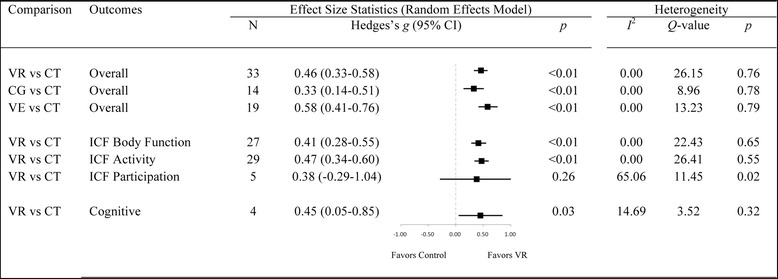
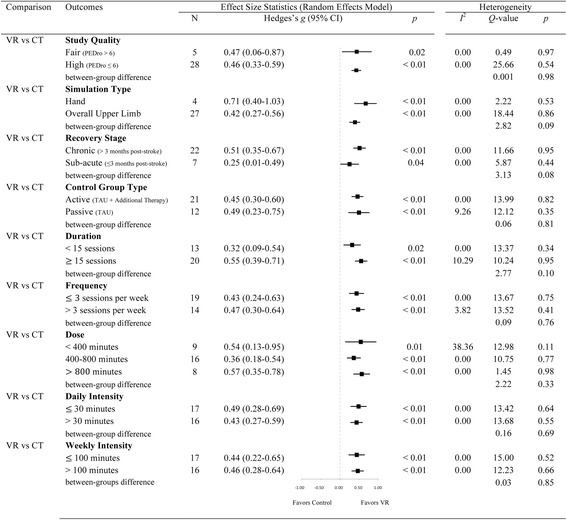
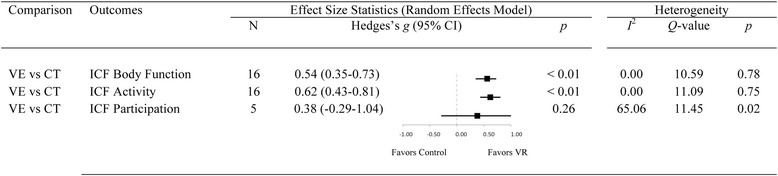
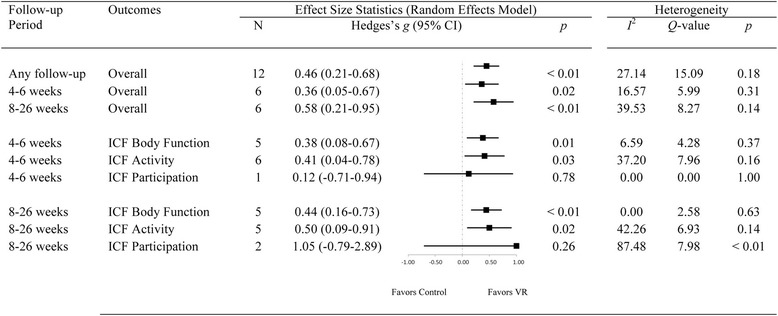
BACKGROUND: Virtual-reality based rehabilitation (VR) shows potential as an engaging and effective way to improve upper-limb function and cognitive abilities following a stroke. However, an updated synthesis of the literature is needed to capture growth in recent research and address gaps in our understanding of factors that may optimize training parameters and treatment effects. METHODS: Published randomized controlled trials comparing VR to conventional therapy were retrieved from seven electronic databases. Treatment effects (Hedge's g) were estimated using a random effects model, with motor and functional outcomes between different protocols compared at the Body Structure/Function, Activity, and Participation levels of the International Classification of Functioning. RESULTS: Thirty-three studies were identified, including 971 participants (492 VR participants). VR produced small to medium overall effects (g = 0.46; 95% CI: 0.33-0.59, p < 0.01), above and beyond conventional therapies. Small to medium effects were observed on Body Structure/Function (g = 0.41; 95% CI: 0.28-0.55; p < 0.01) and Activity outcomes (g = 0.47; 95% CI: 0.34-0.60, p < 0.01), while Participation outcomes failed to reach significance (g = 0.38; 95% CI: -0.29-1.04, p = 0.27). Superior benefits for Body Structure/Function (g = 0.56) and Activity outcomes (g = 0.62) were observed when examining outcomes only from purpose-designed VR systems. Preliminary results (k = 4) suggested small to medium effects for cognitive outcomes (g = 0.41; 95% CI: 0.28-0.55; p < 0.01). Moderator analysis found no advantage for higher doses of VR, massed practice training schedules, or greater time since injury. CONCLUSION: VR can effect significant gains on Body Structure/Function and Activity level outcomes, including improvements in cognitive function, for individuals who have sustained a stroke. The evidence supports the use of VR as an adjunct for stroke rehabilitation, with effectiveness evident for a variety of platforms, training parameters, and stages of recovery.
Overview
The claims and statistics of this paper haven’t been checked yet.
Run the check — free, no account needed. It reads the open-access text and checks the sources it cites.
Integrity signals
Registry
Cites
Statistics
Figures
Verification
Claims the paper makes
The claims and statistics of this paper haven’t been checked yet.
Run the check — free, no account needed. It reads the open-access text and checks the sources it cites.
Claims other papers make about this one
Each is checked against this paper’s own text: does it say what the citing paper says it does?
The cited source says what the claim attributes to it.
In the citing paper
“VR-assisted therapies offer numerous benefits, both for the clinician and the patient, highlighted by most authors cited in this paper, such as: availability, the potential of being used in a more ecological way, and the possibility of molding the virtual environment according to the specific pathology and needs of the patient (Aminov et al., 2018; Botella et al., 2015; Clu”
From Virtual reality and psychedelics for the treatment of psychiatric disease: A systematic literature review (2020) · cites this paper as Aminov et al., 2018
Self-check
Percentages, sums and reported differences re-computed from the paper’s own numbers.
The self-check needs the paper’s full text.
Citations
Cites
1 retracted
RETRACTED: Value and application of the ICF in rehabilitation medicine
Stucki, G., Ewert, T., & Cieza, A. (2002) · Disability and Rehabilitation · doi:10.1080/09638280110070221 · Cited by 174
RetractedStatistical Power Analysis for the Behavioral Sciences
Muller, K. E., & Cohen, J. (1989) · Technometrics · doi:10.2307/1270020 · Cited by 99,603
Statistical power analysis for the behavioral sciences
Cohen, J. (1990) · Computers Environment and Urban Systems · doi:10.1016/0198-9715(90)90050-4 · Cited by 65,417
Bias in meta-analysis detected by a simple, graphical test
Egger, M., Smith, G. D., Schneider, M., & Minder, C. (1997) · BMJ · doi:10.1136/bmj.315.7109.629 · Cited by 56,722
Statistical Power Analysis for the Behavioral Sciences (2nd ed.).
Lachenbruch, P. A., & Cohen, J. (1989) · Journal of the American Statistical Association · doi:10.2307/2290095 · Cited by 37,421
Liberati, A., Altman, D. G., Tetzlaff, J., Mulrow, C., Gøtzsche, P. C., Ioannidis, J. P. A., Clarke, M., Devereaux, P. J., Kleijnen, J., & Moher, D. (2009) · PLoS Medicine · doi:10.1371/journal.pmed.1000100 · Cited by 28,164
Hao (2015) · doi:10.1002/14651858 · Cited by 11,321
The file drawer problem and tolerance for null results.
Rosenthal, R. (1979) · Psychological Bulletin · doi:10.1037/0033-2909.86.3.638 · Cited by 9,068 · cited 1×
“The current review specifically focused on published, peer-review articles to ensure the high quality of included data, but performed a fail-safe N [119] calculation to account for missing studies and grey literature.”
MethodGlobal status report on noncommunicable diseases 2010.
Alwan, A. (2011) · Cited by 8,494
Reliability of the PEDro Scale for Rating Quality of Randomized Controlled Trials
Maher, C. G., Sherrington, C., Herbert, R. D., Moseley, A. M., & Elkins, M. (2003) · Physical Therapy · doi:10.1093/ptj/83.8.713 · Cited by 4,808
Feigin, V. L., Forouzanfar, M. H., Krishnamurthi, R., Mensah, G. A., Connor, M., Bennett, D. A., Moran, A. E., Sacco, R. L., Anderson, L., Truelsen, T., et al. (2014) · The Lancet · doi:10.1016/s0140-6736(13)61953-4 · Cited by 3,899
Publication Bias in Meta‐Analysis: Prevention, Assessment and Adjustments
(2005) · doi:10.1002/0470870168 · Cited by 2,368
Motor recovery after stroke: a systematic review
Langhorne, P., Coupar, F., & Pollock, A. (2009) · The Lancet Neurology · doi:10.1016/s1474-4422(09)70150-4 · Cited by 2,343
Evidence-based cognitive rehabilitation: updated review of the literature from 2003 through 2008
Cicerone, K. D., Langenbahn, D. M., Braden, C., Malec, J. F., Kalmar, K., Fraas, M., Felicetti, T., Laatsch, L., Harley, J. P., Bergquist, T., et al. (2011) · Archives of Physical Medicine and Rehabilitation · doi:10.1016/j.apmr.2010.11.015 · Cited by 1,599
Post-Stroke Fatigue: Epidemiology, Clinical Characteristics and Treatment
Acciarresi, M., Bogousslavsky, J., & Paciaroni, M. (2014) · European Neurology · doi:10.1159/000363763 · Cited by 1,423
Rosenberg, M. S. (2005) · Evolution · doi:10.1111/j.0014-3820.2005.tb01004.x · Cited by 1,285 · cited 1×
“The current study did not include a search and review of unpublished (grey) literature, which could be important to account for publication bias (or file drawer effect) [118].”
BackgroundVirtual reality for stroke rehabilitation
Laver, K., George, S., Thomas, S., Deutsch, J. E., & Crotty, M. (2015) · Cochrane Database of Systematic Reviews · doi:10.1002/14651858.cd008349.pub3 · Cited by 1,162
Writing meta-analytic reviews.
Rosenthal, R. (1995) · Psychological Bulletin · doi:10.1037/0033-2909.118.2.183 · Cited by 1,108
Global status report on noncommunicable diseases
Chan, M. (2010) · Cited by 1,065
Lampit, A., Hallock, H., & Valenzuela, M. (2014) · PLoS Medicine · doi:10.1371/journal.pmed.1001756 · Cited by 1,064
Estimates of the Prevalence of Acute Stroke Impairments and Disability in a Multiethnic Population
Lawrence, E., Coshall, C., Dundas, R., Stewart, J. A., Rudd, A. G., Howard, R., & Wolfe, C. D. A. (2001) · Stroke · doi:10.1161/01.str.32.6.1279 · Cited by 943
Evidence for physiotherapy practice: A survey of the Physiotherapy Evidence Database (PEDro)
Moseley, A. M., Herbert, R. D., Sherrington, C., & Maher, C. G. (2002) · Australian Journal of Physiotherapy · doi:10.1016/s0004-9514(14)60281-6 · Cited by 911 · cited 1×
“Studies with PEDro total scores from 6 to 10 were considered high quality [70]; scores below 6 were considered fair quality.”
BackgroundGuidelines for the Early Management of Adults With Ischemic Stroke
Adams, H. P., del Zoppo, G., Alberts, M. J., Bhatt, D. L., Brass, L. M., Furlan, A. J., Grubb, R. L., Higashida, R. T., Jauch, E. C., Kidwell, C. S., et al. (2007) · Circulation · doi:10.1161/circulationaha.107.181486 · Cited by 901
A SWOT Analysis of the Field of Virtual Reality Rehabilitation and Therapy
Rizzo, A. “., & Kim, G. J. (2005) · Presence: Teleoperators and Virtual Environments · doi:10.1162/1054746053967094 · Cited by 877
Cognitive and Functional Outcome After Aneurysmal Subarachnoid Hemorrhage
Al‐Khindi, T., Macdonald, R. L., & Schweizer, T. A. (2010) · Stroke · doi:10.1161/strokeaha.110.581975 · Cited by 834
Imms, C., Granlund, M., Wilson, P. H., Steenbergen, B., Rosenbaum, P., & Gordon, A. M. (2016) · Developmental Medicine & Child Neurology · doi:10.1111/dmcn.13237 · Cited by 696
Self-citationVirtual Reality in Stroke Rehabilitation
Saposnik, G., & Levin, M. F. (2011) · Stroke · doi:10.1161/strokeaha.110.605451 · Cited by 668
Stroke injury, cognitive impairment and vascular dementia
Kalaria, R. N., Akinyemi, R., & Ihara, M. (2016) · Biochimica et Biophysica Acta (BBA) - Molecular Basis of Disease · doi:10.1016/j.bbadis.2016.01.015 · Cited by 647
Physical rehabilitation approaches for the recovery of function and mobility following stroke
Todhunter‐Brown, A., Baer, G. D., Campbell, P., Choo, P. L., Förster, A., Morris, J. H., Pomeroy, V. M., & Langhorne, P. (2014) · Cochrane Database of Systematic Reviews · doi:10.1002/14651858.cd001920.pub3 · Cited by 611
Publication Bias in Meta‐Analysis
Rothstein, H. R., Sutton, A. J., & Borenstein, M. (2005) · Publication Bias in Meta‐Analysis · doi:10.1002/0470870168.ch1 · Cited by 603
Clare, L., & Woods, B. (2003) · Cochrane Database of Systematic Reviews · doi:10.1002/14651858.cd003260 · Cited by 576
Hemorrhagic and Ischemic Strokes Compared: Stroke Severity, Mortality, and Risk Factors
Andersen, K. K., Olsen, T. S., Dehlendorff, C., & Kammersgaard, L. P. (2009) · Stroke · doi:10.1161/strokeaha.108.540112 · Cited by 552
Henderson, A., Korner-Bitensky, N. A., & Levin, M. F. (2007) · Topics in Stroke Rehabilitation · doi:10.1310/tsr1402-52 · Cited by 543
Analysis of assets for virtual reality applications in neuropsychology
Rizzo, A., Schultheis, M. T., Kerns, K. A., & Mateer, C. A. (2004) · Neuropsychological Rehabilitation · doi:10.1080/09602010343000183 · Cited by 518
Value and application of the ICF in rehabilitation medicine
Stucki, G., Ewert, T., & Cieza, A. (2002) · Disability and Rehabilitation · doi:10.1080/09638280210148594 · Cited by 504
Lohse, K. R., Hilderman, C. G. E., Cheung, K. L., Tatla, S., & Van der Loos, H. F. M. (2014) · PLoS ONE · doi:10.1371/journal.pone.0093318 · Cited by 501
Virtual Reality in Brain Damage Rehabilitation: Review
Rose, F. D., Brooks, B., & Rizzo, A. (2005) · CyberPsychology & Behavior · doi:10.1089/cpb.2005.8.241 · Cited by 466
Cognitive Disorders in Acute Stroke: Prevalence and Clinical Determinants
Nys, G. M. S., van Zandvoort, M. J. E., de Kort, P. L. M., Jansen, B. P. W., de Haan, E. H. F., & Kappelle, L. J. (2007) · Cerebrovascular Diseases · doi:10.1159/000101464 · Cited by 450
Stroke, Cognitive Deficits, and Rehabilitation: Still an Incomplete Picture
Cumming, T. B., Marshall, R. S., & Lazar, R. M. (2012) · International Journal of Stroke · doi:10.1111/j.1747-4949.2012.00972.x · Cited by 435
Saposnik, G., Cohen, L. G., Mamdani, M., Pooyania, S., Ploughman, M., Cheung, D., Shaw, J., Hall, J., Nord, P., Dukelow, S. P., et al. (2016) · The Lancet Neurology · doi:10.1016/s1474-4422(16)30121-1 · Cited by 430
Crichton, S. L., Bray, B., McKevitt, C., Rudd, A. G., & Wolfe, C. D. A. (2016) · Journal of Neurology Neurosurgery & Psychiatry · doi:10.1136/jnnp-2016-313361 · Cited by 385
Upper Limb Outcome Measures Used in Stroke Rehabilitation Studies: A Systematic Literature Review
Santisteban, L., Térémetz, M., Bleton, J., Baron, J., Maier, M. A., & Lindberg, P. G. (2016) · PLoS ONE · doi:10.1371/journal.pone.0154792 · Cited by 382
Norouzi-Gheidari, N., Archambault, P. S., & Fung, J. (2012) · The Journal of Rehabilitation Research and Development · doi:10.1682/jrrd.2010.10.0210 · Cited by 381
Prevalence of Poststroke Cognitive Impairment
Douiri, A., Rudd, A. G., & Wolfe, C. D. A. (2012) · Stroke · doi:10.1161/strokeaha.112.670844 · Cited by 374
Housman, S. J., Scott, K. M., & Reinkensmeyer, D. J. (2009) · Neurorehabilitation and neural repair · doi:10.1177/1545968308331148 · Cited by 370
Effect of a Task-Oriented Rehabilitation Program on Upper Extremity Recovery Following Motor Stroke
Winstein, C. J., Wolf, S. L., Dromerick, A. W., Lane, C. J., Nelsen, M. A., Lewthwaite, R., Cen, S., Azen, S. P., & for the Interdisciplinary Comprehensive Arm Rehabilitation Evaluation (ICARE) Investigative Team (2016) · JAMA · doi:10.1001/jama.2016.0276 · Cited by 369
Frequency and Prognostic Value of Cognitive Disorders in Stroke Patients
Leśniak, M., Bak, T. H., Czepiel, W., Seniów, J. B., & Członkowska, A. (2008) · Dementia and Geriatric Cognitive Disorders · doi:10.1159/000162262 · Cited by 317
Cognitive and memory training in adults at risk of dementia: A Systematic Review
Gates, N. J., Sachdev, P. S., Singh, M. A. F., & Valenzuela, M. (2011) · BMC Geriatrics · doi:10.1186/1471-2318-11-55 · Cited by 309
Cameirão, M. S., Badia, S. B. I., Duarte, E., & Verschure, P. F. M. J. (2011) · Restorative Neurology and Neuroscience · doi:10.3233/rnn-2011-0599 · Cited by 291
Exercises for paretic upper limb after stroke: A combined virtual-reality and telemedicine approach
Piron, L., Turolla, A., Agostini, M., Zucconi, C. S., Cortese, F., Zampolini, M., Zannini, M., Dam, M., Ventura, L., Battauz, M., et al. (2009) · Journal of Rehabilitation Medicine · doi:10.2340/16501977-0459 · Cited by 280
Natural history of cognitive impairment after stroke and factors associated with its recovery
Patel, M., Coshall, C., Rudd, A. G., & Wolfe, C. D. A. (2003) · Clinical Rehabilitation · doi:10.1191/0269215503cr596oa · Cited by 276
Virtual reality in neurorehabilitation
Weiss, P. L., Kizony, R., Feintuch, U., & Katz, N. (2006) · Textbook of Neural Repair and Rehabilitation · doi:10.1017/cbo9780511545078.015 · Cited by 265
Applying principles of motor learning and control to upper extremity rehabilitation
Muratori, L. M., Lamberg, E. M., Quinn, L., & Duff, S. (2013) · Journal of Hand Therapy · doi:10.1016/j.jht.2012.12.007 · Cited by 256
Poststroke Fatigue: Course and Its Relation to Personal and Stroke-Related Factors
Schepers, V. P. M., Visser‐Meily, A., Ketelaar, M., & Lindeman, E. (2006) · Archives of Physical Medicine and Rehabilitation · doi:10.1016/j.apmr.2005.10.005 · Cited by 254
Cognitive rehabilitation for attention deficits following stroke
Loetscher, T., & Lincoln, N. B. (2013) · Cochrane Database of Systematic Reviews · doi:10.1002/14651858.cd002842.pub2 · Cited by 252
Activity-promoting gaming systems in exercise and rehabilitation
Taylor, M. J. D., McCormick, D., Shawis, T. N., Impson, R., & Griffin, M. (2011) · The Journal of Rehabilitation Research and Development · doi:10.1682/jrrd.2010.09.0171 · Cited by 242
Yavuzer, G., Senel, A., Atay, M. B., & Stam, H. J. (2008) · PubMed · Cited by 238
Relationships between long-term stroke disability, handicap and health-related quality of life
Patel, M., Tilling, K. M., Lawrence, E., Rudd, A. G., Wolfe, C. D. A., & McKevitt, C. (2006) · Age and Ageing · doi:10.1093/ageing/afj074 · Cited by 233
Arm Motor Recovery Using a Virtual Reality Intervention in Chronic Stroke
Subramanian, S. K., Lourenço, C. B., Chilingaryan, G., Sveistrup, H., & Levin, M. F. (2012) · Neurorehabilitation and neural repair · doi:10.1177/1545968312449695 · Cited by 230
Additional Virtual Reality Training Using Xbox Kinect in Stroke Survivors with Hemiplegia
Sin, H., & Lee, G. (2013) · American Journal of Physical Medicine & Rehabilitation · doi:10.1097/phm.0b013e3182a38e40 · Cited by 226
Shin, J., Ryu, H. B., & Jang, S. (2014) · Journal of NeuroEngineering and Rehabilitation · doi:10.1186/1743-0003-11-32 · Cited by 226
Cognitive training on stroke patients via virtual reality-based serious games
Gamito, P. S., Oliveira, J., Coelho, C. W., Morais, D., Lopes, P., Pacheco, J., Brito, R., Soares, F., Santos, N., & Barata, A. F. (2015) · Disability and Rehabilitation · doi:10.3109/09638288.2014.934925 · Cited by 222
An overview of systematic reviews on upper extremity outcome measures after stroke
Murphy, M. A., Resteghini, C., Feys, P., & Lamers, I. (2015) · BMC Neurology · doi:10.1186/s12883-015-0292-6 · Cited by 207
Cumming, T. B., Churilov, L. P., Linden, T. K. A., & Bernhardt, J. A. (2013) · Acta Neurologica Scandinavica · doi:10.1111/ane.12084 · Cited by 206
Virtual reality in stroke rehabilitation: Still more virtual than real
Crosbie, J., Lennon, S., Basford, J., & McDonough, S. (2007) · Disability and Rehabilitation · doi:10.1080/09638280600960909 · Cited by 195
Adapting an immersive virtual reality system for rehabilitation
Kizony, R., Katz, N., & Weiss, P. L. (2003) · The Journal of Visualization and Computer Animation · doi:10.1002/vis.323 · Cited by 187
Peek, K., Sanson-Fisher, R., Mackenzie, L., & Carey, M. (2016) · Physiotherapy · doi:10.1016/j.physio.2015.10.003 · Cited by 183
The effect of poststroke cognitive impairment on rehabilitation process and functional outcome
Zinn, S., Dudley, T. K., Bosworth, H. B., Hoenig, H., Duncan, P. W., & Horner, R. D. (2004) · Archives of Physical Medicine and Rehabilitation · doi:10.1016/j.apmr.2003.10.022 · Cited by 182
Musicco, M., Emberti, L., Nappi, G., & Caltagirone, C. (2003) · Archives of Physical Medicine and Rehabilitation · doi:10.1053/apmr.2003.50084 · Cited by 178
Lee, S. J., & Chun, M. H. (2013) · Archives of Physical Medicine and Rehabilitation · doi:10.1016/j.apmr.2013.10.027 · Cited by 154
Functional and Motor Outcome 5 Years After Stroke Is Equivalent to Outcome at 2 Months
Meyer, S., Verheyden, G., Brinkmann, N., Dejaeger, E. W., Weerdt, W. D., Feys, H., Gantenbein, A. R., Jenni, W., Laenen, A., Lincoln, N. B., et al. (2015) · Stroke · doi:10.1161/strokeaha.115.009421 · Cited by 150
Effect of Virtual Reality on Cognition in Stroke Patients
Kim, B. R., Chun, M. H., Kim, L. S., & Park, J. Y. (2011) · Annals of Rehabilitation Medicine · doi:10.5535/arm.2011.35.4.450 · Cited by 149
The Montreal Cognitive Assessment
Cumming, T. B., Bernhardt, J. A., & Linden, T. K. A. (2011) · Stroke · doi:10.1161/strokeaha.111.619486 · Cited by 149
Shin, J.-H., Park, S.-B., & Jang, S. H. (2015) · Computers in Biology and Medicine · doi:10.1016/j.compbiomed.2015.03.011 · Cited by 148
Virtual Rehabilitation in an Activity Centre for Community-Dwelling Persons with Stroke
Broeren, J., Claesson, L., Goude, D., Rydmark, M., & Sunnerhagen, K. S. (2008) · Cerebrovascular Diseases · doi:10.1159/000149576 · Cited by 141
Can virtual reality offer enriched environments for rehabilitation?
Levin, M. F. (2011) · Expert Review of Neurotherapeutics · doi:10.1586/ern.10.201 · Cited by 141
Adaptation in serious games for upper-limb rehabilitation: an approach to improve training outcomes
Hocine, N., Gouaïch, A., Cerri, S. A., Mottet, D., Froger, J., & Laffont, I. (2015) · User Modeling and User-Adapted Interaction · doi:10.1007/s11257-015-9154-6 · Cited by 133
Virtual reality environments for post-stroke arm rehabilitation
Subramanian, S. K., Knaut, L. A. M., Beaudoin, C., McFadyen, B. J., Feldman, A. G., & Levin, M. F. (2007) · Journal of NeuroEngineering and Rehabilitation · doi:10.1186/1743-0003-4-20 · Cited by 132
Crosbie, J., Lennon, S., McGoldrick, M., McNeill, M., & McDonough, S. (2012) · Clinical Rehabilitation · doi:10.1177/0269215511434575 · Cited by 125
Standen, P., Threapleton, K., Richardson, A., Connell, L., Brown, D. J., Battersby, S., Platts, F., & Burton, A. M. (2016) · Clinical Rehabilitation · doi:10.1177/0269215516640320 · Cited by 125
Rlative shoulder fexor and handgrip strength is related to upper limb function after stroke
Mercier, C., & Bourbonnais, D. (2004) · Clinical Rehabilitation · doi:10.1191/0269215504cr724oa · Cited by 125
Kwon, J., Park, M. J., Yoon, I. J., & Park, S.-H. (2012) · Neurorehabilitation · doi:10.3233/nre-2012-00807 · Cited by 122
Wahl, A.-S., & Schwab, M. E. (2014) · Frontiers in Human Neuroscience · doi:10.3389/fnhum.2014.00381 · Cited by 122
Piron, L., Turolla, A., Agostini, M., Zucconi, C. S., Ventura, L., Tonin, P., & Dam, M. (2010) · Neurorehabilitation and neural repair · doi:10.1177/1545968310362672 · Cited by 121
Kiper, P., Agostini, M., Luque-Moreno, C., Tonin, P., & Turolla, A. (2014) · BioMed Research International · doi:10.1155/2014/752128 · Cited by 114
Yin, C. W., Sien, N. Y., Ying, L. A., Chung, S. F.-C. M., & Tan, D. M. L. (2014) · Clinical Rehabilitation · doi:10.1177/0269215514532851 · Cited by 114
Use of virtual reality in gait recovery among post stroke patients – a systematic literature review
Moreira, M. C., de Amorim Lima, A. M., Ferraz, K. M., & Benedetti Rodrigues, M. A. (2013) · Disability and Rehabilitation: Assistive Technology · doi:10.3109/17483107.2012.749428 · Cited by 114
Differences in Outcome and Predictors Between Ischemic and Intracerebral Hemorrhage
Bhalla, A., Wang, Y., Rudd, A. G., & Wolfe, C. D. A. (2013) · Stroke · doi:10.1161/strokeaha.113.001263 · Cited by 114
Lee, G. (2013) · Journal of Physical Therapy Science · doi:10.1589/jpts.25.595 · Cited by 111
Virtual Reality for Physical and Motor Rehabilitation
Weiss, P. L., Keshner, E. A., & Levin, M. F. (2014) · Virtual reality technologies for health and clinical applications · doi:10.1007/978-1-4939-0968-1 · Cited by 111
Choi, J. H., Han, E. Y., Kim, B. R., Kim, S. M., Im, S. H., Lee, S. Y., & Hyun, C. W. (2014) · Annals of Rehabilitation Medicine · doi:10.5535/arm.2014.38.4.485 · Cited by 109
Stroke Rehabilitation: An International Perspective
Teasell, R. W., Meyer, M. J., McClure, J. A., Pan, C., Murie-Fernández, M., Foley, N. C., & Salter, K. L. (2009) · Topics in Stroke Rehabilitation · doi:10.1310/tsr1601-44 · Cited by 108
Fatigue after Stroke: A Systematic Review of Associations with Impaired Physical Fitness
Duncan, F., Kutlubaev, M. A., Dennis, M. S., Greig, C. A., & Mead, G. E. (2012) · International Journal of Stroke · doi:10.1111/j.1747-4949.2011.00741.x · Cited by 105
Ribeiro, N. M. D. S., Ferraz, D. D., Pedreira, É., Pinheiro, I. D. M., Pinto, A. C. D. S., Neto, M. G., dos Santos, L. R. A., Pozzato, M. G. G., Pinho, R. S., & Masruha, M. R. (2015) · Topics in Stroke Rehabilitation · doi:10.1179/1074935714z.0000000017 · Cited by 105
Mullick, A. A., Subramanian, S. K., & Levin, M. F. (2015) · Restorative Neurology and Neuroscience · doi:10.3233/rnn-150510 · Cited by 105
Wagle, J., Farner, L., Flekkøy, K., Wyller, T. B., Sandvik, L., Fure, B., Stensrød, B., & Engedal, K. (2011) · Dementia and Geriatric Cognitive Disorders · doi:10.1159/000328970 · Cited by 104
International Classification of Functioning, Disability and Health (ICF) as a Framework for Change
Vargus‐Adams, J. N., & Majnemer, A. (2014) · Journal of Child Neurology · doi:10.1177/0883073814533595 · Cited by 95
Selection for Inpatient Rehabilitation After Acute Stroke: A Systematic Review of the Literature
Hakkennes, S., Brock, K. A., & Hill, K. (2011) · Archives of Physical Medicine and Rehabilitation · doi:10.1016/j.apmr.2011.07.189 · Cited by 92
Levin, M. F., Snir, O., Liebermann, D. G., Weingarden, H. P., & Weiss, P. L. (2012) · Neurology and Therapy · doi:10.1007/s40120-012-0003-9 · Cited by 92
An Adaptive Mixed Reality Training System for Stroke Rehabilitation
Duff, M., Chen, Y., Attygalle, S., Herman, J., Sundaram, H., Qian, G., He, J., & Rikakis, T. (2010) · IEEE Transactions on Neural Systems and Rehabilitation Engineering · doi:10.1109/tnsre.2010.2055061 · Cited by 92
Kong, K. H., Loh, Y. J., Thia, E., Chai, A., Ng, C. Y., Soh, Y. M., Toh, S., & Tjan, S.-Y. (2016) · Topics in Stroke Rehabilitation · doi:10.1080/10749357.2016.1139796 · Cited by 89
The interaction between neuropsychological and motor deficits in patients after stroke
Chen, C., Leys, D., & Esquenazi, A. (2013) · Neurology · doi:10.1212/wnl.0b013e3182762569 · Cited by 88
15 years of tracking physiotherapy evidence on PEDro, where are we now?
Kamper, S. J., Moseley, A. M., Herbert, R. D., Maher, C. G., Elkins, M. R., & Sherrington, C. (2015) · British Journal of Sports Medicine · doi:10.1136/bjsports-2014-094468 · Cited by 87
Fritz, S. L., Peters, D. M., Merlo, A., & Donley, J. W. (2013) · Topics in Stroke Rehabilitation · doi:10.1310/tsr2003-218 · Cited by 84
Acute single channel EEG predictors of cognitive function after stroke
Aminov, A., Rogers, J. M., Johnstone, S. J., Middleton, S., & Wilson, P. H. (2017) · PLoS ONE · doi:10.1371/journal.pone.0185841 · Cited by 76
Self-citationSchaham, N. G., Zeilig, G., Weingarden, H. P., & Rand, D. (2015) · Clinical Rehabilitation · doi:10.1177/0269215515584382 · Cited by 75
Cognitive rehabilitation for attention deficits following stroke
Lincoln, N. B., Majid, M., & Weyman, N. (2000) · Cochrane Database of Systematic Reviews · doi:10.1002/14651858.cd002842 · Cited by 75
Palma, G. C. D. S., de Freitas, T. B., Bonuzzi, G. M. G., Soares, M. A. A., Leite, P. H. W., Mazzini, N. A., Almeida, M. R. G., Pompeu, J. E., & Torriani‐Pasin, C. (2016) · Topics in Stroke Rehabilitation · doi:10.1080/10749357.2016.1250373 · Cited by 74
Mahdi, S., Viljoen, M., Yee, T., Selb, M., Singhal, N., Almodayfer, O., Granlund, M., de Vries, P. J., Zwaigenbaum, L., & Bölte, S. (2017) · Autism Research · doi:10.1002/aur.1905 · Cited by 64
An augmented reality system for upper-limb post-stroke motor rehabilitation: a feasibility study
de Assis, G. A., Corrêa, A. G. D., Martins, M. B. R., Pedrozo, W. G., & Lopes, R. D. D. (2014) · Disability and Rehabilitation Assistive Technology · doi:10.3109/17483107.2014.979330 · Cited by 64
Mumford, N., & Wilson, P. H. (2009) · Brain Injury · doi:10.1080/02699050802695566 · Cited by 63
Self-citationCho, K. H., Yu, J.-H., & Jung, J. (2012) · Journal of Physical Therapy Science · doi:10.1589/jpts.24.1205 · Cited by 62
Virtual reality for therapeutic purposes in stroke: A systematic review
Viñas‐Diz, S., & Sobrido, M. (2016) · Neurología (English Edition) · doi:10.1016/j.nrleng.2015.06.007 · Cited by 62
Pollock, A., Baer, G., Campbell, P., Choo, P. L., Forster, A., Morris, J., Pomeroy, V. M., & Langhorne, P. (2014) · Stroke · doi:10.1161/strokeaha.114.006275 · Cited by 61
Realidad virtual con fines terapéuticos en pacientes con ictus: revisión sistemática
Viñas‐Diz, S., & Sobrido, M. (2015) · Neurología · doi:10.1016/j.nrl.2015.06.012 · Cited by 60
Chen, M., Huang, L., Lee, C., Hsieh, C., Lin, Y.-C., Liu, H.-C., Chen, M.-I., & Lu, W.-S. (2014) · Clinical Rehabilitation · doi:10.1177/0269215514554115 · Cited by 59
Green, D., & Wilson, P. H. (2011) · Disability and Rehabilitation · doi:10.3109/09638288.2011.613520 · Cited by 58
Self-citationValidity of a Virtual Environment for Stroke Rehabilitation
Edmans, J., Gladman, J. R. F., Cobb, S. V. G., Sunderland, A., Pridmore, T., Hilton, D., & Walker, M. F. (2006) · Stroke · doi:10.1161/01.str.0000245133.50935.65 · Cited by 58
The effectiveness of reinforced feedback in virtual environment in the first 12 months after stroke
Kiper, P., Piron, L., Turolla, A., Stożek, J., & Tonin, P. (2011) · Neurologia i Neurochirurgia Polska · doi:10.1016/s0028-3843(14)60311-x · Cited by 55
Three Years after In-Patient Stroke Rehabilitation: A Follow-Up Study
Löfgren, B., Nyberg, L., Mattsson, M., & Gustafson, Y. (1999) · Cerebrovascular Diseases · doi:10.1159/000015948 · Cited by 54
In, T. S., Jung, K. S., Lee, S., & Song, C. H. (2012) · Journal of Physical Therapy Science · doi:10.1589/jpts.24.339 · Cited by 52
Clinical Feasibility of Interactive Commercial Nintendo Gaming for Chronic Stroke Rehabilitation
Kim, E.-K., Kang, J. H., Park, J. S., & Jung, B. H. (2012) · Journal of Physical Therapy Science · doi:10.1589/jpts.24.901 · Cited by 48
Kizony, R., Katz, N., & Weiss, P. L. (2004) · Cited by 45
Claessen, M. H. G., van der Ham, I. J. M., Jagersma, E., & Visser‐Meily, J. M. A. (2015) · Neuropsychological Rehabilitation · doi:10.1080/09602011.2015.1045910 · Cited by 44
Clinical evaluation of a non-immersive virtual environment in stroke rehabilitation
Edmans, J., Gladman, J. R. F., Hilton, D., Walker, M. F., Sunderland, A., Cobb, S. V. G., Pridmore, T., & Thomas, S. (2009) · Clinical Rehabilitation · doi:10.1177/0269215508095875 · Cited by 43
Kang, S. H., Kim, D., Seo, K. M., Choi, K. N., Yoo, J. Y., Sung, S. Y., & Park, H. J. (2009) · Clinical Rehabilitation · doi:10.1177/0269215508101732 · Cited by 40
Kottink, A. I. R., Prange, G. B., Krabben, T., Rietman, J. S., & Buurke, J. H. (2014) · Games for Health Journal · doi:10.1089/g4h.2014.0026 · Cited by 37
Mumford, N., Duckworth, J., Thomas, P. R., Shum, D., Williams, G. P., & Wilson, P. H. (2012) · Brain Injury · doi:10.3109/02699052.2011.648706 · Cited by 33
Self-citationIntegrating New Technologies into the Treatment of CP and DCD
Wilson, P. H., Green, D., Caeyenberghs, K., Steenbergen, B., & Duckworth, J. (2016) · Current Developmental Disorders Reports · doi:10.1007/s40474-016-0083-9 · Cited by 25
Self-citationResonance: An Interactive Tabletop Artwork for Co-located Group Rehabilitation and Play
Duckworth, J., Mumford, N., Caeyenberghs, K., Eldridge, R., Mayson, S., Thomas, P. R., Shum, D., Williams, G. P., & Wilson, P. H. (2015) · Lecture notes in computer science · doi:10.1007/978-3-319-20684-4_41 · Cited by 19
Self-citationSubramanian, S. K., Chilingaryan, G., Levin, M. F., Subramanian, S. K., Chilingaryan, G., Levin, M. F., & Sveistrup, H. (2015) · International Conference on Virtual Rehabilitation · doi:10.1109/icvr.2015.7358582 · Cited by 14
Designing Co-located Tabletop Interaction for Rehabilitation of Brain Injury
Duckworth, J., Thomas, P. R., Shum, D., & Wilson, P. H. (2013) · Lecture notes in computer science · doi:10.1007/978-3-642-39241-2_43 · Cited by 13
Self-citation15 years of tracking physiotherapy evidence on PEDro, where are we now?
Kamper, S. J., Moseley, A. M., Herbert, R., Maher, C. G., Elkins, M. R., & Sherrington, C. (2015) · Physiotherapy · doi:10.1016/j.physio.2015.03.3565 · Cited by 3
Research works printed but not linked: 1
- Howick J, Chalmers I, Glasziou P, Greenhalgh T, Heneghan C, Liberati A, Moschetti I, Phillips B, Thornton H. Explanation of the 2011 Oxford Centre for Evidence-Based Medicine (OCEBM) levels of evidence Oxford center for Evidence-Based Medicine 2011.
Cited by
Sorted by citations
Chen, J., Or, C. K., & Chen, T. (2022) · Journal of Medical Internet Research · doi:10.2196/24111 · Cited by 291
Kim, W.-S., Cho, S., Ku, J., Kim, Y., Lee, K., Hwang, H.-J., & Paik, N.-J. (2020) · Journal of Clinical Medicine · doi:10.3390/jcm9103369 · Cited by 226
The Clinical Utility of Virtual Reality in Neurorehabilitation: A Systematic Review
Massetti, T., da Silva, T. D., Crocetta, T. B., Guarnieri, R., de Freitas, B. L., Lopes, P. B., Watson, S., Tonks, J., & Monteiro, C. B. D. M. (2018) · Journal of Central Nervous System Disease · doi:10.1177/1179573518813541 · Cited by 255
Maier, M., Rubio Ballester, B., Duff, A., Duarte Oller, E., & Verschure, P. F. M. J. (2019) · Neurorehabilitation and Neural Repair · doi:10.1177/1545968318820169 · Cited by 239
Lee, H.-S., Park, Y. J., & Park, S.-W. (2019) · BioMed Research International · doi:10.1155/2019/7595639 · Cited by 197
Metadata
- Authors
- Aminov, A., Rogers, J. M., Middleton, S., Caeyenberghs, K., & Wilson, P. H.
- Affiliations
- Australian Catholic University (AU)
- South Eastern Sydney Local Health District (AU)
- Corresponding author
- Wilson, Peter H.
- Venue
- Journal of NeuroEngineering and Rehabilitation
- Published
- 2018-03-27
- Volume
- 15
- Issue
- 1
- Pages
- 29-29
- ISSN
- 1743-0003 (ISSN-L)
- PMC
- PMC5870176
- OpenAlex
- W2798072203
- Cited by
- 236
- References
- 132
- Citations by year
- 2026: 15 · 2025: 30 · 2024: 51 · 2023: 25 · 2022: 35 · 2021: 28 · 2020: 29 · 2019: 15 · 2018: 8
- FWCI
- 2.51
- Type
- journal article
- Language
- en
- Open access
- gold
- doi.org
- Licence
- Locations
- Journal of NeuroEngineering and Rehabilitation (publishedVersion, cc-by)
- PubMed Central (publishedVersion, cc-by)
- PubMed (publishedVersion)
- Research Bank (Australian Catholic University) (submittedVersion, cc-by)
- DOAJ (DOAJ: Directory of Open Access Journals) (submittedVersion, cc-by-sa)
- Figshare (submittedVersion, cc-by)
- Funders
- Prince of Wales Hospital Foundation (Grant No. 4R/14)
- The Research Training Program
- Topics
- Health Sciences › Medicine › Rehabilitation › Stroke Rehabilitation and Recovery
- Physical Sciences › Computer Science › Human-Computer Interaction › Virtual Reality Applications and Impacts
- Life Sciences › Neuroscience › Neurology › Transcranial Magnetic Stimulation Studies
- Keywords
- virtual reality rehabilitation, stroke rehabilitation, upper limb function, cognitive function, conventional therapy comparison, International Classification of Functioning, Disability and Health, body structure and function, participation outcomes, training dose, massed practice, time since injury, adjunctive therapy
- MeSH terms
- Stroke Rehabilitation, Virtual Reality, Cognition, Humans, Randomized Controlled Trials as Topic, Stroke, Upper Extremity
About these checks
Registry, retraction, Cites and statistics results are computed, not judged, with one exception: a printed reference that no index lists is read once by a model before it counts as a citation error. Claims are extracted by a model and kept only when their quote appears verbatim in the text; each cited source is then checked, with a model’s help, for whether it says what the claim relies on. Those verdicts can be wrong — read the claim’s quote and the cited source before relying on one.
Statistics and arithmetic are recomputed, not judged.
Confidence bands are shown only for fields calibrated on our annotated test set. None is calibrated yet, so no band is shown.
What counts as a claim ›How we measure confidence ›How we check this ›
Are you an author, or do you see a problem with this page? Request a review
