

The DOI matches its Crossref record; 133 of the 133 references it cites were found in a registry or an index.
What do randomized controlled trials say about virtual rehabilitation in stroke? A systematic literature review and meta-analysis of upper-limb and cognitive outcomes
Open accessAbstract
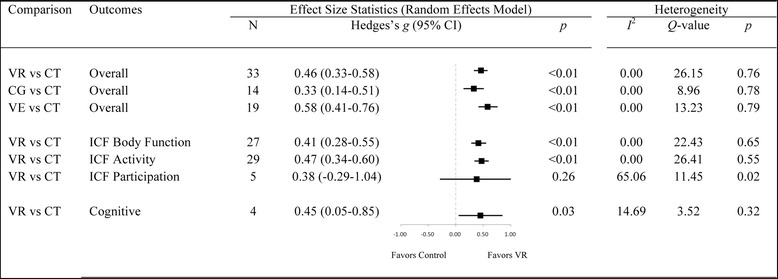
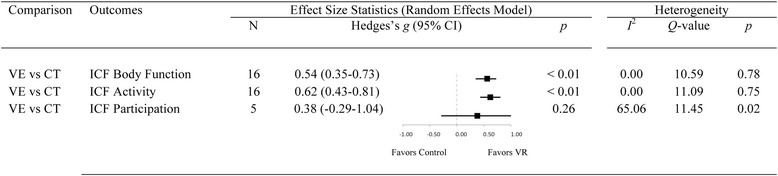
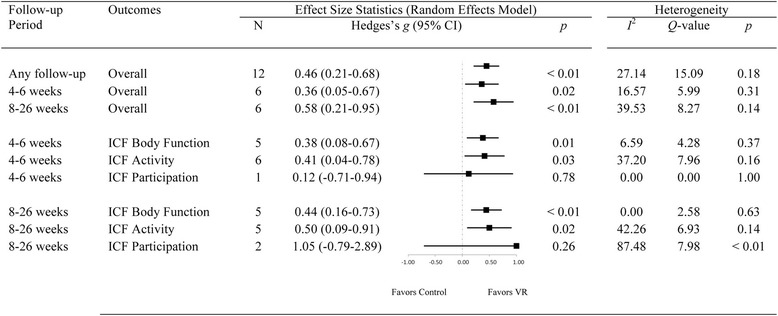
BACKGROUND: Virtual-reality based rehabilitation (VR) shows potential as an engaging and effective way to improve upper-limb function and cognitive abilities following a stroke. However, an updated synthesis of the literature is needed to capture growth in recent research and address gaps in our understanding of factors that may optimize training parameters and treatment effects. METHODS: Published randomized controlled trials comparing VR to conventional therapy were retrieved from seven electronic databases. Treatment effects (Hedge's g) were estimated using a random effects model, with motor and functional outcomes between different protocols compared at the Body Structure/Function, Activity, and Participation levels of the International Classification of Functioning. RESULTS: Thirty-three studies were identified, including 971 participants (492 VR participants). VR produced small to medium overall effects (g = 0.46; 95% CI: 0.33-0.59, p < 0.01), above and beyond conventional therapies. Small to medium effects were observed on Body Structure/Function (g = 0.41; 95% CI: 0.28-0.55; p < 0.01) and Activity outcomes (g = 0.47; 95% CI: 0.34-0.60, p < 0.01), while Participation outcomes failed to reach significance (g = 0.38; 95% CI: -0.29-1.04, p = 0.27). Superior benefits for Body Structure/Function (g = 0.56) and Activity outcomes (g = 0.62) were observed when examining outcomes only from purpose-designed VR systems. Preliminary results (k = 4) suggested small to medium effects for cognitive outcomes (g = 0.41; 95% CI: 0.28-0.55; p < 0.01). Moderator analysis found no advantage for higher doses of VR, massed practice training schedules, or greater time since injury. CONCLUSION: VR can effect significant gains on Body Structure/Function and Activity level outcomes, including improvements in cognitive function, for individuals who have sustained a stroke. The evidence supports the use of VR as an adjunct for stroke rehabilitation, with effectiveness evident for a variety of platforms, training parameters, and stages of recovery.
Overview
The claims and statistics of this paper haven’t been checked yet.
Run the check — free, no account needed. It reads the open-access text and checks the sources it cites.
Integrity signals
Registry
Cites
Statistics
Figures
Verification
Claims the paper makes
The claims and statistics of this paper haven’t been checked yet.
Run the check — free, no account needed. It reads the open-access text and checks the sources it cites.
Claims other papers make about this one
Each is checked against this paper’s own text: does it say what the citing paper says it does?
The cited source says what the claim attributes to it.
In the citing paper
“VR-assisted therapies offer numerous benefits, both for the clinician and the patient, highlighted by most authors cited in this paper, such as: availability, the potential of being used in a more ecological way, and the possibility of molding the virtual environment according to the specific pathology and needs of the patient (Aminov et al., 2018; Botella et al., 2015; Clu”
From Virtual reality and psychedelics for the treatment of psychiatric disease: A systematic literature review (2020) · cites this paper as Aminov et al., 2018
Self-check
Percentages, sums and reported differences re-computed from the paper’s own numbers.
The self-check needs the paper’s full text.
Citations
Cites
1 retracted
RETRACTED: Value and application of the ICF in rehabilitation medicine
Stucki, G., Ewert, T., & Cieza, A. (2002) · Disability and Rehabilitation · doi:10.1080/09638280110070221 · Cited by 174
RetractedStatistical Power Analysis for the Behavioral Sciences
Muller, K. E., & Cohen, J. (1989) · Technometrics · doi:10.2307/1270020 · Cited by 99,603
Statistical power analysis for the behavioral sciences
Cohen, J. (1990) · Computers Environment and Urban Systems · doi:10.1016/0198-9715(90)90050-4 · Cited by 65,417
Bias in meta-analysis detected by a simple, graphical test
Egger, M., Smith, G. D., Schneider, M., & Minder, C. (1997) · BMJ · doi:10.1136/bmj.315.7109.629 · Cited by 56,722
Statistical Power Analysis for the Behavioral Sciences (2nd ed.).
Lachenbruch, P. A., & Cohen, J. (1989) · Journal of the American Statistical Association · doi:10.2307/2290095 · Cited by 37,421
Liberati, A., Altman, D. G., Tetzlaff, J., Mulrow, C., Gøtzsche, P. C., Ioannidis, J. P. A., Clarke, M., Devereaux, P. J., Kleijnen, J., & Moher, D. (2009) · PLoS Medicine · doi:10.1371/journal.pmed.1000100 · Cited by 28,164
Hao (2015) · doi:10.1002/14651858 · Cited by 11,321
The file drawer problem and tolerance for null results.
Rosenthal, R. (1979) · Psychological Bulletin · doi:10.1037/0033-2909.86.3.638 · Cited by 9,068 · cited 1×
“The current review specifically focused on published, peer-review articles to ensure the high quality of included data, but performed a fail-safe N [119] calculation to account for missing studies and grey literature.”
MethodGlobal status report on noncommunicable diseases 2010.
Alwan, A. (2011) · Cited by 8,494
Reliability of the PEDro Scale for Rating Quality of Randomized Controlled Trials
Maher, C. G., Sherrington, C., Herbert, R. D., Moseley, A. M., & Elkins, M. (2003) · Physical Therapy · doi:10.1093/ptj/83.8.713 · Cited by 4,808
Research works printed but not linked: 1
- Howick J, Chalmers I, Glasziou P, Greenhalgh T, Heneghan C, Liberati A, Moschetti I, Phillips B, Thornton H. Explanation of the 2011 Oxford Centre for Evidence-Based Medicine (OCEBM) levels of evidence Oxford center for Evidence-Based Medicine 2011.
Cited by
Sorted by citations
Items 201–237 of 237
GASTRONOMIC CULTURE DEVELOPMENT IN TERMS OF GLOBALIZATION: PROBLEMS, CHALLENGES, SOLUTIONS
Kaika, N. Y. (2024) · Scientific Research of the SCO Countries: Synergy and Integration · doi:10.34660/inf.2023.42.76.196
Табаков, Н. А., Savchenko, T. Y., & Voenbender, L. A. (2024) · Scientific Research of the SCO Countries: Synergy and Integration · doi:10.34660/inf.2023.49.13.207
INTEGRATING CORPORATE CULTURE FOR SUCCESSFUL MERGERS AND ACQUISITIONS: EVIDENCE FROM SOUTH KOREA
Shvets, A. V., & Ilina, E. A. (2024) · Scientific Research of the SCO Countries: Synergy and Integration · doi:10.34660/inf.2023.82.56.183
Petrova, L. V., Pogonchenkova, I. V., & Kostenko, E. V. (2024) · Scientific Research of the SCO Countries: Synergy and Integration · doi:10.34660/inf.2023.13.45.199
Щукин, А. В., Senatskaya, V. G., & Kosovarcev, D. A. (2024) · Scientific Research of the SCO Countries: Synergy and Integration · doi:10.34660/inf.2023.50.82.189
TO THE PROBLEM OF THE EMERGENCE AND ACTIVATION OF FAILURE PHENOMENA IN THE TERRITORY OF GYUMRI
Gasparyan, R. K. (2024) · Scientific Research of the SCO Countries: Synergy and Integration · doi:10.34660/inf.2023.41.92.209
US AND PRC MILITARY DOCTRINES: GEOPOLITICAL ASPECTS OF DETERRENCE IN MODERN CONDITIONS
Полончук, Р. А. (2024) · Scientific Research of the SCO Countries: Synergy and Integration · doi:10.34660/inf.2023.45.55.197
Kovalev, V. N., Kudryavtsev, M. D., & Kuliyev, V. K. (2024) · Scientific Research of the SCO Countries: Synergy and Integration · doi:10.34660/inf.2023.75.10.188
Repina, A. A. (2024) · Scientific Research of the SCO Countries: Synergy and Integration · doi:10.34660/inf.2023.54.71.186
PRC-RUSSIA GEOSTRATEGIC PARTNERSHIP AND ITS TRANSPORT AND LOGISTICS SUPPORT
Wang, M. (2024) · Scientific Research of the SCO Countries: Synergy and Integration · doi:10.34660/inf.2023.60.92.185
IONOSPHERIC STRUCTURE SOUNDING
Voronkov, B. N., & Schegolevatykh, A. S. (2024) · Scientific Research of the SCO Countries: Synergy and Integration · doi:10.34660/inf.2023.42.29.202
Utilization of Virtual Reality(VR)in Rehabilitation Treatment
Nakahara, Y. (2024) · リハビリテーション医学 : 日本リハビリテーション医学会誌 · doi:10.2490/jjrmc.61.1184
Hadjipanayi, C., Banakou, D., & Michael‐Grigoriou, D. (2025) · Springer eBooks · doi:10.1007/978-3-031-87158-0_7 · Cited by 3
Sellner, T., Ehmann, P., Spielmann, J., Gogolla, F., Rösgen, A.-K., Mayer, J., Schoenfeld, M. A., & Flor, H. (2025) · Frontiers in Virtual Reality · doi:10.3389/frvir.2025.1575744
Designing for Engagement: A Co-Created VR Game for Upper Limb Rehabilitation
de Sousa, A. P., Freitas, T., Karnikowski, J. A. G. D. O., Oliveira, L., Lopes, P., Pinto, F., & Fonseca, M. (2025) · IEEE Conference on Games (CoG) · doi:10.1109/cog64752.2025.11114398
Bujnowska–Fedak, M. M., Sobieski, M., Pałys, M., & Waligóra, J. (2025) · Research Square · doi:10.21203/rs.3.rs-7830163/v1
Nath, D., Singh, N., Banduni, O., Saini, M., Kumar, N. K., Srivastava, M. V. P., & Mehndiratta, A. (2025) · Virtual Reality · doi:10.1007/s10055-025-01267-1
Erhardsson, M., Murphy, M. A., & Sunnerhagen, K. S. (2020) · Figshare · doi:10.6084/m9.figshare.13278840
Additional file 1 of Serious games for upper limb rehabilitation after stroke: a meta-analysis
Doumas, I., Everard, G. J., Dehem, S., & Lejeune, T. M. (2021) · Figshare · doi:10.6084/m9.figshare.14788320
Soleimani, M., Ghazisaeedi, M., & Heydari, S. (2024) · Figshare · doi:10.6084/m9.figshare.26725061
Soleimani, M., Ghazisaeedi, M., & Heydari, S. (2024) · Figshare · doi:10.6084/m9.figshare.26725058
Soleimani, M., Ghazisaeedi, M., & Heydari, S. (2024) · Figshare · doi:10.6084/m9.figshare.26725052
Soleimani, M., Ghazisaeedi, M., & Heydari, S. (2024) · Figshare · doi:10.6084/m9.figshare.26725055
Erhardsson, M., Murphy, M. A., & Sunnerhagen, K. S. (2020) · Figshare · doi:10.6084/m9.figshare.13278855
Zhang, T., Yan, H., Liu, Y., Tang, Y., Wang, S., Yang, Z., & Luo, Y. (2026) · Journal of the American Medical Directors Association · doi:10.1016/j.jamda.2025.106064
Virtual Reality (VR) in Post MIPSI Rehabilitation: Redefining Recovery Pathways in Pain Medicine
Dey, S., & Arora, P. (2025) · Journal on musculoskeletal ultrasound in pain medicine. · doi:10.4103/jmupm.jmupm_37_25
Denouël, L., Ménard, M., Olivier, A., & Bilhaut, A. (2026) · Journal of Bodywork and Movement Therapies · doi:10.1016/j.jbmt.2026.03.009
The problem of the development of executive functions in modern foreign studies
Владимирович, Т. Р. (2026) · Journal of Modern Foreign Psychology · doi:10.17759/jmfp.2026150114
Flynn, N., Rahmann, A., Luxton, N., Vu, J., & Kuys, S. S. (2026) · Brain Impairment · doi:10.1071/ib24124
Pavithra, J., Suganthirabau, P., Srinivasan, V., Alagesan, J., -, V. K. P., & Srinivasan, P. (2026) · Lecture notes in electrical engineering · doi:10.1007/978-981-95-5835-3_91
Sayed, A. E. H. I. E., Taha, S. I., Habib, D. A. A., Abd-Elfattah, H. M., & Elserougy, H. R. (2026) · Neurorehabilitation · doi:10.1177/10538135261456309
Virtual Reality-Based Intervention in Neurorehabilitation
Pérez, S. E. M., Stender, C. L. H., Infante-Guedes, A., Vico-Rodríguez, P., Cano-Orihuela, M., González-Martín, A. M., SUÁREZ, A. B., & Pérez, I. M. M. (2026) · Encyclopedia · doi:10.3390/encyclopedia6080164
Technology in Diverse Populations
Thames, A. D., & Cavanagh, L. (2026) · Oxford University Press eBooks · doi:10.1093/9780197814116.003.0011
Marafie, Z., & Jones, S. (2026) · Research Square · doi:10.21203/rs.3.rs-10763946/v1
Roshan, P. S. B., Krishna, H. S., & Aswin, T. J. (2026) · Galore International Journal of Health Sciences and Research · doi:10.52403/gijhsr.20260328
Araya, M. P. (2026) · Revista Médica Clínica Las Condes · doi:10.1016/j.rmclc.2026.07.002
Diriba, C., Abessa, T. G., Lamba, D., & Bonnechère, B. (2026) · PLoS ONE · doi:10.1371/journal.pone.0360216
Metadata
- Authors
- Aminov, A., Rogers, J. M., Middleton, S., Caeyenberghs, K., & Wilson, P. H.
- Affiliations
- Australian Catholic University (AU)
- South Eastern Sydney Local Health District (AU)
- Corresponding author
- Wilson, Peter H.
- Venue
- Journal of NeuroEngineering and Rehabilitation
- Published
- 2018-03-27
- Volume
- 15
- Issue
- 1
- Pages
- 29-29
- ISSN
- 1743-0003 (ISSN-L)
- PMC
- PMC5870176
- OpenAlex
- W2798072203
- Cited by
- 236
- References
- 132
- Citations by year
- 2026: 15 · 2025: 30 · 2024: 51 · 2023: 25 · 2022: 35 · 2021: 28 · 2020: 29 · 2019: 15 · 2018: 8
- FWCI
- 2.51
- Type
- journal article
- Language
- en
- Open access
- gold
- doi.org
- Licence
- Locations
- Journal of NeuroEngineering and Rehabilitation (publishedVersion, cc-by)
- PubMed Central (publishedVersion, cc-by)
- PubMed (publishedVersion)
- Research Bank (Australian Catholic University) (submittedVersion, cc-by)
- DOAJ (DOAJ: Directory of Open Access Journals) (submittedVersion, cc-by-sa)
- Figshare (submittedVersion, cc-by)
- Funders
- Prince of Wales Hospital Foundation (Grant No. 4R/14)
- The Research Training Program
- Topics
- Health Sciences › Medicine › Rehabilitation › Stroke Rehabilitation and Recovery
- Physical Sciences › Computer Science › Human-Computer Interaction › Virtual Reality Applications and Impacts
- Life Sciences › Neuroscience › Neurology › Transcranial Magnetic Stimulation Studies
- Keywords
- virtual reality rehabilitation, stroke rehabilitation, upper limb function, cognitive function, conventional therapy comparison, International Classification of Functioning, Disability and Health, body structure and function, participation outcomes, training dose, massed practice, time since injury, adjunctive therapy
- MeSH terms
- Stroke Rehabilitation, Virtual Reality, Cognition, Humans, Randomized Controlled Trials as Topic, Stroke, Upper Extremity
About these checks
Registry, retraction, Cites and statistics results are computed, not judged, with one exception: a printed reference that no index lists is read once by a model before it counts as a citation error. Claims are extracted by a model and kept only when their quote appears verbatim in the text; each cited source is then checked, with a model’s help, for whether it says what the claim relies on. Those verdicts can be wrong — read the claim’s quote and the cited source before relying on one.
Statistics and arithmetic are recomputed, not judged.
Confidence bands are shown only for fields calibrated on our annotated test set. None is calibrated yet, so no band is shown.
What counts as a claim ›How we measure confidence ›How we check this ›
Are you an author, or do you see a problem with this page? Request a review
