

Antidiabetic properties of dietary flavonoids: a cellular mechanism review
Open accessThe DOI matches its Crossref record; 220 of the 221 references it cites were found in a registry or an index.
Abstract
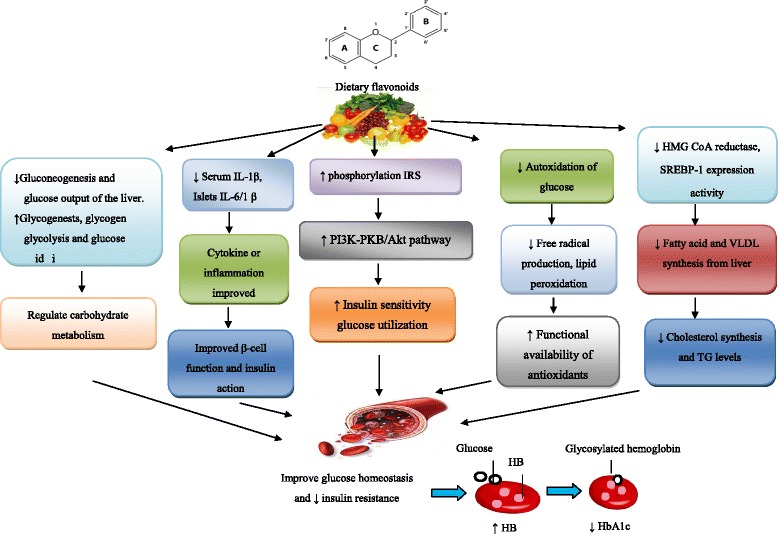
BACKGROUND: Natural food products have been used for combating human diseases for thousands of years. Naturally occurring flavonoids including flavones, flavonols, flavanones, flavonols, isoflavones and anthocyanidins have been proposed as effective supplements for management and prevention of diabetes and its long-term complications based on in vitro and animal models. AIM: To summarize the roles of dietary flavonoids in diabetes management and their molecular mechanisms. FINDINGS: Tremendous studies have found that flavonoids originated from foods could improve glucose metabolism, lipid profile, regulating the hormones and enzymes in human body, further protecting human being from diseases like obesity, diabetes and their complications. CONCLUSION: In the current review, we summarize recent progress in understanding the biological action, mechanism and therapeutic potential of the dietary flavonoids and its subsequent clinical outcomes in the field of drug discovery in management of diabetes mellitus.
Overview
The claims and statistics of this paper haven’t been checked yet.
Free: it reads the open-access text and checks the first 5 claims that cite a source we can check. Create a free account to check every claim.
Integrity signals
Registry
Cites
Statistics
Figures
Verification
Claims the paper makes
The claims and statistics of this paper haven’t been checked yet.
Free: it reads the open-access text and checks the first 5 claims that cite a source we can check. Create a free account to check every claim.
Self-check
Percentages, sums and reported differences re-computed from the paper’s own numbers.
The self-check needs the paper’s full text.
Citations
Cites
1 retracted
Items 201–220 of 220
Luteolin prevents uric acid-induced pancreatic b-cell dysfunction
Ying, D., Xu-hui, S., Xuanyu, S., Xu, Y., Yun, L., Liang, X., Dong, W., & Dongming, S. (2014) · Journal of Biomedical Research · doi:10.7555/jbr.28.20130170 · Cited by 46
El‐Bassossy, H. M., Hassan, N. A., Mahmoud, M. F., & Fahmy, A. (2014) · Phytomedicine · doi:10.1016/j.phymed.2014.08.012 · Cited by 43
Weigt, C., Hertrampf, T., Flenker, U., Hülsemann, F., Kurnaz, P., Fritzemeier, K. H., & Diel, P. R. (2015) · The Journal of Steroid Biochemistry and Molecular Biology · doi:10.1016/j.jsbmb.2015.06.002 · Cited by 42
Apigenin inhibits pancreatic stellate cell activity in pancreatitis
Mrazek, A. A., Porro, L. J., Bhatia, V., Falzon, M., Spratt, H. M., Zhou, J., Chao, C., & Hellmich, M. R. (2015) · Journal of Surgical Research · doi:10.1016/j.jss.2015.02.032 · Cited by 42
Ravikumar, G., Gomathi, D., Kalaiselvi, M., & Uma, C. (2012) · Asian Pacific Journal of Tropical Biomedicine · doi:10.1016/s2221-1691(12)60198-1 · Cited by 40
Kakadiya, J., Mulani, H. T., & Shah, N. J. (2010) · PubMed Central · Cited by 36
Qi, Z., Xu, Y., Liang, Z., Li, S., Wang, J., Wei, Y., & Dong, B. (2015) · PubMed Central · Cited by 36
Wogonin suppresses osteopontin expression in adipocytes by activating PPARα
Zhang, Y., Li, M., Tang, Z., & Wang, C. (2015) · Acta Pharmacologica Sinica · doi:10.1038/aps.2015.37 · Cited by 31
Effects of the natural flavonoid delphinidin on diabetic microangiopathy.
Bertuglia, S., Malandrino, S., & Colantuoni, A. (1995) · PubMed · Cited by 29
Clinical pharmacology of inflammatory bowel disease therapies
Sandborn, W. J., & Faubion, W. A. (2000) · Current Gastroenterology Reports · doi:10.1007/s11894-000-0005-0 · Cited by 28
Regulation of Hexokinase II Gene Expression by Glucose Flux in Skeletal Muscle
Tsao, T., Burcelin, R., & Charron, M. J. (1996) · Journal of Biological Chemistry · doi:10.1074/jbc.271.25.14959 · Cited by 28
Mirshekar, M. A., Roghani, M., Khalili, M., & Baluchnejadmojarad, T. (2011) · PubMed Central · Cited by 25
Yuan, W., Jia, F., & Meng, J.-Z. (2009) · Journal of Artificial Organs · doi:10.1007/s10047-009-0479-y · Cited by 25
(2014) · Macedonian Journal of Medical Sciences · doi:10.3889/mjms.1857-5773.2014.0401 · Cited by 24
Effects of two antioxidants; α-lipoic acid and fisetin against diabetic cataract in mice
Kan, E., Kılıçkan, E., Ayar, A., & Çolak, R. (2014) · International Ophthalmology · doi:10.1007/s10792-014-0029-3 · Cited by 23
Kapiotis, S., Jilma, B., Szalay, T., Dirnberger, E., Wagner, O. F., Eichler, H., & Speiser, W. (1997) · Arteriosclerosis Thrombosis and Vascular Biology · doi:10.1161/01.atv.17.11.2861 · Cited by 21
Genistein modulation of streptozotocin diabetes in male B6C3F1 mice can be induced by diet
Guo, T. L., Yunbiao, W., Xiong, T., Ling Zhi, X. I. A. O., & Zheng, J. (2014) · Toxicology and Applied Pharmacology · doi:10.1016/j.taap.2014.08.028 · Cited by 20
Flavonoid treatment reduces glycation and lipid peroxidation in experimental diabetic rats
Vertommen, J., van den Enden, M., Simoens, L., & Leeuw, I. D. (1994) · Phytotherapy Research · doi:10.1002/ptr.2650080711 · Cited by 17
Schimmer, B. P., Tsao, J., & Czerwinski, W. (1996) · Journal of Biological Chemistry · doi:10.1074/jbc.271.9.4993 · Cited by 15
[Isolation and identification of fisetin in Cotinus coggygria].
Hq, D. (1983) · PubMed · Cited by 2
Research works printed but not linked: 1
- International Diabetes Federation, Sixth edition. 2014.
Cited by
AL-Ishaq, R. K., Abotaleb, M., Kubatka, P., Kajo, K., & Büsselberg, D. (2019) · Biomolecules · doi:10.3390/biom9090430 · Cited by 741
Ginwala, R., Bhavsar, R., Chigbu, D. G. I., Jain, P., & Khan, Z. K. (2019) · Antioxidants · doi:10.3390/antiox8020035 · Cited by 588
Flavonoids a Bioactive Compound from Medicinal Plants and Its Therapeutic Applications
Roy, A., Khan, A., Ahmad, I., Alghamdi, S., Rajab, B. S., Babalghith, A. O., Alshahrani, M. Y., Islam, S., & Islam, M. R. (2022) · BioMed Research International · doi:10.1155/2022/5445291 · Cited by 588
Mechanisms of antidiabetic effects of flavonoid rutin
Ghorbani, A. (2017) · Biomedicine & Pharmacotherapy · doi:10.1016/j.biopha.2017.10.001 · Cited by 511
Molecular Mechanisms of the Anti-Obesity and Anti-Diabetic Properties of Flavonoids
Kawser Hossain, M., Abdal Dayem, A., Han, J., Yin, Y., Kim, K., Kumar Saha, S., Yang, G.-M., Choi, H., & Cho, S.-G. (2016) · International Journal of Molecular Sciences · doi:10.3390/ijms17040569 · Cited by 495
Metadata
- Authors
- Vinayagam, R., & Xu, B.
- Affiliations
- Beijing Normal-Hong Kong Baptist University (CN)
- Corresponding author
- Xu, Baojun
- Venue
- Nutrition & Metabolism
- Published
- 2015-12
- Volume
- 12
- Issue
- 1
- Pages
- 60-60
- ISSN
- 1743-7075 (ISSN-L)
- PMC
- PMC4690284
- OpenAlex
- W2202210344
- Cited by
- 597
- References
- 221
- Citations by year
- 2026: 26 · 2025: 39 · 2024: 71 · 2023: 88 · 2022: 74 · 2021: 73 · 2020: 55 · 2019: 65 · 2018: 41 · 2017: 52 · 2016: 13
- FWCI
- 5.35
- Type
- journal article
- Language
- en
- Open access
- gold
- doi.org
- Licence
- cc-by
- Locations
- Nutrition & Metabolism (publishedVersion, cc-by)
- PubMed Central (publishedVersion, cc-by)
- PubMed (publishedVersion)
- Funders
- Beijing Normal University-Hong Kong Baptist University United International College (UICRG201402)
- Topics
- Health Sciences › Medicine › Endocrinology, Diabetes and Metabolism › Natural Antidiabetic Agents Studies
- Health Sciences › Medicine › Biochemistry (medical) › Phytochemicals and Antioxidant Activities
- Health Sciences › Medicine › Pharmacology (medical) › Flavonoids in Medical Research
- Keywords
- dietary flavonoids, diabetes mellitus, antidiabetic mechanism, glucose metabolism, lipid profile, obesity, flavonols, isoflavones, anthocyanidins, flavanones, flavones, diabetes complications, drug discovery
About these checks
Registry, retraction, Cites and statistics results are computed, not judged, with one exception: a printed reference that no index lists is read once by a model before it counts as a citation error. Claims are extracted by a model and kept only when their quote appears verbatim in the text; each cited source is then checked, with a model’s help, for whether it says what the claim relies on. Those verdicts can be wrong — read the claim’s quote and the cited source before relying on one.
Statistics and arithmetic are recomputed, not judged.
Confidence bands are shown only for fields calibrated on our annotated test set. None is calibrated yet, so no band is shown.
What counts as a claim ›How we measure confidence ›How we check this ›
Are you an author, or do you see a problem with this page? Request a review
Data sources
Bibliographic data: Semantic Scholar, OpenAlex, Crossref.
Contains information from the Semantic Scholar Academic Graph Datasets, made available under the ODC Attribution License (ODC-BY 1.0).
Semantic Scholar’s data is described in: Kinney, R., et al. (2023). The Semantic Scholar Open Data Platform. arXiv:2301.10140.
