

Effects of exenatide versus insulin glargine on body composition in overweight and obese T2DM patients: a randomized controlled trial
Open accessThe DOI matches its Crossref record; 47 of the 47 references it cites were found in a registry or an index.
Abstract
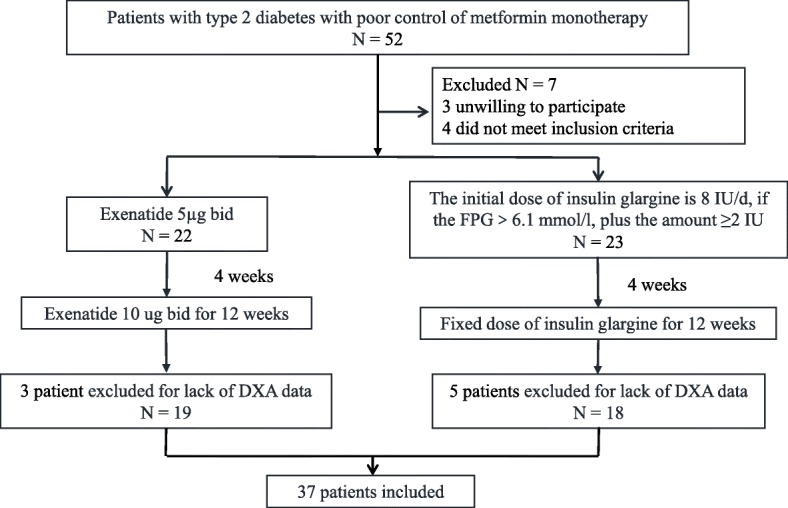
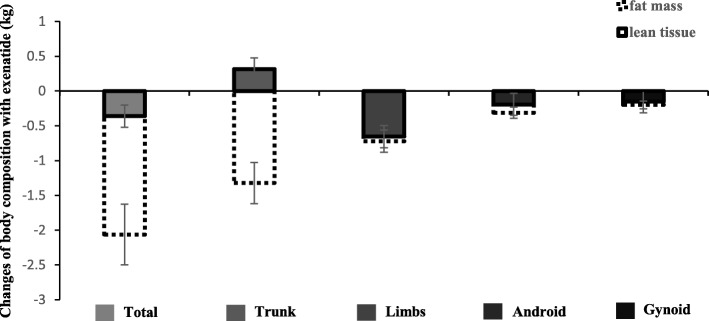
BACKGROUND: Weight loss, especially fat mass reduction, helps to improve blood glucose control, insulin sensitivity, and β-cell function. This study aimed to compare the effect of exenatide and glargine on body composition in overweight and obese patients with type 2 diabetes (T2DM) who do not achieve adequate glycemic control with metformin. METHODS: We performed a prospective, randomized study of 37 overweight or obese patients with T2DM who had inadequate glycemic control with metformin. The patients were treated with either exenatide or glargine for 16 weeks. Dual-energy X-ray absorptiometry was used to assess body composition. RESULTS: Post-intervention weight, body mass index (BMI), waist circumference, body mass, and fat mass were lower in patients treated with exenatide, while weight and BMI significantly increased with glargine. Reductions in weight, BMI, body fat mass, and percent fat mass (except for gynoid) were greater with exenatide than with glargine, and percent lean tissue (other than the limbs) increased with exenatide. In all body regions except for the limbs, fat mass decreased with exenatide to a greater extent than lean tissue. Glucose control, insulin resistance, and β-cell function were not different between the treatment groups. CONCLUSIONS: For overweight and obese patients whose T2DM was inadequately controlled with metformin, exenatide and glargine achieved similar improvements in glycemic control, insulin sensitivity, and β-cell function.However, exenatide produced better weight and fat mass reduction, which were beneficial for blood glucose control. Our findings may guide the selection of appropriate drugs for glycemic and weight control. TRIAL REGISTRATION: NCT02325960, registered 25 December 2014.
Overview
The claims and statistics of this paper haven’t been checked yet.
Free: it reads the open-access text and checks the first 5 claims that cite a source we can check. Create a free account to check every claim.
Integrity signals
Registry
Cites
Statistics
Figures
Verification
Claims the paper makes
The claims and statistics of this paper haven’t been checked yet.
Free: it reads the open-access text and checks the first 5 claims that cite a source we can check. Create a free account to check every claim.
Claims other papers make about this one
Each is checked against this paper’s own text: does it say what the citing paper says it does?
The cited source says what the claim attributes to it.
In the citing paper
“existing evidence suggests that weight loss associated with exenatide is primarily attributable to reductions in fat mass, whereas lean body mass is largely preserved [74].”
From GLP-1 Receptor Agonists for Obesity Management in Older Adults: A Scoping Review on the Risk of Sarcopenia and Sarcopenic Obesity (2026) · doi:10.1007/s13668-026-00777-x · cites this paper as [74]
Self-check
Percentages, sums and reported differences re-computed from the paper’s own numbers.
The self-check needs the paper’s full text.
Citations
Cites
Ng, M., Fleming, T., Robinson, M., Thomson, B., Graetz, N., Margono, C., Mullany, E. C., Biryukov, S., Abbafati, C., Abera, S. F., et al. (2014) · The Lancet · doi:10.1016/s0140-6736(14)60460-8 · Cited by 11,952
Stratton, I. M. (2000) · BMJ · doi:10.1136/bmj.321.7258.405 · Cited by 9,059
Standards of Medical Care in Diabetes
Power, D. (2006) · Diabetes Care · doi:10.2337/diacare.29.02.06.dc05-1593 · Cited by 8,673
IDF Diabetes Atlas: Global estimates for the prevalence of diabetes for 2015 and 2040
Ogurtsova, K., da Rocha Fernandes, J. D., Huang, Y., Linnenkamp, U., Guariguata, L., Cho, N. H., Cavan, D., Shaw, J. E., & Makaroff, L. E. (2017) · Diabetes Research and Clinical Practice · doi:10.1016/j.diabres.2017.03.024 · Cited by 6,966
Standards of medical care in diabetes—2014
American Diabetes Association (2014) · Diabetes Care · doi:10.2337/dc14-s014 · Cited by 4,572
IDF Diabetes Atlas: Global estimates of the prevalence of diabetes for 2011 and 2030
Whiting, D. R., Guariguata, L., Weil, C., & Shaw, J. (2011) · Diabetes Research and Clinical Practice · doi:10.1016/j.diabres.2011.10.029 · Cited by 3,994
Inzucchi, S. E., Bergenstal, R. M., Buse, J. B., Diamant, M., Ferrannini, E., Nauck, M., Peters, A. L., Tsapas, A., Wender, R., & Matthews, D. R. (2012) · Diabetologia · doi:10.1007/s00125-012-2534-0 · Cited by 3,919
Drucker, D. J., & Nauck, M. A. (2006) · The Lancet · doi:10.1016/s0140-6736(06)69705-5 · Cited by 3,896
Inzucchi, S. E., Bergenstal, R. M., Buse, J. B., Diamant, M., Ferrannini, E., Nauck, M., Peters, A. L., Tsapas, A., Wender, R., & Matthews, D. R. (2015) · Diabetes Care · doi:10.2337/dc14-2441 · Cited by 3,066
Pathophysiology of human visceral obesity: an update
Tchernof, A., & Després, J.-P. (2013) · Physiological Reviews · doi:10.1152/physrev.00033.2011 · Cited by 2,583
Cited by
Sargeant, J. A., Henson, J., King, J. A., Yates, T., Khunti, K., & Davies, M. J. (2019) · Endocrinology and Metabolism · doi:10.3803/enm.2019.34.3.247 · Cited by 231
Karakasis, P., Patoulias, D., Fragakis, N., & Mantzoros, C. S. (2025) · Metabolism · doi:10.1016/j.metabol.2024.156113 · Cited by 242
Body composition changes in diabetes and aging
Al-Sofiani, M. E., Ganji, S. S., & Kalyani, R. R. (2019) · Journal of Diabetes and its Complications · doi:10.1016/j.jdiacomp.2019.03.007 · Cited by 157
Oliveira, P. S., Chaves, V. C., Bona, N. P., Soares, M. S. P., Cardoso, J. D. S., Vasconcellos, F. A., Tavares, R. G., Vizzotto, M., da Silva, L. M. C., Grecco, F. B., et al. (2017) · Biomedicine & Pharmacotherapy · doi:10.1016/j.biopha.2017.05.131 · Cited by 52
Dubin, R. L., Heymsfield, S. B., Ravussin, E., & Greenway, F. L. (2024) · Diabetes, Obesity and Metabolism · doi:10.1111/dom.15913 · Cited by 47
Anyiam, O., Ardavani, A., Rashid, R. S. A., Panesar, A., & IDRIS, I. R. (2025) · Obesity Reviews · doi:10.1111/obr.13916 · Cited by 49
Kim, Y. J., Hwang, S. D., & Lim, S. K. (2020) · Frontiers in Endocrinology · doi:10.3389/fendo.2020.00553 · Cited by 24
Rados, D. R. V., Falcetta, M. R. R., Pinto, L. C. F., Leitão, C. B., & Gross, J. L. (2021) · Diabetes Research and Clinical Practice · doi:10.1016/j.diabres.2021.108688 · Cited by 25
Lu, J., Zou, S., Liu, X., Wong, T. Y. P., Zhang, X., Xu, K., Zhao, Y., Hong, Y., Cen, A., & Wang, Y. (2025) · European Journal of Pharmacology · doi:10.1016/j.ejphar.2025.177885 · Cited by 28
Self-citationDing, L., Fan, Y., He, J., Wang, R., He, Q., Cui, J., Ma, Z., Zheng, F., Gao, H., Dai, C., et al. (2021) · Obesity · doi:10.1002/oby.23151 · Cited by 17
“Use of both GLP1 receptor agonists and sodium- dependent glucose transporter2 inhibitor treatments has also induced weight reduction and decrease in fat tissue to a greater extent relative to muscle (26,34,35).”
BackgroundImpact of dietary ingredients on the interpretation of various fecal parameters in rats fed inulin
Chen, H.-J., Dai, F.-J., Chang, C.-R., Lau, Y.-Q., Chew, B.-S., & Chau, C. (2019) · Journal of Food and Drug Analysis · doi:10.1016/j.jfda.2019.06.005 · Cited by 12
Effect of caffeine on the possible amelioration of diabetic neuropathy: A spectroscopic study
Srivastava, B., Sen, S., Bhakta, S., & Sen, K. (2021) · Spectrochimica Acta Part A Molecular and Biomolecular Spectroscopy · doi:10.1016/j.saa.2021.120322 · Cited by 12
(2026) · doi:10.1007/s13668-026-00777-x · Cited by 10
“Notably, concerning body composition and muscle health, existing evidence suggests that weight loss associated with exenatide is primarily attributable to reductions in fat mass, whereas lean body mass is largely preserved [74 ].”
Chrysavgis, L., Mourelatou, N. G., Koloutsou, M. E., Rozani, S., & Cholongitas, Ε. (2025) · International Journal of Molecular Sciences · doi:10.3390/ijms262412130 · Cited by 16
“In Yin et al. [115] and Bunck et al. [124] studies, lean mass loss ranged from 0.9 to 1.6 kg over treatment periods of 16 to 48 weeks.”
InfluentialChen, W., Qin, H., Zhou, Z., Chen, Y., Xu, X., Chen, Y., He, J., Xu, R., Gao, H., & Lu, Q. (2025) · Clinical Nutrition · doi:10.1016/j.clnu.2025.10.006 · Cited by 17
Masuda, A., Seino, Y., Murase, M., Hidaka, S., Shibata, M., Takayanagi, T., Sugimura, Y., Hayashi, Y., & Suzuki, A. (2019) · Nutrients · doi:10.3390/nu11051045 · Cited by 6
Wang, J., Jin, X., An, P., Yu, S., & Mu, Y. (2019) · Journal of Diabetes Research · doi:10.1155/2019/8083417 · Cited by 5
Aldahash, R. (2021) · Journal of Endocrinology and Metabolism · doi:10.14740/jem745 · Cited by 5
“The studies were conducted mostly in developed countries such as USA (n = 4), Japan (n = 1, Europe (n = 1), Italy (n = 2), China (n = 2), Korea (n = 1), UK (n = 1), and Denmark (n = 1) (Table 3 [13-32]).”
BackgroundMethodRakhsha, S. S., Shahinfar, H., Ebrahimi-Mousavi, S., Kosari, A., Aali, Y., Mirzababaei, A., Hosseini, S. A., Jadidi, P., Shafiee, G., Mansourzadeh, M. J., et al. (2026) · Diabetes Obesity and Metabolism · doi:10.1111/dom.70957 · Cited by 4
Glucagon‐Like Peptide‐1 Receptor Agonist‐Based Agents and Body Composition: Filling More Gaps
Dubin, R. L., Sanders, T. N., Schwab, H. M., Heymsfield, S. B., & Greenway, F. L. (2026) · Obesity · doi:10.1002/oby.70212 · Cited by 3
Utilization of Proteomic Measures for Early Detection of Drug Benefits and Adverse Effects
Chadwick, J., Berry, C., Carpenter, M. A., Gulati, G., Heck, S. L., Hinterberg, M., Holman, R. R., Lee, M. M. Y., Omland, T., Paterson, C., et al. (2025) · The Journal of Clinical Pharmacology · doi:10.1002/jcph.70077 · Cited by 3
Wachiraphansakul, N., Vongchaiudomchoke, T., Manosroi, W., Ruengorn, C., Noppakun, K., Ngamvichchukorn, T., Sood, M. M., Thavorn, K., Hutton, B., & Nochaiwong, S. (2026) · Diabetes Obesity and Metabolism · doi:10.1111/dom.70884 · Cited by 2
Tesoro, N. A., Rivera, F. B., Bantayan, N. R. B., Magalong, J. V., Tomada, R., Wong, M. A., Tangco, G. A., Pine, P. L. S., Manha, J. K., Tanni, E. S., et al. (2026) · American Journal of Preventive Cardiology · doi:10.1016/j.ajpc.2026.101623
Zadeh, A. T., Chiapparelli, E. A., Amoroso, K., Guven, A. E., Zhu, J., Köhli, P., Verna, B., Mielke, A. M., Shue, J., Burkhard, M. D., et al. (2026) · HSS Journal® The Musculoskeletal Journal of Hospital for Special Surgery · doi:10.1177/15563316261446300 · Cited by 2
Alhamad, Z. M., AlShalhoub, N., Al-mana, A., Almutairi, F. E., & Alshalhoub, H. M. (2026) · Cureus · doi:10.7759/cureus.117738
Zhang, J., Zhai, X., Sha, S., & Zhang, L. (2026) · Drugs · doi:10.1007/s40265-026-02408-9
Metadata
- Authors
- Yin, T.-T., Bi, Y., Li, P., Shen, S.-M., Wang, W.-M., Jiang, C., Gao, C.-X., Wang, Y., Gao, L.-J., Zhu, D.-L., & Feng, W.-H.
- Affiliations
- Nanjing Drum Tower Hospital (CN)
- Jining First People's Hospital (CN)
- Venue
- Nutrition & Metabolism
- Published
- 2018-10-01
- Volume
- 15
- Issue
- 1
- Pages
- 67-67
- ISSN
- 1743-7075 (ISSN-L)
- PMC
- PMC6167818
- OpenAlex
- W2893958327
- Cited by
- 26
- References
- 46
- Citations by year
- 2026: 8 · 2025: 5 · 2024: 2 · 2021: 4 · 2020: 1 · 2019: 5
- FWCI
- 1.99
- Type
- journal article
- Language
- en
- Open access
- gold
- doi.org
- Licence
- cc-by
- creativecommons.org/licenses/by/4.0/ (tdm)
- Locations
- Nutrition & Metabolism (publishedVersion, cc-by)
- Europe PMC (PubMed Central) (publishedVersion, other-oa)
- PubMed Central (publishedVersion, cc-by)
- PubMed (publishedVersion)
- DOAJ (DOAJ: Directory of Open Access Journals) (submittedVersion)
- Informationszentrum Lebenswissenschaften (ZB MED) (submittedVersion, cc-by)
- Funders
- AstraZeneca
- National Natural Science Foundation of China (81570737, 2017-N-05, 81570736, 2015604, 14380296)
- Government of Jiangsu Province
- Nanjing University (14380296)
- Topics
- Health Sciences › Medicine › Endocrinology, Diabetes and Metabolism › Diabetes Treatment and Management
- Health Sciences › Medicine › Pharmacology (medical) › Pharmacology and Obesity Treatment
- Health Sciences › Medicine › Endocrinology, Diabetes and Metabolism › Diabetes, Cardiovascular Risks, and Lipoproteins
- Keywords
- exenatide, insulin glargine, type 2 diabetes, obesity, overweight, body composition, fat mass reduction, lean tissue, glycemic control, insulin resistance, beta-cell function, weight loss
About these checks
Registry, retraction, Cites and statistics results are computed, not judged, with one exception: a printed reference that no index lists is read once by a model before it counts as a citation error. Claims are extracted by a model and kept only when their quote appears verbatim in the text; each cited source is then checked, with a model’s help, for whether it says what the claim relies on. Those verdicts can be wrong — read the claim’s quote and the cited source before relying on one.
Statistics and arithmetic are recomputed, not judged.
Confidence bands are shown only for fields calibrated on our annotated test set. None is calibrated yet, so no band is shown.
What counts as a claim ›How we measure confidence ›How we check this ›
Are you an author, or do you see a problem with this page? Request a review
Data sources
Bibliographic data: Semantic Scholar, OpenAlex, Crossref.
Contains information from the Semantic Scholar Academic Graph Datasets, made available under the ODC Attribution License (ODC-BY 1.0).
Semantic Scholar’s data is described in: Kinney, R., et al. (2023). The Semantic Scholar Open Data Platform. arXiv:2301.10140.
