

Effects from a 90-day inhalation toxicity study with cerium oxide and barium sulfate nanoparticles in rats
Open accessThe DOI matches its Crossref record; 57 of the 61 references it cites were found in a registry or an index; 50 of the 106 sources its claims cite were checked for support.
Abstract
Nanomaterials like cerium oxide and barium sulfate are frequently processed in industrial and consumer products and exposure of humans and other organisms is likely. Generally less information is given on health effects and toxicity, especially regarding long-term exposure to low nanoparticle doses. Since inhalation is still the major route of uptake the present study focused on pulmonary effects of CeO 2 NM-212 (0.1, 0.3, 1.0, 3.0 mg/m 3 ) and BaSO 4 NM-220 nanoparticles (50.0 mg/m 3 ) in a 90-day exposure setup. To define particle-related effects and potential mechanisms of action, observations in histopathology, bronchoalveolar lavage and immunohistochemistry were linked to pulmonary deposition and clearance rates. This further allows evaluation of potential overload related effects. Lung burden values increased with increasing nanoparticle dose levels and ongoing exposure. At higher doses, cerium clearance was impaired, suggesting lung overload. Barium elimination was extremely rapid and without any signs of overload. Bronchoalveolar lavage fluid analysis and histopathology revealed lung tissue inflammation with increasing severity and post-exposure persistency for CeO 2 . Also, marker levels for genotoxicity and cell proliferation were significantly increased. BaSO 4 showed less inflammation or persistency of effects and particularly affected the nasal cavity. CeO 2 nanoparticles penetrate the alveolar space and affect the respiratory tract after inhalation mainly in terms of inflammation. Effects at low dose levels and post-exposure persistency suggest potential long-term effects and a notable relevance for human health. The generated data might be useful to improve nanoparticle risk assessment and threshold value generation. Mechanistic investigations at conditions of non-overload and absent inflammation should be further investigated in future studies.
Overview
CoChat Summary
TL;DR
In a 90-day inhalation study in female Wistar rats, CeO2 nanoparticles caused dose-dependent lung burden, impaired clearance/lung overload at 3.0 mg/m3, persistent pulmonary inflammation, and increased genotoxicity/proliferation markers, while BaSO4 at 50 mg/m3 cleared rapidly with less severe effects mainly in the nasal cavity. The authors conclude a CeO2 NOAEL below 1.0 mg/m3 and suggest potential long-term human health relevance from low-dose and persistent effects.
Key findings
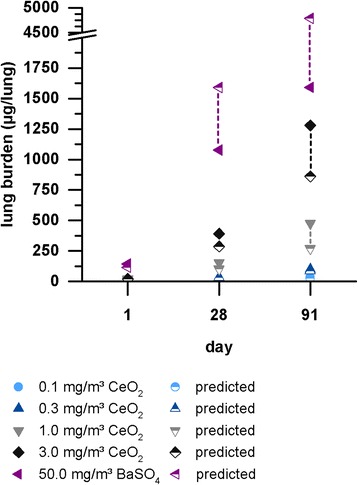
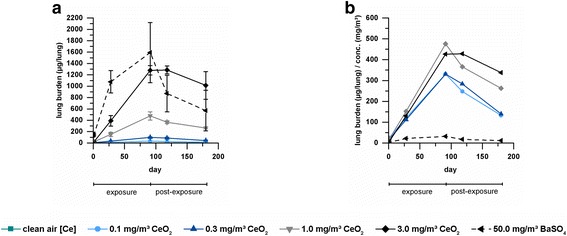
- CeO2 lung burden increased with dose and exposure duration; clearance half-times were 67, 69, 108, and 224 days for 0.1, 0.3, 1.0, and 3.0 mg/m3 CeO2, respectively, indicating impaired clearance/overload at 3.0 mg/m3. BaSO4 at 50.0 mg/m3 had a clearance half-time of 56 days and was eliminated rapidly without signs of overload.
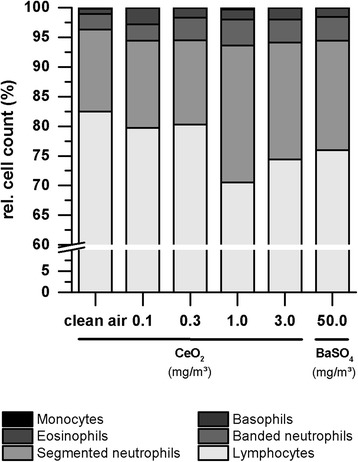
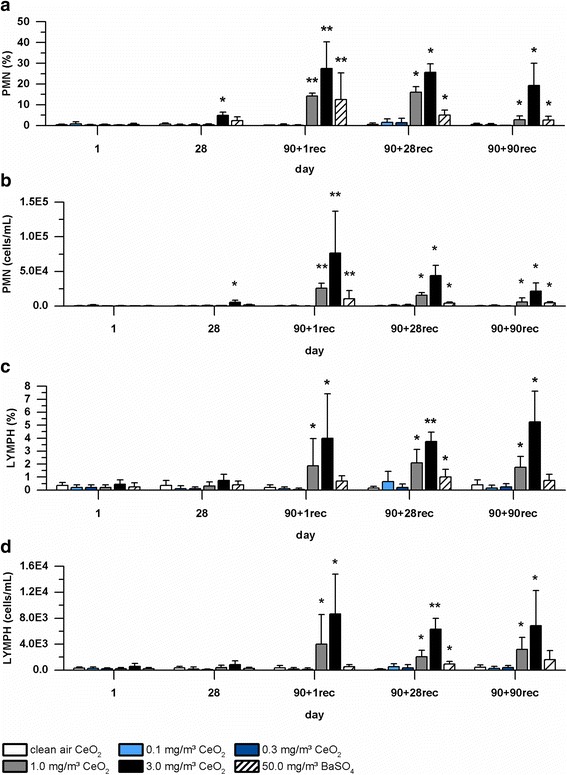
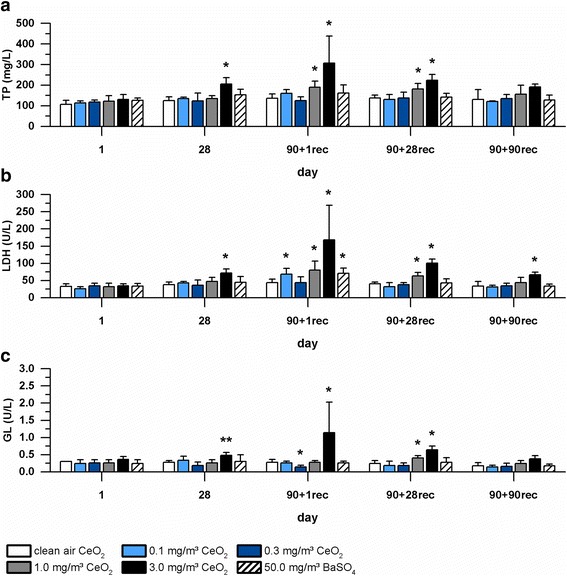
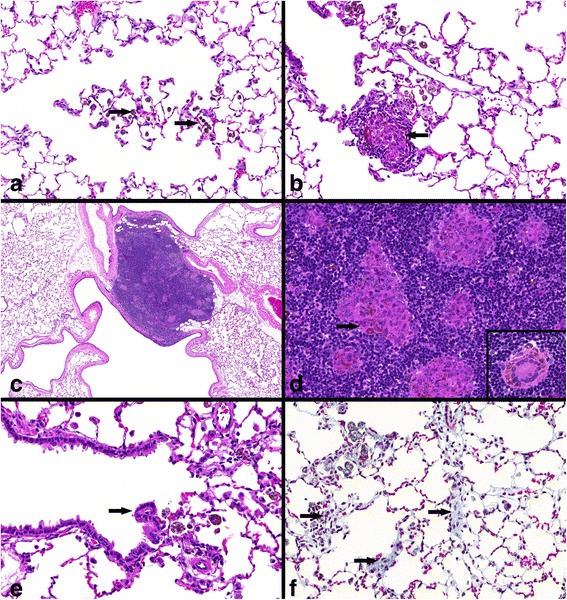
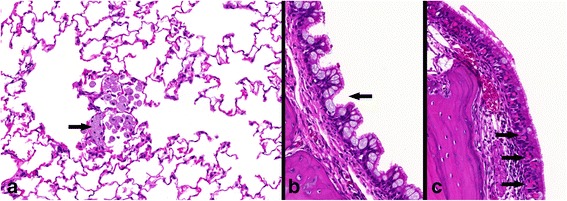
- BALF and histopathology showed increasing, post-exposure-persistent lung inflammation for CeO2, especially at 1.0 and 3.0 mg/m3: elevated neutrophils/lymphocytes and biochemical markers (TP, LDH, GL), plus particle-laden macrophages, inflammatory infiltrations, bronchiolo-alveolar hyperplasia, and very slight interstitial fibrosis at 3.0 mg/m3. BaSO4 caused less severe inflammation, mainly nasal cavity mucous cell hyperplasia and eosinophilic globules.
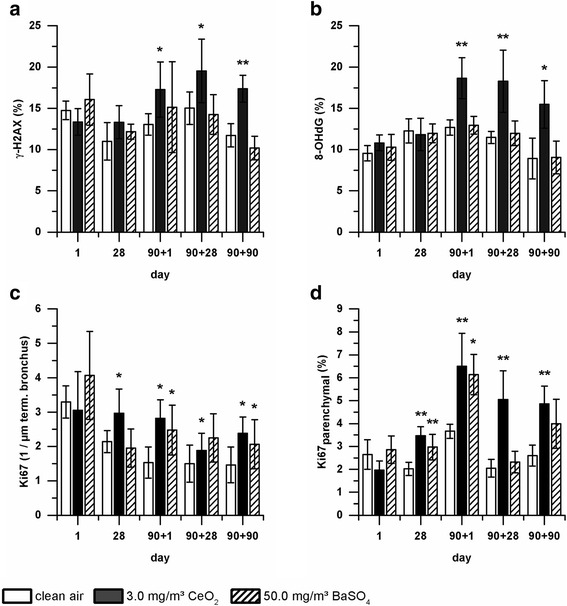
- Immunohistochemistry at 3.0 mg/m3 CeO2 showed significantly elevated γ-H2AX and 8-OHdG (about 5% and 6% above control, respectively) at post-exposure days, and increased Ki67 after 28 days exposure; BaSO4 did not elevate γ-H2AX or 8-OHdG but increased Ki67 without relevant persistency. Cleaved caspase-3 showed no changes.
- The paper reports a CeO2 NOAEL below 1.0 mg/m3 and a BMDL/NOAEL of 0.41 mg/m3 based on 90-day PMN data; the short-term BaSO4 NOAEC of 50.0 mg/m3 was refuted after 90-day inhalation.
Methods
- OECD TG 413 90-day inhalation toxicity study in female Wistar rats (576 total), nose-only exposure for 6 h/day, 5 days/week; CeO2 NM-212 at 0.1, 0.3, 1.0, and 3.0 mg/m3, BaSO4 NM-220 at 50.0 mg/m3, and clean air control; sacrifices at exposure day 1 and 28 and post-exposure days 1, 28, and 90.
- Endpoints included aerosol characterization, ICP-MS lung burden, bronchoalveolar lavage (cell counts, LDH, ß-glucuronidase, total protein), hematology/clinical chemistry, histopathology of respiratory organs, and immunohistochemistry for γ-H2AX, 8-OHdG, Ki67, and cleaved caspase-3.
- Statistics used Kruskal-Wallis-ANOVA with Mann-Whitney U-test for BALF and immunohistochemistry, ANOVA with Dunnett for body weights/hematology, and two-tailed Fisher test for histopathology.
Limitations
- The paper states that mechanistic investigations under non-overload and absent-inflammation conditions should be further investigated; genotoxicity marker increases were significant but slight and “should be interpreted with reservation”; BaSO4 was tested only at a very high 50.0 mg/m3 concentration of less relevance for some exposure scenarios; systemic genotoxicity was not tested; further mechanistic evaluations are required, especially for genotoxic effects and oxidative stress.
- Evident from the text: histopathology and immunohistochemistry were performed only in clean air, 3.0 mg/m3 CeO2, and 50.0 mg/m3 BaSO4 groups, not in the lower CeO2 dose groups; only female rats were used; and BaSO4 was not tested at lower concentrations.
Model-written summary. Check it against the paper before relying on it.
Integrity signals
Registry
Cites
Statistics
Figures

Verification
Claims the paper makes
36 Valid · 1 Not valid · 31 Not checked · 154 Own results and interpretations
At least one cited source doesn’t support this claim or points to a different paper, and none confirmed it — see the verdicts below.
In the paper
“The no-observed adverse effect level (NOAEL) for CeO2 is expected to be below 0.5 mg/m3 [17].”
§ Effects from a 90-day inhalation toxicity study with cerium oxide and barium sulfate nanoparticles in rats > Background
What the sources say
- Disputedcites [17] Keller J Wohlleben W Ma-Hock L Strauss V Groters S Kuttler K Time course of lung retention and toxicity of inhaled particles: short-term exposure to nano-ceria Arch Toxicol 2014 88 2033 2059 10.1007/s00204-014-1349-9 25273020 PMC4555363 sourceExperimental — accuracy not yet measured
The Study design section (page unavailable) says the 0.5 mg/m³ concentration was expected not to cause adverse effects. The Discussion, under Deposition and clearance (page unavailable), reports pulmonary inflammation only at 5 and 25 mg/m³. Although the Results report some changes in lavage markers at 0.5 mg/m³, the paper does not identify those changes as adverse effects or place the expected NOAEL below that concentration. (LLM, conf=0.83)
Checked by a reasoning model — may be wrong.
hedged- Asserted: passes — The authors put it forward as true.
- Checkable: passes — It can be checked against evidence.
- Load-bearing: unclear — It is unclear whether the paper’s conclusions depend on it.
- Based: passes — The paper gives a reason why it holds.
- Disputed
Every source the paper cites for this claim was checked and supports it.
In the paper
“DeLoid et al. [37] performed comprehensive investigations on density estimation for nanomaterial deposition and determined an effective density for CeO2 with different specific surface area in the range of 1.5 to 2.4 g/cm3.”
§ Effects from a 90-day inhalation toxicity study with cerium oxide and barium sulfate nanoparticles in rats > Discussion
What the sources say
- Supportedcites [37] DeLoid G Cohen JM Darrah T Derk R Rojanasakul L Pyrgiotakis G Estimating the effective density of engineered nanomaterials for in vitro dosimetry Nat Commun 2014 5 3514 10.1038/ncomms4514 24675174 PMC4038248 source
The Results section (“Effective Densities of ENMs by VCM and Sterling equation”) reports effective densities of 2.358, 1.625, and 1.474 g cm−3 for three CeO2 materials—approximately 1.5–2.4 g cm−3. It distinguishes them by dBET, a particle-size measure derived from specific surface area as described in Methods (“Nanomaterials and characterization”). (LLM, conf=0.94)
plain- Asserted: passes — The authors put it forward as true.
- Checkable: passes — It can be checked against evidence.
- Load-bearing: passes — The paper’s conclusions depend on it.
- Based: passes — The paper gives a reason why it holds.
- Supported
The sources with a verdict support this claim; the rest weren’t checked yet, have no full text we could read, or their verdicts aren’t rated yet.
In the paper
“Inhalation of CeO2induced pulmonary inflammation in a concentration-dependent manner with post-exposure persistency [3, 17, 22, 23].”
§ Effects from a 90-day inhalation toxicity study with cerium oxide and barium sulfate nanoparticles in rats > Background
What the sources say
- Not checked — no full text of the sourcecites [3] Gosens I Mathijssen LE Bokkers BGH Muijser H Cassee FR Comparative hazard identification of nano- and micro-sized cerium oxide particles based on 28-day inhalation studies in rats Nanotoxicology 2014 8 643 653 10.3109/17435390.2013.815814 23768316 source
- Supportedcites [17] Keller J Wohlleben W Ma-Hock L Strauss V Groters S Kuttler K Time course of lung retention and toxicity of inhaled particles: short-term exposure to nano-ceria Arch Toxicol 2014 88 2033 2059 10.1007/s00204-014-1349-9 25273020 PMC4555363 source
The Conclusion reports no lung inflammation at 0.5 mg/m³ and inflammatory responses at 5 mg/m³ and above. The Discussion (Local effects) reports that histopathological inflammation progressed after exposure ended at concentrations of 5 mg/m³ and above, although bronchoalveolar lavage measures regressed. Page numbers were not provided in our copy. (LLM, conf=0.91)
- Not checked — no full text of the sourcecites [22] Aalapati S Ganapathy S Manapuram S Anumolu G Prakya BM Toxicity and bio-accumulation of inhaled cerium oxide nanoparticles in CD1 mice Nanotoxicology 2014 8 786 798 23914771 source
- Supportedcites [23] Morimoto Y Izumi H Yoshiura Y Tomonaga T Oyabu T Myojo T Pulmonary toxicity of well-dispersed cerium oxide nanoparticles following intratracheal instillation and inhalation J Nanopart Res 2015 17 442 10.1007/s11051-015-3249-1 26594128 PMC4644191 source
The Results (Inhalation study; page not provided) report dose-dependent increases in lung lavage cell counts and persistently elevated neutrophils after inhalation at both tested concentrations. The Discussion (page not provided) describes persistent inflammation in rat lungs through 3 months after inhalation exposure. (LLM, conf=0.91)
plainstates a cause- Asserted: passes — The authors put it forward as true.
- Checkable: passes — It can be checked against evidence.
- Load-bearing: passes — The paper’s conclusions depend on it.
- Based: passes — The paper gives a reason why it holds.
The cited sources support only part of this claim — read each source’s verdict below.
In the paper
“Based on the results CeO2 NM-212 and BaSO4 NM-220 were chosen as representative nanomaterials with respectively higher and lower toxicity for further investigation regarding long-term exposure.”
§ Effects from a 90-day inhalation toxicity study with cerium oxide and barium sulfate nanoparticles in rats > Background
What the sources say
- Partly supportedcites [6] Landsiedel R Ma-Hock L Hofmann T Wiemann M Strauss V Treumann S Application of short-term inhalation studies to assess the inhalation toxicity of nanomaterials Part Fibre Toxicol 2014 11 16 10.1186/1743-8977-11-16 24708749 PMC4113196 sourceExperimental — accuracy not yet measured
The Abstract Results rank nano-CeO2 as higher in toxic potency and BaSO4 as lower; the Results identify the BaSO4 tested as NM-220. Our copy does not identify the CeO2 material as NM-212 or say that these two materials were chosen for further long-term exposure investigation. (LLM, conf=0.86)
plain- Asserted: passes — The authors put it forward as true.
- Checkable: passes — It can be checked against evidence.
- Load-bearing: passes — The paper’s conclusions depend on it.
- Based: passes — The paper gives a reason why it holds.
- Partly supported
Every source the paper cites for this claim was checked and supports it.
In the paper
“Keller et al. [17] measured lung burdens of 41 and 520 μg after 28 days exposure to 0.5 and 5.0 mg/m3 CeO2 NM-212.”
§ Effects from a 90-day inhalation toxicity study with cerium oxide and barium sulfate nanoparticles in rats > Discussion
What the sources say
- Supportedcites [17] Keller J Wohlleben W Ma-Hock L Strauss V Groters S Kuttler K Time course of lung retention and toxicity of inhaled particles: short-term exposure to nano-ceria Arch Toxicol 2014 88 2033 2059 10.1007/s00204-014-1349-9 25273020 PMC4555363 source
Table 5 in the Discussion (Comparison of 5 days and 4 weeks of exposure) reports lung burdens of 41 and 520 µg for Ceria NM-212 at 0.5 and 5 mg/m³, respectively, after four weeks of exposure. Its footnote specifies that these burdens were measured two days after exposure ended. (LLM, conf=0.94)
plain- Asserted: passes — The authors put it forward as true.
- Checkable: passes — It can be checked against evidence.
- Load-bearing: unclear — It is unclear whether the paper’s conclusions depend on it.
- Based: passes — The paper gives a reason why it holds.
- Supported
142 more claims · 17 with their cited sources checked
Create a free account to see all 222 claims and to verify the 2 references still open.
- Probably not a substantial claim. 40
- It may state two separate claims as one. 40
- The quote only partly states this claim. 1
Self-check
Percentages, sums and reported differences re-computed from the paper’s own numbers.
Each contradiction between two passages listed here was confirmed by an independent check.
Rated minor: it would not touch a result — a value no result rests on, a p-value that stays on the same side of the significance level, or a conflict that is clerical, resolved elsewhere in the paper, or outside its own findings.
In the paper
§ Effects from a 90-day inhalation toxicity study with cerium oxide and barium sulfate nanoparticles in rats > Discussion
“especially of 1.0 g/m3 CeO2 exposure”
§ Effects from a 90-day inhalation toxicity study with cerium oxide and barium sulfate nanoparticles in rats > Discussion
“For 1.0 mg/m3 CeO2 we calculated an increased clearance halftime (t1/2 = 108 days).”
Rated minor: it would not touch a result — a value no result rests on, a p-value that stays on the same side of the significance level, or a conflict that is clerical, resolved elsewhere in the paper, or outside its own findings.
In the paper
§ Effects from a 90-day inhalation toxicity study with cerium oxide and barium sulfate nanoparticles in rats > Results > Lung burden
“The mean insoluble fraction was <5% of the total content”
§ Effects from a 90-day inhalation toxicity study with cerium oxide and barium sulfate nanoparticles in rats > Results > Lung burden
“The soluble fraction of Ce or Ba was extremely low (mean values <5%). Hence, the total amount was dominated by the insoluble, particulate fraction”
Rated minor: it would not touch a result — a value no result rests on, a p-value that stays on the same side of the significance level, or a conflict that is clerical, resolved elsewhere in the paper, or outside its own findings.
In the paper
§ Effects from a 90-day inhalation toxicity study with cerium oxide and barium sulfate nanoparticles in rats > Results > Aerosol characteristics
“Note: a n = 78 exposure days; b n = 3”
§ Effects from a 90-day inhalation toxicity study with cerium oxide and barium sulfate nanoparticles in rats > Results > Lung burden
“Note: ad1, d28 and d90 account for one, 20 and 65 days exposure respectively”
Rated minor: it would not touch a result — a value no result rests on, a p-value that stays on the same side of the significance level, or a conflict that is clerical, resolved elsewhere in the paper, or outside its own findings.
In the paper
§ Effects from a 90-day inhalation toxicity study with cerium oxide and barium sulfate nanoparticles in rats > Results > Histopathology of respiratory organs
“Very slight inflammatory cell infiltrations occurred only after 90 days of nanoparticle exposure and did not show any post-exposure persistency.”
§ Effects from a 90-day inhalation toxicity study with cerium oxide and barium sulfate nanoparticles in rats > Results > Histopathology of respiratory organs
“| Infiltration of inflammatory cells, alveolar/interstitial | very slight | 0 | 0 | 0 | 0 | 2 | 0 | 0 | 6 | 5 | 0 | 5 | 5 | 0 | 5 | 3 |”
Cited works that were retracted
Works this paper cites that were later retracted, from the retraction notices publishers deposit. Major when the notice came out before this paper was published.
A note, not an issue: for example, a cited work that was retracted only after this paper was published, which its authors could not have known.
In the paper
“gle and repeated oral administration of CeO2 [49, 50].”
Cited work 10.1016/j.mrgentox.2014.09.009 · retracted 2022-07-08 · notice 10.1016/j.mrgentox.2022.503515 · this paper published 2017-07-12
Citations
Cites
1 retracted
Kumari, M., Kumari, S. I., Kamal, S. S. K., & Grover, P. (2014) · Mutation Research/Genetic Toxicology and Environmental Mutagenesis · doi:10.1016/j.mrgentox.2014.09.009 · Cited by 64 · cited 1×
“gle and repeated oral administration of CeO2 [49, 50].”
BackgroundRetractedNanotoxicology: An Emerging Discipline Evolving from Studies of Ultrafine Particles
Oberdörster, G., Oberdörster, E., & Oberdörster, J. (2005) · Environmental Health Perspectives · doi:10.1289/ehp.7339 · Cited by 7,891
The Principles of Humane Experimental Technique
(1960) · Medical Journal of Australia · doi:10.5694/j.1326-5377.1960.tb73127.x · Cited by 4,912 · cited 1×
“Valid markers for prediction of effects in turn can help to reduce long-term in vivo studies according to the “3R Principle” for replacement, reduction and refinement of animal experiments [31].”
BackgroundPharmacological potential of cerium oxide nanoparticles
Celardo, I., Pedersen, J. Z., Traversa, E., & Ghibelli, L. (2011) · Nanoscale · doi:10.1039/c0nr00875c · Cited by 1,151 · cited 1×
“opportunity of its use in biomedicine is discussed [5].”
BackgroundDeposition and biokinetics of inhaled nanoparticles
Geiser, M., & Kreyling, W. G. (2010) · Particle and Fibre Toxicology · doi:10.1186/1743-8977-7-2 · Cited by 747
Bermudez, E., Mangum, J. B., Wong, B. A., Asgharian, B., Hext, P. M., Warheit, D. B., & Everitt, J. I. (2004) · Toxicological Sciences · doi:10.1093/toxsci/kfh019 · Cited by 652 · cited 4×
“[35] exposed different animal species to 0.”
BackgroundResultInfluentialInfluence of particle size on regional lung deposition – What evidence is there?
Carvalho, T. C., Peters, J. I., & Williams III, R. O. (2011) · International Journal of Pharmaceutics · doi:10.1016/j.ijpharm.2010.12.040 · Cited by 614 · cited 1×
“The site of deposition depends on the material’s physico-chemical characteristics with the particle diameter as one important factor [7].”
BackgroundPossible mechanisms to explain dust overloading of the lungs
MORROW, P. (1988) · Fundamental and Applied Toxicology · doi:10.1016/0272-0590(88)90284-9 · Cited by 500 · cited 5×
“Based on a volumetric perspective an overload threshold of 1– 2 μl PM/lung is assumed for particles with a density of 1 g/cm(3) [12].”
BackgroundMethodInfluentialA Multiple-Path Model of Particle Deposition in the Rat Lung
Anjilvel, S. (1995) · Fundamental and Applied Toxicology · doi:10.1006/faat.1995.1144 · Cited by 498
C. L. Tran, D. B. (2000) · Inhalation Toxicology · doi:10.1080/08958370050166796 · Cited by 436 · cited 2×
“Differences in clearance rates were also detected in comparison to TiO2, another poorly soluble dust [38].”
Background
Research works printed but not linked: 4
- Gehlhaus MW Shapard L External letter peer review of a report by Bio-Research Laboratories, LTD: “Support: Final report for a 90-day inhalation neurotoxicity and toxicity study by exposure to a dry powder aerosol of ceric oxide in the albino rat with cover letter dated 013095” 2006
- US EPA Benchmark Dose Technical Guidance Risk Assessment Forum: U.S. Environmental Protection Agency Document EPA/100/R-12/001 2012
- Singh C Friedrichs S Ceccone G Gibson N Jensen KA Levin M Cerium dioxide NM-211, NM-212, NM-213, characterisation and test item preparation: JRC repository: NM-series of representative manufactured nanomaterials 2014 Luxembourg Publications Office of the European Union
- Wohlleben W Ma-Hock L Boyko V Cox G Egenolf H Freiberger H Nanospecific guidance in REACH: a comparative physical-chemical characterization of 15 materials with methodical correlations J Ceramic Sci Technol 2013 4 93 104 · doi:10.4416/jcst2012-00045
Cited by
Subchronic and chronic toxicity evaluation of inorganic nanoparticles for delivery applications
Mohammadpour, R., Dobrovolskaia, M. A., Cheney, D. L., Greish, K. F., & Ghandehari, H. (2019) · Advanced Drug Delivery Reviews · doi:10.1016/j.addr.2019.07.006 · Cited by 280
“5 nm) nanoparticles by inhalation to female Wistar rats, 6 hrs/day, 5 days/week in different doses (Table 2) for 28 and 90 days.[224] This subchronic exposure induced pulmonary inflammation in alveolar space for CeO2 nanoparticles at the NOEL below 1.”
BackgroundMethodInfluentialQu, G., Xia, T., Zhou, W., Zhang, X., Zhang, H., Hu, L., Shi, J., Yu, X.-F., & Jiang, G. (2020) · Chemical Reviews · doi:10.1021/acs.chemrev.9b00445 · Cited by 275
Cerium Oxide Nanoparticles: Advances in Biodistribution, Toxicity, and Preclinical Exploration
Casals, E., Zeng, M., Parra‐Robert, M., Fernández‐Varo, G., Morales‐Ruiz, M., Jiménez, W., Puntes, V., & Casals, G. (2020) · Small · doi:10.1002/smll.201907322 · Cited by 204
Cerium and Its Oxidant-Based Nanomaterials for Antibacterial Applications: A State-of-the-Art Review
Qi, M., Li, W., Zheng, X., Li, X., Sun, Y., Wang, Y., Li, C., & Wang, L. (2020) · Frontiers in Materials · doi:10.3389/fmats.2020.00213 · Cited by 164
Nanomaterials: certain aspects of application, risk assessment and risk communication
Laux, P., Tentschert, J., Riebeling, C., Braeuning, A., Creutzenberg, O., Epp, A., Fessard, V., Haas, K., Haase, A., Hund‐Rinke, K., et al. (2017) · Archives of Toxicology · doi:10.1007/s00204-017-2144-1 · Cited by 174
“However, due to the small increase and the possibility of overload-related effects, the data on genotoxicity should be considered with care (Schwotzer et al. 2017).”
BackgroundSelf-citationSchulte, P. A., Leso, V., Niang, M., & Iavicoli, I. (2019) · Scandinavian Journal of Work Environment & Health · doi:10.5271/sjweh.3800 · Cited by 127
Braakhuis, H., Murphy, F. A., Ma‐Hock, L., Dekkers, S., Keller, J. G., Oomen, A. G., & Stone, V. (2021) · Applied In Vitro Toxicology · doi:10.1089/aivt.2021.0009 · Cited by 79
“90 days study: neutrophilic infiltration and granulomatous inflammation at 3 mg/m(3), progression to fibrosis.(104)”
BackgroundThe impact of nanomaterial characteristics on inhalation toxicity
Bierkandt, F. S., Leibrock, L., Wagener, S., Laux, P., & Luch, A. (2018) · Toxicology Research · doi:10.1039/c7tx00242d · Cited by 74
Keller, J. G., Graham, U. M., Koltermann-Jülly, J., Gelein, R. M., Ma‐Hock, L., Landsiedel, R., Wiemann, M., Oberdörster, G., Elder, A. C. P., & Wohlleben, W. (2020) · Scientific Reports · doi:10.1038/s41598-019-56872-3 · Cited by 66
Leibrock, L., Wagener, S., Singh, A. V., Laux, P., & Luch, A. (2019) · Toxicology Research · doi:10.1039/c9tx00179d · Cited by 72
Shahini, M. H., Mohammadloo, H. E., & Ramezanzadeh, B. (2021) · Journal of Coatings Technology and Research · doi:10.1007/s11998-021-00466-0 · Cited by 58
Chen, C., Zhou, L., Xie, H., Pei, Z., Zhang, M., Wu, M., Zhang, S., Wang, L., Zhao, C., Shi, L., et al. (2019) · International Journal of Nanomedicine · doi:10.2147/ijn.s198376 · Cited by 61
“09 mg by SDS-PAGE, while the calculated deposition of CB in each rat was 16 mg by MPPD.(34) Though there was inconsistent between calculated and detected deposition of CB in the lung of rat, SDS-PAGEbased detection could provide the relative clearance.”
MethodInfluentialCerium oxide as a nanozyme for plant abiotic stress tolerance: An overview of the mechanisms
Preetha, J. S. Y., Sriram, D., Premasudha, P., Pudake, R. N., & Arun, M. (2023) · Plant Nano Biology · doi:10.1016/j.plana.2023.100049 · Cited by 67
Sánchez-Guzmán, D., Boland, S., Brookes, O., Cord, C. M., Lai–Kuen, R., Sirri, V., Baeza‐Squiban, A., & Devineau, S. (2021) · Scientific Reports · doi:10.1038/s41598-021-86037-0 · Cited by 63
Diabaté, S., Armand, L., Murugadoss, S., Dilger, M., Fritsch‐Decker, S., Schlager, C., Beal, D. M., Arnal, M.-É., Biola-Clier, M., Ambrose, S. V. Y., et al. (2020) · Nanomaterials · doi:10.3390/nano11010065 · Cited by 63
Adverse effects and underlying mechanism of rare earth elements
Wang, X., Wang, F., Yan, L., Gao, Z., Yang, S., Su, Z. G., Chen, W., Li, Y., & Wang, F. (2025) · Environmental Health · doi:10.1186/s12940-025-01178-3 · Cited by 57
“At the same time, the findings of Schwotzer et al. also emphasized the potential long-term health effects of CeO 2 NPs, indicating the need for further research on nanoparticle risk assessment and the establishment of safety thresholds [135].”
Pulmonary toxicity of inhaled nano-sized cerium oxide aerosols in Sprague–Dawley rats
Guo, C., Robertson, S., Weber, R. J. M., Buckley, A. J., Warren, J., Hodgson, A., Rappoport, J. Z., Ignatyev, K., Meldrum, K., Römer, I., et al. (2019) · Nanotoxicology · doi:10.1080/17435390.2018.1554751 · Cited by 49
“…levels of CCL2(MCP-1), which were significantly enhanced in this study, were only significantly enhanced in a 28-d study (6h/d, 5 d/ week, 4weeks) (Schwotzer et al. 2017, 2018) at the two highest concentration levels, which would have resulted in exposure doses >3 times higher than this study,…”
Ceria nanoparticles: biomedical applications and toxicity
Fu, X., Li, P., Chen, X., Ma, Y., Wang, R., Ji, W., Gu, J., Sheng, B., Wang, Y., & Zhang, Z. (2024) · Journal of Zhejiang University SCIENCE B · doi:10.1631/jzus.b2300854 · Cited by 54
“Schwotzer et al. (2017) studied the effects on the lung of concentrated exposure to CeO 2 NM-212 (0.1, 0.3, 1.0, and 3.0 mg/m 3 ) for 90 d.”
InfluentialRadiopaque Fully Degradable Nanocomposites for Coronary Stents
Ang, H. Y., Toong, D. W. Y., Chow, W. S., Seisilya, W., Wu, W. G., Wong, P. E. H., Venkatraman, S. S., Foin, N., & Huang, Y. (2018) · Scientific Reports · doi:10.1038/s41598-018-35663-2 · Cited by 49
Toxicity testing of poorly soluble particles, lung overload and lung cancer
Bevan, R. J., Kreiling, R., Levy, L. S., & Warheit, D. B. (2018) · Regulatory Toxicology and Pharmacology · doi:10.1016/j.yrtph.2018.10.006 · Cited by 49
Sundararajan, V., Dan, P., Kumar, A., Venkatasubbu, G. D., Ichihara, S., Ichihara, G., & Mohideen, S. S. (2019) · Applied Surface Science · doi:10.1016/j.apsusc.2019.06.017 · Cited by 42
Areecheewakul, S., Adamcakova‐Dodd, A., Givens, B. E., Steines, B. R., Wang, Y., Meyerholz, D. K., Parizek, N. J., Altmaier, R. W., Haque, E., O’Shaughnessy, P. T., et al. (2020) · NanoImpact · doi:10.1016/j.impact.2020.100214 · Cited by 46
“The toxicity of some ENMs (TiO2, ZnO, CuO, CeO2, and Fe2O3) has been extensively studied both in vitro and in vivo after inhalation exposure (Grassian et al., 2007; Adamcakova-Dodd et al., 2014; Pettibone et al., 2008; Schwotzer et al., 2017).”
BackgroundCeria nanoparticle theranostics: harnessing antioxidant properties in biomedicine and beyond
Banavar, S., Deshpande, A. S., Sur, S., & Andreescu, S. (2021) · Journal of Physics Materials · doi:10.1088/2515-7639/ac0594 · Cited by 48
Schwotzer, D., Niehof, M., Schaudien, D., Kock, H., Hansen, T., Dasenbrock, C., & Creutzenberg, O. (2018) · Journal of Nanobiotechnology · doi:10.1186/s12951-018-0343-4 · Cited by 42
“0 mg/m3 CeO2 effects are likely not exclusively overload-related but also dependent on materialspecific characteristics, because they did not induce a volumetric or specific surface-related lung overload [1].”
BackgroundMethodInfluentialSelf-citationLiu, B., Bing, Q., Li, S., Han, B., Lu, J., Baiyun, R., Zhang, X., Lv, Y., Wu, H., & Zhang, Z. (2019) · Journal of Nanobiotechnology · doi:10.1186/s12951-019-0478-y · Cited by 37
Leibrock, L., Jungnickel, H., Tentschert, J., Katz, A., Toman, B., Petersen, E. J., Bierkandt, F. S., Singh, A. V., Laux, P., & Luch, A. (2020) · Nanomaterials · doi:10.3390/nano10122369 · Cited by 37
Protective potential of cerium oxide nanoparticles in diabetes mellitus
Chai, W. F., & Tang, K. S. (2021) · Journal of Trace Elements in Medicine and Biology · doi:10.1016/j.jtemb.2021.126742 · Cited by 36
Cerium dioxide nanoparticles exacerbate house dust mite induced type II airway inflammation
Meldrum, K., Robertson, S., Römer, I., Marczylo, T. H., Dean, L. S. N., Rogers, A. V., Gant, T. W., Smith, R., Tetley, T., & Leonard, M. O. (2018) · Particle and Fibre Toxicology · doi:10.1186/s12989-018-0261-5 · Cited by 36
“Sub-chronic exposures up to 90 days also resulted in inflammatory cell accumulation in the lung and were associated with impaired particle clearance [16].”
The Use of Nanomaterial In Vivo Organ Burden Data for In Vitro Dose Setting
Ma‐Hock, L., Sauer, U. G., Ruggiero, E., Keller, J. G., Wohlleben, W., & Landsiedel, R. (2021) · Small · doi:10.1002/smll.202005725 · Cited by 37
Interplay between engineered nanomaterials and microbiota
Zhang, Y., Mortimer, M., & Guo, L. (2020) · Environmental Science Nano · doi:10.1039/d0en00557f · Cited by 37
Wang, M., Yan, L., Dou, S., Liu, Y., Zhang, Y., Huang, W., Li, S., Lü, P., & Guo, Y. (2023) · Journal of Hazardous Materials · doi:10.1016/j.jhazmat.2023.132064 · Cited by 38
Reissig, F., Hübner, R., Steinbach, J., Pietzsch, H., & Mamat, C. (2019) · Inorganic Chemistry Frontiers · doi:10.1039/c9qi00208a · Cited by 31
Sundararajan, V., Venkatasubbu, G. D., & Mohideen, S. S. (2021) · 3 Biotech · doi:10.1007/s13205-021-02706-x · Cited by 34
Modrzynska, J., Mortensen, A., Berthing, T., Ravn‐Haren, G., Szarek, J., Saber, A. T., & Vogel, U. B. (2021) · Applied Nano · doi:10.3390/applnano2030016 · Cited by 31
“24 mg/mL were prepared in 2% v/v mouse serum in nanopure water (as vehicle) as described [34,35,41,42] and were sonicated for 15 min on ice, using a probe sonicator operating at 100 W/22.”
MethodHan, X., Lei, J., Chen, K., Li, Q., Hao, H., Zhou, T., Jiang, F., Li, M., & Liu, Y. (2019) · Ecotoxicology and Environmental Safety · doi:10.1016/j.ecoenv.2019.03.013 · Cited by 27
Recent Advances in the Preparation of Barium Sulfate Nanoparticles: A Mini-Review
Ketegenov, T., Kamunur, K., Batkal, A. N., Gani, D., & Nadirov, R. (2022) · ChemEngineering · doi:10.3390/chemengineering6020030 · Cited by 26
Biological impact of metal nanomaterials in relation to their physicochemical characteristics
Louro, H., Saruga, A., Santos, J., Pinhão, M., & Silva, M. J. (2019) · Toxicology in Vitro · doi:10.1016/j.tiv.2019.01.018 · Cited by 26
Yokel, R. A., Hancock, M. L., Cherian, B., Brooks, A. J., Ensor, M. L., Vekaria, H. J., Sullivan, P. G., & Grulke, E. A. (2019) · European Journal of Pharmaceutics and Biopharmaceutics · doi:10.1016/j.ejpb.2019.09.023 · Cited by 22
Organ burden of inhaled nanoceria in a 2-year low-dose exposure study: dump or depot?
Tentschert, J., Laux, P., Jungnickel, H., Brunner, J., Estrela‐Lopis, I., Merker, C., Meijer, J., Ernst, H., Ma‐Hock, L., Keller, J., et al. (2020) · Nanotoxicology · doi:10.1080/17435390.2020.1736355 · Cited by 24
“#3 and 200 days for #4 taking into account the potential overload situation for the lung (Keller et al. 2015; Schwotzer et al. 2017).”
BackgroundMethodResultInfluentialSelf-citationFate of Barium Sulfate Nanoparticles Deposited in the Lungs of Rats
Molina, R. M., Konduru, N. V., Queiroz, P. M., Figueroa, B., Fu, D., Ma‐Hock, L., Groeters, S., Schaudien, D., & Brain, J. D. (2019) · Scientific Reports · doi:10.1038/s41598-019-44551-2 · Cited by 23
Self-citationOskarsson, A. (2022) · Elsevier eBooks · doi:10.1016/b978-0-12-822946-0.00003-9 · Cited by 21
Hadrup, N., Sahlgren, N. M., Jacobsen, N. R., Saber, A. T., Hougaard, K. S., Vogel, U. B., & Jensen, K. A. (2023) · Nanotoxicology · doi:10.1080/17435390.2023.2221728 · Cited by 20
“…et al. 2011; Demokritou et al. 2013; Aalapati et al. 2014; Gosens et al. 2014; Keller et al. 2014; Larsen et al. 2016; Cordelli et al. 2017; Schwotzer et al. 2017) Cobalt compounds (Co) (Wehner et al. 1977; Wehner, Stuart, Sanders et al. 1979; Johansson, Curstedt, and Camner 1991;…”
BackgroundCreating sets of similar nanoforms with the ECETOC NanoApp: real-life case studies
Janer, G., Seleci, D. A., Sergent, J., Landsiedel, R., & Wohlleben, W. (2021) · Nanotoxicology · doi:10.1080/17435390.2021.1946186 · Cited by 17
In vivo toxicological evaluation of barium-doped bioactive glass in rats
Majumdar, S., & Krishnamurthy, S. (2022) · Ceramics International · doi:10.1016/j.ceramint.2022.07.272 · Cited by 17
Li, Y., & Cummins, E. (2021) · The Science of The Total Environment · doi:10.1016/j.scitotenv.2021.146232 · Cited by 19
Pandey, S., Kumari, S., Aeshala, L. M., et al. (2024) · Journal of Biomaterials Applications · doi:10.1177/08853282231226037 · Cited by 14
“32 With higher concentrations of CNP, the antidiabetic potential in terms of α -amylase inhibition increases and that activity shows it is considerably dose-dependent suppression (Figure 5).”
BackgroundMeldrum, K., Robertson, S., Römer, I., Marczylo, T. H., Gant, T. W., Smith, R., Tetley, T. D., & Leonard, M. O. (2019) · Environmental Toxicology and Pharmacology · doi:10.1016/j.etap.2019.103273 · Cited by 14
Wang, J., Fang, X., Wu, R., Liu, Z., Wang, G., Hu, Y., Wang, H. H., Pi, J., & Xu, Y. (2024) · Toxicology · doi:10.1016/j.tox.2024.154036 · Cited by 13
Holmfred, E., Loeschner, K., Sloth, J. J., & Jensen, K. A. (2022) · Nanomaterials · doi:10.3390/nano12030517 · Cited by 13
“Poorly soluble NMs have been found to accumulate in lung tissue, causing potential long-term effects [42], while more rapidly dissolving NM may or may not cause acute toxic effects depending on chemical composition [41].”
BackgroundGosens, I., Minnema, J., Boere, A. J. F., Duistermaat, E., Fokkens, P. H. B., Vidmar, J., Loeschner, K., Bokkers, B. G. H., Costa, A. L., Peters, R., et al. (2024) · Particle and Fibre Toxicology · doi:10.1186/s12989-024-00588-4 · Cited by 16
“For CeO 2 NM-212, some researchers have already reported detailed lung and lymph nodes burdens sampled in the post-exposure period [15], and have also addressed lung clearance by measuring lung burdens during the exposure [13].”
BackgroundMethodInfluentialEstimates of carbon nanotube deposition in the lung: improving quality and robustness
Wright, M., Buckley, A. J., & Smith, R. (2020) · Inhalation Toxicology · doi:10.1080/08958378.2020.1785594 · Cited by 12
“An increasing number of published in vivo inhalation studies using particulate aerosols, particularly nanomaterials, therefore provide information on the quantity of deposited material, either measured using techniques such as ICP-MS (Schwotzer et al. 2017) or, more frequently, estimated using standard formulae and av…”
MethodThe role of PP2A /NLRP3 signaling pathway in ambient particulate matter 2.5 induced lung injury
Han, B., Liu, Q., Su, X., Zhou, L., Zhang, B., Kang, H., Ning, J., Li, C., Zhao, B., Niu, Y., et al. (2022) · Chemosphere · doi:10.1016/j.chemosphere.2022.135794 · Cited by 12
Deciphering key nano-bio interface descriptors to predict nanoparticle-induced lung fibrosis
Cao, J., Yang, Y., Liu, X., Huang, Y., Xie, Q., Kadushkin, A. G., Nedelko, M. I., Wu, D., Aquilina, N. J., Li, X., et al. (2025) · Particle and Fibre Toxicology · doi:10.1186/s12989-024-00616-3 · Cited by 14
“In addition, many rodent inhalation studies have indicated potential associations between respiratory exposure to MeONPs such as zinc oxide (ZnO) [21, 22], cerium dioxide (CeO 2 ) [23, 24], and titanium dioxide (TiO 2 ) [25] and pulmonary fibrosis.”
Seiffert, S. B., Vennemann, A., Nordhorn, I. D., Kröger, S., Wiemann, M., & Kärst, U. (2022) · Chemical Research in Toxicology · doi:10.1021/acs.chemrestox.1c00433 · Cited by 11
Fate of inhaled Nano-CeO2 revisited: Predicting the unpredictable
Pauluhn, J. (2018) · Regulatory Toxicology and Pharmacology · doi:10.1016/j.yrtph.2018.06.005 · Cited by 11
Functional nanomaterials: selected legal and regulatory issues
Karim, M. E. (2020) · Elsevier eBooks · doi:10.1016/b978-0-12-816787-8.00030-2 · Cited by 9
Hajinezhad, M. R., Shahri, S. H., Rahdar, A., & Zamanian, H. (2020) · Disease and Diagnosis · doi:10.34172/ddj.2020.01 · Cited by 8
“Earlier experiments have shown that CeNPs can induce histological changes in the liver and kidney of rats (23).”
BackgroundWeber, K., Bruer, G. G., Krueger, N., Schuster, T., Creutzenberg, O., & Schaudien, D. (2023) · Toxicology Letters · doi:10.1016/j.toxlet.2023.12.011 · Cited by 10
Self-citationLee, Y., McAllister, K., Lee, H., Jung, S., & Murphy, F. A. (2025) · Nano Today · doi:10.1016/j.nantod.2025.102655 · Cited by 8
Wessely, B., Stintz, M., Nolde, J., et al. (2022) · Frontiers in Public Health · doi:10.3389/fpubh.2022.907202 · Cited by 6
“The particle behavior without such a pretest is unpredictable, in particular the tendency for aerosol altering, i.e., agglomeration and precipitation in the test chamber, which can result in misleading or inconsistent results in the animal studies according to OECD Guidelines 403 and 436.”
MethodSelf-citationQian, Q., Zhang, Y., Chen, Y., Ye, C., Feng, Q., Tu, J., Lu, Z., Xu, Y., Ran, N., Xing, G., et al. (2020) · Journal of Applied Toxicology · doi:10.1002/jat.4079 · Cited by 6
Subirana, M. A., Thomas, S. A., Hause, G., Dobritzsch, D., Glahn, F., Schaumlöffel, D., & Herzberg, M. (2025) · Journal of Trace Elements in Medicine and Biology · doi:10.1016/j.jtemb.2025.127650 · Cited by 4
Liu, Y., Liao, Y.-L., Wang, J., Zhang, B.-F., Tang, Q.-P., Ding, Y., Zuo, S.-J., Zhou, Q.-H., & Pei, D. (2025) · Environmental Pollution · doi:10.1016/j.envpol.2025.126268 · Cited by 5
Li, Z., Wang, X., Wu, H., & Guan, Q. (2025) · Chinese Chemical Letters · doi:10.1016/j.cclet.2025.111671 · Cited by 6
Koltermann-Jülly, J., Ma‐Hock, L., Gröters, S., & Landsiedel, R. (2020) · Toxicologic Pathology · doi:10.1177/0192623319896347 · Cited by 5
“The CeO2induced inflammatory reaction persisted during a postexposure period of 13 weeks and progressed during this time to granulomatous inflammation.(10,12) The initial pulmonary inflammation was characterized by an increased number of AMs loaded with amber-colored small particles, diagnosed as histiocytosis, alveol…”
Background(2023) · Carpathian Journal of Food Science and Technology · doi:10.34302/crpjfst/2023.15.4.3 · Cited by 4
Inhalation Exposure to Cross-linked Polyacrylic Acid Induces Pulmonary Disorders
Higashi, Y., Nishida, C., Izumi, H., Sato, K., Kawai, N., Tomonaga, T., Morimoto, T., Yamasaki, K., Wang, K.-Y., Higashi, H., et al. (2024) · Toxicology · doi:10.1016/j.tox.2024.154001 · Cited by 6
Dey, S., Roy, D., & Ghosh, M. (2025) · Emergent Materials · doi:10.1007/s42247-025-01221-6 · Cited by 3
“Despite these advancements, the potential risks associated with CeO₂ NPs [ 6 ], in nanoen - gineered seed coatings remain largely unexplored.”
The preparation temperature influences the physicochemical nature and activity of nanoceria
Yokel, R. A., Wohlleben, W., Keller, J. G., Hancock, M. L., Unrine, J. M., Butterfield, D. A., & Grulke, E. A. (2021) · Beilstein Journal of Nanotechnology · doi:10.3762/bjnano.12.43 · Cited by 5
A quantitative definition for poorly soluble particles
Ma‐Hock, L., Stratmann, H., Hufnagel, M., Bowden, A. M., Ramón, B. S., Warheit, D. B., Battersby, R. V., Krieger, S. M., Kellert, M., Krueger, N., et al. (2026) · Particle and Fibre Toxicology · doi:10.1186/s12989-026-00670-z · Cited by 2
“Only findings that were observed at least six times within the analyzed dataset are shown within this word cloudor chemically analyzed in studies published by Thoma et al. [25], Bermudez et al., [24], Schwotzer et al. [26] and Dekant et al. [27], respectively.”
Lohse, F., Wessely, B., Stintz, M., Nolde, J., Creutzenberg, O., & Bruer, G. G. (2024) · Toxicology Letters · doi:10.1016/j.toxlet.2024.02.006 · Cited by 2
Self-citationReynoso, C., Badger, N., Erguvan, M., Kimpiab, E. E., Twombly, A. T., Harris, J. W., & Amini, S. (2026) · Energy Conversion and Management · doi:10.1016/j.enconman.2026.121485 · Cited by 2
Jeon, S., Kim, G., An, S.-Y., Duffin, R., & Cho, W. (2026) · Ecotoxicology and Environmental Safety · doi:10.1016/j.ecoenv.2026.120161 · Cited by 1
Abdullayev, Y., Karimova, N., Schenberg, L. A., et al. (2023) · Physical Chemistry Chemical Physics · doi:10.1039/d2cp05877d · Cited by 1
Wiench, K., & Ma‐Hock, L. (2019) · Current topics in environmental health and preventive medicine · doi:10.1007/978-981-13-8433-2_2 · Cited by 1
Occupational Health and Toxicological Aspects of Nanomaterials
Xia, L., & Shannahan, J. H. (2023) · Wiley eBooks · doi:10.1002/0471125474.tox143
Bruer, G. G., Creutzenberg, O., Janssen, P., Krueger, N., Nolde, J., Ramazanoglu, M., Schaudien, D., Schuster, T., Stintz, M., Warfving, N., et al. (2024) · Toxicology Letters · doi:10.1016/j.toxlet.2024.03.006
Self-citationInhalation Exposure to Cross-linked Polyacrylic Acid Induces Pulmonary DisordersPreprint
Higashi, Y., Nishida, C., Izumi, H., et al. (2024) · Research Square · doi:10.21203/rs.3.rs-4787568/v1
Hoet, P. (2018) · Digital Access to Libraries (Université catholique de Louvain (UCL), l'Université de Namur (UNamur) and the Université Saint-Louis (USL-B)) · doi:10.1016/s1877-7856(18)86303-6
Biochemical analyses of bio-wastes-based 45S5 bioglass-ceramics in male Wistar rats
Owoeye, S. S., Folorunso, D. O., Aramide, F. O., Oyeyemi, B. F., Borisade, S. G., Al-Buriahi, M. S., & Alomayrah, N. (2025) · Sustainable Chemistry One World · doi:10.1016/j.scowo.2025.100140 · Cited by 1
van Kesteren, P. C. E., van Berlo, D., Bard, D., Butler, O. T., Dekkers, S., Hadrup, N., Lovén, K., Riediker, M., Schins, R. P. F., van Thriel, C., et al. (2026) · NanoImpact · doi:10.1016/j.impact.2026.100621 · Cited by 2
Reprotoxicité des nanoparticules : approche in vitro
Préaubert, L. (2018) · theses.fr (ABES) · doi:10.70675/6220353fz90cfz4c3dz9e9cz7390bf217a6d
Loncarevic, I., Mutlu, S. M., Fortunatus, R. M., Jung, N., Larios, J., Balog, S., Dzepic, M., Petri‐Fink, A., Blank, F., & Rothen‐Rutishauser, B. (2026) · Journal of Hazardous Materials · doi:10.1016/j.jhazmat.2026.143515
Metadata
- Authors
- Schwotzer, D., Ernst, H., Schaudien, D., Kock, H., Pohlmann, G., Dasenbrock, C., & Creutzenberg, O.
- Affiliations
- Fraunhofer Institute for Toxicology and Experimental Medicine (DE)
- Corresponding author
- Schwotzer, Daniela
- Venue
- Particle and Fibre Toxicology
- Published
- 2017-07-12
- Volume
- 14
- Issue
- 1
- Pages
- 23-23
- ISSN
- 1743-8977 (ISSN-L)
- PMC
- PMC5508701
- OpenAlex
- W2735396415
- Cited by
- 94
- References
- 61
- Citations by year
- 2026: 7 · 2025: 8 · 2024: 16 · 2023: 7 · 2022: 7 · 2021: 11 · 2020: 15 · 2019: 14 · 2018: 8 · 2017: 1
- FWCI
- 4.38
- Type
- journal article
- Language
- en
- Open access
- gold
- doi.org
- Licence
- cc-by
- Locations
- Particle and Fibre Toxicology (publishedVersion, cc-by)
- Europe PMC (PubMed Central) (publishedVersion, cc-by)
- PubMed Central (publishedVersion, cc-by)
- PubMed (publishedVersion)
- DOAJ (DOAJ: Directory of Open Access Journals) (submittedVersion)
- Publikationsdatenbank der Fraunhofer-Gesellschaft (Fraunhofer-Gesellschaft) (submittedVersion, other-oa)
- Fraunhofer-Publica (Fraunhofer-Gesellschaft) (submittedVersion)
- Funders
- Bundesministerium für Bildung und Forschung (03X0149)
- Topics
- Physical Sciences › Materials Science › Materials Chemistry › Nanoparticles: synthesis and applications
- Life Sciences › Immunology and Microbiology › Immunology › Immunotoxicology and immune responses
- Health Sciences › Medicine › Pulmonary and Respiratory Medicine › Occupational and environmental lung diseases
- Keywords
- cerium oxide nanoparticles, barium sulfate nanoparticles, inhalation toxicity, lung deposition, lung inflammation, genotoxicity, cell proliferation, nanoparticle clearance, chronic low-dose exposure, nanoparticle risk assessment, cut-off values
- MeSH terms
- Aerosols, Barium Sulfate, Body Burden, Bronchoalveolar Lavage Fluid, Cerium, Dose-Response Relationship, Drug, Lung, Pneumonia, Time Factors, Tissue Distribution, Biomarkers, Risk Assessment, Inhalation Exposure, Nanoparticles
About these checks
Registry, retraction, Cites and statistics results are computed, not judged, with one exception: a printed reference that no index lists is read once by a model before it counts as a citation error. Claims are extracted by a model and kept only when their quote appears verbatim in the text; each cited source is then checked, with a model’s help, for whether it says what the claim relies on. Those verdicts can be wrong — read the claim’s quote and the cited source before relying on one.
The claim verdicts this report counts are experimental: their accuracy is not yet measured.
A language model drew the claims from the paper on 2026-10-10, under version 3 of the claim definition (model deepseek-v4.1-flash, prompt extract-v3).
A second model labelled each claim on 2026-10-10 (model jev-1.13-20260917, definition revision gold-guideline-v0.2).
Cited sources are checked with a language model’s help (gpt-6-sol).
Statistics and arithmetic are recomputed, not judged.
Confidence bands are shown only for fields calibrated on our annotated test set. None is calibrated yet, so no band is shown.
What counts as a claim ›How we measure confidence ›How we check this ›
Are you an author, or do you see a problem with this page? Request a review
Data sources
Bibliographic data: Semantic Scholar, OpenAlex, Crossref.
Contains information from the Semantic Scholar Academic Graph Datasets, made available under the ODC Attribution License (ODC-BY 1.0).
Semantic Scholar’s data is described in: Kinney, R., et al. (2023). The Semantic Scholar Open Data Platform. arXiv:2301.10140.
