

A systematic appraisal of allegiance effect in randomized controlled trials of psychotherapy
Open accessThe DOI matches its Crossref record; 60 of the 60 references it cites were found in a registry or an index.
Abstract
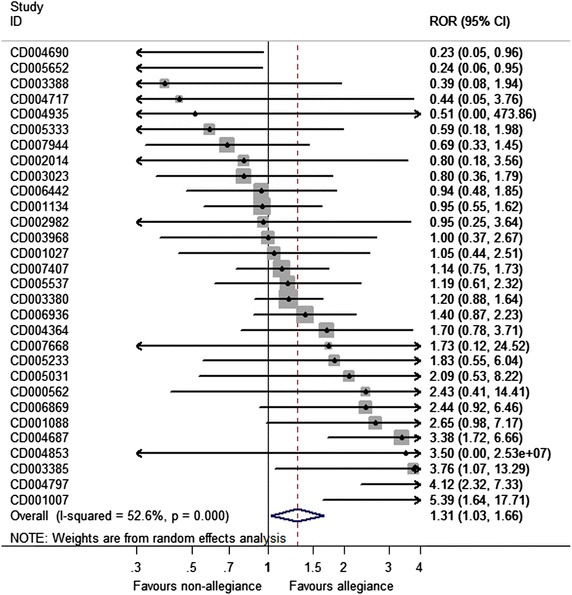
BACKGROUND: Experimenter's allegiance (EA) refers to a personal confidence of the superiority of a specific psychotherapy treatment. This factor has been linked with larger treatment effects in favor of the preferred treatment. However, various studies have displayed contradictory results between EA and the pattern of treatment effects. AIMS: Using a systematic approach followed by meta-analysis, we aimed to evaluate the impact of an allegiance effect on the results of psychotherapeutic studies. METHOD: We considered the meta-analyses of randomized controlled trials (RCTs) of different types of psychotherapies in the Cochrane Database of Systematic Reviews. Eligible articles included meta-analyses of RCTs with at least one study showing evidence of EA (i.e., allegiant study). Effect sizes in allegiant RCTs were compared with non-allegiant using random and fixed models and a summary relative odds ratio (ROR) were calculated. Heterogeneity was quantified with the I (2) metric. RESULTS: A total of 30 meta-analyses including 240 RCTs were analyzed. The summary ROR was 1.31 [(95 % confidence interval (CI: 1.03-1.66) P = 0.30, I (2) = 53 %] indicating larger effects when allegiance exists. The impact of allegiance did not differ significantly (P > 0.05) when we compared psychiatric versus medical outcomes. Allegiance effect was significant for all forms of psychotherapy except for cognitive behavioral therapy. Moreover, the impact of allegiance was significant only when the treatment integrity of delivered psychotherapy was not assessed. Allegiance effect was even stronger where the experimenter was also both the developer of the preferred treatment and supervised or trained the therapists. No significant differences were found between allegiant and non-allegiant studies in terms of overall quality of studies. CONCLUSIONS: Experimenter's allegiance influences the effect sizes of psychotherapy RCTs and can be considered non-financial conflict of interest introducing a form of optimism bias, especially since blinding is problematic in this kind of research. A clear reporting of EA in every single study should be given an opportunity to investigators of minimizing its overestimation effects.
Overview
The claims and statistics of this paper haven’t been checked yet.
Free: it reads the open-access text and checks the first 5 claims that cite a source we can check. Create a free account to check every claim.
Integrity signals
Registry
Cites
Statistics
Figures
Verification
Claims the paper makes
The claims and statistics of this paper haven’t been checked yet.
Free: it reads the open-access text and checks the first 5 claims that cite a source we can check. Create a free account to check every claim.
Claims other papers make about this one
Each is checked against this paper’s own text: does it say what the citing paper says it does?
The source backs part of the claim, not all of it — or backs it for a different population, condition or comparison.
In the citing paper
“When individuals believe in an idea so fully or have built an entire career and image upon an idea, publishing something to the contrary would be to conflict with an entrenched ideology (54, 55).”
From Issues with data and analyses: Errors, underlying themes, and potential solutions (2018) · cites this paper as [55]
Experimental — accuracy not yet measuredThe source backs part of the claim, not all of it — or backs it for a different population, condition or comparison.
In the citing paper
“there is also the concern of experimenter allegiance, which has influenced the effect sizes and biased the outcomes of published clinical trials (Dragioti et al., 2015)”
From Neurodiversity and Autism Intervention: Reconciling Perspectives Through a Naturalistic Developmental Behavioral Intervention Framework (2022) · cites this paper as Dragioti et al., 2015
Experimental — accuracy not yet measuredThe cited source says what the claim attributes to it.
In the citing paper
“A systematic review of 30 meta-analyses found that researchers' allegiance to the tested psychotherapy inflated the reported effect sizes by almost 30% 297 .”
From Ethical challenges in contemporary psychiatry: an overview and an appraisal of possible strategies and research needs (2024) · cites this paper as [297]
Self-check
Percentages, sums and reported differences re-computed from the paper’s own numbers.
The self-check needs the paper’s full text.
Citations
Cites
Meta-analysis in clinical trials
DerSimonian, R., & Laird, N. (1986) · Controlled Clinical Trials · doi:10.1016/0197-2456(86)90046-2 · Cited by 39,552 · cited 1×
“To obtain a summary ROR across the meta-analyses, we combined the natural logarithm estimates of the RORs among all comparisons [31] using fixed and random effects [32].”
MethodQuantifying heterogeneity in a meta‐analysis
Higgins, J. P. T., & Thompson, S. G. (2002) · Statistics in Medicine · doi:10.1002/sim.1186 · Cited by 36,763
The Cochrane Collaboration's tool for assessing risk of bias in randomised trials
Higgins, J. P. T., Altman, D. G., Gotzsche, P. C., Juni, P., Moher, D., Oxman, A. D., Savovic, J., Schulz, K. F., Weeks, L., Sterne, J. A. C., et al. (2011) · BMJ · doi:10.1136/bmj.d5928 · Cited by 33,817
Cochrane Handbook for Systematic Reviews of Interventions: Cochrane Book Series
(2008) · doi:10.1002/9780470712184 · Cited by 25,048
Dermyshi, E., Wang, Y., Yan, C., Hong, W., Qiu, G., Gong, X., & Zhang, T. (2017) · Neonatology · doi:10.1159/000454668 · Cited by 24,451
Cochrane Handbook for Systematic Reviews of Interventions Version 5.0.1. The Cochrane Collaboration
Higgins, J. P. T., Green, S. R., & Higgins, J. P. T. (2008) · Cited by 7,259
The empirical status of cognitive-behavioral therapy: A review of meta-analyses
Butler, A. C., Chapman, J. E., Forman, E. M., & Beck, A. T. (2006) · Clinical Psychology Review · doi:10.1016/j.cpr.2005.07.003 · Cited by 3,215 · cited 1×
“Given that CBT is ranked at the highest level of empirical evidence compared to other types of psychotherapies in the literature [43], someone may argue that optimism bias can be observed in specific and new empirically supported approaches of psychotherapy.”
BackgroundHow should meta‐regression analyses be undertaken and interpreted?
Thompson, S. G., & Higgins, J. P. T. (2002) · Statistics in Medicine · doi:10.1002/sim.1187 · Cited by 3,026 · cited 1×
“Meta‐regression In order to examine further the potential sources of heterogeneity, a random effect meta-regression analysis was performed [34].”
MethodDeeks, J. J., Altman, D. G., & Bradburn, M. J. (2001) · Systematic Reviews in Health Care · doi:10.1002/9780470693926.ch15 · Cited by 2,163
Pharmaceutical industry sponsorship and research outcome and quality: systematic review
Lexchin, J., Bero, L. A., Djulbegovic, B., & Clark, O. (2003) · BMJ · doi:10.1136/bmj.326.7400.1167 · Cited by 2,147
Cited by
Reid, J. E., Laws, K. R., Drummond, L., Vismara, M., Grancini, B., Mpavaenda, D., & Fineberg, N. A. (2021) · Comprehensive Psychiatry · doi:10.1016/j.comppsych.2021.152223 · Cited by 266
Schuck, R. K., Tagavi, D. M., Baiden, K. M. P., Dwyer, P., Williams, Z. J., Osuna, A., Ferguson, E. F., Jimenez Muñoz, M., Poyser, S. K., Johnson, J. F., et al. (2022) · Journal of Autism and Developmental Disorders · doi:10.1007/s10803-021-05316-x · Cited by 208
Common versus specific factors in psychotherapy: opening the black box
Mulder, R., Murray, G., & Rucklidge, J. (2017) · The Lancet Psychiatry · doi:10.1016/s2215-0366(17)30100-1 · Cited by 198
Issues with data and analyses: Errors, underlying themes, and potential solutions
Brown, A. W., Kaiser, K. A., & Allison, D. B. (2018) · Proceedings of the National Academy of Sciences · doi:10.1073/pnas.1708279115 · Cited by 157
“When individuals believe in an idea so fully or have built an entire career and image upon an idea, publishing something to the contrary would be to conflict with an entrenched ideology (54, 55).”
Backgroundde Zwaan, M., Herpertz, S., Zipfel, S., Svaldi, J., Friederich, H.-C., Schmidt, F., Mayr, A., Lam, T., Schade-Brittinger, C., & Hilbert, A. (2017) · JAMA Psychiatry · doi:10.1001/jamapsychiatry.2017.2150 · Cited by 153
Oud, M., Arntz, A., Hermens, M. L., Verhoef, R., & Kendall, T. (2018) · Australian & New Zealand Journal of Psychiatry · doi:10.1177/0004867418791257 · Cited by 134
“Risk of bias should also be reduced by studies performed by independent investigators; in our review, we noticed that some study authors were founders of the study protocols, which could lead to allegiance bias (Dragioti et al., 2015) and thus to an overestimation of the results.”
ResultDoes psychotherapy work? An umbrella review of meta‐analyses of randomized controlled trials
Dragioti, E., Karathanos, V., Gerdle, B., & Evangelou, E. (2017) · Acta Psychiatrica Scandinavica · doi:10.1111/acps.12713 · Cited by 111
“For example, we have previously shown that researcher’s allegiance bias inflates the treatment effect of psychotherapy by almost 30% (13) and in the vast majority of the articles, this nonfinancial conflict of interest is rarely reported (10).”
BackgroundSelf-citationThe limitations of using randomised controlled trials as a basis for developing treatment guidelines
Mulder, R., Singh, A. B., Hamilton, A., Das, P., Outhred, T., Morris, G., Bassett, D., Baune, B. T., Berk, M., Boyce, P., et al. (2018) · Evidence Based Mental Health · doi:10.1136/eb-2017-102701 · Cited by 110
Bradley, H. A., Rucklidge, J. J., & Mulder, R. T. (2017) · Acta Psychiatrica Scandinavica · doi:10.1111/acps.12647 · Cited by 92
Vink, M., & Vink-Niese, A. (2020) · Healthcare · doi:10.3390/healthcare8040552 · Cited by 87
“, the “experimenter’s allegiance effect inflates the reported effect sizes in randomized controlled trials in psychotherapy by 30%” [62].”
BackgroundGalderisi, S., Appelbaum, P. S., Gill, N., Gooding, P., Herrman, H., Melillo, A., Myrick, K., Pathare, S., Savage, M., Szmukler, G., et al. (2024) · World Psychiatry · doi:10.1002/wps.21230 · Cited by 76
“A systematic review of 30 meta-analyses found that researchers’ allegiance to the tested psychotherapy inflated the reported effect sizes by almost 30% 297 .”
Rosenblat, J. D., Husain, M. I., Lee, Y. L., McIntyre, R. S., Mansur, R. B., Castle, D. J., Offman, H., Parikh, S. V., Frey, B. N., Schaffer, A., et al. (2022) · The Canadian Journal of Psychiatry · doi:10.1177/07067437221111371 · Cited by 77
Fazel, S., Hurton, C., Burghart, M., DeLisi, M., & Yu, R. (2024) · Journal of Criminal Justice · doi:10.1016/j.jcrimjus.2024.102197 · Cited by 96
“…treatment and prediction research, with research finding larger effects where alle-giance exists, including effects of psychotherapy on recidivism (Dragioti, Dimoliatis, Fountoulakis, & Evangelou, 2015), accuracy of violence risk assessment tools (Boccaccini, Marcus, & Murrie, 2017) and…”
BackgroundMarkozannes, G., Aretouli, E., Rintou, E., Dragioti, E., Damigos, D., Ntzani, E., Evangelou, E., & Tsilidis, K. K. (2017) · BMC Psychology · doi:10.1186/s40359-017-0200-5 · Cited by 57
Self-citationde Felice, G., Giuliani, A., Halfon, S., Andreassi, S., Paoloni, G., & Orsucci, F. F. (2019) · New Ideas in Psychology · doi:10.1016/j.newideapsych.2019.01.006 · Cited by 75
Tay, A. K., Mung, H. K., Miah, M. A. A., Balasundaram, S., Ventevogel, P., Badrudduza, M., Khan, S., Morgan, K., Rees, S., Mohsin, M., et al. (2020) · PLoS Medicine · doi:10.1371/journal.pmed.1003073 · Cited by 55
“An allegiance effect [45,46] must be considered, that is, the risk that the originators of IAT who initiated and oversaw the study inadvertently conveyed a preference for that modality in training and supervising counsellors.”
BackgroundMeyer, B., Weiss, M., Holtkamp, M., Arnold, S., Brückner, K., Schröder, J., Scheibe, F., & Nestoriuc, Y. (2019) · Epilepsia · doi:10.1111/epi.14673 · Cited by 53
“Another limitation concerns intervention developer involvement, as previous research has shown that developer allegiance effects can sometimes bias findings.(38) However, steps were taken to ensure transparency and objectivity, as described in the trial protocol, and a meta‐ analysis of trials of another Internet inte…”
BackgroundCooper, A. A., Kline, A. C., Baier, A. L., & Feeny, N. C. (2018) · Behavior Modification · doi:10.1177/0145445518792251 · Cited by 57
“Dropout meta-analyses provide an important complement to primary studies of dropout as they may be capable of detecting moderators that are invisible to researchers at the level of an individual study (e.g., therapist allegiance effects; Dragioti, Dimoliatis, Fountoulakis, & Evangelou, 2015).”
BackgroundWFSBP guidelines on how to grade treatment evidence for clinical guideline development
Hasan, A., Bandelow, B., Yatham, L. N., Berk, M., Falkai, P., Möller, H.-J., Kasper, S., & WFSBP Guideline Task Force Chairs (2019) · The World Journal of Biological Psychiatry · doi:10.1080/15622975.2018.1557346 · Cited by 44
“, when the investigators are advocates of certain psychotherapeutic procedures, or when the investigator is aligned or partnered with the developer of the psychotherapeutic method or when authors have written treatment manuals (Dragioti et al. 2015).”
BackgroundEvaluation of randomized controlled trials: a primer and tutorial for mental health researchers
Harrer, M., Cuijpers, P. J., Schuurmans, L., Kaiser, T., Buntrock, C., van Straten, A., & Ebert, D. D. (2023) · Trials · doi:10.1186/s13063-023-07596-3 · Cited by 48
Barbato, A., & D’Avanzo, B. (2020) · Family Process · doi:10.1111/famp.12540 · Cited by 44
Andersson, E., Aspvall, K., Schettini, G., Kraepelien, M., Särnholm, J., Wergeland, G. J., & Öst, L. (2024) · Cognitive Behaviour Therapy · doi:10.1080/16506073.2024.2434920 · Cited by 45
“The last two meta-analyses published on this topic were conducted in 2018–2019 and it is reasonable to assume that more RCTs have been published since then.”
InfluentialJacobsen, P., Peters, E., Robinson, E. J., & Chadwick, P. (2020) · BMC Psychiatry · doi:10.1186/s12888-020-02608-x · Cited by 32
Boness, C. L., Votaw, V. R., Schwebel, F. J., Moniz-Lewis, D. I. K., McHugh, R. K., & Witkiewitz, K. A. (2023) · Clinical Psychology Science and Practice · doi:10.1037/cps0000131 · Cited by 66
Vink, M., & Vink-Niese, F. (2020) · Work · doi:10.3233/wor-203174 · Cited by 35
“, “experimenter’s allegiance effect inflates the reported effect sizes in randomized controlled trials in psychotherapy by 30 %” [50].”
BackgroundBandealy, S. S., Sheth, N., Matuella, S. K., Chaikind, J., Oliva, I. A., Philip, S. R., Jones, P. M., & Hoge, E. A. (2021) · FOCUS The Journal of Lifelong Learning in Psychiatry · doi:10.1176/appi.focus.20200042 · Cited by 41
Effects of emotionally oriented parental interventions: a systematic review and meta-analysis
Zahl‐Olsen, R., Severinsen, L., Stiegler, J. R., Fernee, C. R., Simhan, I., Rekdal, S. S., & Bertelsen, T. B. (2023) · Frontiers in Psychology · doi:10.3389/fpsyg.2023.1159892 · Cited by 34
“study of RCTs within psychotherapy identified that the allegiance effect was even stronger when the developer of the preferred treatment was one of the authors and supervised or trained the therapists (Dragioti et al., 2015).”
BackgroundBaraldi, J. H., Picozzo, S. A., Arnold, J. C., Volarich, K., Gionfriddo, M. R., & Piper, B. J. (2022) · BMJ Open · doi:10.1136/bmjopen-2021-057598 · Cited by 26
Shokraneh, F., & Adams, C. E. (2020) · Schizophrenia Bulletin Open · doi:10.1093/schizbullopen/sgaa061 · Cited by 28
“43”
Increase value and reduce waste in research on psychological therapies
Cristea, I. A., & Naudet, F. (2019) · Behaviour Research and Therapy · doi:10.1016/j.brat.2019.103479 · Cited by 22
Dragioti, E., Björk, M., Larsson, B. K., & Gerdle, B. U. C. (2019) · Journal of Clinical Medicine · doi:10.3390/jcm8060871 · Cited by 20
“However, as in any psychotherapy [22], blinding is not possible, at least to participants or clinicians, in this type of treatment [2,10].”
BackgroundMethodSelf-citationJelinek, L., Serve, A., Pampuch, S., Scheunemann, J., Schultz, J., Miegel, F. S., Hansen, B. K. A., Hagen, K., Bohnsack, F., Gallinat, J., et al. (2024) · Journal of Obsessive-Compulsive and Related Disorders · doi:10.1016/j.jocrd.2024.100913 · Cited by 21
Thompson, T., Dias, S., Poulter, D. R., Weldon, S. M., Marsh, L. L., Rossato, C. J. L., Shin, J. I., Firth, J., Veronese, N., Dragioti, E., et al. (2020) · Systematic Reviews · doi:10.1186/s13643-020-01398-3 · Cited by 24
Self-citationRevisiting the effectiveness of HOPE/swift‐certain‐fair supervision programs: A meta‐analytic review
Pattavina, A., Long, J. S., Petrich, D. M., Byrne, J. M., Cullen, F. T., & Taxman, F. S. (2023) · Criminology & Public Policy · doi:10.1111/1745-9133.12635 · Cited by 21
Tsartsalis, A. N., Lambrou, G. Ι., Tsartsalis, D., Savvidis, C., Karantza, M., Terpos, E., Kanaka‐Gantenbein, C., Chrousos, G. P., & Kattamis, A. (2018) · HORMONES · doi:10.1007/s42000-018-0019-3 · Cited by 15
Inverse publication reporting bias favouring null, negative results
Ioannidis, J. P. A. (2023) · BMJ Evidence-Based Medicine · doi:10.1136/bmjebm-2023-112292 · Cited by 18
Dimou, K., Dragioti, E., Tsitsas, G., Mantzoukas, S., & Gouva, M. (2023) · Cureus · doi:10.7759/cureus.50714 · Cited by 25
Self-citationMontgomery, P., & Weisman, C. B. (2020) · Children and Youth Services Review · doi:10.1016/j.childyouth.2020.105642 · Cited by 14
IAT Scores, Racial Gaps, and Scientific Gaps
Jussim, L. J., Careem, A., Goldberg, Z., Honeycutt, N., & Stevens, S. T. (2024) · Cambridge University Press eBooks · doi:10.1017/9781108885492.021 · Cited by 16
Investigator bias and the PACE trial
Lubet, S. (2017) · Journal of Health Psychology · doi:10.1177/1359105317697324 · Cited by 11
“The latter phenomenon is known as researcher allegiance, which has been recognized in contexts including psychotherapy (Dragioti et al., 2015; Munder et al., 2012).”
BackgroundDon’t Forget the Psychology in Analyses of Psychological Data: The Case of Sequential Testing
Elsey, J. W. B., Filmer, A. I., & Stemerding, L. (2021) · Collabra Psychology · doi:10.1525/collabra.24953 · Cited by 11
Silander, N. C., & Tarescavage, A. M. (2023) · Springer eBooks · doi:10.1007/978-3-031-29148-7_11 · Cited by 12
Assessment of Movement Synchrony and Alliance in Problem-Focused and Solution-Focused Counseling
Hoffmann, C., Gürtler, M., Fendel, J. C., Lahmann, C., & Schmidt, S. (2024) · Journal of Nonverbal Behavior · doi:10.1007/s10919-024-00466-9 · Cited by 9
“Allegiance has been shown to significantly influence intervention effect sizes (Dragioti et al., 2015), change expectancy (Field et al., 2017) and therapeutic outcomes (Toska et al., 2010).”
Psilocybin in the Treatment of Cocaine Use Disorder: A Randomized Clinical Trial
Hendricks, P. S., Lappan, S. N., Shelton, R. C., Lahti, A. C., Cropsey, K. L., Johnson, M. W., Bradley, M. K., Simonsson, O., Davis, L. L., Grossman, D. H., et al. (2026) · JAMA Network Open · doi:10.1001/jamanetworkopen.2026.11029 · Cited by 14
Vink, M., & Vink-Niese, A. (2023) · Diseases · doi:10.3390/diseases11010011 · Cited by 9
“For example, a therapist’s confidence in their therapy of choice is almost certainly perceptible to the patient, even when this is not overtly advertised [36].”
BackgroundSystematic review of servant leadership and burnout
Mahon, D. (2024) · Mental Health and Social Inclusion · doi:10.1108/mhsi-02-2024-0027 · Cited by 11
Wong, J., Bahji, A., & Khalid‐Khan, S. (2020) · The Canadian Journal of Psychiatry · doi:10.1177/0706743719898328 · Cited by 6
“30, I(2) 1⁄4 53%), indicating larger effects when allegiance exists.(11) Allegiance is particularly applicable in psychotherapy research and may threaten to the validity of conclusions from comparative outcome studies.”
BackgroundFinancial and Nonfinancial (Allegiance) Conflicts of Interest in Clinical Research
Malay, D. S. (2016) · The Journal of Foot & Ankle Surgery · doi:10.1053/j.jfas.2016.09.004 · Cited by 5
Online content on eating disorders: a natural language processing study
Tarchi, L., Buonocore, T. M., Selvi, G., Ricca, V., & Castellini, G. (2024) · Journal of Communications In Healthcare · doi:10.1080/17538068.2024.2379160 · Cited by 4
Skills for life: A review of life skills and their measurability, malleability, and meaningfulness
McGrath, R. E., & Adler, A. (2022) · doi:10.18235/0004414 · Cited by 12
Schwarz, U. V. T., Andersson, K., & Loeb, C. (2021) · Journal of Health Organization and Management · doi:10.1108/jhom-12-2020-0503 · Cited by 8
“In psychotherapy, having a developer involved has been shown to inflate the effectiveness of interventions (an experimenter allegiance effect) possibly due to their familiarity with the method and their passion for it (Dragioti et al., 2015).”
BackgroundSchaller, A. S., Dragioti, E., Liedberg, G., & Larsson, B. K. (2019) · Nursing Open · doi:10.1002/nop2.361 · Cited by 3
Self-citationCulturally sanctioned “scientific pluralism” opens the backdoor for the supernatural in Psychiatry
Fountoulakis, K. (2021) · Acta Psychiatrica Scandinavica · doi:10.1111/acps.13382 · Cited by 2
Self-citationThe additional value of self-reflection and feedback on therapy outcome: a pilot study
Kamp, D., Blanker, C., Hafkenscheid, A., & van Os, J. (2024) · Frontiers in Psychology · doi:10.3389/fpsyg.2024.1451251 · Cited by 4
Ζαγοριανάκου, Ν., Mantzoukas, S., Tatsis, F., Tsiloni, E., Georgakis, S., Nakou, A., Gouva, M., & Dragioti, E. (2023) · F1000Research · doi:10.12688/f1000research.139857.1 · Cited by 3
Self-citationEckerdal, D., Pakosta, H., Ali, M., & Atroshi, I. (2024) · EFORT Open Reviews · doi:10.1530/eor-23-0211 · Cited by 2
“Allegiance bias has been recognized as another type of bias in randomized trials (23).”
BackgroundHughes, B. M., & Tuller, D. (2021) · Journal of Health Psychology · doi:10.1177/13591053211008203 · Cited by 2
Treier, A., Hautmann, C., Dose, C., Nordmann, L., Katzmann, J., Pinior, J., Scholz, K., & Döpfner, M. (2022) · Child Psychiatry & Human Development · doi:10.1007/s10578-022-01400-0 · Cited by 4
“Accordingly, therapists might have shown greater expertise in the behavioral treatment and, additionally, might have identified themselves more with the behavioral program [allegiance effect; 53].”
BackgroundWare, J. W., Venere, K., Miller, S. A., Freeman, H., Scalzitti, D. A., & Hoogeboom, T. J. (2023) · Physical Therapy · doi:10.1093/ptj/pzad023 · Cited by 1
Analyzing the concept of independence in psychedelic research
Cheung, K., Ehrenkranz, R. C., Earp, B. D., Jacobs, E., & Yaden, D. B. (2026) · Accountability in Research · doi:10.1080/08989621.2025.2601225 · Cited by 1
“Allegiance has been found to systematically inflate effect sizes in psychotherapy trials but is often not controlled for or reported (Dragioti et al. 2015).”
The nature of depression and the biomedical model: ten questions in search of an answer
Fountoulakis, K. Ν. (2026) · Translational Psychiatry · doi:10.1038/s41398-026-03943-5 · Cited by 1
“…samples (e.g., mild subthres-hold depression, selection based on scales and not on clinical diagnosis, etc.), conducted by researchers with strong allegiance to the type of psychotherapy under investigation [173], and compare the active arm to nocebo, not placebo, conditions (e.g. waiting list).”
Self-citationThe Bergen 4-day treatment for OCD: A systematic review
Hardman, T., Deacon, B., & Gates, J. (2026) · Journal of Obsessive-Compulsive and Related Disorders · doi:10.1016/j.jocrd.2026.101035 · Cited by 1
Psychotherapists’ readiness to treat PTSD: the influence of refugees’ country of origin
Schwegler, P. M., Gössmann, K., Neumann, T., Moser, A., Speth, T., & Rosner, R. (2025) · European Journal of Psychotraumatology · doi:10.1080/20008066.2025.2456381 · Cited by 2
Vink, M., & Partyka-Vink, K. (2025) · Life · doi:10.3390/life15040584 · Cited by 2
““Allegiance in psychotherapy represents the therapist’s personal belief both in the superiority and the efficacy of a particular treatment” (p. 1 [163]).”
Case studies in psychotherapy training using Austria as an example
Neidhart, E., & Löffler‐Stastka, H. (2020) · World Journal of Clinical Cases · doi:10.12998/wjcc.v8.i13.2787 · Cited by 1
Psychiatry: The State of the Art
Fountoulakis, K. Ν. (2021) · Springer eBooks · doi:10.1007/978-3-030-86541-2_18 · Cited by 2
Self-citationEmotion-Focused Group Psychotherapy for Bulimia Nervosa
Bartlett, J. (2019) · ERA: Education and Research Archive (University of Alberta) · doi:10.7939/r3-7m82-7h38 · Cited by 2
The differential efficacy of systemic therapy: a protocol for a systematic review and meta-analysisPreprint
Braus, N., von Oepen, R., Immel, N. F., Wichmann, J., Frankman, C., Meßner, E.-M., Zemp, M., & Hunger‐Schoppe, C. (2021) · Research Square · doi:10.21203/rs.3.rs-1074984/v1 · Cited by 1
Psychotherapie – eine Übersicht
Herpertz, S. C., & Matzke, B. (2017) · Springer eBooks · doi:10.1007/978-3-662-49295-6_35
Keskin, Y. (2017) · VTechWorks (Virginia Tech)
刘剑波, 刘志荣, & 倪进发 (2004) · Zhongguo xiao-yi
Boness, C. L., Votaw, V. R., Schwebel, F. J., Moniz-Lewis, D. I. K., McHugh, R. K., & Witkiewitz, K. A. (2022) · OSF Preprints (OSF Preprints) · doi:10.31219/osf.io/rbx8s · Cited by 4
“Previous studies assessing treatment allegiance have operationalized allegiance as one or more authors having developed this intervention and/or supervising or training the therapists delivering the study intervention (Dragioti et al., 2015).”
BackgroundReality Psychology Applications
McKenzie, S. P. (2022) · Springer eBooks · doi:10.1007/978-3-030-97170-0_13
Psychotherapie – eine Übersicht
Herpertz, S. C., & Matzke, B. (2015) · Springer eBooks · doi:10.1007/978-3-642-45028-0_35-1
Talking control sessions in people with advanced cancer: a qualitative analysis of sessions
Lamirel, D., Davis, S., Low, J., Serfaty, M. A., & Armstrong, M. (2022) · BMC Psychology · doi:10.1186/s40359-022-00837-1
“These include, length and structure of sessions, client and therapist expectations, the establishment of a therapeutic relationship, the ventilation of feelings, the instillation of hope, and the provision of warmth and empathy [14].”
BackgroundConflicts of interest in invasive brain stimulation research
Gomes, F. A., & Brietzke, E. M. (2022) · Brazilian Journal of Psychiatry · doi:10.47626/1516-4446-2022-2747
Movement Synchrony and Alliance in Problem-Focused and Solution-Focused CounselingPreprint
Hoffmann, C., Gürtler, M., Fendel, J. C., Lahmann, C., & Schmidt, S. (2023) · Research Square · doi:10.21203/rs.3.rs-2965546/v1
Why we should all be reflexive: The case for reflexivity in quantitative sciencePreprint
Lammer, L. (2023) · PsyArXiv (OSF Preprints) · doi:10.31234/osf.io/re6zq · Cited by 3
Thérapie familiale intégrative
Delile, J. (2023) · Dunod eBooks · doi:10.3917/dunod.casse.2023.01.0293
Challenges of Research on Implicit Bias
Krosnick, J. A., Stark, T., & Scott, A. L. (2024) · Cambridge University Press eBooks · doi:10.1017/9781108885492.017
Saunders, D. C., Suzuki, S., Vafaie, N., Bloch, M. H., & Kober, H. (2025) · Psychotherapy and Psychosomatics · doi:10.1159/000548530 · Cited by 1
“How do the findings compare to other forms of psychotherapy in which evidence for allegiance bias has been found [68]?”
Thompson, T., Dias, S., Poulter, D. R., Weldon, S. M., Marsh, L., Rossato, C. J. L., Shin, J. I., Firth, J., Veronese, N., Dragioti, E., et al. (2020) · Figshare · doi:10.6084/m9.figshare.12441506
Self-citationThompson, T., Dias, S., Poulter, D. R., Weldon, S. M., Marsh, L., Rossato, C. J. L., Shin, J. I., Firth, J., Veronese, N., Dragioti, E., et al. (2020) · Figshare · doi:10.6084/m9.figshare.12441518
Self-citationThompson, T., Dias, S., Poulter, D. R., Weldon, S. M., Marsh, L., Rossato, C. J. L., Shin, J. I., Firth, J., Veronese, N., Dragioti, E., et al. (2020) · Figshare · doi:10.6084/m9.figshare.12441503
Self-citationLevitt, H. M. (2026) · Journal of Contemporary Psychotherapy · doi:10.1007/s10879-026-09717-w
“…not (e.g., Bell et al., 2013); (b) many therapy orientation effects disappear when researchers’ allegiance is taken into consid - eration (e.g., Dragioti et al., 2015); (c) adherence to treat - ment in RCTs often appears to not be reported or evaluated consistently and so therapists may not be…”
Braus, N., Flückiger, C., Gräfenkämper, R., Frankman, C., Wichmann, J., & Hunger‐Schoppe, C. (2026) · Psychotherapy Research · doi:10.1080/10503307.2026.2654029
Marsh, D. A., & Bacalso, E. (2026) · Current Treatment Options in Psychiatry · doi:10.1007/s40501-026-00384-1
“Research in CBTs has made strong efforts to address these concerns [ 11, 12], with CPT and PE having some of the strongest evidence across all ESTs [13].”
Sunzeri, F. (2026) · Springer eBooks · doi:10.1007/978-3-032-14465-2_4
Sunzeri, E., & Sunzeri, F. (2026) · Springer eBooks · doi:10.1007/978-3-032-14465-2_17
Supplementing Remedies to the Replication Crisis
Hyman, M. R. (2026) · Social Epistemology · doi:10.1080/02691728.2026.2697184
Ethics of psychedelics in clinical research: a state-of-the-field review
Cheung, K., Jacobs, E., & Yaden, D. B. (2026) · JME Practical Bioethics · doi:10.1136/jmepb-2025-000035
Future Research on and Implementaion of the Bergen 4-Day Treatment
Storch, E. A., & Pinciotti, C. M. (2026) · JAMA Network Open · doi:10.1001/jamanetworkopen.2026.39264
Metadata
- Authors
- Dragioti, E., Dimoliatis, I., Fountoulakis, K. N., & Evangelou, E.
- Affiliations
- Linköping University (SE)
- University of Ioannina (GR)
- ORCID
- Dragioti, Elena
- Venue
- Annals of General Psychiatry
- Published
- 2015-09-15
- Volume
- 14
- Issue
- 1
- Pages
- 25-25
- ISSN
- 1744-859X (ISSN-L)
- PMC
- PMC4570291
- OpenAlex
- W2107899339
- Cited by
- 91
- References
- 60
- Citations by year
- 2026: 12 · 2025: 3 · 2024: 11 · 2023: 13 · 2022: 8 · 2021: 8 · 2020: 13 · 2019: 6 · 2018: 5 · 2017: 8 · 2016: 2 · 2015: 1
- FWCI
- 6.62
- Type
- journal article
- Language
- en
- Open access
- gold
- doi.org
- Licence
- cc-by
- Locations
- Annals of General Psychiatry (publishedVersion, cc-by)
- Europe PMC (PubMed Central) (publishedVersion, cc-by)
- PubMed Central (publishedVersion, cc-by)
- PubMed (publishedVersion)
- DiVA (Linkoping University) (submittedVersion, other-oa)
- Spiral (Imperial College London) (submittedVersion, cc-by)
- Topics
- Social Sciences › Psychology › Clinical Psychology › Psychotherapy Techniques and Applications
- Social Sciences › Decision Sciences › Statistics, Probability and Uncertainty › Meta-analysis and systematic reviews
- Social Sciences › Psychology › Experimental and Cognitive Psychology › Psychology Research and Bibliometrics
- Keywords
- psychotherapy, randomized controlled trials, optimism bias, conflicts of interest, implementation fidelity, cognitive behavioral therapy, blinding
About these checks
Registry, retraction, Cites and statistics results are computed, not judged, with one exception: a printed reference that no index lists is read once by a model before it counts as a citation error. Claims are extracted by a model and kept only when their quote appears verbatim in the text; each cited source is then checked, with a model’s help, for whether it says what the claim relies on. Those verdicts can be wrong — read the claim’s quote and the cited source before relying on one.
Statistics and arithmetic are recomputed, not judged.
Confidence bands are shown only for fields calibrated on our annotated test set. None is calibrated yet, so no band is shown.
What counts as a claim ›How we measure confidence ›How we check this ›
Are you an author, or do you see a problem with this page? Request a review
Data sources
Bibliographic data: Semantic Scholar, OpenAlex, Crossref.
Contains information from the Semantic Scholar Academic Graph Datasets, made available under the ODC Attribution License (ODC-BY 1.0).
Semantic Scholar’s data is described in: Kinney, R., et al. (2023). The Semantic Scholar Open Data Platform. arXiv:2301.10140.
