

A systematic appraisal of allegiance effect in randomized controlled trials of psychotherapy
Open accessThe DOI matches its Crossref record; 60 of the 60 references it cites were found in a registry or an index.
Abstract
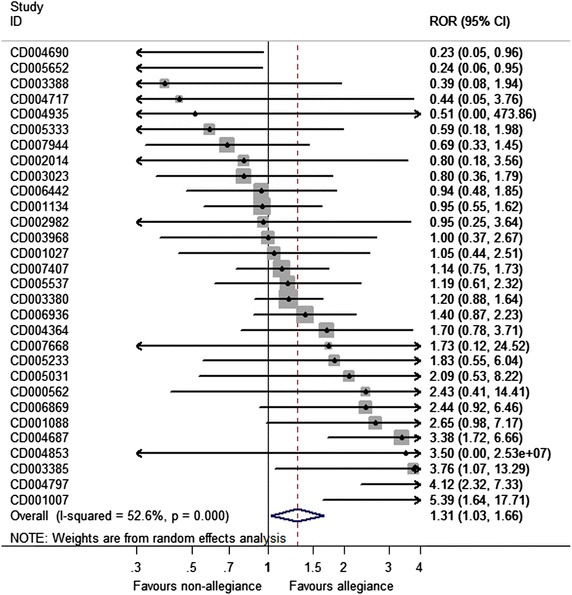
BACKGROUND: Experimenter's allegiance (EA) refers to a personal confidence of the superiority of a specific psychotherapy treatment. This factor has been linked with larger treatment effects in favor of the preferred treatment. However, various studies have displayed contradictory results between EA and the pattern of treatment effects. AIMS: Using a systematic approach followed by meta-analysis, we aimed to evaluate the impact of an allegiance effect on the results of psychotherapeutic studies. METHOD: We considered the meta-analyses of randomized controlled trials (RCTs) of different types of psychotherapies in the Cochrane Database of Systematic Reviews. Eligible articles included meta-analyses of RCTs with at least one study showing evidence of EA (i.e., allegiant study). Effect sizes in allegiant RCTs were compared with non-allegiant using random and fixed models and a summary relative odds ratio (ROR) were calculated. Heterogeneity was quantified with the I (2) metric. RESULTS: A total of 30 meta-analyses including 240 RCTs were analyzed. The summary ROR was 1.31 [(95 % confidence interval (CI: 1.03-1.66) P = 0.30, I (2) = 53 %] indicating larger effects when allegiance exists. The impact of allegiance did not differ significantly (P > 0.05) when we compared psychiatric versus medical outcomes. Allegiance effect was significant for all forms of psychotherapy except for cognitive behavioral therapy. Moreover, the impact of allegiance was significant only when the treatment integrity of delivered psychotherapy was not assessed. Allegiance effect was even stronger where the experimenter was also both the developer of the preferred treatment and supervised or trained the therapists. No significant differences were found between allegiant and non-allegiant studies in terms of overall quality of studies. CONCLUSIONS: Experimenter's allegiance influences the effect sizes of psychotherapy RCTs and can be considered non-financial conflict of interest introducing a form of optimism bias, especially since blinding is problematic in this kind of research. A clear reporting of EA in every single study should be given an opportunity to investigators of minimizing its overestimation effects.
Overview
The claims and statistics of this paper haven’t been checked yet.
Free: it reads the open-access text and checks the first 5 claims that cite a source we can check. Create a free account to check every claim.
Integrity signals
Registry
Cites
Statistics
Figures
Verification
Claims the paper makes
The claims and statistics of this paper haven’t been checked yet.
Free: it reads the open-access text and checks the first 5 claims that cite a source we can check. Create a free account to check every claim.
Claims other papers make about this one
Each is checked against this paper’s own text: does it say what the citing paper says it does?
The source backs part of the claim, not all of it — or backs it for a different population, condition or comparison.
In the citing paper
“When individuals believe in an idea so fully or have built an entire career and image upon an idea, publishing something to the contrary would be to conflict with an entrenched ideology (54, 55).”
From Issues with data and analyses: Errors, underlying themes, and potential solutions (2018) · cites this paper as [55]
Experimental — accuracy not yet measuredThe source backs part of the claim, not all of it — or backs it for a different population, condition or comparison.
In the citing paper
“there is also the concern of experimenter allegiance, which has influenced the effect sizes and biased the outcomes of published clinical trials (Dragioti et al., 2015)”
From Neurodiversity and Autism Intervention: Reconciling Perspectives Through a Naturalistic Developmental Behavioral Intervention Framework (2022) · cites this paper as Dragioti et al., 2015
Experimental — accuracy not yet measuredThe cited source says what the claim attributes to it.
In the citing paper
“A systematic review of 30 meta-analyses found that researchers' allegiance to the tested psychotherapy inflated the reported effect sizes by almost 30% 297 .”
From Ethical challenges in contemporary psychiatry: an overview and an appraisal of possible strategies and research needs (2024) · cites this paper as [297]
Self-check
Percentages, sums and reported differences re-computed from the paper’s own numbers.
The self-check needs the paper’s full text.
Citations
Cites
Meta-analysis in clinical trials
DerSimonian, R., & Laird, N. (1986) · Controlled Clinical Trials · doi:10.1016/0197-2456(86)90046-2 · Cited by 39,552 · cited 1×
“To obtain a summary ROR across the meta-analyses, we combined the natural logarithm estimates of the RORs among all comparisons [31] using fixed and random effects [32].”
MethodQuantifying heterogeneity in a meta‐analysis
Higgins, J. P. T., & Thompson, S. G. (2002) · Statistics in Medicine · doi:10.1002/sim.1186 · Cited by 36,763
The Cochrane Collaboration's tool for assessing risk of bias in randomised trials
Higgins, J. P. T., Altman, D. G., Gotzsche, P. C., Juni, P., Moher, D., Oxman, A. D., Savovic, J., Schulz, K. F., Weeks, L., Sterne, J. A. C., et al. (2011) · BMJ · doi:10.1136/bmj.d5928 · Cited by 33,817
Cochrane Handbook for Systematic Reviews of Interventions: Cochrane Book Series
(2008) · doi:10.1002/9780470712184 · Cited by 25,048
Dermyshi, E., Wang, Y., Yan, C., Hong, W., Qiu, G., Gong, X., & Zhang, T. (2017) · Neonatology · doi:10.1159/000454668 · Cited by 24,451
Cochrane Handbook for Systematic Reviews of Interventions Version 5.0.1. The Cochrane Collaboration
Higgins, J. P. T., Green, S. R., & Higgins, J. P. T. (2008) · Cited by 7,261
The empirical status of cognitive-behavioral therapy: A review of meta-analyses
Butler, A. C., Chapman, J. E., Forman, E. M., & Beck, A. T. (2006) · Clinical Psychology Review · doi:10.1016/j.cpr.2005.07.003 · Cited by 3,215 · cited 1×
“Given that CBT is ranked at the highest level of empirical evidence compared to other types of psychotherapies in the literature [43], someone may argue that optimism bias can be observed in specific and new empirically supported approaches of psychotherapy.”
BackgroundHow should meta‐regression analyses be undertaken and interpreted?
Thompson, S. G., & Higgins, J. P. T. (2002) · Statistics in Medicine · doi:10.1002/sim.1187 · Cited by 3,026 · cited 1×
“Meta‐regression In order to examine further the potential sources of heterogeneity, a random effect meta-regression analysis was performed [34].”
MethodDeeks, J. J., Altman, D. G., & Bradburn, M. J. (2001) · Systematic Reviews in Health Care · doi:10.1002/9780470693926.ch15 · Cited by 2,163
Pharmaceutical industry sponsorship and research outcome and quality: systematic review
Lexchin, J., Bero, L. A., Djulbegovic, B., & Clark, O. (2003) · BMJ · doi:10.1136/bmj.326.7400.1167 · Cited by 2,147
Smith, M. L., Glass, G. V., & Miller, T. I. (1980) · Medical Entomology and Zoology · Cited by 2,123
The Great Psychotherapy Debate: Models Methods and Findings
Horvath, A. O. (2002) · Psychotherapy Research · doi:10.1093/ptr/12.1.108 · Cited by 1,705
Comparative Studies of Psychotherapies: Is It True That "Everyone Has Won and All Must Have Prizes"?
Luborsky, L. (1975) · Archives of General Psychiatry · doi:10.1001/archpsyc.1975.01760260059004 · Cited by 1,485 · cited 1×
“The role of “therapeutic allegiance of the experimenter” [4] on psychotherapy research is a major concern and a long-standing debate has taken place [1, 2, 4, 5, 7].”
BackgroundWesten, D., Novotny, C. M., & Thompson-Brenner, H. (2004) · Psychological Bulletin · doi:10.1037/0033-2909.130.4.631 · Cited by 1,212 · cited 2×
“For each RCT included in the meta-analysis, we also recorded the existence of EA (Y/N), number of authors with allegiance, authentic approaches (also called bona fide treatment [21, 22] Y/N/Unclear), treatment integrity assessment (Y/N) and different levels of EA (e.”
BackgroundMethodInterpersonal expectancy effects: the first 345 studies
Rosenthal, R., & Rubin, D. B. (1978) · Behavioral and Brain Sciences · doi:10.1017/s0140525x00075506 · Cited by 1,158 · cited 3×
“biases are very difficult to be addressed [1–5, 7].”
BackgroundInfluentialWampold, B. E., Mondin, G. W., Moody, M., Stich, F., Benson, K., & Ahn, H.-N. (1997) · Psychological Bulletin · doi:10.1037/0033-2909.122.3.203 · Cited by 1,091 · cited 2×
“For each RCT included in the meta-analysis, we also recorded the existence of EA (Y/N), number of authors with allegiance, authentic approaches (also called bona fide treatment [21, 22] Y/N/Unclear), treatment integrity assessment (Y/N) and different levels of EA (e.”
BackgroundMethodWeisz, J. R., Weiss, B., Han, S. S., Granger, D. A., & Morton, T. (1995) · Psychological Bulletin · doi:10.1037/0033-2909.117.3.450 · Cited by 884 · cited 3×
“One may argue that the observed difference is not a biased inflation of the treatment effect, but could reflect the fact that the treatment offered by the therapist that developed the psychotherapy is simply superior to the treatment offered by other investigators [1, 10, 11].”
BackgroundResultUnderstanding Financial Conflicts of Interest
Thompson, D. F. (1993) · New England Journal of Medicine · doi:10.1056/nejm199308193290812 · Cited by 854 · cited 1×
“, personal recognition, career advancement or visibility in the media; bestowing favor on a relative, friend or colleague; the allegiance to a school of thought) [45].”
BackgroundRobinson, L. A., Berman, J. S., & Neimeyer, R. A. (1990) · Psychological Bulletin · doi:10.1037//0033-2909.108.1.30 · Cited by 671 · cited 2×
“Despite the fact that many researchers found that the outcomes of psychotherapies are influenced from allegiance to a specific school of thought [1, 4, 7, 12–14], the role of allegiance in the research field should be evaluated cautiously [1, 5, 15, 16].”
BackgroundMethodIs cognitive–behavioral therapy more effective than other therapies?
Tolin, D. F. (2010) · Clinical Psychology Review · doi:10.1016/j.cpr.2010.05.003 · Cited by 645
The Dodo bird verdict is alive and well-mostly.
Luborsky, L., Rosenthal, R., Diguer, L., Andrusyna, T. P., Berman, J. S., Levitt, J. T., Seligman, D. A., & Krause, E. D. (2002) · Clinical Psychology: Science and Practice · doi:10.1093/clipsy.9.1.2 · Cited by 581 · cited 2×
“Despite the fact that many researchers found that the outcomes of psychotherapies are influenced from allegiance to a specific school of thought [1, 4, 7, 12–14], the role of allegiance in the research field should be evaluated cautiously [1, 5, 15, 16].”
BackgroundMethodThe researcher's own therapy allegiances: A "wild card" in comparisons of treatment efficacy.
Luborsky, L., Diguer, L., Seligman, D. A., Rosenthal, R., Krause, E. D., Johnson, S., Halperin, G., Bishop, M., Berman, J. S., & Schweizer, E. (1999) · Clinical Psychology: Science and Practice · doi:10.1093/clipsy.6.1.95 · Cited by 572 · cited 4×
“Despite the fact that many researchers found that the outcomes of psychotherapies are influenced from allegiance to a specific school of thought [1, 4, 7, 12–14], the role of allegiance in the research field should be evaluated cautiously [1, 5, 15, 16].”
BackgroundResultInfluentialSterne, J. A. C., Jüni, P., Schulz, K. F., Altman, D. G., Bartlett, C., & Egger, M. (2002) · Statistics in Medicine · doi:10.1002/sim.1184 · Cited by 382
The efficacy of non-directive supportive therapy for adult depression: A meta-analysis
Cuijpers, P., Driessen, E., Hollon, S. D., van Oppen, P., Barth, J., & Andersson, G. (2012) · Clinical Psychology Review · doi:10.1016/j.cpr.2012.01.003 · Cited by 369
Malouff, J. M., Thorsteinsson, E. B., & Schutte, N. S. (2007) · Clinical Psychology Review · doi:10.1016/j.cpr.2005.12.005 · Cited by 368 · cited 1×
“There is a hypothesis that the treatment effect can be larger when the therapist has proposed and developed the particular psychotherapy and/or supervised the therapist(s) applying it [4–6].”
BackgroundAddis, M. E., Wade, W. A., & Hatgis, C. (1999) · Clinical Psychology: Science and Practice · doi:10.1093/clipsy.6.4.430 · Cited by 362
Perlis, R. H., Perlis, C. S., Wu, Y., Hwang, C., Joseph, M., & Nierenberg, A. A. (2005) · American Journal of Psychiatry · doi:10.1176/appi.ajp.162.10.1957 · Cited by 318 · cited 1×
“, efficacy or safety) than independently financed drug trial [46–49].”
BackgroundThe researcher's own therapy allegiances: a ''wild card'' in comparisons of treatment efficacy
Luborsky, L. (1999) · Clinical Psychology Science and Practice · doi:10.1093/clipsy/6.1.95 · Cited by 308
Relationship between conflicts of interest and research results
Friedman, L. S., & Richter, E. D. (2004) · Journal of General Internal Medicine · doi:10.1111/j.1525-1497.2004.30617.x · Cited by 258 · cited 1×
“It has been shown that odds of positive results are more that twofold larger when COI exists, which is comparable with our findings here [48].”
ResultThe Dodo Bird Verdict Is Alive and Well--Mostly
Luborsky, L. (2002) · Clinical Psychology Science and Practice · doi:10.1093/clipsy/9.1.2 · Cited by 222
Frances, R. J. (2007) · Yearbook of Psychiatry and Applied Mental Health · doi:10.1016/s0084-3970(08)70411-0 · Cited by 220
Phillips, M. (1996) · Medical Entomology and Zoology · Cited by 216
Combined psychotherapy plus antidepressants for panic disorder with or without agoraphobia
Furukawa, T. A., Watanabe, N., & Churchill, R. (2007) · Cochrane Database of Systematic Reviews · doi:10.1002/14651858.cd004364.pub2 · Cited by 195 · cited 1×
“[25]: (A) high, when the psychotherapy alone arm was shown to be superior to the placebo arm in the same trial or when the same group of investigators had proved effectiveness in a separate randomized controlled trial; (B) moderate, when the conduct of psychotherapy was examined by a third reviewer through audiotapes,…”
ResultResearcher allegiance and meta-analysis: The case of cognitive therapy for depression.
Gaffan, E. A., Tsaousis, I., & Kemp-Wheeler, S. M. (1995) · Journal of Consulting and Clinical Psychology · doi:10.1037/0022-006x.63.6.966 · Cited by 194 · cited 3×
“has argued that allegiance effect in CBT studies was more intense in earlier years but decreased over time [18].”
BackgroundResultWang, A. T., McCoy, C. P., Murad, M. H., & Montori, V. M. (2010) · BMJ · doi:10.1136/bmj.c1344 · Cited by 173 · cited 1×
“, efficacy or safety) than independently financed drug trial [46–49].”
BackgroundAllegiance in psychotherapy outcome research: Separating association from bias.
Leykin, Y., & DeRubeis, R. J. (2009) · Clinical Psychology: Science and Practice · doi:10.1111/j.1468-2850.2009.01143.x · Cited by 170 · cited 7×
“Many investigators argue that experimenter’s allegiance (EA) can introduce systematic bias suggesting an adjustment in results of these studies in order to minimize the impact of allegiance [1, 8].”
BackgroundResultInfluentialWampold, B. E., Budge, S. L., Laska, K. M., Del Re, A. C., Baardseth, T. P., Flűckiger, C., Minami, T., Kivlighan, D. M., & Gunn, W. (2011) · Clinical Psychology Review · doi:10.1016/j.cpr.2011.07.012 · Cited by 134 · cited 2×
“Other studies that tried to examine the experimenter allegiance hypothesis, focused only on specific psychotherapies or outcomes [5, 15–19, 26].”
BackgroundDirect comparisons of treatment modalities for youth disorders: a meta-analysis
Miller, S., Wampold, B., & Varhely, K. (2008) · Psychotherapy Research · doi:10.1080/10503300701472131 · Cited by 126 · cited 2×
“This finding is in accordance with other studies that found an association between level of allegiance and effect size [17].”
BackgroundResult"Everyone has won and all must have prizes".
Turk, D. (2000) · The Clinical Journal of Pain · doi:10.1097/00002508-200006000-00001 · Cited by 124
From effect size into number needed to treat
Furukawa, T. A. (1999) · The Lancet · doi:10.1016/s0140-6736(99)01163-0 · Cited by 114
Theories Related to Changing Clinician Practice
Riemer, M., Rosof-Williams, J., & Bickman, L. (2005) · Child and Adolescent Psychiatric Clinics of North America · doi:10.1016/j.chc.2004.05.002 · Cited by 104 · cited 1×
“This finding is consistent with the hypothesis that “therapist attitudes and openness” towards a particular treatment are likely to influence treatment integrity [38, 39], given that only the participants are blind to which treatment they receive [2, 5].”
ResultWhat are the implications of optimism bias in clinical research?
Chalmers, I., & Matthews, R. (2006) · The Lancet · doi:10.1016/s0140-6736(06)68153-1 · Cited by 98
Spielmans, G. I., Berman, M. I., & Usitalo, A. N. (2011) · Journal of Nervous & Mental Disease · doi:10.1097/nmd.0b013e31820caefb · Cited by 92
Testing the allegiance bias hypothesis: a meta-analysis
Munder, T., Gerger, H., Trelle, S., & Barth, J. (2011) · Psychotherapy Research · doi:10.1080/10503307.2011.602752 · Cited by 91 · cited 3×
“advocated the hypothesis of bias resulting from methodological weaknesses in treatment comparisons [19].”
BackgroundResultFalkenström, F., Markowitz, Jonker, H., Philips, B., & Holmqvist, R. (2013) · The Journal of Clinical Psychiatry · doi:10.4088/jcp.12r07848 · Cited by 78 · cited 1×
“Sources of how EA could affect the outcome comprise poor training of therapists, the enthusiasm of the investigator for a particular treatment, the phenomenon of negative or null findings remain unpublished and the potential selection of biased therapists holding allegiances in crossed therapist study designs [1, 9].”
BackgroundTreating depression with the evidence‐based psychotherapies: a critique of the evidence
Parker, G., & Fletcher, K. (2007) · Acta Psychiatrica Scandinavica · doi:10.1111/j.1600-0447.2007.01007.x · Cited by 73
Dragioti, E., Dimoliatis, I., & Evangelou, E. (2015) · BMJ Open · doi:10.1136/bmjopen-2014-007206 · Cited by 47 · cited 8×
“Then, we assigned an absolute allegiance rating of 1 (any level of EA = 1–5 in continuum concept) and 0 (no level of EA = 0 in continuum concept) for each psychotherapy treatment of the included RCTs [20].”
BackgroundMethodSelf-citationNon-financial conflicts of interests in psychiatric research and practice
Maj, M. (2008) · British Journal of Psychiatry · doi:10.1192/bjp.bp.108.049361 · Cited by 38 · cited 7×
“This type of bias may be explained by the potential conflict between an experimenter’s allegiance to a school of thought and can be considered as a non-financial conflict of interest (COI) [42].”
BackgroundInfluentialAllegiance effects in treatment research: A commentary.
Hollon, S. D. (1999) · Clinical Psychology: Science and Practice · doi:10.1093/clipsy.6.1.107 · Cited by 37 · cited 3×
“One may argue that the observed difference is not a biased inflation of the treatment effect, but could reflect the fact that the treatment offered by the therapist that developed the psychotherapy is simply superior to the treatment offered by other investigators [1, 10, 11].”
BackgroundResultCommentary. What is the investigator allegiance effect and what should we do about it?
Thase, M. E. (1999) · Clinical Psychology Science and Practice · doi:10.1093/clipsy/6.1.113 · Cited by 28
Understanding why therapy allegiance is linked to clinical outcomes.
McLeod, B. D. (2009) · Clinical Psychology: Science and Practice · doi:10.1111/j.1468-2850.2009.01145.x · Cited by 28 · cited 2×
“This could imply that EA may influence outcomes by affecting treatment adherence and competence [37].”
BackgroundLambert, M. J. (1999) · Clinical Psychology: Science and Practice · doi:10.1093/clipsy.6.1.127 · Cited by 26 · cited 1×
“The role of “therapeutic allegiance of the experimenter” [4] on psychotherapy research is a major concern and a long-standing debate has taken place [1, 2, 4, 5, 7].”
BackgroundΕvangelou, Ε., Tsianos, G. I., & Ioannidis, J. P. A. (2008) · BMJ · doi:10.1136/bmj.39560.759572.be · Cited by 25 · cited 1×
“Moderate heterogeneity was observed; however, this is well expected given the wide range of treatments and outcomes assessed in the analysis [35, 36].”
Commentary. Allegiance effects in treatment research: a commentary
Hollon, S. D. (1999) · Clinical Psychology Science and Practice · doi:10.1093/clipsy/6.1.107 · Cited by 21
Beyond allegiance to comparative outcome studies.
Shoham, V., & Rohrbaugh, M. J. (1999) · Clinical Psychology Science and Practice · doi:10.1093/clipsy.6.1.120 · Cited by 11 · cited 1×
“Many investigators argue that experimenter’s allegiance (EA) can introduce systematic bias suggesting an adjustment in results of these studies in order to minimize the impact of allegiance [1, 8].”
BackgroundLambert, M. (1999) · Clinical Psychology Science and Practice · doi:10.1093/clipsy/6.1.127 · Cited by 6
Commentary. Beyond allegiance to comparative outcome studies
Shoham, V. (1999) · Clinical Psychology Science and Practice · doi:10.1093/clipsy/6.1.120 · Cited by 5
Fc, F. (2016) · Cited by 4
Engels, E. (2000) · doi:10.1002/1097-0258(20000715)19:13 · Cited by 2
A simple method for converting an odds ratio to effect size for use in meta-analysis
Chinn, S. (2000) · Statistics in Medicine · doi:10.1002/1097-0258(20001130)19:22<3127::aid-sim784>3.0.co;2-m
Cited by
Reid, J. E., Laws, K. R., Drummond, L., Vismara, M., Grancini, B., Mpavaenda, D., & Fineberg, N. A. (2021) · Comprehensive Psychiatry · doi:10.1016/j.comppsych.2021.152223 · Cited by 266
Schuck, R. K., Tagavi, D. M., Baiden, K. M. P., Dwyer, P., Williams, Z. J., Osuna, A., Ferguson, E. F., Jimenez Muñoz, M., Poyser, S. K., Johnson, J. F., et al. (2022) · Journal of Autism and Developmental Disorders · doi:10.1007/s10803-021-05316-x · Cited by 208
Common versus specific factors in psychotherapy: opening the black box
Mulder, R., Murray, G., & Rucklidge, J. (2017) · The Lancet Psychiatry · doi:10.1016/s2215-0366(17)30100-1 · Cited by 198
Issues with data and analyses: Errors, underlying themes, and potential solutions
Brown, A. W., Kaiser, K. A., & Allison, D. B. (2018) · Proceedings of the National Academy of Sciences · doi:10.1073/pnas.1708279115 · Cited by 157
“When individuals believe in an idea so fully or have built an entire career and image upon an idea, publishing something to the contrary would be to conflict with an entrenched ideology (54, 55).”
Backgroundde Zwaan, M., Herpertz, S., Zipfel, S., Svaldi, J., Friederich, H.-C., Schmidt, F., Mayr, A., Lam, T., Schade-Brittinger, C., & Hilbert, A. (2017) · JAMA Psychiatry · doi:10.1001/jamapsychiatry.2017.2150 · Cited by 153
Metadata
- Authors
- Dragioti, E., Dimoliatis, I., Fountoulakis, K. N., & Evangelou, E.
- Affiliations
- Linköping University (SE)
- University of Ioannina (GR)
- ORCID
- Dragioti, Elena
- Venue
- Annals of General Psychiatry
- Published
- 2015-09-15
- Volume
- 14
- Issue
- 1
- Pages
- 25-25
- ISSN
- 1744-859X (ISSN-L)
- PMC
- PMC4570291
- OpenAlex
- W2107899339
- Semantic Scholar
- dbd952e712c64ebe9cc322e911c8588217651e8b
- Cited by
- 91
- References
- 60
- Citations by year
- 2026: 12 · 2025: 3 · 2024: 11 · 2023: 13 · 2022: 8 · 2021: 8 · 2020: 13 · 2019: 6 · 2018: 5 · 2017: 8 · 2016: 2 · 2015: 1
- FWCI
- 6.62
- Type
- journal article
- Language
- en
- Open access
- gold
- doi.org
- Licence
- cc-by
- Locations
- Annals of General Psychiatry (publishedVersion, cc-by)
- Europe PMC (PubMed Central) (publishedVersion, cc-by)
- PubMed Central (publishedVersion, cc-by)
- PubMed (publishedVersion)
- DiVA (Linkoping University) (submittedVersion, other-oa)
- Spiral (Imperial College London) (submittedVersion, cc-by)
- Topics
- Social Sciences › Psychology › Clinical Psychology › Psychotherapy Techniques and Applications
- Social Sciences › Decision Sciences › Statistics, Probability and Uncertainty › Meta-analysis and systematic reviews
- Social Sciences › Psychology › Experimental and Cognitive Psychology › Psychology Research and Bibliometrics
- Keywords
- psychotherapy, randomized controlled trials, optimism bias, conflicts of interest, implementation fidelity, cognitive behavioral therapy, blinding
About these checks
Registry, retraction, Cites and statistics results are computed, not judged, with one exception: a printed reference that no index lists is read once by a model before it counts as a citation error. Claims are extracted by a model and kept only when their quote appears verbatim in the text; each cited source is then checked, with a model’s help, for whether it says what the claim relies on. Those verdicts can be wrong — read the claim’s quote and the cited source before relying on one.
Statistics and arithmetic are recomputed, not judged.
Confidence bands are shown only for fields calibrated on our annotated test set. None is calibrated yet, so no band is shown.
What counts as a claim ›How we measure confidence ›How we check this ›
Are you an author, or do you see a problem with this page? Request a review
Data sources
Bibliographic data: Semantic Scholar, OpenAlex, Crossref.
Contains information from the Semantic Scholar Academic Graph Datasets, made available under the ODC Attribution License (ODC-BY 1.0).
Semantic Scholar’s data is described in: Kinney, R., et al. (2023). The Semantic Scholar Open Data Platform. arXiv:2301.10140.
