

Interactions of factors in self-injuries among enrolled students: a network approach.
Open accessThe DOI matches its Crossref record; 40 of the 40 references it cites were found in a registry or an index; none of the 1 sources its claims cite is checked for support yet.
Abstract
Purpose: Suicidal and non-suicidal self-injuries are types of self-directed violence that can become complex health issues. This study assessed how and to what degree the factors of self-injuries are interrelated among enrolled students. Methods: A total of 1481 students were recruited from college and middle or secondary schools, and 1465 (98.92%) subjects comprised the final sample. Mixed graphical models were used to establish network structures. Also explore their shortest paths and conduct a regression analysis. Results: Of the 1465 students, we observed intersections that connected the cluster of early experiences and psychiatric/psychological using network analysis. Shortest paths analysis and regression analysis suggest that symptoms of schizoid (edge-weights = 0.336, OR = 2.79, p < 0.01) and narcissistic (edge-weights=-0.177, OR = 0.35, p < 0.05) personality disorders (PD), acceptance (edge-weights = 0.470, OR = 12.80, p < 0.01) and positive refocusing (edge-weights=-0.171, OR = 0.12, p < 0.05) strategies of emotion-regulation, mindfulness awareness (edge-weights=-0.263, OR = 0.24, p < 0.05), and emotional-neglect in childhood (edge-weights = 0.239, OR = 5.54, p < 0.05) were found with non-suicidal self-injury (NSSI). Symptoms of anxiety (edge-weights = 0.280, OR = 2.00, p < 0.01) and avoidant-PD (edge-weights = 0.229, OR = 1.75, p < 0.01) were associated with suicidal ideation, and symptoms of borderline-PD (edge-weights = 0.432, OR = 5.38, p < 0.05) and mindfulness awareness (edge-weights=-0.180, OR = 0.28, p < 0.05) were associated with suicide attempt. Conclusions: Relying exclusively on acceptance strategy may constitute an avoidance pattern, impeding the ability to confront emotional distress. Clinical intervention aimed at repairing father-child relationship may be helpful to recover from emotional trauma and improve current symptoms and self-injuries.
Overview
CoChat Summary
## TL;DR
This cross-sectional study of 1,465 enrolled students used network analysis and logistic regression to map how distal, mediating, and proximal factors relate to non-suicidal self-injury (NSSI), suicidal ideation (SI), and suicide attempt (SA). The strongest reported links were acceptance with NSSI, anxiety with SI, borderline personality symptoms with SA, and childhood emotional neglect or paternal abuse/punitive parenting with self-injury outcomes.
## Key findings
- The final sample was 1,465 students (from 1,481 recruited; 98.92% retained), aged 12–25 years (M = 18.02, SD = 3.00); 35.36% were male and 64.64% female.
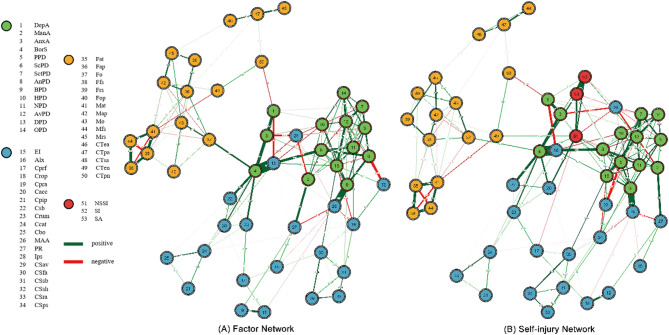
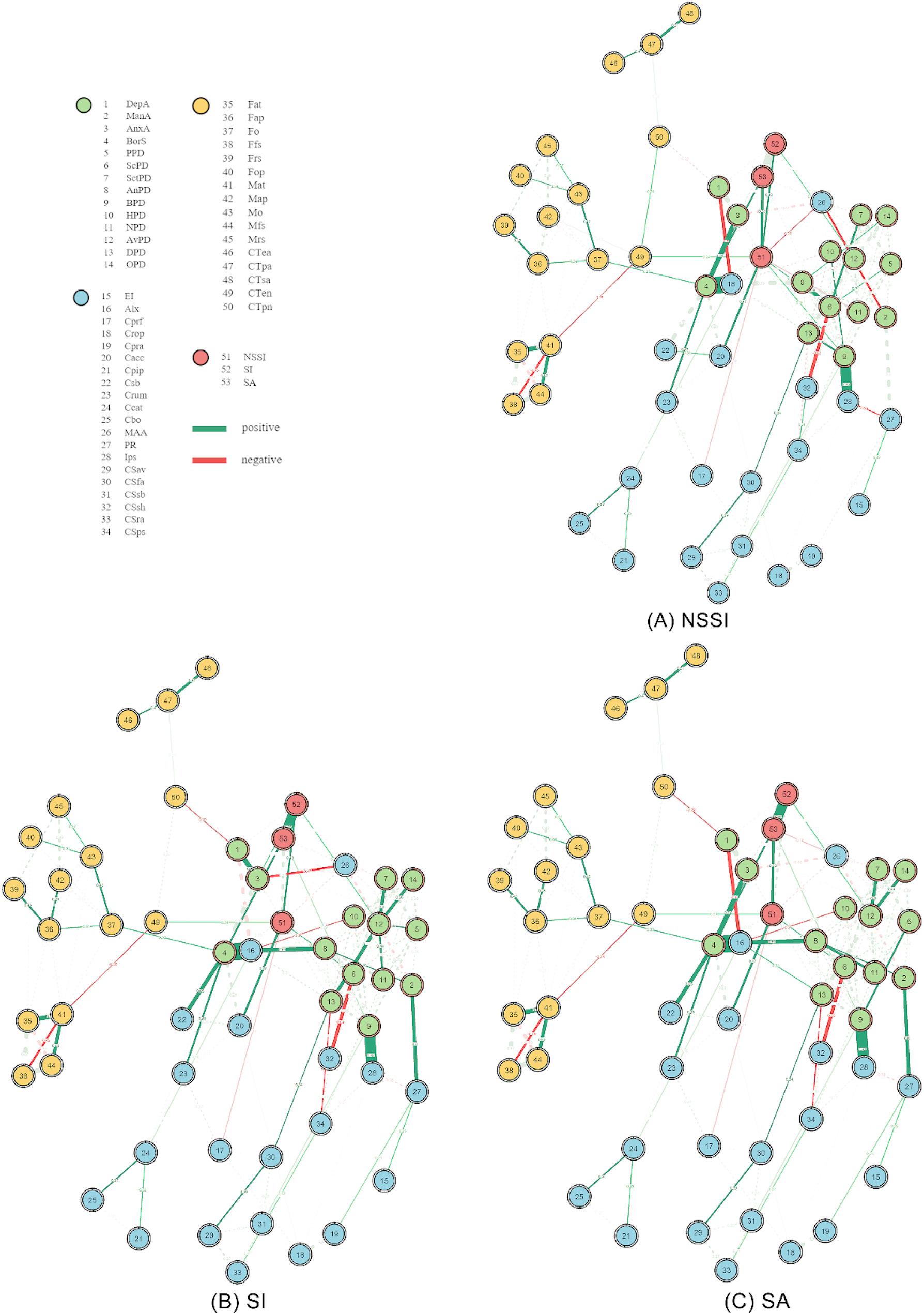
- In the self-injury network, the strongest independent associations were acceptance with NSSI (edge-weight = 0.470), anxiety with SI (edge-weight = 0.280), and borderline personality disorder (BPD) symptoms with SA (edge-weight = 0.432).
- Shortest-path analysis linked NSSI with schizoid PD (0.336), narcissistic PD (-0.177), positive refocusing (-0.171), mindfulness awareness (-0.263), and childhood emotional neglect (0.239); SI with anxiety (0.280) and avoidant PD (0.229); and SA with BPD (0.432) and mindfulness awareness (-0.180).
- Logistic regression found significant effects on NSSI for putting into perspective (OR = 6.75, 95% CI 1.18–38.69), and on SI for depression (OR = 1.48), physical abuse in childhood (OR = 4.15), rumination (OR = 2.56), blaming others (OR = 2.78), emotional abuse in childhood (OR = 32.40), and dependent PD (OR = 0.57). For SA, significant effects were reported for physical abuse in childhood (OR = 0.08), rejecting/shaming fathering (OR = 0.10), and abusive/punitive fathering (OR = 49.70).
## Methods
- Design: Cross-sectional network study with a separate factor network and self-injury network, plus binomial logistic regression to verify associations.
- Sample/data: 1,465 enrolled students from colleges and middle/secondary schools, recruited online between July 2020 and April 2021; 16 incomplete responses were excluded.
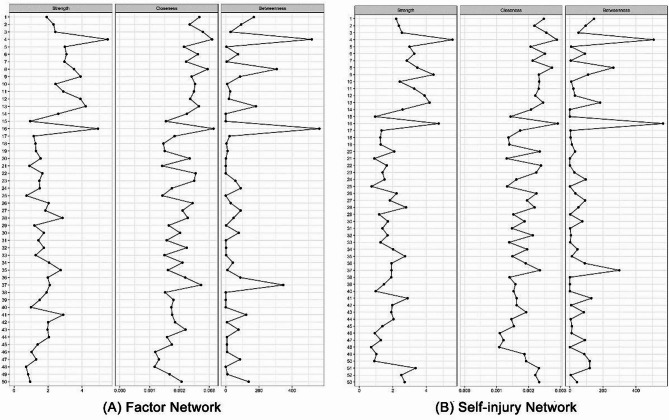
- Analysis: Mixed graphical models with L1-penalty regularization and 10-fold cross-validation; centrality and shortest-path analyses; bootstrapping with 2,500 resamples for stability; logistic regression on 50 variables with ORs and 95% CIs.
## Limitations
- The paper states that participants were from a non-clinical sample, so it is unknown whether reported symptoms met diagnostic criteria for mental disorders.
- It states that the study relied on subjective self-report scales and lacked objective indicators.
- It states that the cross-sectional design prevents causal inference; this is a stated limitation.
- Evident from the text: some interpretations, especially about network connections, are based on graph observation and “should be interpreted with caution” until verified statistically.
Model-written summary. Check it against the paper before relying on it.
Integrity signals
Registry
Cites
Statistics
Figures
Verification
Claims the paper makes
0 Valid · 0 Not valid · 2 Not checked · 49 Own results and interpretations
A result the paper reports from its own data — it cites no other source for it, so there is none to check. The quote shows it is in the paper.
In the paper
“Cpra (OR = 0.08; 95%CI, 0.01–0.53; p < 0.01)”
§ Interactions of factors in self-injuries among enrolled students: a network approach > Results > Logistic regression analysis
plainstates a cause- Asserted: passes — The authors put it forward as true.
- Checkable: passes — It can be checked against evidence.
- Load-bearing: passes — The paper’s conclusions depend on it.
- Based: passes — The paper gives a reason why it holds.
A result the paper reports from its own data — it cites no other source for it, so there is none to check. The quote shows it is in the paper.
In the paper
“positive refocusing (edge-weights=-0.171, OR = 0.12, p < 0.05) strategies of emotion-regulation”
- Also stated in: § Network analysis · plain
“Cprf (edge-weights=-0.171)”
§ Interactions of factors in self-injuries among enrolled students: a network approach > Abstract > Results
plainstates an association- Asserted: passes — The authors put it forward as true.
- Checkable: passes — It can be checked against evidence.
- Load-bearing: passes — The paper’s conclusions depend on it.
- Based: passes — The paper gives a reason why it holds.
- Also stated in: § Network analysis · plain
A result the paper reports from its own data — it cites no other source for it, so there is none to check. The quote shows it is in the paper.
In the paper
“symptoms of schizoid (edge-weights = 0.336, OR = 2.79, p < 0.01)”
- Also stated in: § Network analysis · plain
“ScPD (edge-weights = 0.336)”
§ Interactions of factors in self-injuries among enrolled students: a network approach > Abstract > Results
plainstates an association- Asserted: passes — The authors put it forward as true.
- Checkable: passes — It can be checked against evidence.
- Load-bearing: passes — The paper’s conclusions depend on it.
- Based: passes — The paper gives a reason why it holds.
- Also stated in: § Network analysis · plain
A result the paper reports from its own data — it cites no other source for it, so there is none to check. The quote shows it is in the paper.
In the paper
“symptoms of borderline-PD (edge-weights = 0.432, OR = 5.38, p < 0.05)”
- Also stated in: § Network analysis · plain
“BorS (edge-weights = 0.432) and BPD (edge-weights = 0.188) were associated with SA”
§ Interactions of factors in self-injuries among enrolled students: a network approach > Abstract > Results
plainstates an association- Asserted: passes — The authors put it forward as true.
- Checkable: passes — It can be checked against evidence.
- Load-bearing: passes — The paper’s conclusions depend on it.
- Based: passes — The paper gives a reason why it holds.
- Also stated in: § Network analysis · plain
A result the paper reports from its own data — it cites no other source for it, so there is none to check. The quote shows it is in the paper.
In the paper
“Logistic regression showed that DepA (OR = 1.48; 95%CI, 1.10–2.01; p < 0.05)”
§ Interactions of factors in self-injuries among enrolled students: a network approach > Results > Logistic regression analysis
plainstates a cause- Asserted: passes — The authors put it forward as true.
- Checkable: passes — It can be checked against evidence.
- Load-bearing: passes — The paper’s conclusions depend on it.
- Based: passes — The paper gives a reason why it holds.
36 more claims
Create a free account to see all 51 claims and every source verdict.
- It may state two separate claims as one. 9
- Probably not a substantial claim. 2
Citations
Cites
The benefits of being present: Mindfulness and its role in psychological well-being
Brown, K. W., & Ryan, R. M. (2003) · Journal of Personality and Social Psychology · doi:10.1037/0022-3514.84.4.822 · Cited by 13,448 · cited 1×
“Mindfulness attention awareness ( MAA , node 26), a core characteristic of dispositional mindfulness, was evaluated using Mindfulness Attention Awareness Scale (MAAS) [25].”
Development of a new resilience scale: The Connor-Davidson Resilience Scale (CD-RISC)
Connor, K. M., & Davidson, J. R. T. (2003) · Depression and Anxiety · doi:10.1002/da.10113 · Cited by 11,793 · cited 1×
“Psychological resilience ( PR , node 27), a quality that enables individuals to thrive in the face of adversity, was evaluated using Connor-Davidson Resilience Scale (CD-RISC) [26].”
A self-rating depression scale
ZUNG, W. W. K. (1965) · Archives of General Psychiatry · doi:10.1001/archpsyc.1965.01720310065008 · Cited by 9,813 · cited 1×
“The depression and anxiety, labeled as DepA and AnxA (nodes 1 and 3), were assessed with Zung’s Self-rating Depression Scale (SDS) [16] and Zung’s Self-rating Anxiety Scale (SAS) [17].”
Estimating psychological networks and their accuracy: A tutorial paper
Epskamp, S., Borsboom, D., & Fried, E. I. (2018) · Behavior Research Methods · doi:10.3758/s13428-017-0862-1 · Cited by 5,715 · cited 4×
“Strength centrality (the absolute sum of the edge weights connected to a node) investigates how strongly a node is directly connected to others [12].”
InfluentialPosner, K., Brown, G. K., Stanley, B., Brent, D. A., Yershova, K. V., Oquendo, M. A., Currier, G. W., Melvin, G. A., Greenhill, L., Shen, S., et al. (2011) · American Journal of Psychiatry · doi:10.1176/appi.ajp.2011.10111704 · Cited by 5,157 · cited 1×
“The students also reported their suicidality (including SI and SA) using a simple version of Columbia Suicide Severity Rating Scale (C-SSRS) [15], which consists of 5-levels suicidal thoughts and 4-types suicidal behaviors.”
A Rating Instrument For Anxiety Disorders
Zung, W. W. K. (1971) · Psychosomatics · doi:10.1016/s0033-3182(71)71479-0 · Cited by 4,578 · cited 1×
“The depression and anxiety, labeled as DepA and AnxA (nodes 1 and 3), were assessed with Zung’s Self-rating Depression Scale (SDS) [16] and Zung’s Self-rating Anxiety Scale (SAS) [17].”
Network analysis: An integrative approach to the structure of psychopathology
Borsboom, D., & Cramer, A. O. J. (2013) · Annual Review of Clinical Psychology · doi:10.1146/annurev-clinpsy-050212-185608 · Cited by 4,359 · cited 2×
“Closeness centrality (the inverse of the sum of the shortest path lengths between one node with all other nodes) quantifies how strongly a node is indirectly connected to others [12, 29].”
The effects of leader and follower emotional intelligence on performance and attitude
Wong, C.-S., & Law, K. S. (2002) · The Leadership Quarterly · doi:10.1016/s1048-9843(02)00099-1 · Cited by 3,223 · cited 1×
“Wong-Law Emotional Intelligence Scale (WLEIS) [21] and Toronto Alexithymia Scale (TAS) [22] were used to assess emotional intelligence ( EI , node 15) and severity of alexithymia ( Alx , node 16), respectively.”
Negative life events, cognitive emotion regulation and emotional problems
Garnefski, N., Kraaij, V, & Spinhoven, P. (2001) · Personality and Individual Differences · doi:10.1016/s0191-8869(00)00113-6 · Cited by 2,494 · cited 1×
“Acceptance, often considered a theoretically more “adaptive” strategy, is generally assumed to either have no association with or negatively correlate with maladaptive behaviors [32].”
Suicide and suicidal behaviour
Turecki, G., & Brent, D. A. (2016) · The Lancet · doi:10.1016/s0140-6736(15)00234-2 · Cited by 2,338
Metadata
- Authors
- Zhang, Y.-M., Jiang, X.-M., Xie, Y., Lang, N., Liang, M.-L., Zhang, P., OuYang, L.-C., Lv, Z.-W., Liu, C.-W., Zhang, L.-P., & Wang, C.
- Affiliations
- Nanjing Brain Hospital (CN)
- Nanjing Normal University (CN)
- Corresponding author
- Wang, Chun
- ORCID
- Venue
- Annals of General Psychiatry
- Published
- 2025-05-16
- Volume
- 24
- Issue
- 1
- Pages
- 28-28
- ISSN
- 1744-859X (ISSN-L)
- PMC
- PMC12084963
- OpenAlex
- W4410440323
- Semantic Scholar
- e30d7634695ffd4f909016967fdf8eff6ee52f1d
- Cited by
- 0
- References
- 40
- FWCI
- 0.00
- Type
- journal article
- Language
- en
- Open access
- gold
- doi.org
- Licence
- cc-by
- creativecommons.org/licenses/by/4.0 (tdm)
- creativecommons.org/licenses/by/4.0 (vor)
- Locations
- Annals of General Psychiatry (publishedVersion, cc-by)
- PubMed Central (publishedVersion, cc-by)
- PubMed (publishedVersion)
- DOAJ (DOAJ: Directory of Open Access Journals) (submittedVersion, cc-by-sa)
- Funders
- Jiangsu Provincial Key Research and Development Program (BE2019609)
- National Natural Science Foundation of China (81971289)
- Natural Science Foundation of Jiangsu Province (BK20191369)
- the Natural Science Foundation of the Higher Education Institutions of Jiangsu Province, China (18KJB190003)
- Topics
- Social Sciences › Psychology › Clinical Psychology › Suicide and Self-Harm Studies
- Social Sciences › Psychology › Experimental and Cognitive Psychology › Mental Health Research Topics
- Social Sciences › Psychology › Clinical Psychology › Personality Disorders and Psychopathology
- Keywords
- non-suicidal self-injury, suicidal ideation, suicide attempts, self-directed violence, personality disorders, borderline personality disorder, schizoid personality disorder, narcissistic personality disorder, avoidant personality disorder, emotion regulation strategies, acceptance strategies, positive refocusing, mindfulness awareness, anxiety, students, network analysis, mixed graphical models, father-child relationship
About these checks
Registry, retraction, Cites and statistics results are computed, not judged, with one exception: a printed reference that no index lists is read once by a model before it counts as a citation error. Claims are extracted by a model and kept only when their quote appears verbatim in the text; each cited source is then checked, with a model’s help, for whether it says what the claim relies on. Those verdicts can be wrong — read the claim’s quote and the cited source before relying on one.
A language model drew the claims from the paper on 2026-10-11, under version 3 of the claim definition (model deepseek-v4.1-flash, prompt extract-v3).
A second model labelled each claim on 2026-10-11 (model jev-1.13-20260917, definition revision gold-guideline-v0.2).
Statistics and arithmetic are recomputed, not judged.
Confidence bands are shown only for fields calibrated on our annotated test set. None is calibrated yet, so no band is shown.
What counts as a claim ›How we measure confidence ›How we check this ›
Are you an author, or do you see a problem with this page? Request a review
How to cite
Cite CoChat for the checks on this page, and the paper for its own findings.
- This page
- CoChat. (2026). Citation check: Interactions of factors in self-injuries among enrolled students: a network approach. https://app.cochat.ai/papers/10.1186/s12991-025-00570-0
- The paper
- Zhang, Y.-M., Jiang, X.-M., Xie, Y., Lang, N., Liang, M.-L., Zhang, P., OuYang, L.-C., Lv, Z.-W., Liu, C.-W., Zhang, L.-P., & Wang, C. (2025). Interactions of factors in self-injuries among enrolled students: a network approach. Annals of General Psychiatry. https://doi.org/10.1186/s12991-025-00570-0
Data sources
Bibliographic data: Semantic Scholar, OpenAlex, Crossref.
Contains information from the Semantic Scholar Academic Graph Datasets, made available under the ODC Attribution License (ODC-BY 1.0).
Semantic Scholar’s data is described in: Kinney, R., et al. (2023). The Semantic Scholar Open Data Platform. arXiv:2301.10140.
