

Associations between estrogen receptor-beta polymorphisms and endometriosis risk: a meta-analysis
Open accessThe DOI matches its Crossref record; 51 of the 53 references it cites were found in a registry or an index.
Abstract
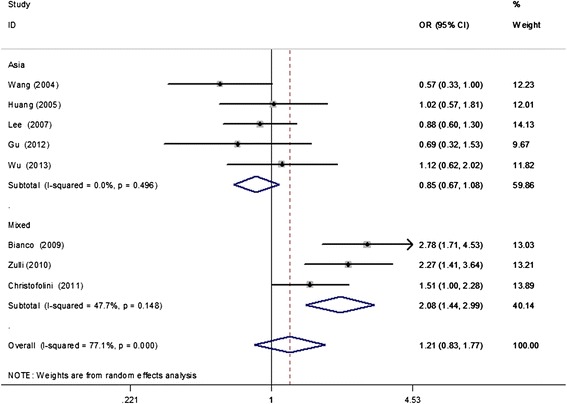
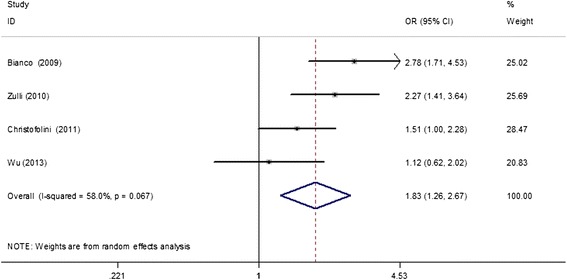
BACKGROUND: Many epidemiological studies have suggested an association between estrogen receptor-beta (ER-β) polymorphisms with endometriosis risk. However, the results of these studies have been inconsistent. In the present study, we performed a meta-analysis to clarify the associations between the ER-β rs4986938 and rs1256049 polymorphisms and endometriosis risk. METHODS: Eligible publications were retrieved from the PubMed, ISI Web of Science, and several Chinese language databases. Pooled odds ratios (ORs) with 95% confidence intervals (CIs) were calculated using a random or fixed effect model. RESULTS: A total of eight studies (1100 cases/1485 controls) for the rs4986938 polymorphism and four studies (353 cases/450 controls) for the rs1256049 polymorphism were included in this meta-analysis. Regarding the rs4986938 polymorphism, no obvious associations were found for all genetic models when all studies were pooled into the meta-analysis. In the subgroup analyses by ethnicity, study sample size, endometriosis-associated infertility, and stage of endometriosis, a significantly increased risk was observed among mixed populations (dominant model, OR=2.03, 95% CI=1.56-2.64) and among cases with endometriosis-associated infertility (dominant model, OR=1.83, 95% CI=1.26-2.67). Regarding the rs1256049 polymorphism, no obvious associations were found for all genetic models in the overall population. Subgroup analyses by ethnicity and study sample size revealed that only one study of a mixed population with small sample size showed an increased risk of endometriosis. No publication bias was found in the present study. CONCLUSIONS: The results of this meta-analysis suggest that the ER-β rs4986938 and rs1256049 polymorphisms may not be associated with endometriosis risk, while the observed increased risk of endometriosis-associated infertility may be due to bias by the inclusion of small-scale studies. VIRTUAL SLIDES: The virtual slide(s) for this article can be found here: http://www.diagnosticpathology.diagnomx.eu/vs/13000_2014_184.
Overview
The claims and statistics of this paper haven’t been checked yet.
Free: it reads the open-access text and checks the first 5 claims that cite a source we can check. Create a free account to check every claim.
Integrity signals
Registry
Cites
Statistics
Figures
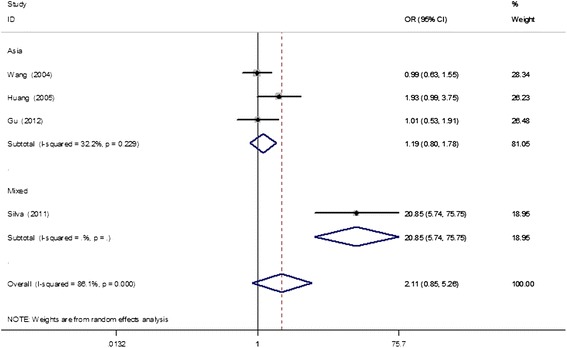
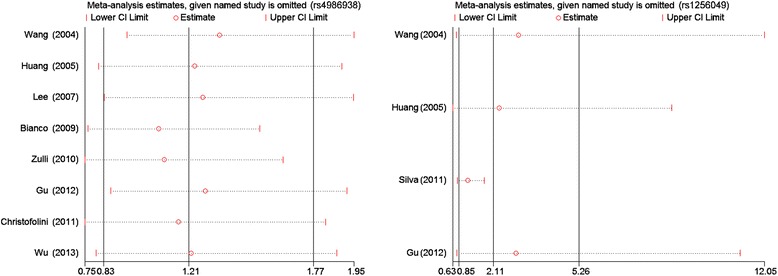
Verification
Claims the paper makes
The claims and statistics of this paper haven’t been checked yet.
Free: it reads the open-access text and checks the first 5 claims that cite a source we can check. Create a free account to check every claim.
Self-check
Percentages, sums and reported differences re-computed from the paper’s own numbers.
The self-check needs the paper’s full text.
Citations
Cites
1 retracted
Gao, Z., Fu, H., Xue, J., Wu, Z.-X., & Zhao, L. (2014) · Molecular Biology Reports · doi:10.1007/s11033-014-3317-0 · Cited by 6
RetractedPreferred Reporting Items for Systematic Reviews and Meta-Analyses: the PRISMA statement
Moher, D., Liberati, A., Tetzlaff, J., Altman, D. G., & for the PRISMA Group (2009) · BMJ · doi:10.1136/bmj.b2535 · Cited by 83,823
Preferred Reporting Items for Systematic Reviews and Meta-Analyses: The PRISMA Statement
Moher, D., Liberati, A., Tetzlaff, J., Altman, D. G., & The PRISMA Group (2009) · PLoS Medicine · doi:10.1371/journal.pmed.1000097 · Cited by 64,042 · cited 1×
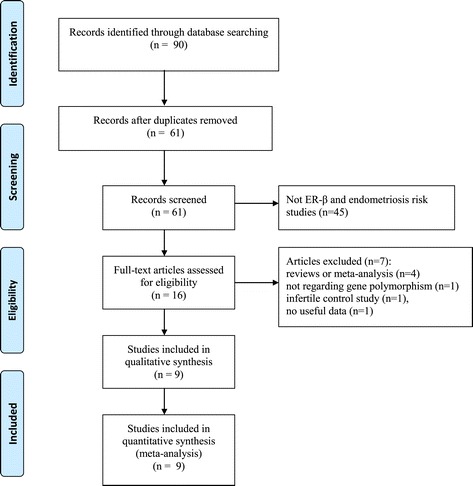
“The detailed screening process is shown in Figure 1, which was modified according to the Preferred Reporting Items for Systematic Reviews and Meta-Analysis (PRISMA) Statement [37].”
MethodMeasuring inconsistency in meta-analyses
Higgins, J. P. T., Thompson, S. G., Deeks, J. J., & Altman, D. G. (2003) · BMJ · doi:10.1136/bmj.327.7414.557 · Cited by 63,139 · cited 2×
“Silva [24] 2011 Brazil Mixed 32.”
Bias in meta-analysis detected by a simple, graphical test
Egger, M., Smith, G. D., Schneider, M., & Minder, C. (1997) · BMJ · doi:10.1136/bmj.315.7109.629 · Cited by 56,722
Preferred reporting items for systematic reviews and meta-analyses: the PRISMA Statement.
(2009) · PubMed Central · Cited by 44,859
Meta-analysis in clinical trials
DerSimonian, R., & Laird, N. (1986) · Controlled Clinical Trials · doi:10.1016/0197-2456(86)90046-2 · Cited by 39,552 · cited 1×
“When between-study heterogeneity was absent, a fixed effect model (Mantel–Haenszel method) was used to pool the data from different studies [25]; otherwise, a random-effects model using the DerSimonian–Laird method was applied [26].”
MethodPreferred Reporting Items for Systematic Reviews and Meta-Analyses: The PRISMA Statement
Moher, D., Liberati, A., Tetzlaff, J., & Altman, D. G. (2009) · Journal of Clinical Epidemiology · doi:10.1016/j.jclinepi.2009.06.005 · Cited by 19,575
Operating characteristics of a rank correlation test for publication bias
Begg, C. B., & Mazumdar, M. (1994) · Biometrics · doi:10.2307/2533446 · Cited by 16,955 · cited 1×
“05 considered statistically significant [28,29].”
Statistical Aspects of the Analysis of Data From Retrospective Studies of Disease
(1959) · JNCI: Journal of the National Cancer Institute · doi:10.1093/jnci/22.4.719 · Cited by 14,689 · cited 1×
“When between-study heterogeneity was absent, a fixed effect model (Mantel–Haenszel method) was used to pool the data from different studies [25]; otherwise, a random-effects model using the DerSimonian–Laird method was applied [26].”
Method
Research works printed but not linked: 1
- Gu YC Cai Q Jiang ZY Zhu JS Zhou LR Relationship between DRa and ERβ gene polymorphisms and endometriosis susceptibility J Diagn Concepts Pract 2012 11 401 406
Cited by
Endometriosis and nuclear receptors
Yilmaz, B. D., & Bulun, S. E. (2019) · Human Reproduction Update · doi:10.1093/humupd/dmz005 · Cited by 243
“Studies investigating the association between ESR2 polymorphisms and endometriosis risk have reported inconsistent results; a meta-analysis comparing eight studies concluded that the previously suggested polymorphisms were associated with bias rather a real risk for endometriosis (Guo et al., 2014).”
ResultEpigenetics of Estrogen and Progesterone Receptors in Endometriosis
Chen, H., Malentacchi, F., Fambrini, M., Harrath, A. H., Huang, H., & Petraglia, F. (2020) · Reproductive Sciences · doi:10.1007/s43032-020-00226-2 · Cited by 73
“A metaanalysis including eight studies showed the possible association between ESR2 rs4986938 and rs1256049 polymorphisms and endometriosis risk [15].”
BackgroundDai, Y., Li, X., Shi, J., & Leng, J. (2018) · Reproductive Health · doi:10.1186/s12978-018-0506-7 · Cited by 70
Moshawih, S., Goh, H. P., Kifli, N., Idris, A. C., Yassin, H., Kotra, V., Goh, K. W., Liew, K. B., & Ming, L. C. (2022) · Chemical Biology & Drug Design · doi:10.1111/cbdd.14062 · Cited by 41
“Other targets, 17- beta-hydroxysteroid dehydrogenase type 2 and estrogen receptor-beta, were connected with other folk uses of Psorospermum aurantiacum , such as to treat infertility (Carneiro et al., 2009; Guo et al., 2014).”
BackgroundPolymorphisms in the 3′UTR Region of ESR2 and CYP19A1 Genes in Women with Endometriosis
Szaflik, T., Smolarz, B., Romanowicz, H., Bryś, M., Forma, E., & Szyłło, K. (2020) · European Journal of Obstetrics & Gynecology and Reproductive Biology · doi:10.1016/j.ejogrb.2020.05.023 · Cited by 8
Estrogen and progesterone receptors in endometriosis
Ferreira, L. R. G., Cavalcanti, T. C. S., Zomer, M. T., Kondo, W., Júnior, E. A., & Kulak, J. (2021) · Minerva Obstetrics and Gynecology · doi:10.23736/s2724-606x.21.04888-0 · Cited by 7
Carneiro, P. P., de Oliveira, B. V., & Silva, A. M. T. C. (2019) · Journal of Endometriosis and Pelvic Pain Disorders · doi:10.1177/2284026518819516 · Cited by 3
Naji, T. S., Al-Rubae'i, S. H. N., & Turki, K. M. (2016) · Journal of the Faculty of Medicine Baghdad · doi:10.32007/jfacmedbagdad.582242 · Cited by 4
Elham, P., Hoseini, S. M., Namayandeh, S. M., Akhavansales, Z., & Sheikhha, M. H. (2020) · International Journal of Reproductive BioMedicine (IJRM) · doi:10.18502/ijrm.v13i7.7368 · Cited by 2
“However, it is possible that the polymorphism is associated with other regulatory sequence changes that may affect gene expression and its function (11).”
BackgroundStudy of RsaI polymorphism of the ERβ gene in Greek women with endometriosis
Anagnostou, E., Theodoropoulou, A., Mavrogianni, D., Πρωτόπαπας, Α., Drakakis, P., & Loutradis, D. (2020) · Hellenic Journal of Obstetrics and Gynecology · doi:10.33574/hjog.2043 · Cited by 1
Metadata
- Authors
- Guo, R., Zheng, N., Ding, S., Zheng, Y., & Feng, L.
- Affiliations
- First Affiliated Hospital Zhejiang University (CN)
- Tongde Hospital of Zhejiang Province (CN)
- Corresponding author
- Feng, Limin
- Venue
- Diagnostic Pathology
- Published
- 2014-09-26
- Volume
- 9
- Issue
- 1
- Pages
- 184-184
- ISSN
- 1746-1596 (ISSN-L)
- PMC
- PMC4179845
- OpenAlex
- W2136859691
- Cited by
- 10
- References
- 53
- Citations by year
- 2022: 1 · 2021: 1 · 2020: 4 · 2019: 2 · 2018: 1 · 2016: 1
- FWCI
- 0.05
- Type
- journal article
- Language
- en
- Open access
- gold
- doi.org
- Locations
- Diagnostic Pathology (publishedVersion, cc-by)
- PubMed Central (publishedVersion, cc-by)
- PubMed (publishedVersion)
- Topics
- Health Sciences › Medicine › Reproductive Medicine › Endometriosis Research and Treatment
- Life Sciences › Biochemistry, Genetics and Molecular Biology › Genetics › Genetic Associations and Epidemiology
- Life Sciences › Biochemistry, Genetics and Molecular Biology › Endocrinology › Estrogen and related hormone effects
- Keywords
- endometriosis, estrogen receptor beta, rs4986938, genetic susceptibility, endometriosis-associated infertility, genetic association
- MeSH terms
- Adult, Endometriosis, Female, Humans, Infertility, Female, Middle Aged, Models, Genetic, Polymorphism, Genetic, Risk Factors, Sensitivity and Specificity, Case-Control Studies, Genetic Predisposition to Disease, Estrogen Receptor beta
About these checks
Registry, retraction, Cites and statistics results are computed, not judged, with one exception: a printed reference that no index lists is read once by a model before it counts as a citation error. Claims are extracted by a model and kept only when their quote appears verbatim in the text; each cited source is then checked, with a model’s help, for whether it says what the claim relies on. Those verdicts can be wrong — read the claim’s quote and the cited source before relying on one.
Statistics and arithmetic are recomputed, not judged.
Confidence bands are shown only for fields calibrated on our annotated test set. None is calibrated yet, so no band is shown.
What counts as a claim ›How we measure confidence ›How we check this ›
Are you an author, or do you see a problem with this page? Request a review
Data sources
Bibliographic data: Semantic Scholar, OpenAlex, Crossref.
Contains information from the Semantic Scholar Academic Graph Datasets, made available under the ODC Attribution License (ODC-BY 1.0).
Semantic Scholar’s data is described in: Kinney, R., et al. (2023). The Semantic Scholar Open Data Platform. arXiv:2301.10140.
