

Changes in cannabis use, exposure, and health perceptions following legalization of adult recreational cannabis use in California: a prospective observational study
Open accessThe DOI matches its Crossref record; 26 of the 26 references it cites were found in a registry or an index.
Abstract
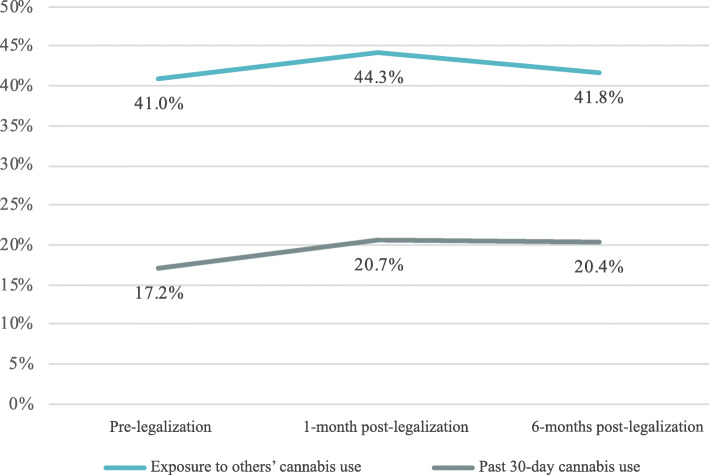
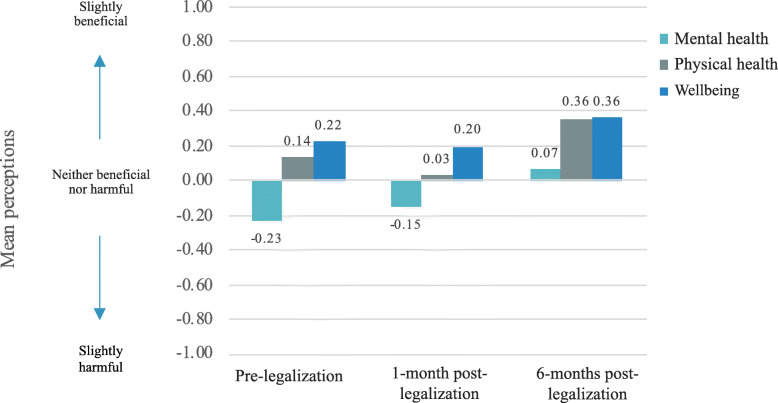
Background: Most U.S. states have legalized cannabis for medical and/or recreational use. In a 6-month prospective observational study, we examined changes in adult cannabis use patterns and health perceptions following broadened legalization of cannabis use from medical to recreational purposes in California. Methods: Respondents were part of Stanford University’s WELL for Life registry, an online adult cohort concentrated in Northern California. Surveys were administered online in the 10 days prior to state legalization of recreational use (1/1/18) and 1-month (2/1/18–2/15/18) and 6-months (7/1/2018–7/15/18) following the change in state policy. Online surveys assessed self-reported past 30-day cannabis use, exposure to others’ cannabis use, and health perceptions of cannabis use. Logistic regression models and generalized estimating equations (GEE) examined associations between participant characteristics and cannabis use pre- to 1-month and 6-months post-legalization. Results: The sample (N = 429, 51% female, 55% non-Hispanic White, age mean = 56 ± 14.6) voted 58% in favor of state legalization of recreational cannabis use, with 26% opposed, and 16% abstained. Cannabis use in the past 30-days significantly increased from pre-legalization (17%) to 1-month post-legalization (21%; odds ratio (OR) = 1.28, p-value (p) = .01) and stayed elevated over pre-legalization levels at 6-months post-legalization (20%; OR = 1.28, p = .01). Exposure to others’ cannabis use in the past 30 days did not change significantly over time: 41% pre-legalization, 44% 1-month post-legalization (OR = 1.18, p = .11), and 42% 6-months post-legalization (OR = 1.08, p = .61). Perceptions of health benefits of cannabis use increased from pre-legalization to 6-months post-legalization (OR = 1.19, p = .02). Younger adults, those with fewer years of education, and those reporting histories of depression were more likely to report recent cannabis use pre- and post-legalization. Other mental illness was associated with cannabis use at post-legalization only. In a multivariate GEE adjusted for sociodemographic characteristics and diagnoses, favoring legalization and the interaction of time and positive health perceptions were associated with a greater likelihood of using cannabis. Conclusions: Legalized recreational cannabis use was associated with greater self-reported past 30-day use post-legalization, and with more-positive health perceptions of cannabis use. Future research is needed to examine longer-term perceptions and behavioral patterns following legalization of recreational cannabis use, especially among those with mental illness.
Overview
The claims and statistics of this paper haven’t been checked yet.
Free: it reads the open-access text and checks the first 5 claims that cite a source we can check. Create a free account to check every claim.
Integrity signals
Registry
Cites
Statistics
Figures
Verification
Claims the paper makes
The claims and statistics of this paper haven’t been checked yet.
Free: it reads the open-access text and checks the first 5 claims that cite a source we can check. Create a free account to check every claim.
Claims other papers make about this one
Each is checked against this paper’s own text: does it say what the citing paper says it does?
The source backs part of the claim, not all of it — or backs it for a different population, condition or comparison.
In the citing paper
“While general adult samples had some mixed findings, the majority of studies (80%) suggested increasing rates of use associated with RCL. 51”
From The Impact of Recreational Cannabis Legalization on Cannabis Use and Associated Outcomes: A Systematic Review (2023) · cites this paper as [51]
Experimental — accuracy not yet measured
Self-check
Percentages, sums and reported differences re-computed from the paper’s own numbers.
The self-check needs the paper’s full text.
Citations
Cites
Harris, P. A., Taylor, R., Thielke, R., Payne, J., Gonzalez, N., & Conde, J. G. (2009) · Journal of Biomedical Informatics · doi:10.1016/j.jbi.2008.08.010 · Cited by 51,384 · cited 2×
“Harris PA, Taylor R, Thielke R, Payne J, Gonzalez N, Conde JG. Research electronic data capture (REDCap)--a metadata-driven methodology and workflow process for providing translational research informatics support.”
MethodLongitudinal data analysis using generalized linear models
LIANG, K.-Y., & ZEGER, S. L. (1986) · Biometrika · doi:10.1093/biomet/73.1.13 · Cited by 18,550
National Conference of State Legislatures
(2011) · Reference Reviews · doi:10.1108/09504121111114072 · Cited by 2,315
Cannabinoids for Medical Use: A Systematic Review and Meta-analysis
Whiting, P. F., Wolff, R. F., Deshpande, S., Di Nisio, M., Duffy, S., Hernandez, A. V., Keurentjes, J. C., Lang, S., Misso, K., Ryder, S., et al. (2015) · JAMA · doi:10.1001/jama.2015.6358 · Cited by 2,169
Groce, E. (2018) · Journal of Medical Regulation · doi:10.30770/2572-1852-104.4.32 · Cited by 1,330
Cerdá, M., Mauro, C., Hamilton, A., Levy, N. S., Santaella-Tenorio, J., Hasin, D., Wall, M. M., Keyes, K. M., & Martins, S. S. (2020) · JAMA Psychiatry · doi:10.1001/jamapsychiatry.2019.3254 · Cited by 598
Attrition in longitudinal studies
Twisk, J., & de Vente, W. (2002) · Journal of Clinical Epidemiology · doi:10.1016/s0895-4356(01)00476-0 · Cited by 527 · cited 1×
“Rather than remove respondents who did not complete all the surveys and conduct a completecase analysis that could lead to less power and biased results, we used GEE analyses, which is useful in dealing with missing data and does not require imputation [34].”
MethodCommittee on the Health Effects of Marijuana: An Evidence Review and Research Agenda, Board on Population Health and Public Health Practice, Division, H. A. M., & National Academies of Sciences, E. (2017) · National Academies Press eBooks · doi:10.17226/24625 · Cited by 455
Jetly, R., Heber, A., Fraser, G., & Boisvert, D. (2015) · Psychoneuroendocrinology · doi:10.1016/j.psyneuen.2014.11.002 · Cited by 321 · cited 1×
“Few studies have examined cannabis’s effects on well-being, a construct related to quality of life, and findings have been mixed [9, 10].”
BackgroundAssociation of High-Potency Cannabis Use With Mental Health and Substance Use in Adolescence
Hines, L. A., Freeman, T. P., Gage, S. H., Zammit, S., Hickman, M., Cannon, M., Munafo, M., MacLeod, J., & Heron, J. (2020) · JAMA Psychiatry · doi:10.1001/jamapsychiatry.2020.1035 · Cited by 208 · cited 1×
“The literature suggests potential anxiolytic effects of CBD [7], but also points to the association of mental health harms with high-potency cannabis use [28].”
BackgroundPrevalence and forms of cannabis use in legal vs. illegal recreational cannabis markets
Goodman, S., Wadsworth, E., Leos-Toro, C., & Hammond, D. (2020) · International Journal of Drug Policy · doi:10.1016/j.drugpo.2019.102658 · Cited by 201 · cited 1×
“States that legalized recreational cannabis use had a higher prevalence of cannabis use and greater use of products such as cannabis edibles, drinks, and high potency concentrate than in those that had not [16].”
BackgroundPrenatal cannabis exposure and infant outcomes: Overview of studies
Huizink, A. C. (2014) · Progress in Neuro-Psychopharmacology and Biological Psychiatry · doi:10.1016/j.pnpbp.2013.09.014 · Cited by 176 · cited 1×
“Smoking cannabis during pregnancy is associated with low birthweight; studies of adverse effects of prenatal cannabis use on offspring behavior and cognitive development have been equivocal [5].”
BackgroundCannabidiol, a Cannabis sativa constituent, as an anxiolytic drug
Schier, A. R. D. M., Ribeiro, N. P. D. O., e Silva, A. C. D. O., Hallak, J. E. C., Crippa, J. A. S., Nardi, A. E., & Zuardi, A. W. (2012) · Revista Brasileira de Psiquiatria · doi:10.1016/s1516-4446(12)70057-0 · Cited by 154 · cited 3×
“Abbreviations THC: Tetrahydrocannabinol; CBD: Cannabidiol; GEE: Generalized estimating eqs.”
BackgroundPacula, R. L., Chriqui, J. F., Reichmann, D. A., & Terry‐McElrath, Y. M. (2002) · Cited by 147
D’Amico, E. J., Rodriguez, A., Tucker, J. S., Pedersen, E. R., & Shih, R. A. (2018) · Drug and Alcohol Dependence · doi:10.1016/j.drugalcdep.2018.03.031 · Cited by 134 · cited 1×
“Since the legalization of recreational cannabis in California, which includes the selling of cannabis, dispensary ads and mass marketing campaigns promoting uses of cannabis have proliferated [29, 30].”
BackgroundA National Survey of Marijuana Use Among US Adults With Medical Conditions, 2016-2017
Dai, H. D., & Richter, K. P. (2019) · JAMA Network Open · doi:10.1001/jamanetworkopen.2019.11936 · Cited by 126 · cited 1×
“These findings are consistent with previous national studies on adults in the United States where cannabis use decreased with increasing age [27].”
ResultMair, C., Freisthler, B., Ponicki, W. R., & Gaidus, A. J. (2015) · Drug and Alcohol Dependence · doi:10.1016/j.drugalcdep.2015.06.019 · Cited by 99 · cited 1×
“A study in California found a link between the density of cannabis dispensaries and neighborhood ecology on cannabis abuse and dependency before the legalization of recreational cannabis [37].”
BackgroundNegative consequences associated with dependence in daily cannabis users
Looby, A., & Earleywine, M. (2007) · Substance Abuse Treatment, Prevention, and Policy · doi:10.1186/1747-597x-2-3 · Cited by 92
Pacek, L. R., Weinberger, A. H., Zhu, J., & Goodwin, R. D. (2020) · Addiction · doi:10.1111/add.14883 · Cited by 89
Differences in Opinions About Marijuana Use and Prevalence of Use by State Legalization Status
Steigerwald, S., Cohen, B. E., Vali, M., Hasin, D. S., Cerdá, M., & Keyhani, S. (2019) · Journal of Addiction Medicine · doi:10.1097/adm.0000000000000593 · Cited by 56 · cited 1×
“, for pain management, relief from stress) was found to be higher in states that had legalized cannabis for recreational use [19].”
BackgroundTakakuwa, K. M., Hergenrather, J. Y., Shofer, F. S., & Schears, R. M. (2020) · Cannabis and Cannabinoid Research · doi:10.1089/can.2019.0039 · Cited by 55 · cited 1×
“Despite the growing evidence of cannabis use as an effective treatment in chronic pain [3, 26] and its use in mitigating side effects of cancer therapies, our study showed that those with pain and those with a history of Table 2 Univariate tests of associations with cannabis use at pre-legalization and 1- and 6-months…”
BackgroundThe Effects of Cannabis on Heart Rate Variability and Well-Being in Young Men
Schmid, K., Schönlebe, J., Drexler, H., & Müeck‐Weymann, M. (2010) · Pharmacopsychiatry · doi:10.1055/s-0030-1248314 · Cited by 49 · cited 1×
“Few studies have examined cannabis’s effects on well-being, a construct related to quality of life, and findings have been mixed [9, 10].”
BackgroundCannabis use in youth is associated with limited alterations in brain structure
Scott, J. C., Rosen, A. F. G., Moore, T. M., Roalf, D. R., Satterthwaite, T. D., Calkins, M. E., Ruparel, K., Gur, R. E., & Gur, R. C. (2019) · Neuropsychopharmacology · doi:10.1038/s41386-019-0347-2 · Cited by 42
Post-legalization changes in marijuana use in a sample of young California adults
Doran, N., Strong, D. R., Myers, M. G., Correa, J. B., & Tully, L. K. (2020) · Addictive Behaviors · doi:10.1016/j.addbeh.2020.106782 · Cited by 37 · cited 1×
“A recent California study found no increase in cannabis use after legalization of recreational cannabis; however, the study sample was restricted to young adults aged 18–24 who used tobacco, so the findings may not generalize to the broader population [18].”
BackgroundSlusky, D. (2019) · Cited by 11
A comment on analyzing addictive behaviors over time
Schneider, K. L., Hedeker, D., Bailey, K. C., Cook, J. W., & Spring, B. J. (2010) · Nicotine & Tobacco Research · doi:10.1093/ntr/ntp213 · Cited by 8 · cited 1×
“therefore consistent with the assumption that outcome data were missing completely at random [35].”
Result
Research works printed but not linked: 7
- Meng Y Ponce N The changing landscape: tobacco and marijuana use among young adults in California UCLA Center for health policy Reseach 2020
- Daniller A Two-thirds of Americans support marijuana legalization 2019
- Substance Abuse and Mental Health Services Administration Key substance use and mental health indicators in the United States: results from the 2019 National Survey on drug use and health. Center for Behavioral Health Statistics and Quality, Substance Abuse and Mental Health Services Administration 2020
- California Legislative Information SB-94 cannabis: medicinal and adult use 2017
- Corp IBM IBM SPSS statistics for windows 2017 Armonk IBM Corp
- Substance Abuse and Mental Health Services Administration Key substance use and mental health indicators in the United States: results from the 2017 National Survey on drug use and health 2018
- Vuong TD Zhang X Roeseler A California tobacco facts and figures 2019 2019 Sacramento California Department of Public Health
Cited by
Farrelly, K. N., Wardell, J. D., Marsden, E., Scarfe, M. L., Najdzionek, P., Turna, J., & MacKillop, J. (2023) · Substance Abuse Research and Treatment · doi:10.1177/11782218231172054 · Cited by 162
Prevalence of and trends in current cannabis use among US youth and adults, 2013–2022
Mattingly, D. T., Richardson, M. K., & Hart, J. L. (2024) · Drug and Alcohol Dependence Reports · doi:10.1016/j.dadr.2024.100253 · Cited by 104
“In the United States (US), cannabis remains the most used psychoactive substance despite shifting views of its social acceptability and perceived harm (Gali et al., 2021; Hasin, 2018; Substance Abuse and Mental Health Services Administration, 2023).”
Comparison of State-Level Regulations for Cannabis Contaminants and Implications for Public Health
Jameson, L. E., Conrow, K. D., Pinkhasova, D. V., Boulanger, H. L., Ha, H., Jourabchian, N., Johnson, S. A., Simeone, M. P., Afia, I. A., Cahill, T. M., et al. (2022) · Environmental Health Perspectives · doi:10.1289/ehp11206 · Cited by 65
Medical Cannabis State and Federal Regulations
Perlman, A. I., McLeod, H. M., Ventresca, E. C., Salinas, M. G., Post, P. J., Schuh, M. J., & Dabrh, A. M. A. (2021) · Mayo Clinic Proceedings · doi:10.1016/j.mayocp.2021.05.005 · Cited by 46
Halladay, J. E., Freibott, C. E., Lipson, S. K., Zhou, S., & Eisenberg, D. (2022) · Journal of American College Health · doi:10.1080/07448481.2022.2098030 · Cited by 35
“Despite limited scientific evidence of benefits for cannabinoid-based psychotherapeutics 49 , there have been increases in public perceptions of health benefits related to cannabis use 50 and declines in the perceived risks of using cannabis, particularly among those with depression.”
Metadata
- Authors
- Gali, K., Winter, S. J., Ahuja, N. J., Frank, E., & Prochaska, J. J.
- Affiliations
- Stanford Medicine (US)
- University of British Columbia (CA)
- Corresponding author
- Prochaska, Judith J.
- Venue
- Substance Abuse Treatment, Prevention, and Policy
- Published
- 2021-02-12
- Volume
- 16
- Issue
- 1
- Pages
- 16-16
- ISSN
- 1747-597X (ISSN-L)
- PMC
- PMC7881543
- OpenAlex
- W3126756663
- Cited by
- 59
- References
- 26
- Citations by year
- 2026: 7 · 2025: 18 · 2024: 8 · 2023: 13 · 2022: 8 · 2021: 5
- FWCI
- 4.96
- Type
- journal article
- Language
- en
- Open access
- gold
- doi.org
- Licence
- cc-by
- creativecommons.org/licenses/by/4.0/ (tdm)
- creativecommons.org/licenses/by/4.0/ (vor)
- Locations
- Substance Abuse Treatment Prevention and Policy (publishedVersion, cc-by)
- PubMed Central (publishedVersion, cc-by)
- PubMed (publishedVersion)
- eScholarship (California Digital Library) (submittedVersion)
- cIRcle (University of British Columbia) (submittedVersion, cc-by)
- DOAJ (DOAJ: Directory of Open Access Journals) (submittedVersion, cc-by-sa)
- Open Collections
- Funders
- National Heart, Lung, and Blood Institute (T32HL007034)
- Amway
- Canada Research Chair Program at the University of British Columbia
- Annenberg Physician Training Program in Addiction Medicine
- Topics
- Health Sciences › Medicine › Pharmacology (medical) › Cannabis and Cannabinoid Research
- Health Sciences › Medicine › Public Health, Environmental and Occupational Health › Smoking Behavior and Cessation
- Health Sciences › Medicine › Epidemiology › Substance Abuse Treatment and Outcomes
- Keywords
- cannabis legalization, recreational cannabis, medical cannabis, cannabis use patterns, cannabis exposure, health perception, cannabis policy, California, depression, age and education differences, substance use trends
- MeSH terms
- Recreational Drug Use, Adult, California, Cannabis, Humans, Legislation, Drug, Perception, Prospective Studies, Cohort Studies
About these checks
Registry, retraction, Cites and statistics results are computed, not judged, with one exception: a printed reference that no index lists is read once by a model before it counts as a citation error. Claims are extracted by a model and kept only when their quote appears verbatim in the text; each cited source is then checked, with a model’s help, for whether it says what the claim relies on. Those verdicts can be wrong — read the claim’s quote and the cited source before relying on one.
Statistics and arithmetic are recomputed, not judged.
Confidence bands are shown only for fields calibrated on our annotated test set. None is calibrated yet, so no band is shown.
What counts as a claim ›How we measure confidence ›How we check this ›
Are you an author, or do you see a problem with this page? Request a review
Data sources
Bibliographic data: Semantic Scholar, OpenAlex, Crossref.
Contains information from the Semantic Scholar Academic Graph Datasets, made available under the ODC Attribution License (ODC-BY 1.0).
Semantic Scholar’s data is described in: Kinney, R., et al. (2023). The Semantic Scholar Open Data Platform. arXiv:2301.10140.
