

Development of a behaviour change intervention to increase upper limb exercise in stroke rehabilitation
Open accessThe DOI matches its Crossref record; 31 of the 31 references it cites were found in a registry or an index.
Abstract
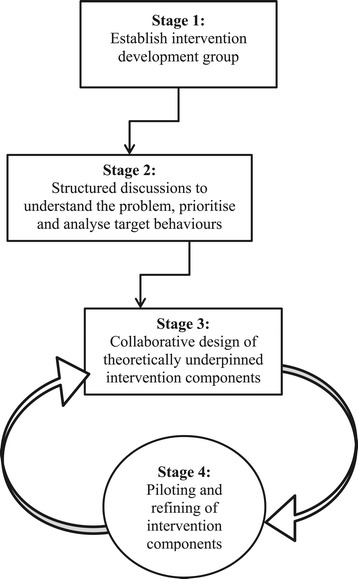
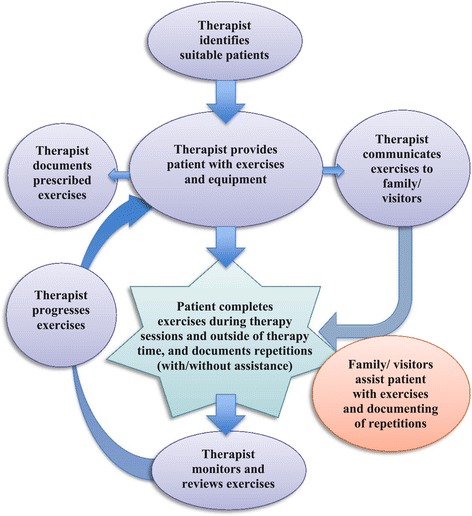
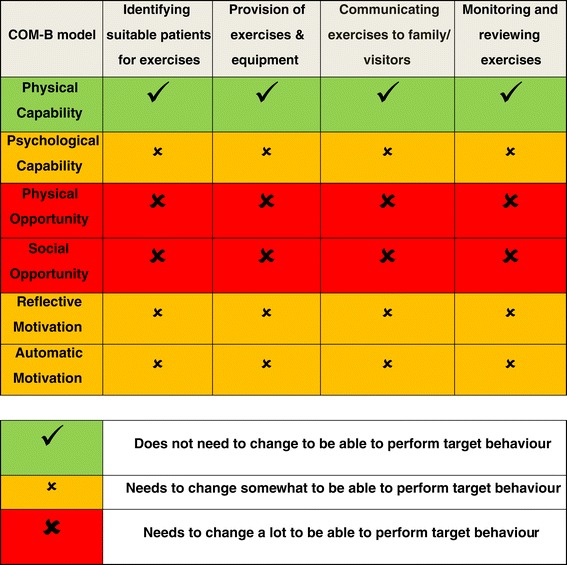
BACKGROUND: Two thirds of survivors will achieve independent ambulation after a stroke, but less than half will recover upper limb function. There is strong evidence to support intensive repetitive task-oriented training for recovery after stroke. The number of repetitions needed is suggested to be in the order of hundreds, but this is not currently being achieved in clinical practice. In an effort to bridge this evidence-practice gap, we have developed a behaviour change intervention that aims to increase provision of upper limb repetitive task-oriented training in stroke rehabilitation. This paper aims to describe the systematic processes that took place in collaboratively developing the behaviour change intervention. METHODS: The methods used in this study were not defined a priori but were guided by the Behaviour Change Wheel. The process was collaborative and iterative with four stages of development emerging (i) establishing an intervention development group; (ii) structured discussions to understand the problem, prioritise target behaviours and analyse target behaviours; (iii) collaborative design of theoretically underpinned intervention components and (iv) piloting and refining of intervention components. RESULTS: The intervention development group consisted of the research team and stroke therapy team at a local stroke rehabilitation unit. The group prioritised four target behaviours at the therapist level: (i) identifying suitable patients for exercises, (ii) provision of exercises, (iii) communicating exercises to family/visitors and (iv) monitoring and reviewing exercises. It also provides a method for self-monitoring performance in order to measure fidelity. The developed intervention, PRACTISE (Promoting Recovery of the Arm: Clinical Tools for Intensive Stroke Exercise), consists of team meetings and the PRACTISE Toolkit (screening tool and upper limb exercise plan, PRACTISE exercise pack and an audit tool). CONCLUSIONS: This paper provides an example of how the Behaviour Change Wheel may be applied in the collaborative development of a behaviour change intervention for health professionals. The process involved was resource-intensive, and the iterative process was difficult to capture. The use of a published behaviour change framework and taxonomy will assist replication in future research and clinical use. The feasibility and acceptability of PRACTISE is currently being explored in two other stroke rehabilitation units.
Overview
The claims and statistics of this paper haven’t been checked yet.
Free: it reads the open-access text and checks the first 5 claims that cite a source we can check. Create a free account to check every claim.
Integrity signals
Registry
Cites
Statistics
Figures
Verification
Claims the paper makes
The claims and statistics of this paper haven’t been checked yet.
Free: it reads the open-access text and checks the first 5 claims that cite a source we can check. Create a free account to check every claim.
Claims other papers make about this one
Each is checked against this paper’s own text: does it say what the citing paper says it does?
The source backs part of the claim, not all of it — or backs it for a different population, condition or comparison.
In the citing paper
“For instance, Theoretical Domains Framework (e.g. [127,128]), and Normalization Process Theory [129] and COM-B (e.g. [130,131]) have all been widely used as evaluation frameworks.”
From Making sense of implementation theories, models and frameworks (2015) · cites this paper as [130]
Experimental — accuracy not yet measuredThe source backs part of the claim, not all of it — or backs it for a different population, condition or comparison.
In the citing paper
“Although evaluation frameworks may be considered in a category of their own, theories, models and frameworks from the other four categories can also be applied for evaluation purposes because they specify concepts and constructs that may be operationalized and measured.”
From Making sense of implementation theories, models and frameworks (2015) · cites this paper as [130]
Experimental — accuracy not yet measured
Self-check
Percentages, sums and reported differences re-computed from the paper’s own numbers.
The self-check needs the paper’s full text.
Citations
Cites
Michie, S., van Stralen, M. M., & West, R. (2011) · Implementation Science · doi:10.1186/1748-5908-6-42 · Cited by 13,697
Developing and evaluating complex interventions: the new Medical Research Council guidance
Craig, P., Dieppe, P., Macintyre, S., Michie, S., Nazareth, I., & Petticrew, M. (2008) · BMJ · doi:10.1136/bmj.a1655 · Cited by 10,995 · cited 3×
“Successful implementation of complex interventions, such as GRASP or TRACS, relies on changing the behaviours of those responsible for their implementation [16].”
InfluentialMichie, S., Richardson, M., Johnston, M., Abraham, C., Francis, J., Hardeman, W., Eccles, M. P., Cane, J., & Wood, C. E. (2013) · Annals of Behavioral Medicine · doi:10.1007/s12160-013-9486-6 · Cited by 7,629 · cited 2×
“It entailed a collaborative design exercise to identify intervention components and was informed by the Behaviour Change Technique Tax-onomy (v1) (BCTTv1) [23].”
A taxonomy of behavior change techniques used in interventions
Abraham, C., & Michie, S. (2008) · Health Psychology · doi:10.1037/0278-6133.27.3.379 · Cited by 2,525 · cited 1×
“Employing consistent terminology to describe these techniques allows developers to identify the active ingredients of interventions, test these active ingredients and comprehensively describe interventions to facilitate replication in future research [24].”
(2014) · Cited by 2,276
Nudo, R. J., Wise, B. M., SiFuentes, F., & Milliken, G. W. (1996) · Science · doi:10.1126/science.272.5269.1791 · Cited by 1,911 · cited 1×
“Neuroplasticity literature suggests that repetitions in the order of hundreds are likely to be necessary [8] to maximise recovery after stroke.”
Complex interventions: how “out of control” can a randomised controlled trial be?
Hawe, P., Shiell, A., & Riley, T. (2004) · BMJ · doi:10.1136/bmj.328.7455.1561 · Cited by 1,244 · cited 1×
“This aligns with previous evidence suggesting that when developing and testing complex interventions, there is a need to be clear about the function of the intervention components but to allow some flexibility with the form to allow adaptation at the local context [29].”
What Is the Evidence for Physical Therapy Poststroke? A Systematic Review and Meta-Analysis
Veerbeek, J. M., van Wegen, E., van Peppen, R., van der Wees, P. J., Hendriks, E., Rietberg, M., & Kwakkel, G. (2014) · PLoS ONE · doi:10.1371/journal.pone.0087987 · Cited by 1,203 · cited 1×
“There is now strong evidence supported by high-quality trials, and underpinned by motor learning and neuroplasticity literature [1], to support intensive repetitive task-oriented training for recovery after stroke [2].”
O'Neil, J. H. (1995) · North East Linguistics Society · Cited by 812
Observation of Amounts of Movement Practice Provided During Stroke Rehabilitation
Lang, C. E., MacDonald, J. R., Reisman, D. S., Boyd, L., Jacobson Kimberley, T., Schindler-Ivens, S. M., Hornby, T. G., Ross, S. A., & Scheets, P. L. (2009) · Archives of Physical Medicine and Rehabilitation · doi:10.1016/j.apmr.2009.04.005 · Cited by 703 · cited 1×
“This contrasts starkly with clinical practice, where it has been reported that the average amount of time spent treating the upper limb in therapy sessions is between 0.9 and 7.9 min [9] resulting in, on average, just 32 repetitions per session [10].”
Influential
Research works printed but not linked: 1
- National Institute for Health and Care Excellence Stroke Rehabilitation [CG162] 2013 London National Institute for Health and Care Excellence
Cited by
Making sense of implementation theories, models and frameworks
Nilsen, P. (2015) · Implementation Science · doi:10.1186/s13012-015-0242-0 · Cited by 4,447
“[130,131]) have all been widely used as evaluation frame-”
Duncan, E., O'Cathain, A., Rousseau, N., Croot, L., Sworn, K., Turner, K. M., Yardley, L., & Hoddinott, P. (2020) · BMJ Open · doi:10.1136/bmjopen-2019-033516 · Cited by 481
Making Sense of Implementation Theories, Models, and Frameworks
Nilsen, P. (2020) · Implementation Science 3.0 · doi:10.1007/978-3-030-03874-8_3 · Cited by 322
Exploring the Role of Accelerometers in the Measurement of Real World Upper-Limb Use After Stroke
Hayward, K. S., Eng, J. J., Boyd, L. A., Lakhani, B., Bernhardt, J., & Lang, C. E. (2016) · Brain Impairment · doi:10.1017/brimp.2015.21 · Cited by 129
“However, there was no correlation between the accelerometry-derived activity count and all human-observed repetitions, that is, purposeful plus non-purposeful repetitions (Connell et al., 2014).”
BackgroundInfluentialSelf-citationDyson, J., & Cowdell, F. (2021) · International Journal for Quality in Health Care · doi:10.1093/intqhc/mzab106 · Cited by 113
Webb, J., Foster, J., & Poulter, E. (2016) · Public Health · doi:10.1016/j.puhe.2015.12.009 · Cited by 97
Implementation of sustainable complex interventions in health care services: the triple C model
Khalil, H., & Kynoch, K. (2021) · BMC Health Services Research · doi:10.1186/s12913-021-06115-x · Cited by 79
Mc Sharry, J., Murphy, P. J., & Byrne, M. (2016) · Implementation Science · doi:10.1186/s13012-016-0493-4 · Cited by 62
“Existing studies have used the BCW, the COM-B model and BCT taxonomies to develop and describe implementation interventions in healthcare settings [26, 30, 31].”
MethodResultInfluentialHall, J., Morton, S., Hall, J., Clarke, D. J., Fitzsimons, C. F., English, C., Forster, A., Mead, G. E., & Lawton, R. (2020) · Pilot and Feasibility Studies · doi:10.1186/s40814-020-00667-1 · Cited by 77
“There are now several examples of the BCW framework being applied to develop interventions, for example, the development of an upper limb exercise intervention in stroke rehabilitation [11] and a workplace sedentary behaviour reduction intervention [12].”
MethodOverview of theories, models and frameworks in implementation science
Nilsen, P. (2020) · Edward Elgar Publishing eBooks · doi:10.4337/9781788975995.00008 · Cited by 76
Croot, L., O’Cathain, A., Sworn, K., Yardley, L., Turner, K., Duncan, E., & Hoddinott, P. (2019) · Pilot and Feasibility Studies · doi:10.1186/s40814-019-0512-8 · Cited by 51
Webb, J., Hall, J., Hall, K., & Fabunmi-Alade, R. (2016) · Public Health · doi:10.1016/j.puhe.2016.05.015 · Cited by 62
Murtagh, E., Barnes, A. T., McMullen, J. M., & Morgan, P. J. (2018) · Public Health · doi:10.1016/j.puhe.2018.01.012 · Cited by 55
“The BCW has been used successfully to inform the design of many interventions which target a variety of health-related issues such as attentive eating,(21) hearing-aid use,(19) physically active teaching methods,(22) obesity prevention(23) and stroke rehabilitation.(24) The National Institute for Health and Clinical E…”
MethodImplementation in rehabilitation: a roadmap for practitioners and researchers
Morris, J. H., Bernhardsson, S., Bird, M., Connell, L., Lynch, E. A., Jarvis, K. A., Kayes, N. M., Miller, K., Mudge, S., & Fisher, R. J. (2019) · Disability and Rehabilitation · doi:10.1080/09638288.2019.1587013 · Cited by 56
Self-citationMa, J. K., Cheifetz, O., Todd, K. R., Chebaro, C., Phang, S. H., Shaw, R. B., Whaley, K. J., & Ginis, K. A. M. (2020) · Spinal Cord · doi:10.1038/s41393-020-0422-x · Cited by 50
Tümkaya, S. (2012) · Educational Sciences Theory & Practice · Cited by 50
Campbell, W. N., & Douglas, N. (2017) · Evidence-Based Communication Assessment and Intervention · doi:10.1080/17489539.2017.1370215 · Cited by 46
“In addition, the specific implementation strategies utilized by Connell et al. (2015) address all three EPOC implementation strategy categories outlined in Table 1.”
BackgroundMethodLoft, M. I., Martinsen, B., Esbensen, B. A., Mathiesen, L. L., Iversen, H. K., & Poulsen, I. (2017) · International Journal of Qualitative Studies on Health and Well-Being · doi:10.1080/17482631.2017.1392218 · Cited by 46
Methods of Health Behavior Change
Tombor, I., & Michie, S. (2017) · Oxford University Press eBooks · doi:10.1093/acrefore/9780190236557.013.125 · Cited by 40
Behavioral models for periodontal health and disease
Newton, T., & Asimakopoulou, K. G. (2018) · Periodontology 2000 · doi:10.1111/prd.12236 · Cited by 39
Paterson, S. J., Dawes, H., Winward, C. E., Bartram, E., Dodds, E., McKinon, J., Gaskell, H., & Collett, J. (2024) · Clinical Rehabilitation · doi:10.1177/02692155231224365 · Cited by 38
“The COM-B has been used to develop rehabilitation interventions after stroke 52,53 but this is the fi rst time it has been used as a framework for synthesis of intervention components.”
MethodSimiyu, S. N., Kweyu, R. M., Antwi-Agyei, P., & Adjei, K. A. (2020) · BMC Public Health · doi:10.1186/s12889-020-09768-1 · Cited by 36
Hunting Relics: A Persuasive Exergame to Promote Collective Exercise in Young Children
Cibrian, F. L., Tentori, M. E., & Martínez-García, A. I. (2016) · International Journal of Human-Computer Interaction · doi:10.1080/10447318.2016.1136180 · Cited by 36
Stewart, C. E., Power, E., McCluskey, A., & Kuys, S. S. (2019) · Disability and Rehabilitation · doi:10.1080/09638288.2019.1597178 · Cited by 35
Romney, W. M., Bellows, D. M., Tavernite, J. P., Salbach, N. M., & Deutsch, J. E. (2021) · Archives of Physical Medicine and Rehabilitation · doi:10.1016/j.apmr.2021.01.076 · Cited by 34
Connell, L., McMahon, N. E., Tyson, S. F., Watkins, C. L., & Eng, J. J. (2016) · BMC Health Services Research · doi:10.1186/s12913-016-1793-8 · Cited by 33
“Development of the implementation intervention was guided by the Behaviour Change Wheel (BCW) [7], the details of which have been reported elsewhere [8].”
Self-citationKettlewell, J., Phillips, J. S., Radford, K., & das Nair, R. (2018) · BMC Medical Informatics and Decision Making · doi:10.1186/s12911-018-0611-0 · Cited by 32
“This approach was used in a similar study evaluating the use of the model [47].”
MethodWeerakkody, A., White, J., Hill, C., Godecke, E., & Singer, B. (2023) · Journal of physiotherapy · doi:10.1016/j.jphys.2023.08.007 · Cited by 31
Factors That Contribute to the Use of Stroke Self-Rehabilitation Technologies: A Review
Vourganas, I., Stanković, V., Stanković, L., & Kerr, A. (2019) · JMIR Biomedical Engineering · doi:10.2196/13732 · Cited by 31
“Recent studies, for example, on applied psychology in behavior change theories for stroke rehabilitation [12-14], do support that the self-esteem of the patient is limited after stroke.”
Jolliffe, L. J., Hoffmann, T., & Lannin, N. A. (2019) · Australian Occupational Therapy Journal · doi:10.1111/1440-1630.12599 · Cited by 29
Walsh, D. M. J., Hynes, L., O’Hara, M. C., McSharry, J., Panel, D. N. Y. A., Dinneen, S. F., & Byrne, M. (2018) · HRB Open Research · doi:10.12688/hrbopenres.12803.2 · Cited by 28
Capability, opportunity, motivation, and social participation after stroke
Gingrich, N., Bosancich, J., Schmidt, J., & Sakakibara, B. M. (2022) · Topics in Stroke Rehabilitation · doi:10.1080/10749357.2022.2070358 · Cited by 27
“the behavior change wheel postulates that behavior is a function of capability, opportunity, and motivation.(17) 424 N.”
BackgroundMethodCassidy, C. E., Steenbeek, A., Langille, D. B., Martin‐Misener, R., & Curran, J. (2019) · BMC Public Health · doi:10.1186/s12889-019-8059-4 · Cited by 24
Walton, H., Spector, A. E., Roberts, A., Williamson, M., Bhatt, J., Tombor, I., & Michie, S. (2020) · BMC Medical Research Methodology · doi:10.1186/s12874-020-01006-x · Cited by 24
Popoola, M., Dingle, M., MacLaren, J., & Dyson, J. (2021) · Australian Critical Care · doi:10.1016/j.aucc.2021.09.002 · Cited by 21
Donkers, S. J., Chan, K., Milosavljevic, S., Pakosh, M. T., & Musselman, K. E. (2018) · Translational Behavioral Medicine · doi:10.1093/tbm/iby118 · Cited by 21
McCluskey, A., Massie, L., Gibson, G. E., Pinkerton, L., & Vandenberg, A. (2020) · Australian Occupational Therapy Journal · doi:10.1111/1440-1630.12647 · Cited by 21
Moving Research From the Bedside Into Practice
Jette, A. M. (2016) · Physical Therapy · doi:10.2522/ptj.2016.96.5.594 · Cited by 21
Mabweazara, S. Z., Leach, L. L., & Ley, C. (2019) · BMC Public Health · doi:10.1186/s12889-019-7091-8 · Cited by 20
Johnson, F., Beeke, S., & Best, W. (2019) · Disability and Rehabilitation · doi:10.1080/09638288.2019.1703147 · Cited by 19
“It has also been used within the Behaviour Change Wheel system to plan Physiotherapy intervention for stroke [14] and change caseload management practices among Occupational Therapists [15].”
MethodBoland, P., Connell, L., Thetford, C., & Janssen, J. (2020) · Disability and Rehabilitation · doi:10.1080/09638288.2020.1817986 · Cited by 19
“Despite criticism that some components of the BCW are not well defined [28], the COM-B model and the BCW have generally been regarded as a useful framework within intervention development [28,32,33].”
BackgroundMethodSelf-citationOdetunde, M. O., Olaoye, O. A., Obajobi, O. A., Yusuf, A. A., & Awotidebe, T. O. (2024) · Bulletin of Faculty of Physical Therapy · doi:10.1186/s43161-024-00224-4 · Cited by 18
“Consistency with treatment and HEPs aided adherence, which was achieved by following a specific daily routine and scheduling of the HEPs, which is in agreement with earlier studies [11, 40].”
Appiah, R., Fadiji, A. W., Wissing, M. P., & Schutte, L. (2021) · Journal of Community Psychology · doi:10.1002/jcop.22566 · Cited by 18
van Leeuwen, L. M., Pronk, M., Merkus, P., Goverts, S. T., Anema, J. R., & Kramer, S. E. (2019) · International Journal of Audiology · doi:10.1080/14992027.2019.1691746 · Cited by 17
“Studies have shown that early engagement of stakeholders may reduce barriers and ensure commitment to implementation (Haverman 2014, Connell et al. 2015, Kwan et al. 2016).”
BackgroundConnell, L., McMahon, N. E., Tyson, S. F., Watkins, C. L., & Eng, J. J. (2016) · Physical Therapy · doi:10.2522/ptj.20150694 · Cited by 17
Self-citationGiroux, E. E., Casemore, S., Clarke, T., McBride, C. B., Wuerstl, K. R., & Gainforth, H. L. (2020) · Spinal Cord · doi:10.1038/s41393-020-00555-8 · Cited by 16
Levine, R., Zingelman, S., McSween, M., Shrubsole, K., Hill, A. J., & Copland, D. A. (2023) · Archives of Physical Medicine and Rehabilitation · doi:10.1016/j.apmr.2023.08.018 · Cited by 13
Trebilcock, M., Shrubsole, K., Worrall, L. E., & Ryan, B. (2021) · Disability and Rehabilitation · doi:10.1080/09638288.2021.1910867 · Cited by 12
Aphasia outcome measurement in clinical practice: An international survey
Tyler, C., Finch, E., Shrubsole, K., Ryan, B., Soroli, E., Martínez‐Ferreiro, S., & Wallace, S. J. (2022) · Aphasiology · doi:10.1080/02687038.2022.2112143 · Cited by 11
“, 2011), which has previously been utilised to design behaviour-change interventions in stroke care (Connell et al., 2015; Loft et al., 2017; Shrubsole et al., 2018).”
BackgroundMethodGunn, K. M., Bamford, L., Olver, I., & Wilson, C. J. (2018) · Translational Behavioral Medicine · doi:10.1093/tbm/iby055 · Cited by 10
Holly, D., & Swanson, V. (2019) · Journal of Advanced Nursing · doi:10.1111/jan.14100 · Cited by 9
Scheffler, B., Schimböck, F., Schöler, A., Rösner, K., Spallek, J., & Kopkow, C. (2022) · Frontiers in Neurology · doi:10.3389/fneur.2022.828521 · Cited by 9
“The BCW and TDF have been successfully applied to develop and tailor implementation interventions by healthcare professionals in the context of stroke rehabilitation (41, 42, 95, 96).”
MethodWeerakkody, A., Emmanuel, R., White, J., Godecke, E., & Singer, B. (2023) · Australian Occupational Therapy Journal · doi:10.1111/1440-1630.12896 · Cited by 8
Kierkegaard, P., Hicks, T., Allen, A. J., Yang, Y., Hayward, G., Głogowska, M., Nicholson, B. D., Buckle, P., Braybrook, J. H., Dark, P. M., et al. (2021) · Implementation Science Communications · doi:10.1186/s43058-021-00242-6 · Cited by 9
“The taxonomy includes 93 behaviour change techniques grouped within 16 categories, and several studies have applied the BCW and BCTTv1 to develop implementation interventions [27, 41, 42].”
MethodRawahi, S. H. A., Asimakopoulou, K. G., Masood, M., Bulushi, N. M. A., Yaqoobi, K. H. A., & Newton, T. (2020) · Oman Medical Journal · doi:10.5001/omj.2020.32 · Cited by 8
Pastva, A. M., Coyle, P. C., Coleman, S. W., Radman, M. D., Taylor, K. M., Jones, S. B., Bushnell, C., Rosamond, W. D., Johnson, A. M., Duncan, P. W., et al. (2020) · Archives of Physical Medicine and Rehabilitation · doi:10.1016/j.apmr.2020.09.386 · Cited by 7
Singh, H., Musselman, K. E., Colella, T. J. F., McGilton, K. S., Iaboni, A., Bayley, M. T., & Zariffa, J. (2020) · Disability and Rehabilitation · doi:10.1080/09638288.2020.1849422 · Cited by 7
“These concerns should be taken into account in the development of new solutions targeting the uptake of innovations in clinical settings [36].”
BackgroundPutra, K. A. N., Suyasa, I. G. P. D., Kamaryati, N. P., & Dharmapatni, N. W. K. (2024) · Jurnal NERS · doi:10.20473/jn.v19i1.48937 · Cited by 6
Tadrous, R., Förster, A., Farrin, A. J., Coventry, P. A., & Clegg, A. P. (2025) · BMC Geriatrics · doi:10.1186/s12877-025-05844-6 · Cited by 6
“As seen with other co-produced interventions [72–75], the selection of policy categories was less straightforward than in other BCW stages.”
Protheroe, J., Saunders, B., Hill, J. C., Chudyk, A., Foster, N. E., Bartlam, B., Wathall, S., & Cooper, V. (2021) · BMC Family Practice · doi:10.1186/s12875-021-01507-8 · Cited by 6
Virtual reality to improve motor function after stroke: Past, present, and future
O’Brien, J., Roberts, D., & Monaghan, K. (2019) · Physiotherapy Practice and Research · doi:10.3233/ppr-190132 · Cited by 6
Evaluation of Implementation: A Taxonomy of Implementation Science Theories, Models, and Frameworks
Nilsén, P. (2025) · Springer eBooks · doi:10.1007/978-3-031-87869-5_9 · Cited by 4
Burton, L.-J., Förster, A., Johnson, J., Crocker, T. F., & Clarke, D. J. (2025) · PLoS ONE · doi:10.1371/journal.pone.0317087 · Cited by 4
Jarvis, K. A., Cook, J., Bavikatte, G., Branscombe, N., Donovan, S., Haworth, J., Lawrence, C., Morland, C., & Stockley, R. (2024) · Disability and Rehabilitation Assistive Technology · doi:10.1080/17483107.2024.2351499 · Cited by 3
“Health professionals’ behaviour is rarely considered in the development and implementation of complex interventions and so the inclusion of their views adds to the novelty of our work [47].”
Virtual Reality to Improve Motor Function After Stroke: Past, Present, and Future
Brien, J. O. (2019) · Open access Journal of Neurology & Neurosurgery · doi:10.19080/oajnn.2019.09.555785 · Cited by 3
Walker, R. A. J., & Harada, K. (2022) · Journal of Aging and Physical Activity · doi:10.1123/japa.2021-0218 · Cited by 3
Examining Factors That Influence Youth Sport Coaches' Transformational Leadership Behaviours
Rochon, C. A. (2018) · QSpace (Queen's University Library) · Cited by 3
Weerakkody, A., Godecke, E., & Singer, B. (2025) · BMC Health Services Research · doi:10.1186/s12913-025-13273-9 · Cited by 2
“Time constraints are frequently cited as a barrier to implementing complex rehabilitation interventions [23, 25, 43, 44].”
Ray, D., Sniehotta, F. F., McColl, E., Ells, L. J., O’Neill, G., & McCabe, K. E. (2022) · BMC Public Health · doi:10.1186/s12889-022-14092-x · Cited by 2
“The literature on intervention development studies often reports using multi-disciplinary consensus meetings and/ or workshops to inform decision making throughout the development process [73, 74].”
BackgroundLiu, H.-G., Liu, J.-J., Wang, Y., Wang, H., Sun, A., Zhou, Y., Cai, M.-M., & Qi, M.-M. (2024) · World Journal of Clinical Cases · doi:10.12998/wjcc.v12.i19.3776 · Cited by 2
James, J., Hardeman, W., Goodall, M., Eborall, H., & Wilding, J. P. H. (2024) · Physiotherapy · doi:10.1016/j.physio.2024.101451 · Cited by 2
Understanding the Role of Nursing in Neurorehabilitation
al., M. N. M. A. E. (2024) · Letters in High Energy Physics · Cited by 1
Walker, R. A. J., & Harada, K. (2024) · Research Quarterly for Exercise and Sport · doi:10.1080/02701367.2024.2375290 · Cited by 1
“The TDF and BCW have been increasingly used in physical activity behavior change research (Connell et al., 2015; Seppälä et al., 2018; Spiteri et al., 2019; Walker et al., 2020, 2021), yet a gap currently exists in their application in Japanese contexts.”
Ataman, R., Ahmed, S., Allegue, D. R., Filali‐Mouhim, A., Misana, A., Auger, C., McKerral, M., Berta, W. B., & Thomas, A. (2025) · Disability and Rehabilitation · doi:10.1080/09638288.2025.2462196 · Cited by 1
“…to identify [16–19]. in implementation studies of direct rehabilitation care practices (e.g., pain self-management [20–22], upper limb exercise [23]), authors investigated how educational strategies work by using theory (e.g., self-determination theory (Sdt) [24], behaviour change techniques…”
Designing a self-management intervention for stroke survivors with communication difficulties
Wray, F. (2017) · White Rose eTheses Online (University of Leeds, The University of Sheffield, University of York) · Cited by 1
Evaluation of factors affecting the implementation of HIV/AIDS treatment guidelines in Lesotho
Ramathebane, M. V. (2020) · Boloka Institutional Repository (North-west University) · Cited by 1
Gelineau, A. (2023) · theses.fr (ABES) · doi:10.70675/4cf00562z3240z45d3z8c50zbc5ddf3a177d · Cited by 1
Cassidy, C. E. (2018) · DalSpace (Dalhousie University)
Mabweazara, S. Z. (2018) · University of the Western Cape Electronic Theses and Dissertations Repository (University of the Western Cape)
Carter, D. D., Robinson, K., Forbes, J., Walsh, J. C., & Hayes, S. (2019) · HRB Open Research · doi:10.12688/hrbopenres.12910.1
Changing physical activity behaviour among people with multiple sclerosis
Casey, B. (2018) · University of Limerick Institutional Repository (University of Limerick) · doi:10.34961/7701
Kolodko, J. (2026) · Warwick Research Archive Portal (University of Warwick) · doi:10.82444/warw.33795745
Banjai, R. M., Costa, L. O. P., de Freitas, S. M. S. F., Giangiardi, V. F., da Silva, M. L., & Alouche, S. R. (2019) · Research Square · doi:10.21203/rs.2.9431/v1
“This type of movement is characterized by an initial phase of acceleration followed by a deceleration that matches the final transport period from the hand to the target [20].”
BackgroundBretherton, C., Al-Saadawi, A., Sandhu, H. K., Baird, J., & Griffin, X. L. (2025) · MUSCULOSKELETAL SURGERY · doi:10.1007/s12306-025-00881-1
“After identifying the behavioural problem, phases two and three of the BCW utilise a qualitative approach, consisting of interviews and workshops, to gain deeper insight into the nature of the behavioural problem and develop effective solutions with stakeholders [12–14].”
Bretherton, C., Al-Saadawi, A., Sandhu, H. K., Baird, J., & Griffin, X. L. (2025) · MUSCULOSKELETAL SURGERY · doi:10.1007/s12306-025-00887-9
“Ten patients may not have provided a representative sample for the consensus, although this is a relatively large sample for the design of BCW-based intervention compared to previously published studies [16, 18].”
Pyatak, B. (2018) · HRB Open Research · doi:10.21956/hrbopenres.13863.r26116
Jones, T. (2019) · Macquarie University · doi:10.21956/hrbopenres.13986.r26727
Evaluation of a Multifactorial Falls Intervention in Regional Acute Hospital Settings
Wallis, A. (2022) · Cross Connect (Southern Cross University) · doi:10.25918/thesis.324
Preventing Infant Falls: A Behaviour Theory Informed User Centered Digital Intervention
Cooray, N. (2022) · UNSWorks (UNSW Sydney) · doi:10.26190/unsworks/24680
Ray, D., Sniehotta, F., McColl, E., Ells, L. J., O'Neill, G., & McCabe, K. E. (2022) · Figshare · doi:10.6084/m9.figshare.21102200
Ray, D., Sniehotta, F., McColl, E., Ells, L. J., O'Neill, G., & McCabe, K. E. (2022) · Figshare · doi:10.6084/m9.figshare.21102209
Ray, D., Sniehotta, F., McColl, E., Ells, L. J., O'Neill, G., & McCabe, K. E. (2022) · Figshare · doi:10.6084/m9.figshare.21102191
Ray, D., Sniehotta, F., McColl, E., Ells, L. J., O'Neill, G., & McCabe, K. E. (2022) · Figshare · doi:10.6084/m9.figshare.21102203
Ray, D., Sniehotta, F., McColl, E., Ells, L. J., O'Neill, G., & McCabe, K. E. (2022) · Figshare · doi:10.6084/m9.figshare.21102185
Gaskins, N. J. (2025) · CLOK (University of Central Lancashire) · doi:10.17030/uclan.thesis.00054580
Ray, D., Sniehotta, F., McColl, E., Ells, L. J., O'Neill, G., & McCabe, K. E. (2022) · Figshare · doi:10.6084/m9.figshare.21102197
Ray, D., Sniehotta, F., McColl, E., Ells, L. J., O'Neill, G., & McCabe, K. E. (2022) · Figshare · doi:10.6084/m9.figshare.21102212
Ray, D., Sniehotta, F., McColl, E., Ells, L. J., O'Neill, G., & McCabe, K. E. (2022) · Figshare · doi:10.6084/m9.figshare.21102206
Ray, D., Sniehotta, F., McColl, E., Ells, L. J., O'Neill, G., & McCabe, K. E. (2022) · Figshare · doi:10.6084/m9.figshare.21102194
Ray, D., Sniehotta, F., McColl, E., Ells, L. J., O'Neill, G., & McCabe, K. E. (2022) · Figshare · doi:10.6084/m9.figshare.21102188
Metadata
- Authors
- Connell, L. A., McMahon, N. E., Redfern, J., Watkins, C. L., & Eng, J. J.
- Affiliations
- University of Lancashire (GB)
- University of British Columbia (CA)
- Corresponding author
- Connell, Louise A
- Venue
- Implementation Science
- Published
- 2015-03-12
- Volume
- 10
- Issue
- 1
- Pages
- 34-34
- ISSN
- 1748-5908 (ISSN-L)
- PMC
- PMC4358857
- OpenAlex
- W2102810760
- Cited by
- 84
- References
- 31
- Citations by year
- 2025: 7 · 2024: 7 · 2023: 3 · 2022: 15 · 2021: 8 · 2020: 13 · 2019: 12 · 2018: 8 · 2017: 2 · 2016: 6 · 2015: 2
- FWCI
- 6.05
- Type
- journal article
- Language
- en
- Open access
- gold
- doi.org
- Locations
- Implementation Science (publishedVersion, cc-by)
- Europe PMC (PubMed Central) (publishedVersion, cc-by)
- PubMed Central (publishedVersion, cc-by)
- PubMed (publishedVersion)
- CLOK (University of Central Lancashire) (acceptedVersion)
- cIRcle (University of British Columbia) (submittedVersion, cc-by)
- Open Collections
- Funders
- National Institute for Health and Care Research (CDF-2012-05-201, NF-SI-0508-10243)
- Topics
- Health Sciences › Medicine › Rehabilitation › Stroke Rehabilitation and Recovery
- Health Sciences › Health Professions › General Health Professions › Health Policy Implementation Science
- Social Sciences › Psychology › Applied Psychology › Behavioral Health and Interventions
- Keywords
- stroke rehabilitation, upper limb function recovery, behaviour change interventions, Behaviour Change Wheel, intervention development, self-monitoring, knowledge-practice gap
- MeSH terms
- Stroke Rehabilitation, Arm, Exercise Therapy, Humans, Recovery of Function
About these checks
Registry, retraction, Cites and statistics results are computed, not judged, with one exception: a printed reference that no index lists is read once by a model before it counts as a citation error. Claims are extracted by a model and kept only when their quote appears verbatim in the text; each cited source is then checked, with a model’s help, for whether it says what the claim relies on. Those verdicts can be wrong — read the claim’s quote and the cited source before relying on one.
Statistics and arithmetic are recomputed, not judged.
Confidence bands are shown only for fields calibrated on our annotated test set. None is calibrated yet, so no band is shown.
What counts as a claim ›How we measure confidence ›How we check this ›
Are you an author, or do you see a problem with this page? Request a review
Data sources
Bibliographic data: Semantic Scholar, OpenAlex, Crossref.
Contains information from the Semantic Scholar Academic Graph Datasets, made available under the ODC Attribution License (ODC-BY 1.0).
Semantic Scholar’s data is described in: Kinney, R., et al. (2023). The Semantic Scholar Open Data Platform. arXiv:2301.10140.
