

Applying GRADE-CERQual to qualitative evidence synthesis findings: introduction to the series
Open accessThe DOI matches its Crossref record; 59 of the 59 references it cites were found in a registry or an index.
Abstract
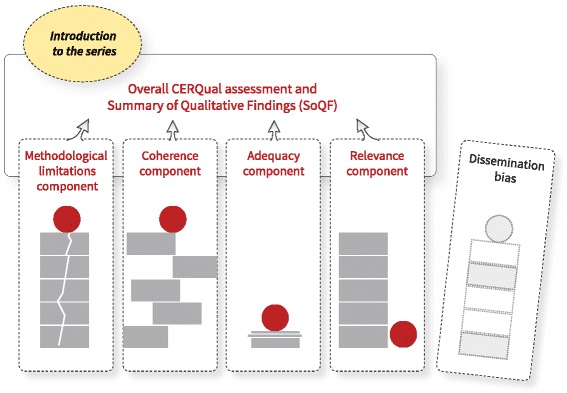
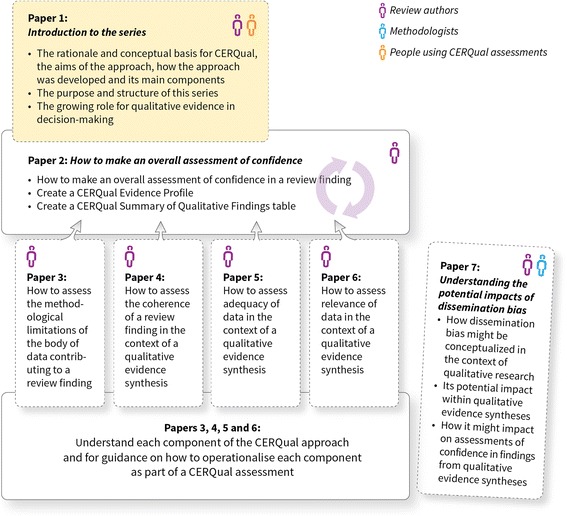
The GRADE-CERQual ('Confidence in the Evidence from Reviews of Qualitative research') approach provides guidance for assessing how much confidence to place in findings from systematic reviews of qualitative research (or qualitative evidence syntheses). The approach has been developed to support the use of findings from qualitative evidence syntheses in decision-making, including guideline development and policy formulation. Confidence in the evidence from qualitative evidence syntheses is an assessment of the extent to which a review finding is a reasonable representation of the phenomenon of interest. CERQual provides a systematic and transparent framework for assessing confidence in individual review findings, based on consideration of four components: (1) methodological limitations, (2) coherence, (3) adequacy of data, and (4) relevance. A fifth component, dissemination (or publication) bias, may also be important and is being explored. As with the GRADE (Grading of Recommendations Assessment, Development, and Evaluation) approach for effectiveness evidence, CERQual suggests summarising evidence in succinct, transparent, and informative Summary of Qualitative Findings tables. These tables are designed to communicate the review findings and the CERQual assessment of confidence in each finding. This article is the first of a seven-part series providing guidance on how to apply the CERQual approach. In this paper, we describe the rationale and conceptual basis for CERQual, the aims of the approach, how the approach was developed, and its main components. We also outline the purpose and structure of this series and discuss the growing role for qualitative evidence in decision-making. Papers 3, 4, 5, 6, and 7 in this series discuss each CERQual component, including the rationale for including the component in the approach, how the component is conceptualised, and how it should be assessed. Paper 2 discusses how to make an overall assessment of confidence in a review finding and how to create a Summary of Qualitative Findings table. The series is intended primarily for those undertaking qualitative evidence syntheses or using their findings in decision-making processes but is also relevant to guideline development agencies, primary qualitative researchers, and implementation scientists and practitioners.
Overview
The claims and statistics of this paper haven’t been checked yet.
Free: it reads the open-access text and checks the first 5 claims that cite a source we can check. Create a free account to check every claim.
Integrity signals
Registry
Cites
Statistics
Figures
Verification
Claims the paper makes
The claims and statistics of this paper haven’t been checked yet.
Free: it reads the open-access text and checks the first 5 claims that cite a source we can check. Create a free account to check every claim.
Claims other papers make about this one
Each is checked against this paper’s own text: does it say what the citing paper says it does?
The source backs part of the claim, not all of it — or backs it for a different population, condition or comparison.
In the citing paper
“The use of the CERQual tool (25) enhances the transparency and credibility of the findings.”
From Experiences and long-term repercussions of perinatal grief in women after perinatal bereavement: a meta-ethnography (2025) · cites this paper as [25]
Experimental — accuracy not yet measuredThe cited source says what the claim attributes to it.
In the citing paper
“Following the GRADE CERQual guidelines, 26 confidence in the analytical themes was assessed in terms of methodological limitations, coherence, relevance, and adequacy.”
From The lived experience of facioscapulohumeral muscular dystrophy: A systematic review and synthesis of the qualitative literature (2024) · cites this paper as [26]
The cited source says what the claim attributes to it.
In the citing paper
“As is common practice, we used ratings to help us understand the methodological limitations and strengths of primary studies and to contribute to the confidence assessment undertaken as part of the analysis (following GRADE CERQual guidelines 26 ) instead of using ratings to exclude studies. 27”
From The lived experience of facioscapulohumeral muscular dystrophy: A systematic review and synthesis of the qualitative literature (2024) · cites this paper as [26]
The cited source says what the claim attributes to it.
In the citing paper
“both analytical themes were derived from data extracted from all six included studies and confidence in these findings based on CERQual framework 26 was deemed to be moderate (see Table 4).”
From The lived experience of facioscapulohumeral muscular dystrophy: A systematic review and synthesis of the qualitative literature (2024) · cites this paper as [26]
Self-check
Percentages, sums and reported differences re-computed from the paper’s own numbers.
The self-check needs the paper’s full text.
Citations
Cites
Dermyshi, E., Wang, Y., Yan, C., Hong, W., Qiu, G., Gong, X., & Zhang, T. (2017) · Neonatology · doi:10.1159/000454668 · Cited by 24,451
GRADE: an emerging consensus on rating quality of evidence and strength of recommendations
Guyatt, G. H., Oxman, A. D., Vist, G. E., Kunz, R., Falck-Ytter, Y., Alonso-Coello, P., & Schünemann, H. J. (2008) · BMJ · doi:10.1136/bmj.39489.470347.ad · Cited by 23,305
GRADE guidelines: 1. Introduction—GRADE evidence profiles and summary of findings tables
Guyatt, G., Oxman, A. D., Akl, E. A., Kunz, R., Vist, G., Brozek, J., Norris, S., Falck-Ytter, Y., Glasziou, P., & deBeer, H. (2011) · Journal of Clinical Epidemiology · doi:10.1016/j.jclinepi.2010.04.026 · Cited by 10,681
Norderyd, O. M., Koch, G., Papias, A., Köhler, A. A., Helkimo, A. N., Brahm, C., Lindmark, U., Lindfors, N., Mattsson, A., Rolander, B., et al. (2015) · PubMed · Cited by 3,584
Methods for the synthesis of qualitative research: a critical review
Barnett-Page, E., & Thomas, J. (2009) · BMC Medical Research Methodology · doi:10.1186/1471-2288-9-59 · Cited by 2,042
Bohren, M. A., Vogel, J. P., Hunter, E. C., Lutsiv, O., Makh, S. K., Souza, J. P., Aguiar, C., Saraiva Coneglian, F., Diniz, A. L. A., Tunçalp, Ö., et al. (2015) · PLOS Medicine · doi:10.1371/journal.pmed.1001847 · Cited by 1,656 · cited 1×
“So far, experience in using CERQual has been concentrated in reviews with findings that are aggregative in nature, for example, related to health care users’ and providers’ experiences and understanding of health issues and health service delivery [6, 7, 28, 29, 31].”
BackgroundSelf-citationGuidance for Developers of Health Research Reporting Guidelines
Moher, D., Schulz, K. F., Simera, I., & Altman, D. G. (2010) · PLoS Medicine · doi:10.1371/journal.pmed.1000217 · Cited by 1,437 · cited 1×
“guidelines for reporting research processes [36].”
An Introduction to Systematic Reviews
Gough, D., Oliver, S., & Thomas, J. (2017) · doi:10.4135/9781036234942 · Cited by 1,239
Qualitative metasynthesis: Issues and techniques
Sandelowski, M., Docherty, S., & Emden, C. (1997) · Research in Nursing & Health · doi:10.1002/(sici)1098-240x(199708)20:4<365::aid-nur9>3.0.co;2-e · Cited by 1,046
What's wrong with ethnography?: methodological explorations
(1992) · Choice Reviews Online · doi:10.5860/choice.30-1008 · Cited by 920
Research works printed but not linked: 5
- Davies P: Evidence-based government: how can we make it happen? CHSRF (Canada Health Services Research Foundation) 7th annual invitational workshop - leveraging knowledge: tools and strategies for action. Montreal, Canada; 2005.
- Pope C Mays N Popay J Synthesising qualitative and quantitative health evidence: a guide to methods 2007 United Kingdom McGraw-Hill Education
- Glenton C Lewin S Norris SL World Health Organization Using evidence from qualitative research to develop WHO guidelines (Chapter 15) Handbook for Guideline Development 2016 2 Geneva WHO
- NICE Community engagement: improving health and wellbeing and reducing health inequalities. NICE Guideline 2016 London, UK National Institute for Health and Care Excellence (NICE)
- WHO Handbook for guideline development (2nd edition) 2016 Geneva World Health Organization
Cited by
Items 701–800 of 1,000
Blackburn, A., Jones, L. L., Morton, V. H., Morris, R. K., Yates, D., & Delicate, A. (2025) · Women and Birth · doi:10.1016/j.wombi.2025.101907 · Cited by 5
Basile, F. W., Sweeney, S., Singh, M. P., Bijker, E. M., Cohen, T., Menzies, N. A., Vassall, A., & Indravudh, P. P. (2024) · PLOS Global Public Health · doi:10.1371/journal.pgph.0003429 · Cited by 5
Kaplan, S., Patterson, B., Bruder, A. M., Ezzat, A. M., Bunzli, S., & Culvenor, A. G. (2026) · British Journal of Sports Medicine · doi:10.1136/bjsports-2025-109746 · Cited by 5
Engel, N., Ochodo, E., Karanja, P. W., Schmidt, B., Janssen, R., Steingart, K. R., & Oliver, S. R. (2021) · Cochrane Database of Systematic Reviews · doi:10.1002/14651858.cd014877 · Cited by 5
Villarreal‐Zegarra, D., Alarcon-Ruiz, C. A., Meléndez‐Torres, G. J., Torres-Puente, R., Ambrosio-Melgarejo, J., Romero-Cabrera, A. B., Navarro‐Flores, A., Albitres‐Flores, L., Lindo-Cavero, A., & Huarcaya-Victoria, J. (2020) · F1000Research · doi:10.12688/f1000research.27150.1 · Cited by 5
Hunter, J., Leach, M., Chang, D., Lee, M. S., Fei, Y., & Liu, J. (2025) · Integrative Medicine Research · doi:10.1016/j.imr.2025.101231 · Cited by 5
Cação-Dias, B., Rothes, I., Carmo, C., Nunes, C., & Brás, M. S. V. (2026) · Archives of Suicide Research · doi:10.1080/13811118.2026.2666405 · Cited by 5
Tian, J., Gu, W. J., Ren, X., Li, H., Teng, M., & Zheng, H. (2025) · Nurse Education in Practice · doi:10.1016/j.nepr.2025.104621 · Cited by 5
Thompson, K. A., Modini, M., & Abbott, M. J. (2024) · International Journal of Mental Health Nursing · doi:10.1111/inm.13374 · Cited by 5
Resilient and Sustainable Energy Infrastructure
Atkinson, C. F. (2022) · Social Science Protocols · doi:10.7565/ssp.v5.6608 · Cited by 5
Osborne, C., Barker, J., Cole, A., & Russell, R. (2026) · Research in Neurodiversity · doi:10.1016/j.rin.2026.100025 · Cited by 5
Bianchim, M. S., Caes, L., Forbat, L., Jordan, A. L., Noyes, J., Thomson, K., Turley, R. L., Uny, I., & France, E. F. (2024) · Health and Social Care Delivery Research · doi:10.3310/utpm7986 · Cited by 5
Self-citationTrotter, E. F., & Woodcock, K. A. (2025) · Frontiers in Psychology · doi:10.3389/fpsyg.2025.1603733 · Cited by 5
Reframing Global Health Ethics Using Ecological, Indigenous, and Regenerative Lenses
Hathaway, M. D., Poland, B. D., & Mashford‐Pringle, A. (2021) · Cambridge University Press eBooks · doi:10.1017/9781108692137.030 · Cited by 5
Is There a Need for Global Health Ethics? For and Against
Hunter, D., & Dawson, A. (2021) · Cambridge University Press eBooks · doi:10.1017/9781108692137.007 · Cited by 5
Gupta, V. A., Scott, S., Tonkinson, M., Jonsson, P. F., Goodburn, L., & Duffield, S. J. (2025) · Journal of Comparative Effectiveness Research · doi:10.57264/cer-2025-0064 · Cited by 5
Dossett, L. A., Miller, J. B., Jagsi, R., Sales, A. E., Fetters, M. D., Boothman, R. C., & Dimick, J. B. (2019) · JMIR Research Protocols · doi:10.2196/13396 · Cited by 5
Al‐Hamad, A., Yasin, Y. M., Metersky, K., Kokorelias, K. M., & Zhuang, Z. C. (2026) · Culture · doi:10.3390/culture2020014 · Cited by 5
Factors that influence recruitment to COVID-19 vaccine trials: a qualitative evidence synthesis
Biesty, L., Sheehan, S., Meskell, P., Dowling, M., Glenton, C., Shepperd, S., Chan, X. H. S., Cox, R. J., Devane, D., Booth, A., et al. (2024) · Trials · doi:10.1186/s13063-024-08670-0 · Cited by 5
Self-citationA qualitative meta-synthesis of the perinatal healthcare experiences of people with disability
Harkins, S., Hahn, A. L., Didier, M., Walsh, C., Barcelona, V., Melton, K., & George, M. (2025) · Disability and health journal · doi:10.1016/j.dhjo.2025.101828 · Cited by 5
Drahota, A., Felix, L. M., Keenan, B. E., Lachance, C. C., Laing, A. C., Mackey, D. C., & Raftery, J. P. (2020) · BMJ Open · doi:10.1136/bmjopen-2019-032315 · Cited by 5
Wæhler, T. A., & Ingebrigtsen, T. (2022) · International Journal of Circumpolar Health · doi:10.1080/22423982.2022.2049055 · Cited by 5
Johal, H. K., Birchley, G., & Huxtable, R. (2022) · BMJ Open · doi:10.1136/bmjopen-2021-057387 · Cited by 5
Kpokiri, E. E., Srinivas, M. L., Tamrat, T., Conyers, H., Shams, H. L., Kerr, H., Said, N., Tao, Y., Bissram, J., Sahin, D., et al. (2025) · PLOS Global Public Health · doi:10.1371/journal.pgph.0002032 · Cited by 5
Conway-Moore, K., McKinlay, A. R., Birch, J. M., Graham, F., Oliver, E. J., Bambra, C. L., Kelly, M. P., & Bonell, C. P. (2025) · Social Science & Medicine · doi:10.1016/j.socscimed.2025.118312 · Cited by 5
Moyo, E., Moyo, P. N., Dzinamarira, T., & Ross, A. J. (2024) · Birth · doi:10.1111/birt.12872 · Cited by 5
Oxman, M., Chesire, F., Mugisha, M., Ssenyonga, R., Nsangi, A., Oxman, A. D., Fretheim, A., Rosenbaum, S., Kaseje, M., Sewankambo, N. K., et al. (2025) · BMJ Open · doi:10.1136/bmjopen-2025-104236 · Cited by 5
Self-citationMoloi, H., Daniels, K., Cooper, S., Odendaal, W., Naledi, T., Goliath, C. D., & Leon, N. (2020) · Cochrane Database of Systematic Reviews · doi:10.1002/14651858.cd013603 · Cited by 5
Ede, J., Westgate, V., Petrinic, T., Darbyshire, J. L., & Watkinson, P. (2019) · BMJ Open · doi:10.1136/bmjopen-2018-025969 · Cited by 5
Kerin, Ú. (2019) · Evidence-Based Nursing · doi:10.1136/ebnurs-2019-103087 · Cited by 5
Nunes, A. D. M., Fernandes, A. T. D. N. S. F., Silva, A. T. D. C., Azevedo, I. G., Monteiro, K. S., & Pereira, S. A. (2025) · Canadian Journal of Respiratory Therapy · doi:10.29390/001c.140878 · Cited by 5
Governing the unseen: A systematic review of AI literacy among language teachers in higher education
Deng, Y., Çelik, F., & Duran, V. (2026) · Computers and Education: Artificial Intelligence · doi:10.1016/j.caeai.2026.100658 · Cited by 4
Guo, S., Jia, Y., Wang, R., Sun, J., & Liu, H. (2025) · BMC Psychology · doi:10.1186/s40359-025-03245-3 · Cited by 4
Parker, R., Burns, E. E., Carding, P. N., & Rowe, R. E. (2025) · Women and Birth · doi:10.1016/j.wombi.2024.101861 · Cited by 4
A pre-hospital mixed methods systematic review protocol
McManamny, T. E., Ortega, M., Munro, S., Jennings, P., & Whitley, G. A. (2023) · British Paramedic Journal · doi:10.29045/14784726.2023.9.8.2.38 · Cited by 4
Shankar, R., Bundele, A., Low, J., & Mukhopadhyay, A. (2025) · BMJ Open · doi:10.1136/bmjopen-2025-099022 · Cited by 4
Arikpo, D., Oku, A. O., Onyema, O. A., Odey, E. O., Hurwitz, H. H., Toledo, J., Dunn, K., Baller, A., Smith, H. J. J., & Meremikwu, M. M. (2025) · Journal of Public Health in Africa · doi:10.4102/jphia.v16i2.621 · Cited by 4
Gonçalves, R. L., Pagano, A. S., Reis, Z. S. N., Afagbedzi, S. K., Head, M., Brackstone, K., Marcolino, M. S., Lopes, T. C. P., Cordeiro, S. A., Nunes, J. M., et al. (2022) · Principles and Practice of Clinical Research Journal · doi:10.21801/ppcrj.2022.82.6 · Cited by 4
Leading through complexity: an integrative review and contingent innovation framework
Chatzinikolaou, D. (2026) · Strategy and Leadership · doi:10.1108/sl-01-2026-0005 · Cited by 4
Lokubal, P., Frischer, S. R., Corcuera, I., Balil, J. M., Nalwadda, C. K., Kurinczuk, J. J., & Nair, M. (2021) · BMJ Open · doi:10.1136/bmjopen-2021-049507 · Cited by 4
Maddigan, K., Kowalski, K. L., Tawiah, A. K., & Rushton, A. (2024) · PLoS ONE · doi:10.1371/journal.pone.0308921 · Cited by 4
Soundy, A. (2026) · Lifespan development and mental health. · doi:10.70322/ldmh.2026.10003 · Cited by 4
Cunningham, J. C., Briggs, A. M., Cottrell, E., Doyle, F., Dziedzic, K., Finney, A. G., Murphy, P., Paskins, Z., Sheridan, E., Swaithes, L., et al. (2024) · Seminars in Arthritis and Rheumatism · doi:10.1016/j.joca.2024.02.318 · Cited by 4
McNeilage, A. G., Nielsen, S., Murnion, B. P., & Ashton-James, C. E. (2023) · BMJ Open · doi:10.1136/bmjopen-2023-073770 · Cited by 4
Mannion, E., McCormack, D., O’Brien, T., McSpadden, H. A., Downes, C., & Turner, R. N. (2023) · Adoption Quarterly · doi:10.1080/10926755.2023.2280668 · Cited by 4
Scott, S., Nguyen, G. T., Bell, Z., Clark, L., van der Pligt, P., McKay, F. H., Zinga, J., & Heslehurst, N. (2026) · Journal of Human Nutrition and Dietetics · doi:10.1111/jhn.70244 · Cited by 4
Kimeu, S., Kihara, L., Sawe, S., Okello, H., & Ndolo, J. (2025) · African Journal of Empirical Research · doi:10.51867/ajernet.6.4.110 · Cited by 4
Petinger, C., Crowley, T., & van Wyk, B. E. (2025) · Adolescents · doi:10.3390/adolescents5020021 · Cited by 4
Aderoba, A. K., Kabra, R., & Kiarie, J. N. (2023) · Systematic Reviews · doi:10.1186/s13643-023-02356-5 · Cited by 4
Development of a community-based COVID-19 intervention in rural Ghana: a document analysis
Frimpong, S. O., Seidu, M., Hilton, S. K., Ransome, Y., Paintsil, E., Talbert‐Slagle, K., Attipoe-Dorcoo, S., & Brayne, C. (2022) · BMC Public Health · doi:10.1186/s12889-022-14338-8 · Cited by 4
Tucker, S., Heneghan, N. R., Alamrani, S. A., Rushton, A., Gardner, A. C., & Soundy, A. (2023) · BMJ Open · doi:10.1136/bmjopen-2022-063946 · Cited by 4
Scott, R. G. B., & Poat, A. (2025) · Midwifery · doi:10.1016/j.midw.2025.104307 · Cited by 4
Development Assistance for Health: Trends and Challenges
Zwi, A. B. (2021) · Cambridge University Press eBooks · doi:10.1017/9781108692137.016 · Cited by 4
Ecological Ethics, Planetary Sustainability, and Global Health
Butler, C. D. (2021) · Cambridge University Press eBooks · doi:10.1017/9781108692137.023 · Cited by 4
Gill, S. R., Bakker, I., & Wamsley, D. (2021) · Cambridge University Press eBooks · doi:10.1017/9781108692137.019 · Cited by 4
Scarth, B., Pavlova, A., Hetrick, S. E., Witt, K., Hawton, K. E., & Fortune, S. A. (2021) · Cochrane Database of Systematic Reviews · doi:10.1002/14651858.cd014940 · Cited by 4
Fortune, S. A., Pavlova, A., Hetrick, S. E., Scarth, B., Hawton, K. E., & Witt, K. (2021) · Cochrane Database of Systematic Reviews · doi:10.1002/14651858.cd014939 · Cited by 4
How adult patients with complex trauma experiences (CTE) experience yoga as treatment
Lorentzen, K. E. A., Nordanger, D. Ø., Weimand, B. M., Hammersbøen, Å. M., Telles, S., & Halvorsen, M. S. (2025) · European Journal of Trauma & Dissociation · doi:10.1016/j.ejtd.2025.100529 · Cited by 5
Qualitative Evidence Synthesis Using the Costaqda Online SoftwarePreprint
Costa, K., & Mfolo, L. N. (2024) · Research Square · doi:10.21203/rs.3.rs-3988946/v1 · Cited by 4
Shankar, R., Bundele, A., Yap, A. E., & Mukhopadhyay, A. (2025) · BMJ Open · doi:10.1136/bmjopen-2024-094876 · Cited by 4
Ciaccioni, S., Lee, Y., Capranica, L., Urban, A., May, R., Massini, S., & Guidotti, F. (2026) · Societies · doi:10.3390/soc16040118 · Cited by 4
Young People’s Sexual Wellbeing: A Qualitative Evidence Synthesis Protocol
Pérez, R. B., Lewis, R., Littlejohn, J., Willis, M., & Mitchell, K. R. (2022) · International Journal of Qualitative Methods · doi:10.1177/16094069221123674 · Cited by 4
Gallego-Gómez, C., Torres-Costoso, A. I., Martínez‐Vizcaíno, V., Quezada-Bascuñán, C. A., Bustelo, S. M., Basco‐López, J. Á., Ferri‐Morales, A., & Martínez-Martínez, H. (2026) · BMC Pregnancy and Childbirth · doi:10.1186/s12884-026-08670-9 · Cited by 4
Rao, R. N. K. Y., Dsouza, J. M., & Mathew, J. L. (2021) · Systematic Reviews · doi:10.1186/s13643-021-01806-2 · Cited by 4
Parikh, R. R., Shetty, N. U., Singhal, C., Patel, P., Manghani, P., Pillai, A. A., Choconta-Piraquive, L. A., & Butler, M. E. (2026) · Clinics and Practice · doi:10.3390/clinpract16010014 · Cited by 4
Schmidt, B., Cooper, S., Klerings, I., Head, K., Sell, K., Houghton, C., Jama, N. A., Pfadenhauer, L. M., Mianda, S., & Toomey, E. C. (2022) · Cochrane Database of Systematic Reviews · doi:10.1002/14651858.cd015346 · Cited by 4
Achieving equity for International Medical Graduates: a systematic review
Saxena, S., Tisdell, E. J., Farace, E., Godfrey, T., Aumiller, B. B., Dell, E. Y., Razzak, O. P., Kumar, B., & Sznajder, K. K. (2025) · Frontiers in Medicine · doi:10.3389/fmed.2025.1601492 · Cited by 4
O’Hare, F., Thrimawithana, S., Clague, A., Robertson, E. G., Foran, D., Ondracek, C., Paynter, C., Saunders, T., & Ayton, L. N. (2025) · Campbell Systematic Reviews · doi:10.1002/cl2.70065 · Cited by 4
Reid, N., Hewlett, N., Hayes, N., Munn, Z., Till, H., Hutchinson, D. M., Stewart, J., Naglazas, M., Crawford, A., Mutch, R. C., et al. (2026) · The Medical Journal of Australia · doi:10.5694/mja2.70159 · Cited by 4
Interventions to Address and Prevent Violence Toward Health Care Workers in the Emergency Department
Banerjee, S., & MacDougall, D. (2021) · Canadian Journal of Health Technologies · doi:10.51731/cjht.2021.88 · Cited by 4
Srikesavan, C. S., Dean, B. J. F., Toyé, F., Bolt, A., & Thurley, N. (2023) · Hand Therapy · doi:10.1177/17589983231210762 · Cited by 4
O’Toole, C., Lyons, R., Ó’Doibhlín, D., O’Farrell, F., & Houghton, C. (2020) · HRB Open Research · doi:10.12688/hrbopenres.12974.2 · Cited by 4
Davis, C., Noblet, T., Breach, J., Mistry, J., Maddigan, K., Kowalski, K. L., & Rushton, A. (2026) · PLoS ONE · doi:10.1371/journal.pone.0342674 · Cited by 4
Mammen, J. R., Goldman, J. G., Tyo, M. B., & Xiao, Y. (2025) · Alzheimer s & Dementia · doi:10.1002/alz.70217 · Cited by 4
The Value of Synthesizing Evidence to Inform Cancer Nursing
Noyes, J. (2020) · Cancer Nursing · doi:10.1097/ncc.0000000000000824 · Cited by 4
Self-citationThe (Co)Benefits Portal—an evidence-based and climate policy-relevant tool for decision-making
van Bavel, B., Berrang‐Ford, L., Willoughby, R. E., Harley-Nyang, D., Sands, E., O’Donnell, C., James, T. D., Forster, P. M. D. F., Arnold, S. R., Reddington, C. L. S., et al. (2025) · Environmental Research Letters · doi:10.1088/1748-9326/adf981 · Cited by 4
Schmidt, B., Späth, C., van Pinxteren, M., Chi, P. C., Wiysonge, C. S., Oliver, J., & Colvin, C. J. (2022) · Cochrane Database of Systematic Reviews · doi:10.1002/14651858.mr000066 · Cited by 4
Self-citationChildren’s views of obesity, body size and weight: systematic review of UK qualitative evidence
Lorenc, T., Burchett, H., Mendizabal‐Espinosa, R. M., Stansfield, C., Sutcliffe, K., & Sowden, A. J. (2026) · Journal of Epidemiology & Community Health · doi:10.1136/jech-2025-225045 · Cited by 4
Toews, I., Nyirenda, J. L. Z., Stadelmaier, J., Schwarzer, G., Noyes, J., Booth, A., Lewin, S. A., & Meerpohl, J. J. (2021) · Research Synthesis Methods · doi:10.1002/jrsm.1534 · Cited by 4
Self-citationFudge, N. (2019) · Age and Ageing · doi:10.1093/ageing/afy168 · Cited by 4
Guia de adaptação e implementação de diretrizes baseadas em evidências. Segunda edição
da Saúde, O. P.-A. (2023) · doi:10.37774/9789275727539 · Cited by 4
Virtual clinical simulation as a pedagogical strategy in healthcare learning: Evidence and gap map
Lino, M. M., Engler, J. C., Guesser, J. C., Castro, L. S. E. P. W., Flôr, J. D. S., Amadigi, F. R., Oriá, M. O. B., Silva, A., & Díaz, D. A. (2026) · Nurse Education in Practice · doi:10.1016/j.nepr.2026.104713 · Cited by 4
Disclosing mental health in medical education: A global qualitative meta‐synthesis
Aljuwaiser, S., & Roberts, G. T. (2026) · Medical Education · doi:10.1111/medu.70240 · Cited by 4
Recommending the Addiction Severity Index for Swedish Social Services: Where is the Evidence?
Björk, A. (2026) · Nordic Studies on Alcohol and Drugs · doi:10.1177/14550725261498138 · Cited by 4
Shamsi, A., & Khalili, R. (2026) · BMC Psychology · doi:10.1186/s40359-026-04726-9 · Cited by 4
Tan, S., & Hope, J. (2025) · International Journal of Mental Health Nursing · doi:10.1111/inm.13503 · Cited by 4
Ford, P., Crowther, S., & Waller, N. (2022) · Women and Birth · doi:10.1016/j.wombi.2022.06.014 · Cited by 4
Uso da evidência qualitativa para informar decisões no Brasil e na região da América LatinaI
Barreto, J. O. M., & Lewin, S. A. (2020) · BIS Boletim do Instituto de Saúde · doi:10.52753/bis.2019.v20.34469 · Cited by 4
Self-citationMass test and treat as an accelerator strategy for malaria elimination: a systematic review
Bhamani, B., Mithi, V., Whitfield, K., Tusell, M., Coma-Cros, E. M., Serra, E., Rabinovich, R. N., & Allen, K. C. (2022) · Zenodo (CERN European Organization for Nuclear Research) · doi:10.5281/zenodo.6498424 · Cited by 4
Rosati, A., Criscione, M., Lilli, L., Petrillo, M., Capobianco, G., Patarnello, S., & Fagotti, A. (2026) · International Journal of Gynecological Cancer · doi:10.1016/j.ijgc.2026.104558 · Cited by 3
Terrens, A. F., Taylor, N. F., Lewis, A. K., Harding, K. E., & Morris, M. E. (2025) · Movement Disorders Clinical Practice · doi:10.1002/mdc3.70453 · Cited by 3
Nagraj, S. K., Hafver, T. L., Reinthaler, V., de Velde, S. V., Zaror, C., Shen, Y., Banda, S., Mpando, T., Kunje, G., Lakudzala, S., et al. (2026) · Journal of Clinical Epidemiology · doi:10.1016/j.jclinepi.2026.112313 · Cited by 3
Nurses’ experiences regarding role boundaries in collaborative AI-Assisted nursing: A meta-synthesis
Zhang, Z., Hou, J., Xu, C., Li, H., & Wan, H. (2026) · Social Science & Medicine · doi:10.1016/j.socscimed.2026.119385 · Cited by 3
Franco, J. V. A., Hindemit, J., Guo, Y., Bongaerts, B. W. C., Metzendorf, M., Peelen, R., Køster‐Rasmussen, R., Meyer, L. B., Noyes, J., & Möhler, R. (2025) · Cochrane Database of Systematic Reviews · doi:10.1002/14651858.cd016107 · Cited by 3
Self-citationPatient experiences of co-designed rehabilitation interventions: protocol for a rapid review
McKercher, J. P., Slade, S. C., Jazayeri, J. A., Hodge, A., Knight, M., Green, J., Woods, J., & Morris, M. E. (2022) · BMJ Open · doi:10.1136/bmjopen-2021-056927 · Cited by 3
Glenton, C., Paulsen, E., Agarwal, S., Gopinathan, U., Johansen, M., Kyaddondo, D., Munabi-Babigumira, S. K., Nabukenya, J., Nakityo, I., Namitala, J., et al. (2023) · Cochrane Database of Systematic Reviews · doi:10.1002/14651858.cd015705 · Cited by 3
Self-citationRogerson, M., Blank, L., Clowes, M., Everson-Hock, E., & Goyder, E. (2024) · BMJ Public Health · doi:10.1136/bmjph-2024-000953 · Cited by 3
Effectiveness of interventions on conscience: Findings of a systematic review
Lamb, C., Pouliopoulou, D. V., Kirkwood, K. W., Groenenboom, K., Kennedy, M., & Pituskin, E. (2025) · Nursing Ethics · doi:10.1177/09697330251333386 · Cited by 3
Marques, R. T., Rúgolo, J. R. M., Thabane, L., Vantone, M., Püschel, V. A. D. A., Weber, S. A. T., & Cardoso, M. M. D. A. (2023) · International Journal of Qualitative Methods · doi:10.1177/16094069231218659 · Cited by 3
The impact of pressure injury on quality of life in adults: protocol for a systematic review
(PI), A. P. I., ulcer, A. R. T. A. P., sore, P., ulcer, B. S. O. D., tissue, I. D. A. ‘. D. T. T. S. A. U., shear, A. A. R. O. P. O. P. I. C. W., problem, A. I. A. C. H., adults, I., sacrum, P. M. C. O. A. T. B. P. O. T. H. A., locations, O., et al. (2023) · Journal of Wound Management Official journal of the European Wound Management Association · doi:10.35279/jowm2023.24.01.03 · Cited by 3
Metadata
- Authors
- Lewin, S., Booth, A., Glenton, C., Munthe-Kaas, H., Rashidian, A., Wainwright, M., Bohren, M. A., Tunçalp, Ö., Colvin, C. J., Garside, R., Carlsen, B., Langlois, E. V., & Noyes, J.
- Affiliations
- South African Medical Research Council (ZA)
- University of Sheffield (GB)
- Norwegian Institute of Public Health (NO)
- World Health Organization Regional Office for the Eastern Mediterranean (EG)
- University of Cape Town (ZA)
- World Health Organization (CH)
- University of Exeter (GB)
- Uni Research (Norway) (NO)
- Bangor University (GB)
- Corresponding author
- Lewin, Simon
- ORCID
- Venue
- Implementation Science
- Published
- 2018-01
- Volume
- 13
- Issue
- S1
- Pages
- 2-2
- ISSN
- 1748-5908 (ISSN-L)
- PMC
- PMC5791040
- OpenAlex
- W2784472800
- Cited by
- 1,231
- References
- 58
- Citations by year
- 2026: 179 · 2025: 180 · 2024: 179 · 2023: 140 · 2022: 168 · 2021: 188 · 2020: 98 · 2019: 68 · 2018: 24
- Type
- journal article
- Language
- en
- Open access
- gold
- doi.org
- Licence
- cc-by
- Locations
- Implementation Science (publishedVersion, cc-by)
- PubMed Central (publishedVersion, cc-by)
- PubMed (publishedVersion)
- White Rose Research Online (University of Leeds, The University of Sheffield, University of York) (acceptedVersion)
- Durham Research Online (Durham University) (acceptedVersion, other-oa)
- Durham Research Online (Durham University) (submittedVersion, cc-by)
- Minerva Access (University of Melbourne) (submittedVersion, cc-by)
- DOAJ (DOAJ: Directory of Open Access Journals) (submittedVersion)
- NORA - Norwegian Open Research Archives (submittedVersion, other-oa)
- Figshare (submittedVersion, cc-by)
- Open University of Cape Town (University of Cape Town) (submittedVersion)
- Open Research Exeter (University of Exeter) (submittedVersion, cc-by)
- Bangor University Research Portal (Bangor University) (submittedVersion, other-oa)
- Funders
- World Health Organization
- South African Medical Research Council
- Norges Forskningsråd
- Alliance for Health Policy and Systems Research
- Medical Research Council
- Topics
- Social Sciences › Decision Sciences › Statistics, Probability and Uncertainty › Meta-analysis and systematic reviews
- Social Sciences › Education › Qualitative Research Methods and Applications
- Social Sciences › Sociology and Political Science › Delphi Technique in Research
- Keywords
- GRADE-CERQual, qualitative evidence synthesis, methodological limitations, coherence, relevance, publication bias, evidence-informed decision-making, guideline development
- MeSH terms
- Data Accuracy, Systematic Reviews as Topic, Decision Making, Humans, Publishing, Confidence Intervals, Evidence-Based Medicine, Biomedical Research, Qualitative Research
About these checks
Registry, retraction, Cites and statistics results are computed, not judged, with one exception: a printed reference that no index lists is read once by a model before it counts as a citation error. Claims are extracted by a model and kept only when their quote appears verbatim in the text; each cited source is then checked, with a model’s help, for whether it says what the claim relies on. Those verdicts can be wrong — read the claim’s quote and the cited source before relying on one.
Statistics and arithmetic are recomputed, not judged.
Confidence bands are shown only for fields calibrated on our annotated test set. None is calibrated yet, so no band is shown.
What counts as a claim ›How we measure confidence ›How we check this ›
Are you an author, or do you see a problem with this page? Request a review
Data sources
Bibliographic data: Semantic Scholar, OpenAlex, Crossref.
Contains information from the Semantic Scholar Academic Graph Datasets, made available under the ODC Attribution License (ODC-BY 1.0).
Semantic Scholar’s data is described in: Kinney, R., et al. (2023). The Semantic Scholar Open Data Platform. arXiv:2301.10140.
