

Applying GRADE-CERQual to qualitative evidence synthesis findings: introduction to the series
Open accessThe DOI matches its Crossref record; 59 of the 59 references it cites were found in a registry or an index.
Abstract
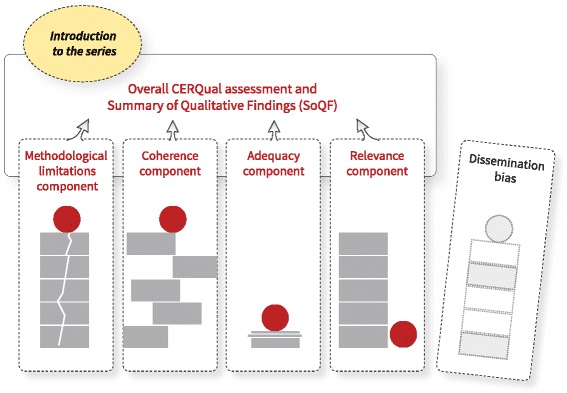
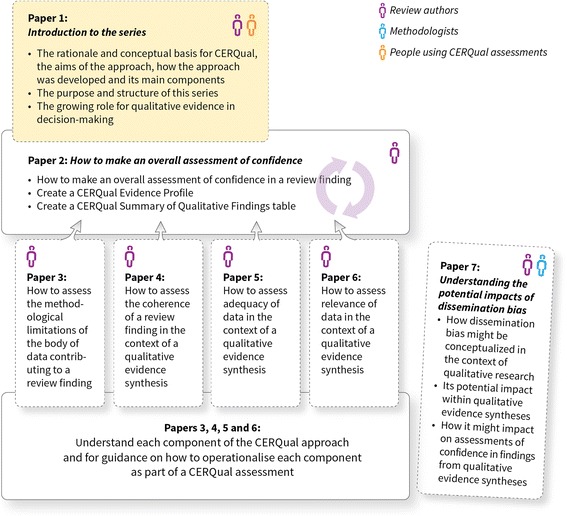
The GRADE-CERQual ('Confidence in the Evidence from Reviews of Qualitative research') approach provides guidance for assessing how much confidence to place in findings from systematic reviews of qualitative research (or qualitative evidence syntheses). The approach has been developed to support the use of findings from qualitative evidence syntheses in decision-making, including guideline development and policy formulation. Confidence in the evidence from qualitative evidence syntheses is an assessment of the extent to which a review finding is a reasonable representation of the phenomenon of interest. CERQual provides a systematic and transparent framework for assessing confidence in individual review findings, based on consideration of four components: (1) methodological limitations, (2) coherence, (3) adequacy of data, and (4) relevance. A fifth component, dissemination (or publication) bias, may also be important and is being explored. As with the GRADE (Grading of Recommendations Assessment, Development, and Evaluation) approach for effectiveness evidence, CERQual suggests summarising evidence in succinct, transparent, and informative Summary of Qualitative Findings tables. These tables are designed to communicate the review findings and the CERQual assessment of confidence in each finding. This article is the first of a seven-part series providing guidance on how to apply the CERQual approach. In this paper, we describe the rationale and conceptual basis for CERQual, the aims of the approach, how the approach was developed, and its main components. We also outline the purpose and structure of this series and discuss the growing role for qualitative evidence in decision-making. Papers 3, 4, 5, 6, and 7 in this series discuss each CERQual component, including the rationale for including the component in the approach, how the component is conceptualised, and how it should be assessed. Paper 2 discusses how to make an overall assessment of confidence in a review finding and how to create a Summary of Qualitative Findings table. The series is intended primarily for those undertaking qualitative evidence syntheses or using their findings in decision-making processes but is also relevant to guideline development agencies, primary qualitative researchers, and implementation scientists and practitioners.
Overview
The claims and statistics of this paper haven’t been checked yet.
Free: it reads the open-access text and checks the first 5 claims that cite a source we can check. Create a free account to check every claim.
Integrity signals
Registry
Cites
Statistics
Figures
Verification
Claims the paper makes
The claims and statistics of this paper haven’t been checked yet.
Free: it reads the open-access text and checks the first 5 claims that cite a source we can check. Create a free account to check every claim.
Claims other papers make about this one
Each is checked against this paper’s own text: does it say what the citing paper says it does?
The source backs part of the claim, not all of it — or backs it for a different population, condition or comparison.
In the citing paper
“The use of the CERQual tool (25) enhances the transparency and credibility of the findings.”
From Experiences and long-term repercussions of perinatal grief in women after perinatal bereavement: a meta-ethnography (2025) · cites this paper as [25]
Experimental — accuracy not yet measuredThe cited source says what the claim attributes to it.
In the citing paper
“Following the GRADE CERQual guidelines, 26 confidence in the analytical themes was assessed in terms of methodological limitations, coherence, relevance, and adequacy.”
From The lived experience of facioscapulohumeral muscular dystrophy: A systematic review and synthesis of the qualitative literature (2024) · cites this paper as [26]
The cited source says what the claim attributes to it.
In the citing paper
“As is common practice, we used ratings to help us understand the methodological limitations and strengths of primary studies and to contribute to the confidence assessment undertaken as part of the analysis (following GRADE CERQual guidelines 26 ) instead of using ratings to exclude studies. 27”
From The lived experience of facioscapulohumeral muscular dystrophy: A systematic review and synthesis of the qualitative literature (2024) · cites this paper as [26]
The cited source says what the claim attributes to it.
In the citing paper
“both analytical themes were derived from data extracted from all six included studies and confidence in these findings based on CERQual framework 26 was deemed to be moderate (see Table 4).”
From The lived experience of facioscapulohumeral muscular dystrophy: A systematic review and synthesis of the qualitative literature (2024) · cites this paper as [26]
Self-check
Percentages, sums and reported differences re-computed from the paper’s own numbers.
The self-check needs the paper’s full text.
Citations
Cites
Dermyshi, E., Wang, Y., Yan, C., Hong, W., Qiu, G., Gong, X., & Zhang, T. (2017) · Neonatology · doi:10.1159/000454668 · Cited by 24,451
GRADE: an emerging consensus on rating quality of evidence and strength of recommendations
Guyatt, G. H., Oxman, A. D., Vist, G. E., Kunz, R., Falck-Ytter, Y., Alonso-Coello, P., & Schünemann, H. J. (2008) · BMJ · doi:10.1136/bmj.39489.470347.ad · Cited by 23,305
GRADE guidelines: 1. Introduction—GRADE evidence profiles and summary of findings tables
Guyatt, G., Oxman, A. D., Akl, E. A., Kunz, R., Vist, G., Brozek, J., Norris, S., Falck-Ytter, Y., Glasziou, P., & deBeer, H. (2011) · Journal of Clinical Epidemiology · doi:10.1016/j.jclinepi.2010.04.026 · Cited by 10,681
Norderyd, O. M., Koch, G., Papias, A., Köhler, A. A., Helkimo, A. N., Brahm, C., Lindmark, U., Lindfors, N., Mattsson, A., Rolander, B., et al. (2015) · PubMed · Cited by 3,584
Methods for the synthesis of qualitative research: a critical review
Barnett-Page, E., & Thomas, J. (2009) · BMC Medical Research Methodology · doi:10.1186/1471-2288-9-59 · Cited by 2,042
Bohren, M. A., Vogel, J. P., Hunter, E. C., Lutsiv, O., Makh, S. K., Souza, J. P., Aguiar, C., Saraiva Coneglian, F., Diniz, A. L. A., Tunçalp, Ö., et al. (2015) · PLOS Medicine · doi:10.1371/journal.pmed.1001847 · Cited by 1,656 · cited 1×
“So far, experience in using CERQual has been concentrated in reviews with findings that are aggregative in nature, for example, related to health care users’ and providers’ experiences and understanding of health issues and health service delivery [6, 7, 28, 29, 31].”
BackgroundSelf-citationGuidance for Developers of Health Research Reporting Guidelines
Moher, D., Schulz, K. F., Simera, I., & Altman, D. G. (2010) · PLoS Medicine · doi:10.1371/journal.pmed.1000217 · Cited by 1,437 · cited 1×
“guidelines for reporting research processes [36].”
An Introduction to Systematic Reviews
Gough, D., Oliver, S., & Thomas, J. (2017) · doi:10.4135/9781036234942 · Cited by 1,239
Qualitative metasynthesis: Issues and techniques
Sandelowski, M., Docherty, S., & Emden, C. (1997) · Research in Nursing & Health · doi:10.1002/(sici)1098-240x(199708)20:4<365::aid-nur9>3.0.co;2-e · Cited by 1,046
What's wrong with ethnography?: methodological explorations
(1992) · Choice Reviews Online · doi:10.5860/choice.30-1008 · Cited by 920
Lewin, S., Glenton, C., Munthe-Kaas, H., Carlsen, B., Colvin, C. J., Gülmezoglu, M., Noyes, J., Booth, A., Garside, R., & Rashidian, A. (2015) · PLOS Medicine · doi:10.1371/journal.pmed.1001895 · Cited by 866
Self-citationBohren, M. A., Hunter, E. C., Munthe-Kaas, H. M., Souza, J. P., Vogel, J. P., & Gülmezoglu, A. M. (2014) · Reproductive Health · doi:10.1186/1742-4755-11-71 · Cited by 823 · cited 1×
“So far, experience in using CERQual has been concentrated in reviews with findings that are aggregative in nature, for example, related to health care users’ and providers’ experiences and understanding of health issues and health service delivery [6, 7, 28, 29, 31].”
BackgroundSelf-citationQualitative Metasynthesis: Reflections on Methodological Orientation and Ideological Agenda
Thorne, S., Jensen, L., Kearney, M. H., Noblit, G., & Sandelowski, M. (2004) · Qualitative Health Research · doi:10.1177/1049732304269888 · Cited by 749
Accountability for reasonableness
Daniels, N. (2000) · BMJ · doi:10.1136/bmj.321.7272.1300 · Cited by 729
Lewin, S., Bohren, M., Rashidian, A., Munthe-Kaas, H., Glenton, C., Colvin, C. J., Garside, R., Noyes, J., Booth, A., Tunçalp, Ö., et al. (2018) · Implementation Science · doi:10.1186/s13012-017-0689-2 · Cited by 562
Self-citationIntroduction to systematic reviews: (657462011-001)
O'Connor, E., Whitlock, E., & Spring, B. (2011) · PsycEXTRA Dataset · doi:10.1037/e657462011-001 · Cited by 463
Glenton, C., Colvin, C., Carlsen, B., Swartz, A., Lewin, S., Noyes, J., & Rashidian, A. (2013) · Cochrane Database of Systematic Reviews · doi:10.1002/14651858.cd010414.pub2 · Cited by 454 · cited 1×
“So far, experience in using CERQual has been concentrated in reviews with findings that are aggregative in nature, for example, related to health care users’ and providers’ experiences and understanding of health issues and health service delivery [6, 7, 28, 29, 31].”
BackgroundSelf-citationOxman, A. D., Lavis, J. N., Lewin, S., & Fretheim, A. (2009) · Health Research Policy and Systems · doi:10.1186/1478-4505-7-s1-s1 · Cited by 398
Self-citationAmes, H. M., Glenton, C., & Lewin, S. (2017) · Cochrane Database of Systematic Reviews · doi:10.1002/14651858.cd011787.pub2 · Cited by 348
Self-citationMunthe-Kaas, H., Bohren, M. A., Glenton, C., Lewin, S., Noyes, J., Tunçalp, Ö., Booth, A., Garside, R., Colvin, C. J., Wainwright, M., et al. (2018) · Implementation Science · doi:10.1186/s13012-017-0690-9 · Cited by 302
Self-citationGlenton, C., Carlsen, B., Lewin, S., Munthe-Kaas, H., Colvin, C. J., Tunçalp, Ö., Bohren, M. A., Noyes, J., Booth, A., Garside, R., et al. (2018) · Implementation Science · doi:10.1186/s13012-017-0692-7 · Cited by 279
Self-citationApplying GRADE-CERQual to qualitative evidence synthesis findings—paper 4: how to assess coherence
Colvin, C. J., Garside, R., Wainwright, M., Munthe-Kaas, H., Glenton, C., Bohren, M. A., Carlsen, B., Tunçalp, Ö., Noyes, J., Booth, A., et al. (2018) · Implementation Science · doi:10.1186/s13012-017-0691-8 · Cited by 276
Self-citationNoyes, J., Booth, A., Lewin, S., Carlsen, B., Glenton, C., Colvin, C. J., Garside, R., Bohren, M. A., Rashidian, A., Wainwright, M., et al. (2018) · Implementation Science · doi:10.1186/s13012-017-0693-6 · Cited by 266
Self-citationThe use of citizens' juries in health policy decision-making: A systematic review
Street, J., Duszynski, K., Krawczyk, S., & Braunack-Mayer, A. (2014) · Social Science & Medicine · doi:10.1016/j.socscimed.2014.03.005 · Cited by 245
Systematic Synthesis of Qualitative Research
Saini, M., & Shlonsky, A. (2012) · Oxford University Press eBooks · doi:10.1093/acprof:oso/9780195387216.001.0001 · Cited by 243
Downe, S., Finlayson, K., Tunçalp, Ӧ., & Metin Gülmezoglu, A. (2016) · BJOG: An International Journal of Obstetrics & Gynaecology · doi:10.1111/1471-0528.13819 · Cited by 240
Self-citationAccountability for reasonableness: an update
Daniels, N., & Sabin, J. E. (2008) · BMJ · doi:10.1136/bmj.a1850 · Cited by 238
Munabi-Babigumira, S., Glenton, C., Lewin, S., Fretheim, A., & Nabudere, H. (2017) · Cochrane Database of Systematic Reviews · doi:10.1002/14651858.cd011558.pub2 · Cited by 214
Self-citationWhat's Wrong with Ethnography? Methodological Explorations
Marks, J. T. W., & Hammersley, M. (1994) · Canadian Journal of Sociology / Cahiers canadiens de sociologie · doi:10.2307/3341159 · Cited by 212
DECIDE Consortium, Treweek, S., Oxman, A. D., Alderson, P., Bossuyt, P. M., Brandt, L., Brożek, J., Davoli, M., Flottorp, S., Harbour, R., et al. (2013) · Implementation Science · doi:10.1186/1748-5908-8-6 · Cited by 201
McCoy, D. C., Hall, J. A., & Ridge, M. (2012) · Health Policy and Planning · doi:10.1093/heapol/czr077 · Cited by 195
Lavis, J. N., Boyko, J. A., Oxman, A. D., Lewin, S., & Fretheim, A. (2009) · Health Research Policy and Systems · doi:10.1186/1478-4505-7-s1-s14 · Cited by 194
Self-citationRashidian, A., Eccles, M. P., & Russell, I. (2008) · Health Policy · doi:10.1016/j.healthpol.2007.07.011 · Cited by 184
Self-citationKarimi-Shahanjarini, A., Shakibazadeh, E., Rashidian, A., Hajimiri, K., Glenton, C., Noyes, J., Lewin, S., Laurant, M., & Colvin, C. J. (2019) · Cochrane Database of Systematic Reviews · doi:10.1002/14651858.cd010412.pub2 · Cited by 177
Self-citationMolyneux, S., Atela, M., Angwenyi, V., & Goodman, C. (2012) · Health Policy and Planning · doi:10.1093/heapol/czr083 · Cited by 174
Odendaal, W. A., Goudge, J., Griffiths, F., Tomlinson, M., Leon, N., & Daniels, K. (2015) · Cochrane Database of Systematic Reviews · doi:10.1002/14651858.cd011942 · Cited by 173
Hsu, J., Brożek, J. L., Terracciano, L., Kreis, J., Compalati, E., Stein, A. T., Fiocchi, A., & Schünemann, H. J. (2011) · Implementation Science · doi:10.1186/1748-5908-6-62 · Cited by 141
Colvin, C. J., de Heer, J., Winterton, L., Mellenkamp, M., Glenton, C., Noyes, J., Lewin, S., & Rashidian, A. (2013) · Midwifery · doi:10.1016/j.midw.2013.05.001 · Cited by 135
Self-citationMetasynthetic Madness: What Kind of Monster Have We Created?
Thorne, S. (2017) · Qualitative Health Research · doi:10.1177/1049732316679370 · Cited by 132
Rashidian, A., Shakibazadeh, E., Karimi- Shahanjarini, A., Glenton, C., Noyes, J., Lewin, S., Colvin, C. J., & Laurant, M. (2013) · Cochrane Database of Systematic Reviews · doi:10.1002/14651858.cd010412 · Cited by 126
Self-citationPublic Deliberation in Health Policy and Bioethics: Mapping an emerging, interdisciplinary field
Abelson, J., Blacksher, E. A., Li, K. K., Boesveld, S. E., & Goold, S. D. (2013) · Journal of Deliberative Democracy · doi:10.16997/jdd.157 · Cited by 121
Leach-Kemon, K., Chou, D. P., Schneider, M. T., Tardif, A., Dieleman, J. L., Brooks, B. P. C., Hanlon, M., & Murray, C. J. L. (2012) · Health Affairs · doi:10.1377/hlthaff.2011.1154 · Cited by 110
Citizens at the centreDeliberative participation in healthcare decisions
Davies, C., Wetherell, M., & Barnett, E. (2006) · Policy Press eBooks · doi:10.1332/policypress/9781861348029.001.0001 · Cited by 107
Citizens at the Centre: Deliberative Participation in Healthcare Decisions
Davies, C., Wetherell, M. S., & Barnett, E. (2006) · Policy Press eBooks · doi:10.2307/j.ctt9qgnvc · Cited by 105
Chapter 20: Qualitative research and Cochrane reviews
Noyes, J., Popay, J., Pearson, A., Hannes, K., & Booth, A. (2008) · Cited by 96
Self-citationOxman, A. D., Lewin, S., Lavis, J. N., & Fretheim, A. (2009) · Health Research Policy and Systems · doi:10.1186/1478-4505-7-s1-s15 · Cited by 82
Self-citationGRADE-CERQual Coordinating Team, Booth, A., Lewin, S., Glenton, C., Munthe-Kaas, H., Toews, I., Noyes, J., Rashidian, A., Berg, R. C., Nyakang’o, B., et al. (2018) · Implementation Science · doi:10.1186/s13012-017-0694-5 · Cited by 82
Self-citationAnsari, S., & Rashidian, A. (2012) · PLoS ONE · doi:10.1371/journal.pone.0049864 · Cited by 73
Self-citationAslam, R. W., Hendry, M., Booth, A., Carter, B., Charles, J. M., Craine, N., Edwards, R. T., Noyes, J., Ntambwe, L. I., Pasterfield, D., et al. (2017) · BMC Medicine · doi:10.1186/s12916-017-0904-7 · Cited by 73
Self-citationExpectant fathers: Influence of perinatal education on stress, coping, and spousal relations
Diemer, G. A. (1997) · Research in Nursing & Health · doi:10.1002/(sici)1098-240x(199708)20:4<281::aid-nur2>3.0.co;2-c · Cited by 67
Toews, I., Glenton, C., Lewin, S. A., Berg, R. C., Noyes, J., Booth, A., Marušić, A., Malički, M., Munthe‐Kaas, H. M., & Meerpohl, J. J. (2016) · PLoS ONE · doi:10.1371/journal.pone.0159290 · Cited by 62
Self-citationLewin, S., Bosch-Capblanch, X., Oliver, S., Akl, E. A., Vist, G. E., Lavis, J. N., Ghersi, D., Røttingen, J.-A., Steinmann, P., Gulmezoglu, M., et al. (2012) · PLoS Medicine · doi:10.1371/journal.pmed.1001187 · Cited by 60
Self-citationToews, I., Booth, A., Berg, R. C., Lewin, S. A., Glenton, C., Munthe‐Kaas, H. M., Noyes, J., Schroter, S., & Meerpohl, J. J. (2017) · Journal of Clinical Epidemiology · doi:10.1016/j.jclinepi.2017.04.010 · Cited by 60
Self-citationAnalytical Dimensions in the Comparison of Social Organizations
Barth, F. (1972) · American Anthropologist · doi:10.1525/aa.1972.74.1-2.02a01720 · Cited by 46
Nabyonga‐Orem, J., & Mijumbi, R. (2015) · International Journal of Health Policy and Management · doi:10.15171/ijhpm.2015.52 · Cited by 24
Whitaker, R., Hendry, M., Booth, A., Carter, B., Charles, J., Craine, N., Edwards, R. T., Lyons, M., Noyes, J., Pasterfield, D., et al. (2014) · BMJ Open · doi:10.1136/bmjopen-2013-004733 · Cited by 21
Self-citationEffekt av og erfaringer med kontinuitetsfremmende tiltak i barnevernsinstitusjoner
Munthe‐Kaas, H. M., Hammerstrøm, K. T., Kurtze, N., & Nordlund, K. R. (2013) · NORA - Norwegian Open Research Archives · Cited by 20
Self-citationO’Brien, T. D., Noyes, J., Spencer, L. H., Kubis, H., Hastings, R. P., Edwards, R. T., Bray, N., & Whitaker, R. (2014) · Journal of Advanced Nursing · doi:10.1111/jan.12428 · Cited by 15
Self-citationInterventions for preventing unintended repeat pregnancies among adolescents
Aslam, R. W., Hendry, M., Carter, B., Noyes, J., Malone, J. R., Booth, A., Pasterfield, D., Charles, J. M., Craine, N., Edwards, R. T., et al. (2015) · Cochrane Database of Systematic Reviews · doi:10.1002/14651858.cd011477 · Cited by 14
Self-citation
Research works printed but not linked: 5
- Davies P: Evidence-based government: how can we make it happen? CHSRF (Canada Health Services Research Foundation) 7th annual invitational workshop - leveraging knowledge: tools and strategies for action. Montreal, Canada; 2005.
- Pope C Mays N Popay J Synthesising qualitative and quantitative health evidence: a guide to methods 2007 United Kingdom McGraw-Hill Education
- Glenton C Lewin S Norris SL World Health Organization Using evidence from qualitative research to develop WHO guidelines (Chapter 15) Handbook for Guideline Development 2016 2 Geneva WHO
- NICE Community engagement: improving health and wellbeing and reducing health inequalities. NICE Guideline 2016 London, UK National Institute for Health and Care Excellence (NICE)
- WHO Handbook for guideline development (2nd edition) 2016 Geneva World Health Organization
Cited by
Houghton, C., Meskell, P., Delaney, H., Smalle, M., Glenton, C., Booth, A., Chan, X. H. S., Devane, D., & Biesty, L. M. (2020) · Cochrane Database of Systematic Reviews · doi:10.1002/14651858.cd013582 · Cited by 732
Self-citationBarriers and facilitators to utilizing digital health technologies by healthcare professionals
Borges do Nascimento, I. J., Abdulazeem, H., Vasanthan, L. T., Martinez, E. Z., Zucoloto, M. L., Østengaard, L., Azzopardi-Muscat, N., Zapata, T., & Novillo-Ortiz, D. (2023) · npj Digital Medicine · doi:10.1038/s41746-023-00899-4 · Cited by 673
A systematic global stocktake of evidence on human adaptation to climate change
Berrang-Ford, L., Siders, A. R., Lesnikowski, A., Fischer, A. P., Callaghan, M. W., Haddaway, N. R., Mach, K. J., Araos, M., Shah, M. A. R., Wannewitz, M., et al. (2021) · Nature Climate Change · doi:10.1038/s41558-021-01170-y · Cited by 655
Pollock, A., Campbell, P., Cheyne, J., Cowie, J., Davis, B., McCallum, J., McGill, K., Elders, A., Hagen, S., McClurg, D., et al. (2020) · Cochrane Database of Systematic Reviews · doi:10.1002/14651858.cd013779 · Cited by 631
Lewin, S., Bohren, M., Rashidian, A., Munthe-Kaas, H., Glenton, C., Colvin, C. J., Garside, R., Noyes, J., Booth, A., Tunçalp, Ö., et al. (2018) · Implementation Science · doi:10.1186/s13012-017-0689-2 · Cited by 562
Self-citation
Metadata
- Authors
- Lewin, S., Booth, A., Glenton, C., Munthe-Kaas, H., Rashidian, A., Wainwright, M., Bohren, M. A., Tunçalp, Ö., Colvin, C. J., Garside, R., Carlsen, B., Langlois, E. V., & Noyes, J.
- Affiliations
- South African Medical Research Council (ZA)
- University of Sheffield (GB)
- Norwegian Institute of Public Health (NO)
- World Health Organization Regional Office for the Eastern Mediterranean (EG)
- University of Cape Town (ZA)
- World Health Organization (CH)
- University of Exeter (GB)
- Uni Research (Norway) (NO)
- Bangor University (GB)
- Corresponding author
- Lewin, Simon
- ORCID
- Venue
- Implementation Science
- Published
- 2018-01
- Volume
- 13
- Issue
- S1
- Pages
- 2-2
- ISSN
- 1748-5908 (ISSN-L)
- PMC
- PMC5791040
- OpenAlex
- W2784472800
- Cited by
- 1,231
- References
- 58
- Citations by year
- 2026: 179 · 2025: 180 · 2024: 179 · 2023: 140 · 2022: 168 · 2021: 188 · 2020: 98 · 2019: 68 · 2018: 24
- Type
- journal article
- Language
- en
- Open access
- gold
- doi.org
- Licence
- cc-by
- Locations
- Implementation Science (publishedVersion, cc-by)
- PubMed Central (publishedVersion, cc-by)
- PubMed (publishedVersion)
- White Rose Research Online (University of Leeds, The University of Sheffield, University of York) (acceptedVersion)
- Durham Research Online (Durham University) (acceptedVersion, other-oa)
- Durham Research Online (Durham University) (submittedVersion, cc-by)
- Minerva Access (University of Melbourne) (submittedVersion, cc-by)
- DOAJ (DOAJ: Directory of Open Access Journals) (submittedVersion)
- NORA - Norwegian Open Research Archives (submittedVersion, other-oa)
- Figshare (submittedVersion, cc-by)
- Open University of Cape Town (University of Cape Town) (submittedVersion)
- Open Research Exeter (University of Exeter) (submittedVersion, cc-by)
- Bangor University Research Portal (Bangor University) (submittedVersion, other-oa)
- Funders
- World Health Organization
- South African Medical Research Council
- Norges Forskningsråd
- Alliance for Health Policy and Systems Research
- Medical Research Council
- Topics
- Social Sciences › Decision Sciences › Statistics, Probability and Uncertainty › Meta-analysis and systematic reviews
- Social Sciences › Education › Qualitative Research Methods and Applications
- Social Sciences › Sociology and Political Science › Delphi Technique in Research
- Keywords
- GRADE-CERQual, qualitative evidence synthesis, methodological limitations, coherence, relevance, publication bias, evidence-informed decision-making, guideline development
- MeSH terms
- Data Accuracy, Systematic Reviews as Topic, Decision Making, Humans, Publishing, Confidence Intervals, Evidence-Based Medicine, Biomedical Research, Qualitative Research
About these checks
Registry, retraction, Cites and statistics results are computed, not judged, with one exception: a printed reference that no index lists is read once by a model before it counts as a citation error. Claims are extracted by a model and kept only when their quote appears verbatim in the text; each cited source is then checked, with a model’s help, for whether it says what the claim relies on. Those verdicts can be wrong — read the claim’s quote and the cited source before relying on one.
Statistics and arithmetic are recomputed, not judged.
Confidence bands are shown only for fields calibrated on our annotated test set. None is calibrated yet, so no band is shown.
What counts as a claim ›How we measure confidence ›How we check this ›
Are you an author, or do you see a problem with this page? Request a review
Data sources
Bibliographic data: Semantic Scholar, OpenAlex, Crossref.
Contains information from the Semantic Scholar Academic Graph Datasets, made available under the ODC Attribution License (ODC-BY 1.0).
Semantic Scholar’s data is described in: Kinney, R., et al. (2023). The Semantic Scholar Open Data Platform. arXiv:2301.10140.
