

Assessing organizational implementation context in the education sector: confirmatory factor analysis of measures of implementation leadership, climate, and citizenship
Open accessThe DOI matches its Crossref record; 78 of the 79 references it cites were found in a registry or an index.
Abstract
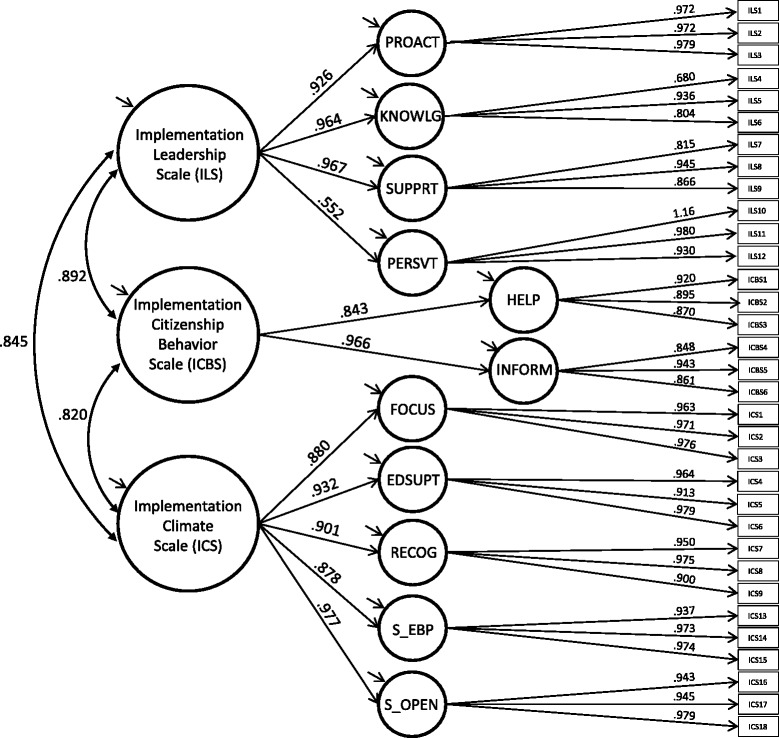
BACKGROUND: A substantial literature has established the role of the inner organizational setting on the implementation of evidence-based practices in community contexts, but very little of this research has been extended to the education sector, one of the most common settings for the delivery of mental and behavioral health services to children and adolescents. The current study examined the factor structure, psychometric properties, and interrelations of an adapted set of pragmatic organizational instruments measuring key aspects of the organizational implementation context in schools: (1) strategic implementation leadership, (2) strategic implementation climate, and (3) implementation citizenship behavior. METHOD: The Implementation Leadership Scale (ILS), Implementation Climate Scale (ICS), and Implementation Citizenship Behavior Scale (ICBS) were adapted by a research team that included the original scale authors and experts in the implementation of evidence-based practices in schools. These instruments were then administered to a geographically representative sample (n = 196) of school-based mental/behavioral health consultants to assess the reliability and structural validity via a series of confirmatory factor analyses. RESULTS: Overall, the original factor structures for the ILS, ICS, and ICBS were confirmed in the current sample. The one exception was poor functioning of the Rewards subscale of the ICS, which was removed in the final ICS model. Correlations among the revised measures, evaluated as part of an overarching model of the organizational implementation context, indicated both unique and shared variance. CONCLUSIONS: The current analyses suggest strong applicability of the revised instruments to implementation of evidence-based mental and behavioral practices in the education sector. The one poorly functioning subscale (Rewards on the ICS) was attributed to typical educational policies that do not allow for individual financial incentives to personnel. Potential directions for future expansion, revision, and application of the instruments in schools are discussed.
Overview
The claims and statistics of this paper haven’t been checked yet.
Free: it reads the open-access text and checks the first 5 claims that cite a source we can check. Create a free account to check every claim.
Integrity signals
Registry
Cites
Statistics
Figures
Verification
Claims the paper makes
The claims and statistics of this paper haven’t been checked yet.
Free: it reads the open-access text and checks the first 5 claims that cite a source we can check. Create a free account to check every claim.
Claims other papers make about this one
Each is checked against this paper’s own text: does it say what the citing paper says it does?
The cited source says what the claim attributes to it.
In the citing paper
“In pursuit of this objective, Lyon and colleagues conducted an initial adaptation of the ILS for use with mental and behavioral health consultants in the education sector [66].”
From Leading the charge in the education sector: development and validation of the School Implementation Leadership Scale (SILS) (2022) · cites this paper as [66]
The cited source says what the claim attributes to it.
In the citing paper
“Findings provided strong support for the original ILS factor structure with this new population.”
From Leading the charge in the education sector: development and validation of the School Implementation Leadership Scale (SILS) (2022) · cites this paper as [66]
The cited source says what the claim attributes to it.
In the citing paper
“The original ILS [9] and original SILS adaptation [66] are 12-item instruments developed to assess strategic leadership for EBP implementation.”
From Leading the charge in the education sector: development and validation of the School Implementation Leadership Scale (SILS) (2022) · cites this paper as [66]
The cited source says what the claim attributes to it.
In the citing paper
“Both versions have previously supported a factor structure with four first-order factors (proactive leadership, knowledgeable leadership, supportive leadership, perseverant leadership)—each with three items—loading onto an overarching implementation leadership latent factor [26, 66].”
From Leading the charge in the education sector: development and validation of the School Implementation Leadership Scale (SILS) (2022) · cites this paper as [66]
The cited source says what the claim attributes to it.
In the citing paper
“Scores also were higher than those observed on the earlier version of the ILS adapted for schools [66].”
From Leading the charge in the education sector: development and validation of the School Implementation Leadership Scale (SILS) (2022) · cites this paper as [66]
Self-check
Percentages, sums and reported differences re-computed from the paper’s own numbers.
The self-check needs the paper’s full text.
Citations
Cites
Hu, L., & Bentler, P. M. (1999) · Structural Equation Modeling A Multidisciplinary Journal · doi:10.1080/10705519909540118 · Cited by 108,788 · cited 1×
“Model fit was assessed based on a preponderance of the evidence from the chi-square statistic, comparative fit index (CFI; [63, 64]), the Tucker-Lewis index (TLI; [65]) and root mean square error of approximation (RMSEA; [66]) with values of the CFI and TLI greater than .”
MethodTabachnick, B. G., & Fidell, L. S. (1983) · Cited by 80,054
Alternative Ways of Assessing Model Fit
Browne, M. W., & Cudeck, R. (1992) · Sociological Methods & Research · doi:10.1177/0049124192021002005 · Cited by 27,200 · cited 1×
“Model fit was assessed based on a preponderance of the evidence from the chi-square statistic, comparative fit index (CFI; [63, 64]), the Tucker-Lewis index (TLI; [65]) and root mean square error of approximation (RMSEA; [66]) with values of the CFI and TLI greater than .”
MethodComparative fit indexes in structural models.
Bentler, P. M. (1990) · Psychological Bulletin · doi:10.1037/0033-2909.107.2.238 · Cited by 25,266 · cited 1×
“Model fit was assessed based on a preponderance of the evidence from the chi-square statistic, comparative fit index (CFI; [63, 64]), the Tucker-Lewis index (TLI; [65]) and root mean square error of approximation (RMSEA; [66]) with values of the CFI and TLI greater than .”
MethodOrganizational culture and leadership
(1993) · Long Range Planning · doi:10.1016/0024-6301(93)90120-5 · Cited by 16,462
Damschroder, L. J., Aron, D. C., Keith, R. E., Kirsh, S. R., Alexander, J. A., & Lowery, J. C. (2009) · Implementation Science · doi:10.1186/1748-5908-4-50 · Cited by 14,496 · cited 1×
“As a result, most leading implementation frameworks provide comprehensive coverage of “inner context” organizational factors [1, 3].”
Background(2007) · Cited by 10,092
Proctor, E., Silmere, H., Raghavan, R., Hovmand, P., Aarons, G., Bunger, A., Griffey, R., & Hensley, M. (2011) · Administration and Policy in Mental Health and Mental Health Services Research · doi:10.1007/s10488-010-0319-7 · Cited by 8,721 · cited 1×
“Furthermore, ILS, ICS, and ICBS scores were not directly linked to implementation [81] or service recipient outcomes.”
BackgroundSelf-citationA Reliability Coefficient for Maximum Likelihood Factor Analysis
Tucker, L. R., & Lewis, C. (1973) · Psychometrika · doi:10.1007/bf02291170 · Cited by 7,330 · cited 1×
“Model fit was assessed based on a preponderance of the evidence from the chi-square statistic, comparative fit index (CFI; [63, 64]), the Tucker-Lewis index (TLI; [65]) and root mean square error of approximation (RMSEA; [66]) with values of the CFI and TLI greater than .”
MethodPowell, B. J., Waltz, T. J., Chinman, M. J., Damschroder, L. J., Smith, J. L., Matthieu, M. M., Proctor, E. K., & Kirchner, J. E. (2015) · Implementation Science · doi:10.1186/s13012-015-0209-1 · Cited by 4,963 · cited 1×
“Subsequent development of data-driven “assessment-to-action” frameworks that link the ILS, ICS, and ICBS to specific, multi-level implementation strategies [84, 85] may represent a next frontier for the implementation behavioral health interventions in the education sector.”
Background
Research works printed but not linked: 7
- Ehrhart MG Aarons GA Torres EM Finn NK Roesch SC Implementation in child welfare: leadership, climate, attitudes, and citizenship behavior 2016 Anaheim, CA Poster presented at the 31st annual conference of the Society for Industrial and Organizational Psychology
- Elias MJ O’Brien U Weisberg P Transformative leadership for social-emotional learning Princ Leadersh 2006 7 10 13
- Hallinger P Principal instructional management rating scale 1990 Sarasota, FL Leading Development Associates
- DiPaola MF Tarter CJ Hoy WK Measuring organizational citizenship in schools: the OCB scale Educat Leadership Reform 2005 4 319 341
- Muthén B Asparouhov T Latent variable analysis with categorical outcomes: multiple-group and growth modeling in Mplus Mplus Web Notes 2002 4 1 22
- Muthén LK Muthén BO Mplus Version 7 user’s guide 2006 Los Angeles, CA Muthén & Muthén
- National Center on Response to Intervention Essential components of RTI: a closer look at response to intervention 2010 Washington, DC U.S. Department of Education, Office of Special Education Programs, National Center on Response to Intervention: National Center on Response to Intervention
Cited by
Items 101–200 of 227
Llarena, M., Rogers, H. L., Macía, P., Pablo, S., González, M., Montejo, M., Paniagua, N., Benito, J., Rueda-Etxebarria, M., Santos, B., et al. (2023) · Implementation Science Communications · doi:10.1186/s43058-023-00495-3 · Cited by 8
“Our findings are in line with the results from previous studies in other languages and in different settings where the staff version of ILS was validated among clinicians working at mental health clinics in the USA [12] and Norway [21]; service providers at substance use disorder treatment agencies [13]; employees at…”
MethodResultSpanish Validation of the Leader Empowering Behavior Questionnaire (LEBQ)
Bonavía, T., & Marin-Garcia, J. A. (2019) · Frontiers in Psychology · doi:10.3389/fpsyg.2019.02368 · Cited by 7
Are Principals’ Social Networks Associated with Interventions’ Social Validity?
Neal, J. W., Neal, Z. P., Barrett, C. A., & Brutzman, B. (2020) · School Mental Health · doi:10.1007/s12310-020-09388-5 · Cited by 7
Canut, E., & Masson, C. (2021) · Travaux neuchâtelois de linguistique · doi:10.26034/tranel.2021.2895 · Cited by 7
“Cette orientation d'une recherche fondée sur l'implémentation de dispositifs (design-based implementation research6) est relativement récente en éducation (Class & Schneider 2013; Dolle et al. 2014; Lyon et al. 2018; Moir 2018).”
BackgroundAdvani, S. D., & McKay, V. (2023) · Antimicrobial Stewardship & Healthcare Epidemiology · doi:10.1017/ash.2023.150 · Cited by 7
Locke, J. J., Corbin, C. M., Cook, C. R., Ehrhart, M. G., Davis, C. J., & Lyon, A. R. (2023) · Global Implementation Research and Applications · doi:10.1007/s43477-023-00080-9 · Cited by 7
Self-citationHealth Dissemination and Implementation Within Schools
Lee, R. M., Eisman, A. B., & Gortmaker, S. L. (2023) · Oxford University Press eBooks · doi:10.1093/oso/9780197660690.003.0022 · Cited by 7
Kallitsoglou, A. (2020) · Journal of Children s Services · doi:10.1108/jcs-04-2019-0022 · Cited by 7
Factors underpinning the adoption of a school-based growth mindset intervention: a qualitative study
Morgan, K., Garay, S. M., Reed, H., de Vocht, F., & Murphy, S. (2024) · Educational Psychology in Practice · doi:10.1080/02667363.2024.2414455 · Cited by 6
“Factors affecting the implementation (Domitrovich et al., 2008; Lyon et al., 2018; Pearson et al., 2015) and sustainability (Herlitz et al., 2020) of”
BackgroundMaya‐Jariego, I., Muñoz-Alvís, A., Polo-Vargas, J. D., Sañudo, J. E. P., & de Castro, A. M. (2022) · Humanities and Social Sciences Communications · doi:10.1057/s41599-022-01081-z · Cited by 6
“Thus, leadership by the principals of schools is one of the factors that improves the sustainability of interventions (Lyon et al., 2018), especially in crisis situations such as the pandemic.”
BackgroundSzota, K., Christiansen, H., Aarons, G. A., Ehrhart, M. G., Fischer, A. M., Rosner, R., Steil, R., & Barke, A. (2023) · Scientific Reports · doi:10.1038/s41598-023-32282-4 · Cited by 6
Self-citationChoi, S. Y., Rusch, A., Lane, A., Liebrecht, C., Bilek, E. L., Eisenberg, D., Andrews, C. M., Perry, M., & Smith, S. N. (2023) · Implementation Research and Practice · doi:10.1177/26334895231159429 · Cited by 5
“1) (Locke, Lawson, et al., 2019; Lyon et al., 2018), our SPs rated organizational support for EBP implementation, via the ICS and ILS, lower than in clinical settings.”
BackgroundMethodInfluentialFacilitators and barriers to implementing a whole-school mental health programme
Wignall, A., Atkinson, C., & Grace, P. X. N. (2023) · Pastoral Care in Education · doi:10.1080/02643944.2023.2214903 · Cited by 6
“…of implementation research has focused on time-limited, small-group or individual interventions within health, clinical and education settings (Lyon et al., 2018); and, therefore, these factors may not apply to complex multi-component programmes designed to have a long-term impact on an…”
BackgroundCorrelates of perceived success of health-promoting interventions in elementary schools
O’Loughlin, E. K., Kalubi, J., Riglea, T., Pelekanakis, A., & O’Loughlin, J. L. (2022) · Health Promotion and Chronic Disease Prevention in Canada · doi:10.24095/hpcdp.42.9.03 · Cited by 5
Gallagher, A., Murphy, R., Fitzgerald, J., Murphy, C., & Law, J. (2023) · PLoS ONE · doi:10.1371/journal.pone.0287471 · Cited by 5
Locke, J. J., Williams, N. J., Sridhar, A., Ehrhart, M. G., Dopp, A. R., Thirion, M., Espeland, C., Riddle, B., Schmitz, K., Hatch, K., et al. (2025) · Implementation Science · doi:10.1186/s13012-025-01429-4 · Cited by 4
Self-citationVictor, L. R., Siluvaimuthu, M., George, H. J., & Parayitam, S. (2024) · International Journal of Educational Management · doi:10.1108/ijem-02-2023-0058 · Cited by 4
Melgarejo, M., Nahmias, A. S., Suhrheinrich, J., Schetter, P. L., Dean, M., Holt, T., Li, J., & Stahmer, A. C. (2022) · Focus on Autism and Other Developmental Disabilities · doi:10.1177/10883576221140149 · Cited by 4
“The School Implementation Leadership Scale (S-ILS; Lyon et al., 2018) is a 30-item rating scale that assesses the degree to which a leader is (a) knowledgeable about EBPs, (b) supportive about the use of EBPs, (c) proactive about the use of EBPs, (d) perseverant in implementing EBPs, (e) communicates about EBPs, (f) h…”
InfluentialFarquharson, K., Kittelman, A., Holmes, S. R., Barrett, C. A., & Lyon, A. R. (2025) · Journal of School Leadership · doi:10.1177/10526846251384766 · Cited by 3
“Previous research has shown the robust importance of school leaders and their critical role in facilitating the adoption, implementation, and sustainment of evidence-based practices (Barrett et al., 2023, 2024; Lyon et al., 2018).”
Self-citationStahmer, A. C., Lau, A. S., Roesch, S. C., Rangel, E., Aarons, G. A., & Brookman-Frazee, L. I. (2025) · Implementation Science · doi:10.1186/s13012-025-01466-z · Cited by 3
Self-citationNadeem, E., Blanton, M. A., Sahay, A., Kycia, O., Dudek, C. M., Heaton, K. G., Garcia, J., Jimenez, E., Healy, S., & Coccaro, C. (2025) · Child Maltreatment · doi:10.1177/10775595251410558 · Cited by 3
“…associated with practice use in the regressions than other hypothesized implementation factors such as implementation leadership support from principals, perceptions about openness to innovation, and teacher self-ef fi cacy (Aarons & Sommerfeld, 2012; Benjamin Wolk et al., 2015; Lyon et al., 2018).”
Barrett, C. A., Sleesman, D. J., & Amin, T. (2024) · Prevention Science · doi:10.1007/s11121-024-01655-0 · Cited by 3
“It is critical for researchers to look beyond the initial adoption decision, as school administrators are responsible for both selecting programs and supporting their implementation over time (Aarons et al., 2014; Lyon et al., 2018).”
Gregory, A., Moya, G., Jimenez, S., Zenou, J., Ward-Seidel, A. R., & Huang, F. L. (2023) · Journal of Educational and Psychological Consultation · doi:10.1080/10474412.2023.2234365 · Cited by 3
“The success and failure of new initiatives so often depends on the commitment of school leaders (Lyon et al., 2018).”
BackgroundKnox, P. N., Garnett, B. R., Kervick, C. T., Simpfenderfer, A. D., Smith, L. C., & Moore, M. (2024) · Contemporary Justice Review · doi:10.1080/10282580.2024.2340974 · Cited by 3
“…climate includes the ‘capacity to use, lead and advocate’ for a given initiative, and a ‘positive implementation climate signals what is expected, supported, and rewarded in relation to use of programs or practices’ (Aarons et al., 2011; Gregory, Osher, et al., 2021; Lyon et al., 2018).”
Xu, D. R., He, W., Hao, C., Zhao, Q., Guo, P., Zhang, L., Chen, Z., 蔡媐媛, Lv, S., Cai, Y., et al. (2025) · BMJ Open · doi:10.1136/bmjopen-2023-078103 · Cited by 3
Herlitz, L., & Bonell, C. P. (2025) · Frontiers in Public Health · doi:10.3389/fpubh.2025.1559954 · Cited by 3
Torres-Cortés, B., Leiva, L., Antivilo-Bruna, A., & Zavala‐Villalón, G. (2021) · Frontiers in Education · doi:10.3389/feduc.2021.599712 · Cited by 3
“, 2011), specifically in the school context (Lyon et al., 2018), the area where this study was carried out.”
BackgroundMerle, J. L. (2021) · University of Minnesota Digital Conservancy (University of Minnesota) · Cited by 3
Eisman, A. B., Martin, J. J., Hasson, R. E., & Kilbourne, A. M. (2024) · Journal of School Health · doi:10.1111/josh.13539 · Cited by 2
Dryburgh, N. S. J., Wang, L., Repchuck, R., Matte, A. R., Runions, K., & Georgiades, K. (2025) · School Mental Health · doi:10.1007/s12310-025-09742-5 · Cited by 2
“…examined the role of leadership in implementation by having other parties, such as clinicians or teachers, report on their views of leadership (e.g., Aarons et al., 2014; Li et al., 2023; Lyon et al., 2018), the current study sought to develop a measure to assess principals’ perspectives directly.”
Eisman, A. B., Koffkey, C., Fridline, J., Harvey, C., Hasson, R. E., Palinkas, L. A., & Kilbourne, A. M. (2025) · Implementation Research and Practice · doi:10.1177/26334895251330520 · Cited by 2
“The implementation climate re fl ects staff perceptions of the school ’ s support for universal prevention and health promotion, particularly MMH (Lyon et al., 2018).”
Gillam, S. L., Horton, L., Reynolds, M., Oluwaseun-Sobo, A., Topple, J., Walters, S., Lippert, A., Gentry, S., Cummings, K., Sainsbury, R., et al. (2025) · Topics in Language Disorders · doi:10.1097/tld.0000000000000363 · Cited by 2
“There has been a strong effort in the field of speech-language pathology to bridge the gap between research findings on the benefits of oral narrative instruction and practical application by educators in elementary school settings (Fixsen et al., 2007; Lyon et al., 2018; Olswang & Prelock, 2015).”
Jang, H. (2025) · Australasian Journal of Special and Inclusive Education · doi:10.1017/jsi.2025.10008 · Cited by 2
Sridhar, A., Bravo, A., Landa, Y., Choudhuri, P. G., Shih, W., Michael, O. G., & Locke, J. J. (2025) · Implementation Science Communications · doi:10.1186/s43058-025-00810-0 · Cited by 2
“While Lyon et al. [20] found that recognition for EBP use was rated in the good range, our study found that recognition was rated low by educators.”
InfluentialSelf-citationEvaluating Teachers’ 21st-Century Skills to Support Sustainable and Quality Education
Akçıl, U., & Yaman, F. E. (2026) · Sustainability · doi:10.3390/su18031246 · Cited by 3
Exploring Ghanaian Primary Teachers’ Readiness for National Curricula and Pedagogical Reform
Francis, D. C., Bharaj, P. K., & Hinden, A. (2022) · Emerald Group Publishing Limited eBooks · doi:10.1108/978-1-64802-928-820251010 · Cited by 2
Perceptions of and Actions toward Unproductive and Deleterious Faculty
Desselle, S. P., Zgarrick, D. P., & Ramachandran, S. (2021) · INNOVATIONS in pharmacy · doi:10.24926/iip.v12i3.3955 · Cited by 2
Gallagher, A., Murphy, C., Fitzgerald, J., & Law, J. (2021) · HRB Open Research · doi:10.12688/hrbopenres.13249.2 · Cited by 2
Siegle, A., zu Sayn-Wittgenstein-Hohenstein, F., & Roes, M. (2020) · Implementation Science · doi:10.1186/s13012-020-01033-8 · Cited by 2
Tafon, C., Sullivan, G., Self, S., & Sullivan, A. (2022) · Journal of Accounting and Finance · doi:10.33423/jaf.v22i4.5342 · Cited by 2
Hubball, H., & García, J. D.-C. (2020) · Global Research in Higher Education · doi:10.22158/grhe.v3n2p34 · Cited by 2
“1 Theoretical Underpinnings Addressing the unique needs and circumstances of ageing players in diverse grassroots small-sided football contexts is a complex and multifaceted process (Blatter & Dvorak, 2014; Lyon et al., 2018; Skoradal et al., 2018).”
BackgroundInfluentialGallagher, A., Murphy, C., Fitzgerald, J., & Law, J. (2021) · HRB Open Research · doi:10.12688/hrbopenres.13249.1 · Cited by 2
Mariano, L. T., Phillips, A., Estes, K., & Kilburn, M. R. (2024) · RAND Corporation eBooks · doi:10.7249/wra3135-1 · Cited by 2
Fitrianingsih, E., Mujanah, S., & Bradford, S. (2023) · Sharia Oikonomia Law Journal · doi:10.55849/solj.v1i3.510 · Cited by 2
Santos, W. J., Hutchinson, A. M., Rader, T., Graham, I. D., Watkins, V. J., de Cândido, L. K., Greenough, M. J., & Squires, J. E. (2023) · BMC Research Notes · doi:10.1186/s13104-023-06294-2 · Cited by 2
Teachers’ perspectives on the implementation of an ethical education curriculum in Ireland
Kinsella, W., Prendeville, P., Hayes, D. T., & Bourke, M. (2024) · Irish Educational Studies · doi:10.1080/03323315.2024.2412200 · Cited by 1
“The application of IS frameworks in educational contexts are recent in the field (Lyon et al. 2018; Moir 2018; Gallagher et al. 2023; Pre-ndeville, Bourke, and Kinsella 2023).”
Matić, N., Matić, I., & Stanešić, Đ. (2025) · Education Sciences · doi:10.3390/educsci15020208 · Cited by 1
“They often transition from the health system to education and engage closely with students in practical settings, emphasizing the application of theoretical knowledge in real-world contexts (Lyon et al., 2018).”
Bliss, C. M., & Barrett, C. A. (2025) · Psychology in the Schools · doi:10.1002/pits.23490 · Cited by 1
“Implementation leaders may be school administrators or other leaders, but may also include other personnel who become “ EBP champions ” and support implementation efforts within a local context (Lyon et al. 2018).”
Samudre, M. D., Torelli, J. N., Mirakhur, Z., & Morganti, M. (2025) · School Mental Health · doi:10.1007/s12310-025-09770-1 · Cited by 1
“…reporting of the granular components of drivers, our results provide additional basis for also exploring the organizational factors (e.g., leadership, school climate; Lyon et al., 2018) and trainer dispositions (Larson et al., 2022) that can influence perceptions on implementation drivers.”
Building a culture of connection in early childhood education: The Hand in Hand Foundations Course
Sillars, A. A., Vogelstein, A., Oatis, P., Davis, A. E., Cole, A., Trivedi, P. A., & Coleman, M. (2025) · Infant Mental Health Journal · doi:10.1002/imhj.70030 · Cited by 1
Godovich, S. A., Goeke‐Morey, M. C., Barrueco, S., Guajardo, K. B., & Rich, B. A. (2025) · Child & Youth Care Forum · doi:10.1007/s10566-025-09882-4 · Cited by 1
Developing and Testing the Integrated Multi-tiered Systems of Support Fidelity Rubric
Pierce, J. D., Thomas, E., Majeika, C. E., Casasanto-Ferro, J., Gandhi, A. G., & Lembke, E. S. (2025) · Global Implementation Research and Applications · doi:10.1007/s43477-025-00191-5 · Cited by 1
Validation of the extended version of the Implementation Leadership Scale (ILS-X)
Ehrhart, M. G., Williams, N. J., Sklar, M., Vega, N. R., Kandah, A., & Aarons, G. A. (2025) · Implementation Science Communications · doi:10.1186/s43058-025-00786-x · Cited by 1
“Originally developed in a mental health context, the ILS has subsequently been validated in other contexts, including substance use treatment [16], child welfare [17], nursing [18], and education [19, 20].”
Self-citationKhasawneh, Y. J. A., Khasawneh, N. A. S., & Khasawneh, M. A. S. (2026) · Journal of Computer Assisted Learning · doi:10.1002/jcal.70216 · Cited by 2
Validation of the Implementation Climate Scale for Early Intervention (ICS-EI)
Lee, J. D., Joo, S., Terol, A. K., Jung, S., Pickard, K. E., Stone, W., & Locke, J. J. (2026) · Journal of Early Intervention · doi:10.1177/10538151261432562 · Cited by 1
“A positive implementation climate can directly support providers in adopting and consistently utilizing EBPs by clearly communicating organizational expectations, providing targeted resources and supports, and reinforcing effective practices through recognition and rewards (Lyon et al., 2018).”
Self-citationKyan, A., Masukawa, K., & Takakura, M. (2026) · Health Promotion International · doi:10.1093/heapro/daag071 · Cited by 1
“In organizational research, social capital is conceptualized not merely as a favorable interpersonal climate but as a functional resource that facilitates problem solving, knowledge sharing, and the reinforcement of shared norms (Kawachi 1999, Bryk and Schneider 2002, Lyon et al. 2018).”
Primack, Z., Palafu, T., Goshgarian-Miller, S., Liu, M., Chertavian, C., Rapadas, C. C., Yamane, R., An, K. J., Chin, S. K., Okamoto, S. K., et al. (2026) · Translational Issues in Psychological Science · doi:10.1037/tps0000516 · Cited by 1
Diversity and Inclusion Strategies in Global Organizations: A Systematic Literature Review
Razak, I. S. A. (2024) · Management Studies and Business Journal (PRODUCTIVITY) · doi:10.62207/2tg1e552 · Cited by 1
Corrélats du succès perçu des interventions de promotion de la santé dans les écoles primaires
O’Loughlin, E. K., Kalubi, J., Riglea, T., Pelekanakis, A., & O’Loughlin, J. L. (2022) · Promotion de la santé et prévention des maladies chroniques au Canada · doi:10.24095/hpcdp.42.9.03f · Cited by 1
The Differential Preliminary Belief in Prevention: The Case of Adolescents’ Problem Behaviors
Israelashvili, M., & Nahhas, A. H. (2023) · Journal of Prevention and Health Promotion · doi:10.1177/26320770221095442 · Cited by 1
“A common feature of these approaches is the importance that they attribute to the role that organizational factors play in determining the fidelity and success of the implementation process (Lyon et al., 2018).”
BackgroundTolentino, K. A. F. (2024) · International Journal of Education Humanities and Social Science · doi:10.54922/ijehss.2024.0815 · Cited by 1
Corbin, C. M., Ehrhart, M. G., Brown, E. C., Locke, J. J., Cook, C. R., Aarons, G. A., & Lyon, A. R. (2025) · Implementation Science Communications · doi:10.1186/s43058-025-00748-3 · Cited by 1
Self-citationEmployee Perceptions of Marriage Enrichment Training Spillover Effects in the Workplace
Moore, T. (2018) · Aquila Digital Community (University of Southern Mississippi) · Cited by 1
Hubert, E. E. (2018) · ResearchWorks at the University of Washington (University of Washington) · Cited by 1
Kimbrough, D. L. (2024) · ScholarWorks (Walden University) · Cited by 1
Stegenga, S. M. (2019) · Scholars' Bank (University of Oregon)
Rasmussen, L. P. (2019) · NVA (Nasjonalt vitenarkiv)
Faizey, R. (2019) · Nottingham ePrints (University of Nottingham)
How Much Ethanol, Ultimately?Preprint
Perrin, R. K., & Sesmero, J. (2007) · RePEc: Research Papers in Economics · doi:10.22004/ag.econ.306526
Seaton, F. S., & Taylor, S. (2022) · Educational Psychology in Scotland · doi:10.53841/bpsepis.2022.22.1.43
Inclusion: Environmental Efforts to Prevent Maladjustment in the Service of Human Growth
Nota, L., & Israelashvili, M. (2023) · Advances in prevention science · doi:10.1007/978-3-031-26700-0_15
Osorio, B. (2024) · Deep Blue (University of Michigan) · doi:10.7302/23756
Wang, S., Kohl, P. L., Quinones, H., Miller, L., & Luby, J. L. (2025) · Implementation Science Communications · doi:10.1016/j.jaac.2025.08.116
Validation of the Implementation Climate Scale (ICS) in a Community-Based Learning Collaborative
Lane, E., Woodard, G. S., Jensen‐Doss, A., & Novello, A. (2025) · Administration and Policy in Mental Health and Mental Health Services Research · doi:10.1007/s10488-025-01483-6
“Two studies (Lyon et al., 2018 ; Szota et al., 2023) tested a second-order latent factor model where the six original first-order factors fell under a second-order latent factor representing a total score.”
InfluentialLyon, A. R., Pullmann, M. D., Dorsey, S., Levin, C., Gaias, L. M., Brewer, S. K., Larson, M. F., Corbin, C. M., Davis, C. J., Muse, I., et al. (2021) · Figshare · doi:10.6084/m9.figshare.13545229
Self-citationLyon, A. R., Cook, C. R., Larson, M. F., Hugh, M. L., Dopp, A. R., Hamlin, C., Reinke, P. H., Bose, M., Law, A., Goosey, R., et al. (2024) · Figshare · doi:10.6084/m9.figshare.26658907
Self-citationSpencer, T. D. (2021) · HRB Open Research · doi:10.21956/hrbopenres.14667.r30843
Peters, N., Borge, R. H., Skar, A. M. S., & Egeland, K. M. (2022) · Figshare · doi:10.6084/m9.figshare.17870361
Zhang, Y., Larson, M. F., Ehrhart, M. G., King, K., Locke, J. J., Cook, C. R., & Lyon, A. R. (2024) · Figshare · doi:10.6084/m9.figshare.26726057
Self-citationBecker, S. J., DiClemente-Bosco, K., Scott, K., Janssen, T., Salino, S., Hasan, F. N., Yap, K. R., & Garner, B. R. (2023) · Figshare · doi:10.6084/m9.figshare.24136245
Lyon, A. R., Pullmann, M. D., Dorsey, S., Levin, C., Gaias, L. M., Brewer, S. K., Larson, M. F., Corbin, C. M., Davis, C. J., Muse, I., et al. (2021) · Figshare · doi:10.6084/m9.figshare.13545226
Self-citationLyon, A. R., Cook, C. R., Larson, M. F., Hugh, M. L., Dopp, A. R., Hamlin, C., Reinke, P. H., Bose, M., Law, A., Goosey, R., et al. (2024) · Figshare · doi:10.6084/m9.figshare.26658904
Self-citationLyon, A. R., Cook, C. R., Larson, M. F., Hugh, M. L., Dopp, A. R., Hamlin, C., Reinke, P. H., Bose, M., Law, A., Goosey, R., et al. (2024) · Figshare · doi:10.6084/m9.figshare.26658901
Self-citationSantos, W. J., Hutchinson, A. M., Rader, T., Graham, I. D., Watkins, V. J., de Cândido, L. K., Greenough, M. J., & Squires, J. E. (2024) · Figshare · doi:10.6084/m9.figshare.26574445
McLoughlin, G. M., Allen, P., Walsh‐Bailey, C., & Brownson, R. C. (2021) · Figshare · doi:10.6084/m9.figshare.14853441
Santos, W. J., Hutchinson, A. M., Rader, T., Graham, I. D., Watkins, V. J., de Cândido, L. K., Greenough, M. J., & Squires, J. E. (2024) · Figshare · doi:10.6084/m9.figshare.26574454
Lyon, A. R., Pullmann, M. D., Dorsey, S., Levin, C., Gaias, L. M., Brewer, S. K., Larson, M. F., Corbin, C. M., Davis, C. J., Muse, I., et al. (2021) · Figshare · doi:10.6084/m9.figshare.13545238
Self-citationZhang, Y., Larson, M. F., Ehrhart, M. G., King, K., Locke, J. J., Cook, C. R., & Lyon, A. R. (2024) · Figshare · doi:10.6084/m9.figshare.26726060
Self-citationSantos, W. J., Hutchinson, A. M., Rader, T., Graham, I. D., Watkins, V. J., de Cândido, L. K., Greenough, M. J., & Squires, J. E. (2024) · Figshare · doi:10.6084/m9.figshare.26574460
Lyon, A. R., Pullmann, M. D., Dorsey, S., Levin, C., Gaias, L. M., Brewer, S. K., Larson, M. F., Corbin, C. M., Davis, C. J., Muse, I., et al. (2021) · Figshare · doi:10.6084/m9.figshare.13545235
Self-citationSantos, W. J., Hutchinson, A. M., Rader, T., Graham, I. D., Watkins, V., de Cândido, L. K., Greenough, M. J., & Squires, J. E. (2024) · Figshare · doi:10.6084/m9.figshare.26574448
Lyon, A. R., Cook, C. R., Larson, M. F., Hugh, M. L., Dopp, A. R., Hamlin, C., Reinke, P. H., Bose, M., Law, A., Goosey, R., et al. (2024) · Figshare · doi:10.6084/m9.figshare.26658910
Self-citationEisman, A. B., Whitman, J., Palinkas, L. A., Fridline, J., Harvey, C., Kilbourne, A. M., & Hutton, D. W. (2023) · Figshare · doi:10.6084/m9.figshare.24540710
Santos, W. J., Hutchinson, A. M., Rader, T., Graham, I. D., Watkins, V. J., de Cândido, L. K., Greenough, M. J., & Squires, J. E. (2024) · Figshare · doi:10.6084/m9.figshare.26574457
Lyon, A. R., Corbin, C. M., Brown, E. C., Ehrhart, M. G., Locke, J. J., Davis, C. J., Picozzi, E., Aarons, G. A., & Cook, C. R. (2022) · Figshare · doi:10.6084/m9.figshare.20342346
Self-citationZhang, Y., Larson, M. F., Ehrhart, M. G., King, K., Locke, J. J., Cook, C. R., & Lyon, A. R. (2024) · Figshare · doi:10.6084/m9.figshare.26726054
Self-citationZhang, Y., Larson, M. F., Ehrhart, M. G., King, K., Locke, J. J., Cook, C. R., & Lyon, A. R. (2024) · Figshare · doi:10.6084/m9.figshare.26726063
Self-citationLlarena, M., Rogers, H. L., Macia, P., Pablo, S., González, M., Montejo, M., Paniagua, N., Benito, J., Rueda, M., Santos, B., et al. (2024) · Figshare · doi:10.6084/m9.figshare.26616964
Peters, N., Borge, R. H., Skar, A. M. S., & Egeland, K. M. (2022) · Figshare · doi:10.6084/m9.figshare.17870358
Metadata
- Authors
- Lyon, A. R., Cook, C. R., Brown, E. C., Locke, J., Davis, C., Ehrhart, M., & Aarons, G. A.
- Affiliations
- University of Washington (US)
- University of Minnesota (US)
- University of Miami (US)
- University of Central Florida (US)
- University of California San Diego (US)
- Corresponding author
- Lyon, Aaron R.
- Venue
- Implementation Science
- Published
- 2018-01-08
- Volume
- 13
- Issue
- 1
- Pages
- 5-5
- ISSN
- 1748-5908 (ISSN-L)
- PMC
- PMC5759223
- OpenAlex
- W2783384668
- Semantic Scholar
- cf483ad12a991336269fcae2760238582374fbeb
- Cited by
- 199
- References
- 79
- Citations by year
- 2026: 11 · 2025: 25 · 2024: 33 · 2023: 30 · 2022: 33 · 2021: 27 · 2020: 13 · 2019: 21 · 2018: 5
- FWCI
- 25.20
- Type
- journal article
- Language
- en
- Open access
- gold
- doi.org
- Licence
- cc-by
- creativecommons.org/licenses/by/4.0/ (tdm)
- creativecommons.org/licenses/by/4.0/ (vor)
- Locations
- Implementation Science (publishedVersion, cc-by)
- PubMed Central (publishedVersion, cc-by)
- PubMed (publishedVersion)
- Journal of International Crisis and Risk Communication Research (submittedVersion)
- DOAJ (DOAJ: Directory of Open Access Journals) (submittedVersion, cc-by-sa)
- eScholarship (California Digital Library) (submittedVersion)
- eScholarship (California Digital Library) (submittedVersion, cc-by)
- Open Scholarship Institutional Repository (Washington University in St. Louis) (submittedVersion, cc-by)
- Grantee Submission
- Funders
- National Institute of Mental Health (K08MH095939, K01MH100199)
- Institute of Education Sciences (R305A160114)
- Topics
- Health Sciences › Health Professions › General Health Professions › Health Policy Implementation Science
- Health Sciences › Medicine › Public Health, Environmental and Occupational Health › School Health and Nursing Education
- Health Sciences › Health Professions › General Health Professions › Health Sciences Research and Education
- Keywords
- implementation leadership, implementation climate, evidence-based practice, school-based mental health services, scale adaptation, psychometric validation, factor structure
- MeSH terms
- Adult, Child, Climate, Factor Analysis, Statistical, Female, Humans, Leadership, Male, Organizational Innovation, Reproducibility of Results, Organizational Culture, Evidence-Based Practice, Young Adult
About these checks
Registry, retraction, Cites and statistics results are computed, not judged, with one exception: a printed reference that no index lists is read once by a model before it counts as a citation error. Claims are extracted by a model and kept only when their quote appears verbatim in the text; each cited source is then checked, with a model’s help, for whether it says what the claim relies on. Those verdicts can be wrong — read the claim’s quote and the cited source before relying on one.
Statistics and arithmetic are recomputed, not judged.
Confidence bands are shown only for fields calibrated on our annotated test set. None is calibrated yet, so no band is shown.
What counts as a claim ›How we measure confidence ›How we check this ›
Are you an author, or do you see a problem with this page? Request a review
Data sources
Bibliographic data: Semantic Scholar, OpenAlex, Crossref.
Contains information from the Semantic Scholar Academic Graph Datasets, made available under the ODC Attribution License (ODC-BY 1.0).
Semantic Scholar’s data is described in: Kinney, R., et al. (2023). The Semantic Scholar Open Data Platform. arXiv:2301.10140.
