

The DOI matches its Crossref record; 14 of the 14 references it cites were found in a registry or an index.
A comprehensive study of the rare diseases and conditions targeted by orphan drug designations and approvals over the forty years of the Orphan Drug Act
Open accessAbstract
Background: Rare diseases affect more than 30 million Americans. The passage of the Orphan Drug Act (ODA) in the United States in 1983 represented a launching point for a rare disease drug development revolution for these patients. Financial incentives provided by the ODA through its Orphan Drug Designation Program, in addition to remarkable scientific advances over the past 40 years, have led to hundreds of drug approvals for rare diseases. Our research examines the rare diseases that have been targeted by orphan drug designations and subsequent approvals since the law was enacted. Methods: Using an internal FDA database, we classified and analyzed all orphan drug designations and approvals from 1983 to 2022 by disease and therapeutic area. Results: Over the 40 years of the ODA, 6,340 orphan drug designations were granted, representing drug development for 1,079 rare diseases. Additionally, 882 of those designations resulted in at least one FDA approval for use in 392 rare diseases. Much of this development has been concentrated in oncology as seven of the top ten most designated and approved diseases were rare cancers. Conclusions: Researchers have estimated that there may be 7000–10,000 rare diseases that have been identified and described. Based on our study, we can conclude that around 5% of rare diseases have an FDA-approved drug and up to 15% of rare diseases have at least one drug that has been developed and shown promise in their treatment, diagnosis or prevention. Funding of basic and translational science for rare disease drug development should continue in order to bring therapies to the millions of affected patients who remain without treatment options.
Overview
The claims and statistics of this paper haven’t been checked yet.
Run the check — free, no account needed. It reads the open-access text and checks the sources it cites.
Integrity signals
Registry
Cites
Statistics
Figures
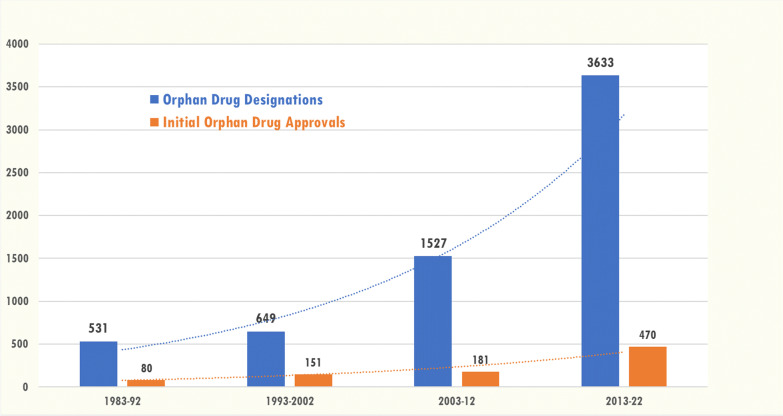
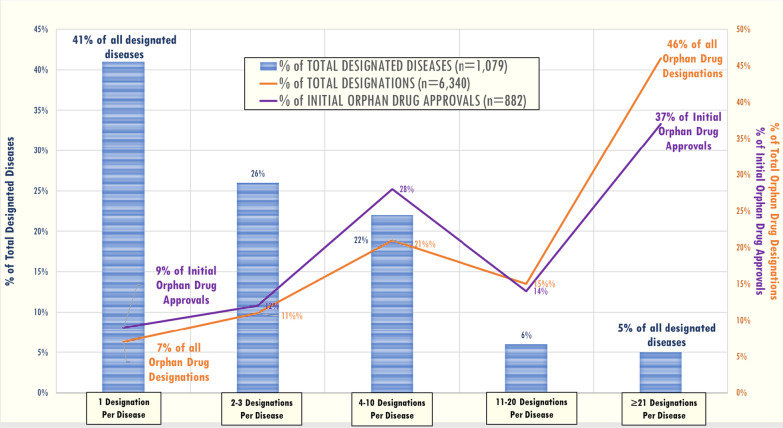
Verification
Claims the paper makes
The claims and statistics of this paper haven’t been checked yet.
Run the check — free, no account needed. It reads the open-access text and checks the sources it cites.
Claims other papers make about this one
Each is checked against this paper’s own text: does it say what the citing paper says it does?
In the citing paper
“Moreover, around 95% of rare diseases have no FDA-approved drugs and up to 85% of rare diseases do not have even one drug developed that would show promise in rare disease treatment, diagnosis or prevention21.”
From A foundation model for clinician-centered drug repurposing (2024) · cites this paper as [21]
In the citing paper
“For instance, the molecular basis of many rare diseases remains poorly understood21.”
From A foundation model for clinician-centered drug repurposing (2024) · cites this paper as [21]
Self-check
Percentages, sums and reported differences re-computed from the paper’s own numbers.
The self-check needs the paper’s full text.
Citations
Cites
Rare-disease genetics in the era of next-generation sequencing: discovery to translation
Boycott, K. M., Vanstone, M. R., Bulman, D. E., & MacKenzie, A. (2013) · Nature Reviews Genetics · doi:10.1038/nrg3555 · Cited by 804
How many rare diseases are there?
Haendel, M., Vasilevsky, N., Unni, D., Bologa, C., Harris, N., Rehm, H., Hamosh, A., Baynam, G., Groza, T., McMurry, J., et al. (2020) · Nature Reviews Drug Discovery · doi:10.1038/d41573-019-00180-y · Cited by 554 · cited 1×
“Now, four decades later, hundreds of “orphan” drugs have been approved for use in the 7000–10,000 diseases and conditions that are considered rare.[3].”
BackgroundMondo: Unifying diseases for the world, by the world
Vasilevsky, N. A., Matentzoglu, N. A., Toro, S., Flack, J. E., Hegde, H., Unni, D. R., Alyea, G. F., Amberger, J. S., Babb, L., Balhoff, J. P., et al. (2022) · doi:10.1101/2022.04.13.22273750 · Cited by 107
Miller, K. L., Fermaglich, L. J., & Maynard, J. W. (2021) · Orphanet Journal of Rare Diseases · doi:10.1186/s13023-021-01901-6 · Cited by 96
Self-citationCFTR modulator therapies – Effect on life expectancy in people with cystic fibrosis
Balfour-Lynn, I. M., & King, J. A. (2022) · Paediatric Respiratory Reviews · doi:10.1016/j.prrv.2020.05.002 · Cited by 85
The Orphan Drug Act. The first 7 years.
Asbury, C. H. (1991) · PubMed · Cited by 70
Investigating the landscape of US orphan product approvals
Miller, K. L., & Lanthier, M. L. (2018) · Orphanet Journal of Rare Diseases · doi:10.1186/s13023-018-0930-3 · Cited by 52
Self-citationShould rare diseases get special treatment?
Magalhães, M. D. A. F. M. (2021) · Journal of Medical Ethics · doi:10.1136/medethics-2021-107691 · Cited by 48
Important Role of Translational Science in Rare Disease Innovation, Discovery, and Drug Development
Pariser, A., & Gahl, W. A. (2014) · Journal of General Internal Medicine · doi:10.1007/s11606-014-2881-2 · Cited by 43
Asbury, C. H. (1991) · JAMA · doi:10.1001/jama.1991.03460070075046 · Cited by 37
Cited by
Sorted by citations
Items 101–135 of 135
Developing therapeutics for rare cardiovascular diseases
Lerman, J. B., Koeberl, D. D., Epstein, S., Roessig, L., Stan, R., Halley, M. C., OWENS, A. T., Greenberg, B., Alexander, K. M., Day, S. M., et al. (2025) · American Heart Journal · doi:10.1016/j.ahj.2025.09.004
PubChat: Evaluating the Effectiveness of Semantic Search in Establishing Drug Safety in Children *Preprint
Smith, A., Dunbar, E., Crowder, C. M., & Might, M. (2025) · medRxiv · doi:10.1101/2025.10.01.25335910
The future of clinical studies of in-utero therapy for genetic diseases
Gough, G., Schaefer, G. O., Lim, K., Choolani, M. A., & Mattar, C. N. Z. (2025) · Best Practice & Research Clinical Obstetrics & Gynaecology · doi:10.1016/j.bpobgyn.2025.102678 · Cited by 1
Pariser, A., Stoyanova-Beninska, V. V., Iliach, O., Jundi, R., Lee, K. J., Morikawa, H., Parker, S. J., Pothet, C., Rizzi, M., Vaillancourt, J., et al. (2025) · Drug Discovery Today · doi:10.1016/j.drudis.2025.104529
How Patients Can Contribute to the Assessments of Health Technologies
Houÿez, F., & Delaye, J. (2025) · Journal of Market Access & Health Policy · doi:10.3390/jmahp13040061
Dunne, T. F., Jeffries, D., & McKay, L. (2024) · Figshare · doi:10.6084/m9.figshare.26752435
Comic: explainable drug repurposing via contrastive masking for interpretable connections
Aamer, N., Asim, M. N., & Dengel, A. (2026) · BMC Bioinformatics · doi:10.1186/s12859-025-06337-4 · Cited by 1
Balas, E. A., Abdelgawad, Y. H., Aubert, C., & Townsend, T. (2026) · Scientific Reports · doi:10.1038/s41598-026-41471-w
Prospective and challenges of rare genetic diseases in India
Panja, A., Tripathy, I., & Dolai, T. K. (2026) · Egyptian Journal of Medical Human Genetics · doi:10.1186/s43042-025-00831-3
Slabá, K., Pokorná, P., Říhová, K., Demlová, R., & Slabý, O. (2026) · Neurologie pro praxi · doi:10.36290/neu.2026.017
Hall, P., Wangler, M. F., & Andrews, J. (2026) · Annual Review of Genomics and Human Genetics · doi:10.1146/annurev-genom-020525-025811
Elango, R., Martin, R., & Mutta, S. K. (2026) · Farmacia Hospitalaria · doi:10.1016/j.farma.2026.04.003
Rare diseases are not rare: Challenges and opportunities for OM research
Martagan, T. (2026) · Production and Operations Management · doi:10.1177/10591478261455121
Rare Diseases and Orphan Drugs: Innovation Through Repurposing Strategies
Otero-Carrasco, B., & Rodríguez‐González, A. (2025) · Springer handbooks · doi:10.1007/978-3-032-01636-2_11
SAIMSARA (2026) · SAIMSARA Journal · doi:10.62487/saimsarae25de34b
Zhao, X. L., & Zhang, M. (2026) · Orphanet Journal of Rare Diseases · doi:10.1186/s13023-026-04404-4
Schellenberg, K. L., Osman, H., Masnata, M., Hicks, R., Kagan, C., Stosic, A., Lintern, S., Beattie, E., Lochmüller, H., Campbell, C., et al. (2026) · Orphanet Journal of Rare Diseases · doi:10.1186/s13023-026-04393-4
Rodriguez, S. H., & Yokota, T. (2026) · Genes · doi:10.3390/genes17060631
Investigating the Landscape of Personalized Medicine Approvals by the FDA
Varpe, P. C., Dask, T. K., Srivastava, S., & Nanduri, S. (2026) · Journal of Pharmaceutical Innovation · doi:10.1007/s12247-026-10816-3
The estimated burden of rare diseases in South Africa using Orphanet: an epidemiological analysis
Malherbe, H. L., Odendaal, S., Kukava, A., & Lucano, C. (2026) · Orphanet Journal of Rare Diseases · doi:10.1186/s13023-026-04444-w
Genetically supported drug target prioritization for rare diseases
Chen, R. E., Duffy, Á., Mort, M. E., Cooper, D. N., Rocheleau, G., Jordan, D. M., & Do, R. (2026) · Genome Medicine · doi:10.1186/s13073-026-01671-5
Yeadon, S., Salazar‐Villacorta, A., Kurian, M. A., & Barral, S. (2026) · Frontiers in Neurology · doi:10.3389/fneur.2026.1810863
Stern, S., Zhang, Y., Pressly, M. A., Yang, X., Abdel‐Rahman, S. M., Wang, J., Chen, M.-C., Chen, C., Pepe, S., Doi, M., et al. (2026) · Journal of Pharmaceutical Sciences · doi:10.1016/j.xphs.2026.104401
A NOVEL SYNTHETIC ROUTE TO RACEMIC SOLRIAMFETOL: ADVANCING THERAPIES FOR NARCOLEPSY
Thakur, V. P., Ponugoti, S. S., & Joshi, S. V. (2026) · INDIAN DRUGS · doi:10.53879/id.63.06.16203
Domaradzki, J., & Walkowiak, D. (2026) · BMC Health Services Research · doi:10.1186/s12913-026-15202-w
Artificial intelligence in pediatric medical genetics and genomics
Meltzer, J. A., & Solomon, B. D. (2026) · Current Opinion in Pediatrics · doi:10.1097/mop.0000000000001600
The Economics Of Orphan Blockbuster Drug Development
Chen, J. C., Madsen, C., & Kaltenboeck, A. (2026) · Health Affairs · doi:10.1377/hlthaff.2026.00209
Juozapavičiūtė, A., Tsang-A-Sjoe, M. W. P., Auzenbaha, M., Ažukaitis, K., Tumiene, B., Obšilová, D., L'khssim, I., Osmanovic, A., Corcia, P., Silani, V., et al. (2026) · European Journal of Medical Genetics · doi:10.1016/j.ejmg.2026.105096
Papanicolaou, D., Perdikeas, S., & Jones, G. B. (2026) · Frontiers in Digital Health · doi:10.3389/fdgth.2026.1880641
Saibaba, G., Giwa, O. D., Booth, T. C., Kisková-Šimková, T., Uka, A., Skuka, F., Javed, B., Ferreira, D., Ferreira, S. S., Sengupta, J., et al. (2026) · European Journal of Cancer · doi:10.1016/j.ejca.2026.116991
Gene therapy: The current trajectory of clinical and commercial translation
Gibson, J. R., & Cottle, R. N. (2026) · Progress in Biophysics and Molecular Biology · doi:10.1016/j.pbiomolbio.2026.08.002
Vargas, C., Goodall, S., Espinoza, M., & Lourenço, R. D. A. (2026) · Health Policy · doi:10.1016/j.healthpol.2026.105761
Personalized drug discovery from rare diseases to cancer
Katanaev, V. L. (2026) · npj Drug Discovery. · doi:10.1038/s44386-026-00085-y
Amniouel, S., Shyr, Z. A., Mathé, E. A., & Zheng, W. (2026) · Drug Discovery Today · doi:10.1016/j.drudis.2026.104836
Companion diagnostics and clinical drug development in oncology: a survey based on US FDA data
Jørgensen, J. T. (2026) · Frontiers in Medicine · doi:10.3389/fmed.2026.1938709
Metadata
- Authors
- Fermaglich, L. J., & Miller, K. L.
- Affiliations
- United States Food and Drug Administration (US)
- Corresponding author
- Fermaglich, Lewis J.
- Venue
- Orphanet Journal of Rare Diseases
- Published
- 2023-06-23
- Volume
- 18
- Issue
- 1
- Pages
- 163-163
- ISSN
- 1750-1172 (ISSN-L)
- PMC
- PMC10290406
- OpenAlex
- W4381839562
- Cited by
- 134
- References
- 14
- Citations by year
- 2026: 41 · 2025: 58 · 2024: 28 · 2023: 7
- FWCI
- 27.29
- Type
- journal article
- Language
- en
- Open access
- gold
- doi.org
- Locations
- Orphanet Journal of Rare Diseases (publishedVersion, cc-by)
- PubMed Central (publishedVersion, cc-by)
- PubMed (publishedVersion)
- DOAJ (DOAJ: Directory of Open Access Journals) (submittedVersion, cc-by-sa)
- Topics
- Social Sciences › Economics, Econometrics and Finance › Economics and Econometrics › Pharmaceutical Economics and Policy
- Health Sciences › Medicine › Pediatrics, Perinatology and Child Health › Pharmaceutical studies and practices
- Health Sciences › Nursing › Issues, ethics and legal aspects › Biomedical Ethics and Regulation
- Keywords
- rare diseases, orphan drugs, Orphan Drug Act, orphan drug designation, drug approval, rare tumor, anticancer drug development, therapeutic areas, FDA drug approval, rare disease drug development
- MeSH terms
- Humans, Neoplasms, Orphan Drug Production, United States, United States Food and Drug Administration, Drug Approval, Rare Diseases
About these checks
Registry, retraction, Cites and statistics results are computed, not judged, with one exception: a printed reference that no index lists is read once by a model before it counts as a citation error. Claims are extracted by a model and kept only when their quote appears verbatim in the text; each cited source is then checked, with a model’s help, for whether it says what the claim relies on. Those verdicts can be wrong — read the claim’s quote and the cited source before relying on one.
Statistics and arithmetic are recomputed, not judged.
Confidence bands are shown only for fields calibrated on our annotated test set. None is calibrated yet, so no band is shown.
What counts as a claim ›How we measure confidence ›How we check this ›
Are you an author, or do you see a problem with this page? Request a review
