

TREM2 is associated with increased risk for Alzheimer’s disease in African Americans
Open accessThe DOI matches its Crossref record; 28 of the 28 references it cites were found in a registry or an index.
Abstract
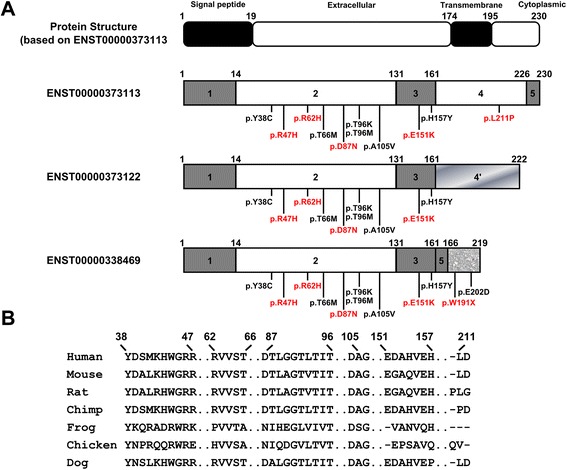
BACKGROUND: TREM2 encodes for triggering receptor expressed on myeloid cells 2 and has rare, coding variants that associate with risk for late-onset Alzheimer's disease (LOAD) in Caucasians of European and North-American origin. This study evaluated the role of TREM2 in LOAD risk in African-American (AA) subjects. We performed exonic sequencing and validation in two independent cohorts of >800 subjects. We selected six coding variants (p.R47H, p.R62H, p.D87N, p.E151K, p.W191X, and p.L211P) for case-control analyses in a total of 906 LOAD cases vs. 2,487 controls. RESULTS: We identified significant LOAD risk association with p.L211P (p=0.01, OR=1.27, 95%CI=1.05-1.54) and suggestive association with p.W191X (p=0.08, OR=1.35, 95%CI=0.97-1.87). Conditional analysis suggests that p.L211P, which is in linkage disequilibrium with p.W191X, may be the stronger variant of the two, but does not rule out independent contribution of the latter. TREM2 p.L211P resides within the cytoplasmic domain and p.W191X is a stop-gain mutation within the shorter TREM-2V transcript. The coding variants within the extracellular domain of TREM2 previously shown to confer LOAD risk in Caucasians were extremely rare in our AA cohort and did not associate with LOAD risk. CONCLUSIONS: Our findings suggest that TREM2 coding variants also confer LOAD risk in AA, but implicate variants within different regions of the gene than those identified for Caucasian subjects. These results underscore the importance of investigating different ethnic populations for disease risk variant discovery, which may uncover allelic heterogeneity with potentially diverse mechanisms of action.
Overview
The claims and statistics of this paper haven’t been checked yet.
Free: it reads the open-access text and checks the first 5 claims that cite a source we can check. Create a free account to check every claim.
Integrity signals
Registry
Cites
Statistics
Figures
Verification
Claims the paper makes
The claims and statistics of this paper haven’t been checked yet.
Free: it reads the open-access text and checks the first 5 claims that cite a source we can check. Create a free account to check every claim.
Claims other papers make about this one
Each is checked against this paper’s own text: does it say what the citing paper says it does?
The cited source says what the claim attributes to it.
In the citing paper
“Given that TREM2 mutations are associated with increased risk of AD in humans126,176,177, a protective role for this receptor appears to be the predominant biologic effect.”
From Microglial signatures and their role in health and disease (2018) · cites this paper as [177]
The cited source says what the claim attributes to it.
In the citing paper
“Since the identification of R47H, additional rare variants in TREM2 have been associated with AD risk [138–140]”
From Genetic architecture of Alzheimer's disease (2020) · cites this paper as [140]
Self-check
Percentages, sums and reported differences re-computed from the paper’s own numbers.
The self-check needs the paper’s full text.
Citations
Cites
The Amyloid Hypothesis of Alzheimer’s Disease: Progress and Problems on the Road to Therapeutics
Hardy, J., & Selkoe, D. J. (2002) · Science · doi:10.1126/science.1072994 · Cited by 13,864 · cited 1×
“…of which was shown to undergo proteolytic processing via an ADAM or MMP protein family member [23] and in a more recent report, by ADAM10 [24], followed by intramembranous cleavage of its C-terminal fragment (CTF) by γ -secretase, which also cleaves amyloid precursor protein (APP) (reviewed [25]).”
BackgroundAmyloid oligomers exacerbate tau pathology in a mouse model of tauopathy
Selenica, M.-L. B., Brownlow, M., Jimenez, J. P., Lee, D. C., Pena, G., Dickey, C. A., Gordon, M. N., & Morgan, D. (2013) · Neurodegenerative Diseases · doi:10.1159/000337230 · Cited by 10,359
TREM2 Variants in Alzheimer's Disease
Guerreiro, R., Wojtas, A., Bras, J., Carrasquillo, M., Rogaeva, E., Majounie, E., Cruchaga, C., Sassi, C., Kauwe, J. S. K., Younkin, S., et al. (2013) · New England Journal of Medicine · doi:10.1056/nejmoa1211851 · Cited by 3,020 · cited 9×
“heterozygous state in a different Caucasian AD subject [6].”
BackgroundResultInfluentialSelf-citationVariant of TREM2 Associated with the Risk of Alzheimer's Disease
Jonsson, T., Stefansson, H., Steinberg, S., Jonsdottir, I., Jonsson, P. V., Snaedal, J., Bjornsson, S., Huttenlocher, J., Levey, A. I., Lah, J. J., et al. (2013) · New England Journal of Medicine · doi:10.1056/nejmoa1211103 · Cited by 2,558 · cited 3×
“D87N [6,7].”
Self-citationBouchon, A., Dietrich, J., & Colonna, M. (2000) · The Journal of Immunology · doi:10.4049/jimmunol.164.10.4991 · Cited by 1,284 · cited 1×
“Background TREM2 is a transmembrane receptor expressed on microglia, macrophages, monocyte-derived dendritic cells, and osteoclasts [1,2].”
BackgroundTREM2 mutations implicated in neurodegeneration impair cell surface transport and phagocytosis
Kleinberger, G., Yamanishi, Y., Suárez-Calvet, M., Czirr, E., Lohmann, E., Cuyvers, E., Struyfs, H., Pettkus, N., Wenninger-Weinzierl, A., Mazaheri, F., et al. (2014) · Science Translational Medicine · doi:10.1126/scitranslmed.3009093 · Cited by 798 · cited 4×
“TREM2 is a type-I transmembrane protein, the extra-cellular domain of which was shown to undergo proteolytic processing via an ADAM or MMP protein family member [23] and in a more recent report, by ADAM10 [24], followed by intramembranous cleavage of its C-terminal fragment (CTF) by γ -secretase, which also cleaves am…”
BackgroundInfluentialPaloneva, J., Manninen, T., Christman, G., Hovanes, K., Mandelin, J., Adolfsson, R., Bianchin, M., Bird, T., Miranda, R., Salmaggi, A., et al. (2002) · The American Journal of Human Genetics · doi:10.1086/342259 · Cited by 683 · cited 1×
“called Nasu-Hakola disease) characterized by progressive early-onset dementia and bone lesions leading to fractures [3-5].”
BackgroundBouchon, A., Hernández-Munain, C., Cella, M., & Colonna, M. (2001) · The Journal of Experimental Medicine · doi:10.1084/jem.194.8.1111 · Cited by 460 · cited 1×
“Background TREM2 is a transmembrane receptor expressed on microglia, macrophages, monocyte-derived dendritic cells, and osteoclasts [1,2].”
BackgroundReitz, C., Jun, G., Naj, A., Rajbhandary, R., Vardarajan, B. N., Wang, L.-S., Valladares, O., Lin, C.-F., Larson, E. B., Graff-Radford, N. R., et al. (2013) · JAMA · doi:10.1001/jama.2013.2973 · Cited by 431
Self-citationRayaprolu, S., Mullen, B., Baker, M., Lynch, T., Finger, E., Seeley, W. W., Hatanpaa, K. J., Lomen-Hoerth, C., Kertesz, A., Bigio, E. H., et al. (2013) · Molecular Neurodegeneration · doi:10.1186/1750-1326-8-19 · Cited by 404
Self-citation
Cited by
Items 101–155 of 155
Pilat, D. J., Le, H., Prokopenko, D., Lin, C.-C. J., Eimer, W. A., Quinti, L., Gavrilles, E. P., Garcia, S. N., Heitman, S. N., McGinty, D., et al. (2026) · Neuron · doi:10.1016/j.neuron.2025.09.032 · Cited by 14
Antwi, M. H., Bockarie, A. S., Osei, G. N., Donkor, D. M., & Simpong, D. L. (2025) · Alzheimer s & Dementia · doi:10.1002/alz.70514 · Cited by 15
“34 However, the implicated variants are located in different regions of the gene in AAs compared to those found in Caucasian individuals.”
Uddin, M. S., Kabir, M. T., Mamun, A. A., Behl, T., Mansouri, R. A., Aloqbi, A. A., Perveen, A., Hafeez, A., & Ashraf, G. M. (2020) · Current Pharmaceutical Design · doi:10.2174/1381612826666200531151004 · Cited by 20
Tosto, G., & Reitz, C. (2016) · Molecular and Cellular Probes · doi:10.1016/j.mcp.2016.09.001 · Cited by 15
Self-citationBrain MRI findings related to Alzheimer's disease in older African American adults
Carmichael, O. T., & Newton, R. L. (2019) · Progress in molecular biology and translational science · doi:10.1016/bs.pmbts.2019.04.002 · Cited by 13
Systems biology of Alzheimer’s Disease: a scoping review of key pathways and mechanisms
Bice, P. J., Nho, K. T., Ertekin‐Taner, N., & Saykin, A. J. (2026) · Molecular Neurodegeneration · doi:10.1186/s13024-026-00934-4 · Cited by 18
“The TREM2 R47H missense variant increases AD risk [57, 71, 297–300] by approximately 2-3-fold [73], whereas putative regulatory variants that enhance TREM2 expression appear protective [58, 297], highlighting the central role of microglial activation, phagocytosis, and innate immune signaling in AD…”
Self-citationGiorgio, J., Jonson, C., Wang, Y., Yokoyama, J. S., Wang, J., Jagust, W. J., & Initiative, O. B. O. T. A. D. N. (2025) · Nature Communications · doi:10.1038/s41467-025-60370-8 · Cited by 15
“We selected 6 rare variant single nucleotide polymorphisms (SNPs) on the coding region of the TREM2 gene that have previously been associated with increased AD risk rs2234256, rs2234255, rs142232675, rs143332484, rs75932628, rs2234253 22,67 – 71 .”
Identification of a rare coding variant in TREM2 in a Chinese individual with Alzheimer’s disease
Bonham, L. W., Sirkis, D. W., Fan, J., Aparicio, R. E., Tse, M., Ramos, E. M., Wang, Q., Coppola, G., Rosen, H. J., Miller, B. L., et al. (2017) · Neurocase · doi:10.1080/13554794.2017.1294182 · Cited by 10
“The R47H finding has not yet been replicated in East Asian (Huang et al., 2015; Ma et al., 2014; Miyashita et al., 2014; Yu et al., 2014) nor other diverse populations (Jin et al., 2015).”
BackgroundGarcia, C., Banerjee, A., Montgomery, C. B., Adcock, L., Maezawa, I., Ramsey, J. J., Grodzki, A. C., Kim, K., & Cortopassi, G. A. (2025) · Frontiers in Aging · doi:10.3389/fragi.2025.1628835 · Cited by 10
“Changes in TREM2 expression are connected to AD pathophysiology (Gratuze et al., 2018), and TREM2 variants confer AD risk (Benitez et al., 2013; Jin et al., 2014; Jin et al., 2015; Jonsson et al., 2013; Guerreiro et al., 2013).”
Bustos, C., Ortega-Rojas, J., Mahecha, M. F., Arboleda, G., Vásquez, R., Pardo, R., & Arboleda, H. (2018) · Alzheimer Disease & Associated Disorders · doi:10.1097/wad.0000000000000275 · Cited by 10
Multi-scale modeling for systematically understanding the key roles of microglia in AD development
Ji, Z., Liu, C., Zhao, W., Soto, C. A., & Zhou, X. (2021) · Computers in Biology and Medicine · doi:10.1016/j.compbiomed.2021.104374 · Cited by 16
Reappraisal of the Concept of Accelerated Aging in Neurodegeneration and Beyond
Statsenko, Y. A., Kuznetsov, N. V., Morozova, D., Liaonchyk, K., Simiyu, G. L., Smetanina, D., Kashapov, A., Meribout, S., Gorkom, K., Hamoudi, R., et al. (2023) · Cells · doi:10.3390/cells12202451 · Cited by 11
“In dementia with Lewy bodies, multi-cognitive decline and corticobasal degeneration, the risk factors shown to be involved are the APOE e4 allele and the mutation spectrum for TREM2 gene [78–87].”
BackgroundAvalos, B., Kulbe, J. R., Ford, M. K., Laird, A. E., Walter, K., Mante, M., Florio, J. B., Boustani, A., Chaillon, A., Schlachetzki, J. C. M., et al. (2024) · Viruses · doi:10.3390/v16101509 · Cited by 11
Haploinsufficiency and Alzheimer’s Disease: The Possible Pathogenic and Protective Genetic Factors
Bagyinszky, E., & An, S. S. A. (2024) · International Journal of Molecular Sciences · doi:10.3390/ijms252211959 · Cited by 10
“The Gln33Ter mutation was reported in cases of NHD, AD, and FTD [88–94].”
Identification of novel risk genes for Alzheimer’s disease by integrating genetics from hippocampus
Li, J., Li, L., Cai, S., Song, K., & Hu, S. (2024) · Scientific Reports · doi:10.1038/s41598-024-78181-0 · Cited by 12
“Additionally, the triggering receptor expressed on myeloid cells 2 (TREM2) gene has emerged as another noteworthy contributor, elevating the risk ratio by 2.9% for the development of AD 19,20 .”
InfluentialSinghaarachchi, P. H., Antal, P., Calon, F., Culmsee, C., Delpech, J.-C., Feldotto, M., Geertsema, J., Hoeksema, E. E., Kőrösi, A., Layé, S., et al. (2025) · Progress in Neurobiology · doi:10.1016/j.pneurobio.2025.102821 · Cited by 13
TREM2 promotes natural killer cell development in CD3−CD122+NK1.1+ pNK cells
Lee, H.-Y., Lee, E., Yi, J., Ji, K.-Y., Kim, S., Choi, H.-R., Yee, S., Kang, H., & Kim, E. (2021) · BMC Immunology · doi:10.1186/s12865-021-00420-0 · Cited by 10
Neurodegenerative Disease Risk in Carriers of Autosomal Recessive Disease
Vieira, S. R. L., & Morris, H. R. (2021) · Frontiers in Neurology · doi:10.3389/fneur.2021.679927 · Cited by 10
“R47H-AD association failed to be confirmed in several East Asian and other cohorts, perhaps due to diverse populationspecific TREM2 allele frequencies (120, 121).”
BackgroundGenetic Analysis of TREM2 Variants in Tunisian Patients with Alzheimer's Disease
Landoulsi, Z., Djebara, M. B., Kacem, I., Sidhom, Y., Kéfi, R., Abdelhak, S., Gargouri, A., & Gouider, R. (2018) · Medical Principles and Practice · doi:10.1159/000489779 · Cited by 10
Novel Susceptibility Loci for Alzheimer's DXSisease
Reitz, C. (2015) · Future Neurology · doi:10.2217/fnl.15.42 · Cited by 10
Self-citationBenefits and Challenges of Rare Genetic Variation in Alzheimer’s Disease
Grozeva, D., Saad, S., Menzies, G. E., & Sims, R. (2019) · Current Genetic Medicine Reports · doi:10.1007/s40142-019-0161-5 · Cited by 11
Single cell molecular alterations reveal target cells and pathways of conditioned fear memory
Shen, M., Shang, M., Tian, R.-F., Hu, Y., Han, Q., Hu, J., An, G., Wang, B., Cao, Z., Lin, X., et al. (2023) · Brain Research · doi:10.1016/j.brainres.2023.148309 · Cited by 8
Ray, N. R., Kunkle, B. W., Hamilton‐Nelson, K. L., Kurup, J. T., Rajabli, F., Coşacak, M. İ., Kızıl, Ç., Jean‐Francois, M. N., Cuccaro, M. L., Reyes‐Dumeyer, D., et al. (2023) · Alzheimer s & Dementia · doi:10.1002/alz.078904 · Cited by 6
“Of the variants previously implicated in either AD, ADRD, or AD by proxy in African Americans by other studies[30-35], rs112404845 in COBL (P = 6.”
BackgroundResultSelf-citationProteomics as an innovative tool to investigate frontotemporal disorders
Agresta, A. M., Palma, A. D., Bardoni, A., Salvini, R., Iadarola, P., & Mauri, P. (2015) · PROTEOMICS - CLINICAL APPLICATIONS · doi:10.1002/prca.201500090 · Cited by 7
“Of note, genetic variants in TREM2 have been linked to AD, PD, amyotrophic lateral sclerosis (ALS), FTD, and FTD-like syndrome without bone involvement [15, 16].”
BackgroundRikos, D., Siokas, V., Mentis, A. A., Aloizou, A., Liampas, I., Tsouris, Z., Peristeri, E., Stamati, P., Hadjigeorgiou, G. M., & Dardiotis, E. (2022) · International Journal of Neuroscience · doi:10.1080/00207454.2022.2150844 · Cited by 15
Knockdown of astrocytic TREM2 in the hippocampus relieves cognitive decline in elderly male mice
Wei, M.-D., Lan, Y.-X., Lu, K., Wang, Y., & Chen, W. (2020) · Behavioural Brain Research · doi:10.1016/j.bbr.2020.112939 · Cited by 5
TREM2 coding variants in Slovak Alzheimer's disease patients
Ďurmanová, V., Javor, J., Párnická, Z., Minárik, G., Ocenasova, A., Vašečková, B., Kiralyova, I., Šutovský, S., Petrovič, R., & Shawkatová, I. (2022) · Journal of Integrative Neuroscience · doi:10.31083/j.jin2104105 · Cited by 5
“served in European [38–46], and Afro-American populations [47,48].”
BackgroundResultAlzheimer’s disease: a step closer to understanding type 3 diabetes in African Americans
Ferguson, S. A., Panos, J., Sloper, D. T., Varma, V., & Sarkar, S. (2021) · Metabolic Brain Disease · doi:10.1007/s11011-021-00754-z · Cited by 6
Genetics of A lzheimer's Disease
Brookes, K. J., & Morgan, K. (2017) · Wiley eBooks · doi:10.1002/9780470015902.a0020228.pub2 · Cited by 6
Kuchenbecker, L. A., Thompson, K. J., Hurst, C. D., Huang, Y.-N., Heckman, M. G., Reddy, J. S., Nguyen, T., Casellas, H. L., Sotelo, K. D., Reddy, D. J., et al. (2025) · Alzheimer s & Dementia · doi:10.1002/alz.70505 · Cited by 7
Self-citationKhaled, M., Al-Jamal, H., Tajer, L., & El-Mir, R. (2024) · Journal of Alzheimer s Disease · doi:10.3233/jad-231432 · Cited by 4
The Panomics Approach in Neurodegenerative Disorders
Szatmári, B., Balicza, P., Németh, G., & Molnár, M. J. (2019) · Current Medicinal Chemistry · doi:10.2174/0929867324666170705120038 · Cited by 4
Farias, F., Benítez, B. A., & Cruchaga, C. (2021) · Neurobiology of Disease · doi:10.1016/j.nbd.2020.105247 · Cited by 6
“Variants in the TREM2 (triggering receptor expressed on myeloid cells 2) gene have been associated with increased risk of AD in different populations (Guerreiro et al., 2013; Jonsson et al., 2013; Benitez et al., 2013; Jin et al., 2014; Jin et al., 2015).”
Self-citationAn Update on Neuroaging on Earth and in Spaceflight
Kuznetsov, N. V., Statsenko, Y. A., & Ljubisavljević, M. (2025) · International Journal of Molecular Sciences · doi:10.3390/ijms26041738 · Cited by 7
“In addition, the APOE e4 allele and mutation spectrum for TREM2 gene were found to be the risk factors for developing dementia with Lewy bodies, multi-cognitive decline, and corticobasal degeneration [132–141].”
Biophysical characterization of TREM2 missense variants implicated in neurodegenerative disease
Pillai, J. P., Sung, K., Shi, L. Z., & Wu, C. (2025) · Computational and Structural Biotechnology Journal · doi:10.1016/j.csbj.2025.07.003 · Cited by 3
“The A105T variant has only been reported in one study evaluating mutations in FTD subtypes [39], while A105V was only confirmed to not be associated with AD in two clinical studies [40,41].”
Zhong, Z., Ulmschneider, M. B., & Lorenz, C. D. (2025) · Journal of Chemical Information and Modeling · doi:10.1021/acs.jcim.5c01891 · Cited by 2
Multi-ancestry studies in multi-omics of Alzheimer’s disease: Recent insights and future directions
Shir, D., Seifar, F., & Ertekin‐Taner, N. (2026) · Current Opinion in Neurobiology · doi:10.1016/j.conb.2026.103205 · Cited by 3
Self-citationGenetic and Epigenetic Architecture of Alzheimer’s Dementia
Cervera‐Carles, L., & Clarimón, J. (2016) · Current Genetic Medicine Reports · doi:10.1007/s40142-016-0086-1 · Cited by 4
Navarro, E., & Montesinos, J. (2025) · Contact · doi:10.1177/25152564241312807 · Cited by 6
“Other TREM2 coding variants have been associated with increased AD risk in African-Americans (Jin et al., 2015), although no association of TREM2 and increased AD risk has been found in Asian populations (Jiao et al., 2014; Miyashita et al., 2014; Yu et al., 2014).”
Cochran, J. N., McKinley, E., Cochran, M., Amaral, M. D., Moyers, B. A., Lasseigne, B. N., Gray, D. E., Lawlor, J. M. J., Prokop, J. W., Geier, E. G., et al. (2019) · bioRxiv (Cold Spring Harbor Laboratory) · doi:10.1101/748046 · Cited by 2
Reddy, J. S., Wang, X., Allen, M., Carrasquillo, M. M., Biernacka, J. M., Jenkins, G. D., Coombes, B. J., Belbin, O., Golde, T. E., Ertekin‐Taner, N., et al. (2022) · medRxiv · doi:10.1101/2022.07.12.22277557 · Cited by 3
“myeloid cells 2 (TREM2) strongly increase risk of AD in populations of European [9-16] and African American ancestry [17, 18].”
BackgroundSelf-citationPottorf, T. S., Lane, E. L., & Álvarez, F. J. (2025) · Cells · doi:10.3390/cells14191520 · Cited by 1
Genetics of Alzheimer's Disease: An Update
Tang, M., & Reitz, C. (2017) · Future Neurology · doi:10.2217/fnl-2017-0003 · Cited by 1
Self-citationTakahashi, K. (2018) · Clinical and Experimental Neuroimmunology · doi:10.1111/cen3.12479 · Cited by 1
How understudied populations leverage our understanding of Alzheimer’s disease genetics
Dehghani, N., Brás, J., & Guerreiro, R. J. (2020) · Alzheimer s & Dementia · doi:10.1002/alz.044901 · Cited by 2
Reddy, J. S., Wang, X., Allen, M., Carrasquillo, M. M., Biernacka, J. M., Jenkins, G. D., Coombes, B. J., Belbin, O., Golde, T. E., Ertekin‐Taner, N., et al. (2022) · Research Square · doi:10.21203/rs.3.rs-1885551/v1 · Cited by 1
Self-citationKuchenbecker, L. A., Thompson, K. J., Hurst, C. D., Opdenbosch, B. M., Heckman, M. G., Reddy, J. S., Nguyen, T., Casellas, H. L., Sotelo, K. D., Reddy, D. J., et al. (2024) · bioRxiv (Cold Spring Harbor Laboratory) · doi:10.1101/2024.07.27.605373 · Cited by 1
Self-citationStatistical Analyses to Detect and Refine Genetic Associations with Neurodegenerative Diseases
Katsumata, Y. (2017) · UKnowledge (University of Kentucky) · doi:10.13023/etd.2017.486
“in East Asian and African American populations [168-171].”
BackgroundGenetic Risk Factors for Complex Forms of Alzheimer’s Disease
Bellenguez, C., & Lambert, J. (2018) · Springer eBooks · doi:10.1007/978-3-319-72938-1_4
Jadhav, V. (2021) · IUScholarWorks (Indiana University) · doi:10.7912/c2/2086
Renton, A. E., & Goate, A. (2017) · Oxford University Press eBooks · doi:10.1093/med/9780190681425.003.0051
Self-citationDegenerative Disorders of Cognition
O’Brien, K. S., Mechanic-Hamilton, D. J., Rascovsky, K., & Hamilton, R. H. (2024) · Springer eBooks · doi:10.1007/978-3-031-62727-9_4
Pillai, J. P., Sung, K., Shi, L. Z., & Wu, C. (2025) · bioRxiv (Cold Spring Harbor Laboratory) · doi:10.1101/2025.05.25.656054
“The A105T variant has only been reported in one study evaluating mutations in FTD subtypes (Thelen et al., 2014), while A105V was only confirmed to not be associated with AD in two clinical studies (Sims et al., 2017; Jin et al., 2015).”
Wang, L., Nykänen, N.-P., Western, D., Gorijala, P., Timsina, J., Li, F., Wang, Z., Ali, M., Yang, C., Liu, M., et al. (2024) · Figshare · doi:10.6084/m9.figshare.24940635
Self-citationWang, L., Nykänen, N.-P., Western, D., Gorijala, P., Timsina, J., Li, F., Wang, Z., Ali, M., Yang, C., Liu, M., et al. (2024) · Figshare · doi:10.6084/m9.figshare.24940872
Self-citation
Metadata
- Authors
- Jin, S. C., Carrasquillo, M. M., Benitez, B. A., Skorupa, T., Carrell, D., Patel, D., Lincoln, S., Krishnan, S., Kachadoorian, M., Reitz, C., Mayeux, R., Wingo, T. S., Lah, J. J., Levey, A. I., Murrell, J., Hendrie, H., Foroud, T., Graff-Radford, N. R., Goate, A. M., Cruchaga, C., & Ertekin-Taner, N.
- Affiliations
- Washington University in St. Louis (US)
- Mayo Clinic (US)
- Columbia University Irving Medical Center (US)
- Emory University (US)
- Indiana University Indianapolis (US)
- Regenstrief Institute (US)
- Corresponding author
- Cruchaga, Carlos
- ORCID
- Venue
- Molecular Neurodegeneration
- Published
- 2015-04-10
- Volume
- 10
- Issue
- 1
- Pages
- 19-19
- ISSN
- 1750-1326 (ISSN-L)
- PMC
- PMC4426167
- OpenAlex
- W2167516157
- Semantic Scholar
- 6b6748ba9c74522820e7f11d849a175d65dc12e1
- Cited by
- 153
- References
- 28
- Citations by year
- 2026: 2 · 2025: 17 · 2024: 13 · 2023: 7 · 2022: 11 · 2021: 17 · 2020: 13 · 2019: 16 · 2018: 21 · 2017: 18 · 2016: 12 · 2015: 6
- FWCI
- 14.00
- Type
- journal article
- Language
- en
- Open access
- gold
- doi.org
- Locations
- Molecular Neurodegeneration (publishedVersion, cc-by)
- Europe PMC (PubMed Central) (publishedVersion, cc-by)
- PubMed Central (publishedVersion, cc-by)
- PubMed (publishedVersion)
- Research Explorer (The University of Manchester) (publishedVersion, other-oa)
- Digital Commons@Becker (Washington University School of Medicine) (submittedVersion)
- eScholarship (California Digital Library) (submittedVersion, cc-by)
- IUScholarWorks (Indiana University) (submittedVersion, cc-by)
- Purdue University Indianapolis (Indiana University) (submittedVersion, cc-by)
- Funders
- U.S. Department of Veterans Affairs (IK2 BX001820)
- Alzheimer's Association (R01-AG044546, P50 AG025688, AG05681, NIRG-11-200110, R01 AG035083)
- American Federation for Aging Research
- Emory University (P50AG025688, AG025688)
- Alvin J. Siteman Cancer Center (CA91842, #P30 CA91842)
- GHR Foundation
- Georgia Clinical and Translational Science Alliance (UL1TR000448)
- National Institutes of Health (1rc2hl103010-01, NIH P50, UL1TR000448, 5p30ns069329-02, AG05681, AG046139, AG025688, AG 03991, AG026276, CA91842, NS069329)
- Alzheimer's Disease Research Center, Emory University (P50 AG025688, AG025688)
- National Institute on Aging (AG 10133, P50 AG0016574, P30AG010133, AG03991, R01AG037212, AG09956, AG046139, AG 025688, K23AG034550, RF1AG015473, AG 05681, R01AG035083, U24 AG21886, P 50 AG05681, R01AG041797, R01AG044546, AG026276, P50AG005681, R01AG032990, P01 AG0 3991, P01AG003991, AG035083, U24AG026395, U01AG046139, P50AG025688, P30 AG-10133, P01AG026276, U24AG021886, P50AG016574, R01AG009956)
- National Heart, Lung, and Blood Institute (HL 102923, RC2HL102925, HL-102924, HL-102925, RC2HL102926, RC2HL102923, UC2HL102924, RC2HL-103010, UC2HL102925, HL 103010, UC2HL102923, UC2HL103010, RC2HL102924, UC2HL102926, HL-102926)
- National Cancer Institute (P30 CA 91842, CA91842, P30CA091842)
- National Institute of Neurological Disorders and Stroke (P30-NS069329, R01NS080820)
- National Center for Research Resources (P30 CA91842)
- National Center for Advancing Translational Sciences
- Topics
- Life Sciences › Neuroscience › Cellular and Molecular Neuroscience › Alzheimer's disease research and treatments
- Health Sciences › Medicine › Psychiatry and Mental health › Dementia and Cognitive Impairment Research
- Life Sciences › Neuroscience › Neurology › Neuroinflammation and Neurodegeneration Mechanisms
- Keywords
- TREM2, Alzheimer's disease, late-onset Alzheimer's disease, African Americans, genetic risk variants, allelic heterogeneity, ethnic differences in genetic risk, myeloid cells, conditional analysis, linkage disequilibrium
- MeSH terms
- Alzheimer Disease, Black or African American, Humans, Membrane Glycoproteins, Mutation, Receptors, Immunologic, Risk Factors, Age of Onset, Genetic Predisposition to Disease
About these checks
Registry, retraction, Cites and statistics results are computed, not judged, with one exception: a printed reference that no index lists is read once by a model before it counts as a citation error. Claims are extracted by a model and kept only when their quote appears verbatim in the text; each cited source is then checked, with a model’s help, for whether it says what the claim relies on. Those verdicts can be wrong — read the claim’s quote and the cited source before relying on one.
Statistics and arithmetic are recomputed, not judged.
Confidence bands are shown only for fields calibrated on our annotated test set. None is calibrated yet, so no band is shown.
What counts as a claim ›How we measure confidence ›How we check this ›
Are you an author, or do you see a problem with this page? Request a review
Data sources
Bibliographic data: Semantic Scholar, OpenAlex, Crossref.
Contains information from the Semantic Scholar Academic Graph Datasets, made available under the ODC Attribution License (ODC-BY 1.0).
Semantic Scholar’s data is described in: Kinney, R., et al. (2023). The Semantic Scholar Open Data Platform. arXiv:2301.10140.
