

TREM2 is associated with increased risk for Alzheimer’s disease in African Americans
Open accessThe DOI matches its Crossref record; 28 of the 28 references it cites were found in a registry or an index.
Abstract
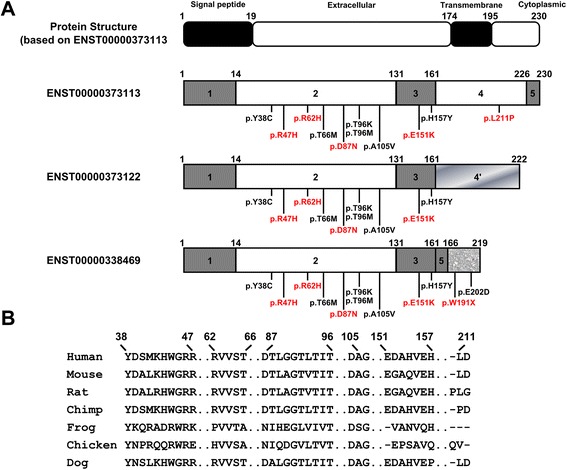
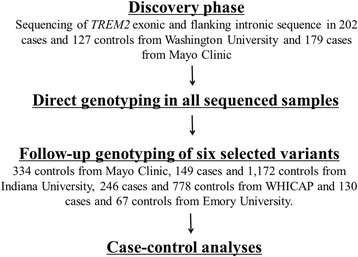
BACKGROUND: TREM2 encodes for triggering receptor expressed on myeloid cells 2 and has rare, coding variants that associate with risk for late-onset Alzheimer's disease (LOAD) in Caucasians of European and North-American origin. This study evaluated the role of TREM2 in LOAD risk in African-American (AA) subjects. We performed exonic sequencing and validation in two independent cohorts of >800 subjects. We selected six coding variants (p.R47H, p.R62H, p.D87N, p.E151K, p.W191X, and p.L211P) for case-control analyses in a total of 906 LOAD cases vs. 2,487 controls. RESULTS: We identified significant LOAD risk association with p.L211P (p=0.01, OR=1.27, 95%CI=1.05-1.54) and suggestive association with p.W191X (p=0.08, OR=1.35, 95%CI=0.97-1.87). Conditional analysis suggests that p.L211P, which is in linkage disequilibrium with p.W191X, may be the stronger variant of the two, but does not rule out independent contribution of the latter. TREM2 p.L211P resides within the cytoplasmic domain and p.W191X is a stop-gain mutation within the shorter TREM-2V transcript. The coding variants within the extracellular domain of TREM2 previously shown to confer LOAD risk in Caucasians were extremely rare in our AA cohort and did not associate with LOAD risk. CONCLUSIONS: Our findings suggest that TREM2 coding variants also confer LOAD risk in AA, but implicate variants within different regions of the gene than those identified for Caucasian subjects. These results underscore the importance of investigating different ethnic populations for disease risk variant discovery, which may uncover allelic heterogeneity with potentially diverse mechanisms of action.
Overview
The claims and statistics of this paper haven’t been checked yet.
Free: it reads the open-access text and checks the first 5 claims that cite a source we can check. Create a free account to check every claim.
Integrity signals
Registry
Cites
Statistics
Figures
Verification
Claims the paper makes
The claims and statistics of this paper haven’t been checked yet.
Free: it reads the open-access text and checks the first 5 claims that cite a source we can check. Create a free account to check every claim.
Claims other papers make about this one
Each is checked against this paper’s own text: does it say what the citing paper says it does?
The cited source says what the claim attributes to it.
In the citing paper
“Given that TREM2 mutations are associated with increased risk of AD in humans126,176,177, a protective role for this receptor appears to be the predominant biologic effect.”
From Microglial signatures and their role in health and disease (2018) · cites this paper as [177]
The cited source says what the claim attributes to it.
In the citing paper
“Since the identification of R47H, additional rare variants in TREM2 have been associated with AD risk [138–140]”
From Genetic architecture of Alzheimer's disease (2020) · cites this paper as [140]
Self-check
Percentages, sums and reported differences re-computed from the paper’s own numbers.
The self-check needs the paper’s full text.
Citations
Cites
The Amyloid Hypothesis of Alzheimer’s Disease: Progress and Problems on the Road to Therapeutics
Hardy, J., & Selkoe, D. J. (2002) · Science · doi:10.1126/science.1072994 · Cited by 13,864 · cited 1×
“…of which was shown to undergo proteolytic processing via an ADAM or MMP protein family member [23] and in a more recent report, by ADAM10 [24], followed by intramembranous cleavage of its C-terminal fragment (CTF) by γ -secretase, which also cleaves amyloid precursor protein (APP) (reviewed [25]).”
BackgroundAmyloid oligomers exacerbate tau pathology in a mouse model of tauopathy
Selenica, M.-L. B., Brownlow, M., Jimenez, J. P., Lee, D. C., Pena, G., Dickey, C. A., Gordon, M. N., & Morgan, D. (2013) · Neurodegenerative Diseases · doi:10.1159/000337230 · Cited by 10,359
TREM2 Variants in Alzheimer's Disease
Guerreiro, R., Wojtas, A., Bras, J., Carrasquillo, M., Rogaeva, E., Majounie, E., Cruchaga, C., Sassi, C., Kauwe, J. S. K., Younkin, S., et al. (2013) · New England Journal of Medicine · doi:10.1056/nejmoa1211851 · Cited by 3,020 · cited 9×
“heterozygous state in a different Caucasian AD subject [6].”
BackgroundResultInfluentialSelf-citationVariant of TREM2 Associated with the Risk of Alzheimer's Disease
Jonsson, T., Stefansson, H., Steinberg, S., Jonsdottir, I., Jonsson, P. V., Snaedal, J., Bjornsson, S., Huttenlocher, J., Levey, A. I., Lah, J. J., et al. (2013) · New England Journal of Medicine · doi:10.1056/nejmoa1211103 · Cited by 2,558 · cited 3×
“D87N [6,7].”
Self-citationBouchon, A., Dietrich, J., & Colonna, M. (2000) · The Journal of Immunology · doi:10.4049/jimmunol.164.10.4991 · Cited by 1,284 · cited 1×
“Background TREM2 is a transmembrane receptor expressed on microglia, macrophages, monocyte-derived dendritic cells, and osteoclasts [1,2].”
BackgroundTREM2 mutations implicated in neurodegeneration impair cell surface transport and phagocytosis
Kleinberger, G., Yamanishi, Y., Suárez-Calvet, M., Czirr, E., Lohmann, E., Cuyvers, E., Struyfs, H., Pettkus, N., Wenninger-Weinzierl, A., Mazaheri, F., et al. (2014) · Science Translational Medicine · doi:10.1126/scitranslmed.3009093 · Cited by 798 · cited 4×
“TREM2 is a type-I transmembrane protein, the extra-cellular domain of which was shown to undergo proteolytic processing via an ADAM or MMP protein family member [23] and in a more recent report, by ADAM10 [24], followed by intramembranous cleavage of its C-terminal fragment (CTF) by γ -secretase, which also cleaves am…”
BackgroundInfluentialPaloneva, J., Manninen, T., Christman, G., Hovanes, K., Mandelin, J., Adolfsson, R., Bianchin, M., Bird, T., Miranda, R., Salmaggi, A., et al. (2002) · The American Journal of Human Genetics · doi:10.1086/342259 · Cited by 683 · cited 1×
“called Nasu-Hakola disease) characterized by progressive early-onset dementia and bone lesions leading to fractures [3-5].”
BackgroundBouchon, A., Hernández-Munain, C., Cella, M., & Colonna, M. (2001) · The Journal of Experimental Medicine · doi:10.1084/jem.194.8.1111 · Cited by 460 · cited 1×
“Background TREM2 is a transmembrane receptor expressed on microglia, macrophages, monocyte-derived dendritic cells, and osteoclasts [1,2].”
BackgroundReitz, C., Jun, G., Naj, A., Rajbhandary, R., Vardarajan, B. N., Wang, L.-S., Valladares, O., Lin, C.-F., Larson, E. B., Graff-Radford, N. R., et al. (2013) · JAMA · doi:10.1001/jama.2013.2973 · Cited by 431
Self-citationRayaprolu, S., Mullen, B., Baker, M., Lynch, T., Finger, E., Seeley, W. W., Hatanpaa, K. J., Lomen-Hoerth, C., Kertesz, A., Bigio, E. H., et al. (2013) · Molecular Neurodegeneration · doi:10.1186/1750-1326-8-19 · Cited by 404
Self-citationGuerreiro, R. J., Lohmann, E., Brás, J. M., Gibbs, J. R., Rohrer, J. D., Gurunlian, N., Dursun, B., Bilgic, B., Hanagasi, H., Gurvit, H., et al. (2013) · JAMA Neurology · doi:10.1001/jamaneurol.2013.579 · Cited by 374 · cited 1×
“its homozygous state in the proband of a Turkish pedigree with an FTD-like syndrome [16] and also observed in its”
BackgroundDAP12/TREM2 deficiency results in impaired osteoclast differentiation and osteoporotic features
Paloneva, J., Mandelin, J., Kiialainen, A., Böhling, T., Prudlo, J., Hakola, P., Haltia, M., Konttinen, Y. T., & Peltonen, L. (2003) · The Journal of Experimental Medicine · doi:10.1084/jem.20030027 · Cited by 318 · cited 1×
“called Nasu-Hakola disease) characterized by progressive early-onset dementia and bone lesions leading to fractures [3-5].”
BackgroundCoding variants in TREM2 increase risk for Alzheimer's disease
Jin, S. C., Benitez, B. A., Karch, C. M., Cooper, B., Skorupa, T., Carrell, D., Norton, J. B., Hsu, S., Harari, O., Cai, Y., et al. (2014) · Human Molecular Genetics · doi:10.1093/hmg/ddu277 · Cited by 314 · cited 10×
“In our study of AA subjects we did not find a significant LOAD risk association with p.R47H, the most widely replicated TREM2 LOAD risk variant in Caucasians, or with the additional risk variants p.R62H or p.D87N [6,7].”
BackgroundResultInfluentialSelf-citationPiccio, L., Buonsanti, C., Cella, M., Tassi, I., Schmidt, R. E., Fenoglio, C., Rinker, J., Naismith, R. T., Panina-Bordignon, P., Passini, N., et al. (2008) · Brain · doi:10.1093/brain/awn217 · Cited by 307 · cited 1×
“It is plausible that sTREM2 per se can have functions in signaling [24] or the immune system [26].”
BackgroundWunderlich, P., Glebov, K., Kemmerling, N., Tien, N. T., Neumann, H., & Walter, J. (2013) · Journal of Biological Chemistry · doi:10.1074/jbc.m113.517540 · Cited by 296 · cited 2×
“Disruption of γ-secretase cleavage of TREM2 leads to accumulation of TREM2-CTFs, which in turn trap the TREM2 signalling adaptor protein DAP12, ultimately leading to reduced signaling [23].”
BackgroundTREM2 Variant p.R47H as a Risk Factor for Sporadic Amyotrophic Lateral Sclerosis
Cady, J., Koval, E. D., Benitez, B. A., Zaidman, C., Jockel-Balsarotti, J., Allred, P., Baloh, R. H., Ravits, J., Simpson, E., Appel, S. H., et al. (2014) · JAMA Neurology · doi:10.1001/jamaneurol.2013.6237 · Cited by 262
Self-citationTREM2 and Neurodegenerative Disease
(2013) · New England Journal of Medicine · doi:10.1056/nejmc1306509 · Cited by 254 · cited 1×
“LD between p.W191X and s7748513 estimated in the 274 Mayo Clinic samples that were included in the AA GWAS was D ’ = 1, R 2 = 0.06) [22].”
InfluentialSelf-citationThe genetic causes of basal ganglia calcification, dementia, and bone cysts: DAP12 and TREM2
Klünemann, H. H., Ridha, B. H., Magy, L., Wherrett, J. R., Hemelsoet, D. M., Keen, R. W., De Bleecker, J. L., Rossor, M. N., Marienhagen, J., Klein, H. E., et al. (2005) · Neurology · doi:10.1212/01.wnl.0000160304.00003.ca · Cited by 254 · cited 1×
“called Nasu-Hakola disease) characterized by progressive early-onset dementia and bone lesions leading to fractures [3-5].”
BackgroundCuyvers, E., Bettens, K., Philtjens, S., Van Langenhove, T., Gijselinck, I., van der Zee, J., Engelborghs, S., Vandenbulcke, M., Van Dongen, J., Geerts, N., et al. (2014) · Neurobiology of Aging · doi:10.1016/j.neurobiolaging.2013.09.009 · Cited by 182 · cited 9×
“One caveat of this study is that since we sequenced a relatively small number of individuals and only screened for exon 2 in the Mayo control samples, it is possible that some potential functional variants (e.g. p.P3T, p. R5W, p.F170L, p.A192T, p.D216Y, and p.T223I based on NHLBI Exome Variant Server [EVS] data base)…”
BackgroundMethodResultInfluentialShankaran, S. S., Capell, A., Hruscha, A. T., Fellerer, K., Neumann, M., Schmid, B., & Haass, C. (2008) · Journal of Biological Chemistry · doi:10.1074/jbc.m705115200 · Cited by 170 · cited 1×
“L211P could theoretically result in reduced protein levels via inefficient translation or degradation of full length TREM2, as previously demonstrated for missense mutations in other genes [27].”
BackgroundTREM2 R47H Variant as a Risk Factor for Early-Onset Alzheimer's Disease
Pottier, C., collaborators, G., Wallon, D., Rousseau, S., Rovelet-Lecrux, A., Richard, A.-C., Rollin-Sillaire, A., Frebourg, T., Campion, D., & Hannequin, D. (2013) · Journal of Alzheimer's Disease · doi:10.3233/jad-122311 · Cited by 164
TREM2 is associated with the risk of Alzheimer's disease in Spanish population
Benitez, B. A., Cooper, B., Pastor, P., Jin, S.-C., Lorenzo, E., Cervantes, S., & Cruchaga, C. (2013) · Neurobiology of Aging · doi:10.1016/j.neurobiolaging.2012.12.018 · Cited by 163 · cited 1×
“R47H and AD risk was replicated in Spanish and French-Caucasian populations [8-10] and other North American-Caucasian series, [11,12] but not in Asian populations, where this variant is either very rare or absent, highlighting the need to study diverse populations [13,14].”
BackgroundSelf-citationRuiz, A., Dols-Icardo, O., Bullido, M. J., Pastor, P., Rodríguez-Rodríguez, E., López de Munain, A., de Pancorbo, M. M., Pérez-Tur, J., Álvarez, V., Antonell, A., et al. (2014) · Neurobiology of Aging · doi:10.1016/j.neurobiolaging.2013.08.011 · Cited by 118 · cited 1×
“R47H and AD risk was replicated in Spanish and French-Caucasian populations [8-10] and other North American-Caucasian series, [11,12] but not in Asian populations, where this variant is either very rare or absent, highlighting the need to study diverse populations [13,14].”
BackgroundMiyashita, A., Wen, Y., Kitamura, N., Matsubara, E., Kawarabayashi, T., Shoji, M., Tomita, N., Furukawa, K., Arai, H., Asada, T., et al. (2014) · Journal of Alzheimer’s Disease · doi:10.3233/jad-140225 · Cited by 69 · cited 1×
“R47H and AD risk was replicated in Spanish and FrenchCaucasian populations [8-10] and other North American-Caucasian series, [11,12] but not in Asian populations, where this variant is either very rare or absent, highlighting the need to study diverse populations [13,14].”
BackgroundYu, J.-T., Jiang, T., Wang, Y.-L., Wang, H.-F., Zhang, W., Hu, N., Tan, L., Sun, L., Tan, M.-S., Zhu, X.-C., et al. (2014) · Neurobiology of Aging · doi:10.1016/j.neurobiolaging.2013.10.075 · Cited by 68 · cited 1×
“R47H and AD risk was replicated in Spanish and FrenchCaucasian populations [8-10] and other North American-Caucasian series, [11,12] but not in Asian populations, where this variant is either very rare or absent, highlighting the need to study diverse populations [13,14].”
BackgroundBenítez, B. A., & Cruchaga, C. (2013) · PubMed Central · doi:10.1056/nejmc1306509#sa4 · Cited by 65
Gonzalez Murcia, J. D., Schmutz, C., Munger, C., Perkes, A., Gustin, A., Peterson, M., Ebbert, M. T. W., Norton, M. C., Tschanz, J. T., Munger, R. G., et al. (2013) · Neurobiology of Aging · doi:10.1016/j.neurobiolaging.2013.06.004 · Cited by 53
The rare TREM2 R47H variant exerts only a modest effect on Alzheimer disease risk
Hooli, B. V., Parrado, A. R., Mullin, K., Yip, W.-K., Liu, T., Roehr, J. T., Qiao, D., Jessen, F., Peters, O., Becker, T., et al. (2014) · Neurology · doi:10.1212/wnl.0000000000000855 · Cited by 43 · cited 1×
“R47H and AD risk was replicated in Spanish and FrenchCaucasian populations [8-10] and other North American-Caucasian series, [11,12] but not in Asian populations, where this variant is either very rare or absent, highlighting the need to study diverse populations [13,14].”
Background
Cited by
Inflammation as a central mechanism in Alzheimer's disease
Kinney, J. W., Bemiller, S. M., Murtishaw, A. S., Leisgang, A. M., Salazar, A. M., & Lamb, B. T. (2018) · Alzheimer's & Dementia: Translational Research & Clinical Interventions · doi:10.1016/j.trci.2018.06.014 · Cited by 2,253
“[135] Jin SC, Carrasquillo MM, Benitez BA, Skorupa T, Carrell D, Patel D, et al.”
BackgroundMicroglial signatures and their role in health and disease
Butovsky, O., & Weiner, H. L. (2018) · Nature Reviews Neuroscience · doi:10.1038/s41583-018-0057-5 · Cited by 1,046
TREM2 — a key player in microglial biology and Alzheimer disease
Ulland, T. K., & Colonna, M. (2018) · Nature Reviews Neurology · doi:10.1038/s41582-018-0072-1 · Cited by 735
Apolipoprotein E Is a Ligand for Triggering Receptor Expressed on Myeloid Cells 2 (TREM2)
Atagi, Y., Liu, C.-C., Painter, M. M., Chen, X.-F., Verbeeck, C., Zheng, H., Li, X., Rademakers, R., Kang, S. S., Xu, H., et al. (2015) · Journal of Biological Chemistry · doi:10.1074/jbc.m115.679043 · Cited by 587
New insights into the role of TREM2 in Alzheimer’s disease
Gratuze, M., Leyns, C. E. G., & Holtzman, D. M. (2018) · Molecular Neurodegeneration · doi:10.1186/s13024-018-0298-9 · Cited by 489
Metadata
- Authors
- Jin, S. C., Carrasquillo, M. M., Benitez, B. A., Skorupa, T., Carrell, D., Patel, D., Lincoln, S., Krishnan, S., Kachadoorian, M., Reitz, C., Mayeux, R., Wingo, T. S., Lah, J. J., Levey, A. I., Murrell, J., Hendrie, H., Foroud, T., Graff-Radford, N. R., Goate, A. M., Cruchaga, C., & Ertekin-Taner, N.
- Affiliations
- Washington University in St. Louis (US)
- Mayo Clinic (US)
- Columbia University Irving Medical Center (US)
- Emory University (US)
- Indiana University Indianapolis (US)
- Regenstrief Institute (US)
- Corresponding author
- Cruchaga, Carlos
- ORCID
- Venue
- Molecular Neurodegeneration
- Published
- 2015-04-10
- Volume
- 10
- Issue
- 1
- Pages
- 19-19
- ISSN
- 1750-1326 (ISSN-L)
- PMC
- PMC4426167
- OpenAlex
- W2167516157
- Cited by
- 153
- References
- 28
- Citations by year
- 2026: 2 · 2025: 17 · 2024: 13 · 2023: 7 · 2022: 11 · 2021: 17 · 2020: 13 · 2019: 16 · 2018: 21 · 2017: 18 · 2016: 12 · 2015: 6
- FWCI
- 14.00
- Type
- journal article
- Language
- en
- Open access
- gold
- doi.org
- Locations
- Molecular Neurodegeneration (publishedVersion, cc-by)
- Europe PMC (PubMed Central) (publishedVersion, cc-by)
- PubMed Central (publishedVersion, cc-by)
- PubMed (publishedVersion)
- Research Explorer (The University of Manchester) (publishedVersion, other-oa)
- Digital Commons@Becker (Washington University School of Medicine) (submittedVersion)
- eScholarship (California Digital Library) (submittedVersion, cc-by)
- IUScholarWorks (Indiana University) (submittedVersion, cc-by)
- Purdue University Indianapolis (Indiana University) (submittedVersion, cc-by)
- Funders
- U.S. Department of Veterans Affairs (IK2 BX001820)
- Alzheimer's Association (R01-AG044546, P50 AG025688, AG05681, NIRG-11-200110, R01 AG035083)
- American Federation for Aging Research
- Emory University (P50AG025688, AG025688)
- Alvin J. Siteman Cancer Center (CA91842, #P30 CA91842)
- GHR Foundation
- Georgia Clinical and Translational Science Alliance (UL1TR000448)
- National Institutes of Health (1rc2hl103010-01, NIH P50, UL1TR000448, 5p30ns069329-02, AG05681, AG046139, AG025688, AG 03991, AG026276, CA91842, NS069329)
- Alzheimer's Disease Research Center, Emory University (P50 AG025688, AG025688)
- National Institute on Aging (AG 10133, P50 AG0016574, P30AG010133, AG03991, R01AG037212, AG09956, AG046139, AG 025688, K23AG034550, RF1AG015473, AG 05681, R01AG035083, U24 AG21886, P 50 AG05681, R01AG041797, R01AG044546, AG026276, P50AG005681, R01AG032990, P01 AG0 3991, P01AG003991, AG035083, U24AG026395, U01AG046139, P50AG025688, P30 AG-10133, P01AG026276, U24AG021886, P50AG016574, R01AG009956)
- National Heart, Lung, and Blood Institute (HL 102923, RC2HL102925, HL-102924, HL-102925, RC2HL102926, RC2HL102923, UC2HL102924, RC2HL-103010, UC2HL102925, HL 103010, UC2HL102923, UC2HL103010, RC2HL102924, UC2HL102926, HL-102926)
- National Cancer Institute (P30 CA 91842, CA91842, P30CA091842)
- National Institute of Neurological Disorders and Stroke (P30-NS069329, R01NS080820)
- National Center for Research Resources (P30 CA91842)
- National Center for Advancing Translational Sciences
- Topics
- Life Sciences › Neuroscience › Cellular and Molecular Neuroscience › Alzheimer's disease research and treatments
- Health Sciences › Medicine › Psychiatry and Mental health › Dementia and Cognitive Impairment Research
- Life Sciences › Neuroscience › Neurology › Neuroinflammation and Neurodegeneration Mechanisms
- Keywords
- TREM2, Alzheimer's disease, late-onset Alzheimer's disease, African Americans, genetic risk variants, allelic heterogeneity, ethnic differences in genetic risk, myeloid cells, conditional analysis, linkage disequilibrium
- MeSH terms
- Alzheimer Disease, Black or African American, Humans, Membrane Glycoproteins, Mutation, Receptors, Immunologic, Risk Factors, Age of Onset, Genetic Predisposition to Disease
About these checks
Registry, retraction, Cites and statistics results are computed, not judged, with one exception: a printed reference that no index lists is read once by a model before it counts as a citation error. Claims are extracted by a model and kept only when their quote appears verbatim in the text; each cited source is then checked, with a model’s help, for whether it says what the claim relies on. Those verdicts can be wrong — read the claim’s quote and the cited source before relying on one.
Statistics and arithmetic are recomputed, not judged.
Confidence bands are shown only for fields calibrated on our annotated test set. None is calibrated yet, so no band is shown.
What counts as a claim ›How we measure confidence ›How we check this ›
Are you an author, or do you see a problem with this page? Request a review
Data sources
Bibliographic data: Semantic Scholar, OpenAlex, Crossref.
Contains information from the Semantic Scholar Academic Graph Datasets, made available under the ODC Attribution License (ODC-BY 1.0).
Semantic Scholar’s data is described in: Kinney, R., et al. (2023). The Semantic Scholar Open Data Platform. arXiv:2301.10140.
