

The DOI matches its Crossref record; 40 of the 40 references it cites were found in a registry or an index.
Increased cerebrospinal fluid soluble TREM2 concentration in Alzheimer’s disease
Open accessAbstract
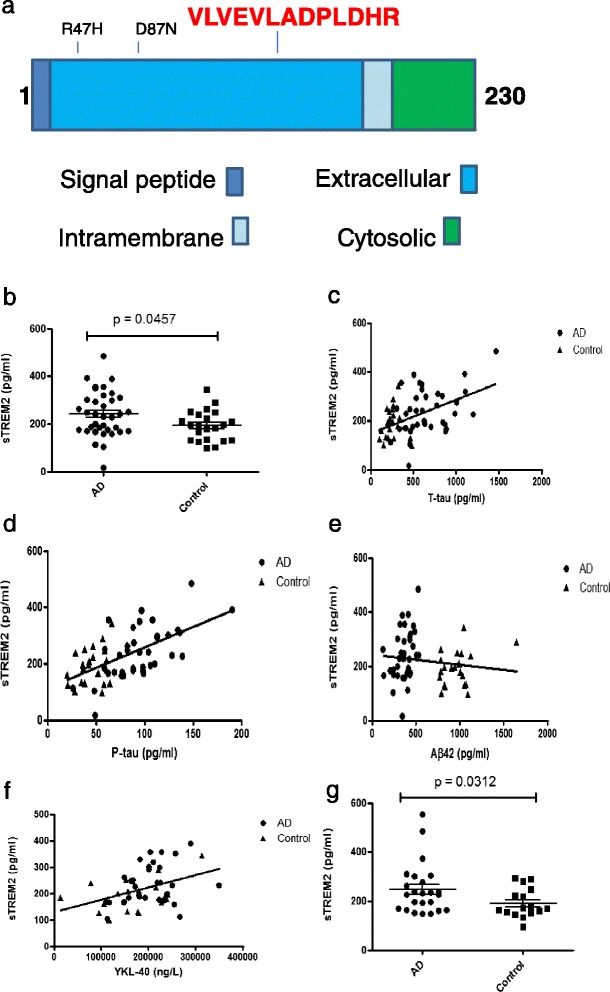
BACKGROUND: The discovery that heterozygous missense mutations in the gene encoding triggering receptor expressed on myeloid cells 2 (TREM2) are risk factors for Alzheimer's disease (AD), with only the apolipoprotein E (APOE) ε4 gene allele conferring a higher risk, has led to increased interest in immune biology in the brain. TREM2 is expressed on microglia, the resident immune cells of the brain and has been linked to phagocytotic clearance of amyloid β (Aβ) plaques. Soluble TREM2 (sTREM2) has previously been measured in cerebrospinal fluid (CSF) by ELISA but in our hands commercial kits have proved unreliable, suggesting that other methods may be required. We developed a mass spectrometry method using selected reaction monitoring for the presence of a TREM2 peptide, which can be used to quantify levels of sTREM2 in CSF. FINDINGS: We examined CSF samples from memory clinics in Sweden and the UK. For all samples the following were available: clinical diagnosis, age, sex, and measurements of the CSF AD biomarkers Aβ42, T-tau and P-tau181. AD patients (n = 37) all met biomarker (IWG2) criteria for AD. Control individuals (n = 22) were cognitively normal without evidence for AD in CSF. We found significantly higher sTREM2 concentration in AD compared to control CSF. There were significant correlations between CSF sTREM2 and T-tau as well as P-tau181. CSF sTREM2 increase in AD was replicated in a second, independent cohort consisting of 24 AD patients and 16 healthy volunteers. CONCLUSION: CSF concentrations of sTREM2 are higher in AD than in controls, and correlate with markers of neurodegeneration. CSF sTREM2 may be used to quantify glial activation in AD.
Overview
The claims and statistics of this paper haven’t been checked yet.
Run the check — free, no account needed. It reads the open-access text and checks the sources it cites.
Integrity signals
Registry
Cites
Statistics
Figures
Verification
Claims the paper makes
The claims and statistics of this paper haven’t been checked yet.
Run the check — free, no account needed. It reads the open-access text and checks the sources it cites.
Claims other papers make about this one
Each is checked against this paper’s own text: does it say what the citing paper says it does?
The source backs part of the claim, not all of it — or backs it for a different population, condition or comparison.
In the citing paper
“This could be representative of changes in TREM2 expression or shedding, both of which are altered during ageing and disease [55], thereby reducing TREM2-mediated signalling and subsequent conversion of microglia to DAM [56].”
From TREM2/PLCγ2 signalling in immune cells: function, structural insight, and potential therapeutic modulation (2021) · cites this paper as [55]
Experimental — accuracy not yet measured
Self-check
Percentages, sums and reported differences re-computed from the paper’s own numbers.
The self-check needs the paper’s full text.
Citations
Cites
Neuroinflammation in Alzheimer's disease
Heneka, M. T., Carson, M. J., Khoury, J. E., Landreth, G. E., Brosseron, F., Feinstein, D. L., Jacobs, A. H., Wyss-Coray, T., Vitorica, J., Ransohoff, R. M., et al. (2015) · The Lancet Neurology · doi:10.1016/s1474-4422(15)70016-5 · Cited by 6,226
Classification of primary progressive aphasia and its variants
Gorno-Tempini, M. L., Hillis, A. E., Weintraub, S., Kertesz, A., Mendez, M., Cappa, S. F., Ogar, J. M., Rohrer, J. D., Black, S., Boeve, B. F., et al. (2011) · Neurology · doi:10.1212/wnl.0b013e31821103e6 · Cited by 5,141
Monocyte Chemoattractant Protein-1 (MCP-1): An Overview
Deshmane, S. L., Kremlev, S., Amini, S., & Sawaya, B. E. (2009) · Journal of Interferon & Cytokine Research · doi:10.1089/jir.2008.0027 · Cited by 3,889
Advancing research diagnostic criteria for Alzheimer's disease: the IWG-2 criteria
Dubois, B., Feldman, H. H., Jacova, C., Hampel, H., Molinuevo, J. L., Blennow, K., DeKosky, S. T., Gauthier, S., Selkoe, D., Bateman, R., et al. (2014) · The Lancet Neurology · doi:10.1016/s1474-4422(14)70090-0 · Cited by 3,321
Self-citationTREM2 Variants in Alzheimer's Disease
Guerreiro, R., Wojtas, A., Bras, J., Carrasquillo, M., Rogaeva, E., Majounie, E., Cruchaga, C., Sassi, C., Kauwe, J. S. K., Younkin, S., et al. (2013) · New England Journal of Medicine · doi:10.1056/nejmoa1211851 · Cited by 3,020
Self-citationVariant of TREM2 Associated with the Risk of Alzheimer's Disease
Jonsson, T., Stefansson, H., Steinberg, S., Jonsdottir, I., Jonsson, P. V., Snaedal, J., Bjornsson, S., Huttenlocher, J., Levey, A. I., Lah, J. J., et al. (2013) · New England Journal of Medicine · doi:10.1056/nejmoa1211103 · Cited by 2,558
Qualitative Assessment of Verbal Fluency Performance in Frontotemporal Dementia
van den Berg, E., Jiskoot, L. C., Grosveld, M. J. H., Swieten, J. C. V., & Papma, J. M. (2017) · Dementia and Geriatric Cognitive Disorders · doi:10.1159/000477538 · Cited by 2,065
Cerebrospinal fluid and plasma biomarkers in Alzheimer disease
Blennow, K., Hampel, H., Weiner, M., & Zetterberg, H. (2010) · Nature Reviews Neurology · doi:10.1038/nrneurol.2010.4 · Cited by 1,863
Self-citationTakahashi, K., Rochford, C. D. P., & Neumann, H. (2005) · The Journal of Experimental Medicine · doi:10.1084/jem.20041611 · Cited by 1,124
Tapiola, T., Alafuzoff, I., Herukka, S.-K., Parkkinen, L., Hartikainen, P., Soininen, H., & Pirttilä, T. (2009) · Archives of Neurology · doi:10.1001/archneurol.2008.596 · Cited by 896
Research works printed but not linked: 1
- Benitez BA, Cruchaga C. TREM2 and neurodegenerative disease. N Engl J Med. 2013;369(16):1567–8.
Cited by
Sorted by citations
Items 301–303 of 303
Yang, G., Xu, X., & Xu, Y. (2026) · Frontiers in Immunology · doi:10.3389/fimmu.2026.1893545
Chen, X., Wang, X., Li, C., Shan, K., Wang, L., Hashimoto, K., Shao, K., Wei, P., & Yang, J.-J. (2026) · Brain Behavior and Immunity · doi:10.1016/j.bbi.2026.106965 · Cited by 1
Identification of RNA-Binding Proteins Regulating the Alternative Splicing of TREM2 Exon 4
Yamada, H., Yanaizu, M., Iwai, N., Kato, M., Suzuki, H., 若井, 瑞., Araki, M., & Kino, Y. (2026) · Genes · doi:10.3390/genes17101188
Metadata
- Authors
- Heslegrave, A., Heywood, W., Paterson, R., Magdalinou, N., Svensson, J., Johansson, P., Öhrfelt, A., Blennow, K., Hardy, J., Schott, J., Mills, K., & Zetterberg, H.
- Affiliations
- National Hospital for Neurology and Neurosurgery (GB)
- University College London (GB)
- University of Gothenburg (SE)
- Skaraborg Hospital (SE)
- Corresponding author
- Heslegrave, Amanda
- ORCID
- Venue
- Molecular Neurodegeneration
- Published
- 2016-01-12
- Volume
- 11
- Issue
- 1
- Pages
- 3-3
- ISSN
- 1750-1326 (ISSN-L)
- PMC
- PMC4709982
- OpenAlex
- W2234866329
- Cited by
- 303
- References
- 40
- Citations by year
- 2026: 13 · 2025: 24 · 2024: 43 · 2023: 24 · 2022: 31 · 2021: 39 · 2020: 34 · 2019: 22 · 2018: 39 · 2017: 24 · 2016: 9
- FWCI
- 17.17
- Type
- journal article
- Language
- en
- Open access
- gold
- doi.org
- Licence
- cc-by
- Locations
- Molecular Neurodegeneration (publishedVersion, cc-by)
- PubMed Central (publishedVersion, cc-by)
- PubMed (publishedVersion)
- UCL Discovery (University College London) (submittedVersion)
- Lund University Publications (Lund University) (submittedVersion)
- Funders
- Wolfson Foundation
- Alzheimer’s Research UK
- Svenska Forskningsrådet Formas
- Biomedical Research Council (GOSH)
- Topics
- Life Sciences › Neuroscience › Neurology › Neuroinflammation and Neurodegeneration Mechanisms
- Life Sciences › Neuroscience › Cellular and Molecular Neuroscience › Alzheimer's disease research and treatments
- Health Sciences › Medicine › Psychiatry and Mental health › Dementia and Cognitive Impairment Research
- Keywords
- soluble TREM2, Alzheimer's disease, cerebrospinal fluid biomarkers, microglia, neuroinflammation, tau phosphorylation, phosphorylated tau 181, total tau, amyloid-beta, glial activation, multiple reaction monitoring, mass spectrometry quantification
- MeSH terms
- Aged, Aged, 80 and over, Alzheimer Disease, Enzyme-Linked Immunosorbent Assay, Female, Humans, Male, Membrane Glycoproteins, Middle Aged, Receptors, Immunologic, Risk Factors, Biomarkers, Amyloid beta-Peptides, tau Proteins, Apolipoprotein E4, Plaque, Amyloid
About these checks
Registry, retraction, Cites and statistics results are computed, not judged, with one exception: a printed reference that no index lists is read once by a model before it counts as a citation error. Claims are extracted by a model and kept only when their quote appears verbatim in the text; each cited source is then checked, with a model’s help, for whether it says what the claim relies on. Those verdicts can be wrong — read the claim’s quote and the cited source before relying on one.
Statistics and arithmetic are recomputed, not judged.
Confidence bands are shown only for fields calibrated on our annotated test set. None is calibrated yet, so no band is shown.
What counts as a claim ›How we measure confidence ›How we check this ›
Are you an author, or do you see a problem with this page? Request a review
