

The DOI matches its Crossref record; 40 of the 40 references it cites were found in a registry or an index.
Increased cerebrospinal fluid soluble TREM2 concentration in Alzheimer’s disease
Open accessAbstract
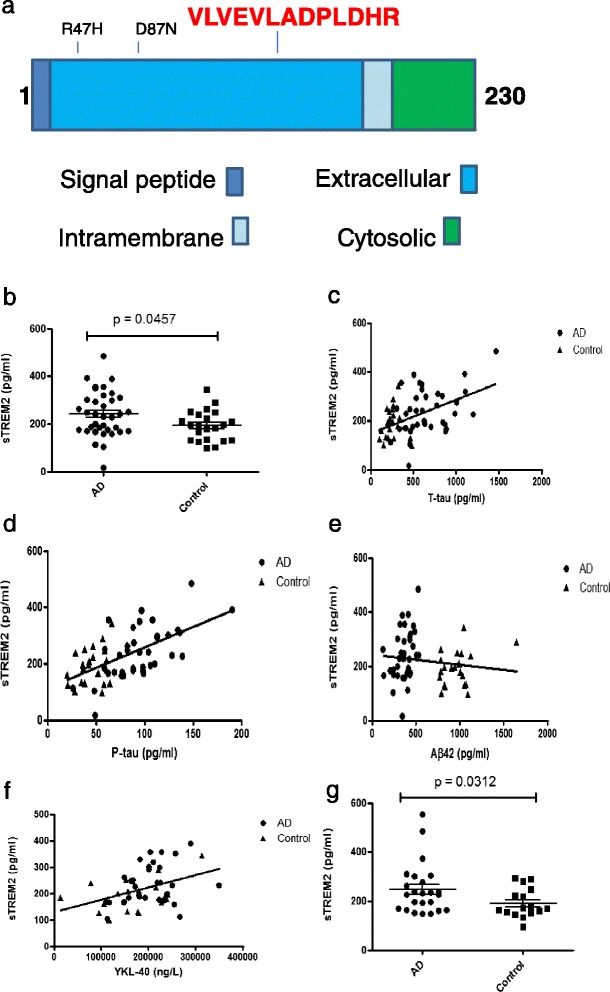
BACKGROUND: The discovery that heterozygous missense mutations in the gene encoding triggering receptor expressed on myeloid cells 2 (TREM2) are risk factors for Alzheimer's disease (AD), with only the apolipoprotein E (APOE) ε4 gene allele conferring a higher risk, has led to increased interest in immune biology in the brain. TREM2 is expressed on microglia, the resident immune cells of the brain and has been linked to phagocytotic clearance of amyloid β (Aβ) plaques. Soluble TREM2 (sTREM2) has previously been measured in cerebrospinal fluid (CSF) by ELISA but in our hands commercial kits have proved unreliable, suggesting that other methods may be required. We developed a mass spectrometry method using selected reaction monitoring for the presence of a TREM2 peptide, which can be used to quantify levels of sTREM2 in CSF. FINDINGS: We examined CSF samples from memory clinics in Sweden and the UK. For all samples the following were available: clinical diagnosis, age, sex, and measurements of the CSF AD biomarkers Aβ42, T-tau and P-tau181. AD patients (n = 37) all met biomarker (IWG2) criteria for AD. Control individuals (n = 22) were cognitively normal without evidence for AD in CSF. We found significantly higher sTREM2 concentration in AD compared to control CSF. There were significant correlations between CSF sTREM2 and T-tau as well as P-tau181. CSF sTREM2 increase in AD was replicated in a second, independent cohort consisting of 24 AD patients and 16 healthy volunteers. CONCLUSION: CSF concentrations of sTREM2 are higher in AD than in controls, and correlate with markers of neurodegeneration. CSF sTREM2 may be used to quantify glial activation in AD.
Overview
The claims and statistics of this paper haven’t been checked yet.
Run the check — free, no account needed. It reads the open-access text and checks the sources it cites.
Integrity signals
Registry
Cites
Statistics
Figures
Verification
Claims the paper makes
The claims and statistics of this paper haven’t been checked yet.
Run the check — free, no account needed. It reads the open-access text and checks the sources it cites.
Claims other papers make about this one
Each is checked against this paper’s own text: does it say what the citing paper says it does?
The source backs part of the claim, not all of it — or backs it for a different population, condition or comparison.
In the citing paper
“This could be representative of changes in TREM2 expression or shedding, both of which are altered during ageing and disease [55], thereby reducing TREM2-mediated signalling and subsequent conversion of microglia to DAM [56].”
From TREM2/PLCγ2 signalling in immune cells: function, structural insight, and potential therapeutic modulation (2021) · cites this paper as [55]
Experimental — accuracy not yet measured
Self-check
Percentages, sums and reported differences re-computed from the paper’s own numbers.
The self-check needs the paper’s full text.
Citations
Cites
Neuroinflammation in Alzheimer's disease
Heneka, M. T., Carson, M. J., Khoury, J. E., Landreth, G. E., Brosseron, F., Feinstein, D. L., Jacobs, A. H., Wyss-Coray, T., Vitorica, J., Ransohoff, R. M., et al. (2015) · The Lancet Neurology · doi:10.1016/s1474-4422(15)70016-5 · Cited by 6,226
Classification of primary progressive aphasia and its variants
Gorno-Tempini, M. L., Hillis, A. E., Weintraub, S., Kertesz, A., Mendez, M., Cappa, S. F., Ogar, J. M., Rohrer, J. D., Black, S., Boeve, B. F., et al. (2011) · Neurology · doi:10.1212/wnl.0b013e31821103e6 · Cited by 5,141
Monocyte Chemoattractant Protein-1 (MCP-1): An Overview
Deshmane, S. L., Kremlev, S., Amini, S., & Sawaya, B. E. (2009) · Journal of Interferon & Cytokine Research · doi:10.1089/jir.2008.0027 · Cited by 3,889
Advancing research diagnostic criteria for Alzheimer's disease: the IWG-2 criteria
Dubois, B., Feldman, H. H., Jacova, C., Hampel, H., Molinuevo, J. L., Blennow, K., DeKosky, S. T., Gauthier, S., Selkoe, D., Bateman, R., et al. (2014) · The Lancet Neurology · doi:10.1016/s1474-4422(14)70090-0 · Cited by 3,321
Self-citationTREM2 Variants in Alzheimer's Disease
Guerreiro, R., Wojtas, A., Bras, J., Carrasquillo, M., Rogaeva, E., Majounie, E., Cruchaga, C., Sassi, C., Kauwe, J. S. K., Younkin, S., et al. (2013) · New England Journal of Medicine · doi:10.1056/nejmoa1211851 · Cited by 3,020
Self-citationVariant of TREM2 Associated with the Risk of Alzheimer's Disease
Jonsson, T., Stefansson, H., Steinberg, S., Jonsdottir, I., Jonsson, P. V., Snaedal, J., Bjornsson, S., Huttenlocher, J., Levey, A. I., Lah, J. J., et al. (2013) · New England Journal of Medicine · doi:10.1056/nejmoa1211103 · Cited by 2,558
Qualitative Assessment of Verbal Fluency Performance in Frontotemporal Dementia
van den Berg, E., Jiskoot, L. C., Grosveld, M. J. H., Swieten, J. C. V., & Papma, J. M. (2017) · Dementia and Geriatric Cognitive Disorders · doi:10.1159/000477538 · Cited by 2,065
Cerebrospinal fluid and plasma biomarkers in Alzheimer disease
Blennow, K., Hampel, H., Weiner, M., & Zetterberg, H. (2010) · Nature Reviews Neurology · doi:10.1038/nrneurol.2010.4 · Cited by 1,863
Self-citationTakahashi, K., Rochford, C. D. P., & Neumann, H. (2005) · The Journal of Experimental Medicine · doi:10.1084/jem.20041611 · Cited by 1,124
Tapiola, T., Alafuzoff, I., Herukka, S.-K., Parkkinen, L., Hartikainen, P., Soininen, H., & Pirttilä, T. (2009) · Archives of Neurology · doi:10.1001/archneurol.2008.596 · Cited by 896
Research works printed but not linked: 1
- Benitez BA, Cruchaga C. TREM2 and neurodegenerative disease. N Engl J Med. 2013;369(16):1567–8.
Cited by
Sorted by citations
Microglia in neurodegenerative diseases: mechanism and potential therapeutic targets
Gao, C., Jiang, J., Tan, Y., & Chen, S. (2023) · Signal Transduction and Targeted Therapy · doi:10.1038/s41392-023-01588-0 · Cited by 1,616
Lin, Y.-T., Seo, J., Gao, F., Feldman, H. M., Wen, H.-L., Penney, J., Cam, H. P., Gjoneska, E., Raja, W. K., Cheng, J., et al. (2018) · Neuron · doi:10.1016/j.neuron.2018.05.008 · Cited by 1,125
TREM2 — a key player in microglial biology and Alzheimer disease
Ulland, T. K., & Colonna, M. (2018) · Nature Reviews Neurology · doi:10.1038/s41582-018-0072-1 · Cited by 735
The Physiology, Pathology, and Potential Therapeutic Applications of the TREM2 Signaling Pathway
Deczkowska, A., Weiner, A., & Amit, I. (2020) · Cell · doi:10.1016/j.cell.2020.05.003 · Cited by 648
Plasma GFAP is an early marker of amyloid-β but not tau pathology in Alzheimer's disease
Pereira, J. B., Janelidze, S., Smith, R., Mattsson-Carlgren, N., Palmqvist, S., Teunissen, C. E., Zetterberg, H., Stomrud, E., Ashton, N. J., Blennow, K., et al. (2021) · Brain · doi:10.1093/brain/awab223 · Cited by 598
Self-citationNeuroinflammation in Alzheimer disease
Heneka, M. T., van der Flier, W. M., Jessen, F., Hoozemanns, J., Thal, D. R., Boche, D., Brosseron, F., Teunissen, C., Zetterberg, H., Jacobs, A. H., et al. (2025) · Nature Reviews Immunology · doi:10.1038/s41577-024-01104-7 · Cited by 638
Self-citationInflammation: the link between comorbidities, genetics, and Alzheimer’s disease
Newcombe, E. A., Camats-Perna, J., Silva, M. L., Valmas, N., Huat, T. J., & Medeiros, R. (2018) · Journal of Neuroinflammation · doi:10.1186/s12974-018-1313-3 · Cited by 532
Suárez‐Calvet, M., Kleinberger, G., Araque Caballero, M. Á., Brendel, M., Rominger, A., Alcolea, D., Fortea, J., Lleó, A., Blesa, R., Gispert, J. D., et al. (2016) · EMBO Molecular Medicine · doi:10.15252/emmm.201506123 · Cited by 522
Self-citationCurrent state of Alzheimer’s fluid biomarkers
Molinuevo, J. L., Ayton, S., Batrla, R., Bednar, M. M., Bittner, T., Cummings, J., Fagan, A. M., Hampel, H., Mielke, M. M., Mikulskis, A., et al. (2018) · Acta Neuropathologica · doi:10.1007/s00401-018-1932-x · Cited by 518
Self-citationSynaptic degeneration in Alzheimer disease
Tzioras, M., McGeachan, R. I., Durrant, C. S., & Spires-Jones, T. L. (2023) · Nature Reviews Neurology · doi:10.1038/s41582-022-00749-z · Cited by 504
Microglial activation and tau propagate jointly across Braak stages
Pascoal, T. A., Benedet, A. L., Ashton, N. J., Kang, M. S., Therriault, J., Chamoun, M., Savard, M., Lussier, F. Z., Tissot, C., Karikari, T. K., et al. (2021) · Nature Medicine · doi:10.1038/s41591-021-01456-w · Cited by 490
Self-citationTREM2, microglia, and neurodegenerative diseases
Yeh, F. L., Hansen, D. V., & Sheng, M. (2017) · Trends in Molecular Medicine · doi:10.1016/j.molmed.2017.03.008 · Cited by 440
The role of astrocytes in amyloid production and Alzheimer's disease
Frost, G. R., & Li, Y. (2017) · Open Biology · doi:10.1098/rsob.170228 · Cited by 448
An early and late peak in microglial activation in Alzheimer’s disease trajectory
Fan, Z., Brooks, D. J., Okello, A., & Edison, P. (2017) · Brain · doi:10.1093/brain/aww349 · Cited by 438
TREM2 in Neurodegenerative Diseases
Jay, T. R., von Saucken, V. E., & Landreth, G. E. (2017) · Molecular Neurodegeneration · doi:10.1186/s13024-017-0197-5 · Cited by 427
Colonna, M. (2023) · Nature Reviews Immunology · doi:10.1038/s41577-023-00837-1 · Cited by 394
Zhong, L., Xu, Y., Zhuo, R., Wang, T., Wang, K., Huang, R., Wang, D., Gao, Y., Zhu, Y., Sheng, X., et al. (2019) · Nature Communications · doi:10.1038/s41467-019-09118-9 · Cited by 371
Soluble TREM2 induces inflammatory responses and enhances microglial survival
Zhong, L., Chen, X., Wang, T., Wang, Z., Liao, C., Wang, Z., Huang, R., Wang, D., Li, X., Wu, L., et al. (2017) · The Journal of Experimental Medicine · doi:10.1084/jem.20160844 · Cited by 372
TREM2 deficiency impairs chemotaxis and microglial responses to neuronal injury
Mazaheri, F., Snaidero, N., Kleinberger, G., Madore, C., Daria, A., Werner, G., Krasemann, S., Capell, A., Trümbach, D., Wurst, W., et al. (2017) · The EMBO Reports · doi:10.15252/embr.201743922 · Cited by 351
Initiative, F. T. A. D. N., Suárez-Calvet, M., Morenas-Rodríguez, E., Kleinberger, G., Schlepckow, K., Araque Caballero, M. Á., Franzmeier, N., Capell, A., Fellerer, K., Nuscher, B., et al. (2019) · Molecular Neurodegeneration · doi:10.1186/s13024-018-0301-5 · Cited by 347
The clinical promise of biomarkers of synapse damage or loss in Alzheimer’s disease
the Synaptic Health Endpoints Working Group, Colom-Cadena, M., Spires-Jones, T., Zetterberg, H., Blennow, K., Caggiano, A., DeKosky, S. T., Fillit, H., Harrison, J. E., Schneider, L. S., et al. (2020) · Alzheimer's Research & Therapy · doi:10.1186/s13195-020-00588-4 · Cited by 328
Self-citationEwers, M., Franzmeier, N., Suárez-Calvet, M., Morenas-Rodriguez, E., Caballero, M. A. A., Kleinberger, G., Piccio, L., Cruchaga, C., Deming, Y., Dichgans, M., et al. (2019) · Science Translational Medicine · doi:10.1126/scitranslmed.aav6221 · Cited by 327
Elucidating the Role of TREM2 in Alzheimer’s Disease
Ulrich, J. D., Ulland, T. K., Colonna, M., & Holtzman, D. M. (2017) · Neuron · doi:10.1016/j.neuron.2017.02.042 · Cited by 325
Lewczuk, P., Riederer, P. F., O’Bryant, S. E., Verbeek, M. M., Dubois, B., Visser, P. J., Jellinger, K. A., Engelborghs, S., Ramírez, A., Parnetti, L., et al. (2017) · The World Journal of Biological Psychiatry · doi:10.1080/15622975.2017.1375556 · Cited by 318
Self-citationMicroglial TREM2/DAP12 signaling: a double-edged sword in neural diseases
Konishi, H., & Kiyama, H. (2018) · Frontiers in Cellular Neuroscience · doi:10.3389/fncel.2018.00206 · Cited by 300
Microglia in Alzheimer’s disease: pathogenesis, mechanisms, and therapeutic potentials
Miao, J., Ma, H., Yang, Y., Liao, Y., Lin, C., Zheng, J., Yu, M., & Lan, J. (2023) · Frontiers in Aging Neuroscience · doi:10.3389/fnagi.2023.1201982 · Cited by 293
TREM2-Ligand Interactions in Health and Disease
Kober, D. L., & Brett, T. J. (2017) · Journal of Molecular Biology · doi:10.1016/j.jmb.2017.04.004 · Cited by 284
Glial activation and inflammation along the Alzheimer’s disease continuum
Nordengen, K., Kirsebom, B.-E., Henjum, K., Selnes, P., Gísladóttir, B., Wettergreen, M., Torsetnes, S. B., Grøntvedt, G. R., Waterloo, K. K., Aarsland, D., et al. (2019) · Journal of Neuroinflammation · doi:10.1186/s12974-019-1399-2 · Cited by 274
The MS4A gene cluster is a key modulator of soluble TREM2 and Alzheimer’s disease risk
Deming, Y., Filipello, F., Cignarella, F., Cantoni, C., Hsu, S., Mikesell, R., Li, Z., Del-Aguila, J. L., Dube, U., Farias, F. G., et al. (2019) · Science Translational Medicine · doi:10.1126/scitranslmed.aau2291 · Cited by 271
“Our group and others have demonstrated that CSF sTREM2 is elevated in AD (23, 24, 26).”
InfluentialSelf-citationSuárez-Calvet, M., Araque Caballero, M. Á., Kleinberger, G., Bateman, R. J., Fagan, A. M., Morris, J. C., Levin, J., Danek, A., Ewers, M., Haass, C., et al. (2016) · Science Translational Medicine · doi:10.1126/scitranslmed.aag1767 · Cited by 272
Schlepckow, K., Kleinberger, G., Fukumori, A., Feederle, R., Lichtenthaler, S. F., Steiner, H., & Haass, C. (2017) · EMBO Molecular Medicine · doi:10.15252/emmm.201707672 · Cited by 266
Kleinberger, G., Brendel, M., Mracsko, E. Z., Wefers, B., Groeneweg, L., Xiang, X., Focke, C., Deußing, M., Suárez‐Calvet, M., Mazaheri, F., et al. (2017) · The EMBO Journal · doi:10.15252/embj.201796516 · Cited by 249
The role of TREM2 in Alzheimer's disease and other neurodegenerative disorders
Carmona, S., Zahs, K., Wu, E., Dakin, K., Bras, J., & Guerreiro, R. (2018) · The Lancet Neurology · doi:10.1016/s1474-4422(18)30232-1 · Cited by 244
Milà‐Alomà, M., Salvadó, G., Gispert, J. D., Vilor‐Tejedor, N., Grau‐Rivera, O., Sala‐Vila, A., Sánchez‐Benavides, G., Arenaza‐Urquijo, E. M., Crous‐Bou, M., González‐de‐Echávarri, J. M., et al. (2020) · Alzheimer's & Dementia · doi:10.1002/alz.12131 · Cited by 241
“The Elecsys β-Amyloid (1-42) CSF immunoassay in use is not a commercially available IVD assay.”
MethodSelf-citationMolecular biomarkers of Alzheimer's disease: progress and prospects
Lashley, T., Schott, J. M., Weston, P. S. J., Murray, C. E., Wellington, H., Keshavan, A., Foti, S. C., Foiani, M. S., Toombs, J., Rohrer, J. D., et al. (2018) · Disease Models & Mechanisms · doi:10.1242/dmm.031781 · Cited by 251
Self-citationThe roles of inflammation and immune mechanisms in Alzheimer's disease
Eldik, L. J. V., Carrillo, M. C., Cole, P. E., Feuerbach, D., Greenberg, B., Hendrix, J. A., Kennedy, M. E., Kozauer, N., Margolin, R. A., Molinuevo, J. L., et al. (2016) · Alzheimer s & Dementia Translational Research & Clinical Interventions · doi:10.1016/j.trci.2016.05.001 · Cited by 238
Emerging Microglia Biology Defines Novel Therapeutic Approaches for Alzheimer’s Disease
Lewcock, J. W., Schlepckow, K., Di Paolo, G., Tahirovic, S., Monroe, K. M., & Haass, C. (2020) · Neuron · doi:10.1016/j.neuron.2020.09.029 · Cited by 221
Thornton, P., Sevalle, J., Deery, M. J., Fraser, G., Zhou, Y., Ståhl, S., Franssen, E. H., Dodd, R. B., Qamar, S., Gomez Perez‐Nievas, B., et al. (2017) · EMBO Molecular Medicine · doi:10.15252/emmm.201707673 · Cited by 200
TREM2 dependent and independent functions of microglia in Alzheimer’s disease
Hou, J., Chen, Y., Grajales-Reyes, G., & Colonna, M. (2022) · Molecular Neurodegeneration · doi:10.1186/s13024-022-00588-y · Cited by 191
The Role of APOE and TREM2 in Alzheimer′s Disease—Current Understanding and Perspectives
Wolfe, C. M., Fitz, N. F., Nam, K. N., Lefterov, I. M., & Koldamova, R. P. (2018) · International Journal of Molecular Sciences · doi:10.3390/ijms20010081 · Cited by 201
Mitochondrial Dysfunction in Alzheimers Disease: Opportunities forDrug Development
Bhatia, S., Rawal, R., Sharma, P., Singh, T., Singh, M., & Singh, V. (2021) · Current Neuropharmacology · doi:10.2174/1570159x19666210517114016 · Cited by 209
Cerebrospinal Fluid Biomarkers of Alzheimer’s Disease: Current Evidence and Future Perspectives
McGrowder, D. A., Miller, F. G., Vaz, K., Nwokocha, C. R., Wilson-Clarke, C. F., Anderson, M., Brown, J., Anderson-Jackson, L., Williams, L., Latore, L., et al. (2021) · Brain Sciences · doi:10.3390/brainsci11020215 · Cited by 169
Hüttenrauch, M., Ogorek, I., Klafki, H., Otto, M., Stadelmann, C., Weggen, S., Wiltfang, J., & Wirths, O. (2018) · Acta Neuropathologica Communications · doi:10.1186/s40478-018-0612-3 · Cited by 166
Biomarkers used in Alzheimer’s disease diagnosis, treatment, and prevention
Mahaman, Y. A. R., Embaye, K. S., Huang, F., Li, L., Zhu, F., Wang, J.-Z., Liu, R., Feng, J., & Wang, X. (2022) · Ageing Research Reviews · doi:10.1016/j.arr.2021.101544 · Cited by 149
The Past and the Future of Alzheimer’s Disease Fluid Biomarkers
Blennow, K., & Zetterberg, H. (2018) · Journal of Alzheimer s Disease · doi:10.3233/jad-170773 · Cited by 154
Self-citationEwers, M., Biechele, G., Suárez‐Calvet, M., Sacher, C., Blume, T., Morenas‐Rodriguez, E., Deming, Y., Piccio, L., Cruchaga, C., Kleinberger, G., et al. (2020) · EMBO Molecular Medicine · doi:10.15252/emmm.202012308 · Cited by 133
Zhou, J., Yu, W., Zhang, M., Tian, X., Li, Y., & Lü, Y. (2019) · Neurochemical Research · doi:10.1007/s11064-019-02748-x · Cited by 139
Microglia in Alzheimer's Disease: Risk Factors and Inflammation
Katsumoto, A., Takeuchi, H., Takahashi, K., & Tanaka, F. (2018) · Frontiers in Neurology · doi:10.3389/fneur.2018.00978 · Cited by 140
Inflammatory aspects of Alzheimer’s disease
Lucena, P. B., & Heneka, M. T. (2024) · Acta Neuropathologica · doi:10.1007/s00401-024-02790-2 · Cited by 152
Long, H., Simmons, A., Mayorga, A. J., Burgess, B., Nguyen, T., Budda, B., Rychkova, A., Rhinn, H., Tassi, I., Ward, M. E., et al. (2024) · Alzheimer s Research & Therapy · doi:10.1186/s13195-024-01599-1 · Cited by 153
Soluble TREM2: Innocent bystander or active player in neurological diseases?
Filipello, F., Goldsbury, C., You, S. F., Locca, A., Karch, C. M., & Piccio, L. (2022) · Neurobiology of Disease · doi:10.1016/j.nbd.2022.105630 · Cited by 134
Alosco, M. L., Tripodis, Y., Fritts, N. G., Heslegrave, A., Baugh, C. M., Conneely, S. E., Mariani, M. L., Martin, B. M., Frank, S., Mez, J., et al. (2018) · Alzheimer s & Dementia · doi:10.1016/j.jalz.2018.05.004 · Cited by 126
Self-citationJensen, C. S., Bahl, J. M. C., Østergaard, L. B., Høgh, P., Wermuth, L., Heslegrave, A., Zetterberg, H., Heegaard, N. H. H., Hasselbalch, S. G., & Simonsen, A. H. (2019) · Experimental Gerontology · doi:10.1016/j.exger.2019.04.003 · Cited by 126
Self-citationGispert, J. D., Suárez‐Calvet, M., Monté, G. C., Tucholka, A., Falcón, C., Rojas, S., Rami, L., Sánchez‐Valle, R., Lladó, A., Kleinberger, G., et al. (2016) · Alzheimer s & Dementia · doi:10.1016/j.jalz.2016.06.005 · Cited by 116
Dhiman, K., Blennow, K., Zetterberg, H., Martins, R. N., & Gupta, V. B. (2019) · Cellular and Molecular Life Sciences · doi:10.1007/s00018-019-03040-5 · Cited by 117
Self-citationBrosseron, F., Traschütz, A., Widmann, C. N., Kummer, M. P., Tacik, P., Santarelli, F., Jessen, F., & Heneka, M. T. (2018) · Alzheimer's Research & Therapy · doi:10.1186/s13195-018-0353-3 · Cited by 113
TREM2 ectodomain and its soluble form in Alzheimer’s disease
Yang, J., Fu, Z., Zhang, X., Xiong, M., Meng, L., & Zhang, Z. (2020) · Journal of Neuroinflammation · doi:10.1186/s12974-020-01878-2 · Cited by 113
Staging of Alzheimer’s disease: past, present, and future perspectives
Therriault, J., Zimmer, E. R., Benedet, A. L., Pascoal, T. A., Gauthier, S. G., & Rosa‐Neto, P. (2022) · Trends in Molecular Medicine · doi:10.1016/j.molmed.2022.05.008 · Cited by 123
Suárez‐Calvet, M., Capell, A., Araque Caballero, M. Á., Morenas‐Rodríguez, E., Fellerer, K., Franzmeier, N., Kleinberger, G., Eren, E., Deming, Y., Piccio, L., et al. (2018) · EMBO Molecular Medicine · doi:10.15252/emmm.201809712 · Cited by 109
Alawode, D. O. T., Heslegrave, A., Ashton, N. J., Karikari, T. K., Simrén, J., Montoliu‐Gaya, L., Pannee, J., O’Connor, A., Weston, P. S. J., Lantero‐Rodriguez, J., et al. (2021) · Journal of Internal Medicine · doi:10.1111/joim.13332 · Cited by 107
Self-citationMullins, A. E., Kam, K., Parekh, A., Bubu, O. M., Osorio, R. S., & Varga, A. W. (2020) · Neurobiology of Disease · doi:10.1016/j.nbd.2020.105054 · Cited by 107
Soluble TREM2 and biomarkers of central and peripheral inflammation in neurodegenerative disease
Bekris, L. M., Khrestian, M., Dyne, E. D., Shao, Y. Y., Pillai, J. A., Rao, S. M., Bemiller, S. M., Lamb, B. T., Fernandez, H. H., & Leverenz, J. B. (2018) · Journal of Neuroimmunology · doi:10.1016/j.jneuroim.2018.03.003 · Cited by 101
Soluble TREM2 is elevated in Parkinson’s disease subgroups with increased CSF tau
Wilson, E. N., Swarovski, M. S., Linortner, P., Shahid, M., Zuckerman, A. J., Wang, Q., Channappa, D., Minhas, P. S., Mhatre, S. D., Plowey, E. D., et al. (2020) · Brain · doi:10.1093/brain/awaa021 · Cited by 99
From Cerebrospinal Fluid to Blood: The Third Wave of Fluid Biomarkers for Alzheimer’s Disease
Zetterberg, H., & Blennow, K. (2018) · Journal of Alzheimer s Disease · doi:10.3233/jad-179926 · Cited by 98
Self-citationTREM2 in Alzheimer’s Disease: Microglial Survival and Energy Metabolism
Zheng, H., Cheng, B., Li, Y., Li, X., Chen, X., & Zhang, Y.-W. (2018) · Frontiers in Aging Neuroscience · doi:10.3389/fnagi.2018.00395 · Cited by 94
Molecular and Imaging Biomarkers in Alzheimer’s Disease: A Focus on Recent Insights
Villa, C., Lavitrano, M., Salvatore, E., & Combi, R. (2020) · Journal of Personalized Medicine · doi:10.3390/jpm10030061 · Cited by 94
Soluble TREM2 changes during the clinical course of Alzheimer’s disease: A meta-analysis
Liu, D., Cao, B., Zhao, Y., Huang, H., McIntyre, R. S., Rosenblat, J. D., & Zhou, H. (2018) · Neuroscience Letters · doi:10.1016/j.neulet.2018.08.038 · Cited by 88
Zhang, X., Tang, L., Yang, J., Meng, L., Chen, J., Zhou, L., Wang, J., Xiong, M., & Zhang, Z. (2023) · Nature Communications · doi:10.1038/s41467-023-42505-x · Cited by 91
Dynamic changes of CSF sTREM2 in preclinical Alzheimer’s disease: the CABLE study
Ma, L., Tan, L., Bi, Y., Shen, X., Xu, W., Ma, Y., Li, H., Dong, Q., & Yu, J. (2020) · Molecular Neurodegeneration · doi:10.1186/s13024-020-00374-8 · Cited by 89
Lista, S., Imbimbo, B. P., Grasso, M., Fidilio, A., Emanuele, E., Minoretti, P., López-Ortiz, S., Martín-Hernández, J., Gabelle, A., Caruso, G., et al. (2024) · Journal of Neuroinflammation · doi:10.1186/s12974-024-03163-y · Cited by 81
Hashemiaghdam, A., & Mroczek, M. (2020) · Journal of Neuroimmunology · doi:10.1016/j.jneuroim.2020.577185 · Cited by 79
A data-driven approach links microglia to pathology and prognosis in amyotrophic lateral sclerosis
Cooper-Knock, J., Green, C., Altschuler, G., Wei, W., Bury, J. J., Heath, P. R., Wyles, M., Gelsthorpe, C., Highley, J. R., Lorente-Pons, A., et al. (2017) · Acta Neuropathologica Communications · doi:10.1186/s40478-017-0424-x · Cited by 80
Latest advances in cerebrospinal fluid and blood biomarkers of Alzheimer’s disease
Milà‐Alomà, M., Suárez‐Calvet, M., & Molinuevo, J. L. (2019) · Therapeutic Advances in Neurological Disorders · doi:10.1177/1756286419888819 · Cited by 81
Higher CSF sTREM2 attenuates ApoE4-related risk for cognitive decline and neurodegeneration
Franzmeier, N., Suárez‐Calvet, M., Frontzkowski, L. K., Moore, A. M., Hohman, T. J., Morenas‐Rodríguez, E., Nuscher, B., Shaw, L. M. J., Trojanowski, J. Q., Dichgans, M., et al. (2020) · Molecular Neurodegeneration · doi:10.1186/s13024-020-00407-2 · Cited by 78
Noh, M., Kwon, H. S., Kwon, M., Nahm, M., Jin, H. K., Bae, J., & Kim, S. H. (2025) · Molecular Neurodegeneration · doi:10.1186/s13024-025-00867-4 · Cited by 94
Korecka, M., & Shaw, L. M. J. (2021) · Journal of Neurochemistry · doi:10.1111/jnc.15465 · Cited by 82
Zeng, X., Lafferty, T. K., Sehrawat, A., Chen, Y., Ferreira, P. C. L., Bellaver, B., Povala, G., Kamboh, M. I., Klunk, W. E., Cohen, A. D., et al. (2024) · Molecular Neurodegeneration · doi:10.1186/s13024-024-00753-5 · Cited by 91
CSF concentrations of soluble TREM2 as a marker of microglial activation in HIV-1 infection
Gisslén, M., Heslegrave, A., Veleva, E., Yilmaz, A., Andersson, L., Hagberg, L., Spudich, S., Fuchs, D., Price, R. W., & Zetterberg, H. (2018) · Neurology Neuroimmunology & Neuroinflammation · doi:10.1212/nxi.0000000000000512 · Cited by 74
Self-citationTREM2 regulates innate immunity in Alzheimer’s disease
Li, J.-T., & Zhang, Y. (2018) · Journal of Neuroinflammation · doi:10.1186/s12974-018-1148-y · Cited by 76
Danger-Sensing/Patten Recognition Receptors and Neuroinflammation in Alzheimer’s Disease
Chiarini, A., Armato, U., Hu, P., & Prà, I. D. (2020) · International Journal of Molecular Sciences · doi:10.3390/ijms21239036 · Cited by 77
CSF soluble TREM2 as a measure of immune response along the Alzheimer's disease continuum
Rauchmann, B., Schneider-Axmann, T., Alexopoulos, P., & Perneczky, R. (2018) · Neurobiology of Aging · doi:10.1016/j.neurobiolaging.2018.10.022 · Cited by 74
Melchiorri, D., Merlo, S., Micallef, B., Borg, J.-J., & Dráfi, F. (2023) · Frontiers in Pharmacology · doi:10.3389/fphar.2023.1196413 · Cited by 73
Cerebrospinal Fluid Biomarkers in Cerebral Amyloid Angiopathy
Banerjee, G., Ambler, G., Keshavan, A., Paterson, R. W., Foiani, M. S., Toombs, J., Heslegrave, A., Dickson, J. C., Fraioli, F., Groves, A. M., et al. (2020) · Journal of Alzheimer s Disease · doi:10.3233/jad-191254 · Cited by 74
Self-citationChen, Y., Lad, E. M., Mathew, R., Shiraki, N., Littleton, S., Chen, Y., Hou, J., Schlepckow, K., Degan, S., Chew, L. A., et al. (2024) · The Journal of Experimental Medicine · doi:10.1084/jem.20231011 · Cited by 72
TREM2 and sTREM2 in Alzheimer’s disease: from mechanisms to therapies
Zhang, L., Xiang, X., Li, Y., Bu, G., & Chen, X. (2025) · Molecular Neurodegeneration · doi:10.1186/s13024-025-00834-z · Cited by 87
Ohara, T., Hata, J., Tanaka, M., Honda, T., Yamakage, H., Yoshida, D., Inoue, T., Hirakawa, Y., Kusakabe, T., Shibata, M., et al. (2018) · Annals of Neurology · doi:10.1002/ana.25385 · Cited by 67
Brendel, M., Kleinberger, G., Probst, F., Jaworska, A., Overhoff, F., Blume, T., Albert, N. L., Carlsen, J., Lindner, S., Gildehaus, F. J., et al. (2017) · Frontiers in Aging Neuroscience · doi:10.3389/fnagi.2017.00008 · Cited by 66
Microglia, Trem2, and Neurodegeneration
Shi, Q., Gutierrez, R. A., & Bhat, M. A. (2025) · The Neuroscientist · doi:10.1177/10738584241254118 · Cited by 69
“Current evidence indicates that the presence of the T66M variant in individuals is associated with significantly reduced concentrations of soluble Trem2 (sTrem2) in the cerebrospinal fluid (Henjum and others 2016; Heslegrave and others 2016; Piccio and others 2016).”
Neuroinflammatory Biomarkers in Alzheimer’s Disease: From Pathophysiology to Clinical Implications
Roveta, F., Bonino, L., Piella, E. M., Rainero, I., & Rubino, E. (2024) · International Journal of Molecular Sciences · doi:10.3390/ijms252211941 · Cited by 80
Magno, L., Bunney, T. D., Mead, E., Svensson, F., & Bictash, M. N. (2021) · Molecular Neurodegeneration · doi:10.1186/s13024-021-00436-5 · Cited by 64
Woollacott, I. O. C., Nicholas, J. M., Heslegrave, A., Heller, C., Foiani, M. S., Dick, K. M., Russell, L. L., Paterson, R. W., Keshavan, A., Fox, N. C., et al. (2018) · Alzheimer's Research & Therapy · doi:10.1186/s13195-018-0405-8 · Cited by 62
Self-citationApplying fluid biomarkers to Alzheimer's disease
Zetterberg, H. (2017) · American Journal of Physiology-Cell Physiology · doi:10.1152/ajpcell.00007.2017 · Cited by 63
Self-citationSabogal-Guáqueta, A. M., Marmolejo-Garza, A., de Pádua, V. P., Eggen, B. J. L., Boddeke, E., & Dolga, A. M. (2020) · Progress in Neurobiology · doi:10.1016/j.pneurobio.2020.101805 · Cited by 65
Dhandapani, R., Neri, M., Bernhard, M., Brzak, I., Schweizer, T., Rudin, S., Joller, S., Berth, R., Kernen, J., Neuhaus, A., et al. (2022) · Cell Reports · doi:10.1016/j.celrep.2022.110883 · Cited by 60
Hippocampal glucose uptake as a surrogate of metabolic change of microglia in Alzheimer’s disease
Choi, H., Choi, Y., Lee, E. J., Kim, H., Lee, Y., Kwon, S., Hwang, D. W., Lee, D. S., & Initiative, A. D. N. (2021) · Journal of Neuroinflammation · doi:10.1186/s12974-021-02244-6 · Cited by 58
Biofluid Biomarkers of Alzheimer’s Disease: Progress, Problems, and Perspectives
Huang, S., Wang, Y., & Guo, J. (2022) · Neuroscience Bulletin · doi:10.1007/s12264-022-00836-7 · Cited by 63
Different pattern of CSF glial markers between dementia with Lewy bodies and Alzheimer’s disease
Morenas‐Rodríguez, E., Alcolea, D. A., Suárez‐Calvet, M., Muñoz, L., Vilaplana, E., Sala, I., Subirana, A., Querol‐Vilaseca, M., Carmona‐Iragui, M., Illán‐Gala, I., et al. (2019) · Scientific Reports · doi:10.1038/s41598-019-44173-8 · Cited by 61
The Immune System's Role in the Consequences of Mild Traumatic Brain Injury (Concussion)
Verboon, L. N., Patel, H. C., & Greenhalgh, A. D. (2021) · Frontiers in Immunology · doi:10.3389/fimmu.2021.620698 · Cited by 63
Wang, L., Nykänen, N.-P., Western, D., Gorijala, P., Timsina, J., Li, F., Wang, Z., Ali, M., Yang, C., Liu, M., et al. (2024) · Molecular Neurodegeneration · doi:10.1186/s13024-023-00687-4 · Cited by 58
Tan, Y. J., Ng, A. S., Vipin, A., Lim, J. K. W., Chander, R. J., Ji, F., Qiu, Y., Ting, S. K. S., Hameed, S., Lee, T.-S. W., et al. (2017) · Journal of Alzheimer s Disease · doi:10.3233/jad-161277 · Cited by 52
Metadata
- Authors
- Heslegrave, A., Heywood, W., Paterson, R., Magdalinou, N., Svensson, J., Johansson, P., Öhrfelt, A., Blennow, K., Hardy, J., Schott, J., Mills, K., & Zetterberg, H.
- Affiliations
- National Hospital for Neurology and Neurosurgery (GB)
- University College London (GB)
- University of Gothenburg (SE)
- Skaraborg Hospital (SE)
- Corresponding author
- Heslegrave, Amanda
- ORCID
- Venue
- Molecular Neurodegeneration
- Published
- 2016-01-12
- Volume
- 11
- Issue
- 1
- Pages
- 3-3
- ISSN
- 1750-1326 (ISSN-L)
- PMC
- PMC4709982
- OpenAlex
- W2234866329
- Cited by
- 303
- References
- 40
- Citations by year
- 2026: 13 · 2025: 24 · 2024: 43 · 2023: 24 · 2022: 31 · 2021: 39 · 2020: 34 · 2019: 22 · 2018: 39 · 2017: 24 · 2016: 9
- FWCI
- 17.17
- Type
- journal article
- Language
- en
- Open access
- gold
- doi.org
- Licence
- cc-by
- Locations
- Molecular Neurodegeneration (publishedVersion, cc-by)
- PubMed Central (publishedVersion, cc-by)
- PubMed (publishedVersion)
- UCL Discovery (University College London) (submittedVersion)
- Lund University Publications (Lund University) (submittedVersion)
- Funders
- Wolfson Foundation
- Alzheimer’s Research UK
- Svenska Forskningsrådet Formas
- Biomedical Research Council (GOSH)
- Topics
- Life Sciences › Neuroscience › Neurology › Neuroinflammation and Neurodegeneration Mechanisms
- Life Sciences › Neuroscience › Cellular and Molecular Neuroscience › Alzheimer's disease research and treatments
- Health Sciences › Medicine › Psychiatry and Mental health › Dementia and Cognitive Impairment Research
- Keywords
- soluble TREM2, Alzheimer's disease, cerebrospinal fluid biomarkers, microglia, neuroinflammation, tau phosphorylation, phosphorylated tau 181, total tau, amyloid-beta, glial activation, multiple reaction monitoring, mass spectrometry quantification
- MeSH terms
- Aged, Aged, 80 and over, Alzheimer Disease, Enzyme-Linked Immunosorbent Assay, Female, Humans, Male, Membrane Glycoproteins, Middle Aged, Receptors, Immunologic, Risk Factors, Biomarkers, Amyloid beta-Peptides, tau Proteins, Apolipoprotein E4, Plaque, Amyloid
About these checks
Registry, retraction, Cites and statistics results are computed, not judged, with one exception: a printed reference that no index lists is read once by a model before it counts as a citation error. Claims are extracted by a model and kept only when their quote appears verbatim in the text; each cited source is then checked, with a model’s help, for whether it says what the claim relies on. Those verdicts can be wrong — read the claim’s quote and the cited source before relying on one.
Statistics and arithmetic are recomputed, not judged.
Confidence bands are shown only for fields calibrated on our annotated test set. None is calibrated yet, so no band is shown.
What counts as a claim ›How we measure confidence ›How we check this ›
Are you an author, or do you see a problem with this page? Request a review
