

The DOI matches its Crossref record; 142 of the 143 references it cites were found in a registry or an index, and 1 are not checked yet.
Microglial TYROBP/DAP12 in Alzheimer's Disease: Transduction of Physiological and Pathological Signals Across TREM2
Open accessAbstract
TYROBP (also known as DAP12 or KARAP) is a transmembrane adaptor protein initially described as a receptor-activating subunit component of natural killer (NK) cells. TYROBP is expressed in numerous cell types, including peripheral blood monocytes, macrophages, dendritic cells, and osteoclasts, but a key point of recent interest is related to the critical role played by TYROBP in the function of many receptors expressed on the plasma membrane of microglia. TYROBP is the downstream adaptor and putative signaling partner for several receptors implicated in Alzheimer’s disease (AD), including SIRP1β, CD33, CR3, and TREM2. TYROBP has received much of its current notoriety because of its importance in brain homeostasis by signal transduction across those receptors. In this review, we provide an overview of evidence indicating that the biology of TYROBP extends beyond its interaction with these four ligand-binding ectodomain-intramembranous domain molecules. In addition to reviewing the structure and localization of TYROBP, we discuss our recent progress using mouse models of either cerebral amyloidosis or tauopathy that were engineered to be TYROBP-deficient or TYROBP-overexpressing. Remarkably, constitutively TYROBP-deficient mice provided a model of genetic resilience to either of the defining proteinopathies of AD. Learning behavior and synaptic electrophysiological function were preserved at normal physiological levels even in the face of robust cerebral amyloidosis (in APP/PSEN1 ; Tyrobp −/− mice) or tauopathy (in MAPT P301S ; Tyrobp −/− mice). A fundamental underpinning of the functional synaptic dysfunction associated with each proteotype was an accumulation of complement C1q. TYROBP deficiency prevented C1q accumulation associated with either proteinopathy. Based on these data, we speculate that TYROBP plays a key role in the microglial sensome and the emergence of the disease-associated microglia (DAM) phenotype. TYROBP may also play a key role in the loss of markers of synaptic integrity (e.g., synaptophysin-like immunoreactivity) that has long been held to be the feature of human AD molecular neuropathology that most closely correlates with concurrent clinical cognitive function.
Overview
The claims and statistics of this paper haven’t been checked yet.
Run the check — free, no account needed. It reads the open-access text and checks the sources it cites.
Integrity signals
Registry
Cites
Statistics
Figures
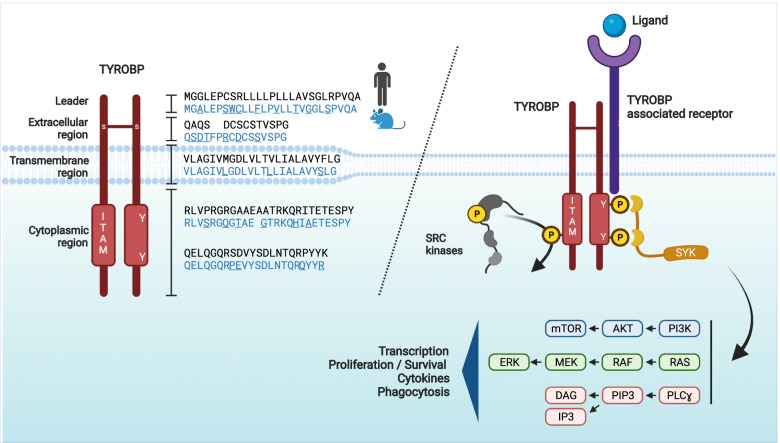
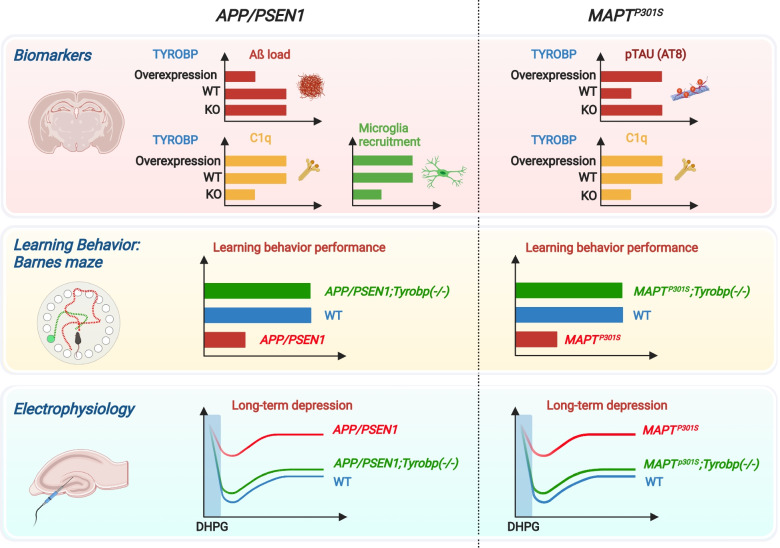
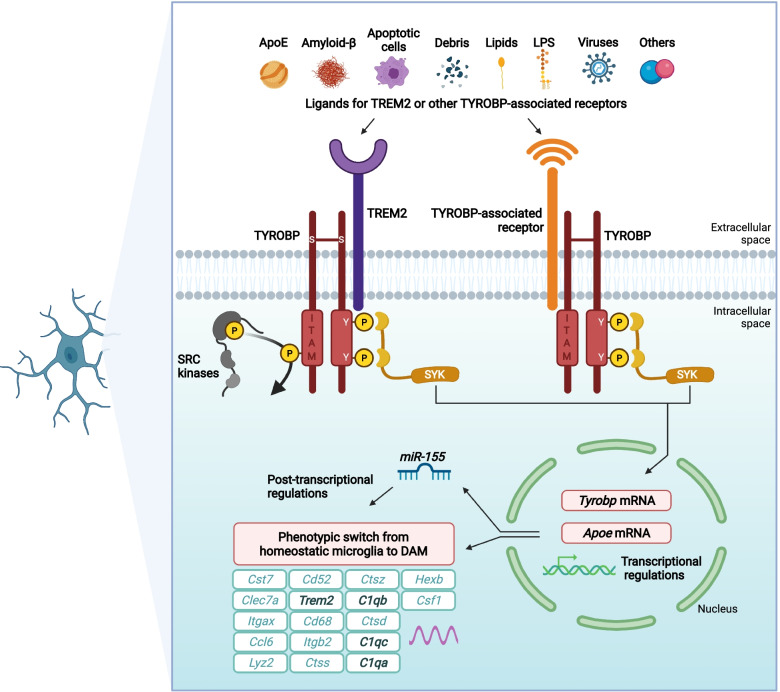
Verification
Claims the paper makes
The claims and statistics of this paper haven’t been checked yet.
Run the check — free, no account needed. It reads the open-access text and checks the sources it cites.
Claims other papers make about this one
Each is checked against this paper’s own text: does it say what the citing paper says it does?
The source backs part of the claim, not all of it — or backs it for a different population, condition or comparison.
In the citing paper
“As shown in Figure 1, previous studies showed that PU.1 induces the transcription of several surface receptors, such as Integrin subunit alpha M (ITGAM, also known as CD11b), vascular cell adhesion molecule 1 (VCAM1, also known as CD106), TREM2, and TYROBP [32, 55], thereby enhancing microglial phagocytic capacity for Aβ clearance [56, 57].”
From Targeting Microglial Transcriptional Reprogramming as a Therapy Strategy for Alzheimer's Disease (2026) · cites this paper as [56]
Experimental — accuracy not yet measuredThe source backs part of the claim, not all of it — or backs it for a different population, condition or comparison.
In the citing paper
“TYROBP is a key regulator of this gene-network module, driving the expression of other genes.”
From The effect of Abi3 locus deletion on the progression of Alzheimer’s disease-related pathologies (2023) · cites this paper as [48]
Experimental — accuracy not yet measuredThe source backs part of the claim, not all of it — or backs it for a different population, condition or comparison.
In the citing paper
“Interestingly, it is also the downstream signaling mediator of several microglial receptors that are implicated in AD, such as TREM2 and CD33 (41, 48).”
From The effect of Abi3 locus deletion on the progression of Alzheimer’s disease-related pathologies (2023) · cites this paper as [48]
Experimental — accuracy not yet measured
Self-check
Percentages, sums and reported differences re-computed from the paper’s own numbers.
The self-check needs the paper’s full text.
Citations
Cites
A Unique Microglia Type Associated with Restricting Development of Alzheimer’s Disease
Keren-Shaul, H., Spinrad, A., Weiner, A., Matcovitch-Natan, O., Dvir-Szternfeld, R., Ulland, T. K., David, E., Baruch, K., Lara-Astaiso, D., Toth, B., et al. (2017) · Cell · doi:10.1016/j.cell.2017.05.018 · Cited by 5,493
Meta-Analysis of 74,046 Individuals Identifies 11 New Susceptibility Loci for Alzheimer’s Disease
(EADI), E. A. D. I., Lambert, J.-C., (GERAD), G. A. E. R. I. A. D., Alzheimer's Disease Genetic Consortium (ADGC), (CHARGE), C. F. H. A. A. R. I. G. E., Ibrahim-Verbaas, C. A., Harold, D., Naj, A. C., Sims, R., Bellenguez, C., et al. (2013) · Nature Genetics · doi:10.1038/ng.2802 · Cited by 4,336
Synaptic Pruning by Microglia Is Necessary for Normal Brain Development
Paolicelli, R. C., Bolasco, G., Pagani, F., Maggi, L., Scianni, M., Panzanelli, P., Giustetto, M., Ferreira, T. A., Guiducci, E., Dumas, L., et al. (2011) · Science · doi:10.1126/science.1202529 · Cited by 4,244
Microglia Sculpt Postnatal Neural Circuits in an Activity and Complement-Dependent Manner
Schafer, D. P., Lehrman, E. K., Kautzman, A. G., Koyama, R., Mardinly, A. R., Yamasaki, R., Ransohoff, R. M., Greenberg, M. E., Barres, B. A., & Stevens, B. (2012) · Neuron · doi:10.1016/j.neuron.2012.03.026 · Cited by 4,089
Complement and microglia mediate early synapse loss in Alzheimer mouse models
Hong, S., Beja-Glasser, V. F., Nfonoyim, B. M., Frouin, A., Li, S., Ramakrishnan, S., Merry, K. M., Shi, Q., Rosenthal, A., Barres, B. A., et al. (2016) · Science · doi:10.1126/science.aad8373 · Cited by 3,343 · cited 3×
“This decrease is associated with the maintenance of normal learning behavior and electrophysiological properties, supporting suggestions from others that C1q is a target of interest in the treatment of neurodegenerative diseases [11, 18].”
BackgroundHarold, D., Abraham, R., Hollingworth, P., Sims, R., Gerrish, A., Hamshere, M. L., Pahwa, J. S., Moskvina, V., Dowzell, K., Williams, A., et al. (2009) · Nature Genetics · doi:10.1038/ng.440 · Cited by 3,326
The Classical Complement Cascade Mediates CNS Synapse Elimination
Stevens, B., Allen, N. J., Vazquez, L. E., Howell, G. R., Christopherson, K. S., Nouri, N., Micheva, K. D., Mehalow, A. K., Huberman, A. D., Stafford, B., et al. (2007) · Cell · doi:10.1016/j.cell.2007.10.036 · Cited by 3,313
TREM2 Variants in Alzheimer's Disease
Guerreiro, R., Wojtas, A., Bras, J., Carrasquillo, M., Rogaeva, E., Majounie, E., Cruchaga, C., Sassi, C., Kauwe, J. S. K., Younkin, S., et al. (2013) · New England Journal of Medicine · doi:10.1056/nejmoa1211851 · Cited by 3,020
Krasemann, S., Madore, C., Cialic, R., Baufeld, C., Calcagno, N., El Fatimy, R., Beckers, L., O’Loughlin, E., Xu, Y., Fanek, Z., et al. (2017) · Immunity · doi:10.1016/j.immuni.2017.08.008 · Cited by 2,979
Variant of TREM2 Associated with the Risk of Alzheimer's Disease
Jonsson, T., Stefansson, H., Steinberg, S., Jonsdottir, I., Jonsson, P. V., Snaedal, J., Bjornsson, S., Huttenlocher, J., Levey, A. I., Lah, J. J., et al. (2013) · New England Journal of Medicine · doi:10.1056/nejmoa1211103 · Cited by 2,558
Research works printed but not linked: 1
- Tomasello E, Cant C, Buhring HJ, Vely F, Andre P, Seiffert M, et al. Association of signal-regulatory proteins beta with KARAP/DAP-12. Eur J Immunol. 2000;30:2147–56. · DOI
Cited by
Sorted by citations
Items 101–161 of 161
MU-BRAIN: MUltiethnic Brain Rna-seq for Alzheimer INitiativePreprint
Yang, Z., Cieza, B., Reyes‐Dumeyer, D., Lee, A., Ma, Y., Yılmaz, E., Lantigua, R., Miller, G. W., Brown, L. M., Honig, L. S., et al. (2024) · bioRxiv (Cold Spring Harbor Laboratory) · doi:10.1101/2024.02.20.581250 · Cited by 2
Yoo, S., Lee, K., Seo, J., Choi, H. K., Kim, S., Chang, J., Shim, Y., Kim, J., Won, J., & Park, S. (2024) · Research Square · doi:10.1101/2024.07.28.605055 · Cited by 2
Liu, H., Yu, H., Cao, Y., Gao, Y., Wei, S., Shi, J., & Liu, D. (2025) · Current Medicinal Chemistry · doi:10.2174/0109298673342409241230113947 · Cited by 1
Ardakan, A. M., Farsani, Z. H., Heydari, Z., Ghahfarrokhi, S. H., & Raisi, Z. (2025) · Iranian Journal of Psychiatry and Behavioral Sciences · doi:10.5812/ijpbs-158682 · Cited by 1
Spermidine reduces peri-implant inflammation and fibrosis to nurture osseointegration
Liu, Q., Wu, Q., Cao, T., Miao, R., Wang, C., Zhang, J., Gao, X., Wang, L., Shi, G., Lai, J., et al. (2025) · Bioactive Materials · doi:10.1016/j.bioactmat.2025.09.036 · Cited by 2
Diez-Pinel, G., Muratore, A., Ruhrberg, C., & Canu, G. (2026) · Journal of Developmental Biology · doi:10.3390/jdb14010004 · Cited by 1
Yang, Z., Zhang, M., Zhi, W., Lizhen, Hu, X., Zou, Y., & Wang, L. (2026) · International Journal of Molecular Sciences · doi:10.3390/ijms27031492 · Cited by 3
Bergkamp, D. J., Coffey, K. R., Dawkins, A. J., Rice, M. T., Peden-Asarch, A. M., & Neumaier, J. F. (2026) · Psychopharmacology · doi:10.1007/s00213-026-07011-0 · Cited by 1
Sha, X., Tang, J., Li, Y., Zhao, S., Guo, J., Xu, L., Zhao, T., Liu, L., & Liu, L. (2026) · Ecotoxicology and Environmental Safety · doi:10.1016/j.ecoenv.2026.119968 · Cited by 1
Wang, R., Feng, Y., Zhou, Z., Jiang, J., Zhang, R., Zou, W., Yang, H., Lv, W., & Shen, Y. (2026) · Frontiers in Aging Neuroscience · doi:10.3389/fnagi.2026.1748418 · Cited by 2
TREM2 as a possible link between Alzheimer's disease and diabetes mellitus
Chen, W., Huang, N., Huang, W., Wang, M., Luo, Y., & Huang, J. (2026) · Experimental Neurology · doi:10.1016/j.expneurol.2026.115739 · Cited by 3
Tang, H.-L., Min, Y., & Long, Y. (2026) · PLoS ONE · doi:10.1371/journal.pone.0344387 · Cited by 1
EtCBN-associated olfactory dysfunction involves Irf7 signaling and a microbiota-metabolite axis
Duan, L., Liang, J., Zhang, W., Liu, Z., Kang, H., Huang, D., Wang, Z., Jiang, G., & Gao, A. (2026) · Chemico-Biological Interactions · doi:10.1016/j.cbi.2026.112109 · Cited by 1
Hirota, Y., Yamamoto, J., Takatori, S., Sakakibara, Y., Takei, K., 佐治多美子, Sekiya, M., Tomita, T., & Iijima, K. (2026) · Molecular Neurodegeneration Advances · doi:10.1186/s44477-026-00032-1 · Cited by 1
Personalized single-cell transcriptomics reveals molecular diversity in Alzheimer’s disease
Chandrashekar, P. B., Alatkar, S. A., Kalafut, N. C., Jin, T., Gupta, C., Burczak, R. C., Xiang, H., Liu, S., Li, A. Z., Hong, A., et al. (2026) · Nature Communications · doi:10.1038/s41467-026-72310-1 · Cited by 2
Identification and analysis of key immunity-related genes in experimental ischemic stroke
Li, Z., Li, X., Guo, H., Zhang, Z., Ge, Y., Dong, F., Zhang, F., & Zhang, F. (2024) · Heliyon · doi:10.1016/j.heliyon.2024.e36837 · Cited by 1
Liang, J., Menon, A., Tomco, T., Bhattarai, N., Smith, I. N., Khrestian, M., Formica, S. V., Eng, C., Buck, M., & Bekris, L. M. (2024) · International Journal of Molecular Sciences · doi:10.3390/ijms25179667 · Cited by 1
Correlation Analysis of Serum TYROBP Level and Metabolic Indexes of Obesity
Xiao, Z., Han, G., Gao, Y., Li, G., He, J., Li, H., Liu, X., Wang, J., & Chen, Y. (2025) · Diabetes Metabolic Syndrome and Obesity · doi:10.2147/dmso.s512731 · Cited by 1
Kwak, C. S., Finan, G. M., Park, Y. R., Garg, A., Harari, O., Mun, J. Y., Rhee, H., & Kim, T. (2023) · bioRxiv (Cold Spring Harbor Laboratory) · doi:10.1101/2023.03.21.533722 · Cited by 1
Targeting Microglial Transcriptional Reprogramming as a Therapy Strategy for Alzheimer's Disease
Kim, B., Wang, S. S., Kim, J. R., & Kim, J. (2026) · BioEssays · doi:10.1002/bies.70186
“…that PU.1 induces the transcription of several surface receptors, such as Integrin subunit alpha M (ITGAM, also known as CD11b), vascular cell adhesion molecule 1 (VCAM1, also known as CD106), TREM2, and TYROBP [32, 55], thereby enhancing microglial phagocytic capacity for A β clearance [56, 57].”
Khaire, A. S., Wen, J., Yang, X., Zhou, H., Shen, Y., & Li, Y. (2022) · bioRxiv (Cold Spring Harbor Laboratory) · doi:10.1101/2022.11.01.514771
Zhou, X., He, J., Yue, A., Song, H., Liu, X., Han, W., & Li, Q. (2023) · Research Square · doi:10.21203/rs.3.rs-2612464/v1
Keshvari, S., Masson, J. J. R., Ferrari-Cestari, M., Bodea, L., Nooru‐Mohamed, F., Tse, B. W.-C., Sokolowski, K. A., Batoon, L., Patkar, O. L., Sullivan, M. A., et al. (2023) · bioRxiv (Cold Spring Harbor Laboratory) · doi:10.1101/2023.05.17.538022
Wang, R., Guo, Q., Ma, M., & Shi, X. (2023) · Research Square · doi:10.21203/rs.3.rs-3201488/v1
Tissue-specific atlas of trans-models for gene regulation elucidates complex regulation patterns
D’Agostino, R. D., & Gottlieb, A. (2024) · BMC Genomics · doi:10.1186/s12864-024-10317-y
Liu, H., Yu, H., Cao, Y., Gao, Y., Wei, S., Shi, J., & Liu, D. (2024) · Research Square · doi:10.21203/rs.3.rs-4220304/v1
RetractedIdentification of hub genes and key pathways in spinal cord injury via bioinformatics analysis
Cheng, H., Wang, Y., & Xuan, J. (2024) · Cellular and Molecular Biology · doi:10.14715/cmb/2024.70.3.9
Sobrecarga de cobre y enfermedad de Alzheimer, búsqueda de posibles blancos terapéuticos
Zubillaga, M. (2023) · El Servicio de Difusión de la Creación Intelectual (National University of La Plata) · doi:10.35537/10915/165188
Mining and exploration of appendicitis nursing targets: An observational study
Mi, X., Kang, C., Hou, S., Gao, Y., Hao, L., & Gao, X. (2024) · Medicine · doi:10.1097/md.0000000000038667
Mary, A., Barale, S., Eysert, F., Valverde, A., Lacas‐Gervais, S., Bauer, C., Eddarkaoui, S., Buée, L., Buée‐Scherrer, V., Checler, F., et al. (2024) · bioRxiv (Cold Spring Harbor Laboratory) · doi:10.1101/2024.12.28.630598
Huang, L., Pei, Z., Zhang, T., Zhang, Z., Sun, F., & Wen, L. (2025) · Journal of Orthopaedic Surgery and Research · doi:10.1186/s13018-025-05925-7
Ji, C., Cheng, D., Yang, S., & Wang, Z. (2025) · PubMed Central · doi:10.30498/ijb.2025.487125.4019
Yu, Y., Zhang, W., Zheng, X., Shen, J., & Li, Y. (2025) · Interdisciplinary Sciences Computational Life Sciences · doi:10.1007/s12539-025-00762-y
Takita, S., Harikrishnan, H., Miyagi, M., & Imanishi, Y. (2025) · Human Molecular Genetics · doi:10.1093/hmg/ddaf146
Carver, S., Taraszka, K., Groha, S., & Gusev, A. (2025) · Human Genetics and Genomics Advances · doi:10.1016/j.xhgg.2025.100538
Chen, C., Zheng, L., Zeng, G., Chen, Y., Liu, W., & Song, W. (2024) · Figshare · doi:10.6084/m9.figshare.26646667
D’Agostino, R. D., & Gottlieb, A. (2024) · Figshare · doi:10.6084/m9.figshare.25632975
Chen, C., Zheng, L., Zeng, G., Chen, Y., Liu, W., & Song, W. (2024) · Figshare · doi:10.6084/m9.figshare.26646664
Chen, C., Zheng, L., Zeng, G., Chen, Y., Liu, W., & Song, W. (2024) · Figshare · doi:10.6084/m9.figshare.26646670
Additional file 1 of Low TYROBP expression predicts poor prognosis in multiple myeloma
Luo, H., Pan, C., Wang, L., Zheng, L., Cao, S., Hu, X., Hu, T., Zhao, N., Shang, Q., & Wang, J. (2024) · Figshare · doi:10.6084/m9.figshare.26699327
Cui, L., Yue, Z., Sun, C., & Shao, K. (2026) · Journal of Alzheimer s Disease Reports · doi:10.1177/25424823251411528
Gong, Y., Zhang, X., Ren, W., Peng, J., Liu, M., Jiang, L., Pei, C., Hu, X., Xu, J., Zhang, T., et al. (2026) · Journal of Controlled Release · doi:10.1016/j.jconrel.2026.114603
Yang, X., Zhao, Y., Liu, W., Feng, J., Wu, X., Ye, H., Xu, Y., Chen, C., & Zhai, G. (2026) · Journal of Ethnopharmacology · doi:10.1016/j.jep.2026.121188
Zhang, K., Chi, W., Guo, J., Huang, Y., Zhang, Z., Guo, X., Zhang, B., & Meng, F. (2026) · International Immunopharmacology · doi:10.1016/j.intimp.2026.116269
Maladaptive aging trajectory in late-onset Alzheimer's disease
Lv, T., Sun, H., Xia, T., Zhu, M. L., & Li, Y. (2026) · The Innovation Life · doi:10.59717/j.xinn-life.2026.100206
Expression of amyloid-β antibody via AAV of CNS tropism alleviates Alzheimer’s disease in micePreprint
Dai, Z., Jiang, M., Yin, W., Wang, Z., Zhu, X., & Qiu, M. S. (2026) · bioRxiv (Cold Spring Harbor Laboratory) · doi:10.64898/2026.03.19.712819
Zhou, Z., Jiang, C., & Chen, Z. (2026) · Research Square · doi:10.21203/rs.3.rs-9504119/v1
Ramos-Rosales, D. F., Echeverria-Carrillo, C. A., Barraza-Salas, M., Cervantes-Flores, M., Salas-Pacheco, S. M., Méndez-Hernández, E. M., Castellanos-Juárez, F. X., Llave-León, O. L., Sandoval-Carrillo, A. A., & Salas-Pacheco, J. M. (2026) · BMC Psychiatry · doi:10.1186/s12888-026-08170-2
TREM2-Targeting peptide tracer for neuroinflammation PET imaging
Zhang, X., Liu, W., Guo, N., Gao, X., Pu, S., Yang, Y., Zha, X., Ding, K., Shi, D., Zhao, J., et al. (2026) · European Journal of Nuclear Medicine and Molecular Imaging · doi:10.1007/s00259-026-07929-9
A rare homozygous mutation in TYROBP resulting in early-onset dementia with bone cysts
Li, Y., Sui, S., Fu, X., Wang, Q.-X., Li, L., & He, Y. (2026) · Neurocase · doi:10.1080/13554794.2026.2684661
Liu, J., Zhang, X., Xu, H. M., Fu, X., Sheng, D., Huang, Y. L., Huang, Y. L., Lv, X., & Lu, W. (2026) · Frontiers in Genetics · doi:10.3389/fgene.2026.1820192
Functional omics for disease modelling and target identification in neurodegenerative drug discovery
Singh, S. A., Nirenjen, S., Sridevi, S., Afreen, N., Prajapati, B. G., Rushendran, R., Vellapandian, C., & Begum, R. F. (2026) · Advances in protein chemistry and structural biology · doi:10.1016/bs.apcsb.2026.02.008
Neuroinflammation and Tauopathies
Zeenny, M.-N., Salame, I., Maatouk, L., & Akoury, E. (2026) · Molecular Biology Reports · doi:10.1007/s11033-026-12253-4
Wang, H., Wen, R., Parker, E., & Yang, L. (2026) · Cell Communication and Signaling · doi:10.1186/s12964-026-03083-9 · Cited by 2
Yang, G., Xu, X., & Xu, Y. (2026) · Frontiers in Immunology · doi:10.3389/fimmu.2026.1893545
Hossain, M. M., Adhikari, J., Fardous, J., Ahmed, S., Ferdous, M. T., & Shibly, A. Z. (2026) · Next research. · doi:10.1016/j.nexres.2026.102314
Li, M., Zhao, R., Wang, Q., Chen, J., Ma, X., Wang, H., & Li, J. (2026) · Journal of Agricultural and Food Chemistry · doi:10.1021/acs.jafc.6c07144
Sun, Z., Lei, T., Shuanglong, 谭. T., Liu, X., Wang, X., Gao, X., Quan, X., Zhang, C., Xue, M., Yang, T., et al. (2026) · Ecotoxicology and Environmental Safety · doi:10.1016/j.ecoenv.2026.120683
Epigenetic and Transcriptomic Regulations in Brain Disorders
Pal, A., & Rathored, J. (2026) · Royal Society of Chemistry eBooks · doi:10.1039/9781837071395-00203
Zheng, Y., Cheng, J., Li, F., Ren, Z., Chen, C., Zhang, Z., Lan, X., Zhang, C., Zhao, Y., Han, J., et al. (2026) · Neurochemical Research · doi:10.1007/s11064-026-04916-2
Tumor-derived amyloid-β drives TREM2+ macrophages immunosuppression in cholangiocarcinoma
Li, X., Qian, R., Li, Y., Xu, X., Luo, Z., Lin, H., Zhu, G., Wang, G., Gao, Y., Liu, C., et al. (2026) · International Immunopharmacology · doi:10.1016/j.intimp.2026.117548
Metadata
- Authors
- Haure-Mirande, J.-V., Audrain, M., Ehrlich, M. E., & Gandy, S.
- Affiliations
- Icahn School of Medicine at Mount Sinai (US)
- James J. Peters VA Medical Center (US)
- Corresponding author
- Ehrlich, Michelle E.
- Gandy, Sam
- Venue
- Molecular Neurodegeneration
- Published
- 2022-08-24
- Volume
- 17
- Issue
- 1
- Pages
- 55-55
- ISSN
- 1750-1326 (ISSN-L)
- PMC
- PMC9404585
- OpenAlex
- W4292939095
- Cited by
- 159
- References
- 142
- Citations by year
- 2026: 41 · 2025: 41 · 2024: 47 · 2023: 28 · 2022: 2
- FWCI
- 3.07
- Type
- journal article
- Language
- en
- Open access
- gold
- doi.org
- Locations
- Molecular Neurodegeneration (publishedVersion, cc-by)
- PubMed Central (publishedVersion, cc-by)
- PubMed (publishedVersion)
- DOAJ (DOAJ: Directory of Open Access Journals) (submittedVersion, cc-by-sa)
- Funders
- National Institute on Aging (U01AG046170, R01AG057907, R03AG070710)
- Cure Alzheimer's Fund
- BrightFocus Foundation (A2018253F, A2016482F)
- Mount Sinai Alzheimer’s Disease Research Center (AG005138, P30AG066514)
- Topics
- Life Sciences › Neuroscience › Neurology › Neuroinflammation and Neurodegeneration Mechanisms
- Life Sciences › Neuroscience › Cellular and Molecular Neuroscience › Alzheimer's disease research and treatments
- Life Sciences › Neuroscience › Cellular and Molecular Neuroscience › Neuroscience and Neuropharmacology Research
- Keywords
- TYROBP, DAP12, Alzheimer's disease, microglia, TREM2, C1q, cerebral amyloidosis, tauopathy, disease-associated microglia, synaptic dysfunction, synaptophysin, receptor signaling
- MeSH terms
- Alzheimer Disease, Amyloidosis, Animals, Brain, Disease Models, Animal, Membrane Glycoproteins, Membrane Proteins, Receptors, Immunologic, Microglia, Tauopathies, Adaptor Proteins, Signal Transducing, Mice
About these checks
Registry, retraction, Cites and statistics results are computed, not judged, with one exception: a printed reference that no index lists is read once by a model before it counts as a citation error. Claims are extracted by a model and kept only when their quote appears verbatim in the text; each cited source is then checked, with a model’s help, for whether it says what the claim relies on. Those verdicts can be wrong — read the claim’s quote and the cited source before relying on one.
Statistics and arithmetic are recomputed, not judged.
Confidence bands are shown only for fields calibrated on our annotated test set. None is calibrated yet, so no band is shown.
What counts as a claim ›How we measure confidence ›How we check this ›
Are you an author, or do you see a problem with this page? Request a review
