

Mechanism and therapeutic potential of targeting cGAS-STING signaling in neurological disorders
Open accessThe DOI matches its Crossref record; 136 of the 136 references it cites were found in a registry or an index.
Abstract
DNA sensing is a pivotal component of the innate immune system that is responsible for detecting mislocalized DNA and triggering downstream inflammatory pathways. Among the DNA sensors, cyclic GMP-AMP synthase (cGAS) is a primary player in detecting cytosolic DNA, including foreign DNA from pathogens and self-DNA released during cellular damage, culminating in a type I interferon (IFN-I) response through stimulator of interferon genes (STING) activation. IFN-I cytokines are essential in mediating neuroinflammation, which is widely observed in CNS injury, neurodegeneration, and aging, suggesting an upstream role for the cGAS DNA sensing pathway. In this review, we summarize the latest developments on the cGAS-STING DNA-driven immune response in various neurological diseases and conditions. Our review covers the current understanding of the molecular mechanisms of cGAS activation and highlights cGAS-STING signaling in various cell types of central and peripheral nervous systems, such as resident brain immune cells, neurons, and glial cells. We then discuss the role of cGAS-STING signaling in different neurodegenerative conditions, including tauopathies, Alzheimer’s disease, Parkinson’s disease, and amyotrophic lateral sclerosis, as well as aging and senescence. Finally, we lay out the current advancements in research and development of cGAS inhibitors and assess the prospects of targeting cGAS and STING as therapeutic strategies for a wide spectrum of neurological diseases.
Overview
The claims and statistics of this paper haven’t been checked yet.
Free: it reads the open-access text and checks the first 5 claims that cite a source we can check. Create a free account to check every claim.
Integrity signals
Registry
Cites
Statistics
Figures
Verification
Claims the paper makes
The claims and statistics of this paper haven’t been checked yet.
Free: it reads the open-access text and checks the first 5 claims that cite a source we can check. Create a free account to check every claim.
Claims other papers make about this one
Each is checked against this paper’s own text: does it say what the citing paper says it does?
The cited source says what the claim attributes to it.
In the citing paper
“Studies by Xie et al. found that the abnormal accumulation of double-stranded DNA in the cytoplasm may bind to the cytoplasmic DNA sensor (cGAS), thereby specifically triggering the STING-interferon (IFN) signaling pathway in microglia, promoting the expression and secretion of inflammatory cytokines.”
From Recent advances in Alzheimer's disease: Mechanisms, clinical trials and new drug development strategies. (2024) · cites this paper as [254]
Self-check
Percentages, sums and reported differences re-computed from the paper’s own numbers.
The self-check needs the paper’s full text.
Citations
Cites
1 retracted
RETRACTED ARTICLE: Parkin and PINK1 mitigate STING-induced inflammation
Sliter, D. A., Martinez, J., Hao, L., Chen, X., Sun, N., Fischer, T. D., Burman, J. L., Li, Y., Zhang, Z., Narendra, D. P., et al. (2018) · Nature · doi:10.1038/s41586-018-0448-9 · Cited by 1,287 · cited 5×
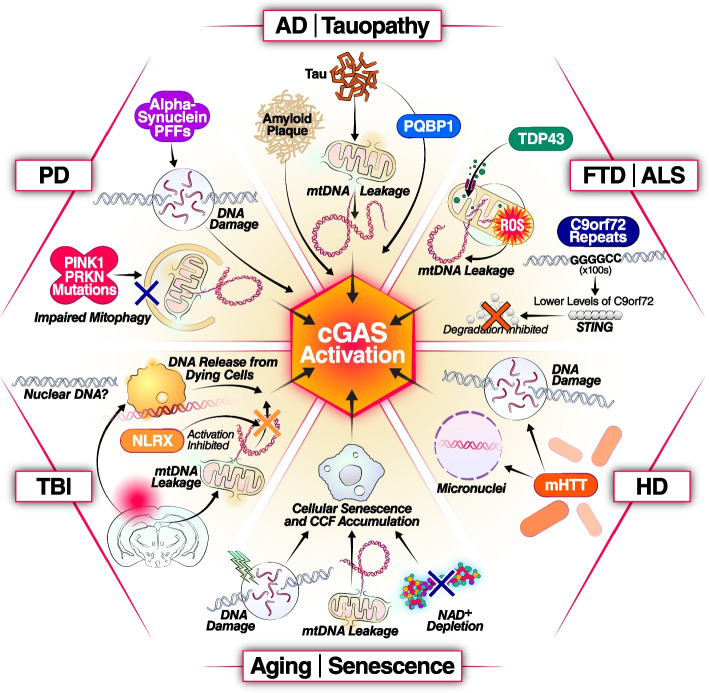
“Parkin or PINK1 deficiency impairs mitophagy, inducing mtDNA release, and activation of the cGAS-STING IFN-I response [24].”
BackgroundInfluentialRetractedA Toll-like receptor recognizes bacterial DNA
Hemmi, H., Takeuchi, O., Kawai, T., Kaisho, T., Sato, S., Sanjo, H., Matsumoto, M., Hoshino, K., Wagner, H., Takeda, K., et al. (2000) · Nature · doi:10.1038/35047123 · Cited by 6,491
The senescence-associated secretory phenotype: the dark side of tumor suppression
Coppé, J.-P., Desprez, P.-Y., Krtolica, A., & Campisi, J. (2010) · Annual Review of Pathology: Mechanisms of Disease · doi:10.1146/annurev-pathol-121808-102144 · Cited by 5,206 · cited 1×
“Senescent cells exhibit several hallmarks, including the upregulation of senescence-associated β-galactosidase (SA-β-Gal) activity and the induction of a senescence-associated secretory phenotype (SASP) [72].”
BackgroundCyclic GMP-AMP Synthase Is a Cytosolic DNA Sensor That Activates the Type I Interferon Pathway
Sun, L., Wu, J., Du, F., Chen, X., & Chen, Z. J. (2013) · Science · doi:10.1126/science.1232458 · Cited by 4,996
STING is an endoplasmic reticulum adaptor that facilitates innate immune signalling
Ishikawa, H., & Barber, G. N. (2008) · Nature · doi:10.1038/nature07317 · Cited by 3,576 · cited 3×
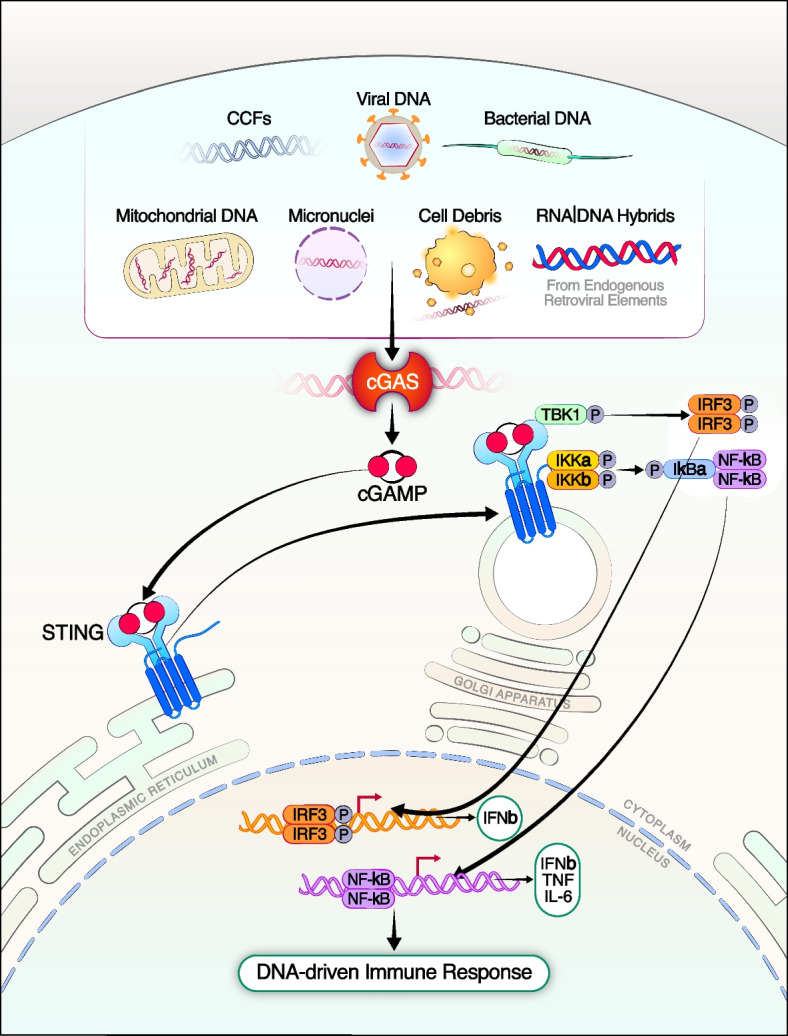
“The degradation of IκBα leads to rapid and transient nuclear translocation of canonical NF-κB, resulting in the production of pro-inflammatory cytokines and chemokines [13] (Fig.”
BackgroundCyclic GMP-AMP Is an Endogenous Second Messenger in Innate Immune Signaling by Cytosolic DNA
Wu, J., Sun, L., Chen, X., Du, F., Shi, H., Chen, C., & Chen, Z. J. (2013) · Science · doi:10.1126/science.1229963 · Cited by 2,541 · cited 2×
“Recognizing DNA is a fundamental mechanism of host defense that involves various PRRs, including Toll-like receptor 9 (TLR9), IFI16, RNA polymerase III, and cyclic GMP-AMP synthase (cGAS) [1–4].”
BackgroundCellular senescence in aging and age-related disease: from mechanisms to therapy
Childs, B. G., Durik, M., Baker, D. J., & van Deursen, J. M. (2015) · Nature Medicine · doi:10.1038/nm.4000 · Cited by 2,363 · cited 1×
“Cellular senescence is a natural process, whereby cells enter an irreversible state of cell-cycle arrest, limiting the growth of abnormal cells and serving as a critical mechanism to prevent tumorigenesis [71].”
BackgroundThe cGAS–STING pathway as a therapeutic target in inflammatory diseases
Decout, A., Katz, J. D., Venkatraman, S., & Ablasser, A. (2021) · Nature Reviews Immunology · doi:10.1038/s41577-021-00524-z · Cited by 2,309 · cited 3×
“cGAS and STING proteins are two key targets of the innate immune cGAS-STING signaling pathway [92, 93].”
BackgroundOxidized mitochondrial DNA activates the NLRP3 inflammasome during apoptosis
Shimada, K., Crother, T. R., Karlin, J., Dagvadorj, J., Chiba, N., Chen, S., Ramanujan, V. K., Wolf, A. J., Vergnes, L., Ojcius, D. M., et al. (2012) · Immunity · doi:10.1016/j.immuni.2012.01.009 · Cited by 2,282 · cited 1×
“Mitochondrial oxidative stress leads to release of oxidized mtDNA to the cytosol, triggering innate immune signaling, such as IFN-I and NLRP3 inflammasome activation [21–23].”
BackgroundInflammation as a central mechanism in Alzheimer's disease
Kinney, J. W., Bemiller, S. M., Murtishaw, A. S., Leisgang, A. M., Salazar, A. M., & Lamb, B. T. (2018) · Alzheimer's & Dementia: Translational Research & Clinical Interventions · doi:10.1016/j.trci.2018.06.014 · Cited by 2,253 · cited 2×
“Sustained neuroin-flammation in response to pathogenic proteins through activation of immune cells, especially microglia, has been recognized as another hallmark of AD [38].”
Background
Cited by
Zhang, J., Zhang, Y., Wang, J., Xia, Y., Zhang, J., & Chen, L. (2024) · Signal Transduction and Targeted Therapy · doi:10.1038/s41392-024-01911-3 · Cited by 1,138
“253,254 254 – 256 A recent study using a special 3D human neuroimmune axis model explored the interactions between in fi ltrative peripheral immune cells and innate immune cells in AD.”
BackgroundAutophagy, aging, and age-related neurodegeneration
Palmer, J. E., Wilson, N., Son, S. M., Obrocki, P., Wrobel, L., Rob, M., Takla, M., Korolchuk, V. I., & Rubinsztein, D. C. (2025) · Neuron · doi:10.1016/j.neuron.2024.09.015 · Cited by 241
Cellular and pathological functions of tau
Parra Bravo, C., Naguib, S. A., & Gan, L. (2024) · Nature Reviews Molecular Cell Biology · doi:10.1038/s41580-024-00753-9 · Cited by 238
“We refer readers to other recent reviews for further reading on specific aspects of tau research, such as tau and amyloid-β 20 , tau and α-synuclein 21 , tau and synaptic dysfunction 22 and tau and adaptive immunity 23 .”
Self-citationInnate immune activation in neurodegenerative diseases
Castro-Gomez, S., & Heneka, M. T. (2024) · Immunity · doi:10.1016/j.immuni.2024.03.010 · Cited by 162
Quan, S., Fu, X., Cai, H., Ren, Z., Xu, Y., & Jia, L. (2025) · Molecular Neurodegeneration · doi:10.1186/s13024-025-00815-2 · Cited by 117
“…alleviating and inhibiting the abnormal release of mtDNA or other dsDNA caused by mitochondrial stress and autophagy imbalance [233], blocking the transmission of cGAS-STING signaling and the activation of its downstream inflammatory signals may represent a feasible approach for AD therapy [218].”
Metadata
- Authors
- Huang, Y., Liu, B., Sinha, S. C., Amin, S., & Gan, L.
- Affiliations
- Weill Cornell Medicine (US)
- Corresponding author
- Gan, Li
- Venue
- Molecular Neurodegeneration
- Published
- 2023-11-08
- Volume
- 18
- Issue
- 1
- Pages
- 79-79
- ISSN
- 1750-1326 (ISSN-L)
- PMC
- PMC10634099
- OpenAlex
- W4388483815
- Cited by
- 164
- References
- 135
- Citations by year
- 2026: 60 · 2025: 70 · 2024: 34
- FWCI
- 4.56
- Type
- journal article
- Language
- en
- Open access
- gold
- doi.org
- Licence
- cc-by
- creativecommons.org/licenses/by/4.0 (tdm)
- creativecommons.org/licenses/by/4.0 (vor)
- Locations
- Molecular Neurodegeneration (publishedVersion, cc-by)
- PubMed Central (publishedVersion, cc-by)
- PubMed (publishedVersion)
- DOAJ (DOAJ: Directory of Open Access Journals) (submittedVersion, cc-by-sa)
- Funders
- National Institute on Aging (R01AG072758, R01AG054214, R01AG074541)
- Tau Consortium
- JPB Foundation
- Cure Alzheimer's Fund
- BrightFocus Foundation (A20201312F)
- Topics
- Life Sciences › Immunology and Microbiology › Immunology › interferon and immune responses
- Life Sciences › Neuroscience › Neurology › Neuroinflammation and Neurodegeneration Mechanisms
- Life Sciences › Biochemistry, Genetics and Molecular Biology › Molecular Biology › Inflammasome and immune disorders
- Keywords
- cGAS-STING pathway, DNA sensing, cytosolic DNA, type I interferon, neuroinflammation, neurodegenerative diseases, tauopathy, Alzheimer's disease, Parkinson's disease, amyotrophic lateral sclerosis, aging, cellular senescence, cGAS inhibitors, therapeutic targeting, glial cells, neurons, innate immunity
- MeSH terms
- DNA, Humans, Interferon Type I, Nervous System Diseases, Nucleotidyltransferases, Signal Transduction
About these checks
Registry, retraction, Cites and statistics results are computed, not judged, with one exception: a printed reference that no index lists is read once by a model before it counts as a citation error. Claims are extracted by a model and kept only when their quote appears verbatim in the text; each cited source is then checked, with a model’s help, for whether it says what the claim relies on. Those verdicts can be wrong — read the claim’s quote and the cited source before relying on one.
Statistics and arithmetic are recomputed, not judged.
Confidence bands are shown only for fields calibrated on our annotated test set. None is calibrated yet, so no band is shown.
What counts as a claim ›How we measure confidence ›How we check this ›
Are you an author, or do you see a problem with this page? Request a review
Data sources
Bibliographic data: Semantic Scholar, OpenAlex, Crossref.
Contains information from the Semantic Scholar Academic Graph Datasets, made available under the ODC Attribution License (ODC-BY 1.0).
Semantic Scholar’s data is described in: Kinney, R., et al. (2023). The Semantic Scholar Open Data Platform. arXiv:2301.10140.
