

The DOI matches its Crossref record; 10 of the 10 references it cites were found in a registry or an index; 1 of the 15 sources its claims cite were checked for support.
Bit-related lesions in Icelandic competition horses
Open accessAbstract
BACKGROUND: Oral lesions related to the use of the bit and bridle are reported to be common findings in horses worldwide and represent an important animal welfare issue. In order to provide an overview of bit-related lesions in Icelandic competition horses, a field examination of the rostral part of the oral cavity was performed in 424 competition horses coming to the two major national horse events in Iceland in 2012. Records from repeated examination of 77 horses prior to the finals were used to assess potential risk factors. RESULTS: Mild lesions were recorded in 152 horses (36%) prior to the preliminary rounds. They were most often located in the commissures of the lips and the adjacent buccal mucosa (n=111). Severe lesions were found in 32 (8%) horses. For 77 horses examined prior to the finals, the frequency of findings in the area of the mandibular interdental space (bars of the mandible) had increased from 8% to 31% (P<0.0001). These findings were most often (16/24) regarded as severe. The presence of lesions on the bars was strongly associated to the use of curb bits with a port (OR=75, P=0.009). CONCLUSIONS: Bit-related lesions were found to be a general problem in Icelandic competition horses. The type of bits used influenced both the location and the severity of the lesions. The use of curb bits with a port was found to be a decisive risk factor for lesions on the bars of the mandible, most of which were regarded as severe. The results also raised questions about the head and neck carriage demanded for the competition horses.
Overview
AI snapshot
Written from the paper’s full text.
TL;DR
Bit-related oral lesions were common in Icelandic competition horses, with 43% of 424 horses examined before preliminary rounds having lesions and 8% having severe lesions. In 77 horses re-examined before finals, bar-region lesions increased from 8% to 31%, and curb bits with a port were a decisive risk factor for severe bar lesions.
Key findings
- Among 424 horses examined prior to preliminary rounds, mild lesions were found in 152 (36%) and severe lesions in 32 (8%); total lesions were 184 (43%). Mild lesions were most often in the commissures of the lips and adjacent buccal mucosa (n = 111).
- In 77 horses re-examined before finals, lesions in the bar region increased from 8% to 31% (OR = 9.25, P = 0.0002; Table 3 OR = 9.29, P < 0.0001), while buccal-region lesions did not change. Of bar-region findings at the second examination, 16/24 (67%) were severe, compared with 2/22 (9%) in the buccal region.
- Curb bits with a port were strongly associated with bar lesions (OR = 75, P = 0.009); snaffle bits were associated with buccal lesions (OR = 8.07, P = 0.0002). Six horses ridden with traditional Icelandic curb bits had no lesions in either location.
- Tongue lesions were found in five horses, always with severe bar findings, and all had been ridden with a curb bit with a port in the previous performance.
Methods
- Field examination of the rostral oral cavity was performed on 424 competition horses at the two major national horse events in Iceland in 2012 (334 at Landsmót hestamanna 2012 and 90 at Íslandsmót í hestaíþróttum 2012); 77 horses had a repeated examination before the finals. Examinations occurred 1–24 hours before competing, used inspection and palpation without oral speculum or sedation, and graded lesions as mild or severe by location (buccal, bar, or tongue).
- Risk-factor data for the 77 finalists were collected by rider interviews (n = 25), video tapes (n = 44), or other footage (n = 8). Statistical analysis used χ² tests for disciplines, generalized estimating equations for repeated examinations, and multivariable logistic regression for disciplines, bits, and number of performances in SAS.
Limitations
- The paper states that the caudal regions of the oral cavity were not examined; horses were not re-examined directly after each performance, so some acute lesions might have passed unnoticed; rider effect was not included due to few riders with multiple horses and confounding between bit and rider; noseband influence could not be separated from that of the snaffle bit; and pace-horse findings were based on one examination and not controlled for bit type.
- Evident from the text: this is an observational field study, so associations cannot establish causation; specific snaffle bit types were not identified; and risk-factor analysis was limited to the 77 horses that qualified for the finals.
Model-written summary. Check it against the paper before relying on it.
Integrity signals
Registry
Cites
Statistics
Figures
Verification
Claims the paper makes
23 Own result · 12 Own interpretation · 9 Own method · 4 No full text of the sources · 3 No basis given · 2 Sources not found · 2 Not checked yet · 1 Partly supported · accuracy not yet measured
A result the paper reports from its own data — it cites no other source for it, so there is none to check. The quote shows it is in the paper.
In the paper
“Severe lesions were found in 32 (8%) horses.”
§ Bit-related lesions in Icelandic competition horses > Abstract > Results
plain- Asserted: passes — The authors put it forward as true.
- Checkable: passes — It can be checked against evidence.
- Load-bearing: unclear — It is unclear whether the paper’s conclusions depend on it.
- Based: passes — The paper gives a reason why it holds.
A result the paper reports from its own data — it cites no other source for it, so there is none to check. The quote shows it is in the paper.
In the paper
“They were most often located in the commissures of the lips and the adjacent buccal mucosa (n = 111).”
§ Bit-related lesions in Icelandic competition horses > Abstract > Results
plainn = 111- Asserted: passes — The authors put it forward as true.
- Checkable: passes — It can be checked against evidence.
- Load-bearing: unclear — It is unclear whether the paper’s conclusions depend on it.
- Based: passes — The paper gives a reason why it holds.
A result the paper reports from its own data — it cites no other source for it, so there is none to check. The quote shows it is in the paper.
In the paper
“For 77 horses examined prior to the finals, the frequency of findings in the area of the mandibular interdental space (bars of the mandible) had increased from 8% to 31% (P < 0.0001).”
§ Bit-related lesions in Icelandic competition horses > Abstract > Results
plaindirect- Asserted: passes — The authors put it forward as true.
- Checkable: passes — It can be checked against evidence.
- Load-bearing: passes — The paper’s conclusions depend on it.
- Based: passes — The paper gives a reason why it holds.
A result the paper reports from its own data — it cites no other source for it, so there is none to check. The quote shows it is in the paper.
In the paper
“These findings were most often (16/24) regarded as severe.”
§ Bit-related lesions in Icelandic competition horses > Abstract > Results
plain- Asserted: passes — The authors put it forward as true.
- Checkable: passes — It can be checked against evidence.
- Load-bearing: unclear — It is unclear whether the paper’s conclusions depend on it.
- Based: passes — The paper gives a reason why it holds.
The paper states this without a source or data behind it here, so there is nothing to check it against. The quote shows it is in the paper.
In the paper
“The complete absence of lesions in horses competing in T2 is an interesting finding given that all were ridden on a curb bit with a port.”
§ Bit-related lesions in Icelandic competition horses > Discussion
plain- Asserted: passes — The authors put it forward as true.
- Checkable: passes — It can be checked against evidence.
- Load-bearing: passes — The paper’s conclusions depend on it.
- Based: passes — The paper gives a reason why it holds.
A result the paper reports from its own data — it cites no other source for it, so there is none to check. The quote shows it is in the paper.
In the paper
“No significant difference was found in the frequency of lesions between the different disciplines.”
§ Bit-related lesions in Icelandic competition horses > Results > Repeated examination of 77 horses
plain- Asserted: passes — The authors put it forward as true.
- Checkable: passes — It can be checked against evidence.
- Load-bearing: unclear — It is unclear whether the paper’s conclusions depend on it.
- Based: passes — The paper gives a reason why it holds.
A result the paper reports from its own data — it cites no other source for it, so there is none to check. The quote shows it is in the paper.
In the paper
“All tests of two-way interactions were not significant.”
§ Bit-related lesions in Icelandic competition horses > Results > Repeated examination of 77 horses
plain- Asserted: passes — The authors put it forward as true.
- Checkable: passes — It can be checked against evidence.
- Load-bearing: unclear — It is unclear whether the paper’s conclusions depend on it.
- Based: passes — The paper gives a reason why it holds.
The paper states this without a source or data behind it here, so there is nothing to check it against. The quote shows it is in the paper.
In the paper
“The English noseband which was always combined with the two types of curb bits (with and without a port) had no correlation with the development of lesions in the bar region.”
§ Bit-related lesions in Icelandic competition horses > Discussion
plain- Asserted: passes — The authors put it forward as true.
- Checkable: passes — It can be checked against evidence.
- Load-bearing: unclear — It is unclear whether the paper’s conclusions depend on it.
- Based: passes — The paper gives a reason why it holds.
A result the paper reports from its own data — it cites no other source for it, so there is none to check. The quote shows it is in the paper.
In the paper
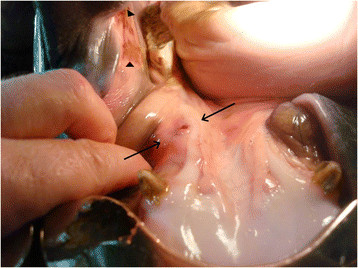
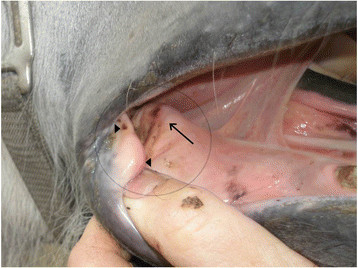
“The bar lesions were in most cases located caudal to the level of the lingual frenulum (Figure 2)”
§ Bit-related lesions in Icelandic competition horses > Discussion
plain- Asserted: passes — The authors put it forward as true.
- Checkable: passes — It can be checked against evidence.
- Load-bearing: passes — The paper’s conclusions depend on it.
- Based: passes — The paper gives a reason why it holds.
A result the paper reports from its own data — it cites no other source for it, so there is none to check. The quote shows it is in the paper.
In the paper
“Horses that qualified for the finals had commonly been ridden with a curb bit which had a port, especially in T1 (83%).”
§ Bit-related lesions in Icelandic competition horses > Discussion
plaincorrelational- Asserted: passes — The authors put it forward as true.
- Checkable: passes — It can be checked against evidence.
- Load-bearing: passes — The paper’s conclusions depend on it.
- Based: passes — The paper gives a reason why it holds.
- Probably not a substantial claim. 11
- It may state two separate claims as one. 23
- The quote only partly states this claim. 1
The cited sources support only part of this claim — read each source’s verdict below.
In the paper
“Bit-induced lesions located on the bars of the mandible are also described, including soft tissue oedema, erosions to the mucosa, periosteal reactions and exostoses, and regarded to be of concern for animal welfare [6],[7].”
§ Bit-related lesions in Icelandic competition horses > Background
What the sources say
- Partly supportedcites [6] Cook WR: Bit-induced pain: a cause of fear, flight, fight and facial neuralgia in the horse. Pferdeheilkd. 2003, 19: 75-82. sourceExperimental — accuracy not yet measured
The Survey of skulls reports bit-induced exostoses on the mandibular diastema, and the Abstract calls them painful and concludes that the bit harms horses’ health. The passages do not describe soft-tissue oedema, mucosal erosions, or periosteal reactions on the bars of the mandible. (LLM, conf=0.87)
- Not matchedcites [7] Johnson TJ: Surgical removal of mandibular periostitis (bone spurs) caused by bit damage. Proc Am Ass Equine Practnrs. 2002, 48: 458-462.
Couldn’t be matched to a paper in Crossref, so it can’t be checked.
plaindirect- Asserted: passes — The authors put it forward as true.
- Checkable: passes — It can be checked against evidence.
- Load-bearing: fails — The paper’s conclusions may not depend on it.
- Based: passes — The paper gives a reason why it holds.
Probably not a substantial claim. The paper’s conclusions may not depend on it. It may state two separate claims as one.
- Partly supported
A result the paper reports from its own data — it cites no other source for it, so there is none to check. The quote shows it is in the paper.
In the paper
“Mild lesions were recorded in 152 horses (36%) prior to the preliminary rounds.”
§ Bit-related lesions in Icelandic competition horses > Abstract > Results
plain- Asserted: passes — The authors put it forward as true.
- Checkable: passes — It can be checked against evidence.
- Load-bearing: unclear — It is unclear whether the paper’s conclusions depend on it.
- Based: passes — The paper gives a reason why it holds.
The quote only partly states this claim.
A result the paper reports from its own data — it cites no other source for it, so there is none to check. The quote shows it is in the paper.
In the paper
“Lesions in the bar region were found in 51% of horses ridden with a curb bit which had a port but only in one horse (4%) ridden with a snaffle bit.”
§ Bit-related lesions in Icelandic competition horses > Results > Repeated examination of 77 horses
plaincorrelational- Asserted: passes — The authors put it forward as true.
- Checkable: passes — It can be checked against evidence.
- Load-bearing: passes — The paper’s conclusions depend on it.
- Based: passes — The paper gives a reason why it holds.
It may state two separate claims as one.
A result the paper reports from its own data — it cites no other source for it, so there is none to check. The quote shows it is in the paper.
In the paper
“Lesions were found on the lateral edges of the tongue in five horses, always in combination with severe findings on the bars of the mandible.”
§ Bit-related lesions in Icelandic competition horses > Results > Repeated examination of 77 horses
plaincorrelational- Asserted: passes — The authors put it forward as true.
- Checkable: passes — It can be checked against evidence.
- Load-bearing: unclear — It is unclear whether the paper’s conclusions depend on it.
- Based: passes — The paper gives a reason why it holds.
It may state two separate claims as one.
A result the paper reports from its own data — it cites no other source for it, so there is none to check. The quote shows it is in the paper.
In the paper
“The frequency of lesions in the bar region increased between the two examinations from 8% to 31% (OR = 9.25, P = 0.0002) while no change was found for lesions in the buccal region (Tables 2 and 3).”
§ Bit-related lesions in Icelandic competition horses > Results > Repeated examination of 77 horses
plaindirect- Asserted: passes — The authors put it forward as true.
- Checkable: passes — It can be checked against evidence.
- Load-bearing: passes — The paper’s conclusions depend on it.
- Based: passes — The paper gives a reason why it holds.
It may state two separate claims as one.
A result the paper reports from its own data — it cites no other source for it, so there is none to check. The quote shows it is in the paper.
In the paper
“The frequency of oral lesions was already found to be high (43%) prior to the preliminary tests although most of the findings were graded as mild at that time (Table 2).”
§ Bit-related lesions in Icelandic competition horses > Discussion
plain- Asserted: passes — The authors put it forward as true.
- Checkable: passes — It can be checked against evidence.
- Load-bearing: unclear — It is unclear whether the paper’s conclusions depend on it.
- Based: passes — The paper gives a reason why it holds.
It may state two separate claims as one.
A result the paper reports from its own data — it cites no other source for it, so there is none to check. The quote shows it is in the paper.
In the paper
“Six horses ridden with traditional Icelandic curb bits were without findings in both locations.”
§ Bit-related lesions in Icelandic competition horses > Results > Repeated examination of 77 horses
plain- Asserted: passes — The authors put it forward as true.
- Checkable: passes — It can be checked against evidence.
- Load-bearing: fails — The paper’s conclusions may not depend on it.
- Based: passes — The paper gives a reason why it holds.
Probably not a substantial claim. The paper’s conclusions may not depend on it.
A result the paper reports from its own data — it cites no other source for it, so there is none to check. The quote shows it is in the paper.
In the paper
“On the other hand, 62% of horses ridden with a snaffle bit had lesions in the buccal region compared to 13% of horses ridden with curb bits which had a port.”
§ Bit-related lesions in Icelandic competition horses > Results > Repeated examination of 77 horses
plaincorrelational- Asserted: passes — The authors put it forward as true.
- Checkable: passes — It can be checked against evidence.
- Load-bearing: passes — The paper’s conclusions depend on it.
- Based: passes — The paper gives a reason why it holds.
It may state two separate claims as one.
A result the paper reports from its own data — it cites no other source for it, so there is none to check. The quote shows it is in the paper.
In the paper
“Sixteen out of 24 findings recorded in the bar region at the second examination (67%) were regarded as severe compared to 2 out of 22 findings in the buccal region (9%).”
§ Bit-related lesions in Icelandic competition horses > Results > Repeated examination of 77 horses
plain- Asserted: passes — The authors put it forward as true.
- Checkable: passes — It can be checked against evidence.
- Load-bearing: unclear — It is unclear whether the paper’s conclusions depend on it.
- Based: passes — The paper gives a reason why it holds.
It may state two separate claims as one.
A conclusion the paper draws from its own results — it cites no other source for it, so there is none to check. The quote shows it is in the paper.
In the paper
“The use of curb bits with a port was found to be a decisive risk factor for lesions on the bars of the mandible, most of which were regarded as severe.”
§ Bit-related lesions in Icelandic competition horses > Abstract > Conclusions
boosteddirect- Asserted: passes — The authors put it forward as true.
- Checkable: passes — It can be checked against evidence.
- Load-bearing: passes — The paper’s conclusions depend on it.
- Based: passes — The paper gives a reason why it holds.
It may state two separate claims as one.
None of the sources cited for this claim have been checked yet.
In the paper
“Ulcers and abrasions of the buccal mucosa, the lips and the tongue are common findings in horses worldwide [1]-[5].”
§ Bit-related lesions in Icelandic competition horses > Background
What the sources say
- Not matchedcites [1] Lundström T, Pettersson H: Oral status of Swedish horses [in Swedish]. Svensk Vet Tidn. 1988, 40: 247-252.
Couldn’t be matched to a paper in Crossref, so it can’t be checked.
- Not matchedcites [2] Lundström T, Pettersson H: Oral status of Swedish horses II [in Swedish]. Svensk Vet Tidn. 1990, 42: 559-563.
Couldn’t be matched to a paper in Crossref, so it can’t be checked.
- Not checked yetcites [3] Allen TE: Incidence and severity of abrasions on the buccal mucosa adjacent to the cheek teeth in 199 horses. Proceedings of the 50th Annual Convension of the American Association of Equine Practitioners, Denver CO, USA. 2004, American Association of Equine Practitioners, Lexington KY, 31-36. Internet Publisher: International Veterinary Information Service, Ithaca NY (www.ivis.org), Last updated: 4-Dec-2004; P1406.1204, [http://www.ivis.org]
- Not checked yetcites [4] Stubbs R: Dentistry of Equine Cheek Teeth. In Proceedings of the 50 th Annual Convention of the American Association of Equine Practitioners, Denver CO, USA. Lexington KY: American Association of Equine Practitioners; 2004:1–6. Internet Publisher: International Veterinary Information Service, Ithaca NY (), Last updated: 4-Dec-2004; P1401.1204., [http://www.ivis.org]
- Not checked — no full text of the sourcecites [5] Tell A, Egenvall A, Lundström T, Wattle O: The prevalence of oral ulceration in Swedish horses when ridden with bit and bridle and when unridden. Vet J. 2008, 178: 405-410. 10.1016/j.tvjl.2008.09.020. source
plain- Asserted: passes — The authors put it forward as true.
- Checkable: passes — It can be checked against evidence.
- Load-bearing: fails — The paper’s conclusions may not depend on it.
- Based: passes — The paper gives a reason why it holds.
Probably not a substantial claim. The paper’s conclusions may not depend on it.
- Not matched
A conclusion the paper draws from its own results — it cites no other source for it, so there is none to check. The quote shows it is in the paper.
In the paper
“This type of bit seems therefore to be of great importance in achieving the highest scores, most likely as the bit pressure on the bars helps the rider to achieve the rewarded head and neck carriage and to control the horse.”
§ Bit-related lesions in Icelandic competition horses > Discussion
hedgedconditional- Asserted: passes — The authors put it forward as true.
- Checkable: passes — It can be checked against evidence.
- Load-bearing: unclear — It is unclear whether the paper’s conclusions depend on it.
- Based: unclear — It is unclear why the paper says it holds.
It may state two separate claims as one.
- Rests on an assumption: The bit pressure on the bars helps the rider to achieve the rewarded head and neck carriage and to control the horse.
A conclusion the paper draws from its own results — it cites no other source for it, so there is none to check. The quote shows it is in the paper.
In the paper
“The increase in the frequency of lesions in this location between the first and second examination from 7.8% to 31.2% respectively (Table 3) demonstrated a competition effect, given that curb bits with a port had also been used (to some degree at least) in training both before and during the competition.”
§ Bit-related lesions in Icelandic competition horses > Discussion
boosteddirect- Asserted: passes — The authors put it forward as true.
- Checkable: passes — It can be checked against evidence.
- Load-bearing: passes — The paper’s conclusions depend on it.
- Based: passes — The paper gives a reason why it holds.
It may state two separate claims as one.
- Rests on an assumption: Curb bits with a port had also been used (to some degree at least) in training both before and during the competition.
In the paper
“High front limb movements, together with an elevated head and neck position are among qualities that are rewarded [9].”
§ Bit-related lesions in Icelandic competition horses > Discussion
What the sources say
- Not matchedcites [9] The International Federation of Icelandic Horse Associations: [], [http://www.feif.org]
Couldn’t be matched to a paper in Crossref, so it can’t be checked.
plain- Asserted: passes — The authors put it forward as true.
- Checkable: passes — It can be checked against evidence.
- Load-bearing: unclear — It is unclear whether the paper’s conclusions depend on it.
- Based: passes — The paper gives a reason why it holds.
It may state two separate claims as one.
- Not matched
What the paper did — it cites no source for this, so there is none to check. The quote shows it is in the paper.
In the paper
“The horses were not re-examined directly after each performance, and thus some new (acute) lesions might have passed unnoticed.”
§ Bit-related lesions in Icelandic competition horses > Discussion
hedgedconditional- Asserted: passes — The authors put it forward as true.
- Checkable: passes — It can be checked against evidence.
- Load-bearing: unclear — It is unclear whether the paper’s conclusions depend on it.
- Based: passes — The paper gives a reason why it holds.
It may state two separate claims as one.
None of the sources cited for this claim have been checked yet.
In the paper
“An extreme elevation of the head and neck has been shown in the trot to increase the (lumbar) back extension [14] which has been claimed to negatively affect the contact with the mouth of the horse [15].”
§ Bit-related lesions in Icelandic competition horses > Discussion
What the sources say
- Not checked — no full text of the sourcecites [14] Rhodin M, GB GÁ, Byström A, Johnston C, van Veeren PR, Roepstorff L, Weishaupt MA: The effect of different head and neck positions on the caudal back and hindlimb kinematics in the elite dressage horse at trot. Equine Vet J. 2009, 41: 274-279. 10.2746/042516409X394436. source
- Not checked yetcites [15] Heuschmann G: Tug of War: Classical Versus “Modern” Dressage. 2006, Wu Wei Verlag, Schondorf
plaindirect- Asserted: passes — The authors put it forward as true.
- Checkable: passes — It can be checked against evidence.
- Load-bearing: fails — The paper’s conclusions may not depend on it.
- Based: passes — The paper gives a reason why it holds.
Probably not a substantial claim. The paper’s conclusions may not depend on it. It may state two separate claims as one.
What the paper did — it cites no source for this, so there is none to check. The quote shows it is in the paper.
In the paper
“A team of eight veterinarians with experience in oral examination of horses performed the examinations, coordinated by the veterinarian in charge.”
§ Bit-related lesions in Icelandic competition horses > Methods > Oral examination
plain- Asserted: passes — The authors put it forward as true.
- Checkable: passes — It can be checked against evidence.
- Load-bearing: fails — The paper’s conclusions may not depend on it.
- Based: passes — The paper gives a reason why it holds.
Probably not a substantial claim. The paper’s conclusions may not depend on it. It may state two separate claims as one.
What the paper did — it cites no source for this, so there is none to check. The quote shows it is in the paper.
In the paper
“The caudal regions of the oral cavity were not examined in this study.”
§ Bit-related lesions in Icelandic competition horses > Discussion
plain- Asserted: passes — The authors put it forward as true.
- Checkable: passes — It can be checked against evidence.
- Load-bearing: fails — The paper’s conclusions may not depend on it.
- Based: passes — The paper gives a reason why it holds.
Probably not a substantial claim. The paper’s conclusions may not depend on it.
What the paper did — it cites no source for this, so there is none to check. The quote shows it is in the paper.
In the paper
“To ensure consistency, one veterinarian (SB), supervised all the examinations and the grading of severe findings was in most cases made in consensus between two veterinarians.”
§ Bit-related lesions in Icelandic competition horses > Discussion
plain- Asserted: passes — The authors put it forward as true.
- Checkable: passes — It can be checked against evidence.
- Load-bearing: fails — The paper’s conclusions may not depend on it.
- Based: passes — The paper gives a reason why it holds.
Probably not a substantial claim. The paper’s conclusions may not depend on it. It may state two separate claims as one.
In the paper
“The tongue has been described as a pad that acts to protect the bars of the mandible from the pressure of the bit and to control the distribution of bit pressure within the oral cavity [12].”
§ Bit-related lesions in Icelandic competition horses > Discussion
What the sources say
- Not checked — no full text of the sourcecites [12] Engelke E, Gasse H: An anatomical study of the rostral part of the equine oral cavity with respect to position and size of a snaffle bit. Equine Vet Educ. 2003, 15: 158-163. 10.1111/j.2042-3292.2003.tb00235.x. source
plaindirect- Asserted: passes — The authors put it forward as true.
- Checkable: passes — It can be checked against evidence.
- Load-bearing: passes — The paper’s conclusions depend on it.
- Based: passes — The paper gives a reason why it holds.
Probably not a substantial claim. It may state two separate claims as one.
In the paper
“On the other hand, it has been demonstrated how horses may frequently bulge the tongue over variations of the snaffle bit [13] which might increase the risk of lesions on the bars.”
§ Bit-related lesions in Icelandic competition horses > Discussion
What the sources say
- Not checked — no full text of the sourcecites [13] Manfredi JM, Rosenstein D, Lanovaz JL, Nauwelaerts S, Clayton HM: Fluoroscopic study of oral behaviours in response to the presence of a bit and the effects of rein tension. Comp Exerc Physiol. 2010, 6: 143-148. 10.1017/S1755254010000036. source
hedgedconditional- Asserted: passes — The authors put it forward as true.
- Checkable: passes — It can be checked against evidence.
- Load-bearing: fails — The paper’s conclusions may not depend on it.
- Based: passes — The paper gives a reason why it holds.
Probably not a substantial claim. The paper’s conclusions may not depend on it. It may state two separate claims as one.
In the paper
“Subsequently, a carriage close to the extremely elevated head and neck position described by Rhodin et al.[14] in the trot is frequently observed and contact to the mouth of the horse is allowed on a stretched rein.”
§ Bit-related lesions in Icelandic competition horses > Discussion
What the sources say
- Not checked — no full text of the sourcecites [14] Rhodin M, GB GÁ, Byström A, Johnston C, van Veeren PR, Roepstorff L, Weishaupt MA: The effect of different head and neck positions on the caudal back and hindlimb kinematics in the elite dressage horse at trot. Equine Vet J. 2009, 41: 274-279. 10.2746/042516409X394436. source
plain- Asserted: passes — The authors put it forward as true.
- Checkable: passes — It can be checked against evidence.
- Load-bearing: unclear — It is unclear whether the paper’s conclusions depend on it.
- Based: passes — The paper gives a reason why it holds.
It may state two separate claims as one.
A conclusion the paper draws from its own results — it cites no other source for it, so there is none to check. The quote shows it is in the paper.
In the paper
“The bar lesions were in most cases located caudal to the level of the lingual frenulum (Figure 2), which was unlikely to be possible with the tongue over the bit, and therefore the habit was excluded as a causative factor.”
§ Bit-related lesions in Icelandic competition horses > Discussion
hedged- Asserted: passes — The authors put it forward as true.
- Checkable: passes — It can be checked against evidence.
- Load-bearing: passes — The paper’s conclusions depend on it.
- Based: passes — The paper gives a reason why it holds.
It may state two separate claims as one.
What the paper did — it cites no source for this, so there is none to check. The quote shows it is in the paper.
In the paper
“Examination of the rostral part of the oral cavity was compulsory according to the rules of the Icelandic Equestrian Association and performed according to the same protocol for all competition horses participating in the two major national horse events in Iceland in 2012.”
§ Bit-related lesions in Icelandic competition horses > Methods > Horses
plain- Asserted: passes — The authors put it forward as true.
- Checkable: passes — It can be checked against evidence.
- Load-bearing: passes — The paper’s conclusions depend on it.
- Based: passes — The paper gives a reason why it holds.
Probably not a substantial claim.
A conclusion the paper draws from its own results — it cites no other source for it, so there is none to check. The quote shows it is in the paper.
In the paper
“The type of bits used influenced both the location and the severity of the lesions.”
§ Bit-related lesions in Icelandic competition horses > Abstract > Conclusions
plaindirect- Asserted: passes — The authors put it forward as true.
- Checkable: passes — It can be checked against evidence.
- Load-bearing: passes — The paper’s conclusions depend on it.
- Based: passes — The paper gives a reason why it holds.
It may state two separate claims as one.
What the paper did — it cites no source for this, so there is none to check. The quote shows it is in the paper.
In the paper
“The effect of the rider was not included in the statistical model due to few riders who rode multiple horses and because of the confounding effect between the bit and rider.”
§ Bit-related lesions in Icelandic competition horses > Methods > Potential risk factors
plain- Asserted: passes — The authors put it forward as true.
- Checkable: passes — It can be checked against evidence.
- Load-bearing: passes — The paper’s conclusions depend on it.
- Based: passes — The paper gives a reason why it holds.
It may state two separate claims as one.
What the paper did — it cites no source for this, so there is none to check. The quote shows it is in the paper.
In the paper
“Use of the English noseband was common for the two types of curb bits and use of the German noseband was restricted to snaffle bits, therefore, only the type of bit could be assessed as a risk factor.”
§ Bit-related lesions in Icelandic competition horses > Methods > Potential risk factors
plain- Asserted: passes — The authors put it forward as true.
- Checkable: passes — It can be checked against evidence.
- Load-bearing: passes — The paper’s conclusions depend on it.
- Based: passes — The paper gives a reason why it holds.
It may state two separate claims as one.
In the paper
“Ulcers located adjacent to the first and second premolar teeth and in close proximity to the commissures of the lips, are reported to be caused by the stress of bit and bridle, without being influenced by routine floating of the teeth [5].”
§ Bit-related lesions in Icelandic competition horses > Background
What the sources say
- Not checked — no full text of the sourcecites [5] Tell A, Egenvall A, Lundström T, Wattle O: The prevalence of oral ulceration in Swedish horses when ridden with bit and bridle and when unridden. Vet J. 2008, 178: 405-410. 10.1016/j.tvjl.2008.09.020. source
plaindirect- Asserted: passes — The authors put it forward as true.
- Checkable: passes — It can be checked against evidence.
- Load-bearing: fails — The paper’s conclusions may not depend on it.
- Based: passes — The paper gives a reason why it holds.
Probably not a substantial claim. The paper’s conclusions may not depend on it. It may state two separate claims as one.
The paper relies on this without support.
Curb bits with a port had also been used (to some degree at least) in training both before and during the competition.
“given that curb bits with a port had also been used (to some degree at least) in training both before and during the competition.”
The paper relies on this without support.
The thin layer of mucosa and sensitive periosteum covering the mandibular bone cannot readily absorb pressure while maintaining tissue integrity.
“As the thin layer of mucosa and the sensitive periostium covering the mandibular bone cannot readily absorb the pressure while maintaining tissue integrity”
The paper relies on this without support.
The bit pressure on the bars helps the rider to achieve the rewarded head and neck carriage and to control the horse.
“most likely as the bit pressure on the bars helps the rider to achieve the rewarded head and neck carriage and to control the horse.”
Self-check
Percentages, sums and reported differences re-computed from the paper’s own numbers.
Each contradiction between two passages listed here was confirmed by an independent check.
Rated minor: it would not touch a result — a value no result rests on, a p-value that stays on the same side of the significance level, or a conflict that is clerical, resolved elsewhere in the paper, or outside its own findings.
In the paper
§ Bit-related lesions in Icelandic competition horses > Results > Repeated examination of 77 horses
“The frequency of lesions in the bar region increased between the two examinations from 8% to 31% (OR = 9.25, P = 0.0002)”
§ Bit-related lesions in Icelandic competition horses > Results > Repeated examination of 77 horses
“| Examination a | | | <0.0001 | | | | First examination | 77 | 8 | | 1.00 | | | Second examination | 77 | 31 | | 9.29 | 3.03 - 28.50 |”
Rated minor: it would not touch a result — a value no result rests on, a p-value that stays on the same side of the significance level, or a conflict that is clerical, resolved elsewhere in the paper, or outside its own findings.
In the paper
§ Bit-related lesions in Icelandic competition horses > Results > Repeated examination of 77 horses
“| Number of performances b | | | 0.8907 | | | | 1 | 21 | 33 | | | | | 2 | 34 | 21 | | | | | 3 | 14 | 36 | | | | | ≥4 | 8 | 2 | | | |”
§ Bit-related lesions in Icelandic competition horses > Results > Repeated examination of 77 horses
“| Second examination | 77 | 29 | | | |”
Citations
Cites
Longitudinal data analysis using generalized linear models
LIANG, K.-Y., & ZEGER, S. L. (1986) · Biometrika · doi:10.1093/biomet/73.1.13 · Cited by 18,550
Rhodin, M., Álvarez, C. B. G., Byström, A., Johnston, C., Van Weeren, P. R., Roepstorff, L., & Weishaupt, M. A. (2009) · Equine Veterinary Journal · doi:10.2746/042516409x394436 · Cited by 78
Tell, A., Egenvall, A., Lundström, T., & Wattle, O. (2008) · The Veterinary Journal · doi:10.1016/j.tvjl.2008.09.020 · Cited by 50
Self-citationManfredi, J. M., Rosenstein, D., Lanovaz, J. L., Nauwelaerts, S., & Clayton, H. M. (2009) · Comparative Exercise Physiology · doi:10.1017/s1755254010000036 · Cited by 45
Bit-induced pain: a cause of fear, flight, fight und facial neuralgia in the horse
Cook, W. R. (2003) · Pferdeheilkunde Equine Medicine · doi:10.21836/pem20030111 · Cited by 38
Engelke, E., & Gasse, H. (2003) · Equine Veterinary Education · doi:10.1111/j.2042-3292.2003.tb00235.x · Cited by 28
Genetic analysis of competition data on Icelandic horses
Albertsdóttir, E., Eriksson, S., Näsholm, A., Strandberg, E., & Árnason, T. (2006) · Livestock Science · doi:10.1016/j.livsci.2006.11.008 · Cited by 26
Surgical Removal of Mandibular Periostitis (Bone Spurs) Caused by Bit Damage
Johnson, T. (2002) · Cited by 20
Incidence and severity of abrasions on the buccal mucosa adjacent to the cheek teeth in 199 horses.
Allen, T. E. (2004) · Cited by 10
Dentistry of equine cheek teeth.
Stubbs, R. C. (2004) · Cited by 9
Research works printed but not linked: 3
- Lundström T, Pettersson H: Oral status of Swedish horses [in Swedish]. Svensk Vet Tidn. 1988, 40: 247-252.
- Lundström T, Pettersson H: Oral status of Swedish horses II [in Swedish]. Svensk Vet Tidn. 1990, 42: 559-563.
- Heuschmann G: Tug of War: Classical Versus “Modern” Dressage. 2006, Wu Wei Verlag, Schondorf
Cited by
Sorted by citations
Pertanika Journal of Tropical Agricultural Science
(2020) · Pertanika journal of tropical agricultural science · doi:10.47836/pjtas · Cited by 345
Lesions associated with the use of bits, nosebands, spurs and whips in Danish competition horses
Uldahl, M., & Clayton, H. M. (2018) · Equine Veterinary Journal · doi:10.1111/evj.12827 · Cited by 94
Mellor, D. J. (2020) · Animals · doi:10.3390/ani10040572 · Cited by 63
Determining a Welfare Prioritization for Horses Using a Delphi Method
Rioja-Lang, F. C., Connor, M., Bacon, H., & Dwyer, C. M. (2020) · Animals · doi:10.3390/ani10040647 · Cited by 57
Bit-Related Lesions in Event Horses After a Cross-Country Test
Tuomola, K., Mäki‐Kihniä, N., Valros, A., Mykkänen, A. K., & Kujala‐Wirth, M. (2021) · Frontiers in Veterinary Science · doi:10.3389/fvets.2021.651160 · Cited by 44
Metadata
- Authors
- Björnsdóttir, S., Frey, R., Kristjansson, T., & Lundström, T.
- Affiliations
- Norrköping Hospital (SE)
- Corresponding author
- Björnsdóttir, Sigríður
- ORCID
- Frey, Rebecka
- Venue
- Acta Veterinaria Scandinavica
- Published
- 2014-08-13
- Volume
- 56
- Issue
- 1
- Pages
- 40-40
- ISSN
- 0044-605X (ISSN-L)
- 1751-0147
- PMC
- PMC4236600
- OpenAlex
- W2161378112
- Cited by
- 50
- References
- 10
- Citations by year
- 2026: 3 · 2025: 5 · 2024: 8 · 2023: 6 · 2022: 9 · 2021: 3 · 2020: 6 · 2019: 3 · 2018: 3 · 2017: 2 · 2016: 1 · 2015: 1
- FWCI
- 2.24
- Type
- journal article
- Language
- en
- Open access
- gold
- doi.org
- Locations
- Acta veterinaria Scandinavica (publishedVersion, cc-by)
- PubMed Central (publishedVersion, cc-by)
- PubMed (publishedVersion)
- Topics
- Health Sciences › Veterinary › Equine › Veterinary Equine Medical Research
- Health Sciences › Veterinary › Small Animals › Veterinary Pharmacology and Anesthesia
- Life Sciences › Agricultural and Biological Sciences › Animal Science and Zoology › Animal Behavior and Welfare Studies
- Keywords
- buccal mucosa lesions, equine welfare, risk factors, Icelandic horses
- MeSH terms
- Animals, Animal Welfare, Horses, Iceland, Mouth, Sports
About these checks
Registry, retraction, Cites and statistics results are computed, not judged, with one exception: a printed reference that no index lists is read once by a model before it counts as a citation error. Claims are extracted by a model and kept only when their quote appears verbatim in the text; each cited source is then checked, with a model’s help, for whether it says what the claim relies on. Those verdicts can be wrong — read the claim’s quote and the cited source before relying on one.
A language model drew the claims from the paper on 2026-11-08, under version 3 of the claim definition (model deepseek-v4.1-flash, prompt extract-v3).
A second model labelled each claim on 2026-11-08 (model jev-1.13-20260917, definition revision gold-guideline-v0.2).
Cited sources are checked with a language model’s help (gpt-6-sol).
Statistics and arithmetic are recomputed, not judged.
Confidence bands are shown only for fields calibrated on our annotated test set. None is calibrated yet, so no band is shown.
What counts as a claim ›How we measure confidence ›How we check this ›
Are you an author, or do you see a problem with this page? Request a review
