

Key attributes of integrated community-based youth service hubs for mental health: a scoping review
Open accessThe DOI matches its Crossref record; 113 of the 113 references it cites were found in a registry or an index.
Abstract
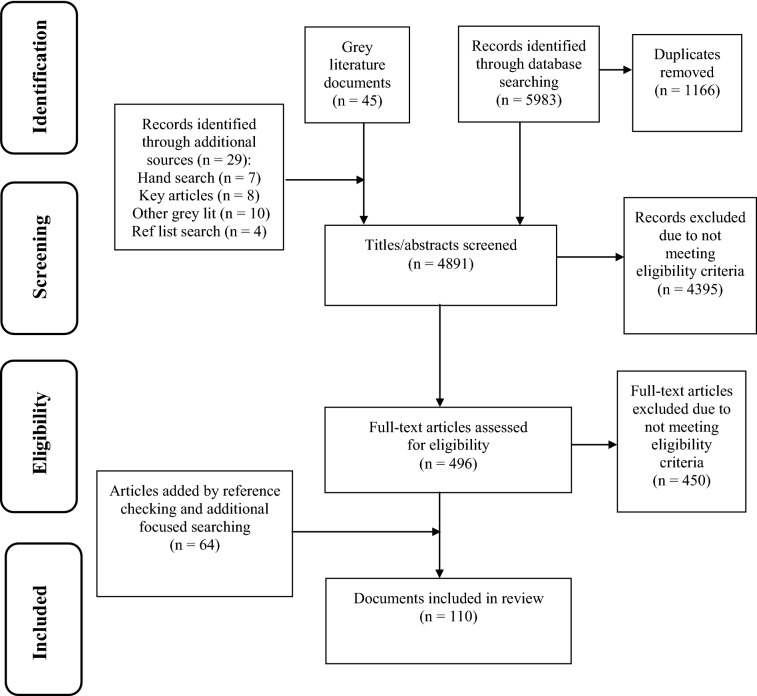
BACKGROUND: Community-based, integrated youth service hubs have the potential to address some of the longstanding issues with mental health services for youth, including problems with access and system fragmentation. Better understanding of these approaches, particularly efforts to create a single point of entry to comprehensive, evidence-based services through youth service hubs, is needed to help guide future implementation and evaluation. This scoping review identifies the key principles and characteristics of these models of care, as well as the state of the literature, particularly with regard to implementation and replicability. METHOD: Electronic databases and grey literature sources were searched for material from 2001 to 2019, with diverse search terms capturing the concept of "integrated" or "one-stop shop" youth mental health services. Title/abstract and full text review were conducted, as well as additional focused searching. After screening 4891 texts at the title/abstract level and 496 at the full-text level, 110 documents were included for data extraction. RESULTS: Several integrated care hub models for youth mental health services and related frameworks were identified internationally, largely in high-income countries. Common principles included an emphasis on rapid access to care and early intervention, youth and family engagement, youth-friendly settings and services, evidence-informed approaches, and partnerships and collaboration. Program characteristics also revealed similarities (e.g., providing evidence-informed or evidence-based services in youth-friendly spaces), with some differences (e.g., care coordination methods, types of service providers), potentially attributable to lack of available information about key ingredients. Outcome research was limited, with few rigorous evaluations of youth outcomes. Moreover, sufficient information for replication, community evaluation of feasibility or actual implementation was rarely provided. CONCLUSION: Internationally, integrated youth service hubs were found to share common key principles, while providing comprehensive services to youth with mental health difficulties. There is a great need for common language and measurement framework to facilitate replication, rigorous evaluation of outcomes, knowledge exchange, and dissemination of findings.
Overview
The claims and statistics of this paper haven’t been checked yet.
Free: it reads the open-access text and checks the first 5 claims that cite a source we can check. Create a free account to check every claim.
Integrity signals
Registry
Cites
Statistics
Figures
Verification
Claims the paper makes
The claims and statistics of this paper haven’t been checked yet.
Free: it reads the open-access text and checks the first 5 claims that cite a source we can check. Create a free account to check every claim.
Claims other papers make about this one
Each is checked against this paper’s own text: does it say what the citing paper says it does?
The source backs part of the claim, not all of it — or backs it for a different population, condition or comparison.
In the citing paper
“Codesign (by which the model of care benefits from the ideas and views of young people with lived experience of mental ill health) and youth partnership (in which young people have an ongoing role in the operation of the service) are underlying principles and are essential elements for building a trusted brand (table 2). 208,209,286”
From The Lancet Psychiatry Commission on youth mental health (2024) · cites this paper as [286]
Experimental — accuracy not yet measuredThe source backs part of the claim, not all of it — or backs it for a different population, condition or comparison.
In the citing paper
“Although primary care services are predominantly designed for young people with mild-to-moderate needs, individuals with higher or more complex needs are increasingly accessing these services.”
From The Lancet Psychiatry Commission on youth mental health (2024) · cites this paper as [286]
Experimental — accuracy not yet measuredThe source backs part of the claim, not all of it — or backs it for a different population, condition or comparison.
In the citing paper
“Peer or lay workers are a core component of the youth mental health workforce across all resource settings, 29,286,343 complementing traditional clinical roles rather than merely filling staff shortages.”
From The Lancet Psychiatry Commission on youth mental health (2024) · cites this paper as [286]
Experimental — accuracy not yet measuredThe cited source says what the claim attributes to it.
In the citing paper
“Within the past two decades, a range of integrated youth mental health care services have emerged internationally, although reform has largely occurred in high-resource settings. 209,250,286”
From The Lancet Psychiatry Commission on youth mental health (2024) · cites this paper as [286]
Self-check
Percentages, sums and reported differences re-computed from the paper’s own numbers.
The self-check needs the paper’s full text.
Citations
Cites
Scoping studies: towards a methodological framework
Arksey, H., & O'Malley, L. (2005) · International Journal of Social Research Methodology · doi:10.1080/1364557032000119616 · Cited by 36,742 · cited 1×
“Scoping reviews comprehensively identify important concepts in a structured manner [20], including the extent, range, and nature of research activity in areas in which the available range of materials is unknown [21], e.”
BackgroundKessler, R. C., Berglund, P., Demler, O., Jin, R., Merikangas, K. R., & Walters, E. E. (2005) · Archives of General Psychiatry · doi:10.1001/archpsyc.62.6.593 · Cited by 20,391 · cited 2×
“Worldwide, approximately 10–20% of children and adolescents experience mental health disorders [3, 4] and cumulative lifetime prevalence approaches 50% among adolescents and young adults in developed countries [1, 5, 6].”
BackgroundScoping studies: advancing the methodology
Levac, D., Colquhoun, H., & O'Brien, K. K. (2010) · Implementation Science · doi:10.1186/1748-5908-5-69 · Cited by 15,268
Hoffmann, T. C., Glasziou, P. P., Boutron, I., Milne, R., Perera, R., Moher, D., Altman, D. G., Barbour, V., Macdonald, H., Johnston, M., et al. (2014) · BMJ · doi:10.1136/bmj.g1687 · Cited by 10,548 · cited 1×
“Future reporting should follow TIDieR guidelines in order to facilitate replication, evaluation and implementation [91].”
MethodMerikangas, K. R., He, J.-P., Burstein, M., Swanson, S. A., Avenevoli, S., Cui, L., Benjet, C., Georgiades, K., & Swendsen, J. (2010) · Journal of the American Academy of Child & Adolescent Psychiatry · doi:10.1016/j.jaac.2010.05.017 · Cited by 6,278
Whiteford, H. A., Degenhardt, L., Rehm, J., Baxter, A. J., Ferrari, A. J., Erskine, H. E., Charlson, F. J., Norman, R. E., Flaxman, A. D., Johns, N., et al. (2013) · The Lancet · doi:10.1016/s0140-6736(13)61611-6 · Cited by 6,006
Polanczyk, G. V., Salum, G. A., Sugaya, L. S., Caye, A., & Rohde, L. A. (2015) · Journal of Child Psychology and Psychiatry · doi:10.1111/jcpp.12381 · Cited by 3,990 · cited 1×
“Worldwide, approximately 10–20% of children and adolescents experience mental health disorders [3, 4] and cumulative lifetime prevalence approaches 50% among adolescents and young adults in developed countries [1, 5, 6].”
BackgroundChild and adolescent mental health worldwide: evidence for action
Kieling, C., Baker-Henningham, H., Belfer, M., Conti, G., Ertem, I., Omigbodun, O., Rohde, L. A., Srinath, S., Ulkuer, N., & Rahman, A. (2011) · The Lancet · doi:10.1016/s0140-6736(11)60827-1 · Cited by 2,449 · cited 1×
“Worldwide, approximately 10–20% of children and adolescents experience mental health disorders [3, 4] and cumulative lifetime prevalence approaches 50% among adolescents and young adults in developed countries [1, 5, 6].”
BackgroundKim-Cohen, J., Caspi, A., Moffitt, T. E., Harrington, H., Milne, B. J., & Poulton, R. (2003) · Archives of General Psychiatry · doi:10.1001/archpsyc.60.7.709 · Cited by 2,025 · cited 1×
“Int J Ment Health Syst (2019) 13:52 Introduction Mental health problems commonly start during childhood or adolescence, with about half of all lifetime cases starting by ages 14–15 and three-quarters by ages 18–24 [1, 2].”
BackgroundThe COMET Handbook: version 1.0
Williamson, P. R., Altman, D. G., Bagley, H., Barnes, K. L., Blazeby, J. M., Brookes, S. T., Clarke, M., Gargon, E., Gorst, S., Harman, N., et al. (2017) · Trials · doi:10.1186/s13063-017-1978-4 · Cited by 2,011 · cited 1×
“Finally, using common, core outcome measures [95] to track outcomes and other aspects of ICYSHs would help facilitate collaborative research efforts, support future meta-analyses, and more rapidly advance the field.”
Method
Research works printed but not linked: 7
- Ontario Ministry of Health and Long Term Care Ontario providing faster access to mental health services for thousands of people 2017 Toronto Ontario Ministry of Health and Long-Term Care
- Bates T Illback RJ Scanlan F Carroll L Somewhere to turn to, someone to talk to. Headstrong—The National Centre for Youth Mental Health 2009 Dublin Headstrong
- Szatmari P Henderson J Cheung A Cleverley K Chaim G Hawke L Transforming youth mental health services in Canada: YouthCan IMPACT World Child Adolesc Psychiatry. 2016 10 14 15
- Hopkins G The Wight stuff Community Care. 2004 1550 38 39
- Gwynne K Zilibowitz M Spilstead model of early intervention for vulnerable families J Paediatr Child Health 2010 46 6 7
- Tobon JI, Jeffs L, editors. Bridging gaps in youth mental health: who is presenting to the youth wellness centre in Hamilton, Ontario? Paper presented at the research and policy in child, youth, and youth adult mental health conference, Tampa, Florida. 2017.
- Tee K Oyedele O Salmon A Helfrich W Banjo J Berger M Foundry—transforming access through integrated youth services in British Columbia, Canada Early Interv Psychiatry. 2018 12 Suppl. 1 230
Cited by
Items 101–171 of 171
Looking at Global Mental Health Models to Prevent Youth Suicide in the United States
Vélez‐Grau, C., & Álvarez, K. (2024) · Journal of Adolescent Health · doi:10.1016/j.jadohealth.2024.07.022 · Cited by 3
Hews‐Girard, J., Cullen, E., Singh, M., Perry, R., Brill, K., Taylor, N., Munson, M. R., Barbic, S. P., Henderson, J. L., Cronin, S., et al. (2025) · Community Mental Health Journal · doi:10.1007/s10597-024-01440-x · Cited by 3
“Over the past two decades, IYS has been an emerging model of integrative and youth friendly care globally (Halsall et al., 2019; Henderson et al., 2023; Settipani et al., 2019).”
Self-citationShah, J. L., Thanh, N. X., Surood, S., Poudel, S., Urichuk, L., D'andrea, G., Latimer, E. A., Andersson, N., Boksa, P., Joober, R., et al. (2026) · The Lancet Psychiatry · doi:10.1016/s2215-0366(26)00165-3 · Cited by 3
Kreim, S., Marchand, K., Mallia, E., Dubras, R., McMaster, W. R., Tee, K. A., Mathias, S., & Barbic, S. P. (2023) · Journal of Substance Use and Addiction Treatment · doi:10.1016/j.josat.2023.209076 · Cited by 4
Dowell, A. C., Stubbe, M. H., Dunlop, A., Fedchuk, D., Gardiner, T., Garrett, S., Gordon, S., Hilder, J., Mathieson, F. M., & Tester, R. (2024) · Cureus · doi:10.7759/cureus.58870 · Cited by 3
“Implementing an appropriate balance between access and triage has been recognised for youth services in a number of different settings [26].”
BackgroundThe Effectiveness of EduMind for Mental Health Promotion Among Youths
Harith, H., Farid, N. D. N., Yahya, A., & Shuib, N. L. M. (2024) · Cureus · doi:10.7759/cureus.61462 · Cited by 3
Osuch, E. A., Vingilis, E. R., Wammes, M., Demy, J., Summerhurst, C., & Arcaro, J. A. (2024) · PLOS mental health. · doi:10.1371/journal.pmen.0000008 · Cited by 2
Wittevrongel, E., Kessels, R., Everaert, G., Vrijens, M., Danckaerts, M., & van Winkel, R. (2025) · Early Intervention in Psychiatry · doi:10.1111/eip.70012 · Cited by 2
“These models have in common that they are geared towards adolescents and young adults, try to develop youth-friendly settings and offer multiple services in addition to mental health care (Hetrick et al. 2017; McGorry et al. 2022; Settipani et al. 2019).”
Chiodo, D., Turpin, A., Wolfe, J., Darnay, K., & Henderson, J. L. (2025) · Health Expectations · doi:10.1111/hex.70240 · Cited by 4
Self-citationHu, M., Tingting, A., Zhang, X., Huang, X., Wu, Q., Wei, T., Song, B., & Hu, S. (2025) · Asia-Pacific Journal of Oncology Nursing · doi:10.1016/j.apjon.2025.100755 · Cited by 2
“57,58 In China, however, the development of mental health services is uneven, with resources predominantly concentrated in economically developed eastern cities, while the central and western regions suffer from an insufficient supply and a lack of publicity.”
Making the case for citizenship-oriented mental healthcare for youth in Canada
Jordan, G., Mutschler, C., Kidd, S. A., Rowe, M., & Iyer, S. N. (2023) · Journal of Public Mental Health · doi:10.1108/jpmh-06-2022-0055 · Cited by 2
Rao, S., & Dimitropoulos, G. (2023) · Mental Health and Social Inclusion · doi:10.1108/mhsi-02-2023-0016 · Cited by 2
Rosic, T., Lovell, E., MacMillan, H. L., Samaan, Z., & Morgan, R. L. (2023) · The Canadian Journal of Psychiatry · doi:10.1177/07067437231212037 · Cited by 2
Bechdolf, A., Correll, C. U., Hellenschmidt, T., Holzner, L., von Hardenberg, L., Jäckel, D., Kambeitz, J. P., Koutsouleris, N., Kusserow, N., Leopold, K., et al. (2025) · Der Nervenarzt · doi:10.1007/s00115-025-01895-7 · Cited by 1
Andersén, M., Lostelius, P. V., Bring, A., Ring, L., Nystrand, C., & Olsson, E. M. G. (2025) · BMJ Open · doi:10.1136/bmjopen-2024-095714 · Cited by 1
“29 35 Due to a current lack of common terminology in the research field, studies describing ‘youth-friendly’ health services often use varying terms to describe these services.”
Johansen, M., Ness, O., Stuen, H. K., Brekke, E., & Landheim, A. S. (2026) · Frontiers in Psychiatry · doi:10.3389/fpsyt.2026.1759231 · Cited by 1
Corriveau, H., Landry, C., Paulin, C., Roy, D., Godin, I., & Plourde, V. (2026) · Community Mental Health Journal · doi:10.1007/s10597-026-01633-6 · Cited by 2
Mousazadeh, H., & Hubach, R. D. (2026) · Social Sciences & Humanities Open · doi:10.1016/j.ssaho.2026.102906 · Cited by 1
McInerney, K., Marchand, K., Buckley, J. L., Gao, C., Kestler, A. M., Mathias, S., Argyle, A., & Barbic, S. P. (2023) · Early Intervention in Psychiatry · doi:10.1111/eip.13446 · Cited by 4
“While availability of services varies slightly between IYS models, most provide primary care, mental health and substance use services, and social services (e.g., vocational assistance, housing support) (Settipani et al., 2019).”
BackgroundInfluentialRealizing an Evidence-Based Framework for the Management and Delivery of Family Support Services
Archer‐Kuhn, B., Lind, C., Beltrano, N. R., Garrisen, L., Hettler, J., & Reilly, S. M. (2024) · Journal of Evidence-Based Social Work · doi:10.1080/26408066.2024.2310599 · Cited by 1
Lo, R. F., Schumacher, A., LaForge-MacKenzie, K., Cost, K. T., Crosbie, J., Charach, A., Anagnostou, E. A., Birken, C. S., Monga, S., & Korczak, D. J. (2024) · Child and Adolescent Psychiatry and Mental Health · doi:10.1186/s13034-024-00716-0 · Cited by 1
“…demand for child and youth MH services during the pandemic further exacerbated pre-existing difficulties with access to MH care, including cumbersome and non-streamlined referral processes, long wait lists, and the need for multiple points of assessment prior to receiving ongoing treat-ment [5–7].”
BackgroundWhat do justice-involved youth want from integrated youth services? A conjoint analysis.
Klymkiw, D. F., Day, D. M., Henderson, J. L., & Hawke, L. D. (2024) · PubMed Central · Cited by 3
Self-citationNurse Perceptions of Pediatric Mental Health Emergency Care: A Qualitative Study
Alhamidi, S. A., & Alyousef, S. M. (2024) · SAGE Open · doi:10.1177/21582440241285374 · Cited by 2
“This approach may not provide comprehensive assessment and planning for pediatric MHC patients (Marynowski-Traczyk et al., 2017; Settipani et al., 2019).”
Jonescu, E. E., Chirichilli, S., White, C., Uylaki, T. J., & Piggot, I. (2024) · Springer eBooks · doi:10.1007/978-3-031-65766-5_22 · Cited by 1
Lee, J., Barnett, P., Yang, J., Appleton, R., Lloyd‐Evans, B., Hahn, J. S., Rich, N., Francis, E., Mitchell, L., Driskell, E., et al. (2025) · medRxiv · doi:10.1101/2025.05.08.25323765 · Cited by 1
Integrated Youth Mental Health Services – Neue Hoffnung für junge Menschen mit psychischen Krisen
Bechdolf, A., Correll, C. U., & Uhlhaas, P. J. (2025) · Psychiatrische Praxis · doi:10.1055/a-2657-9858 · Cited by 1
Tavoitteiden asettaminen ja niiden toteutuminen nuorten mielenterveyskuntoutuksessa
Korkeamäki, J., Harkko, J., Poutiainen, E. T., & Vaalasranta, L. (2020) · Kuntoutus · doi:10.37451/kuntoutus.95533 · Cited by 2
Integration of Services in Child and Youth Mental Health: A Case Study
Sloos, R. (2019) · TSpace (University of Toronto) · Cited by 1
Sun, K., Shivakumar, V., & Kishore, A. R. (2021) · Springer eBooks · doi:10.1007/978-3-030-62113-1_7
Uchino, T., Fukui, E., Takubo, Y., Iwai, M., Katagiri, N., Tsujino, N., Imamura, H., Fujii, C., Tanaka, K., Shimizu, T., et al. (2022) · Research Square · doi:10.21203/rs.3.rs-2243084/v1
Puffer, E. S., Johnson, S. L., & Sim, A. L. (2022) · Oxford University Press eBooks · doi:10.1093/med-psych/9780197649510.003.0013
Hogan, C. (2023) · Research Square · doi:10.21203/rs.3.rs-3161075/v1 · Cited by 2
Early alcohol onset: clinical and demographic characteristics of service-seeking youth.
Tackaberry-Giddens, L., Henderson, J. L., & Hawke, L. D. (2023) · PubMed Central · Cited by 6
Self-citationDecolonizing Youth Development on Turtle Island (Canada): Research, Scholarship and Practice
Llewellyn, J., & Ansari, N. (2023) · Springer eBooks · doi:10.1007/978-981-99-4969-4_18
Klymkiw, D. F., Day, D. M., Henderson, J. L., & Hawke, L. D. (2024) · International Journal of Integrated Care · doi:10.5334/ijic.7044
Self-citationTouati, N., Ruelland, I., del Barrio, L. R., Bouchard, M., Beaulieu, K., & Courcy, I. (2024) · Health Services Insights · doi:10.1177/11786329241232299
Adolescent Mental Health Care: Time for Revolution
Marini, S., D’Agostino, L., Ciamarra, C., LenaMara, R. D., Giacomodonato, M., Molinero, M., Corsi, L., Gentile, A., & Acciavatti, T. (2024) · Juniper Online Journal of Case Studies · doi:10.19080/jojcs.2024.14.555891
Goicolea, I., Sundberg, L. R., Wiklund, M., Gotfredsen, A. C., & Christianson, M. (2024) · International Journal of Qualitative Studies on Health and Well-Being · doi:10.1080/17482631.2024.2348879
“As Setippani emphasizes: “the complexity of managing numerous objectives and components within comprehensive integrated community-based youth service hubs for mental health may limit the ability to fully address each aspect simultaneously” (Settipani et al., 2019).”
BackgroundLes pratiques citoyennes et la démocratisation de l’action publique en santé de proximité
Ruelland, I. (2024) · SociologieS · doi:10.4000/11ulf
The Influence of Social Media Marketing on Customer Engagement: The Case of ZynergiaPreprint
Darunday, R., Dejarme, A., Opalla, J. M. G., & Bacatan, J. R. (2024) · SSRN Electronic Journal · doi:10.2139/ssrn.4882750 · Cited by 1
Dar, D. R., & Sobhana, H. (2025) · Archives of Medicine and Health Sciences · doi:10.4103/amhs.amhs_103_24 · Cited by 3
Silke, C., & Brady, B. (2025) · Child & Youth Care Forum · doi:10.1007/s10566-025-09852-w · Cited by 3
“…resources for young people with mild-moderate mental health difficulties (Munson & Railey, 2016), but also have the potential to help address some of the restrictions associated with traditional mental health care models, including issues around access and engagement (Settipani et al., 2019).”
How negative life events affect emotional eating in Chinese adolescents: moderated mediation model
Tan, R., Huang, T., Li, Y., Zhang, Y., Li, X. Y., Lin, X., Liao, Z., & Huang, Q. (2025) · BJPsych Open · doi:10.1192/bjo.2025.63 · Cited by 1
Oha, J. T., Bridge, G., Flood, C., Jenkins, C. L., Taylor-Page, C., Sykes, S., Wills, J., York, W., Callaghan, P., & Reavey, P. (2025) · Frontiers in Public Health · doi:10.3389/fpubh.2025.1684562
Ding, X., Dao, V., Raimundo, A., Nanji, S., Mulligan, C., Schmidt, J., Parde, N., Sakakibara, B. M., Holsti, L., & Barbic, S. P. (2025) · Journal of Adolescent Health · doi:10.1016/j.jadohealth.2025.09.013 · Cited by 2
Marchand, K., Liu, G., Hastings, K. G., Palis, H., Mathias, S., Sutherland, J. M., & Barbic, S. P. (2025) · Substance Abuse Treatment Prevention and Policy · doi:10.1186/s13011-025-00682-6
What's it gonna take? Lessons learned for youth-friendly mental health services research
Cheng, C., Siddiqui, H. B., Jacques, A., Kumar, S., Vader, K., Campbell, M., Maisonneuve, S., & Minnery, E. (2025) · Frontiers in Health Services · doi:10.3389/frhs.2025.1623179
Hawke, L. D., Thabane, L., Iyer, S. N., Jaouich, A., Reaume‐Zimmer, P., & Henderson, J. L. (2021) · Figshare · doi:10.6084/m9.figshare.16725888
Self-citationOw, N., Marchand, K., Liu, G., Mallia, E., Mathias, S., Sutherland, J. M., & Barbic, S. P. (2024) · Figshare · doi:10.6084/m9.figshare.26635446
Alderwick, H., Hutchings, A., Briggs, A., & Mays, N. (2021) · Figshare · doi:10.6084/m9.figshare.14451064
Alderwick, H., Hutchings, A., Briggs, A., & Mays, N. (2021) · Figshare · doi:10.6084/m9.figshare.14451061
Alderwick, H., Hutchings, A., Briggs, A., & Mays, N. (2021) · Figshare · doi:10.6084/m9.figshare.14451055
Alderwick, H., Hutchings, A., Briggs, A., & Mays, N. (2021) · Figshare · doi:10.6084/m9.figshare.14451067
Richter Sundberg, L., Gotfredsen, A. C., Christianson, M., Wiklund, M., Hurtig, A.-K., & Goicolea, I. (2024) · Figshare · doi:10.6084/m9.figshare.25389451
Additional file 1 of Infusing wellness opportunities into integrated youth services
Glowacki, K., Affolder, J., Macnab, B., Ewert, A., Tee, K. A., Wenger, M., Chan, G., Mathias, S., & Barbic, S. (2024) · Figshare · doi:10.6084/m9.figshare.26594192
Alderwick, H., Hutchings, A., Briggs, A., & Mays, N. (2021) · Figshare · doi:10.6084/m9.figshare.14451058
Richter Sundberg, L., Gotfredsen, A. C., Christianson, M., Wiklund, M., Hurtig, A.-K., & Goicolea, I. (2024) · Figshare · doi:10.6084/m9.figshare.25389937
Gallant, A. J., O’Connor, K., Lyne, J., Ryan, L., Doody, M., Sheaf, G., Higgins, A., Cotter, D., Murphy, R., Doyle, L., et al. (2026) · BMC Health Services Research · doi:10.1186/s12913-026-14178-x
Wittevrongel, E., Jackers, M., Everaert, G., Vrijens, M., Danckaerts, M., & van Winkel, R. (2026) · BMC Psychiatry · doi:10.1186/s12888-026-07891-8
“Apart from aiming at intervention in the early stages of distress, youth participation and co-design is a crucial feature of this service model [16].”
Mughal, S., Sanchez-Allakhverdieva, A., Abdel‐Baki, A., Andersson, N., Boksa, P., Hutt‐MacLeod, D., Joober, R., Lal, S., Chisholm‐Nelson, J., Morrison, N., et al. (2026) · International Journal of Integrated Care · doi:10.5334/ijic.10147 · Cited by 1
Dhonnagáin, N. M., O’Reilly, A., Allen, C., & Dooley, B. A. (2026) · Advances in Mental Health · doi:10.1080/18387357.2026.2657844
O’Brien, A. M., Sullivan, E., & Gaab, N. (2026) · International Journal of Speech-Language Pathology · doi:10.1080/17549507.2026.2651736
Holgado, D., Santolaya, F. J., & Maya‐Jariego, I. (2026) · Social Sciences · doi:10.3390/socsci15040264
Soutter, A. K., Friesen, M. D., Sotardi, V. A., & Dutton, H. D. (2026) · International Journal of Adolescence and Youth · doi:10.1080/02673843.2026.2662384
Niederlohmann, E. (2026) · Frontiers in Psychiatry · doi:10.3389/fpsyt.2026.1865419
Benevides, A. D. A., Gonçalves, D. N., Gonzalez, R. H., Alcantara, J. L., Mesquita, P. F. B. A., Rolim, R. B., Pontes, A. K., Pires, T. G., de Albuquerque, L., Pinheiro, M. S. N., et al. (2026) · Cadernos Saúde Coletiva · doi:10.1590/1414-462x202634010208
Zentner, K., Tsisar, R., Shettell, K., Abba‐Aji, A., & Robles, M. (2026) · Discover Mental Health · doi:10.1007/s44192-026-00548-8
“Staged intervention models, implemented through integrated youth service hubs or other embedded mental health services, are leading approaches to providing accessible, family-inclusive services before families reach a crisis threshold [27, 76, 77].”
Omundo, J., Föcker, M., Stiehl, S. A., Miah, S., Schulz, M., & Okan, O. (2026) · Frontiers in Psychiatry · doi:10.3389/fpsyt.2026.1892661 · Cited by 1
“These challenges have intensi fi ed calls for innovative approaches that complement traditional treatment-ori-ented services by promoting prevention, early intervention, participation, and recovery within community and educational settings (2, 7, 8).”
Hastings, K. G., Liu, G., Marchand, K., Gadermann, A., Sutherland, J. M., Jenkins, E., & Barbic, S. P. (2026) · BMC Pediatrics · doi:10.1186/s12887-026-07543-6
“These models are grounded in youth-centered design, with services co-created and informed by youth and families/caregivers to ensure that they are not only accessible but also developmentally appropriate and responsive to their needs [19, 20].”
Corriveau, H., Goguen, C., Ahmadi, S., Mau, K., & Plourde, V. (2026) · Research Square · doi:10.21203/rs.3.rs-10814266/v1
Leung, B. M. Y., & Dorman, J. D. (2026) · Journal of Integrated Care · doi:10.1108/jica-01-2026-0018
Metadata
- Authors
- Settipani, C. A., Hawke, L. D., Cleverley, K., Chaim, G., Cheung, A., Mehra, K., Rice, M., Szatmari, P., & Henderson, J.
- Affiliations
- Centre for Addiction and Mental Health (CA)
- University of Toronto (CA)
- McMaster University (CA)
- Corresponding author
- Henderson, Joanna
- ORCID
- Venue
- International Journal of Mental Health Systems
- Published
- 2019-07-23
- Volume
- 13
- Issue
- 1
- Pages
- 52-52
- ISSN
- 1752-4458 (ISSN-L)
- PMC
- PMC6651922
- OpenAlex
- W2962760934
- Cited by
- 172
- References
- 113
- Citations by year
- 2026: 19 · 2025: 25 · 2024: 32 · 2023: 25 · 2022: 23 · 2021: 34 · 2020: 11 · 2019: 2
- FWCI
- 2.77
- Type
- journal article
- Language
- en
- Open access
- gold
- doi.org
- Licence
- cc-by
- creativecommons.org/licenses/by/4.0/ (tdm)
- creativecommons.org/licenses/by/4.0/ (vor)
- Locations
- International Journal of Mental Health Systems (publishedVersion, cc-by)
- PubMed Central (publishedVersion, cc-by)
- PubMed (publishedVersion)
- TSpace (University of Toronto) (submittedVersion, other-oa)
- DOAJ (DOAJ: Directory of Open Access Journals) (submittedVersion, cc-by-sa)
- Funders
- Ontario SPOR Support Unit
- Topics
- Social Sciences › Psychology › Clinical Psychology › Psychiatric care and mental health services
- Health Sciences › Medicine › Psychiatry and Mental health › Mental Health Treatment and Access
- Health Sciences › Health Professions › General Health Professions › Health Policy Implementation Science
- Keywords
- child and adolescent mental health services, one-stop service, community-based services, access to mental health care, care coordination, early intervention, youth participation, family involvement, service fragmentation, implementation, replicability
About these checks
Registry, retraction, Cites and statistics results are computed, not judged, with one exception: a printed reference that no index lists is read once by a model before it counts as a citation error. Claims are extracted by a model and kept only when their quote appears verbatim in the text; each cited source is then checked, with a model’s help, for whether it says what the claim relies on. Those verdicts can be wrong — read the claim’s quote and the cited source before relying on one.
Statistics and arithmetic are recomputed, not judged.
Confidence bands are shown only for fields calibrated on our annotated test set. None is calibrated yet, so no band is shown.
What counts as a claim ›How we measure confidence ›How we check this ›
Are you an author, or do you see a problem with this page? Request a review
Data sources
Bibliographic data: Semantic Scholar, OpenAlex, Crossref.
Contains information from the Semantic Scholar Academic Graph Datasets, made available under the ODC Attribution License (ODC-BY 1.0).
Semantic Scholar’s data is described in: Kinney, R., et al. (2023). The Semantic Scholar Open Data Platform. arXiv:2301.10140.
