

Key attributes of integrated community-based youth service hubs for mental health: a scoping review
Open accessThe DOI matches its Crossref record; 113 of the 113 references it cites were found in a registry or an index.
Abstract
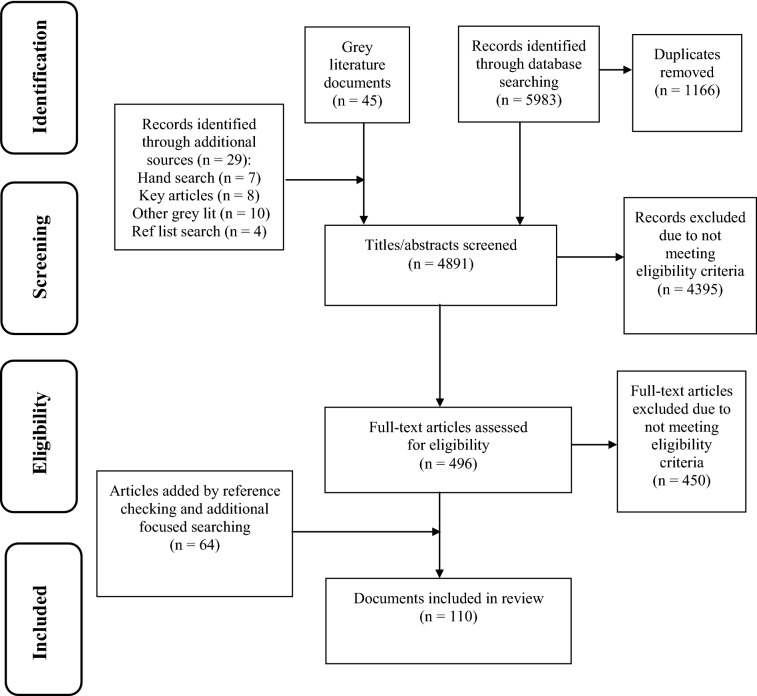
BACKGROUND: Community-based, integrated youth service hubs have the potential to address some of the longstanding issues with mental health services for youth, including problems with access and system fragmentation. Better understanding of these approaches, particularly efforts to create a single point of entry to comprehensive, evidence-based services through youth service hubs, is needed to help guide future implementation and evaluation. This scoping review identifies the key principles and characteristics of these models of care, as well as the state of the literature, particularly with regard to implementation and replicability. METHOD: Electronic databases and grey literature sources were searched for material from 2001 to 2019, with diverse search terms capturing the concept of "integrated" or "one-stop shop" youth mental health services. Title/abstract and full text review were conducted, as well as additional focused searching. After screening 4891 texts at the title/abstract level and 496 at the full-text level, 110 documents were included for data extraction. RESULTS: Several integrated care hub models for youth mental health services and related frameworks were identified internationally, largely in high-income countries. Common principles included an emphasis on rapid access to care and early intervention, youth and family engagement, youth-friendly settings and services, evidence-informed approaches, and partnerships and collaboration. Program characteristics also revealed similarities (e.g., providing evidence-informed or evidence-based services in youth-friendly spaces), with some differences (e.g., care coordination methods, types of service providers), potentially attributable to lack of available information about key ingredients. Outcome research was limited, with few rigorous evaluations of youth outcomes. Moreover, sufficient information for replication, community evaluation of feasibility or actual implementation was rarely provided. CONCLUSION: Internationally, integrated youth service hubs were found to share common key principles, while providing comprehensive services to youth with mental health difficulties. There is a great need for common language and measurement framework to facilitate replication, rigorous evaluation of outcomes, knowledge exchange, and dissemination of findings.
Overview
The claims and statistics of this paper haven’t been checked yet.
Free: it reads the open-access text and checks the first 5 claims that cite a source we can check. Create a free account to check every claim.
Integrity signals
Registry
Cites
Statistics
Figures
Verification
Claims the paper makes
The claims and statistics of this paper haven’t been checked yet.
Free: it reads the open-access text and checks the first 5 claims that cite a source we can check. Create a free account to check every claim.
Claims other papers make about this one
Each is checked against this paper’s own text: does it say what the citing paper says it does?
The source backs part of the claim, not all of it — or backs it for a different population, condition or comparison.
In the citing paper
“Codesign (by which the model of care benefits from the ideas and views of young people with lived experience of mental ill health) and youth partnership (in which young people have an ongoing role in the operation of the service) are underlying principles and are essential elements for building a trusted brand (table 2). 208,209,286”
From The Lancet Psychiatry Commission on youth mental health (2024) · cites this paper as [286]
Experimental — accuracy not yet measuredThe source backs part of the claim, not all of it — or backs it for a different population, condition or comparison.
In the citing paper
“Although primary care services are predominantly designed for young people with mild-to-moderate needs, individuals with higher or more complex needs are increasingly accessing these services.”
From The Lancet Psychiatry Commission on youth mental health (2024) · cites this paper as [286]
Experimental — accuracy not yet measuredThe source backs part of the claim, not all of it — or backs it for a different population, condition or comparison.
In the citing paper
“Peer or lay workers are a core component of the youth mental health workforce across all resource settings, 29,286,343 complementing traditional clinical roles rather than merely filling staff shortages.”
From The Lancet Psychiatry Commission on youth mental health (2024) · cites this paper as [286]
Experimental — accuracy not yet measuredThe cited source says what the claim attributes to it.
In the citing paper
“Within the past two decades, a range of integrated youth mental health care services have emerged internationally, although reform has largely occurred in high-resource settings. 209,250,286”
From The Lancet Psychiatry Commission on youth mental health (2024) · cites this paper as [286]
Self-check
Percentages, sums and reported differences re-computed from the paper’s own numbers.
The self-check needs the paper’s full text.
Citations
Cites
Scoping studies: towards a methodological framework
Arksey, H., & O'Malley, L. (2005) · International Journal of Social Research Methodology · doi:10.1080/1364557032000119616 · Cited by 36,742 · cited 1×
“Scoping reviews comprehensively identify important concepts in a structured manner [20], including the extent, range, and nature of research activity in areas in which the available range of materials is unknown [21], e.”
BackgroundKessler, R. C., Berglund, P., Demler, O., Jin, R., Merikangas, K. R., & Walters, E. E. (2005) · Archives of General Psychiatry · doi:10.1001/archpsyc.62.6.593 · Cited by 20,391 · cited 2×
“Worldwide, approximately 10–20% of children and adolescents experience mental health disorders [3, 4] and cumulative lifetime prevalence approaches 50% among adolescents and young adults in developed countries [1, 5, 6].”
BackgroundScoping studies: advancing the methodology
Levac, D., Colquhoun, H., & O'Brien, K. K. (2010) · Implementation Science · doi:10.1186/1748-5908-5-69 · Cited by 15,268
Hoffmann, T. C., Glasziou, P. P., Boutron, I., Milne, R., Perera, R., Moher, D., Altman, D. G., Barbour, V., Macdonald, H., Johnston, M., et al. (2014) · BMJ · doi:10.1136/bmj.g1687 · Cited by 10,548 · cited 1×
“Future reporting should follow TIDieR guidelines in order to facilitate replication, evaluation and implementation [91].”
MethodMerikangas, K. R., He, J.-P., Burstein, M., Swanson, S. A., Avenevoli, S., Cui, L., Benjet, C., Georgiades, K., & Swendsen, J. (2010) · Journal of the American Academy of Child & Adolescent Psychiatry · doi:10.1016/j.jaac.2010.05.017 · Cited by 6,278
Whiteford, H. A., Degenhardt, L., Rehm, J., Baxter, A. J., Ferrari, A. J., Erskine, H. E., Charlson, F. J., Norman, R. E., Flaxman, A. D., Johns, N., et al. (2013) · The Lancet · doi:10.1016/s0140-6736(13)61611-6 · Cited by 6,006
Polanczyk, G. V., Salum, G. A., Sugaya, L. S., Caye, A., & Rohde, L. A. (2015) · Journal of Child Psychology and Psychiatry · doi:10.1111/jcpp.12381 · Cited by 3,990 · cited 1×
“Worldwide, approximately 10–20% of children and adolescents experience mental health disorders [3, 4] and cumulative lifetime prevalence approaches 50% among adolescents and young adults in developed countries [1, 5, 6].”
BackgroundChild and adolescent mental health worldwide: evidence for action
Kieling, C., Baker-Henningham, H., Belfer, M., Conti, G., Ertem, I., Omigbodun, O., Rohde, L. A., Srinath, S., Ulkuer, N., & Rahman, A. (2011) · The Lancet · doi:10.1016/s0140-6736(11)60827-1 · Cited by 2,449 · cited 1×
“Worldwide, approximately 10–20% of children and adolescents experience mental health disorders [3, 4] and cumulative lifetime prevalence approaches 50% among adolescents and young adults in developed countries [1, 5, 6].”
BackgroundKim-Cohen, J., Caspi, A., Moffitt, T. E., Harrington, H., Milne, B. J., & Poulton, R. (2003) · Archives of General Psychiatry · doi:10.1001/archpsyc.60.7.709 · Cited by 2,025 · cited 1×
“Int J Ment Health Syst (2019) 13:52 Introduction Mental health problems commonly start during childhood or adolescence, with about half of all lifetime cases starting by ages 14–15 and three-quarters by ages 18–24 [1, 2].”
BackgroundThe COMET Handbook: version 1.0
Williamson, P. R., Altman, D. G., Bagley, H., Barnes, K. L., Blazeby, J. M., Brookes, S. T., Clarke, M., Gargon, E., Gorst, S., Harman, N., et al. (2017) · Trials · doi:10.1186/s13063-017-1978-4 · Cited by 2,011 · cited 1×
“Finally, using common, core outcome measures [95] to track outcomes and other aspects of ICYSHs would help facilitate collaborative research efforts, support future meta-analyses, and more rapidly advance the field.”
MethodCanadian Institutes of Health Research
(2019) · The Grants Register 2020 · doi:10.1057/978-1-349-95943-3_219 · Cited by 1,466
Integrated care: meaning, logic, applications, and implications – a discussion paper
Kodner, D. L., & Spreeuwenberg, C. (2002) · International Journal of Integrated Care · doi:10.5334/ijic.67 · Cited by 1,155 · cited 1×
“Other inclusion criteria included models of care that brought together multiple service components to improve access to service, service quality, client satisfaction, efficiency [27], or youth outcomes [11], and aimed to make mental health systems or service delivery more fulsome [28]; services were coordinated, co-lo…”
Background(2007) · PubMed Central · Cited by 623
Integrated care: a position paper of the WHO European Office for Integrated Health Care Services.
Groene, O., & García-Barbero, M. (2001) · PubMed Central · Cited by 585
Asarnow, J. R., Rozenman, M., Wiblin, J., & Zeltzer, L. (2015) · JAMA Pediatrics · doi:10.1001/jamapediatrics.2015.1141 · Cited by 545 · cited 1×
“Literature reviews of medical and behavioral health integration in primary care settings have been conducted [16, 17] and a meta-analysis suggests benefits [18].”
BackgroundMcGorry, P., Bates, T., & Birchwood, M. (2013) · British Journal of Psychiatry · doi:10.1192/bjp.bp.112.119214 · Cited by 523 · cited 13×
“Similarly, a number of programs highlighted the importance of early intervention [14, 31, 34, 36, 39, 43, 52, 78] and some included clinical staging [78] or stepped-care [52] to provide services at the earliest stage necessary.”
BackgroundInfluentialMiddel, B., & Van Sonderen, E. (2002) · International Journal of Integrated Care · doi:10.5334/ijic.65 · Cited by 464
Costello, E. J., He, J.-P., Sampson, N. A., Kessler, R. C., & Merikangas, K. R. (2014) · Psychiatric Services · doi:10.1176/appi.ps.201100518 · Cited by 441 · cited 1×
“Despite the clear need for mental health services, youth often do not receive evidence-based services in a timely, effective manner [9, 10].”
BackgroundEarly intervention in youth mental health: progress and future directions
McGorry, P. D., & Mei, C. (2018) · Evidence Based Mental Health · doi:10.1136/ebmental-2018-300060 · Cited by 391
Rickwood, D. J., Mazzer, K. R., Telford, N. R., Parker, A. G., Tanti, C. J., & McGorry, P. D. (2015) · Medical Journal of Australia · doi:10.5694/mja14.01696 · Cited by 291 · cited 3×
“Generally, positive outcomes, particularly improvements in psychological distress and psychosocial functioning have been found [37, 45, 73, 84].”
BackgroundIntegrated (one‐stop shop) youth health care: best available evidence and future directions
Hetrick, S. E., Bailey, A. P., Smith, K. E., Malla, A., Mathias, S., Singh, S. P., O'Reilly, A., Verma, S. K., Benoit, L., Fleming, T. M., et al. (2017) · Medical Journal of Australia · doi:10.5694/mja17.00694 · Cited by 288 · cited 4×
“Authors highlight the need to further evaluate outcomes and develop best practice models [19].”
BackgroundInfluentialO’Brien, K. K., Colquhoun, H., Levac, D., Baxter, L., Tricco, A. C., Straus, S., Wickerson, L., Nayar, A., Moher, D., & O’Malley, L. (2016) · BMC Health Services Research · doi:10.1186/s12913-016-1579-z · Cited by 282
Ormel, J., Raven, D., van Oort, F., Hartman, C. A., Reijneveld, S. A., Veenstra, R., Vollebergh, W. A. M., Buitelaar, J., Verhulst, F. C., & Oldehinkel, A. J. (2015) · Psychological Medicine · doi:10.1017/s0033291714001469 · Cited by 276 · cited 1×
“Worldwide, approximately 10–20% of children and adolescents experience mental health disorders [3, 4] and cumulative lifetime prevalence approaches 50% among adolescents and young adults in developed countries [1, 5, 6].”
Backgroundheadspace: Australia's National Youth Mental Health Foundation — where young minds come first
McGorry, P. D., Tanti, C., Stokes, R., Hickie, I. B., Carnell, K., Littlefield, L. K., & Moran, J. (2007) · Medical Journal of Australia · doi:10.5694/j.1326-5377.2007.tb01342.x · Cited by 272 · cited 2×
“For example, headspace and Jigsaw include youth ages 12–25 [30, 31, 36, 45], and ACCESS Open Minds serves youth ages 11–25 [38–41].”
BackgroundAustralia’s Innovation in Youth Mental Health Care: The Headspace Centre Model
Rickwood, D., Paraskakis, M., Quin, D., Hobbs, N., Ryall, V., Trethowan, J., & McGorry, P. (2019) · Early Intervention in Psychiatry · doi:10.1111/eip.12740 · Cited by 237 · cited 9×
“At headspace, data are collected through a minimum dataset process in which all youth accessing centers and their service providers enter data electronically at each service occasion [31, 46].”
BackgroundMethodInfluential(2015) · UNSWorks (UNSW Sydney) · Cited by 225
Cultures for mental health care of young people: an Australian blueprint for reform
McGorry, P. D., Goldstone, S. D., Parker, A. G., Rickwood, D. J., & Hickie, I. B. (2014) · The Lancet Psychiatry · doi:10.1016/s2215-0366(14)00082-0 · Cited by 221 · cited 1×
“Reported efforts were consistent with recommended approaches for improving accessibility and youth-friendliness laid out within calls for youth mental health services reform [90].”
BackgroundRickwood, D. J., Telford, N. R., Parker, A. G., Tanti, C. J., & McGorry, P. D. (2014) · Medical Journal of Australia · doi:10.5694/mja13.11235 · Cited by 207 · cited 3×
“At headspace, data are collected through a minimum dataset process in which all youth accessing centers and their service providers enter data electronically at each service occasion [31, 46].”
BackgroundMethodMalla, A., Iyer, S., McGorry, P., Cannon, M., Coughlan, H., Singh, S., Jones, P., & Joober, R. (2016) · Social Psychiatry and Psychiatric Epidemiology · doi:10.1007/s00127-015-1165-4 · Cited by 196 · cited 24×
“ACCESS Open Minds is implementing 14 ICYSHs in urban and rural areas across Canada [13, 39, 40].”
BackgroundInfluentialMcGorry, P. D. (2007) · Medical Journal of Australia · doi:10.5694/j.1326-5377.2007.tb01338.x · Cited by 191 · cited 2×
“Longstanding problems with youth mental health service provision, including system fragmentation, poor access to evidence-based services, discontinuation of support at the transition to adulthood and lack of an informed developmental perspective, could be effectively addressed by integrated care approaches offered acr…”
BackgroundKolko, D. J., & Perrin, E. (2014) · Journal of Clinical Child & Adolescent Psychology · doi:10.1080/15374416.2013.862804 · Cited by 181 · cited 1×
“Literature reviews of medical and behavioral health integration in primary care settings have been conducted [16, 17] and a meta-analysis suggests benefits [18].”
BackgroundTargeted primary care‐based mental health services for young Australians
Scott, E. M., Hermens, D. F., Glozier, N., Naismith, S. L., Guastella, A. J., & Hickie, I. B. (2012) · Medical Journal of Australia · doi:10.5694/mja11.10481 · Cited by 155
What makes mental health and substance use services youth friendly? A scoping review of literature
Hawke, L. D., Mehra, K., Settipani, C., Relihan, J., Darnay, K., Chaim, G., & Henderson, J. (2019) · BMC Health Services Research · doi:10.1186/s12913-019-4066-5 · Cited by 139 · cited 1×
“Nearly all models reported trying to develop non-stigmatizing, youth-friendly environments [89].”
BackgroundSelf-citationIntegrated Behavioral Health in Pediatric Primary Care
Njoroge, W., Hostutler, C. A. A., Schwartz, B. S., & Mautone, J. A. (2016) · Current Psychiatry Reports · doi:10.1007/s11920-016-0745-7 · Cited by 111 · cited 1×
“Literature reviews of medical and behavioral health integration in primary care settings have been conducted [16, 17] and a meta-analysis suggests benefits [18].”
BackgroundO'Dea, B., Glozier, N., Purcell, R., McGorry, P. D., Scott, J., Feilds, K.-L., Hermens, D. F., Buchanan, J., Scott, E. M., Yung, A. R., et al. (2014) · BMJ Open · doi:10.1136/bmjopen-2014-006378 · Cited by 107 · cited 1×
“Additionally, 69–73% of headspace youth presented with high or very high levels of psychological distress [46, 48], and 19–29% of young adult clients were not engaged in education, employment or training [46, 56].”
BackgroundMalla, A., Iyer, S., Shah, J., Joober, R., Boksa, P., Lal, S., Fuhrer, R., Andersson, N., Abdel‐Baki, A., Hutt‐MacLeod, D., et al. (2019) · Early Intervention in Psychiatry · doi:10.1111/eip.12772 · Cited by 107 · cited 21×
“ACCESS Open Minds is implementing 14 ICYSHs in urban and rural areas across Canada [13, 39, 40].”
BackgroundMethodInfluentialHenderson, J. L., Cheung, A., Cleverley, K., Chaim, G., Moretti, M. E., de Oliveira, C., Hawke, L. D., Willan, A. R., O'Brien, D., Heffernan, O., et al. (2017) · BMJ Open · doi:10.1136/bmjopen-2016-014080 · Cited by 104 · cited 9×
“Most models identified a focus on intervening during early stages of distress, possibly before diagnostic criteria are met [13, 36, 39, 40, 43, 51, 52].”
BackgroundMethodInfluentialSelf-citationCreating Headspace for Integrated Youth Mental Health Care
McGorry, P., Trethowan, J., & Rickwood, D. (2019) · World Psychiatry · doi:10.1002/wps.20619 · Cited by 97 · cited 24×
“Carbone S, Rickwood D, Tanti C. Workforce shortages and their impact on Australian youth mental health service reform.”
BackgroundInfluentialScott, E., Naismith, S., Whitwell, B., Hamilton, B., Chudleigh, C., & Hickie, I. (2009) · Australasian Psychiatry · doi:10.1080/10398560802657322 · Cited by 85
Halsall, T., Manion, I., Iyer, S. N., Mathias, S., Purcell, R., & Henderson, J. (2019) · Healthcare Management Forum · doi:10.1177/0840470418808815 · Cited by 85
Self-citationO’Keeffe, L., O’Reilly, A., O’Brien, G., Buckley, R., & Illback, R. (2015) · Irish Journal of Psychological Medicine · doi:10.1017/ipm.2014.86 · Cited by 80 · cited 3×
“Generally, positive outcomes, particularly improvements in psychological distress and psychosocial functioning have been found [37, 45, 73, 84].”
BackgroundThe services provided to young people through the headspace centres across Australia
Rickwood, D. J., Telford, N. R., Mazzer, K. R., Parker, A. G., Tanti, C. J., & McGorry, P. D. (2015) · Medical Journal of Australia · doi:10.5694/mja14.01695 · Cited by 79
Hamilton, B. A., Naismith, S. L., Scott, E. M., Purcell, S., & Hickie, I. B. (2010) · Journal of Affective Disorders · doi:10.1016/j.jad.2010.10.052 · Cited by 71
Principles of youth participation in mental health services
James, A. M. (2007) · Medical Journal of Australia · doi:10.5694/j.1326-5377.2007.tb01339.x · Cited by 70
Purcell, R., Jorm, A. F., Hickie, I. B., Yung, A. R., Pantelis, C., Amminger, G. P., Glozier, N., Killackey, E., Phillips, L. J., Wood, S. J., et al. (2015) · Early Intervention in Psychiatry · doi:10.1111/eip.12133 · Cited by 70 · cited 1×
“Additionally, several studies suggest that at least some of the youth presenting for services were experiencing more distress and impairment than models may have been primarily designed to address [49, 51, 59, 93], which is a key finding that should be taken into account in the design and development of robust ICYSH m…”
BackgroundThe Burden of Mental Illness and Addiction in Ontario
Ratnasingham, S., Cairney, J., Manson, H., Rehm, J., Lin, E., & Kurdyak, P. (2013) · The Canadian Journal of Psychiatry · doi:10.1177/070674371305800809 · Cited by 68 · cited 1×
“Mental health problems are also associated with high societal burden [7, 8].”
BackgroundRickwood, D., Webb, M., Kennedy, V., & Telford, N. (2016) · JMIR Mental Health · doi:10.2196/mental.5988 · Cited by 66 · cited 2×
“, self-referral [14, 31], walk-in or drop-in services [41– 44], and online access to services [48] including telemedicine [41, 42].”
BackgroundTreatment patterns and short‐term outcomes in an early intervention youth mental health service
Cross, S. P. M., Hermens, D. F., & Hickie, I. B. (2016) · Early Intervention in Psychiatry · doi:10.1111/eip.12191 · Cited by 65 · cited 5×
“Most models identified a focus on intervening during early stages of distress, possibly before diagnostic criteria are met [13, 36, 39, 40, 43, 51, 52].”
BackgroundMethodInfluentialTransforming youth mental health: a Canadian perspective
Iyer, S. N., Boksa, P., Lal, S., Shah, J., Marandola, G., Jordan, G., Doyle, M., Joober, R., & Malla, A. K. (2015) · Irish Journal of Psychological Medicine · doi:10.1017/ipm.2014.89 · Cited by 61 · cited 22×
“ACCESS Open Minds is implementing 14 ICYSHs in urban and rural areas across Canada [13, 39, 40].”
BackgroundInfluentialMeasuring the quality of interprofessional collaboration in child mental health collaborative care
Rousseau, C., Laurin‐Lamothe, A., Nadeau, L., Deshaies, S., & Measham, T. (2012) · International Journal of Integrated Care · doi:10.5334/ijic.676 · Cited by 59
Muir, K., Powell, A., & McDermott, S. (2012) · Health & Social Care in the Community · doi:10.1111/j.1365-2524.2011.01029.x · Cited by 56
de Voursney, D., & Huang, L. N. (2016) · Psychological Services · doi:10.1037/ser0000045 · Cited by 53 · cited 2×
“Other inclusion criteria included models of care that brought together multiple service components to improve access to service, service quality, client satisfaction, efficiency [27], or youth outcomes [11], and aimed to make mental health systems or service delivery more fulsome [28]; services were coordinated, co-lo…”
BackgroundAdvances in Fidelity Measurement for Mental Health Services Research: Four Measures
Teague, G. B., Mueser, K. T., & Rapp, C. A. (2012) · Psychiatric Services · doi:10.1176/appi.ps.201100430 · Cited by 48 · cited 1×
“Some models discussed the role of support or outreach workers in linking clients to services outside the ICYSH and maintaining connection and follow up [34, 72].”
BackgroundCoates, D., & Howe, D. J. (2014) · Children and Youth Services Review · doi:10.1016/j.childyouth.2014.09.012 · Cited by 47
Hodges, C. A., O'Brien, M. S., & McGorry, P. D. (2007) · Australian Journal of Rural Health · doi:10.1111/j.1440-1584.2007.00868.x · Cited by 47
Youth services: meeting the mental health needs of adolescents
Vyas, N. S., Birchwood, M., & Singh, S. P. (2015) · Irish Journal of Psychological Medicine · doi:10.1017/ipm.2014.73 · Cited by 47 · cited 8×
“Social services, including vocational assistance, education and training support, and housing support were a component of other models [37, 38].”
BackgroundMethodInfluentialOspina-Pinillos, L., Davenport, T., Iorfino, F., Tickell, A., Cross, S., Scott, E. M., & Hickie, I. B. (2018) · Journal of Medical Internet Research · doi:10.2196/jmir.9966 · Cited by 42
Interagency collaborative care for young people with complex needs: Front‐line staff perspectives
Morgan, S. J., Pullon, S. R. H., Garrett, S. M., & McKinlay, E. M. (2019) · Health & Social Care in the Community · doi:10.1111/hsc.12719 · Cited by 42 · cited 1×
“In addition, a study conducted with internal and external staff of Youth One Stop Shops reported that individual staff’s trusting personal relationships was crucial for successfully overcoming agency differences, and collaborative care was found to be essential to the successful care of youth with high needs [82].”
BackgroundTransforming youth mental health services and supports in Ireland
Illback, R. J., & Bates, T. (2011) · Early Intervention in Psychiatry · doi:10.1111/j.1751-7893.2010.00236.x · Cited by 41
Scott, E. M., Hermens, D. F., Naismith, S. L., White, D., Whitwell, B., Guastella, A. J., Glozier, N., & Hickie, I. B. (2012) · BMC Psychiatry · doi:10.1186/1471-244x-12-234 · Cited by 41
Participatory Action Research and young adults with psychiatric disabilities.
Delman, J. (2012) · Psychiatric Rehabilitation Journal · doi:10.2975/35.3.2012.231.234 · Cited by 39 · cited 1×
“Covidence [29], the Cochrane-recommended systematic review software, was used for title/ abstract and full text review.”
MethodIllback, R. J., Bates, T., Hodges, C., Galligan, K., Smith, P., Sanders, D., & Dooley, B. (2010) · Journal of Mental Health · doi:10.3109/09638231003728141 · Cited by 38 · cited 8×
“Most models identified a focus on intervening during early stages of distress, possibly before diagnostic criteria are met [13, 36, 39, 40, 43, 51, 52].”
BackgroundInfluentialMet and unmet need in youth mental health
Cosgrave, E. M., Yung, A. R., Killackey, E. J., Buckby, J. A., Godfrey, K. A., Stanford, C. A., & McGorry, P. D. (2008) · Journal of Mental Health · doi:10.1080/09638230701506267 · Cited by 38 · cited 2×
“This service seeks to bridge the gap between child/adolescent and adult mental health services in the Melbourne area [33].”
BackgroundBarbic, S. P., Leon, A., Manion, I. G., Irving, S., Zivanovic, R., Jenkins, E., Ben‐David, S., Azar, P., Salmon, A., Helps, C. E., et al. (2019) · International Journal of Mental Health Systems · doi:10.1186/s13033-019-0264-0 · Cited by 38
McCann, T. V., & Lubman, D. I. (2012) · BMC Psychiatry · doi:10.1186/1471-244x-12-96 · Cited by 37
Consumer participation in a youth mental health service
Monson, K., & Thurley, M. (2011) · Early Intervention in Psychiatry · doi:10.1111/j.1751-7893.2011.00309.x · Cited by 37 · cited 1×
“Several ICYSH models in this review included peer support workers as service providers [38, 40, 43, 52, 63], reflecting the importance of youth with lived experience supporting other youth experiencing similar issues.”
BackgroundRickwood, D., Van Dyke, N., & Telford, N. (2015) · Early Intervention in Psychiatry · doi:10.1111/eip.12071 · Cited by 35 · cited 3×
“Coordinating external referral pathways was viewed as helpful by youth accessing headspace services [59] and care coordination is a key headspace performance indicator [70].”
BackgroundMental health in primary care for adolescent parents.
LePlatte, D., Rosenblum, K. L., Stanton, E., Miller, N., & Muzik, M. (2012) · Europe PMC (PubMed Central) · Cited by 35
O'Reilly, A., Illback, R., Peiper, N., O'Keeffe, L., & Clayton, R. (2015) · Journal of Mental Health · doi:10.3109/09638237.2015.1019050 · Cited by 34 · cited 19×
“Additionally, several studies suggest that at least some of the youth presenting for services were experiencing more distress and impairment than models may have been primarily designed to address [49, 51, 59, 93], which is a key finding that should be taken into account in the design and development of robust ICYSH m…”
BackgroundInfluentialAnsah, J. P., Islam, A. M., Koh, V., Ly, V., Kol, H., Matchar, D. B., Loun, C., & Loun, M. (2019) · BMC Health Services Research · doi:10.1186/s12913-018-3830-2 · Cited by 34
Rowlandson, P. H., & Smith, C. (2009) · Child: Care, Health and Development · doi:10.1111/j.1365-2214.2009.00956.x · Cited by 33
Coates, D., & Howe, D. J. (2014) · Administration and Policy in Mental Health and Mental Health Services Research · doi:10.1007/s10488-014-0599-4 · Cited by 32
Patulny, R., Muir, K., Powell, A., Flaxman, S., & Oprea, I. (2013) · Child and Adolescent Mental Health · doi:10.1111/j.1475-3588.2012.00662.x · Cited by 32
Rickwood, D., Nicholas, A., Mazzer, K., Telford, N., Parker, A., Tanti, C., & Simmons, M. (2017) · Early Intervention in Psychiatry · doi:10.1111/eip.12248 · Cited by 32
Bella, E. D., Tramacere, I., Antonini, G., Borghero, G., Capasso, M., Caponnetto, C., Chiò, A., Corbo, M., Eleopra, R., Filosto, M., et al. (2017) · BMJ Open · doi:10.1136/bmjopen-2016-015434 · Cited by 31
Schley, C., Pace, N., Mann, R., McKenzie, C., McRoberts, A., & Parker, A. G. (2018) · Early Intervention in Psychiatry · doi:10.1111/eip.12729 · Cited by 30
Schley, C., Ryall, V. L., Crothers, L., Radovini, S., Fletcher, K., Marriage, K., Nudds, S., Groufsky, C., & Yuen, H. P. (2008) · Early Intervention in Psychiatry · doi:10.1111/j.1751-7893.2008.00079.x · Cited by 29 · cited 1×
“One additional article reported youth outcomes; however, the focus was on evaluating an intensive mobile outreach subcomponent rather than overall integrated care [83].”
BackgroundHowe, D., Batchelor, S., & Bochynska, K. (2011) · Advances in Mental Health · doi:10.5172/jamh.2011.10.1.20 · Cited by 29
Bassilios, B., Telford, N., Rickwood, D., Spittal, M. J., & Pirkis, J. (2017) · International Journal of Mental Health Systems · doi:10.1186/s13033-017-0125-7 · Cited by 28
Interprofessional collaboration in mental health settings: a social network analysis
Pomare, C., Long, J. C., Ellis, L. A., Churruca, K., & Braithwaite, J. (2018) · Journal of Interprofessional Care · doi:10.1080/13561820.2018.1544550 · Cited by 28 · cited 1×
“A social network analysis of the headspace staff reported interprofessional collaboration existed in both routine and uncertain situations [81].”
BackgroundDevelopment and validation of MyLifeTracker: a routine outcome measure for youth mental health
Kwan, B., Rickwood, D. J., & Telford, N. R. (2018) · Psychology Research and Behavior Management · doi:10.2147/prbm.s152342 · Cited by 27
Cross, S. P. M., Hermens, D. F., Scott, J., Salvador‐Carulla, L., & Hickie, I. B. (2017) · Early Intervention in Psychiatry · doi:10.1111/eip.12319 · Cited by 26
Managing risks of violence in a youth mental health service: a service model description
Purcell, R., Fraser, R., Greenwood‐Smith, C., Baksheev, G., McCarthy, J., Reid, D., Lemphers, A., & Sullivan, D. H. (2012) · Early Intervention in Psychiatry · doi:10.1111/j.1751-7893.2012.00372.x · Cited by 25
Heenan, D., & Birrell, D. (2009) · Journal of Integrated Care · doi:10.1108/14769018200900032 · Cited by 24
Donnelly, A., O’Reilly, A., Dolphin, L., O’Keeffe, L., & Moore, J. (2019) · Irish Journal of Psychological Medicine · doi:10.1017/ipm.2018.55 · Cited by 24 · cited 1×
“Headstrong, the National Centre for Youth Mental Health in Ireland, established Jigsaw [34] to integrate supports and services for young people through community capacity building, with 13 centers currently providing evidence-based services [35].”
BackgroundWorkforce shortages and their impact on Australian youth mental health service reform
Carbone, S., Rickwood, D., & Tanti, C. (2011) · Advances in Mental Health · doi:10.5172/jamh.2011.10.1.92 · Cited by 23 · cited 1×
“Specifically, limited service availability [33] and workforce shortages [92] are challenges for the field more broadly and also impact ICYSHs.”
BackgroundSchley, C., Radovini, A., Halperin, S., & Fletcher, K. (2011) · Children and Youth Services Review · doi:10.1016/j.childyouth.2011.03.013 · Cited by 22 · cited 9×
“In addition to the 11 documents with youth outcome information, three articles reported on case study findings; of them, one utilized a standardized self-report measure [65], whereas two did not [61, 78].”
BackgroundInfluentialMuir, K., McDermott, S., Gendera, S., Flaxman, S., Patulny, R., Sitek, T., Abelló, D., Oprea, I., & Katz, I. (2021) · UNSWorks (University of New South Wales, Sydney, Australia) · doi:10.26190/unsworks/852 · Cited by 21
Callaly, T., von Treuer, K. M., van Hamond, T., & Windle, K. (2011) · Early Intervention in Psychiatry · doi:10.1111/j.1751-7893.2010.00237.x · Cited by 21
Development of a satisfaction scale for young people attending youth mental health services
Simmons, M. B., Parker, A. G., Hetrick, S. E., Telford, N., Bailey, A., & Rickwood, D. (2014) · Early Intervention in Psychiatry · doi:10.1111/eip.12104 · Cited by 21
Nadeau, L., Jaimes, A., Rousseau, C., Papazian-Zohrabian, G., Germain, K., Broadhurst, J., Battaglini, A., & Measham, T. (2012) · PubMed Central · Cited by 19
Settipani, C. A., Cleverley, K., Hawke, L. D., Rice, M., & Henderson, J. L. (2017) · BMJ Open · doi:10.1136/bmjopen-2016-015454 · Cited by 19 · cited 2×
“For a detailed description of the review methodology, see [24].”
BackgroundMethodSelf-citationAustralian Young People's Awareness of Headspace, Beyondblue and other Mental Health Organizations
Jorm, A. F. (2009) · Australasian Psychiatry · doi:10.1080/10398560902915596 · Cited by 18 · cited 1×
“Publications regarding ICYSHs need to include greater detail regarding key attributes, especially those considered unique to the model, such as integration of care, partnership agreements, integrated decision-making processes and youth friendliness to allow for replicability [94].”
BackgroundEarly intervention services in youth mental health
Wade, D., Johnston, A. K., Campbell, B., & Littlefield, L. (2007) · Clinical Psychologist · doi:10.1080/13284200701870988 · Cited by 17 · cited 2×
“For example, headspace interventions are said to be delivered according to severity and complexity of an individual’s needs [64].”
BackgroundRyall, V. L., Radovini, S., Crothers, L., Schley, C., Fletcher, K., Nudds, S., & Groufsky, C. (2008) · Social Work in Mental Health · doi:10.1080/15332980802072512 · Cited by 14 · cited 3×
“In addition to the 11 documents with youth outcome information, three articles reported on case study findings; of them, one utilized a standardized self-report measure [65], whereas two did not [61, 78].”
BackgroundMedlow, S., Kelk, N., Cohen, A., & Hickie, I. (2010) · Australasian Psychiatry · doi:10.3109/10398560903468777 · Cited by 14 · cited 2×
“Youthfriendly services include not only the environment, but also welcoming and friendly staff [31, 38, 42, 60].”
BackgroundGwinner, K. (2016) · The Arts in Psychotherapy · doi:10.1016/j.aip.2016.05.016 · Cited by 13
Peiper, N. C., Illback, R. J., O’Reilly, A., & Clayton, R. (2015) · Early Intervention in Psychiatry · doi:10.1111/eip.12213 · Cited by 12 · cited 2×
“Jigsaw similarly reported seeing youth with high levels of psychological distress [49], with four main types of issues identified among youth: developmental, comorbid, anxious and externalizing disorders [57].”
BackgroundMethodService Innovation Project Component 1: Best practice framework
Rickwood, D., Anile, G., Telford, N. R., Thomas, K. A., Brown, A., & Parker, A. G. (2014) · Victoria University Research Repository (Victoria University) · Cited by 10
Broadening the early intervention paradigm: a one stop shop for youth
Lee, V. W. W., & Murphy, B. (2013) · Early Intervention in Psychiatry · doi:10.1111/eip.12055 · Cited by 9
People with disabilities and professionals’ views on access to health services in Western Sydney
Gallego, G., Dryden, A., Dew, A., Fernández, A., Salvador‐Carulla, L., & Lincoln, M. (2014) · International Journal of Integrated Care · doi:10.5334/ijic.1904 · Cited by 9
Australian youth still have limited awareness of headspace: Results from a national survey
Yap, M. B. H., Reavley, N. J., & Jorm, A. F. (2012) · Australian & New Zealand Journal of Psychiatry · doi:10.1177/0004867411427808 · Cited by 8
Rice, S., Halperin, S., Blaikie, S., Monson, K., Stefaniak, R., Phelan, M., & Davey, C. G. (2016) · Early Intervention in Psychiatry · doi:10.1111/eip.12383 · Cited by 8
Description and Qualitative Evaluation of Jigsaw, an Integrated Young Persons’ Mental Health Program
Callaly, T., Dodd, S., Ackerly, C., Hantz, P. M., O’Shea, M., & Berk, M. (2009) · Australasian Psychiatry · doi:10.1080/10398560902957119 · Cited by 7 · cited 1×
“For example, some programs were located in shopping centers and storefronts and involved youth in decisions about design and décor [43, 58].”
BackgroundWalker, S. (2010) · Journal of Child and Adolescent Mental Health · doi:10.2989/17280583.2010.493664 · Cited by 6
Australia’s national youth mental health initiative: Is headspace underachieving?
Allison, S. C., Bastiampillai, T. J., & Goldney, R. D. (2015) · Australian & New Zealand Journal of Psychiatry · doi:10.1177/0004867415621394 · Cited by 5
Development of the headspace Family and Friends Satisfaction Scale: Findings from a pilot study
Nicholas, A., Holloway, E. M., Telford, N. R., & Rickwood, D. (2017) · Early Intervention in Psychiatry · doi:10.1111/eip.12427 · Cited by 5
Child health care centres: an academic model for comprehensive child health care in the community
Katz, M., Urkin, J., Bar-David, Y., Cohen, A. H., Warshawsky, S. S., & Barak, N. (2005) · Child Care Health and Development · doi:10.1111/j.1365-2214.2004.00467.x · Cited by 4 · cited 1×
“Some documents broadly indicated that there is training in evidence-based interventions and best practices [36, 59, 64], in working with youth and youth-friendly approaches [59, 65], and professional development or continuing education activities [38, 66, 67], though difficulties with releasing staff for professional…”
BackgroundBagshaw, S. (2006) · PubMed · Cited by 4
Bullock, H. L., Waddell, K., & Lavis, J. N. (2016) · MacSphere (McMaster University) · Cited by 3
ycentral - An Integrated Youth Mental Health Service Platform
Howe, D. (2014) · International Journal of Integrated Care · doi:10.5334/ijic.1915 · Cited by 2
A one-stop shop for Wellington youth.
Zonneveld, R. (2014) · PubMed · Cited by 2
Howe, D., & Dimopoulos-Bick, T. L. (2014) · International Journal of Integrated Care · doi:10.5334/ijic.1916 · Cited by 1
Research works printed but not linked: 7
- Ontario Ministry of Health and Long Term Care Ontario providing faster access to mental health services for thousands of people 2017 Toronto Ontario Ministry of Health and Long-Term Care
- Bates T Illback RJ Scanlan F Carroll L Somewhere to turn to, someone to talk to. Headstrong—The National Centre for Youth Mental Health 2009 Dublin Headstrong
- Szatmari P Henderson J Cheung A Cleverley K Chaim G Hawke L Transforming youth mental health services in Canada: YouthCan IMPACT World Child Adolesc Psychiatry. 2016 10 14 15
- Hopkins G The Wight stuff Community Care. 2004 1550 38 39
- Gwynne K Zilibowitz M Spilstead model of early intervention for vulnerable families J Paediatr Child Health 2010 46 6 7
- Tobon JI, Jeffs L, editors. Bridging gaps in youth mental health: who is presenting to the youth wellness centre in Hamilton, Ontario? Paper presented at the research and policy in child, youth, and youth adult mental health conference, Tampa, Florida. 2017.
- Tee K Oyedele O Salmon A Helfrich W Banjo J Berger M Foundry—transforming access through integrated youth services in British Columbia, Canada Early Interv Psychiatry. 2018 12 Suppl. 1 230
Cited by
The Lancet Psychiatry Commission on youth mental health
McGorry, P. D., Mei, C., Dalal, N., Alvarez-Jimenez, M., Blakemore, S.-J., Browne, V., Dooley, B., Hickie, I. B., Jones, P. B., McDaid, D., et al. (2024) · The Lancet Psychiatry · doi:10.1016/s2215-0366(24)00163-9 · Cited by 663
Self-citationDesigning and scaling up integrated youth mental health care
McGorry, P. D., Mei, C., Chanen, A., Hodges, C., Alvarez‐Jimenez, M., & Killackey, E. (2022) · World Psychiatry · doi:10.1002/wps.20938 · Cited by 546
Alderwick, H., Hutchings, A., Briggs, A., & Mays, N. (2021) · BMC Public Health · doi:10.1186/s12889-021-10630-1 · Cited by 386
Hawke, L. D., Sheikhan, N. Y., MacCon, K., & Henderson, J. L. (2021) · BMC Health Services Research · doi:10.1186/s12913-021-06321-7 · Cited by 112
“to address many of these barriers by creating integrated, youth-friendly service delivery models [24, 25].”
BackgroundSelf-citationFoundry: early learnings from the implementation of an integrated youth service network
Mathias, S., Tee, K., Helfrich, W., Gerty, K., Chan, G., & Barbic, S. P. (2022) · Early Intervention in Psychiatry · doi:10.1111/eip.13181 · Cited by 70
“Finally, our findings contribute to an emerging body of literature on integrated youth health services (Hetrick et al., 2017; McGorry et al., 2019; Mei et al., 2020; Rickwood et al., 2019; Settipani et al., 2019).”
Background
Metadata
- Authors
- Settipani, C. A., Hawke, L. D., Cleverley, K., Chaim, G., Cheung, A., Mehra, K., Rice, M., Szatmari, P., & Henderson, J.
- Affiliations
- Centre for Addiction and Mental Health (CA)
- University of Toronto (CA)
- McMaster University (CA)
- Corresponding author
- Henderson, Joanna
- ORCID
- Venue
- International Journal of Mental Health Systems
- Published
- 2019-07-23
- Volume
- 13
- Issue
- 1
- Pages
- 52-52
- ISSN
- 1752-4458 (ISSN-L)
- PMC
- PMC6651922
- OpenAlex
- W2962760934
- Cited by
- 172
- References
- 113
- Citations by year
- 2026: 19 · 2025: 25 · 2024: 32 · 2023: 25 · 2022: 23 · 2021: 34 · 2020: 11 · 2019: 2
- FWCI
- 2.77
- Type
- journal article
- Language
- en
- Open access
- gold
- doi.org
- Licence
- cc-by
- creativecommons.org/licenses/by/4.0/ (tdm)
- creativecommons.org/licenses/by/4.0/ (vor)
- Locations
- International Journal of Mental Health Systems (publishedVersion, cc-by)
- PubMed Central (publishedVersion, cc-by)
- PubMed (publishedVersion)
- TSpace (University of Toronto) (submittedVersion, other-oa)
- DOAJ (DOAJ: Directory of Open Access Journals) (submittedVersion, cc-by-sa)
- Funders
- Ontario SPOR Support Unit
- Topics
- Social Sciences › Psychology › Clinical Psychology › Psychiatric care and mental health services
- Health Sciences › Medicine › Psychiatry and Mental health › Mental Health Treatment and Access
- Health Sciences › Health Professions › General Health Professions › Health Policy Implementation Science
- Keywords
- child and adolescent mental health services, one-stop service, community-based services, access to mental health care, care coordination, early intervention, youth participation, family involvement, service fragmentation, implementation, replicability
About these checks
Registry, retraction, Cites and statistics results are computed, not judged, with one exception: a printed reference that no index lists is read once by a model before it counts as a citation error. Claims are extracted by a model and kept only when their quote appears verbatim in the text; each cited source is then checked, with a model’s help, for whether it says what the claim relies on. Those verdicts can be wrong — read the claim’s quote and the cited source before relying on one.
Statistics and arithmetic are recomputed, not judged.
Confidence bands are shown only for fields calibrated on our annotated test set. None is calibrated yet, so no band is shown.
What counts as a claim ›How we measure confidence ›How we check this ›
Are you an author, or do you see a problem with this page? Request a review
Data sources
Bibliographic data: Semantic Scholar, OpenAlex, Crossref.
Contains information from the Semantic Scholar Academic Graph Datasets, made available under the ODC Attribution License (ODC-BY 1.0).
Semantic Scholar’s data is described in: Kinney, R., et al. (2023). The Semantic Scholar Open Data Platform. arXiv:2301.10140.
