

Considering culture, context and community in mhGAP implementation and training: challenges and recommendations from the field
Open accessThe DOI matches its Crossref record; 84 of the 84 references it cites were found in a registry or an index.
Abstract
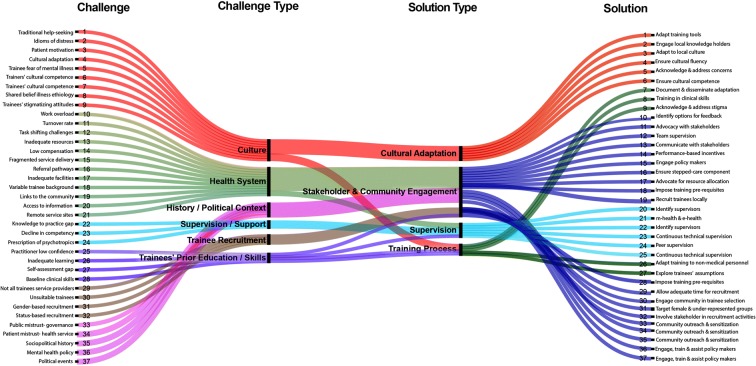
BACKGROUND: Major efforts are underway to improve access to mental health care in low- and middle-income countries (LMIC) including systematic training of non-specialized health professionals and other care providers to identify and help individuals with mental disorders. In many LMIC, this effort is guided by the mental health Gap Action Programme (mhGAP) established by the World Health Organization, and commonly centres around one tool in this program: the mhGAP-Intervention Guide. OBJECTIVE: To identify cultural and contextual challenges in mhGAP training and implementation and potential strategies for mitigation. METHOD: An informal consultative approach was used to analyze the authors' combined field experience in the practice of mhGAP implementation and training. We employed iterative thematic analysis to consolidate and refine lessons, challenges and recommendations through multiple drafts. Findings were organized into categories according to specific challenges, lessons learned and recommendations for future practice. We aimed to identify cross-cutting and recurrent issues. RESULTS: Based on intensive fieldwork experience with a focus on capacity building, we identify six major sets of challenges: (i) cultural differences in explanations of and attitudes toward mental disorder; (ii) the structure of the local health-care system; (iii) the level of supervision and support available post-training; (iv) the level of previous education, knowledge and skills of trainees; (v) the process of recruitment of trainees; and (vi) the larger socio-political context. Approaches to addressing these problems include: (1) cultural and contextual adaptation of training activities, (2) meaningful stakeholder and community engagement, and (3) processes that provide support to trainees, such as ongoing supervision and Communities of Practice. CONCLUSION: Contextual and cultural factors present major barriers to mhGAP implementation and sustainability of improved services. To enable trainees to effectively apply their local cultural knowledge, mhGAP training needs to: (1) address assumptions, biases and stigma associated with mental health symptoms and problems; (2) provide an explicit framework to guide the integration of cultural knowledge into assessment, treatment negotiation, and delivery; and (3) address the specific kinds of problems, modes of clinical presentations and social predicaments seen in the local population. Continued research is needed to assess the effectiveness these strategies.
Overview
The claims and statistics of this paper haven’t been checked yet.
Free: it reads the open-access text and checks the first 5 claims that cite a source we can check. Create a free account to check every claim.
Integrity signals
Registry
Cites
Statistics
Figures
Verification
Claims the paper makes
The claims and statistics of this paper haven’t been checked yet.
Free: it reads the open-access text and checks the first 5 claims that cite a source we can check. Create a free account to check every claim.
Claims other papers make about this one
Each is checked against this paper’s own text: does it say what the citing paper says it does?
The cited source says what the claim attributes to it.
In the citing paper
“The barriers that were identified in the implementation of this project are also consistent with other cultural and contextual challenges to the mhGAP-IG implementation identified by Fargeh et al., including the local perception of mental disorders, the healthcare system, available support for trainees, prior knowledge of trainees, trainee recruitment, and the larger socio-political context [57].”
Self-check
Percentages, sums and reported differences re-computed from the paper’s own numbers.
The self-check needs the paper’s full text.
Citations
Cites
Resources for mental health: scarcity, inequity, and inefficiency
Saxena, S., Thornicroft, G., Knapp, M., & Whiteford, H. (2007) · The Lancet · doi:10.1016/s0140-6736(07)61239-2 · Cited by 1,789
Wang, P. S., Aguilar-Gaxiola, S., Alonso, J., Angermeyer, M. C., Borges, G., Bromet, E. J., Bruffaerts, R., de Girolamo, G., de Graaf, R., Gureje, O., et al. (2007) · The Lancet · doi:10.1016/s0140-6736(07)61414-7 · Cited by 1,655
Treatment gap in mental health care.
Abramowitz, M. Z., Greenberg, D., & Levav, I. (2008) · PubMed · Cited by 1,484
The treatment gap in mental health care.
(2004) · Europe PMC (PubMed Central) · Cited by 1,419
Barriers to mental health treatment: results from the WHO World Mental Health surveys
Andrade, L. H., Alonso, J., Mneimneh, Z., Wells, J. E., Al-Hamzawi, A., Borges, G., Bromet, E., Bruffaerts, R., de Girolamo, G., de Graaf, R., et al. (2014) · Psychological Medicine · doi:10.1017/s0033291713001943 · Cited by 1,289
Culturally adapted mental health intervention: a meta-analytic review
Griner, D., & Smith, T. B. (2006) · Psychotherapy: Theory, Research, Practice, Training · doi:10.1037/0033-3204.43.4.531 · Cited by 1,236
Cultural adaptation of treatments: A resource for considering culture in evidence-based practice
Bernal, G., Jiménez-Chafey, M. I., & Domenech Rodríguez, M. M. (2009) · Professional Psychology: Research and Practice · doi:10.1037/a0016401 · Cited by 1,186
Barriers to improvement of mental health services in low-income and middle-income countries
Saraceno, B., van Ommeren, M., Batniji, R., Cohen, A., Gureje, O., Mahoney, J., Sridhar, D., & Underhill, C. (2007) · The Lancet · doi:10.1016/s0140-6736(07)61263-x · Cited by 1,088
Treatment and prevention of mental disorders in low-income and middle-income countries
Patel, V., Araya, R., Chatterjee, S., Chisholm, D., Cohen, A., De Silva, M., Hosman, C., McGuire, H., Rojas, G., & van Ommeren, M. (2007) · The Lancet · doi:10.1016/s0140-6736(07)61240-9 · Cited by 930
Patel, V., Chisholm, D., Parikh, R., Charlson, F. J., Degenhardt, L., Dua, T., Ferrari, A. J., Hyman, S., Laxminarayan, R., Levin, C., et al. (2016) · The Lancet · doi:10.1016/s0140-6736(15)00390-6 · Cited by 889 · cited 1×
“Mental health service delivery warrants special attention because deficiencies in this area are associated with great suffering, morbidity and mortality, economic costs, and human rights abuses for those afflicted by mental disorders and their families [14].”
Research works printed but not linked: 7
- World Health Organization Integrating the response to mental disorders and other chronic diseases in health care systems 2014 Geneva World Health Organization
- World Health Organization mhGAP intervention guide for mental, neurological and substance use disorders in non-specialized health settings: mental health Gap Action Programme (mhGAP) 2008 Geneva World Health Organization 23741783
- World Health Organization Global action plan on the public health response to dementia 2017–2025 2017 Geneva World Health Organization
- World Health Organization Culture and mental health in liberia: a primer 2017 Geneva World Health Organization
- Pérez-Sales P Férnandez-Liria A Baingana F Ventevogel P Integrating mental health into existing systems of care during and after complex humanitarian emergencies: rethinking the experience Intervention. 2011 9 3 345 357
- Rancati A Troussard X Cuccillato E Svanfeldt C Enabling communities of practice 2017 Luxembourg Publications Office of the EU 28432
- World Health Organization Partnership preparation package: a practical guide to implementing twinning partnerships: WHO twinning partnerships 2018 Geneva World Health Organization
Cited by
Items 101–142 of 142
Pal, H., Bettridge, J., Domínguez-Salas, P., & Grace, D. (2026) · Global Health Action · doi:10.1080/16549716.2026.2698281
Iheanacho, T., Chu, C., Aguocha, C. M., et al. (2023) · Cambridge Prisms Global Mental Health · doi:10.1017/gmh.2024.4.pr11
Iheanacho, T., Chu, C., Aguocha, C. M., et al. (2023) · Cambridge Prisms Global Mental Health · doi:10.1017/gmh.2024.4.pr9
Iheanacho, T., Chu, C., Aguocha, C. M., et al. (2023) · Cambridge Prisms Global Mental Health · doi:10.1017/gmh.2024.4.pr8
Iheanacho, T. (2023) · Cambridge Prisms Global Mental Health · doi:10.1017/gmh.2024.4.pr7
Iheanacho, T., Chu, C., Aguocha, C. M., et al. (2023) · Cambridge Prisms Global Mental Health · doi:10.1017/gmh.2024.4.pr5
Iheanacho, T., Chu, C., Aguocha, C. M., et al. (2023) · Cambridge Prisms Global Mental Health · doi:10.1017/gmh.2024.4.pr6
Iheanacho, T. (2023) · Cambridge Prisms Global Mental Health · doi:10.1017/gmh.2024.4.pr4
Iheanacho, T., Chu, C., Aguocha, C. M., et al. (2023) · Cambridge Prisms Global Mental Health · doi:10.1017/gmh.2024.4.pr3
Iheanacho, T., Chu, C., Aguocha, C. M., et al. (2023) · Cambridge Prisms Global Mental Health · doi:10.1017/gmh.2024.4.pr2
Iheanacho, T. (2023) · Cambridge Prisms Global Mental Health · doi:10.1017/gmh.2024.4.pr1
Iheanacho, T., Chu, C., Aguocha, C., Nwefoh, E., & Dike, C. C. (2023) · Research Square · doi:10.21203/rs.3.rs-3148682/v1
Singh, A., Nemiro, A., Malik, A., Guimond, M.-F., Nduwimana, E., Likindikoki, S. L., Annan, J. R., & Tol, W. A. (2021) · Research Square · doi:10.21203/rs.3.rs-295574/v1
Ayonrinde, O., & Mngoma, N. F. (2025) · Cambridge University Press eBooks · doi:10.1017/9781108963763.003
Minjoz, S., Collin‐Vézina, D., Genest, C., Carleton, R. N., Ricciardelli, R., Moll, S. E., St-Hilaire, G., & Geoffrion, S. (2025) · Implementation Science Communications · doi:10.1186/s43058-025-00804-y
Humayun, A., Najmussaqib, A., & Muneeb, N. U. A. (2024) · medRxiv · doi:10.1101/2024.11.29.24317879
Paudel, D., & Bastola, N. (2023) · PsyArXiv (OSF Preprints) · doi:10.31234/osf.io/gbkt4
Salam, Z., Côté‐Olijnyk, M., Balsoy, A., Lee, K., Malaket, M., Real, F. D., Machado, P., Jaramillo, J. J. O., & Kronick, R. (2026) · Global Implementation Research and Applications · doi:10.1007/s43477-025-00198-y
Sit, H. F., Ling, R., Lam, A. I. F., Chen, W. L., & Hall, B. J. (2020) · doi:10.2196/preprints.19535
Leithner, C., Gerst, S., Niyaz, R., Heusler, L., Terhorst, Y., Ehring, T. W., & Semmlinger, V. (2026) · Psychological Medicine · doi:10.1017/s0033291726105807
Singh, A., Nemiro, A., Malik, A., Guimond, M.-F., Nduwimana, E., Likindikoki, S. L., Annan, J., & Tol, W. A. (2021) · Figshare · doi:10.6084/m9.figshare.16689752
Integrated Behavioral Healthcare: Paving the Future of Mental Health in India
Bansal, M., Bhatia, T., -, M. N., & -, A. S. T. (2023) · International Journal For Multidisciplinary Research · doi:10.36948/ijfmr.2023.v05i05.7933
Co-developing suicide prevention guidelines for pakistan: a mixed-methods Delphi consensus study
Kiran, T., Colucci, E., Shahid, S., Tofique, S., Shakoor, S., Imam, Z., Husain, N., & Chaudhry, N. (2025) · BMC Public Health · doi:10.1186/s12889-025-23942-3
Fine, S. L., Kane, J. C., Spiegel, P. B., Tol, W. A., & Ventevogel, P. (2022) · Figshare · doi:10.6084/m9.figshare.19769172
Self-citationNdetei, D. M., Mutiso, V., Musyimi, C. W., Walusaka, S., Jeremiah, E., & Nyamai, P. K. (2026) · Springer eBooks · doi:10.1007/978-981-95-5871-1_10
Ventevogel, P., & Djogo, E. A. (2026) · Springer eBooks · doi:10.1007/978-981-95-5871-1_11
Self-citationCastro, H. C. M. (2024) · Digital Library of Theses and Dissertations (Universidade de São Paulo) · doi:10.11606/t.5.2024.tde-11032025-165402
Humayun, A., Nisa, A., Haq, I. U., Najmussaqib, A., Muneeb, N. U. A., Shah, S. T. H., Khan, H. A., Mandokhail, K. K., Zehri, S., & Kakar, H. (2026) · Cambridge Prisms Global Mental Health · doi:10.1017/gmh.2026.10281
Evaluating a ten years training course in child psychiatry in Jimma, South-West EthiopiaPreprint
Abera, M., Hailu, Y., Kerebih, H., Gruber-Frank, C., & Frank, R. (2022) · Research Square · doi:10.21203/rs.3.rs-898519/v1
Abera, M., Hailu, Y., Kerebih, H., Gruber-Frank, C., & Frank, R. (2024) · International Journal of Mental Health · doi:10.1080/00207411.2024.2413994
Figueiredo, C. A., Treichel, C. A. D. S., Lourencetti, A. L. S., Júnior, J. H. D. J. S., & Saidel, M. G. B. (2026) · Clinical Epidemiology and Global Health · doi:10.1016/j.cegh.2026.102500
Local perspectives and experiences of alcohol use in the south-central Andean highland of Peru
Yamaguchi, S. (2021) · eScholarship@McGill (McGill) · doi:10.82308/37698
Kokole, D. (2023) · Research Publications (Maastricht University) · doi:10.26481/dis.20230502dk
Transformative Public Health Education
(2026) · Frontiers Media SA eBooks · doi:10.3389/978-2-8325-8287-9
Mkubwa, B., Angwenyi, V., Gichuki, J., Kibirige, N., Pacione, L. R., Odhiambo, R., Newton, C. R. J. C., Sijbrandij, M., & Abubakar, A. A. (2026) · International Journal of Mental Health · doi:10.1080/00207411.2026.2755890
Alsaadi, A. M. (2024) · Review of Contemporary Philosophy
Ntekor, E. (n.d.) · UWE Research Repository (UWE Bristol)
Counsellor Decision-Making In Sex Therapy Within Low-Resource And Multicultural Contexts
NIKITA FERNANDES, L. (2024) · Evolutionary Studies in Imaginative Culture
Enhancing Psychiatry Education with WHO mhGAP Videos: Insights from Undergraduate Medical Students
Alfahal, M. S., & Elmuttalut, M. A. (2024) · International Journal of Innovative Research in Medical Science · doi:10.23958/ijirms/vol09-i11/2000
Lemos, M., Tobón, S., Algarín, G., & Vanegas-Arias, M. (2026) · Cambridge Prisms Global Mental Health · doi:10.1017/gmh.2026.10282
Using Interactive Storytelling to Boost Listening Engagement in Young Learners
Mukhlisin, M., & Prastiwi, M. A. (2026) · Islamic Education and Research Academy. · doi:10.59689/iera.v6i3.1987
Metadata
- Authors
- Faregh, N., Lencucha, R., Ventevogel, P., Dubale, B. W., & Kirmayer, L. J.
- Affiliations
- McGill University (CA)
- Office of the United Nations High Commissioner for Refugees (CH)
- Addis Ababa University (ET)
- Corresponding author
- Faregh, Neda
- Venue
- International Journal of Mental Health Systems
- Published
- 2019-08-24
- Volume
- 13
- Issue
- 1
- Pages
- 58-58
- ISSN
- 1752-4458 (ISSN-L)
- PMC
- PMC6708207
- OpenAlex
- W2969253017
- Cited by
- 120
- References
- 84
- Citations by year
- 2026: 18 · 2025: 18 · 2024: 19 · 2023: 24 · 2022: 15 · 2021: 10 · 2020: 12 · 2019: 3
- FWCI
- 1.54
- Type
- journal article
- Language
- en
- Open access
- gold
- doi.org
- Licence
- cc-by
- creativecommons.org/licenses/by/4.0/ (tdm)
- creativecommons.org/licenses/by/4.0/ (vor)
- Locations
- International Journal of Mental Health Systems (publishedVersion, cc-by)
- PubMed Central (publishedVersion, cc-by)
- PubMed (publishedVersion)
- DOAJ (DOAJ: Directory of Open Access Journals) (submittedVersion, cc-by-sa)
- Greater South Information System
- Topics
- Health Sciences › Medicine › Psychiatry and Mental health › Mental Health Treatment and Access
- Health Sciences › Health Professions › General Health Professions › Health Policy Implementation Science
- Health Sciences › Medicine › Public Health, Environmental and Occupational Health › Global Health and Surgery
- Keywords
- Mental Health Gap Action Programme, implementation barriers, mental health stigma, community participation, capacity building, supervision and support, trainee recruitment, health system structure, low- and middle-income countries, access to mental health care, communities of practice
About these checks
Registry, retraction, Cites and statistics results are computed, not judged, with one exception: a printed reference that no index lists is read once by a model before it counts as a citation error. Claims are extracted by a model and kept only when their quote appears verbatim in the text; each cited source is then checked, with a model’s help, for whether it says what the claim relies on. Those verdicts can be wrong — read the claim’s quote and the cited source before relying on one.
Statistics and arithmetic are recomputed, not judged.
Confidence bands are shown only for fields calibrated on our annotated test set. None is calibrated yet, so no band is shown.
What counts as a claim ›How we measure confidence ›How we check this ›
Are you an author, or do you see a problem with this page? Request a review
Data sources
Bibliographic data: Semantic Scholar, OpenAlex, Crossref.
Contains information from the Semantic Scholar Academic Graph Datasets, made available under the ODC Attribution License (ODC-BY 1.0).
Semantic Scholar’s data is described in: Kinney, R., et al. (2023). The Semantic Scholar Open Data Platform. arXiv:2301.10140.
