

Considering culture, context and community in mhGAP implementation and training: challenges and recommendations from the field
Open accessThe DOI matches its Crossref record; 84 of the 84 references it cites were found in a registry or an index.
Abstract
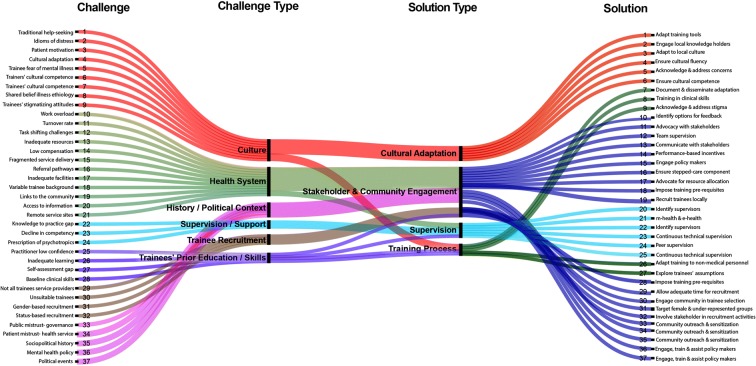
BACKGROUND: Major efforts are underway to improve access to mental health care in low- and middle-income countries (LMIC) including systematic training of non-specialized health professionals and other care providers to identify and help individuals with mental disorders. In many LMIC, this effort is guided by the mental health Gap Action Programme (mhGAP) established by the World Health Organization, and commonly centres around one tool in this program: the mhGAP-Intervention Guide. OBJECTIVE: To identify cultural and contextual challenges in mhGAP training and implementation and potential strategies for mitigation. METHOD: An informal consultative approach was used to analyze the authors' combined field experience in the practice of mhGAP implementation and training. We employed iterative thematic analysis to consolidate and refine lessons, challenges and recommendations through multiple drafts. Findings were organized into categories according to specific challenges, lessons learned and recommendations for future practice. We aimed to identify cross-cutting and recurrent issues. RESULTS: Based on intensive fieldwork experience with a focus on capacity building, we identify six major sets of challenges: (i) cultural differences in explanations of and attitudes toward mental disorder; (ii) the structure of the local health-care system; (iii) the level of supervision and support available post-training; (iv) the level of previous education, knowledge and skills of trainees; (v) the process of recruitment of trainees; and (vi) the larger socio-political context. Approaches to addressing these problems include: (1) cultural and contextual adaptation of training activities, (2) meaningful stakeholder and community engagement, and (3) processes that provide support to trainees, such as ongoing supervision and Communities of Practice. CONCLUSION: Contextual and cultural factors present major barriers to mhGAP implementation and sustainability of improved services. To enable trainees to effectively apply their local cultural knowledge, mhGAP training needs to: (1) address assumptions, biases and stigma associated with mental health symptoms and problems; (2) provide an explicit framework to guide the integration of cultural knowledge into assessment, treatment negotiation, and delivery; and (3) address the specific kinds of problems, modes of clinical presentations and social predicaments seen in the local population. Continued research is needed to assess the effectiveness these strategies.
Overview
The claims and statistics of this paper haven’t been checked yet.
Free: it reads the open-access text and checks the first 5 claims that cite a source we can check. Create a free account to check every claim.
Integrity signals
Registry
Cites
Statistics
Figures
Verification
Claims the paper makes
The claims and statistics of this paper haven’t been checked yet.
Free: it reads the open-access text and checks the first 5 claims that cite a source we can check. Create a free account to check every claim.
Claims other papers make about this one
Each is checked against this paper’s own text: does it say what the citing paper says it does?
The cited source says what the claim attributes to it.
In the citing paper
“The barriers that were identified in the implementation of this project are also consistent with other cultural and contextual challenges to the mhGAP-IG implementation identified by Fargeh et al., including the local perception of mental disorders, the healthcare system, available support for trainees, prior knowledge of trainees, trainee recruitment, and the larger socio-political context [57].”
Self-check
Percentages, sums and reported differences re-computed from the paper’s own numbers.
The self-check needs the paper’s full text.
Citations
Cites
Resources for mental health: scarcity, inequity, and inefficiency
Saxena, S., Thornicroft, G., Knapp, M., & Whiteford, H. (2007) · The Lancet · doi:10.1016/s0140-6736(07)61239-2 · Cited by 1,789
Wang, P. S., Aguilar-Gaxiola, S., Alonso, J., Angermeyer, M. C., Borges, G., Bromet, E. J., Bruffaerts, R., de Girolamo, G., de Graaf, R., Gureje, O., et al. (2007) · The Lancet · doi:10.1016/s0140-6736(07)61414-7 · Cited by 1,655
Treatment gap in mental health care.
Abramowitz, M. Z., Greenberg, D., & Levav, I. (2008) · PubMed · Cited by 1,484
The treatment gap in mental health care.
(2004) · Europe PMC (PubMed Central) · Cited by 1,419
Barriers to mental health treatment: results from the WHO World Mental Health surveys
Andrade, L. H., Alonso, J., Mneimneh, Z., Wells, J. E., Al-Hamzawi, A., Borges, G., Bromet, E., Bruffaerts, R., de Girolamo, G., de Graaf, R., et al. (2014) · Psychological Medicine · doi:10.1017/s0033291713001943 · Cited by 1,289
Culturally adapted mental health intervention: a meta-analytic review
Griner, D., & Smith, T. B. (2006) · Psychotherapy: Theory, Research, Practice, Training · doi:10.1037/0033-3204.43.4.531 · Cited by 1,236
Cultural adaptation of treatments: A resource for considering culture in evidence-based practice
Bernal, G., Jiménez-Chafey, M. I., & Domenech Rodríguez, M. M. (2009) · Professional Psychology: Research and Practice · doi:10.1037/a0016401 · Cited by 1,186
Barriers to improvement of mental health services in low-income and middle-income countries
Saraceno, B., van Ommeren, M., Batniji, R., Cohen, A., Gureje, O., Mahoney, J., Sridhar, D., & Underhill, C. (2007) · The Lancet · doi:10.1016/s0140-6736(07)61263-x · Cited by 1,088
Treatment and prevention of mental disorders in low-income and middle-income countries
Patel, V., Araya, R., Chatterjee, S., Chisholm, D., Cohen, A., De Silva, M., Hosman, C., McGuire, H., Rojas, G., & van Ommeren, M. (2007) · The Lancet · doi:10.1016/s0140-6736(07)61240-9 · Cited by 930
Patel, V., Chisholm, D., Parikh, R., Charlson, F. J., Degenhardt, L., Dua, T., Ferrari, A. J., Hyman, S., Laxminarayan, R., Levin, C., et al. (2016) · The Lancet · doi:10.1016/s0140-6736(15)00390-6 · Cited by 889 · cited 1×
“Mental health service delivery warrants special attention because deficiencies in this area are associated with great suffering, morbidity and mortality, economic costs, and human rights abuses for those afflicted by mental disorders and their families [14].”
Research works printed but not linked: 7
- World Health Organization Integrating the response to mental disorders and other chronic diseases in health care systems 2014 Geneva World Health Organization
- World Health Organization mhGAP intervention guide for mental, neurological and substance use disorders in non-specialized health settings: mental health Gap Action Programme (mhGAP) 2008 Geneva World Health Organization 23741783
- World Health Organization Global action plan on the public health response to dementia 2017–2025 2017 Geneva World Health Organization
- World Health Organization Culture and mental health in liberia: a primer 2017 Geneva World Health Organization
- Pérez-Sales P Férnandez-Liria A Baingana F Ventevogel P Integrating mental health into existing systems of care during and after complex humanitarian emergencies: rethinking the experience Intervention. 2011 9 3 345 357
- Rancati A Troussard X Cuccillato E Svanfeldt C Enabling communities of practice 2017 Luxembourg Publications Office of the EU 28432
- World Health Organization Partnership preparation package: a practical guide to implementing twinning partnerships: WHO twinning partnerships 2018 Geneva World Health Organization
Cited by
Keynejad, R., Spagnolo, J., & Thornicroft, G. (2021) · Evidence Based Mental Health · doi:10.1136/ebmental-2021-300254 · Cited by 219
Trauma and Resilience Among Displaced Populations: A Sociocultural Exploration
Theisen-Womersley, G. (2021) · Springer eBooks · doi:10.1007/978-3-030-67712-1 · Cited by 107
Global Mental Health: Interdisciplinary challenges for a field in motion
Bemme, D., & Kirmayer, L. J. (2020) · Transcultural Psychiatry · doi:10.1177/1363461519898035 · Cited by 103
Self-citationPsychological care in low-resource settings for adolescents
Galagali, P. M., & Brooks, M. J. (2020) · Clinical Child Psychology and Psychiatry · doi:10.1177/1359104520929741 · Cited by 100
Sit, H. F., Ling, R., Lam, A. I. F., Chen, W., Latkin, C. A., & Hall, B. J. (2020) · Frontiers in Psychiatry · doi:10.3389/fpsyt.2020.00650 · Cited by 93
Lange, K. W. (2021) · Global Health Journal · doi:10.1016/j.glohj.2021.07.001 · Cited by 68
Secor, A., Macauley, R., Stan, L., Kagone, M., Sidibé, S., Sow, S., Aronovich, D., Litvin, K., Davis, N., Alva, S., et al. (2020) · BMJ Open · doi:10.1136/bmjopen-2019-035217 · Cited by 68
Ventevogel, P., Tarannum, S., Elshazly, M., & Harlass, S. (2019) · Intervention · doi:10.4103/intv.intv_34_19 · Cited by 60
Self-citationIndia's policy and programmatic response to mental health of young people: A narrative review
Girase, B., Parikh, R., Vashisht, S., Mullick, A., Ambhore, V., & Maknikar, S. (2022) · SSM - Mental Health · doi:10.1016/j.ssmmh.2022.100145 · Cited by 35
Tareke, M., Yirdaw, B. A., Worku, A. G., Gelaye, B., & Azale, T. (2023) · PLoS ONE · doi:10.1371/journal.pone.0293988 · Cited by 34
Will increasing access to mental health treatment close India's mental health gap?
Weaver, L. J., Karasz, A., Muralidhar, K., Jaykrishna, P., Krupp, K., & Madhivanan, P. (2022) · SSM - Mental Health · doi:10.1016/j.ssmmh.2022.100184 · Cited by 34
Regalado, I. C. R., Lindquist, A. R. R., Cardoso, R., Longo, E., Lencucha, R., Hunt, M. R., Thomas, A., Bussières, A., Boruff, J. T., & Shikako, K. (2022) · Disability and Rehabilitation · doi:10.1080/09638288.2022.2030415 · Cited by 33
Self-citationLambert, J. E., Nantogmah, F. A., Dokurugu, A. Y., Alhassan, H., Azuure, S. S., Yaro, P. B., & Kørner, J. (2020) · Cambridge Prisms Global Mental Health · doi:10.1017/gmh.2020.21 · Cited by 33
Chu, C., Roxas, N., Aguocha, C. M., Nwefoh, E., Wang, K., Dike, C., & Iheanacho, T. (2022) · BMC Health Services Research · doi:10.1186/s12913-022-07703-1 · Cited by 30
“, including the local perception of mental disorders, the healthcare system, available support for trainees, prior knowledge of trainees, trainee recruitment, and the larger socio-political context [57].”
BackgroundInfluentialPurgato, M., Prina, E., Ceccarelli, C., Cadorin, C., Abdulmalik, J. O., Amaddeo, F., Arcari, L., Churchill, R., Jordans, M. J., Lund, C., et al. (2023) · Cochrane Database of Systematic Reviews · doi:10.1002/14651858.cd014722.pub2 · Cited by 27
Ahrens, J., Kokota, D., Mafuta, C., Konyani, M., Chasweka, D., Mwale, O., Stewart, R. C., Osborn, M., Chikasema, B., Mcheka, M., et al. (2020) · International Journal of Mental Health Systems · doi:10.1186/s13033-020-00345-y · Cited by 27
Herbert, H. S., & Munivenkatappa, M. (2022) · Mental Health & Prevention · doi:10.1016/j.mhp.2022.200239 · Cited by 25
Elias, L., Singh, A., & Burgess, R. A. (2021) · Health Policy and Planning · doi:10.1093/heapol/czaa140 · Cited by 23
Singh, A., Nemiro, A., Malik, A., Guimond, M.-F., Nduwimana, E., Likindikoki, S. L., Annan, J. R., & Tol, W. A. (2021) · Conflict and Health · doi:10.1186/s13031-021-00391-4 · Cited by 22
Nyongesa, V., Kathono, J., Mwaniga, S., Yator, O., Madeghe, B. A., Kiburi, S. K., Amugune, B. K., Anyango, N. I., Nyamai, D. N., Wambua, G. N., et al. (2022) · PLoS ONE · doi:10.1371/journal.pone.0277619 · Cited by 22
Fine, S. L., Kane, J. C., Spiegel, P. B., Tol, W. A., & Ventevogel, P. (2022) · BMC Medicine · doi:10.1186/s12916-022-02371-8 · Cited by 20
Self-citationPraptomojati, A., Icanervilia, A. V., Nauta, M. H., & Bouman, T. K. (2023) · Asian Journal of Psychiatry · doi:10.1016/j.ajp.2023.103896 · Cited by 20
Scaling up public mental health care in Sub-Saharan Africa: insights from infectious disease
Meffert, S. M., Lawhorn, C., Ongeri, L., Bukusi, E. A., Campbell, H. R., Goosby, E., Bertozzi, S., & Njuguna, S. (2021) · Cambridge Prisms Global Mental Health · doi:10.1017/gmh.2021.41 · Cited by 18
Addition of mental health to the lady health worker curriculum in Pakistan: now or never
Rabbani, F., Akhtar, S., Nafis, J., Khan, S., Siddiqi, S., & Merali, Z. (2023) · Human Resources for Health · doi:10.1186/s12960-023-00814-8 · Cited by 18
The prevalence and factors associated with mental disorders in a community setting in central Uganda
Akena, D. H., Kiguba, R., Muwhezi, W. W., Kwesiga, B., Kigozi, G., Lukwata, H., & Nakasujja, N. (2023) · PLoS ONE · doi:10.1371/journal.pone.0285091 · Cited by 17
hAnrachtaigh, É. Ó., Brown, G. P., Beck, A. F., Conway, R., Jones, H. G., & Angelakis, I. (2024) · Depression and Anxiety · doi:10.1155/2024/5037662 · Cited by 17
Agudelo‐Hernández, F., Plata‐Casas, L. I., Vélez-Botero, H., Vieira, L. M. S., & Mayorga, B. M. (2024) · Revista Panamericana de Salud Pública · doi:10.26633/rpsp.2024.49 · Cited by 17
A Review of the Use of Trauma Systems Therapy to Treat Refugee Children, Adolescents, and Families
Kaplin, D., Parente, K., & Santacroce, F. A. (2019) · Journal of Infant Child and Adolescent Psychotherapy · doi:10.1080/15289168.2019.1687220 · Cited by 16
Engdawork, K., D’Ambruoso, L., Hailu, T., Yared, M., Geletu, G. M., Baraki, S. G., Sebsibe, E., & Abbott, P. (2025) · Frontiers in Sociology · doi:10.3389/fsoc.2024.1488619 · Cited by 16
Rohingya mHealth: Investigating Mental Health in Kutupalong Refugee Camp
Christensen, L., Ahsan, H., & Mandal, S. (2020) · Intervention · doi:10.4103/intv.intv_10_20 · Cited by 16
O'Donnell, A. J., Anderson, P., Schmidt, C. S., Braddick, F., López‐Pelayo, H., Mejía‐Trujillo, J., Rey, G. N., Arroyo, M., Aguilar, N. B., Piazza, M., et al. (2022) · Global Health Action · doi:10.1080/16549716.2022.2080344 · Cited by 15
Horn, R., Sesay, S. S., Jalloh, M., Bayoh, A., Lavally, J. B., & Ager, A. (2020) · Cambridge Prisms Global Mental Health · doi:10.1017/gmh.2020.12 · Cited by 13
de Queiroz, M. R., Rubini, E., Valente, M., Hubloue, I., & Corte, F. D. (2025) · Cadernos de Saúde Pública · doi:10.1590/0102-311xen199224 · Cited by 12
Bassi, T. M. D. S., de Brito, V. M., & Neres, C. C. (2020) · Revista on line de Política e Gestão Educacional · doi:10.22633/rpge.v24iesp2.14329 · Cited by 12
Heltne, U. M., Sarkadi, A., Lien, L., & Dybdahl, R. (2023) · International Journal for Equity in Health · doi:10.1186/s12939-023-01999-z · Cited by 11
Kumar, M., Chu, W., Gellatly, R., Wambua, G. N., Becker, K. D., & Chorpita, B. F. (2021) · Current Opinion in Psychology · doi:10.1016/j.copsyc.2021.12.003 · Cited by 11
Raghuram, H., Rajguru, A. J., Pathiyil, M. M., Brahmbhatt, A., Bhan, A., Spagnolo, J., & Naslund, J. A. (2025) · International Journal of Mental Health Systems · doi:10.1186/s13033-025-00671-z · Cited by 11
Transforming global health: decoloniality and the human condition
Lencucha, R. (2024) · BMJ Global Health · doi:10.1136/bmjgh-2024-015420 · Cited by 11
Self-citationNguyen, A. J., Rykiel, N. A., Murray, L. K., Amin, A., Haroz, E. E., Lee, C., & Bolton, P. A. (2019) · International Journal of Mental Health Systems · doi:10.1186/s13033-019-0330-7 · Cited by 10
Khanal, G., Selvamani, Y., Ghimire, S., Thapa, S., & Dhital, R. (2024) · Asian Journal of Psychiatry · doi:10.1016/j.ajp.2024.104331 · Cited by 9
Drivers of and Solutions for the Overuse of Antidepressant Medication in Pediatric Populations
Cosgrove, L., Morrill, Z., Yusif, M., Vaswani, A., Cathcart, S. C., Troeger, R., & Karter, J. M. (2020) · Frontiers in Psychiatry · doi:10.3389/fpsyt.2020.00017 · Cited by 9
Humayun, A., & Najmussaqib, A. (2025) · BJPsych International · doi:10.1192/bji.2025.10059 · Cited by 9
Dokurugu, M. A., Aninanya, G. A., Alhassan, M., Dowou, R. K., & Daliri, D. B. (2025) · BMC Health Services Research · doi:10.1186/s12913-025-12432-2 · Cited by 9
Böhm, B., Keane, G., Karimet, M., & Palma, M. (2022) · Cambridge Prisms Global Mental Health · doi:10.1017/gmh.2022.53 · Cited by 8
Syahir, A. N. A., Abidin, M. S. Z., Sa’ari, C. Z., & Mukaffa, Z. (2025) · Teosofi Jurnal Tasawuf dan Pemikiran Islam · doi:10.15642/teosofi.2025.15.1.229-258 · Cited by 8
Agudelo‐Hernández, F., & Giraldo-Álvarez, A. B. (2025) · Public health reviews · doi:10.3389/phrs.2025.1607759 · Cited by 8
Zeleke, W. A., Dagnew, M., Wondie, Y., Hailu, T., Holmes, C. M., Mekonnen, M., Eshete, B. T., & Nenko, G. (2025) · Trauma Care · doi:10.3390/traumacare5010004 · Cited by 7
Ribić, E., Sikira, H., Kulenović, A. D., Pemovska, T., Russo, M., Jovanović, N., Radojičić, T., Repišti, S., Milutinović, M., Blazevska, B., et al. (2022) · BJPsych Open · doi:10.1192/bjo.2022.539 · Cited by 7
Humayun, A., Najmussaqib, A., & Muneeb, N. U. A. (2025) · SSM - Mental Health · doi:10.1016/j.ssmmh.2025.100451 · Cited by 7
Jervase, R., Adams, B., Myaba, J., & Vallières, F. (2022) · SSM - Mental Health · doi:10.1016/j.ssmmh.2022.100108 · Cited by 7
Mahsoon, A. N., Alnakli, M., Azab, S., Abed, M., Aabduqader, A., Sharif, L., & Sharif, K. (2024) · Healthcare · doi:10.3390/healthcare12121168 · Cited by 7
Shao, S., Zhang, Y., Yang, M., Li, C., Zhao, R., Liu, Z., Wu, M., Liu, Y., Zhu, Z., & Cui, L. (2024) · Journal of School Psychology · doi:10.1016/j.jsp.2024.101357 · Cited by 6
Adjei-Banuah, N. Y., Ayiku, R. N. B., Reichenberger, V., Sasu, D., Mirzoev, T. N., Murphy, A., Ohene, S., Antwi, E., & Agyepong, I. A. (2024) · JMIR Research Protocols · doi:10.2196/58890 · Cited by 6
Humayun, A., Muneeb, N. U. A., Najmussaqib, A., Haq, I. U., & Asif, M. (2025) · medRxiv · doi:10.1101/2025.05.21.25327990 · Cited by 6
Mutahi, J., Kangwana, B. P., Khasowa, D., Muthoni, I., Charo, O., Muli, A., & Kumar, M. (2024) · International Journal of Environmental Research and Public Health · doi:10.3390/ijerph21020223 · Cited by 6
Müller, M. R., & Ortega, F. (2024) · Culture Medicine and Psychiatry · doi:10.1007/s11013-024-09852-w · Cited by 6
Mkubwa, B., Angwenyi, V., Pacione, L. R., Nzioka, B. M., John, M., Kibirige, N., Gichuki, J., Newton, C. R. J. C., Sijbrandij, M., & Abubakar, A. A. (2025) · Cambridge Prisms Global Mental Health · doi:10.1017/gmh.2025.10049 · Cited by 5
Competency-based mental health supervision: evidence-based tool needs for the humanitarian context
Böhm, B., Palma, M., Ousley, J., & Keane, G. (2022) · Cambridge Prisms Global Mental Health · doi:10.1017/gmh.2022.23 · Cited by 5
Marques, B. L., Lirio, P. H. C., Vicente, M. A., Unzueta‐Larrinaga, P., Urigüen, L., & Campos, A. C. (2025) · Pharmaceuticals · doi:10.3390/ph18121817 · Cited by 4
Kokole, D., Mercken, L. A. G., Anderson, P., Mejía‐Trujillo, J., Pérez‐Gómez, A., Bustamante, I. V., Piazza, M., Rey, G. N., Arroyo, M., de León, A. P., et al. (2023) · Global Public Health · doi:10.1080/17441692.2023.2207410 · Cited by 4
Yaro, P. B., Asampong, E., Tabong, P. T., Thornicroft, G., & Tindana, P. O. (2025) · PLOS Global Public Health · doi:10.1371/journal.pgph.0002672 · Cited by 4
Salt, G., Salie, M., & Roomaney, R. (2024) · South African Journal of Psychology · doi:10.1177/00812463241265951 · Cited by 4
Fortes, D. C. S., da Silva, M. R. S., Fonseca, K. S. G., & da Silva, A. S. B. (2021) · Research Society and Development · doi:10.33448/rsd-v10i4.14329 · Cited by 4
Meshesha, H. S., & Johnson, V. (2021) · Frontiers in Sociology · doi:10.3389/fsoc.2020.583864 · Cited by 4
Iheanacho, T., Chu, C., Aguocha, C. M., Nwefoh, E., & Dike, C. (2024) · Cambridge Prisms Global Mental Health · doi:10.1017/gmh.2024.4 · Cited by 3
“Furthermore, there is limited data on the rate of adoption of mhGAP-IG-based collaborative care models in primary, secondary and tertiary care centers in Nigeria (Timothy et al., 2018; Faregh et al., 2019).”
BackgroundAkhtar, S., Rabbani, F., Nafis, J., Siddiqui, A., & Merali, Z. (2026) · BJPsych Open · doi:10.1192/bjo.2026.11051 · Cited by 3
Lao, U., Zhu, H., Liang, F., Bai, E. W., Yin, P., Huang, X., Girdler, S. J., Bölte, S., & Zou, X. (2024) · BMJ Open · doi:10.1136/bmjopen-2023-081827 · Cited by 3
Kookal, S., George, L. S., Chakrabarty, J., Vinish, V., Praharaj, S. K., Vani Lakshmi, S., Nayak, B. S., John, S., & Noronha, J. A. (2026) · Mental Health & Prevention · doi:10.1016/j.mhp.2026.200501 · Cited by 3
Zheng, M., Zhang, Y., Chen, F., Chen, A., Kong, D., Xie, K., Li, J., Hall, B. J., Renzaho, A. M. N., Gao, J., et al. (2025) · SSM - Mental Health · doi:10.1016/j.ssmmh.2025.100389 · Cited by 3
Perry, A., Zawadzka, M., Łapiński, P., Moore, K., Rychlik, J., & Nowak, B. M. (2023) · BMJ Open · doi:10.1136/bmjopen-2022-069252 · Cited by 3
Primary outcomes of mhGAP program implementation in higher medical education institutions
Kuchyn, I. L., Khaustova, O. O., Саханда, І. В., Burdeinyi, A. O., & Stashenko, S. (2005) · Wiadomości Lekarskie · doi:10.36740/wlek/205375 · Cited by 3
Tomi, A. (2025) · Journal of interdisciplinary perspectives · doi:10.69569/jip.2025.004 · Cited by 3
Stewart, H. L. N., Jackman, M. R., Agarwal, S., Abanga, M. A., Kyalo, C. W., Mkorongo, A., Hagianu, R. M., Athié, K., Jammalamadugu, S. B., Misganaw, E., et al. (2020) · The Lancet Psychiatry · doi:10.1016/s2215-0366(20)30526-5 · Cited by 3
Oladipo, O. E., & Adewuya, A. O. (2026) · International Journal of Mental Health · doi:10.1080/00207411.2025.2612254 · Cited by 2
Mudiyanselage, K. W. W., Jörg, F., Mendis, M. S. D., Fuhr, D. C., & Busse, H. (2024) · Cambridge Prisms Global Mental Health · doi:10.1017/gmh.2024.75 · Cited by 2
Abamara, N. C., Obiora, N. B., & Vivalya, B. M. N. (2022) · Research Square · doi:10.21203/rs.3.rs-2095070/v1 · Cited by 2
Enhancing mental health service use: insights from caregivers, providers, and managers in Ghana
Daliri, D. B., Aninanya, G. A., Afaya, A., Laari, T. T., & Abagye, N. (2024) · Academia Mental Health and Well-Being · doi:10.20935/mhealthwellb7446 · Cited by 2
Banda, L., Mokgatle, M. M., & Oladimeji, O. (2025) · The Open Public Health Journal · doi:10.2174/0118749445345522241211093758 · Cited by 2
Moses, N. (2025) · Happiness Journal of Psychology and Islamic Science · doi:10.30762/happiness.v9i1.1633 · Cited by 2
Implementation of Technology in Cross-Cultural Counseling Process: Challenges and Opportunities
Hapipi, M., Ahmad, K. R., & Amir, L. S. (2024) · International Journal of Multicultural Counseling and Development · doi:10.31960/ijomcd.v1i1.2281 · Cited by 2
Adeleke, O. T., Orji, E. J., Adekunle, W. A., Akinbode, A. O., Oluwasanya, A. N., Oduniyi, O. A., Aibangbee, O., Olabode, A. T., & Ariba, A. J. (2025) · Research Square · doi:10.21203/rs.3.rs-5957751/v1 · Cited by 2
Ventevogel, P., N’Dri, E.-D. K., & Djogo, E. A. (2026) · BJPsych Open · doi:10.1192/bjo.2025.10970 · Cited by 2
Self-citationMukasa, M. N., Donahue, M. L., Levin, M. E., Rodríguez, M. M. D., Kasujja, R., Damulira, C., & Vance, J. (2026) · Journal of Contextual Behavioral Science · doi:10.1016/j.jcbs.2026.101017 · Cited by 1
Impacts of climate change on mental health and its underlying mechanisms: an umberella review
Davariniamotlaghquchan, A., Niazmand, Z., Shafiee, M., & Ostadtaghizadeh, A. (2026) · Annals of General Psychiatry · doi:10.1186/s12991-026-00668-z · Cited by 1
Vahedi, L., Zaïdi, S., Pradhan, S., Smolik, J., Tikhonov, J., Gaffey, M. F., & Bhutta, Z. A. (2026) · PLOS Climate · doi:10.1371/journal.pclm.0000984 · Cited by 1
Abraham, D., Kumar, K., Hoogendoorn, A. W., de Wit, E. E., Veltman, D. J., & Bunders, J. (2025) · Advances in Mental Health · doi:10.1080/18387357.2025.2591084 · Cited by 1
Ventevogel, P. (2026) · Springer eBooks · doi:10.1007/978-981-95-5871-1_2 · Cited by 1
Self-citationDas, S., Fearon, D., & Grant, L. (2026) · Community Mental Health Journal · doi:10.1007/s10597-026-01681-y · Cited by 1
Botyar, M., Moghaddam-Banaem, L., Sadatmahalleh, S. J., Esmaeilinasab, M., & Ahmadi, F. (2026) · Iranian Journal of Nursing and Midwifery Research · doi:10.4103/ijnmr.ijnmr_243_24 · Cited by 1
Yaro, P. B., Asampong, E., Tabong, P. T.-N., Thornicroft, G., & Tindana, P. (2023) · medRxiv · doi:10.1101/2023.11.09.23298301 · Cited by 1
Making it real: Actioning the mental health strategy with Pacific Island communities
Gopalkrishnan, N., & Crookes, A. E. (2024) · Australasian Psychiatry · doi:10.1177/10398562241293263 · Cited by 1
Muneeb, N. U. A., Nisa, A., & Humayun, A. (2026) · medRxiv · doi:10.64898/2026.03.14.26347350 · Cited by 1
Siddaiah, A., SATHE, H., Chari, U., Manivannan, M. M., Rathod, R., Kudlekar, A., Urkude, A., Kalidindi, B., Devadass, D., Parthasarathy, R., et al. (2026) · BMC Public Health · doi:10.1186/s12889-026-28263-7 · Cited by 1
Rosa, R. D. D., Balleza, S. L. N., Olivar, J. J. R., Aguila, N. A., Castro, C. S. D., & Aliswag, E. G. (2025) · International Journal of Psychiatry Research · doi:10.33545/26648962.2025.v7.i2a.97 · Cited by 1
Resistance In The Everyday: An Ethnographic Study of Mental Health Activism in Uganda
Ionescu, A. (2025) · UCL Discovery (University College London) · Cited by 1
Elias, L., Singh, A., & Burgess, R. A. (2021) · Health Policy and Planning · doi:10.1093/heapol/czab020 · Cited by 1
Adeyemi, I. O., Hammed, T. M., Tijani, M. O., & Tajudeen, M. E. (2026) · The International Information & Library Review · doi:10.1080/10572317.2026.2634503 · Cited by 1
WHO Owns the Language: “Domination Code” in the Mental Health Gap Action Program
Walker, D. E. (2022) · Ethical Human Psychology and Psychiatry · doi:10.1891/ehpp-2021-0008 · Cited by 1
Theisen-Womersley, G. (2021) · Springer eBooks · doi:10.1007/978-3-030-67712-1_1
Theisen-Womersley, G. (2021) · Springer eBooks · doi:10.1007/978-3-030-67712-1_12
Metadata
- Authors
- Faregh, N., Lencucha, R., Ventevogel, P., Dubale, B. W., & Kirmayer, L. J.
- Affiliations
- McGill University (CA)
- Office of the United Nations High Commissioner for Refugees (CH)
- Addis Ababa University (ET)
- Corresponding author
- Faregh, Neda
- Venue
- International Journal of Mental Health Systems
- Published
- 2019-08-24
- Volume
- 13
- Issue
- 1
- Pages
- 58-58
- ISSN
- 1752-4458 (ISSN-L)
- PMC
- PMC6708207
- OpenAlex
- W2969253017
- Cited by
- 120
- References
- 84
- Citations by year
- 2026: 18 · 2025: 18 · 2024: 19 · 2023: 24 · 2022: 15 · 2021: 10 · 2020: 12 · 2019: 3
- FWCI
- 1.54
- Type
- journal article
- Language
- en
- Open access
- gold
- doi.org
- Licence
- cc-by
- creativecommons.org/licenses/by/4.0/ (tdm)
- creativecommons.org/licenses/by/4.0/ (vor)
- Locations
- International Journal of Mental Health Systems (publishedVersion, cc-by)
- PubMed Central (publishedVersion, cc-by)
- PubMed (publishedVersion)
- DOAJ (DOAJ: Directory of Open Access Journals) (submittedVersion, cc-by-sa)
- Greater South Information System
- Topics
- Health Sciences › Medicine › Psychiatry and Mental health › Mental Health Treatment and Access
- Health Sciences › Health Professions › General Health Professions › Health Policy Implementation Science
- Health Sciences › Medicine › Public Health, Environmental and Occupational Health › Global Health and Surgery
- Keywords
- Mental Health Gap Action Programme, implementation barriers, mental health stigma, community participation, capacity building, supervision and support, trainee recruitment, health system structure, low- and middle-income countries, access to mental health care, communities of practice
About these checks
Registry, retraction, Cites and statistics results are computed, not judged, with one exception: a printed reference that no index lists is read once by a model before it counts as a citation error. Claims are extracted by a model and kept only when their quote appears verbatim in the text; each cited source is then checked, with a model’s help, for whether it says what the claim relies on. Those verdicts can be wrong — read the claim’s quote and the cited source before relying on one.
Statistics and arithmetic are recomputed, not judged.
Confidence bands are shown only for fields calibrated on our annotated test set. None is calibrated yet, so no band is shown.
What counts as a claim ›How we measure confidence ›How we check this ›
Are you an author, or do you see a problem with this page? Request a review
Data sources
Bibliographic data: Semantic Scholar, OpenAlex, Crossref.
Contains information from the Semantic Scholar Academic Graph Datasets, made available under the ODC Attribution License (ODC-BY 1.0).
Semantic Scholar’s data is described in: Kinney, R., et al. (2023). The Semantic Scholar Open Data Platform. arXiv:2301.10140.
