

Review of Australian initiatives to reduce stigma towards people with complex mental illness: what exists and what works?
Open accessThe DOI matches its Crossref record; 47 of the 49 references it cites were found in a registry or an index; 1 of the 27 sources its claims cite were checked for support.
Abstract
Background: Australian national mental health policy outlines the need for a nationally coordinated strategy to address stigma and discrimination, particularly towards people with complex mental illness that is poorly understood in the community. To inform implementation of this policy, this review aimed to identify and examine the effectiveness of existing Australian programs or initiatives that aim to reduce stigma and discrimination. Method: Programs were identified via a search of academic databases and grey literature, and an online survey of key stakeholder organisations. Eligible programs aimed to reduce stigma towards people with complex mental illness, defined as schizophrenia, psychosis, personality disorder, or bipolar disorder; or they focused on nonspecific ‘mental illness’ but were conducted in settings relevant to individuals with the above diagnoses, or they included the above diagnoses in program content. Key relevant data from programs identified from the literature search and survey were extracted and synthesized descriptively. Results: We identified 61 programs or initiatives currently available in Australia. These included face-to-face programs (n = 29), online resources (n = 19), awareness campaigns (n = 8), and advocacy work (n = 5). The primary target audiences for these initiatives were professionals (health or emergency), people with mental illness, family or carers of people with mental illness, and members of the general population. Most commonly, programs tended to focus on stigma towards people with non-specific mental illness rather than on particular diagnostic labels. Evidence for effectiveness was generally lacking. Face-to-face programs were the most well-evaluated, but only two used a randomised controlled trial design. Conclusions: This study identified areas of strength and weakness in current Australian practice for the reduction of stigma towards people with complex mental illness. Most programs have significant input from people with lived experience, and programs involving education and contact with a person with mental illness are a particular strength. Nevertheless, best-practice programs are not widely implemented, and we identified few programs targeting stigma for people with mental illness and their families, or for culturally and linguistically diverse communities, Aboriginal and Torres Strait Islander communities and LGBTIQ people. These can inform stakeholder consultations on effective options for a national stigma and discrimination reduction strategy.
Overview
CoChat Summary
TL;DR
This review identified 61 currently operating Australian programs or initiatives to reduce stigma towards people with complex mental illness, spanning face-to-face programs (n = 29), online resources (n = 19), awareness campaigns (n = 8), and advocacy work (n = 5). Evidence for effectiveness was generally lacking; face-to-face programs were the most evaluated, but only two used a randomised controlled trial design.
Key findings
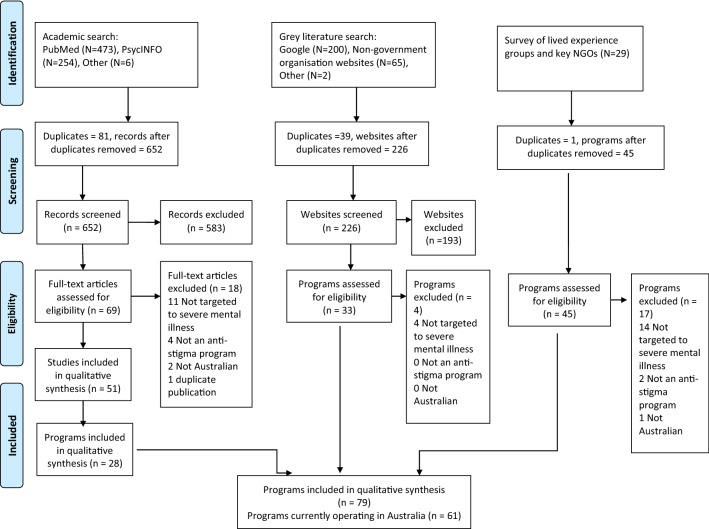
- The review identified 61 programs currently available in Australia: face-to-face programs (n = 29), online resources (n = 19), awareness campaigns (n = 8), and advocacy programs (n = 5).
- Most programs focused on non-specific mental illness rather than particular diagnostic labels. Among face-to-face programs, 55% focused on non-specific mental illness, 21% targeted a range including psychosis, schizophrenia, bipolar disorder, or personality disorders, 10% specifically focused on psychosis or schizophrenia, 7% on “severe” mental illness, and 7% on borderline personality disorder.
- Evidence was low: seven programs (24%) reported no evaluation evidence, eight (28%) were evaluated with post-program surveys or qualitative interviews only, and only two programs (7%) were evaluated with one or more randomised controlled trials. Six programs (21%) had one or more controlled trials, four (14%) had uncontrolled trials or repeated cross-sectional surveys, and for two programs the evaluation type was unclear.
- Lived experience involvement was common: 59% of programs involved people with lived experience in design and 76% in delivery. Common components were education (66%), face-to-face contact (62%), online/video contact (24%), and protest or advocacy (24%). Few programs targeted culturally and linguistically diverse communities, Aboriginal and Torres Strait Islander communities, or LGBTIQ people.
Methods
- Eligible programs aimed to reduce stigma towards people with complex mental illness, defined as schizophrenia, psychosis, personality disorder, or bipolar disorder; or focused on non-specific mental illness in settings relevant to those diagnoses, or included those diagnoses in program content. Programs focused on common mental disorders, suicide, eating disorders, dementia, intellectual disability, PTSD, OCD, substance misuse or dual diagnoses, or conducted outside Australia were excluded.
- Identification combined academic database searches (PubMed and PsycINFO, limited to studies published since 2009; 652 studies screened), grey literature searches (Google Australia; 267 websites searched), and an online survey of key stakeholder organisations (177 organisations invited; survey open 9 December 2019 to 31 January 2020).
- Data were extracted and synthesized descriptively and thematically. Level of evidence was classified on a 1–5 scale, where 1 = no evaluation evidence and 5 = one or more randomised controlled trials.
Limitations
- Stated: the survey was open only during the busy December/January holiday season, so some programs may have been missed; relevant carer psychoeducation programs may have been missed if they did not allude to reducing stigma as a focus; and some continuing professional development resources on stigma may not have been accessible.
- Stated: evidence for effectiveness was generally lacking, and some program types or online resources are difficult to evaluate effectively.
- Evident from the text: many evaluations measured satisfaction or perceived knowledge rather than stigma outcomes, and no evaluation evidence was reported for the majority (79%) of online resources. The review also relies heavily on self-reported program information and grey literature, with limited long-term or standardised outcome data.
Model-written summary. Check it against the paper before relying on it.
Integrity signals
Registry
Cites
Statistics
Figures
Verification
Claims the paper makes
1 Valid · 0 Not valid · 27 Not checked · 246 Own results and interpretations
Every source the paper cites for this claim was checked and supports it.
In the paper
“Meta-analyses show the program leads to a reduction in stigmatising attitudes after training and up to six months later [10].”
§ Review of Australian initiatives to reduce stigma towards people with complex mental illness: what exists and what works? > Results > Face-to-face programs
What the sources say
- Supportedcites [10] Morgan AJ Ross A Reavley NJ Systematic review and meta-analysis of Mental Health First Aid training: effects on knowledge, stigma, and helping behaviour PLoS ONE 2018 13 5 e0197102 10.1371/journal.pone.0197102 29851974 PMC5979014 source
The Results section 'Attitudes' (p. Results > Effects of MHFA) reports small significant effects on stigmatizing attitudes at post-intervention (d = 0.14) and up to 6-month follow-up (d = 0.14), and the Abstract Results state 'small reductions in stigma (ds 0.08–0.14)'. The Discussion confirms 'MHFA training led to approximately small reductions in stigmatising attitudes', with effects at 12 months very small and non-significant (d = 0.08) — consistent with the claim being limited to post-training and up to six months. The only caveat is magnitude: the source describes the reductions as small, and sensitivity/trim-and-fill analyses attenuated them to non-significance, so the citing sentence's unqualified 'a reduction' understates the effect size somewhat. (LLM, conf=0.85)
plainstates a cause- Asserted: passes — The authors put it forward as true.
- Checkable: passes — It can be checked against evidence.
- Load-bearing: passes — The paper’s conclusions depend on it.
- Based: passes — The paper gives a reason why it holds.
- Supported
A result the paper reports from its own data — it cites no other source for it, so there is none to check. The quote shows it is in the paper.
In the paper
“Results from our survey of organisations in the mental health sector, grey literature search, and search of academic literature, identified 79 Australian programs or initiatives.”
§ Review of Australian initiatives to reduce stigma towards people with complex mental illness: what exists and what works? > Results
plain- Asserted: passes — The authors put it forward as true.
- Checkable: passes — It can be checked against evidence.
- Load-bearing: passes — The paper’s conclusions depend on it.
- Based: passes — The paper gives a reason why it holds.
A result the paper reports from its own data — it cites no other source for it, so there is none to check. The quote shows it is in the paper.
In the paper
“These 79 programs were described or evaluated in 108 resources (as some programs were included in multiple academic papers).”
§ Review of Australian initiatives to reduce stigma towards people with complex mental illness: what exists and what works? > Results
plain- Asserted: passes — The authors put it forward as true.
- Checkable: passes — It can be checked against evidence.
- Load-bearing: unclear — It is unclear whether the paper’s conclusions depend on it.
- Based: passes — The paper gives a reason why it holds.
A result the paper reports from its own data — it cites no other source for it, so there is none to check. The quote shows it is in the paper.
In the paper
“Evidence for effectiveness was generally lacking.”
§ Review of Australian initiatives to reduce stigma towards people with complex mental illness: what exists and what works? > Abstract > Results
plain- Asserted: passes — The authors put it forward as true.
- Checkable: passes — It can be checked against evidence.
- Load-bearing: passes — The paper’s conclusions depend on it.
- Based: passes — The paper gives a reason why it holds.
A result the paper reports from its own data — it cites no other source for it, so there is none to check. The quote shows it is in the paper.
In the paper
“However, some of the identified programs did not appear to be currently available, based on information from program authors or a web search for further information.”
§ Review of Australian initiatives to reduce stigma towards people with complex mental illness: what exists and what works? > Results
hedged- Asserted: passes — The authors put it forward as true.
- Checkable: passes — It can be checked against evidence.
- Load-bearing: unclear — It is unclear whether the paper’s conclusions depend on it.
- Based: passes — The paper gives a reason why it holds.
160 more claims
Create a free account to see all 274 claims and to verify the 26 references still open.
- It may state two separate claims as one. 61
- Probably not a substantial claim. 65
Claims other papers make about this one
Each is checked against this paper’s own text: does it say what the citing paper says it does?
The source backs part of the claim, not all of it — or backs it for a different population, condition or comparison.
In the citing paper
“Combined interventions, particularly those including educational and social contact components, significantly reduced stigmatising attitudes and social distance.178,196,198,199”
From The Lancet Commission on ending stigma and discrimination in mental health (2022) · cites this paper as [199]
Experimental — accuracy not yet measuredIn the citing paper
“Video-based contact combined with education was effective in reducing stigma among students in general and among health professionals, 198,199,[209][210][211] and led to a more balanced portrayal of people with mental health problems by media professionals.212”
From The Lancet Commission on ending stigma and discrimination in mental health (2022) · cites this paper as [199]
In the citing paper
“Two other systematic reviews concluded that the outcomes of protest campaigns in reducing stigma are unknown.199,209”
From The Lancet Commission on ending stigma and discrimination in mental health (2022) · cites this paper as [199]
In the citing paper
“Negative reports that focused on danger or which irresponsibly reported on suicide led to more stigmatising attitudes 273,274 and a reduction in willingness to disclose one's own mental health difficulties.199,275”
From The Lancet Commission on ending stigma and discrimination in mental health (2022) · cites this paper as [199]
Self-check
Percentages, sums and reported differences re-computed from the paper’s own numbers.
Each contradiction between two passages listed here was confirmed by an independent check.
Rated minor: it would not touch a result — a value no result rests on, a p-value that stays on the same side of the significance level, or a conflict that is clerical, resolved elsewhere in the paper, or outside its own findings.
In the paper
“56 (28 students, 27 LE)”
§ Review of Australian initiatives to reduce stigma towards people with complex mental illness: what exists and what works? > Results > Face-to-face programs
Reported 56 · recomputed 55
Rated minor: it would not touch a result — a value no result rests on, a p-value that stays on the same side of the significance level, or a conflict that is clerical, resolved elsewhere in the paper, or outside its own findings.
In the paper
§ Review of Australian initiatives to reduce stigma towards people with complex mental illness: what exists and what works? > Results > Face-to-face programs
“Significant decreases in stigma at 6-week post and follow-up for 5 out of 8 items relating to schizophrenia (p < .05)”
§ Review of Australian initiatives to reduce stigma towards people with complex mental illness: what exists and what works? > Results > Face-to-face programs
“(unpredictable; have different feelings; are difficult to talk to; should pull themselves together; are not a danger to others; have themselves to blame)”
Citations
Cites
Thornicroft, G., Brohan, E., Rose, D., Sartorius, N., & Leese, M. (2009) · The Lancet · doi:10.1016/s0140-6736(08)61817-6 · Cited by 1,189
Morgan, A. J., Ross, A., & Reavley, N. J. (2018) · PLOS ONE · doi:10.1371/journal.pone.0197102 · Cited by 461
Self-citationMorgan, A. J., Reavley, N. J., Ross, A., Too, L. S., & Jorm, A. F. (2018) · Journal of Psychiatric Research · doi:10.1016/j.jpsychires.2018.05.017 · Cited by 372
Self-citationMental health first aid training for high school teachers: a cluster randomized trial
Jorm, A. F., Kitchener, B. A., Sawyer, M. G., Scales, H., & Cvetkovski, S. (2010) · BMC Psychiatry · doi:10.1186/1471-244x-10-51 · Cited by 349
Reavley, N. J., & Jorm, A. F. (2011) · Australian & New Zealand Journal of Psychiatry · doi:10.3109/00048674.2011.621061 · Cited by 298
Self-citationYouth mental health first aid: a description of the program and an initial evaluation
Kelly, C. M., Mithen, J. M., Fischer, J. A., Kitchener, B. A., Jorm, A. F., Lowe, A., & Scanlan, C. (2011) · International Journal of Mental Health Systems · doi:10.1186/1752-4458-5-4 · Cited by 174
Structures and Types of Stigma
Sheehan, L. L., Nieweglowski, K., & Corrigan, P. W. (2016) · Springer eBooks · doi:10.1007/978-3-319-27839-1_3 · Cited by 171
‘Things you can't learn from books’: Teaching recovery from a lived experience perspective
Byrne, L., Happell, B., Welch, T., & Moxham, L. J. (2012) · International Journal of Mental Health Nursing · doi:10.1111/j.1447-0349.2012.00875.x · Cited by 162
O'Reilly, C. L., Bell, J. S., Kelly, P. J., & Chen, T. F. (2011) · Australian & New Zealand Journal of Psychiatry · doi:10.3109/00048674.2011.585454 · Cited by 162
Hanssen-Bauer, K., Heyerdahl, S., Hatling, T., Jensen, G., Olstad, P., Stangeland, T., & Tinderholt, T. (2011) · International Journal of Mental Health Systems · doi:10.1186/1752-4458-5-1 · Cited by 150
Research works printed but not linked: 10
- Department of Health The Fifth National Mental Health and Suicide Prevention Plan 2017 Canberra, Australia Commonwealth of Australia
- RiCharde SG. American and Australian communications officers: Mental health stigma and crisis intervention team. Dissertation Abstracts International: Section B: The Sciences and Engineering. 2017;78(5-B(E)):No-Specified.
- MIEACT. Mental Health 101 - Adult. https://mieact.org.au/workshops/mental-health-101-adult/.
- CHESS Connect. Fee Schedule: Mentally health workplace workshops 2019 [Available from: https://www.chessconnect.org.au/wp-content/uploads/2019/02/MHW-Fee-Structure-Document-2019.pdf.
- Linking body and mind All in The Mind with Lynne Malcom 2013 Australia ABC Radio National
- BPD and healing relationships All in The Mind with Lynne Malcolm 2018 Australia ABC Radio National
- The silence around schizophrenia All in The Mind with Lynne Malcolm 2019 Australia ABC Radio National
- Günsberg O Falling apart behind the scenes 2018 The Feed. Australia SBS
- SANE Australia. SANE Research Bulletin 19: SANE Forums: online peer support for people living with mental illness and for carers 2015. https://www.sane.org/images/PDFs/rb19_forums.pdf.
- 'Say no to stigma!' says mental health charity, SANE Australia [press release] [press release]. Aug 21 2013.
Cited by
The Lancet Commission on ending stigma and discrimination in mental health
Thornicroft, G., Sunkel, C., Alikhon Aliev, A., Baker, S., Brohan, E., el Chammay, R., Davies, K., Demissie, M., Duncan, J., Fekadu, W., et al. (2022) · The Lancet · doi:10.1016/s0140-6736(22)01470-2 · Cited by 748
“Video-based contact combined with education was effective in reducing stigma among students in general and among health professionals, 198,199,209–211 and led to a more balanced portrayal of people with mental health problems by media professionals.”
Background‘A way to be me’: Autobiographical reflections of autistic adults diagnosed in mid-to-late adulthood
Lilley, R., Lawson, W. B., Hall, G., Mahony, J., Clapham, H., Heyworth, M., Arnold, S. R. C., Trollor, J. N., Yudell, M., & Pellicano, E. (2021) · Autism · doi:10.1177/13623613211050694 · Cited by 127
Shahwan, S., Goh, C. M. J., Tan, G. T. H., Ong, W. J., Chong, S. A., & Subramaniam, M. (2022) · International Journal of Environmental Research and Public Health · doi:10.3390/ijerph19031632 · Cited by 109
Doan, T. T., Ha, V. T. C., Strazdins, L. M., & Chateau, D. G. (2022) · Current Psychology · doi:10.1007/s12144-022-03053-7 · Cited by 74
Ethical considerations in quality improvement: key questions and a practical guide
Hunt, D. F., Dunn, M., Harrison, G., & Bailey, J. (2021) · BMJ Open Quality · doi:10.1136/bmjoq-2021-001497 · Cited by 70
Issac, A., Nayak, S. G., Yesodharan, R., & Sequira, L. (2022) · Archives of Psychiatric Nursing · doi:10.1016/j.apnu.2022.09.001 · Cited by 47
da Conceição, V., Rothes, I., & Gusmão, R. (2021) · Psychiatry Research · doi:10.1016/j.psychres.2021.114356 · Cited by 39
Andary, S., Bassani, J., Burrell, G., Cole, E., Evans, R., Redman, E., & Kumar, S. (2023) · Asia-Pacific Psychiatry · doi:10.1111/appy.12549 · Cited by 47
“An Australian study by Morgan et al. (2021) explored the current anti-stigma initiatives and reported that interventions such as education were effective at reducing stigma.”
BackgroundFauk, N. K., Ziersch, A. M., Gesesew, H. A., Ward, P., & Mwanri, L. (2021) · SSM - Mental Health · doi:10.1016/j.ssmmh.2021.100058 · Cited by 36
Arblaster, K., Mackenzie, L. A., Buus, N., Chen, T. F., Gill, K. H., Gomez, L., Hamilton, D., Hancock, N., McCloughen, A., Nicholson, M., et al. (2023) · Australian Occupational Therapy Journal · doi:10.1111/1440-1630.12859 · Cited by 31
Mental health of vulnerable groups experiencing a drought or bushfire: a systematic review
Varshney, K., Makleff, S., Krishna, R. N., Romero, L., Willems, J., Wickes, R. L., & Fisher, J. (2023) · Cambridge Prisms Global Mental Health · doi:10.1017/gmh.2023.13 · Cited by 36
Ho, T. Q. A., Engel, L., Melvin, G., Le, L. K.-D., Le, H. N. D., & Mihalopoulos, C. (2024) · The Patient - Patient-Centered Outcomes Research · doi:10.1007/s40271-024-00707-5 · Cited by 15
“Educational programmes and awareness campaigns (e.g., presentations by those having mental illnesses, advertisements on social media) can be adopted to reduce stigma towards mental illnesses [39, 40].”
BackgroundBalancing Ethics and Opportunities: The Role of AI in Psychotherapy and Counselling
Bloch‐Atefi, A. (2025) · Psychotherapy and Counselling Journal of Australia · doi:10.59158/001c.129884 · Cited by 25
Breaking barriers: addressing opioid stigma in chronic pain and opioid use disorder
Edwards, K. A., Merlin, J. S., Webster, F., Mackey, S., & Darnall, B. D. (2024) · Pain · doi:10.1097/j.pain.0000000000003475 · Cited by 21
“International 100 and federal 22,42,69,72,73,93 initiatives have prioritized stigma research to improve treatment access and outcomes.”
Carrotte, E. R., Hopgood, F., Blanchard, M., Groot, C., & Phillips, L. (2023) · JMIR Formative Research · doi:10.2196/44412 · Cited by 22
“Of note, in Australia, only 59% of stigma reduction programs report involving people with lived experience in their design, although 76% report involving people with lived experience in their delivery [10].”
BackgroundDisease information disclosure among patients with mental illness and their family members in China
Wang, Y., An, S., Yang, X., Zhang, Z., Li, S., Yao, J., Chen, Y., & Deng, H. (2023) · Frontiers in Psychiatry · doi:10.3389/fpsyt.2022.1036568 · Cited by 13
“Previous studies have explored many methods, such as companion support groups, psychological education or cognitive reconstruction, to reduce stigma and further reduce the burden of mental illness (6).”
BackgroundWainwright, C., Sofija, E., Riley, T., Tudehope, L., & Harris, N. (2025) · Children and Youth Services Review · doi:10.1016/j.childyouth.2025.108182 · Cited by 13
Tran, C., Pirotta, S., Hailu, H., Kandel, P., Skouteris, H., & Hill, B. (2025) · Obesity Reviews · doi:10.1111/obr.13933 · Cited by 15
“9,10 Weight stigma is commonly experienced by females, particularly during the preconception, pregnancy, and postpartum (PPP) period-sdue to body changes, 11 and increased healthcare service demands (e.g., preconception counseling, labor, and postpartum care), that are characterized by intensive…”
Pullman, J., Santangelo, P., Molloy, L., & Campbell, S. J. (2022) · International Journal of Mental Health Nursing · doi:10.1111/inm.13079 · Cited by 15
Ross, A., Morgan, A. J., & Reavley, N. J. (2023) · Advances in Mental Health · doi:10.1080/18387357.2023.2223702 · Cited by 9
“These conditions may be de fi ned as ‘ complex mental illness ’ , which can have recurring and persistent symptoms and more complex support needs (Morgan et al., 2021).”
BackgroundSelf-citationBlignault, I., Saab, H., Youssef, H. A. M., Baddah, H., Giourgas, K., & Woodland, L. (2023) · International Journal of Environmental Research and Public Health · doi:10.3390/ijerph20166608 · Cited by 11
Chaudhary, S., Ray, R., & Glass, B. D. (2023) · Exploratory Research in Clinical and Social Pharmacy · doi:10.1016/j.rcsop.2023.100254 · Cited by 12
McKillop, N., & Price, S. (2023) · Journal of Child Sexual Abuse · doi:10.1080/10538712.2023.2204864 · Cited by 12
“…problems indicate that using vignettes and education sessions can produce measurable effects in the immediate time period following exposure (e.g., Morgan et al., 2018, 2021), the longevity of these brief interventions in influencing participants’ attitudes, and hence sustained benefits, is…”
BackgroundMakleff, S., Varshney, K., Krishna, R. N., Romero, L., & Fisher, J. (2022) · Methods and Protocols · doi:10.3390/mps5060088 · Cited by 22
“Results relating to mental health outcomes will be interpreted in light of existing structural barriers to accessing mental health services, such as stigma and limited availability of service providers, particularly in rural areas [25,26].”
BackgroundMoxham, L. J., Roberts, M., Yousiph, T., Jay, E., Lewer, K., Robson, G., Drury, P., Cordina, J., Villeneuve‐Smith, S., & Patterson, C. (2024) · International Journal of Mental Health Nursing · doi:10.1111/inm.13429 · Cited by 11
Donovan, R. J., Drane, C. F., Santini, Z. I., & Jalleh, G. (2024) · Health Promotion Journal of Australia · doi:10.1002/hpja.859 · Cited by 15
Cooper, J., Theivendrampillai, S., Lee, T., Marquez, C., Lau, M. W. K., Straus, S., & Fahim, C. (2023) · BMC Global and Public Health · doi:10.1186/s44263-023-00020-7 · Cited by 6
“Similar calls for action have been highlighted in academic literature, though there are limited data on the effectiveness of strategies to reduce stigma during public health emergencies [33–35].”
BackgroundBurzee, Z., Bowers, C. A., & Beidel, D. C. (2022) · Frontiers in Public Health · doi:10.3389/fpubh.2022.951347 · Cited by 14
“Additionally, they may influence the quality of one’s work when dealing with mentally ill people (28).”
BackgroundWhitelaw, K., Seubert, L., Lee, K., Etherton‐Beer, C., Clifford, R. M., Sheers, C., Loveny, J., & Brand, G. (2022) · The British Journal of Social Work · doi:10.1093/bjsw/bcac155 · Cited by 11
Hospitalisation for mental health disorders in Australians with type 1 or type 2 diabetes
Tomic, D., Morton, J. I., Salim, A., Lambert, T. J. R., Magliano, D. J., & Shaw, J. E. (2023) · Diabetes Research and Clinical Practice · doi:10.1016/j.diabres.2023.110244 · Cited by 6
Casey, T. W., Hu, X., Carden, C., & Lee, Q. Y. (2025) · Journal of Safety Research · doi:10.1016/j.jsr.2025.01.003 · Cited by 10
Transforming public mental health: a review on global trends, challenges, and pathways to change
Okesanya, O. J., Oso, T. A., Adebayo, U. O., Obadofin, J. A., Abdulghaniy, R. O., Bamigbade, A. A., Ogaya, J. B., Ngwoke, I., Ahmed, M. M., & Aban, J. L. (2026) · Health Care Analysis · doi:10.1007/s10728-025-00549-8 · Cited by 5
“National governments must elevate mental health as a budgetary priority, as demonstrated by effective funding frameworks in countries such as Norway and Australia [76, 100 , 130].”
Morgan, A., Ross, A., McNaught, G., Green, R., & Reavley, N. J. (2026) · Epidemiology and Psychiatric Sciences · doi:10.1017/s2045796026100602 · Cited by 6
Self-citationLambert, C., Egan, R., Turner, S., Milton, M., Khalu, M., Lobo, R., & Douglas, J. (2023) · International Journal of Environmental Research and Public Health · doi:10.3390/ijerph20136268 · Cited by 8
“Structural stigma exists at the broader, macro-social level [22] and emphasises the role of institutions and cultural ideologies in perpetuating bias and discrimination [19].”
BackgroundOe, M., Nakai, H., & Nagayama, Y. (2024) · Nursing Reports · doi:10.3390/nursrep14020076 · Cited by 5
Attitudes towards mental health professionals in social media: infodemiology study
Battle, H., Álvarez-Mon, M. Á., Lara-Abelenda, F. J., Pérez-Araluce, R., & da Costa, M. P. (2025) · The British Journal of Psychiatry · doi:10.1192/bjp.2024.261 · Cited by 6
Public Stigma and Continuum Beliefs Across Personality Disorder Severity Levels
Stricker, J., Hasenburg, L., Jakob, L., Weigl, T., & Pietrowsky, R. (2024) · Journal of Personality Disorders · doi:10.1521/pedi.2024.38.1.75 · Cited by 7
Burden of mental disorders and risk factors in the Western Pacific region from 1990 to 2021
Xu, Y., Niu, X.-X., Jia, W.-C., Wen, J., Cheng, X.-L., Han, Y., Peng, M., Zhou, J., Liu, Y., Jiang, S., et al. (2025) · World Journal of Psychiatry · doi:10.5498/wjp.v15.i1.101750 · Cited by 3
Patel, A. D., Sharma, M. P., Pal, A., Verma, U. K., Tiwari, P., & Alam, Z. (2024) · Journal of Family Medicine and Primary Care · doi:10.4103/jfmpc.jfmpc_442_24 · Cited by 5
“[11,12] However, despite all the publicity and education, mental illness stigma and discrimination are widely present and persistent in the community, much like they were before.”
Roberts, M., Moxham, L. J., Yousiph, T., Robson, G., Lewer, K., Jay, E., Drury, P., Cordina, J., Villeneuve‐Smith, S., & Patterson, C. (2025) · Nurse Education Today · doi:10.1016/j.nedt.2025.106660 · Cited by 4
Kavanagh, N., & Heffernan, M. (2023) · The Irish Journal of Management · doi:10.2478/ijm-2023-0013 · Cited by 4
Anti-stigmatizing: a collaborative autoethnography on recovery from depression
Zhu, D., & Lyu, K. (2024) · Frontiers in Psychiatry · doi:10.3389/fpsyt.2024.1360967 · Cited by 2
“They may even feel guilty that they lack the courage to fi ght off their illness or consider themselves failures for allowing their lives to be limited by it (56).”
Dyke, N. V., Keo, S. O., & de Courten, M. (2024) · Frontiers in Public Health · doi:10.3389/fpubh.2024.1360441 · Cited by 2
Mackay, S., Rushton, A., Bell, J., & Young, A. (2024) · Journal of the Academy of Nutrition and Dietetics · doi:10.1016/j.jand.2024.10.024 · Cited by 3
Leplaw, A., Alford, S., & Moxham, L. J. (2025) · Journal of Outdoor and Environmental Education · doi:10.1007/s42322-025-00218-3 · Cited by 2
“The opportunity to expose pre-registration health professionals, as well as AIs to mental health TR camps, provides unique prospects of enhancing awareness and understanding of mental illness, as well as leading to the opportunity to reduce mental illness related stigma (Morgan et al., 2021 ).”
Recognition of mental disorders among the Singapore general population: an 8-year comparison
Shahwan, S., Tan, B. C. W., Tan, Y. B., Gunasekaran, S., Ong, W. J., Shafie, S., Poh, P., Schomerus, G., Chong, S. A., & Subramaniam, M. (2026) · BMC Psychiatry · doi:10.1186/s12888-026-07784-w · Cited by 3
“These episodes attained high viewership [13].”
Where does research design fall short? Mental health related‐stigma as example
Walsh, D., & Foster, J. (2022) · Journal for the Theory of Social Behaviour · doi:10.1111/jtsb.12337 · Cited by 4
Ryan, C. M., Innes, C. S., Kannis‐Dymand, L., Mason, J., & Lovell, G. P. (2023) · Asia Pacific Journal of Counselling and Psychotherapy · doi:10.1080/21507686.2023.2193751 · Cited by 4
“Interestingly, a review of Australian initiatives ( N = 61) to reduce stigma around mental illness found the involvement of people with lived experience, delivering content, occurred frequently and was a strength of Australian approaches (Morgan et al., 2021).”
BackgroundStettaford, T., Fehily, C. M. C., Campbell, E. M., Barker, D., Oldmeadow, C. J., McKeon, E., Love, S., Lawn, S., Castle, D. J., & Bowman, J. (2024) · Australian & New Zealand Journal of Psychiatry · doi:10.1177/00048674241257751 · Cited by 3
“…the broader contributors and social determinants of inequity, including low health literacy (Hassan et al., 2020), stigma and discrimination (Morgan et al., 2021a), lack of appropriate physical health services/ interventions (Richardson et al., 2020), underpromotion and cost of…”
BackgroundThompson, H., Patterson, C., Lewer, K., & Moxham, L. J. (2025) · International Journal of Mental Health Nursing · doi:10.1111/inm.13465 · Cited by 2
İnan, F. Ş., Sarı, A., & Duman, Z. Ç. (2025) · International Journal of Mental Health Nursing · doi:10.1111/inm.70015 · Cited by 2
Clauss, J. A., Foo, C. Y. S., Leonard, C. J., Dokholyan, K. N., Cather, C., & Holt, D. J. (2025) · Harvard Review of Psychiatry · doi:10.1097/hrp.0000000000000419 · Cited by 6
de Montgomery, C. J., Rasmussen, A., Bergström, J., Taipale, H. T., Akhtar, A., Krasnik, A., Nørredam, M. L., Mittendorfer‐Rutz, E., & Cullen, A. E. (2025) · Early Intervention in Psychiatry · doi:10.1111/eip.70039 · Cited by 2
The effects of stigma and discrimination on help‐seeking behaviour and the role of police contact
Randone, J., & Thomas, S. D. M. (2023) · Australian Journal of Social Issues · doi:10.1002/ajs4.285 · Cited by 3
Iida, M., Sawada, U., Usuda, K., Hazumi, M., Okazaki, E., Ogura, K., Kataoka, M., Sasaki, N., Ojio, Y., Matsunaga, A., et al. (2024) · Psychiatry and Clinical Neurosciences Reports · doi:10.1002/pcn5.176 · Cited by 3
“…during lecture contents, but also social contact (including watching videos) and focusing on recovery from mental illness are particularly effective in reducing stigma, 34,35 we asked three people who had experienced mental illness to share their lived experiences with the program participants.”
BackgroundAlyousef, S. M. (2024) · Journal of the American Psychiatric Nurses Association · doi:10.1177/10783903241260734 · Cited by 1
“Morgan et al. (2021) found that false perceptions and beliefs about mental disorders created the feeling that people believe that psychiatric patients are dangerous and unpredictable.”
Bindicsova, I., Hides, L. M., Brain, K., Hodson, F. J., Jackson, P., Jensen, M. P., Ehde, D. M., & Day, M. A. (2025) · Journal of Pain · doi:10.1016/j.jpain.2025.105429 · Cited by 3
Stigmatized Minds, Neglected Care? A Global Analysis of Schizophrenia-Related Stigma
Durar, E., Durmuş, Y., Durmuş, M., & Yıldırım, S. (2026) · Issues in Mental Health Nursing · doi:10.1080/01612840.2025.2590698 · Cited by 1
“Countries such as Australia and the United States are at the forefront of mental health advocacy and research, which includes examining societal issues, such as stigma (Ijiga et al., 2024; Morgan et al., 2021).”
The Role of Community Engagement in Promoting Mental Wellness
Taliana, L. (2023) · Interdisciplinary Journal Papier Human Review · doi:10.47667/ijphr.v4i2.267 · Cited by 2
“Anti-stigma campaigns, community forums, and educational packages are effective techniques that engage community members in conversations approximately intellectual fitness, dispelling myths and incorrect information (Morgan et al., 2021).”
BackgroundEl peso del estigma: una revisión bibliométrica de la salud mental y la exclusión social
Hernández-Lugo, M. D. L. C., & Díaz‐Guerra, D. D. (2025) · JoSME : · doi:10.69821/josme.vi.17 · Cited by 1
Leizerovitz, R., Williams, I., Laughlin, A., & Sanci, L. A. (2025) · Australian Journal of Primary Health · doi:10.1071/py25034 · Cited by 1
Mental health nurse practitioner psychotherapy; a scoping review
Raeburn, T., Gupta, M., Cadry, L., & Ireland, M. (2025) · Journal of Mental Health · doi:10.1080/09638237.2025.2558505 · Cited by 4
“Causes of mental health conditions are complex and have often been associated with stigma, the poor efficacy of psychotropic medications and inadequate access to services (Duggan et al., 2020; Morgan et al., 2021).”
Simulated Patients’ Beliefs Towards Mental Illness
SARIKOÇ, G., Attoe, C., Elçin, M., & Vega, M. O. (2022) · Clinical Simulation in Nursing · doi:10.1016/j.ecns.2022.02.013 · Cited by 2
Smith‐Merry, J., Fujita, K., Chen, T. F., & Baillie, A. (2022) · Social Psychiatry and Psychiatric Epidemiology · doi:10.1007/s00127-022-02280-4 · Cited by 2
“This gap is particularly problematic given that this is a group that are already vulnerable because of unmet and often complex needs [16] are socially stigmatised [17] and therefore experience considerable social marginalisation [18, 19].”
BackgroundTwo tiers of judicial officers
Hunter, J. (2023) · Oñati Socio-legal Series · doi:10.35295/osls.iisl.1755 · Cited by 1
“…that fear of stigma and discrimination regarding psychological distress means disclosure requires “a high level of trust, a leap of faith”, from the beginning the team of four researchers acted with extreme caution in collecting and reporting our findings (McGorry 2005, Morgan et al. 2021).”
BackgroundMorgan, A. J., Wright, J., & Reavley, N. J. (2021) · International Journal of Mental Health Systems · doi:10.1186/s13033-021-00490-y · Cited by 1
Self-citationOn the processing of irony: An electrophysiological study
Regel, S., Gunter, T. C., & Friederici, A. D. (2005) · Max Planck Institute for Plasma Physics · Cited by 1
Clauss, J. A., Foo, C. Y. S., Leonard, C. J., Dokholyan, K. N., Cather, C., & Holt, D. J. (2024) · medRxiv · doi:10.1101/2024.04.14.24305796 · Cited by 1
“105 Implementation of such campaigns along with routine psychosis screening may bring more attention to these symptoms and improve early detection.”
BackgroundLuo, J., Ge, Y., Hao, J., Wilkinson, R. B., & Wenger, J. L. (2022) · Frontiers in Psychiatry · doi:10.3389/fpsyt.2022.823504
Novel research on mental health and suicide first aid training
Bond, K. S., & Morgan, A. J. (2024) · Advances in Mental Health · doi:10.1080/18387357.2024.2402043 · Cited by 1
Self-citationKershaw, S., Deng, J., Keaveny, M., Speirs, B., Grager, A., Sampson, D. L., Ross, K., Newton, N. C., Teesson, M., KAY‐LAMBKIN, F. J., et al. (2025) · JMIR Formative Research · doi:10.2196/72425 · Cited by 1
“This feedback is reflective of broader research highlighting the value of sharing lived experiences to reduce stigma and discrimination around mental health and substance use for both individuals and the general public [55-57].”
Suso‐Ribera, C. (2025) · International Journal of Mental Health Promotion · doi:10.32604/ijmhp.2025.065646 · Cited by 1
Luo, K., Ren, L., Wang, J., Liu, C., Luo, X., & Li, K. (2025) · Social Psychiatry and Psychiatric Epidemiology · doi:10.1007/s00127-025-02900-9
“In summary, stigmatizing attitudes during the COVID-19 pandemic are associated with individuals’ anxiety symptoms, and researchers have called for stigma reduction to improve the well-being of people with mental illness [15].”
How Mad Are You? Anti-stigma guidelines and Australian television
Beirne, R. (2025) · Continuum · doi:10.1080/10304312.2025.2574644
“…that although reducing ‘stigma towards people with complex mental illness is a key priority area of Australian national mental health policy,’ evidence was lacking as to whether any of the programmes engaged with were effective in addressing this priority (Morgan, Reavley, and Reavley 2021, 44).”
Chua, P. M.-L., Ozols, I., Pope, K., & Kehoe, M. (2025) · Psychiatry International · doi:10.3390/psychiatryint6040138
“Stigma research needs to assess whether changes in attitudes are sustained beyond 12 months and whether courses lead to behavioural changes [17,30]).”
InfluentialUsing Design Thinking and Bringing Ideas to Life
Jarldorn, M., Andrew, J. E., Wyatt, K., Moulding, N., & Deuter, K. (2025) · Springer eBooks · doi:10.1007/978-3-032-04406-8_6
Mulvogue, J., Byrne, A. L., Delport, A., & Raina, S. (2025) · Psychology of Women and Equalities Section Review · doi:10.53841/bpspowe.2025.8.2.6
Qatar’s Mental Health Policies in Action: Exploring Patient Perspectives on Access and Care Services
Al-Ibrahim, F., & Farag, M. (2025) · Gulf Studies · doi:10.1007/978-981-95-2050-3_10
Richards, S. E., Davis, A. M., Blake, C., Errington, H., Singh, J., Fernyhough, C., Moseley, P., Ramachandran, P., Thomas, N., Rossell, S. L., et al. (2026) · Schizophrenia Research · doi:10.1016/j.schres.2026.02.012
Online health communities, decision making and the over-engagement paradox
Maddah, M., & Esmaeilzadeh, P. (2026) · British Journal of Healthcare Management · doi:10.12968/bjhc.2024.0118 · Cited by 1
Rainbow, C., Morgan, A. J., Green, R., McNaught, G., & Reavley, N. J. (2026) · Social Psychiatry and Psychiatric Epidemiology · doi:10.1007/s00127-026-03137-w
“While anti-stigma campaigns can be effective [58], their impact is often modest [59] and may fail to target high-stigma groups or reflect community diversity [ 60].”
Self-citationDeng, J., Choi, I., & Hunt, C. J. (2026) · Social Psychiatry and Psychiatric Epidemiology · doi:10.1007/s00127-026-03219-9
Metadata
- Authors
- Morgan, A. J., Wright, J., & Reavley, N. J.
- Affiliations
- The University of Melbourne (AU)
- Corresponding author
- Morgan, Amy J.
- Venue
- International Journal of Mental Health Systems
- Published
- 2021-01-18
- Volume
- 15
- Issue
- 1
- Pages
- 10-10
- ISSN
- 1752-4458 (ISSN-L)
- PMC
- PMC7814561
- OpenAlex
- W3125713227
- Semantic Scholar
- cbec1195a12d0946b4a005cc4e6fe7c36e780a7b
- Cited by
- 82
- References
- 49
- Citations by year
- 2026: 7 · 2025: 24 · 2024: 16 · 2023: 17 · 2022: 12 · 2021: 5
- FWCI
- 12.25
- Type
- journal article
- Language
- en
- Update notices
- correction (2021-08-05)
- Open access
- gold
- doi.org
- Licence
- cc-by
- creativecommons.org/licenses/by/4.0 (tdm)
- creativecommons.org/licenses/by/4.0 (vor)
- Locations
- International Journal of Mental Health Systems (publishedVersion, cc-by)
- PubMed Central (publishedVersion, cc-by)
- PubMed (publishedVersion)
- Minerva Access (University of Melbourne) (submittedVersion, other-oa)
- DOAJ (DOAJ: Directory of Open Access Journals) (submittedVersion, cc-by-sa)
- Funders
- Commonwealth Department of Health
- Topics
- Health Sciences › Medicine › Psychiatry and Mental health › Mental Health Treatment and Access
- Social Sciences › Psychology › Clinical Psychology › Psychology and Mental Health
- Health Sciences › Health Professions › General Health Professions › Mental Health and Patient Involvement
- Keywords
- mental health stigma, stigma reduction interventions, discrimination, mental health policy, schizophrenia, psychosis, bipolar disorder, personality disorders, family and carer support, lived experience, culturally and linguistically diverse populations, Aboriginal and Torres Strait Islander communities, LGBTQ+ people, program effectiveness, Australia
About these checks
Registry, retraction, Cites and statistics results are computed, not judged, with one exception: a printed reference that no index lists is read once by a model before it counts as a citation error. Claims are extracted by a model and kept only when their quote appears verbatim in the text; each cited source is then checked, with a model’s help, for whether it says what the claim relies on. Those verdicts can be wrong — read the claim’s quote and the cited source before relying on one.
A language model drew the claims from the paper on 2026-10-07, under version 3 of the claim definition (model deepseek-v4.1-flash, prompt extract-v3).
A second model labelled each claim on 2026-10-07 (model jev-1.13-20260917, definition revision gold-guideline-v0.2).
Cited sources are checked with a language model’s help (qwen3.8-omni-flash).
Statistics and arithmetic are recomputed, not judged.
Confidence bands are shown only for fields calibrated on our annotated test set. None is calibrated yet, so no band is shown.
What counts as a claim ›How we measure confidence ›How we check this ›
Are you an author, or do you see a problem with this page? Request a review
Data sources
Bibliographic data: Semantic Scholar, OpenAlex, Crossref.
Contains information from the Semantic Scholar Academic Graph Datasets, made available under the ODC Attribution License (ODC-BY 1.0).
Semantic Scholar’s data is described in: Kinney, R., et al. (2023). The Semantic Scholar Open Data Platform. arXiv:2301.10140.
