

A randomized controlled trial of mindfulness: effects on university students’ mental health
Open accessPublished version of a preprint
The DOI matches its Crossref record; 67 of the 69 references it cites were found in a registry or an index.
Abstract
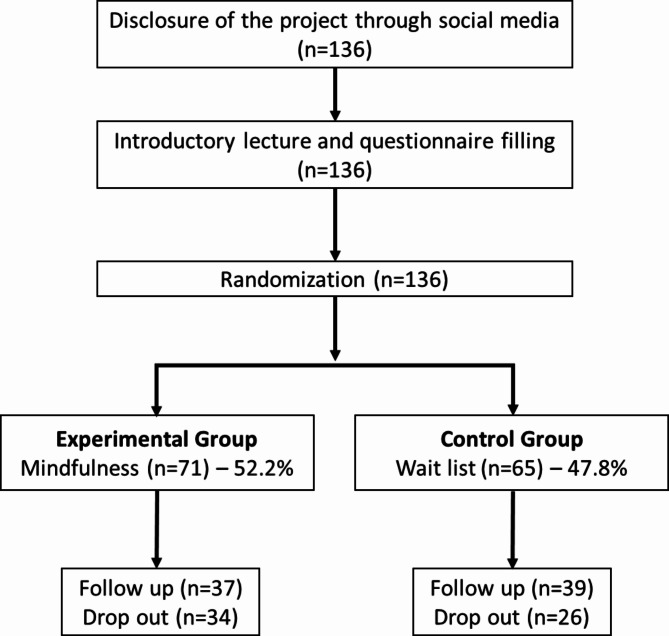
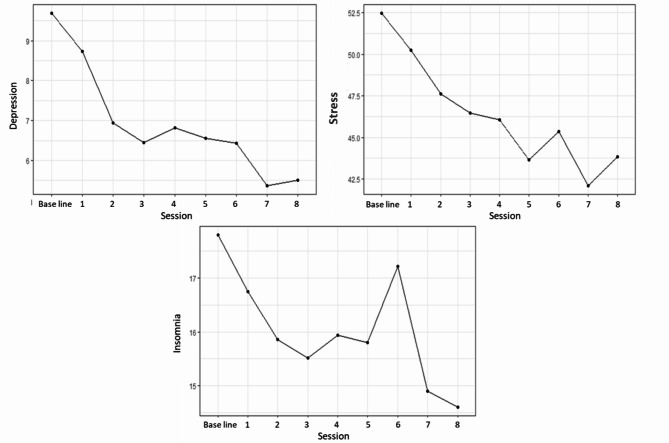
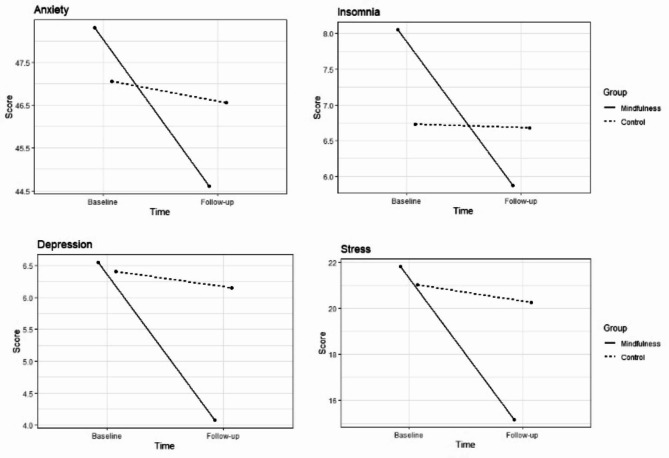
Background: The development of mental health disorders is common in the university population, and mindfulness-based interventions (MBIs) seem to be effective in addressing them in different contexts. Thus, this study investigated the impact of an 8-week MBI adapted to university students from the Mindfulness-Based Relapse Prevention (MBSR) on different symptoms related to mental health problems, specifically symptoms of anxiety, depression, stress and insomnia. Methods: University students (n = 136) were randomized into MBI group (n = 71) or wait-list group (n = 65). All participants completed self-administered questionnaires before and after the intervention, and the experimental group answered questionnaires weekly during intervention. Generalized mixed models were used to assess the effects of the intervention. Results: There were improvements in the symptoms of stress (B = 5.76, p < 0.001), depression (B = 1.55, p < 0.01) and insomnia (B = 1.35, p = 0.020) from the beginning of the intervention to the final assessment when it was compared to the control group. No effect was found in respect of trait anxiety. The MBI was found to be effective in reducing important symptoms related to university students’ mental health, possibly grounding further research on the intervention’s potential of preventing the development of mental disorders. Trial registration: The research was registered in the Brazilian Registry of Clinical Trials (ReBEC) - number RBR-63qsqx, approved at 09/16/2019.
Overview
The claims and statistics of this paper haven’t been checked yet.
Free: it reads the open-access text and checks the first 5 claims that cite a source we can check. Create a free account to check every claim.
Integrity signals
Registry
Cites
Statistics
Figures
Verification
Claims the paper makes
The claims and statistics of this paper haven’t been checked yet.
Free: it reads the open-access text and checks the first 5 claims that cite a source we can check. Create a free account to check every claim.
Claims other papers make about this one
Each is checked against this paper’s own text: does it say what the citing paper says it does?
The cited source says what the claim attributes to it.
In the citing paper
“several trials of Gallo, Torres-Plates, or Trombka reporting statistically significant reductions in psychological distress in both clinical and non-clinical samples [36,37,39].”
From The Effects of Mindfulness Techniques on Anxiety, Depression, and Stress, with an Emphasis on Gratitude: A Systematic Review and Meta-Analysis (2026) · cites this paper as [39]
Self-check
Percentages, sums and reported differences re-computed from the paper’s own numbers.
The self-check needs the paper’s full text.
Citations
Cites
(2010) · Intellectum (Universidad de La Sabana) · doi:10.1111/j.1467- · Cited by 16,131
Whiteford, H. A., Degenhardt, L., Rehm, J., Baxter, A. J., Ferrari, A. J., Erskine, H. E., Charlson, F. J., Norman, R. E., Flaxman, A. D., Johns, N., et al. (2013) · The Lancet · doi:10.1016/s0140-6736(13)61611-6 · Cited by 6,006 · cited 1×
“In addition to being among the health problems that most impact the lives of individuals [7], anxiety and depression disorders also share symptoms, such as fatigue, problems related to sleep and irritability, and cognitive processes, such as negative affects and errors in processing information [8].”
BackgroundMindfulness-based therapy: a comprehensive meta-analysis
Khoury, B., Lecomte, T., Fortin, G., Masse, M., Therien, P., Bouchard, V., Chapleau, M.-A., Paquin, K., & Hofmann, S. G. (2013) · Clinical Psychology Review · doi:10.1016/j.cpr.2013.05.005 · Cited by 2,003 · cited 1×
“…can be defined as the ability to “pay attention at the present moment in an intentional and non-judgmental way” [17] and has become popular in recent decades, presenting very positive results when associated with psychotherapy for the treatment of depression and anxiety disorders [18–20].”
BackgroundSleep Patterns and Predictors of Disturbed Sleep in a Large Population of College Students
Lund, H. G., Reider, B. D., Whiting, A. B., & Prichard, J. R. (2010) · Journal of Adolescent Health · doi:10.1016/j.jadohealth.2009.06.016 · Cited by 1,907
Chiesa, A., & Serretti, A. (2009) · The Journal of Alternative and Complementary Medicine · doi:10.1089/acm.2008.0495 · Cited by 1,681
Effects of mindfulness-based stress reduction on medical and premedical students
Shapiro, S. L., Schwartz, G. E., & Bonner, G. (1998) · Journal of Behavioral Medicine · doi:10.1023/a:1018700829825 · Cited by 1,493 · cited 1×
“In fact, there is no consensus in the literature on the effect of mindfulness on anxiety, with some studies pointing to improvements [67, 69] and others, including ours, finding no difference [65, 70].”
BackgroundMindfulness meditation improves cognition: evidence of brief mental training
Zeidan, F., Johnson, S. K., Diamond, B. J., David, Z., & Goolkasian, P. (2010) · Consciousness and Cognition · doi:10.1016/j.concog.2010.03.014 · Cited by 1,363 · cited 1×
“…8-week protocol [49], decreased proinflammatory cytokines related to depression disorder [47], improvements in depression symptoms and of psychological well-being [50] and the reduction of tiredness, anxiety, improvement of visual-spatial processing, working memory and executive functioning [51].”
BackgroundCollege Students: Mental Health Problems and Treatment Considerations
Pedrelli, P., Nyer, M., Yeung, A., Zulauf, C., & Wilens, T. (2015) · Academic Psychiatry · doi:10.1007/s40596-014-0205-9 · Cited by 1,325 · cited 1×
“High rates of mental disorders have been reported in this population [1, 2], leading to an increase in the demand for mental health services at universities [2–4] and a search for effective ways to meet this demand.”
BackgroundAmerican College Health Association
(1979) · Journal of American College Health Association · doi:10.1080/01644300.1979.10392892 · Cited by 1,154
Mechanisms of mindfulness training: Monitor and Acceptance Theory (MAT
Lindsay, E. K., & Creswell, J. D. (2017) · Clinical Psychology Review · doi:10.1016/j.cpr.2016.10.011 · Cited by 919 · cited 2×
“…awareness of experiences, that is, the ability to monitor attention, can explain the improvement presented with regard to the cognitive functioning of individuals who undergo mindfulness protocols, but this same skill can increase affective reactivity [43], which could explain this slight increase.”
Background
Cited by
Alvarado-García, P. A. A., Vásquez, M. R. S., Gomez, F. M. I., Rodríguez, N. M. G., & Paniagua, W. G. C. (2025) · Frontiers in Psychology · doi:10.3389/fpsyg.2025.1508934 · Cited by 72
Tadros, M., Newby, J. M., Li, S., & Werner‐Seidler, A. (2025) · PLoS ONE · doi:10.1371/journal.pone.0317125 · Cited by 41
Juniar, D., van Ballegooijen, W., Kleygrewe, G., van Schaik, A., Passchier, J., & Riper, H. M. (2025) · Frontiers in Digital Health · doi:10.3389/fdgth.2025.1603389 · Cited by 22
García-Pérez, L., Atencia-Rodríguez, M. E., González, M. D. M. C., & Ruz, R. P. (2025) · Journal of American College Health · doi:10.1080/07448481.2025.2492174 · Cited by 17
Rajan, A., Kumar, M., & Pranav Raj, P. (2026) · npj Mental Health Research · doi:10.1038/s44184-026-00188-4 · Cited by 12
Yay-Pence, A., Aslan, S., Çöldür, M., Atalay, Z., Beba, B., Sayın, C. C., Aydin, E., Gumus, Z., Uckan, A. S., Sahinoglu, E. N., et al. (2025) · Psychiatry Research · doi:10.1016/j.psychres.2025.116632 · Cited by 8
García-Pérez, L., Fernández, D. C., Lamas-Cepero, J. L., & Ubago-Jiménez, J. L. (2024) · Retos · doi:10.47197/retos.v55.104012 · Cited by 5
Mambetalina, A. S., Gitikhmayeva, L. M., Aubakirova, Z. K., Abishev, Z., & Karagulakova, S. V. (2025) · Psychology and Cognitive Sciences · doi:10.32523/3080-1893-2025-152-3-39-52 · Cited by 3
Doctoral students in arts and humanities: Soft skills, self-perceived employability, and mindfulness
Pandya, S. P. (2025) · Higher Education · doi:10.1007/s10734-025-01470-8 · Cited by 2
“There are numerous studies, including randomised trials and systematic reviews, that highlight the positive benefits of mindfulness training for university students in mitigating stress and bolstering mental health (Balci et al., 2023; Fagioli et al., 2023; Gallo et al., 2023).”
Jiwani, Z., Xie, Q., Lam, S. U., Walsh, T. B., Hirshberg, M. J., Davidson, R. J., & Goldberg, S. B. (2026) · Counselling Psychology Quarterly · doi:10.1080/09515070.2025.2610287 · Cited by 2
“However, many meditation interventions take place outside the classroom context or are implemented as non-credit well-being courses through university counseling centers (e.g., Gallo et al., 2023).”
Puente-Torre, P., Benito, V. D., Cano, S. R., & García-Delgado, M. Á. (2025) · Formación universitaria · doi:10.4067/s0718-50062025000200151 · Cited by 2
Hosea, E. (2024) · Cendikia Media Jurnal Ilmiah Pendidikan · doi:10.35335/cendikia.v14i3.4464 · Cited by 2
SLEEP MODULATION AND NEUROPROTECTION THROUGH THE PRISM OF HERBAL PLANTS
Hristova, P. M., & Nikolov, S. (2025) · Trakia Journal of Sciences · doi:10.15547/tjs.2025.03.009 · Cited by 1
Гундертайло, Ю. Д. (2025) · Habitus · doi:10.32782/hbts.78.2.21 · Cited by 1
Jiménez, R. M. R., Bonete, S., & Romero, J. M. (2026) · Body Movement and Dance in Psychotherapy · doi:10.1080/17432979.2026.2625214 · Cited by 4
“These outcomes are comparable to those reported for established interventions, including mindfulness-based and cognitive–behavioural programmes (Gallo et al., 2023; Lowe & Wuthrich, 2021).”
Treglia, E., & Mariani, A. (2025) · Giornale Italiano di Educazione alla Salute, Sport e Didattica Inclusiva · doi:10.32043/gsd.v9i2.1499 · Cited by 2
Cafaro, D. (2026) · Research Square · doi:10.21203/rs.3.rs-8729974/v1 · Cited by 1
Sarca, M., Cojocaru, A., Dumache, R., Bernad, B. C., Nussbaum, L. A., Costea, I., Anghel, T., & Hogea, L. (2026) · Healthcare · doi:10.3390/healthcare14050601
“Other represented countries include Canada [24,36], Brazil [37–39], Spain [40–42], Finland [43,44], the UK [45,46], Sweden [47], Turkey [48], India [49], Jordan [50], and Switzerland [51].”
InfluentialCase Study 3: Mindful Writing in an Adult Learning Context
Foster, H. (2024) · Emerald Group Publishing Limited eBooks · doi:10.1108/978-1-83753-372-520241011
García-Taibo, O., Ferriz-Valero, A., Rodríguez-Fernández, J. E., & Baena‐Morales, S. (2024) · Journal of Physical Education and Sport · doi:10.7752/jpes.2024.06151
Spitzenstetter, F., & Marion, C. (2025) · Pratiques Psychologiques · doi:10.1016/j.prps.2025.04.003
Torre, P. P. (2025) · Repositorio Institucional de la Universidad de Burgos (University of Burgos) · doi:10.36443/10259/10741
Chung, K. Y., & Mo, K. Y. (2025) · Journal of Evidence-Based Social Work · doi:10.1080/26408066.2025.2547220
de México, U. A. D. E., & Vargas, A. E. O. (2025) · Revista Mexicana de Investigación en Psicología · doi:10.32870/rmip.v17i1.669
Tadros, M. (2025) · UNSWorks (University of New South Wales, Sydney, Australia) · doi:10.26190/unsworks/30974
STRENGTHENING TEACHERS' SOCIAL-EMOTIONAL SKILLS: THE PRELIMINARY RESULTS OF A MINDFUL-BASED PROTOCOL
Mariani, A. M., Giaconi, C., & Ceccacci, S. (2024) · U-PAD Unimc - Open Digital Publications (University of Macerata) · doi:10.32043/gsd.v8i3.1224
Psychosomatika jako komplexní pohled na zdraví člověka
Jáklová, K. (2024) · Digitální knihovna Univerzity Pardubice (Univerzity Pardubice)
Staff Education to Improve Depression Management Using Mindfulness Meditation Intervention
OBIOHA, N. C. (2024) · ScholarWorks (Walden University)
Proyecto de intervención: uniZar Bienestar
Duarte Caudevilla, D., & Bellido Bellé, A. M. (2025) · Zaguan (Universidad de Zaragoza)
Креденцер, О. В., Лазоренко, Б. П., Громова, Г. М., Кулаєва, Т., Ларіна, Т. О., Гундертайло, Ю. Д., & Савінов, В. В. (2025) · Digital Library NAES of Ukraine (National Academy of Educational Sciences of Ukraine)
Paucar, R. T., & Verán, H. R. C. (2026) · Revista Tribunal · doi:10.59659/revistatribunal.v6i14.351
Scalora, S. C., Lechich, S., DePasquale, A., Geramian, H., Blodget, K., Ilieva, I. P., Temkin, A. B., & Marino, P. (2026) · Journal of Psychiatric Research · doi:10.1016/j.jpsychires.2026.01.062
Mendoza, C. J. B., Andres, R. A. E., Enriquez, A. A. A. C., Novicio, A. M., Escala, J. N. A., & Miguel, A. (2026) · International journal of research and scientific innovation · doi:10.51244/ijrsi.2026.13010193
Implementação de uma Intervenção Digital Baseada em Mindfulness para Estudantes Universitários
Ribeiro, B. M., Basso, F. P., Pellegrini, D. D. C. P., & Bernardino, M. (2025) · Escola Regional de Engenharia de Software (ERES) · doi:10.5753/eres.2025.16846
Aránega, A. Y., Montesinos, C. G., Cerrillo, E. L., & Urueña, R. C. (2026) · European Journal of Innovation Management · doi:10.1108/ejim-06-2025-0715
da Silva, B. I., Atanes, A. C., Bedendo, A., Santos, J. S., Faria, M. N., Saletti, L. C., & Noto, A. R. (2026) · Journal of Rational-Emotive & Cognitive-Behavior Therapy · doi:10.1007/s10942-026-00643-3
Self-citationRedd, K., Kennedy, K. R., & Bräuer, M. (2026) · Frontiers in Education · doi:10.3389/feduc.2026.1798646
“…either in person or online through formats such as mindfulness-based stress reduction (MBSR), mindfulness based cognitive therapy (MBCT), or acceptance and commitment therapy (ACT) based training (Galante et al., 2018; Gallo et al., 2023; González-Martin et al., 2023; Simonsson et al., 2021).”
Parida, S., Suresh, D., Yerapathi, P., K, P. K., Vinod, A., & S, A. G. A. S. G. (2026) · International Conference on Computing for Sustainable Global Development · doi:10.23919/indiacom70271.2026.11525795
“R ELATED W ORK Academic stress among university students has been widely studied, and mindfulness, meditation, and yoga interventions have consistently demonstrated positive effects on stress reduction and emotional wellbeing [1], [5], [7], [15].”
Майндфулнес як чинник суб’єктивного благополуччя студентської молоді
Титаренко, Т., Кулаєва, Т., & Лазоренко, Б. (2026) · Социально-гуманитарные исследования: векторы развития науки и образования · doi:10.67242/conference-2026-39
Roy, S., Kanekar, A. S., Biswas, A. K., & Sharma, M. (2026) · Healthcare · doi:10.3390/healthcare14131875
“Additionally, some studies, such as Gallo et al. (2023) [19] and Balci et al. (2024) [17], reported limited or non-significant anxiety effects, and in some cases, anxiety was included within broader psychological distress constructs rather than assessed independently.”
Laughter Yoga for the wellness of our students
Bouchard, V., Smith, A., & Boland, A. K. (2026) · European Journal of Humour Research · doi:10.7592/ejhr.2026.14.2.1175
“Research suggests that mindfulness practices help decrease feelings of anxiety, depression, and stress among university students, thus improving their educational outputs and overall mental wellness (Gallo et al., 2023).”
Mindfulness Meditation for Smartphone Addiction in Adolescents and College StudentsPreprint
Amali, J., David, A., Soundari, H., Anita, P., & Deepa, G. (2026) · SSRN Electronic Journal · doi:10.2139/ssrn.7005342
Гундертайло, Ю. Д. (2026) · Scientific Studios on Social and Political Psychology · doi:10.61727/sssppj/1.2026.45
EXAMINING THE EFFECTIVENESS OF BODY SCAN MEDITATION ON STRESS AMONG FIRST-YEAR UNIVERSITY STUDENTS
Uzun, Y. (2026) · TPM Testing, psychometrics, methodology in applied psychology · Cited by 1
Altın, B. K. (2025) · Yildiz Technical University - AVESIS
Qowimah, S. N., & Jainudin (2025) · International Conference on Sustainable Health Promotion · doi:10.29080/icoshpro.v4i1.3505
Mariani, A. M., Treglia, E., & Cassese, F. P. (2026) · Journal of Inclusive Methodology and Technology in Learning and Teaching
Kholifatul, U., & Harningtyas, S. (2026) · Borneo Nursing Journal (BNJ) · doi:10.61878/bnj.v8i2b.2148
“Mahasiswa yang memiliki Mindfulness tinggi cenderung memiliki tingkat stres yang lebih rendah, kemampuan regulasi emosi yang lebih baik, serta mampu mempertahankan fokus dalam menyelesaikan tuntutan akademik (Gallo et al. , 2023; González – Martín et al. , 2023).”
Wang, H., Guo, L., Wang, J., Chen, Z., & Han, W. (2026) · Frontiers in Public Health · doi:10.3389/fpubh.2026.1988584
Maharani, E. A., & Khaiyom, J. H. A. (2026) · Intellectual Discourse · doi:10.31436/id.v34i3.2286
Metadata
- Authors
- Gallo, G. G., Curado, D. F., Machado, M. P. A., Espíndola, M. I., Scattone, V. V., & Noto, A. R.
- Affiliations
- Universidade Federal de São Paulo (BR)
- Corresponding author
- Gallo, Giovana Gonçalves
- Venue
- International Journal of Mental Health Systems
- Published
- 2023-10-13
- Volume
- 17
- Issue
- 1
- Pages
- 32-32
- ISSN
- 1752-4458 (ISSN-L)
- PMC
- PMC10571349
- OpenAlex
- W4387601824
- Cited by
- 23
- References
- 69
- Citations by year
- 2026: 12 · 2025: 9 · 2024: 2
- FWCI
- 6.71
- Type
- journal article
- Language
- en
- Open access
- gold
- doi.org
- Licence
- cc-by
- creativecommons.org/licenses/by/4.0 (tdm)
- creativecommons.org/licenses/by/4.0 (vor)
- Locations
- International Journal of Mental Health Systems (publishedVersion, cc-by)
- Research Square (acceptedVersion, cc-by)
- PubMed Central (publishedVersion, cc-by)
- PubMed (publishedVersion)
- DOAJ (DOAJ: Directory of Open Access Journals) (submittedVersion, cc-by-sa)
- Funders
- Associação Fundo de Incentivo à Pesquisa
- Topics
- Social Sciences › Psychology › Clinical Psychology › Mindfulness and Compassion Interventions
- Social Sciences › Psychology › Applied Psychology › Digital Mental Health Interventions
- Social Sciences › Psychology › Developmental and Educational Psychology › Student Stress and Coping
- Keywords
- mindfulness-based interventions, mindfulness-based relapse prevention, university students, student mental health, anxiety, depression, stress, insomnia, mental disorder prevention
About these checks
Registry, retraction, Cites and statistics results are computed, not judged, with one exception: a printed reference that no index lists is read once by a model before it counts as a citation error. Claims are extracted by a model and kept only when their quote appears verbatim in the text; each cited source is then checked, with a model’s help, for whether it says what the claim relies on. Those verdicts can be wrong — read the claim’s quote and the cited source before relying on one.
Statistics and arithmetic are recomputed, not judged.
Confidence bands are shown only for fields calibrated on our annotated test set. None is calibrated yet, so no band is shown.
What counts as a claim ›How we measure confidence ›How we check this ›
Are you an author, or do you see a problem with this page? Request a review
Data sources
Bibliographic data: Semantic Scholar, OpenAlex, Crossref.
Contains information from the Semantic Scholar Academic Graph Datasets, made available under the ODC Attribution License (ODC-BY 1.0).
Semantic Scholar’s data is described in: Kinney, R., et al. (2023). The Semantic Scholar Open Data Platform. arXiv:2301.10140.
