

The contribution of parent and youth information to identify mental health disorders or problems in adolescents
Open accessThe DOI matches its Crossref record; 50 of the 50 references it cites were found in a registry or an index.
Abstract
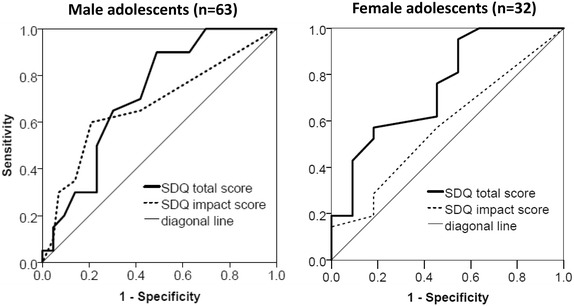
BACKGROUND: Discrepancies between multiple informants often create considerable uncertainties in delivering services to youth. The present study assessed the ability of the parent and youth scales of the Strength and Difficulties Questionnaire (SDQ) to predict mental health problems/disorders across several mental health domains as validated against two contrasting indices of validity for psychopathology derived from the Development and Well Being Assessment (DAWBA): (1) an empirically derived computer algorithm and (2) expert based ICD-10 diagnoses. METHODS: Ordinal and logistic regressions were used to predict any problems/disorders, emotional problems/disorders and behavioural problems/disorders in a community sample (n = 252) and in a clinic sample (n = 95). RESULTS: The findings were strikingly similar in both samples. Parent and youth SDQ scales were related to any problem/disorder. Youth SDQ symptom and impact had the strongest association with emotional problems/disorder and parent SDQ symptom score were most strongly related to behavioural problems/disorders. Both the SDQ total and the impact scores significantly predicted emotional problems/disorders in males whereas this was the case only for the total SDQ score in females. CONCLUSION: The present study confirms and expands previous findings on parent and youth informant validity. Clinicians should include both parent and youth for identifying any mental health problems/disorders, youth information for detecting emotional problems/disorders, and parent information to detect behavioural problems/disorders. Not only symptom scores but also impact measures may be useful to detect emotional problems/disorders, particularly in male youth.
Overview
The claims and statistics of this paper haven’t been checked yet.
Free: it reads the open-access text and checks the first 5 claims that cite a source we can check. Create a free account to check every claim.
Integrity signals
Registry
Cites
Statistics
Figures
Verification
Claims the paper makes
The claims and statistics of this paper haven’t been checked yet.
Free: it reads the open-access text and checks the first 5 claims that cite a source we can check. Create a free account to check every claim.
Claims other papers make about this one
Each is checked against this paper’s own text: does it say what the citing paper says it does?
The cited source says what the claim attributes to it.
In the citing paper
“In addition, youth reports were found superior to parent reports for identifying emotional problems and disorders in at least one study (Aebi et al., 2017).”
From Positive impacts of a universal trauma-informed intervention on student mental health: The Project POWER trial (2025) · cites this paper as Aebi et al., 2017
Self-check
Percentages, sums and reported differences re-computed from the paper’s own numbers.
The self-check needs the paper’s full text.
Citations
Cites
The Strengths and Difficulties Questionnaire: A research note
Goodman, R. (1997) · Journal of Child Psychology and Psychiatry · doi:10.1111/j.1469-7610.1997.tb01545.x · Cited by 14,908
Self-citationDe Los Reyes, A., & Kazdin, A. E. (2005) · Psychological Bulletin · doi:10.1037/0033-2909.131.4.483 · Cited by 2,548
Goodman, R. (1999) · Journal of Child Psychology and Psychiatry · doi:10.1017/s0021963099004096 · Cited by 1,756
Self-citationGoodman, R., Ford, T., Richards, H., Gatward, R., & Meltzer, H. (2000) · Journal of Child Psychology and Psychiatry · doi:10.1111/j.1469-7610.2000.tb02345.x · Cited by 1,755
Self-citationThe validity of the multi-informant approach to assessing child and adolescent mental health.
De Los Reyes, A., Augenstein, T. M., Wang, M., Thomas, S. A., Drabick, D. A. G., Burgers, D. E., & Rabinowitz, J. (2015) · Psychological Bulletin · doi:10.1037/a0038498 · Cited by 1,666
Strengths and Difficulties Questionnaire as a Dimensional Measure of Child Mental Health
Goodman, A., & Goodman, R. (2009) · Journal of the American Academy of Child & Adolescent Psychiatry · doi:10.1097/chi.0b013e3181985068 · Cited by 977 · cited 2×
“The psychometric properties of the SDQ are well established [1, 39] so that we did not compute them again in the present study.”
Self-citationEvidence-Based Assessment of Attention Deficit Hyperactivity Disorder in Children and Adolescents
Pelham, Jr., Fabiano, G. A., & Massetti, G. M. (2005) · Journal of Clinical Child & Adolescent Psychology · doi:10.1207/s15374424jccp3403_5 · Cited by 803
Kraemer, H. C., Measelle, J. R., Ablow, J. C., Essex, M. J., Boyce, W. T., & Kupfer, D. J. (2003) · American Journal of Psychiatry · doi:10.1176/appi.ajp.160.9.1566 · Cited by 765
Goodman, R., Ford, T., Simmons, H., Gatward, R., & Meltzer, H. (2003) · International Review of Psychiatry · doi:10.1080/0954026021000046128 · Cited by 706
Self-citationThe IMAGEN study: reinforcement-related behaviour in normal brain function and psychopathology
Schumann, G., Loth, E., Banaschewski, T., Barbot, A., Barker, G., Büchel, C., Conrod, P. J., Dalley, J. W., Flor, H., Gallinat, J., et al. (2010) · Molecular Psychiatry · doi:10.1038/mp.2010.4 · Cited by 626
Self-citationPARENT-CHILD AGREEMENT ON CHILD PSYCHIATRIC SYMPTOMS ASSESSED VIA STRUCTURED INTERVIEW
Edelbrock, C., Costello, A. J., Dulcan, M. K., Conover, N. C., & Kala, R. (1986) · Journal of Child Psychology and Psychiatry · doi:10.1111/j.1469-7610.1986.tb02282.x · Cited by 565
Principles Underlying the Use of Multiple Informants' Reports
De Los Reyes, A., Thomas, S. A., Goodman, K. L., & Kundey, S. M. A. (2013) · Annual Review of Clinical Psychology · doi:10.1146/annurev-clinpsy-050212-185617 · Cited by 559
Fishman (2006) · doi:10.1097/01 · Cited by 547
Hunsley, J., & Mash, E. J. (2007) · Annual Review of Clinical Psychology · doi:10.1146/annurev.clinpsy.3.022806.091419 · Cited by 528
Social anxiety disorder: questions and answers for the DSM-V
Bögels, S. M., Alden, L., Beidel, D. C., Clark, L. A., Pine, D. S., Stein, M. B., & Voncken, M. (2010) · Depression and Anxiety · doi:10.1002/da.20670 · Cited by 526
Correspondence Between Adolescent Report and Parent Report of Psychiatric Diagnostic Data
CANTWELL, D. P., LEWINSOHN, P. M., ROHDE, P., & SEELEY, J. R. (1997) · Journal of the American Academy of Child & Adolescent Psychiatry · doi:10.1097/00004583-199705000-00011 · Cited by 429
Loeber, R., Green, S., & Lahey, B. (1990) · Journal of Clinical Child & Adolescent Psychology · doi:10.1207/s15374424jccp1902_5 · Cited by 398
Rescorla, L. A., Ginzburg, S., Achenbach, T. M., Ivanova, M. Y., Almqvist, F., Begovac, I., Bilenberg, N., Bird, H., Chahed, M., Dobrean, A., et al. (2013) · Journal of Clinical Child & Adolescent Psychology · doi:10.1080/15374416.2012.717870 · Cited by 343
Self-citationLoeber, R., Green, S. M., Lahey, B. B., & Stouthamer-Loeber, M. (1991) · Journal of Abnormal Child Psychology · doi:10.1007/bf00910566 · Cited by 304
Parent-adolescent agreement on emotional and behavioral problems
Sourander, A., Helstelä, L., & Helenius, H. (1999) · Social Psychiatry and Psychiatric Epidemiology · doi:10.1007/s001270050189 · Cited by 288
Rettew, D. C., Lynch, A. D., Achenbach, T. M., Dumenci, L., & Ivanova, M. Y. (2009) · International Journal of Methods in Psychiatric Research · doi:10.1002/mpr.289 · Cited by 283
Becker, A., Hagenberg, N., Roessner, V., Woerner, W., & Rothenberger, A. (2004) · European Child & Adolescent Psychiatry · doi:10.1007/s00787-004-2004-4 · Cited by 269
Dirks, M. A., De Los Reyes, A., Briggs‐Gowan, M., Cella, D., & Wakschlag, L. S. (2012) · Journal of Child Psychology and Psychiatry · doi:10.1111/j.1469-7610.2012.02537.x · Cited by 245
Making Sense of Multiple Informants in Child and Adolescent Psychopathology: A Guide for Clinicians
Smith, S. R. (2007) · Journal of Psychoeducational Assessment · doi:10.1177/0734282906296233 · Cited by 244
Viner, R. M., Booy, R., Johnson, H., Edmunds, W. J., Hudson, L., Bedford, H., Kaczmarski, E., Rajput, K., Ramsay, M., & Christie, D. (2012) · The Lancet Neurology · doi:10.1016/s1474-4422(12)70180-1 · Cited by 201
Goodman, A., Heiervang, E., Collishaw, S., & Goodman, R. (2011) · Social Psychiatry and Psychiatric Epidemiology · doi:10.1007/s00127-010-0219-x · Cited by 195
Self-citationLaird, R. D., & Weems, C. F. (2011) · Psychological Assessment · doi:10.1037/a0021926 · Cited by 176
Lagattuta, K. H., Sayfan, L., & Bamford, C. (2012) · Journal of Experimental Child Psychology · doi:10.1016/j.jecp.2012.04.001 · Cited by 165
Validity of Structured Clinical Evaluations in Adolescents With Conduct and Substance Problems
Crowley, T. J., Mikulich, S. K., Ehlers, K. M., WHITMORE, E. A., & Macdonald, M. J. (2001) · Journal of the American Academy of Child & Adolescent Psychiatry · doi:10.1097/00004583-200103000-00005 · Cited by 155
Smith, B. H., Pelham, W. E., Gnagy, E. M., Molina, B. S. G., & Evans, S. W. (2000) · Journal of Consulting and Clinical Psychology · doi:10.1037//0022-006x.68.3.489 · Cited by 138
Aebi, M., Giger, J., Plattner, B., Metzke, C. W., & Steinhausen, H. (2013) · European Child & Adolescent Psychiatry · doi:10.1007/s00787-013-0458-y · Cited by 131
Self-citationThe end of the primary outcome measure: A research agenda for constructing its replacement
Reyes, A. D. L., Kundey, S. M. A., & Wang, M. (2011) · Clinical Psychology Review · doi:10.1016/j.cpr.2011.03.011 · Cited by 122
Psychiatric Diagnostic Interviews for Children and Adolescents: A Comparative Study
Angold, A., Erkanli, A., Copeland, W., Goodman, R., Fisher, P. W., & Costello, E. J. (2012) · Journal of the American Academy of Child & Adolescent Psychiatry · doi:10.1016/j.jaac.2012.02.020 · Cited by 119
Self-citationParent vs. Self-Report: Contributions Toward Diagnosis of Adolescent Psychopathology
Hope, T., Adams, C. D., Reynolds, L. K., Powers, D., Perez, R. A., & Kelley, M. L. (1999) · Journal of Psychopathology and Behavioral Assessment · doi:10.1023/a:1022124900328 · Cited by 115
Kühn, C., Aebi, M., Jakobsen, H. N., Banaschewski, T., Poustka, L., Grimmer, Y., Goodman, R., & Steinhausen, H. (2016) · Child Psychiatry & Human Development · doi:10.1007/s10578-016-0665-0 · Cited by 97
Self-citationRescorla, L. A., Ewing, G., Ivanova, M. Y., Aebi, M., Bilenberg, N., Dieleman, G. C., Döpfner, M., Kajokienė, I., Leung, P. W. L., Plück, J., et al. (2017) · Journal of Clinical Child & Adolescent Psychology · doi:10.1080/15374416.2016.1266642 · Cited by 95
Self-citationAebi, M., Kuhn, C., Metzke, C. W., Stringaris, A., Goodman, R., & Steinhausen, H.-C. (2012) · European Child & Adolescent Psychiatry · doi:10.1007/s00787-012-0293-6 · Cited by 92
Self-citationVerhulst, F. C., Dekker, M. C., & van der Ende, J. (1997) · Acta Psychiatrica Scandinavica · doi:10.1111/j.1600-0447.1997.tb09909.x · Cited by 89
Drabick, D. A. G., Gadow, K. D., & Loney, J. (2006) · Journal of the American Academy of Child & Adolescent Psychiatry · doi:10.1097/01.chi.0000242245.00174.90 · Cited by 84
Aebi, M., Plattner, B., Metzke, C. W., Bessler, C., & Steinhausen, H. (2013) · Journal of Child Psychology and Psychiatry · doi:10.1111/jcpp.12039 · Cited by 80
Self-citationParent?Adolescent Agreement on Disruptive Behavior Symptoms: A Multitrait-Multimethod Model
Hartung, C. M., McCarthy, D. M., Milich, R. S., & Martin, C. A. (2005) · Journal of Psychopathology and Behavioral Assessment · doi:10.1007/s10862-005-0632-8 · Cited by 76
Lewis, A. J., Bertino, M. D., Bailey, C. M., Skewes, J., Lubman, D. I., & Toumbourou, J. W. (2014) · Frontiers in Psychology · doi:10.3389/fpsyg.2014.00766 · Cited by 76
van Dulmen, M. H. M., & Egeland, B. R. (2010) · International Journal of Behavioral Development · doi:10.1177/0165025410392112 · Cited by 76
Sawyer, M. G., Baghurst, P., & Mathias, J. (1992) · Journal of Child Psychology and Psychiatry · doi:10.1111/j.1469-7610.1992.tb00878.x · Cited by 69
Stringaris, A., & Goodman, R. (2013) · Journal of Abnormal Child Psychology · doi:10.1007/s10802-013-9744-x · Cited by 67
Self-citationLong-term sequelae of subclinical depressive symptoms in early adolescence
Allen, J. P., Chango, J., Szwedo, D., & Schad, M. (2014) · Development and Psychopathology · doi:10.1017/s095457941300093x · Cited by 55
Oppositional defiant disorder dimensions and subtypes among detained male adolescent offenders
Aebi, M., Barra, S., Bessler, C., Steinhausen, H., Walitza, S., & Plattner, B. (2016) · Journal of Child Psychology and Psychiatry · doi:10.1111/jcpp.12473 · Cited by 53
Self-citationSourander, A., Pihlakoski, L., Aromaa, M. E., Rautava, P. T., Helenius, H. Y. M., & Sillanpää, M. L. (2006) · Social Psychiatry and Psychiatric Epidemiology · doi:10.1007/s00127-005-0013-3 · Cited by 42
Imbach, D., Aebi, M., Metzke, C. W., Bessler, C., & Steinhausen, H. (2013) · Child and Adolescent Psychiatry and Mental Health · doi:10.1186/1753-2000-7-7 · Cited by 27
Self-citationBarbero (2014) · doi:10.1016/j · Cited by 1
Research works printed but not linked: 1
- 43. R Development Core Team. R: A language and environment for statistical computing. R Foundation for Statistical Computing. Vienna: R Foundation for Statistical Computing; 2011.
Cited by
van Vuuren, C. L., Wachter, G. G., Veenstra, R., Rijnhart, J. J. M., van der Wal, M. F., Chinapaw, M. J. M., & Busch, V. (2019) · BMC Public Health · doi:10.1186/s12889-019-6832-z · Cited by 117
Bergström, M., & Baviskar, S. (2021) · Journal of Evidence-Based Social Work · doi:10.1080/26408066.2020.1788477 · Cited by 80
Theunissen, M. H. C., de Wolff, M. S., & Reijneveld, S. A. (2019) · Academic Pediatrics · doi:10.1016/j.acap.2018.12.008 · Cited by 110
Rakesh, D., Kelly, C. A. M., Vijayakumar, N., Zalesky, A., Allen, N. B., & Whittle, S. (2020) · Biological Psychiatry Cognitive Neuroscience and Neuroimaging · doi:10.1016/j.bpsc.2020.09.016 · Cited by 98
Wadsworth, M. E., Broderick, A. V., Loughlin‐Presnal, J. E., Bendezú, J. J., Joos, C. M., Ahlkvist, J. A., Perzow, S. E. D., & McDonald, A. R. (2019) · Developmental Psychobiology · doi:10.1002/dev.21866 · Cited by 89
Metadata
- Authors
- Aebi, M., Kuhn, C., Banaschewski, T., Grimmer, Y., Poustka, L., Steinhausen, H.-C., & Goodman, R.
- Affiliations
- University of Zurich (CH)
- Heidelberg University (DE)
- University of Göttingen (DE)
- University of Basel (CH)
- King's College London (GB)
- Corresponding author
- Aebi, Marcel
- ORCID
- Venue
- Child and Adolescent Psychiatry and Mental Health
- Published
- 2017-04-28
- Volume
- 11
- Issue
- 1
- Pages
- 23-23
- ISSN
- 1753-2000 (ISSN-L)
- PMC
- PMC5408828
- OpenAlex
- W2605430505
- Cited by
- 95
- References
- 48
- Citations by year
- 2026: 6 · 2025: 15 · 2024: 12 · 2023: 14 · 2022: 12 · 2021: 9 · 2020: 13 · 2019: 9 · 2018: 4 · 2017: 1
- FWCI
- 9.13
- Type
- journal article
- Language
- en
- Open access
- gold
- doi.org
- Licence
- cc-by
- Locations
- Child and Adolescent Psychiatry and Mental Health (publishedVersion, cc-by)
- Europe PMC (PubMed Central) (publishedVersion, cc-by)
- PubMed Central (publishedVersion, cc-by)
- PubMed (publishedVersion)
- Zurich Open Repository and Archive (University of Zurich) (acceptedVersion, cc-by)
- DOAJ (DOAJ: Directory of Open Access Journals) (submittedVersion)
- GoeScholar The Publication Server of the Georg-August-Universität Göttingen (Georg-August-Universität Göttingen) (submittedVersion, cc-by)
- Research Portal (King's College London) (submittedVersion, cc-by)
- GRO (submittedVersion, cc-by)
- Zurich Open Repository and Archive (University of Zurich) (submittedVersion, cc-by)
- Zurich Open Repository and Archive (University of Zurich)
- Funders
- Eli Lilly and Company
- University of Cambridge
- Shire
- Universitätsspital Zürich
- Topics
- Social Sciences › Psychology › Clinical Psychology › Child and Adolescent Psychosocial and Emotional Development
- Social Sciences › Psychology › Experimental and Cognitive Psychology › Mental Health Research Topics
- Health Sciences › Medicine › Psychiatry and Mental health › Mental Health Treatment and Access
- Keywords
- Strengths and Difficulties Questionnaire, adolescent mental health, emotional problems, behavioral problems, Development and Well-Being Assessment, ICD-10 diagnoses, sex differences
About these checks
Registry, retraction, Cites and statistics results are computed, not judged, with one exception: a printed reference that no index lists is read once by a model before it counts as a citation error. Claims are extracted by a model and kept only when their quote appears verbatim in the text; each cited source is then checked, with a model’s help, for whether it says what the claim relies on. Those verdicts can be wrong — read the claim’s quote and the cited source before relying on one.
Statistics and arithmetic are recomputed, not judged.
Confidence bands are shown only for fields calibrated on our annotated test set. None is calibrated yet, so no band is shown.
What counts as a claim ›How we measure confidence ›How we check this ›
Are you an author, or do you see a problem with this page? Request a review
Data sources
Bibliographic data: Semantic Scholar, OpenAlex, Crossref.
Contains information from the Semantic Scholar Academic Graph Datasets, made available under the ODC Attribution License (ODC-BY 1.0).
Semantic Scholar’s data is described in: Kinney, R., et al. (2023). The Semantic Scholar Open Data Platform. arXiv:2301.10140.
