

The DOI matches its Crossref record; 110 of the 110 references it cites were found in a registry or an index.
Gut microbiome modulates efficacy of immune checkpoint inhibitors
Open accessAbstract
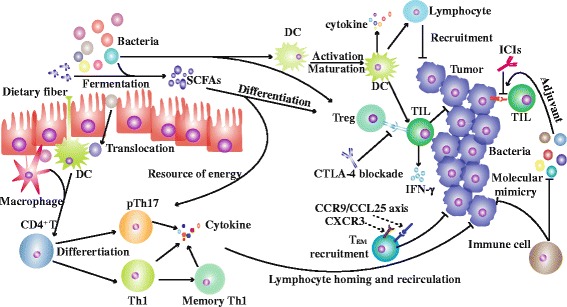
Immune checkpoint inhibitors (ICIs) therapy is a novel strategy for cancer treatments in recent years. However, it was observed that most patients treated with ICIs could not get benefit from the therapy, which led to the limitation of clinical application. Motivated by potent and durable efficacy of ICIs, oncologists endeavor to explore the mechanisms of resistance to ICIs and increase the drug sensitivity. It is known that heterogeneity of gut microbiome in populations may result in different outcomes of therapy. In xenograft model, bacteria in gut have been proved as a crucial factor regulating immunotherapy efficacy. And the similar phenomenon was obtained in patients. In this review, we summarized relevant advancements about gut microbiome and ICIs. Furthermore, we focused on modulatory function of gut microbiome in ICIs therapy and possible antitumor mechanism of specific commensals in ICIs treatment. We propose that gut microbiome is an important predictive factor, and manipulation of gut microbiome is feasible to elevate response rate in ICIs therapy.
Overview
The claims and statistics of this paper haven’t been checked yet.
Run the check — free, no account needed. It reads the open-access text and checks the sources it cites.
Integrity signals
Registry
Cites
Statistics
Figures
Verification
Claims the paper makes
The claims and statistics of this paper haven’t been checked yet.
Run the check — free, no account needed. It reads the open-access text and checks the sources it cites.
Claims other papers make about this one
Each is checked against this paper’s own text: does it say what the citing paper says it does?
The cited source says what the claim attributes to it.
In the citing paper
“Some gut bacteria act as suppressors of inhibitory signal pathways, facilitate antigen presentation, and improve specific antitumor immunity (118).”
From Gut Microbiome as a Potential Factor for Modulating Resistance to Cancer Immunotherapy (2020) · cites this paper as [118]
In the citing paper
“In conclusion, in view of the metabolic function elicited by gut microbiota, we infer that their metabolic byproducts are perceived by cells and molecules of the immune system and modulate the equilibrium between pro- and antitumor functions.”
From Gut Microbiome as a Potential Factor for Modulating Resistance to Cancer Immunotherapy (2020) · cites this paper as [118]
In the citing paper
“The influence of gut microbiota on host immunity is multifaceted, simultaneously regulating the gut mucosal immune system and systemic immune system (Fig. 2d) [307–310].”
From Combination strategies with PD-1/PD-L1 blockade: current advances and future directions (2022) · cites this paper as [308]
Self-check
Percentages, sums and reported differences re-computed from the paper’s own numbers.
The self-check needs the paper’s full text.
Citations
Cites
PD-1 and PD-L1 Immune Checkpoint Blockade to Treat Breast Cancer
Hartkopf, A. D., Taran, F., Wallwiener, M., Walter, C. B., Krämer, B., Grischke, E., & Brucker, S. Y. (2016) · Breast Care · doi:10.1159/000453569 · Cited by 30,989
Adverse Renal Effects of Immune Checkpoint Inhibitors: A Narrative Review
Wanchoo, R., Karam, S., Uppal, N. N., Barta, V. S., Deray, G., Devoe, C., Launay‐Vacher, V., Jhaveri, K. D., & on behalf of Cancer and Kidney International Network Workgroup on Immune Checkpoint Inhibitors (2017) · American Journal of Nephrology · doi:10.1159/000455014 · Cited by 15,320
Combined Nivolumab and Ipilimumab or Monotherapy in Untreated Melanoma
Larkin, J., Chiarion-Sileni, V., Gonzalez, R., Grob, J. J., Cowey, C. L., Lao, C. D., Schadendorf, D., Dummer, R., Smylie, M., Rutkowski, P., et al. (2015) · New England Journal of Medicine · doi:10.1056/nejmoa1504030 · Cited by 8,157
Pembrolizumab versus Ipilimumab in Advanced Melanoma
Robert, C., Schachter, J., Long, G. V., Arance, A., Grob, J. J., Mortier, L., Daud, A., Carlino, M. S., McNeil, C., Lotem, M., et al. (2015) · New England Journal of Medicine · doi:10.1056/nejmoa1503093 · Cited by 5,887
Gut microbiome influences efficacy of PD-1-based immunotherapy against epithelial tumors
Routy, B., Le Chatelier, E., Derosa, L., Duong, C. P. M., Alou, M. T., Daillère, R., Fluckiger, A., Messaoudene, M., Rauber, C., Roberti, M. P., et al. (2018) · Science · doi:10.1126/science.aan3706 · Cited by 5,671
Commensal microbe-derived butyrate induces the differentiation of colonic regulatory T cells
Furusawa, Y., Obata, Y., Fukuda, S., Endo, T. A., Nakato, G., Takahashi, D., Nakanishi, Y., Uetake, C., Kato, K., Kato, T., et al. (2013) · Nature · doi:10.1038/nature12721 · Cited by 5,549
The Microbial Metabolites, Short-Chain Fatty Acids, Regulate Colonic T reg Cell Homeostasis
Smith, P. M., Howitt, M. R., Panikov, N., Michaud, M., Gallini, C. A., Bohlooly-Y, M., Glickman, J. N., & Garrett, W. S. (2013) · Science · doi:10.1126/science.1241165 · Cited by 5,413
Cancer immunoediting: from immunosurveillance to tumor escape
Dunn, G. P., Bruce, A. T., Ikeda, H., Old, L. J., & Schreiber, R. D. (2002) · Nature Immunology · doi:10.1038/ni1102-991 · Cited by 5,393
Elements of cancer immunity and the cancer–immune set point
Chen, D. S., & Mellman, I. (2017) · Nature · doi:10.1038/nature21349 · Cited by 5,352
Gut microbiome modulates response to anti-PD-1 immunotherapy in melanoma patients
Gopalakrishnan, V., Spencer, C. N., Nezi, L., Reuben, A., Andrews, M. C., Karpinets, T. V., Prieto, P. A., Vicente, D., Hoffman, K., Wei, S. C., et al. (2018) · Science · doi:10.1126/science.aan4236 · Cited by 4,812 · cited 15×
“The fecal microbiome transplantation in mice supported the conclusions aforementioned [11].”
BackgroundMethodResultInfluential
Cited by
Sorted by citations
Combination strategies with PD-1/PD-L1 blockade: current advances and future directions
Yi, M., Zheng, X., Niu, M., Zhu, S., Ge, H., & Wu, K. (2022) · Molecular Cancer · doi:10.1186/s12943-021-01489-2 · Cited by 1,445
Self-citationNovel immune checkpoint targets: moving beyond PD-1 and CTLA-4
Qin, S., Xu, L., Yi, M., Yu, S., Wu, K., & Luo, S. (2019) · Molecular Cancer · doi:10.1186/s12943-019-1091-2 · Cited by 1,145
Self-citationBiomarkers for predicting efficacy of PD-1/PD-L1 inhibitors
Yi, M., Jiao, D., Xu, H., Liu, Q., Zhao, W., Han, X., & Wu, K. (2018) · Molecular Cancer · doi:10.1186/s12943-018-0864-3 · Cited by 764
Self-citationRegulation of PD-L1 expression in the tumor microenvironment
Yi, M., Niu, M., Xu, L., Luo, S., & Wu, K. (2021) · Journal of Hematology & Oncology · doi:10.1186/s13045-020-01027-5 · Cited by 681
Self-citationRNA sequencing: new technologies and applications in cancer research
Hong, M., Tao, S., Zhang, L., Diao, L., Huang, X., Huang, S., Xie, S., Xiao, Z., & Zhang, H. (2020) · Journal of Hematology & Oncology · doi:10.1186/s13045-020-01005-x · Cited by 626
Metadata
- Authors
- Yi, M., Yu, S., Qin, S., Liu, Q., Xu, H., Zhao, W., Chu, Q., & Wu, K.
- Affiliations
- Tongji Hospital (CN)
- Corresponding author
- Chu, Qian
- Wu, Kongming
- Venue
- Journal of Hematology & Oncology
- Published
- 2018-03-27
- Volume
- 11
- Issue
- 1
- Pages
- 47-47
- ISSN
- 1756-8722 (ISSN-L)
- PMC
- PMC5870075
- OpenAlex
- W2794616539
- Cited by
- 179
- References
- 110
- Citations by year
- 2026: 9 · 2025: 12 · 2024: 17 · 2023: 23 · 2022: 32 · 2021: 26 · 2020: 24 · 2019: 26 · 2018: 10
- FWCI
- 2.25
- Type
- journal article
- Language
- en
- Open access
- gold
- doi.org
- Licence
- Locations
- Journal of Hematology & Oncology (publishedVersion, cc-by)
- PubMed Central (publishedVersion, cc-by)
- PubMed (publishedVersion)
- DOAJ (DOAJ: Directory of Open Access Journals) (submittedVersion)
- Funders
- National Natural Science Foundation of China (81572608 and 81172422, 81672984)
- Wuhan Science and Technology Bureau (2017060201010170)
- Topics
- Health Sciences › Medicine › Oncology › Cancer Immunotherapy and Biomarkers
- Life Sciences › Biochemistry, Genetics and Molecular Biology › Molecular Biology › Gut microbiota and health
- Life Sciences › Biochemistry, Genetics and Molecular Biology › Biotechnology › Bacterial Cancer Therapy
- Keywords
- gut microbiota, immune checkpoint inhibitors, immunotherapy efficacy, cancer immunotherapy, treatment resistance, predictive biomarkers, commensal bacteria, anticancer mechanism, microbiome manipulation
- MeSH terms
- Gastrointestinal Microbiome, Humans, Programmed Cell Death 1 Receptor
About these checks
Registry, retraction, Cites and statistics results are computed, not judged, with one exception: a printed reference that no index lists is read once by a model before it counts as a citation error. Claims are extracted by a model and kept only when their quote appears verbatim in the text; each cited source is then checked, with a model’s help, for whether it says what the claim relies on. Those verdicts can be wrong — read the claim’s quote and the cited source before relying on one.
Statistics and arithmetic are recomputed, not judged.
Confidence bands are shown only for fields calibrated on our annotated test set. None is calibrated yet, so no band is shown.
What counts as a claim ›How we measure confidence ›How we check this ›
Are you an author, or do you see a problem with this page? Request a review
