

Exploring immunotherapy in colorectal cancer
Open accessThe DOI matches its Crossref record; 225 of the 225 references it cites were found in a registry or an index.
Abstract
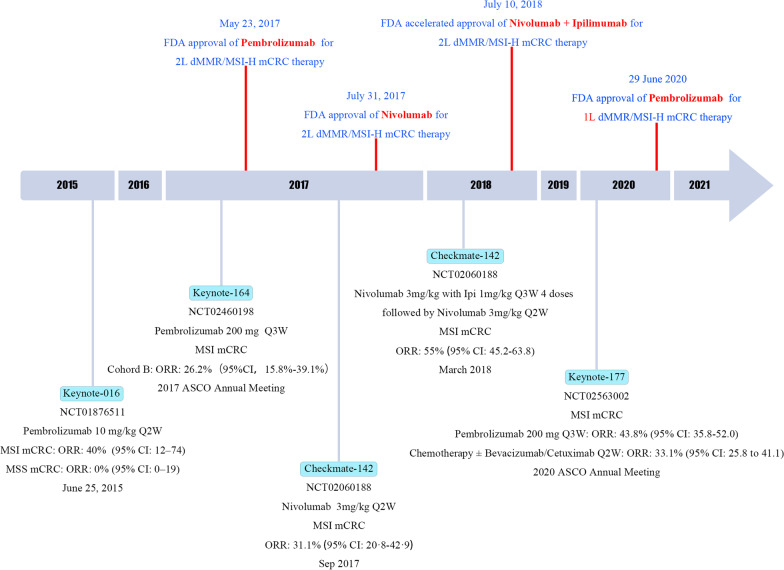
Chemotherapy combined with or without targeted therapy is the fundamental treatment for metastatic colorectal cancer (mCRC). Due to the adverse effects of chemotherapeutic drugs and the biological characteristics of the tumor cells, it is difficult to make breakthroughs in traditional strategies. The immune checkpoint blockades (ICB) therapy has made significant progress in the treatment of advanced malignant tumors, and patients who benefit from this therapy may obtain a long-lasting response. Unfortunately, immunotherapy is only effective in a limited number of patients with microsatellite instability—high (MSI-H), and segment initial responders can subsequently develop acquired resistance. From September 4, 2014, the first anti-PD-1/PD-L1 drug Pembrolizumab was approved by the FDA for the second-line treatment of advanced malignant melanoma. Subsequently, it was approved for mCRC second-line treatment in 2017. Immunotherapy has rapidly developed in the past 7 years. The in-depth research of the ICB treatment indicated that the mechanism of colorectal cancer immune-resistance has become gradually clear, and new predictive biomarkers are constantly emerging. Clinical trials examining the effect of immune checkpoints are actively carried out, in order to produce long-lasting effects for mCRC patients. This review summarizes the treatment strategies for mCRC patients, discusses the mechanism and application of ICB in mCRC treatment, outlines the potential markers of the ICB efficacy, lists the key results of the clinical trials, and collects the recent basic research results, in order to provide a theoretical basis and practical direction for immunotherapy strategies.
Overview
The claims and statistics of this paper haven’t been checked yet.
Free: it reads the open-access text and checks the first 5 claims that cite a source we can check. Create a free account to check every claim.
Integrity signals
Registry
Cites
Statistics
Figures
Verification
Claims the paper makes
The claims and statistics of this paper haven’t been checked yet.
Free: it reads the open-access text and checks the first 5 claims that cite a source we can check. Create a free account to check every claim.
Claims other papers make about this one
Each is checked against this paper’s own text: does it say what the citing paper says it does?
In the citing paper
“MSI-high or dMMR mCRC patients favorably respond to immune checkpoint blockade (ICB), and this is now the preferred front-line treatment [129].”
From Recent Advances in Therapeutic Strategies to Improve Colorectal Cancer Treatment (2024) · cites this paper as [129]
In the citing paper
“Immune checkpoint blockade (ICB) therapy with anti-PD-1 drug Pembrolizumab or Nivolumab is the approved first-line treatment for mCRC that is dMMR or MSI-high; however, this is only <5% of mCRC, and some estimates indicate that only 2% of mCRC patients are candidates for successful therapy with ICB therapy [129].”
From Recent Advances in Therapeutic Strategies to Improve Colorectal Cancer Treatment (2024) · cites this paper as [129]
Self-check
Percentages, sums and reported differences re-computed from the paper’s own numbers.
The self-check needs the paper’s full text.
Citations
Cites
1 retracted
Items 201–225 of 225
β-Catenin inhibition shapes tumor immunity and synergizes with immunotherapy in colorectal cancer
Wang, C., Yan, J., Yin, P., Gui, L., Ji, L., Ma, B., & Gao, W.-Q. (2020) · OncoImmunology · doi:10.1080/2162402x.2020.1809947 · Cited by 46
Blaeschke, F., Paul, M. C., Schuhmann, M. U., Rabsteyn, A., Schroeder, C., Casadei, N., Matthes, J., Mohr, C., Lotfi, R., Wagner, B., et al. (2019) · Cytotherapy · doi:10.1016/j.jcyt.2019.06.009 · Cited by 45
Garralda, E., Sukari, A. W., Lakhani, N. J., Patnaik, A., Lou, Y., Im, S., Golan, T., Geva, R., Wermke, M., Miguel, M. D., et al. (2021) · Journal of Clinical Oncology · doi:10.1200/jco.2021.39.15_suppl.3584 · Cited by 45
Lee, M. S., Loehrer, P. J., Imanirad, I., Cohen, S., Ciombor, K. K., Moore, D. T., Carlson, C. A., Sanoff, H. K., & McRee, A. J. (2021) · Journal of Clinical Oncology · doi:10.1200/jco.2021.39.3_suppl.7 · Cited by 43
Ghiringhelli, F., Chibaudel, B., Taieb, J., Bennouna, J., Martin-Babau, J., Fonck, M., Borg, C., Cohen, R., Thibaudin, M., Limagne, E., et al. (2020) · Journal of Clinical Oncology · doi:10.1200/jco.2020.38.15_suppl.3006 · Cited by 40
Lee, J., Park, N., Park, J. Y., Kaplan, B. L. F., Pruett, S. B., Park, J. W., Park, Y. H., & Seo, K. S. (2017) · The Journal of Immunology · doi:10.4049/jimmunol.1602109 · Cited by 40
Wu, X., Lan, X.-L., Hu, W., Zhang, W., Lai, X., Xu, S., Li, J., Qiu, W., Wang, W., Xiao, J., et al. (2021) · Cancer Immunology Immunotherapy · doi:10.1007/s00262-021-02931-6 · Cited by 37
Jiang, J., Ding, Y., Wu, M., Chen, Y., Lyu, X., Lü, J., Wang, H., & Teng, L. (2020) · Cancer Medicine · doi:10.1002/cam4.3481 · Cited by 36
Chen, S., Li, R., Zhang, Z., Huang, Z., Cui, P., Jia, W., Zhang, S., Tao, H., Wang, L., Li, X., et al. (2021) · Translational Lung Cancer Research · doi:10.21037/tlcr-21-43 · Cited by 36
Self-citationUnmasking PD-1 Resistance by Next-Generation Sequencing
Bifulco, C. B., & Urba, W. J. (2016) · New England Journal of Medicine · doi:10.1056/nejme1606042 · Cited by 34
Kim, T. W., Lee, K. W., Ahn, J. B., Lee, J., Ryu, J., Oh, B., Ock, C., Hwang, S.-J., Hahm, K. B., Kim, S.-J., et al. (2021) · Journal of Clinical Oncology · doi:10.1200/jco.2021.39.15_suppl.3573 · Cited by 34 · cited 1×
“Preclinical and clinical studies have demonstrated that TGF-β inhibitors can reverse immune tolerance into immune sensitization [99].”
BackgroundUeda, T., Chikuie, N., Takumida, M., Furuie, H., Kono, T., Taruya, T., Hamamoto, T., Hattori, M., Ishino, T., & Takeno, S. (2019) · Acta Oto-Laryngologica · doi:10.1080/00016489.2019.1699250 · Cited by 34
Cona, M. S., Lecchi, M., Cresta, S., Damian, S., Vecchio, M. D., Necchi, A., Poggi, M. M., Raggi, D., Randon, G., Ratta, R., et al. (2019) · Cancers · doi:10.3390/cancers11020223 · Cited by 29
den Eynde, M. V., Huyghe, N. D., Cuyper, A. D., Sinapi, I., Ferrier, M., Gilet, M., Maanen, A. G. V., Castella, M.-L., Galon, J., & Carrasco, J. (2021) · Journal of Clinical Oncology · doi:10.1200/jco.2021.39.3_suppl.80 · Cited by 29
Dong, X., Lv, S., Zhang, X., & Hao, R. (2020) · International Immunopharmacology · doi:10.1016/j.intimp.2020.106599 · Cited by 26
CDK12 Deficiency and the Immune Microenvironment in Prostate Cancer
Lotan, T. L., & Antonarakis, E. S. (2020) · Clinical Cancer Research · doi:10.1158/1078-0432.ccr-20-3877 · Cited by 24
Ree, A. H., Hamre, H. M., Kersten, C., Hofsli, E., Guren, M. G., Sørbye, H., Johansen, C., Negård, A., Flatmark, K., & Meltzer, S. (2021) · Journal of Clinical Oncology · doi:10.1200/jco.2021.39.15_suppl.3556 · Cited by 22
Chen, E. X., Jonker, D. J., Loree, J. M., Kennecke, H. F., Berry, S. R., Couture, F., Ahmad, C. E., Goffin, J. R., Kavan, P., Harb, M., et al. (2019) · Journal of Clinical Oncology · doi:10.1200/jco.2019.37.15_suppl.3512 · Cited by 22
Araújo, D. V., Wang, A., Torti, D., Leon, A. J., Marsh, K., McCarthy, A. J., Berman, H. K., Spreafico, A., Hansen, A. R., Razak, A.-A., et al. (2020) · JNCI Cancer Spectrum · doi:10.1093/jncics/pkaa122 · Cited by 21
Bai, Y., Xu, N., An, S., Chen, W., Gao, C., & Zhang, D. (2021) · Journal of Clinical Oncology · doi:10.1200/jco.2021.39.15_suppl.e15551 · Cited by 12
Kim, R., Chaves, J. M., Kavan, P., Fakih, M., Kortmansky, J. S., Spencer, K. R., Wong, L., Tehfe, M. A., Li, J. J., Lee, M. W., et al. (2019) · Annals of Oncology · doi:10.1093/annonc/mdz246.085 · Cited by 10
Park, R., da Silva, L. L., Lee, S., & Saeed, A. (2021) · Journal of Clinical Oncology · doi:10.1200/jco.2021.39.15_suppl.3557 · Cited by 10 · cited 1×
“The results suggested that BRAF mutation did not exhibit predictive value in MSI-H mCRC immunotherapy [109].”
BackgroundGromeier, M., Brown, M. C., Beuabier, N., Yan, H., He, Y., Zhang, G., Desjardins, A., Herndon, J. E., Bolognesi, D. P., Friedman, A. H., et al. (2019) · Neuro-Oncology · doi:10.1093/neuonc/noz175.026 · Cited by 8
New Molecular Targeted Therapy of Metastatic Colorectal Cancer
Jo, J. (2021) · Ewha Medical Journal · doi:10.12771/emj.2021.44.1.11 · Cited by 2 · cited 1×
“BRAF mutation was found to be a negative prognostic marker in CRC, and it could promote the development of TME [107, 108].”
BackgroundZuazo-Ibarra, M., Arasanz, H., Fernández-Hinojal, G., María, G.-C., Hernández-Marín, B., Martínez-Aguillo, M., Lecumberri, M. J., Fernández, A., Teijeira, L., Vera, R., et al. (2018) · doi:10.1101/320176
Research works printed but not linked: 1
- Kim R 493P - Pembrolizumab (pembro) plus mFOLFOX7 or FOLFIRI in patients (pts) with metastatic colorectal cancer (mCRC): updated results from KEYNOTE-651 cohorts B and D Ann Oncol 2020 suppl_4 S409 S461
Cited by
Metastatic colorectal cancer: mechanisms and emerging therapeutics
Shin, A. E., Giancotti, F. G., & Rustgi, A. K. (2023) · Trends in Pharmacological Sciences · doi:10.1016/j.tips.2023.01.003 · Cited by 669
Targeting cytokine and chemokine signaling pathways for cancer therapy
Yi, M., Li, T., Niu, M., Zhang, H., Wu, Y., Wu, K., & Dai, Z. (2024) · Signal Transduction and Targeted Therapy · doi:10.1038/s41392-024-01868-3 · Cited by 455
Liga, S., Paul, C., Moacă, E.-A., & Péter, F. (2024) · Pharmaceutics · doi:10.3390/pharmaceutics16020223 · Cited by 187
The role of RNA methylation in tumor immunity and its potential in immunotherapy
Li, Y., Jin, H., Li, Q., Shi, L., Mao, Y., & Zhao, L. (2024) · Molecular Cancer · doi:10.1186/s12943-024-02041-8 · Cited by 185
Exosomal circular RNAs: A chief culprit in cancer chemotherapy resistance
Guo, X., Gao, C., Yang, D., & Li, S. (2023) · Drug Resistance Updates · doi:10.1016/j.drup.2023.100937 · Cited by 156
Self-citation
Metadata
- Authors
- Weng, J., Li, S., Zhu, Z., Liu, Q., Zhang, R., Yang, Y., & Li, X.
- Affiliations
- Fudan University Shanghai Cancer Center (CN)
- Shanghai Jiao Tong University (CN)
- Corresponding author
- Li, Xinxiang
- Venue
- Journal of Hematology & Oncology
- Published
- 2022-07-16
- Volume
- 15
- Issue
- 1
- Pages
- 95-95
- ISSN
- 1756-8722 (ISSN-L)
- PMC
- PMC9288068
- OpenAlex
- W4285587152
- Cited by
- 355
- References
- 224
- Citations by year
- 2026: 62 · 2025: 93 · 2024: 127 · 2023: 61 · 2022: 12
- FWCI
- 8.97
- Type
- journal article
- Language
- en
- Open access
- gold
- doi.org
- Licence
- cc-by
- creativecommons.org/licenses/by/4.0 (tdm)
- creativecommons.org/licenses/by/4.0 (vor)
- Locations
- Journal of Hematology & Oncology (publishedVersion, cc-by)
- PubMed Central (publishedVersion, cc-by)
- PubMed (publishedVersion)
- DOAJ (DOAJ: Directory of Open Access Journals) (submittedVersion, cc-by-sa)
- Funders
- National Natural Science Foundation of China (82003060, 81772599)
- Topics
- Health Sciences › Medicine › Oncology › Cancer Immunotherapy and Biomarkers
- Health Sciences › Medicine › Oncology › Colorectal Cancer Treatments and Studies
- Health Sciences › Medicine › Pathology and Forensic Medicine › Genetic factors in colorectal cancer
- Keywords
- immunotherapy, metastatic colorectal cancer, immune checkpoint blockade, pembrolizumab, PD-1/PD-L1, microsatellite instability-high, acquired resistance, predictive biomarkers, immune resistance mechanisms, second-line therapy, clinical trials
- MeSH terms
- Humans, Immunologic Factors, Immunotherapy, Colorectal Neoplasms, Microsatellite Instability
About these checks
Registry, retraction, Cites and statistics results are computed, not judged, with one exception: a printed reference that no index lists is read once by a model before it counts as a citation error. Claims are extracted by a model and kept only when their quote appears verbatim in the text; each cited source is then checked, with a model’s help, for whether it says what the claim relies on. Those verdicts can be wrong — read the claim’s quote and the cited source before relying on one.
Statistics and arithmetic are recomputed, not judged.
Confidence bands are shown only for fields calibrated on our annotated test set. None is calibrated yet, so no band is shown.
What counts as a claim ›How we measure confidence ›How we check this ›
Are you an author, or do you see a problem with this page? Request a review
Data sources
Bibliographic data: Semantic Scholar, OpenAlex, Crossref.
Contains information from the Semantic Scholar Academic Graph Datasets, made available under the ODC Attribution License (ODC-BY 1.0).
Semantic Scholar’s data is described in: Kinney, R., et al. (2023). The Semantic Scholar Open Data Platform. arXiv:2301.10140.
