

The role of DNA damage repair (DDR) system in response to immune checkpoint inhibitor (ICI) therapy
Open accessThe DOI matches its Crossref record; 253 of the 254 references it cites were found in a registry or an index, and 1 are not checked yet.
Abstract
As our understanding of the mechanisms of cancer treatment has increased, a growing number of studies demonstrate pathways through which DNA damage repair (DDR) affects the immune system. At the same time, the varied response of patients to immune checkpoint blockade (ICB) therapy has prompted the discovery of various predictive biomarkers and the study of combination therapy. Here, our investigation explores the interactions involved in combination therapy, accompanied by a review that summarizes currently identified and promising predictors of response to immune checkpoint inhibitors (ICIs) that are useful for classifying oncology patients. In addition, this work, which discusses immunogenicity and several components of the tumor immune microenvironment, serves to illustrate the mechanism by which higher response rates and improved efficacy of DDR inhibitors (DDRi) in combination with ICIs are achieved.
Overview
The claims and statistics of this paper haven’t been checked yet.
Free: it reads the open-access text and checks the first 5 claims that cite a source we can check. Create a free account to check every claim.
Integrity signals
Registry
Cites
Statistics
Figures
Verification
Claims the paper makes
The claims and statistics of this paper haven’t been checked yet.
Free: it reads the open-access text and checks the first 5 claims that cite a source we can check. Create a free account to check every claim.
Self-check
Percentages, sums and reported differences re-computed from the paper’s own numbers.
The self-check needs the paper’s full text.
Citations
Cites
PD-1 and PD-L1 Immune Checkpoint Blockade to Treat Breast Cancer
Hartkopf, A. D., Taran, F.-A., Wallwiener, M., Walter, C. B., Krämer, B., Grischke, E.-M., & Brucker, S. Y. (2016) · Breast Care · doi:10.1159/000453569 · Cited by 30,845
Safety, activity, and immune correlates of anti–PD-1 antibody in cancer
Topalian, S. L., Hodi, F. S., Brahmer, J. R., Gettinger, S. N., Smith, D. C., McDermott, D. F., Powderly, J. D., Carvajal, R. D., Sosman, J. A., Atkins, M. B., et al. (2012) · New England Journal of Medicine · doi:10.1056/nejmoa1200690 · Cited by 12,628
PD-1 Blockade in Tumors with Mismatch-Repair Deficiency
Le, D. T., Uram, J. N., Wang, H., Bartlett, B. R., Kemberling, H., Eyring, A. D., Skora, A. D., Luber, B. S., Azad, N. S., Laheru, D., et al. (2015) · New England Journal of Medicine · doi:10.1056/nejmoa1500596 · Cited by 9,377
Mutational landscape determines sensitivity to PD-1 blockade in non–small cell lung cancer
Rizvi, N. A., Hellmann, M. D., Snyder, A., Kvistborg, P., Makarov, V., Havel, J. J., Lee, W., Yuan, J., Wong, P., Ho, T. S., et al. (2015) · Science · doi:10.1126/science.aaa1348 · Cited by 7,802
Mismatch repair deficiency predicts response of solid tumors to PD-1 blockade
Le, D. T., Durham, J. N., Smith, K. N., Wang, H., Bartlett, B. R., Aulakh, L. K., Lu, S., Kemberling, H., Wilt, C., Luber, B. S., et al. (2017) · Science · doi:10.1126/science.aan6733 · Cited by 6,645 · cited 1×
“For one, MSI-H/dMMR, which is listed as a predictive biomarker [51, 52], is directly related to greater benefits observed in ICB patients [24, 27, 38, 53].”
BackgroundToll-like receptors and innate immunity
Medzhitov, R. (2001) · Nature Reviews Immunology · doi:10.1038/35100529 · Cited by 4,308 · cited 1×
“DCs express IL-12, which allows Th1 cells to differentiate into Th1 effector cells and ultimately facilitates T-cell immunity [203].”
BackgroundGenetic Basis for Clinical Response to CTLA-4 Blockade in Melanoma
Snyder, A., Makarov, V., Merghoub, T., Yuan, J., Zaretsky, J. M., Desrichard, A., Walsh, L. A., Postow, M. A., Wong, P., Ho, T. S., et al. (2014) · New England Journal of Medicine · doi:10.1056/nejmoa1406498 · Cited by 4,286
Rosenberg, J. E., Hoffman-Censits, J., Powles, T., van der Heijden, M. S., Balar, A. V., Necchi, A., Dawson, N., O'Donnell, P. H., Balmanoukian, A., Loriot, Y., et al. (2016) · The Lancet · doi:10.1016/s0140-6736(16)00561-4 · Cited by 3,669
Genomic and Transcriptomic Features of Response to Anti-PD-1 Therapy in Metastatic Melanoma
Hugo, W., Zaretsky, J. M., Sun, L., Song, C., Moreno, B. H., Hu-Lieskovan, S., Berent-Maoz, B., Pang, J., Chmielowski, B., Cherry, G., et al. (2016) · Cell · doi:10.1016/j.cell.2016.02.065 · Cited by 3,448 · cited 1×
“In an analysis of whole exome sequences recorded in 38 patients diagnosed with melanoma and previously treated with PD-1 inhibitors, the ICB responders expressed augmented states in BRCA2 mutations [61].”
MethodMolecular Mechanisms of Mammalian DNA Repair and the DNA Damage Checkpoints
Sancar, A., Lindsey-Boltz, L. A., Ünsal-Kaçmaz, K., & Linn, S. (2004) · Annual Review of Biochemistry · doi:10.1146/annurev.biochem.73.011303.073723 · Cited by 3,317
Research works printed but not linked: 1
- Ahrum M Kyung-Hun L Seock-Ah I Dong-Young N Wonshik H Masakazu T DNA damage repair inhibitor for breast cancer treatment Translational research in breast cancer advances in experimental medicine and biology 2019 163 176
Cited by
Immune checkpoint therapy for solid tumours: clinical dilemmas and future trends
Sun, Q., Hong, Z., Zhang, C., Wang, L., Han, Z., & Ma, D. (2023) · Signal Transduction and Targeted Therapy · doi:10.1038/s41392-023-01522-4 · Cited by 598
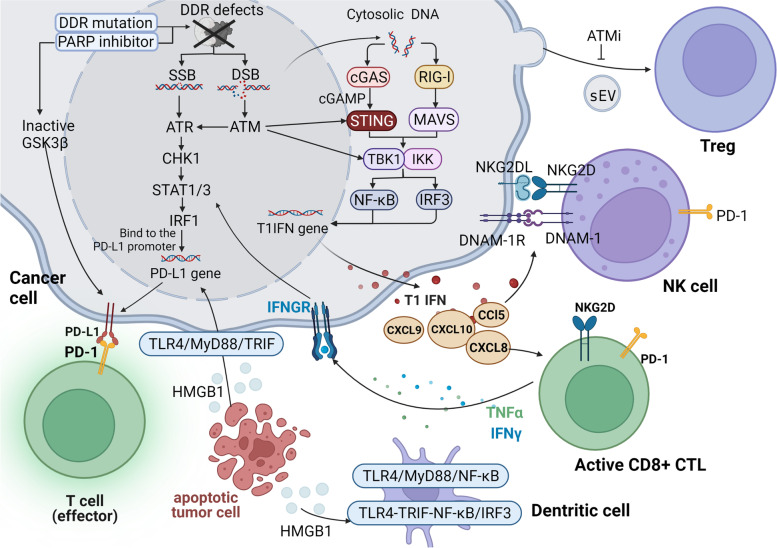
“113,114 Ataxia telangiectasia mutated (ATM) protein participates in Fig.”
BackgroundLin, A., Xiong, M., Jiang, A., Huang, L., Wong, H. Z. H., Feng, S., Zhang, C., Yu, H., Chen, L., Chi, H., et al. (2025) · iMeta · doi:10.1002/imt2.70070 · Cited by 108
Self-citationYap, T. A., Tolcher, A. W., Plummer, R., Mukker, J. K., Enderlin, M., Hicking, C., Grombacher, T., Locatelli, G., Szűcs, Z., Gounaris, I., et al. (2024) · Clinical Cancer Research · doi:10.1158/1078-0432.ccr-23-2409 · Cited by 65
“The DNA damage caused by DDR inhibition results in DNA fragmentation and micronucleation, increasing the expression of neoantigens on the cell surface (45).”
BackgroundCancer Vulnerabilities Through Targeting the ATR/Chk1 and ATM/Chk2 Axes in the Context of DNA Damage
Fernandez, A., Artola, M., Leon, S., Otegui, N., Jimeno, A., Serrano, D., & Calvo, A. (2025) · Cells · doi:10.3390/cells14100748 · Cited by 53
“This activation triggers type I interferon responses and upregulation of inflammatory cytokines and chemokines, enhancing recruitment and activation of immune cells, particularly cytotoxic T cells [140].”
Su, X., Li, J., Xu, X., Ye, Y., Wang, C., Pang, G., Liu, W., Liu, A., Zhao, C., & Hao, X. (2024) · Journal of Translational Medicine · doi:10.1186/s12967-024-05552-6 · Cited by 49
“The ATM/ATR/CHK1 pathway is involved in regulating the cell cycle and could repair cellular damage [391].”
BackgroundInfluential
Metadata
- Authors
- Shi, C., Qin, K., Lin, A., Jiang, A., Cheng, Q., Liu, Z., Zhang, J., & Luo, P.
- Affiliations
- Zhujiang Hospital (CN)
- Second Military Medical University (CN)
- Central South University (CN)
- First Affiliated Hospital of Zhengzhou University (CN)
- Corresponding author
- Zhang, Jian
- Luo, Peng
- Venue
- Journal of Experimental & Clinical Cancer Research
- Published
- 2022-09-07
- Volume
- 41
- Issue
- 1
- Pages
- 268-268
- ISSN
- 0392-9078 (ISSN-L)
- 1756-9966
- PMC
- PMC9450390
- OpenAlex
- W4294991252
- Semantic Scholar
- ca5ccb87af57b388b5d4235e15093eafa3aa4978
- Cited by
- 85
- References
- 254
- Citations by year
- 2026: 20 · 2025: 30 · 2024: 22 · 2023: 12 · 2022: 1
- FWCI
- 1.99
- Type
- journal article
- Language
- en
- Open access
- gold
- doi.org
- Licence
- cc-by
- creativecommons.org/licenses/by/4.0 (tdm)
- creativecommons.org/licenses/by/4.0 (vor)
- Locations
- Journal of Experimental & Clinical Cancer Research (publishedVersion, cc-by)
- PubMed Central (publishedVersion, cc-by)
- PubMed (publishedVersion)
- DOAJ (DOAJ: Directory of Open Access Journals) (submittedVersion, cc-by-sa)
- Funders
- Natural Science Foundation of Guangdong Province (2018A030313846, 2021A1515012593)
- Innovative Research Group Project of the National Natural Science Foundation of China (81802257, 81871859, 81772457, 82172811, 82172750)
- Science and Technology Planning Project of Guangdong Province (2019A030317020)
- Topics
- Health Sciences › Medicine › Oncology › Cancer Immunotherapy and Biomarkers
- Life Sciences › Biochemistry, Genetics and Molecular Biology › Molecular Biology › DNA Repair Mechanisms
- Health Sciences › Medicine › Oncology › PARP inhibition in cancer therapy
- Keywords
- DNA repair, immune checkpoint inhibitors, immune checkpoint blockade, DDR inhibitors, combination therapy, predictive biomarkers, tumor immune microenvironment, immunogenicity, cancer immunotherapy response
- MeSH terms
- Immune Checkpoint Inhibitors, DNA Damage, DNA Repair, Humans, Neoplasms, Tumor Microenvironment
About these checks
Registry, retraction, Cites and statistics results are computed, not judged, with one exception: a printed reference that no index lists is read once by a model before it counts as a citation error. Claims are extracted by a model and kept only when their quote appears verbatim in the text; each cited source is then checked, with a model’s help, for whether it says what the claim relies on. Those verdicts can be wrong — read the claim’s quote and the cited source before relying on one.
Statistics and arithmetic are recomputed, not judged.
Confidence bands are shown only for fields calibrated on our annotated test set. None is calibrated yet, so no band is shown.
What counts as a claim ›How we measure confidence ›How we check this ›
Are you an author, or do you see a problem with this page? Request a review
Data sources
Bibliographic data: Semantic Scholar, OpenAlex, Crossref.
Contains information from the Semantic Scholar Academic Graph Datasets, made available under the ODC Attribution License (ODC-BY 1.0).
Semantic Scholar’s data is described in: Kinney, R., et al. (2023). The Semantic Scholar Open Data Platform. arXiv:2301.10140.
