

Should central venous catheter be systematically removed in patients with suspected catheter related infection?
Open accessThe DOI matches its Crossref record; 22 of the 22 references it cites were found in a registry or an index.
Abstract
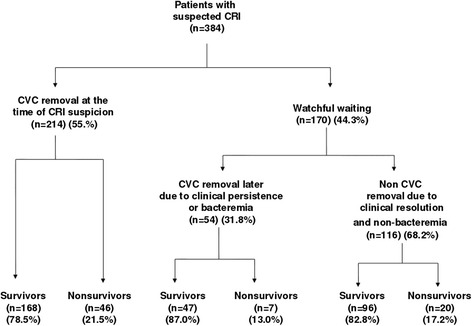
Introduction: Best clinical practice for patients with suspected catheter-related infection (CRI) remains unclear according to the latest Infectious Diseases Society of America (IDSA) guidelines. Thus, the objective of this study was to analyze clinical practice concerning the central venous catheter (CVC) and its impact on prognosis in patients with suspected CRI. Methods: We performed a prospective, multicenter, observational study in 18 Spanish Intensive Care Units (ICUs). Inclusion criteria were patients with CVC and suspected CRI. The following exclusion criteria were used: age less than 18 years; pregnancy; lactation; human immunodeficiency virus; neutropenia; solid or haematological tumor; immunosuppressive or radiation therapy; transplanted organ; intravascular foreign body; haemodynamic instability; suppuration or frank erythema/induration at the insertion site of the CVC, and patients with bacteremia or fungemia. The end-point of the study was mortality at 30 days of CRI suspicion. Results: The study included 384 patients. In 214 (55.8%) patients, CVC was removed at the moment of CRI suspicion, in 114 (29.7%) CVC was removed later and in 56 (14.6%) CVC was not removed. We did not find significant differences between survivors (n =311) and non-survivors (n =73) at 30 days according to CVC decision (P =0.26). The rate of confirmed catheter-related bloodstream infection (CRBSI) was higher in survivors than in non-survivors (14.5% versus 4.1%; P =0.02). Mortality rate was lower in patients with CRBSI than in the group of patients whose clinical symptoms were due to other causes (3/48 (6.25%) versus 70/336 (20.8%); P =0.02). We did not find significant differences in mortality in patients with confirmed CRBSI according to CVC removal at the moment of CRI suspicion (n =38) or later (n =10) (7.9% versus 0; P =0.99). Conclusion: In patients with suspected CRI, immediate CVC removal may be not necessary in all patients. Other aspects should be taken into account in the decision-making, such as vascular accessibility, the risk of mechanical complications during new cannulation that may be life-threatening, and the possibility that the CVC may not be the origin of the suspected CRI.
Overview
The claims and statistics of this paper haven’t been checked yet.
Free: it reads the open-access text and checks the first 5 claims that cite a source we can check. Create a free account to check every claim.
Integrity signals
Registry
Cites
Statistics
Figures
Verification
Claims the paper makes
The claims and statistics of this paper haven’t been checked yet.
Free: it reads the open-access text and checks the first 5 claims that cite a source we can check. Create a free account to check every claim.
Self-check
Percentages, sums and reported differences re-computed from the paper’s own numbers.
The self-check needs the paper’s full text.
Citations
Cites
Vincent, J. L., Moreno, R., Takala, J., Willatts, S., De Mendonça, A., Bruining, H., Reinhart, C. K., Suter, P. M., & Thijs, L. G. (1996) · Intensive Care Medicine · doi:10.1007/bf01709751 · Cited by 11,674
Surviving Sepsis Campaign: International Guidelines for Management of Severe Sepsis and Septic Shock
Dellinger, R. P., Levy, M. M., Rhodes, A., Annane, D., Gerlach, H., Opal, S. M., Sevransky, J. E., Sprung, C. L., Douglas, I. S., Jaeschke, R., et al. (2013) · Critical Care Medicine · doi:10.1097/ccm.0b013e31827e83af · Cited by 9,694
The Surviving Sepsis Campaign Guidelines Committee including The Pediatric Subgroup*, Dellinger, R. P., Levy, M. M., Rhodes, A., Annane, D., Gerlach, H., Opal, S. M., Sevransky, J. E., Sprung, C. L., Douglas, I. S., et al. (2013) · Intensive Care Medicine · doi:10.1007/s00134-012-2769-8 · Cited by 7,290
Intravenous Fluids and Acute Kidney Injury
Ding, X., Cheng, Z., & Qian, Q. (2017) · Blood Purification · doi:10.1159/000452702 · Cited by 6,827
An Intervention to Decrease Catheter-Related Bloodstream Infections in the ICU
Pronovost, P., Needham, D., Berenholtz, S., Sinopoli, D., Chu, H., Cosgrove, S., Sexton, B., Hyzy, R., Welsh, R., Roth, G., et al. (2006) · New England Journal of Medicine · doi:10.1056/nejmoa061115 · Cited by 4,387
Mermel, L. A., Allon, M., Bouza, E., Craven, D. E., Flynn, P., O'Grady, N. P., Raad, I. I., Rijnders, B. J. A., Sherertz, R. J., & Warren, D. K. (2009) · Clinical Infectious Diseases · doi:10.1086/599376 · Cited by 3,638
O’Grady, N. P., Barie, P. S., Bartlett, J. G., Bleck, T., Carroll, K., Kalil, A. C., Linden, P., Maki, D. G., Nierman, D., Pasculle, W., et al. (2008) · Critical Care Medicine · doi:10.1097/ccm.0b013e318169eda9 · Cited by 600
Timsit, J.-F., Schwebel, C., Bouadma, L., Geffroy, A., Garrouste-Orgeas, M., Pease, S., Herault, M.-C., Haouache, H., Calvino-Gunther, S., Gestin, B., et al. (2009) · JAMA · doi:10.1001/jama.2009.376 · Cited by 449
Lambert, M.-L., Suetens, C., Savey, A., Palomar, M., Hiesmayr, M., Morales, I., Agodi, A., Frank, U., Mertens, K., Schumacher, M., et al. (2011) · The Lancet Infectious Diseases · doi:10.1016/s1473-3099(10)70258-9 · Cited by 443 · cited 1×
“On the one hand, catheter-related bloodstream infection (CRBSI) has been associated with increased mortality [2] and delayed CVC removal could lead to worse prognosis if the focus of infection is the CVC itself [3].”
BackgroundLorente, L., Henry, C., Martín, M. M., Jiménez, A., & Mora, M. L. (2005) · Critical Care · doi:10.1186/cc3824 · Cited by 307
Self-citation
Cited by
Surviving sepsis campaign: international guidelines for management of sepsis and septic shock 2021
Evans, L., Rhodes, A., Alhazzani, W., Antonelli, M., Coopersmith, C. M., French, C., Machado, F. R., Mcintyre, L., Ostermann, M., Prescott, H. C., et al. (2021) · Intensive Care Medicine · doi:10.1007/s00134-021-06506-y · Cited by 5,082
Surviving Sepsis Campaign: International Guidelines for Management of Sepsis and Septic Shock 2021.
Evans, L., Rhodes, A., Alhazzani, W., Antonelli, M., Coopersmith, C. M., French, C., Machado, F. R., Mcintyre, L., Ostermann, M., Prescott, H. C., et al. (2021) · Critical Care Medicine · doi:10.1097/ccm.0000000000005337 · Cited by 2,935
Chaves, F., Garnacho-Montero, J., del Pozo, J. L., Bouza, E., Capdevila, J. A., de Cueto, M., Domínguez, M. Á., Esteban, J., Fernández-Hidalgo, N., Fernández Sampedro, M., et al. (2018) · Medicina Intensiva · doi:10.1016/j.medin.2017.09.012 · Cited by 170
Self-citationComplication and Failures of Central Vascular Access Device in Adult Critical Care Settings*
Takashima, M., Schults, J. A., Mihala, G., Corley, A., & Ullman, A. J. (2018) · Critical Care Medicine · doi:10.1097/ccm.0000000000003370 · Cited by 95
Zhong, Y., Zhou, L., Liu, X., Deng, L., Wu, R.-N., Xia, Z., Mo, G., Zhang, L., Liu, Z., & Tang, J. Y. (2021) · Infectious Diseases and Therapy · doi:10.1007/s40121-021-00429-3 · Cited by 51
“A suspected CRBSI was identified when a patient developed a new episode of fever or sepsis [11], with at least 1 additional parameter described in the 2001 ISDC guidelines noted in the progress notes in the medical charts [13].”
BackgroundResultInfluentialEmergency medicine updates: Management of sepsis and septic shock
Long, B., & Gottlieb, M. A. (2025) · The American Journal of Emergency Medicine · doi:10.1016/j.ajem.2025.01.054 · Cited by 34
Savio, R. D., Jagathkar, G. M., Pandit, R. A., Mishra, R. C., Clerk, A. M., Zirpe, K. G., Sahoo, T. K., Jakkinaboina, S., & Jampala, N. (2019) · Indian Journal of Critical Care Medicine · doi:10.5005/jp-journals-10071-g23183 · Cited by 32
Zhong, Y., Deng, L., Zhou, L., Liao, S., Yue, L., Wen, S. W., Xie, R., Lu, Y., Zhang, L., Tang, J., et al. (2022) · Annals of Intensive Care · doi:10.1186/s13613-022-01014-8 · Cited by 25
“Moreover, a prospective observational study conducted in 18 ICUs in Spain showed that patients with immediate CVC removal had a higher rate of 30-day mortality than those with later CVC removal in suspected CRBSI [5].”
BackgroundMethodResultInfluentialVasudevan, C., Oddie, S., & McGuire, W. L. (2016) · Cochrane Database of Systematic Reviews · doi:10.1002/14651858.cd008436.pub3 · Cited by 22
Mitchell, M. L., Ullman, A. J., Takashima, M., Davis, C., Mihala, G., Powell, M., Gibson, V., Zhang, L., Bauer, M. J., Playford, E. G., et al. (2019) · Australian Critical Care · doi:10.1016/j.aucc.2019.10.002 · Cited by 22
“3) APACHE II score 120 20 (7) 22 (8) 20 (7) 19 (6) 20 (7) APACHE III score 120 65 (26) 76 (33) 71 (30) 64 (25) 69 (29) Length of stay in the ICU (days) 120 11 (10) 11 (7) 10 (15) 10 (10) 11 (10) Weight (kg) (n 1⁄4 84) 115 84 (22) 79 (23) 87 (22) 86 (25) 84 (23)”
Practical approach to the management of catheter-related bloodstream infection.
Cantón‐Bulnes, M. L., & Garnacho‐Montero, J. (2019) · PubMed Central · Cited by 16
Pearse, I., Corley, A., Rickard, C. M., & Marsh, N. M. (2021) · Australian Critical Care · doi:10.1016/j.aucc.2021.09.005 · Cited by 13
“16 This, in turn, may have led to worse prognoses in these patients than others in the study 18,26 and negatively impacted their mortality.”
ResultIachkine, J., Buetti, N., de Grooth, H., Briant, A. R., Mimoz, O., Mégarbane, B., Mira, J. P., Ruckly, S., Souweine, B., du Cheyron, D., et al. (2022) · Critical Care · doi:10.1186/s13054-022-04078-x · Cited by 10
Pérez-Zárate, P., Aragón‐Piña, A., Soria‐Guerra, R. E., Amaro, A. M. G., Pérez‐Urizar, J., Pérez-González, L. F., & Martínez‐Gutiérrez, F. (2015) · Micron · doi:10.1016/j.micron.2015.07.001 · Cited by 11
Venous access devices: Clinical rounds
Matey, L., & Camp-Sorrell, D. (2016) · Asia-Pacific Journal of Oncology Nursing · doi:10.4103/2347-5625.196480 · Cited by 12
Risk factors of nosocomial bloodstream infections in surgical intensive care unit.
Zhang, X., Tong, M., Zhang, M., & Zhu, H. (2015) · PubMed · Cited by 9
Cháves, F., Garnacho‐Montero, J., del Pozo, J. L., Bouza, E., Capdevila, J. A., de Cueto, M., Domínguez, M. Á., Esteban, J., Fernández‐Hidalgo, N., Sampedro, M. F., et al. (2018) · Medicina Intensiva (English Edition) · doi:10.1016/j.medine.2017.09.001 · Cited by 15
Self-citationInfections Associated with Intravascular Lines and Grafts
Kern, W. V. (2016) · Elsevier eBooks · doi:10.1016/b978-0-7020-6285-8.00048-4 · Cited by 9
Ren, H., Ge, Y., He, X., Li, C., Xu, B., Gong, D., & Liu, Z. (2019) · Therapeutic Apheresis and Dialysis · doi:10.1111/1744-9987.12799 · Cited by 6
“A generalized concept of catheter-related infection covers the following three aspects: (i) Catheterrelated bloodstream infection (CRBSI): Clinical presentation of infection-related symptoms, with at least 1 blood culture obtained by peripheral venipuncture and catheter tip culture, or separate culture of catheter tip…”
BackgroundMarc D. Trust, & Teixeira, P. G. (2018) · Springer eBooks · doi:10.1007/978-3-319-71712-8_65 · Cited by 4
Muñóz, P., Guembe, M., Pérez-Granda, M. J., del Pozo, J. L., López-Cortés, L. E., Pittiruti, M., Martín-Delgado, M. C., & Bouza, E. (2024) · Revista Española de Quimioterapia · doi:10.37201/req/051.2024 · Cited by 9
Innovations in Quality Improvement of Intravascular Catheter-Related Bloodstream Infections
Karnatak, R., Rupp, M. E., & Cawcutt, K. A. (2019) · Current treatment options in infectious diseases/Current treatment options in infectious disease · doi:10.1007/s40506-019-0180-5 · Cited by 4
Kaya, E., Tollapi, L., Pastore, A., Aringhieri, G., Maisetta, G., Barnini, S., Paolicchi, A., Batoni, G., & Esin, S. (2020) · Journal of Medical Microbiology · doi:10.1099/jmm.0.001263 · Cited by 5
Deng, A., Xiong, F., & Ren, Q. (2025) · Scientific Reports · doi:10.1038/s41598-025-92476-w · Cited by 5
“…with fever of ≥ 38.5 °C and a reduction in body temperature for at least 1 °C within 48 h. after catheter removal without other apparent causes of fever 18,19 ; (3) catheter colonization, which is defined as ≥ 15 colony-forming units (CFUs) in a semiquantitative catheter tip culture 20,21 .”
InfluentialLye, I., Corley, A., Rickard, C. M., & Marsh, N. M. (2019) · Vascular Access · doi:10.33235/va.5.2.42-48 · Cited by 4
“No other significant differences found Lorente et al. (2014)17 Spain Not reported Prospective, multicentre, observational study 384 adult patients Non-tunnelled CVCs Mortality 30 days after suspicion of CVC-associated infection No significant difference (p=0.99) 46 Volume 5 Issue 2 – October 2019”
BackgroundInfluentialMelo, M. S., Oliveira, C. S., Rodrigues, I. D. C. V., de Souza, C. A. D., Sousa, C. S., de Mendonça, S. C. B., de Resende, L. T., & de Andrade, J. S. (2020) · Revista Enfermagem Atual In Derme · doi:10.31011/reaid-2020-v.93-n.31-art.747 · Cited by 3
Kueht, M., Bebko, S. P., Helmick, R. A., & Awad, S. S. (2015) · The American Journal of Surgery · doi:10.1016/j.amjsurg.2015.07.033 · Cited by 3
Neutropenic sepsis and septic shock in ICU patients: A single-center experience over the last decade
Guillotin, F., Aubert, L., Benguerfi, S., Calahorro, R. M., Vennier, A., Boutoille, D., Gastinne, T., Reignier, J., Lascarrou, J.-B., Karakachoff, M., et al. (2025) · PLoS ONE · doi:10.1371/journal.pone.0334511 · Cited by 2
“Early source control involving central line removal and/or surgery was not associated with better hospital survival in our cohort or in previous studies [36,37].”
Quality management of patient care
Guidet, B., Valentin, A., & Flaatten, H. K. (2016) · Cambridge University Press eBooks · doi:10.1017/cbo9781316218563.002 · Cited by 2
Hospital-Acquired Catheter-Related Bloodstream Infection Prevention
Comisso, I., & Lucchini, A. (2018) · Springer eBooks · doi:10.1007/978-3-319-50559-6_11 · Cited by 2
Skin insertion site culture for the prediction of primary bloodstream infection
Lorente, L., Lecuona, M., Pérez-Llombet, A., González-Mesa, A., Fernández, M. C., Jiménez, A., Mora, M. L., & Madueño, A. (2021) · Irish Journal of Medical Science (1971 -) · doi:10.1007/s11845-021-02685-1 · Cited by 2
Self-citationKim, T.-H., Choi, Y. W., Ahn, M. S., Choi, Y. S., Lee, H. W., Jeong, S. H., Kang, S. Y., Choi, J., Park, J. S., & Lee, H. Y. (2021) · Annals of Hematology · doi:10.1007/s00277-021-04673-y · Cited by 2
“However, that study was limited because it excluded patients with hematologic malignancies [22].”
BackgroundStaneloni, M. I., Rodriguez, V. M., Colque, Á. M., Nemirovsky, C., Ezcurra, C., Reijtman, V. R., Carrión, N. A., Arriazu, E. F. H., Stanek, V. C., Clara, L., et al. (2026) · Revista Argentina de Microbiología · doi:10.1016/j.ram.2026.100715 · Cited by 1
Early source control of infection in patients seen in the emergency department: a systematic review
Julián-Jiménez, A., Lorenzo-Álvarez, R., Bueno, V. G., Trujillo, M. S., & García, D. E. (2024) · Revista Española de Quimioterapia · doi:10.37201/req/027.2024 · Cited by 4
Kluzik, A., Tomczak, H., Nowicki, M., Koszel, T., Bartkowska‐Śniatkowska, A., Kusza, K., & Grześkowiak, M. (2022) · Postępy Higieny i Medycyny Doświadczalnej · doi:10.2478/ahem-2022-0010 · Cited by 1
Bastoni, D., Cecconi, M., & Rhodes, A. (2016) · Cambridge University Press eBooks · doi:10.1017/cbo9781316218563.004
da Silva, A. C. P. (2020) · Digital Library of Theses and Dissertations (Universidade de São Paulo) · doi:10.11606/d.5.2020.tde-08062021-121437 · Cited by 1
Evaluation der Kontamination von Infusionssytemen bei Intensivpatienten
Menger, J. (2024) · eDiss (Georg-August-Universität Göttingen) · doi:10.53846/goediss-10523
Iachkine, J., Buetti, N., de Grooth, H., Briant, A. R., Mimoz, O., Mégarbane, B., Mira, J. P., Ruckly, S., Souweine, B., du Cheyron, D., et al. (2022) · Figshare · doi:10.6084/m9.figshare.20267506
Iachkine, J., Buetti, N., de Grooth, H., Briant, A. R., Mimoz, O., Mégarbane, B., Mira, J. P., Ruckly, S., Souweine, B., du Cheyron, D., et al. (2022) · Figshare · doi:10.6084/m9.figshare.20267512
Iachkine, J., Buetti, N., de Grooth, H., Briant, A. R., Mimoz, O., Mégarbane, B., Mira, J. P., Ruckly, S., Souweine, B., du Cheyron, D., et al. (2022) · Figshare · doi:10.6084/m9.figshare.20267524
Iachkine, J., Buetti, N., de Grooth, H., Briant, A. R., Mimoz, O., Mégarbane, B., Mira, J. P., Ruckly, S., Souweine, B., du Cheyron, D., et al. (2022) · Figshare · doi:10.6084/m9.figshare.20267509
Iachkine, J., Buetti, N., de Grooth, H., Briant, A. R., Mimoz, O., Mégarbane, B., Mira, J. P., Ruckly, S., Souweine, B., du Cheyron, D., et al. (2022) · Figshare · doi:10.6084/m9.figshare.20267521
Iachkine, J., Buetti, N., de Grooth, H., Briant, A. R., Mimoz, O., Mégarbane, B., Mira, J. P., Ruckly, S., Souweine, B., du Cheyron, D., et al. (2022) · Figshare · doi:10.6084/m9.figshare.20267518
Iachkine, J., Buetti, N., de Grooth, H., Briant, A. R., Mimoz, O., Mégarbane, B., Mira, J. P., Ruckly, S., Souweine, B., du Cheyron, D., et al. (2022) · Figshare · doi:10.6084/m9.figshare.20267503
Zhong, Y., Deng, L., Zhou, L., Liao, S., Yue, L., Wen, S. W., Xie, R., Lu, Y., Zhang, L., Tang, J., et al. (2022) · Figshare · doi:10.6084/m9.figshare.19728352
Iachkine, J., Buetti, N., de Grooth, H., Briant, A. R., Mimoz, O., Mégarbane, B., Mira, J. P., Ruckly, S., Souweine, B., du Cheyron, D., et al. (2022) · Figshare · doi:10.6084/m9.figshare.20267527
Iachkine, J., Buetti, N., de Grooth, H., Briant, A. R., Mimoz, O., Mégarbane, B., Mira, J. P., Ruckly, S., Souweine, B., du Cheyron, D., et al. (2022) · Figshare · doi:10.6084/m9.figshare.20267497
Iachkine, J., Buetti, N., de Grooth, H., Briant, A. R., Mimoz, O., Mégarbane, B., Mira, J. P., Ruckly, S., Souweine, B., du Cheyron, D., et al. (2022) · Figshare · doi:10.6084/m9.figshare.20267515
Fang, W., Hu, B., Liu, F., Liu, J., Shang, X., Wang, C., Yang, X., Zhang, S., Pan, A., Liu, J., et al. (2026) · Journal of Intensive Medicine · doi:10.1016/j.jointm.2025.10.009
Metadata
- Authors
- Lorente, L., Martín, M. M., Vidal, P., Rebollo, S., Ostabal, M. I., Solé-Violán, J., & Vascular Catheter Working Group of GTEIS/SEMICYUC
- Affiliations
- Hospital Universitario de Canarias (ES)
- Complejo Hospitalario de Ourense (ES)
- Hospital Universitario Miguel Servet (ES)
- Corresponding author
- Lorente, Leonardo
- Venue
- Critical Care
- Published
- 2014-10-17
- Volume
- 18
- Issue
- 5
- Pages
- 564-564
- ISSN
- 1364-8535 (ISSN-L)
- PMC
- PMC4245782
- OpenAlex
- W2100090718
- Cited by
- 52
- References
- 22
- Citations by year
- 2026: 2 · 2025: 3 · 2024: 4 · 2022: 14 · 2021: 6 · 2020: 3 · 2019: 7 · 2018: 5 · 2016: 5 · 2015: 3
- FWCI
- 4.63
- Type
- journal article
- Language
- en
- Open access
- gold
- doi.org
- Licence
- cc-by
- creativecommons.org/licenses/by/4.0 (tdm)
- creativecommons.org/licenses/by/4.0 (vor)
- Locations
- Critical Care (publishedVersion, cc-by)
- Europe PMC (PubMed Central) (publishedVersion, cc-by)
- PubMed Central (publishedVersion, cc-by)
- PubMed (publishedVersion)
- Funders
- Instituto de Salud Carlos III (I3SNS-INT-12-087, I3SNS)
- European Regional Development Fund
- Topics
- Health Sciences › Medicine › Critical Care and Intensive Care Medicine › Central Venous Catheters and Hemodialysis
- Health Sciences › Medicine › Cardiology and Cardiovascular Medicine › Infective Endocarditis Diagnosis and Management
- Health Sciences › Medicine › Critical Care and Intensive Care Medicine › Nosocomial Infections in ICU
- Keywords
- central venous catheters, catheter-related infection, catheter-related bloodstream infection, catheter removal timing, intensive care unit patients, 30-day mortality, clinical practice variation, vascular access, catheter-related complications, IDSA guidelines, catheter-related sepsis, catheter-related pneumonia
- MeSH terms
- Cross Infection, Humans, Intensive Care Units, Prognosis, Prospective Studies, Bacteremia, Hospital Mortality, Device Removal, Catheter-Related Infections, Central Venous Catheters
About these checks
Registry, retraction, Cites and statistics results are computed, not judged, with one exception: a printed reference that no index lists is read once by a model before it counts as a citation error. Claims are extracted by a model and kept only when their quote appears verbatim in the text; each cited source is then checked, with a model’s help, for whether it says what the claim relies on. Those verdicts can be wrong — read the claim’s quote and the cited source before relying on one.
Statistics and arithmetic are recomputed, not judged.
Confidence bands are shown only for fields calibrated on our annotated test set. None is calibrated yet, so no band is shown.
What counts as a claim ›How we measure confidence ›How we check this ›
Are you an author, or do you see a problem with this page? Request a review
Data sources
Bibliographic data: Semantic Scholar, OpenAlex, Crossref.
Contains information from the Semantic Scholar Academic Graph Datasets, made available under the ODC Attribution License (ODC-BY 1.0).
Semantic Scholar’s data is described in: Kinney, R., et al. (2023). The Semantic Scholar Open Data Platform. arXiv:2301.10140.
