

Should central venous catheter be systematically removed in patients with suspected catheter related infection?
Open accessThe DOI matches its Crossref record; 22 of the 22 references it cites were found in a registry or an index.
Abstract
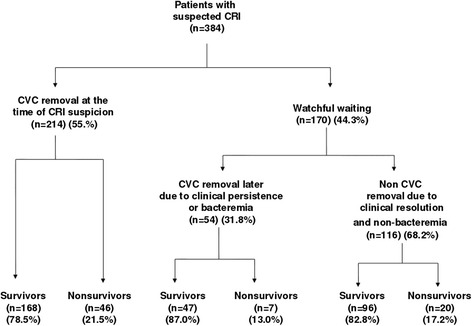
Introduction: Best clinical practice for patients with suspected catheter-related infection (CRI) remains unclear according to the latest Infectious Diseases Society of America (IDSA) guidelines. Thus, the objective of this study was to analyze clinical practice concerning the central venous catheter (CVC) and its impact on prognosis in patients with suspected CRI. Methods: We performed a prospective, multicenter, observational study in 18 Spanish Intensive Care Units (ICUs). Inclusion criteria were patients with CVC and suspected CRI. The following exclusion criteria were used: age less than 18 years; pregnancy; lactation; human immunodeficiency virus; neutropenia; solid or haematological tumor; immunosuppressive or radiation therapy; transplanted organ; intravascular foreign body; haemodynamic instability; suppuration or frank erythema/induration at the insertion site of the CVC, and patients with bacteremia or fungemia. The end-point of the study was mortality at 30 days of CRI suspicion. Results: The study included 384 patients. In 214 (55.8%) patients, CVC was removed at the moment of CRI suspicion, in 114 (29.7%) CVC was removed later and in 56 (14.6%) CVC was not removed. We did not find significant differences between survivors (n =311) and non-survivors (n =73) at 30 days according to CVC decision (P =0.26). The rate of confirmed catheter-related bloodstream infection (CRBSI) was higher in survivors than in non-survivors (14.5% versus 4.1%; P =0.02). Mortality rate was lower in patients with CRBSI than in the group of patients whose clinical symptoms were due to other causes (3/48 (6.25%) versus 70/336 (20.8%); P =0.02). We did not find significant differences in mortality in patients with confirmed CRBSI according to CVC removal at the moment of CRI suspicion (n =38) or later (n =10) (7.9% versus 0; P =0.99). Conclusion: In patients with suspected CRI, immediate CVC removal may be not necessary in all patients. Other aspects should be taken into account in the decision-making, such as vascular accessibility, the risk of mechanical complications during new cannulation that may be life-threatening, and the possibility that the CVC may not be the origin of the suspected CRI.
Overview
The claims and statistics of this paper haven’t been checked yet.
Free: it reads the open-access text and checks the first 5 claims that cite a source we can check. Create a free account to check every claim.
Integrity signals
Registry
Cites
Statistics
Figures
Verification
Claims the paper makes
The claims and statistics of this paper haven’t been checked yet.
Free: it reads the open-access text and checks the first 5 claims that cite a source we can check. Create a free account to check every claim.
Self-check
Percentages, sums and reported differences re-computed from the paper’s own numbers.
The self-check needs the paper’s full text.
Citations
Cites
Vincent, J. L., Moreno, R., Takala, J., Willatts, S., De Mendonça, A., Bruining, H., Reinhart, C. K., Suter, P. M., & Thijs, L. G. (1996) · Intensive Care Medicine · doi:10.1007/bf01709751 · Cited by 11,674
Surviving Sepsis Campaign: International Guidelines for Management of Severe Sepsis and Septic Shock
Dellinger, R. P., Levy, M. M., Rhodes, A., Annane, D., Gerlach, H., Opal, S. M., Sevransky, J. E., Sprung, C. L., Douglas, I. S., Jaeschke, R., et al. (2013) · Critical Care Medicine · doi:10.1097/ccm.0b013e31827e83af · Cited by 9,694
The Surviving Sepsis Campaign Guidelines Committee including The Pediatric Subgroup*, Dellinger, R. P., Levy, M. M., Rhodes, A., Annane, D., Gerlach, H., Opal, S. M., Sevransky, J. E., Sprung, C. L., Douglas, I. S., et al. (2013) · Intensive Care Medicine · doi:10.1007/s00134-012-2769-8 · Cited by 7,290
Intravenous Fluids and Acute Kidney Injury
Ding, X., Cheng, Z., & Qian, Q. (2017) · Blood Purification · doi:10.1159/000452702 · Cited by 6,827
An Intervention to Decrease Catheter-Related Bloodstream Infections in the ICU
Pronovost, P., Needham, D., Berenholtz, S., Sinopoli, D., Chu, H., Cosgrove, S., Sexton, B., Hyzy, R., Welsh, R., Roth, G., et al. (2006) · New England Journal of Medicine · doi:10.1056/nejmoa061115 · Cited by 4,387
Mermel, L. A., Allon, M., Bouza, E., Craven, D. E., Flynn, P., O'Grady, N. P., Raad, I. I., Rijnders, B. J. A., Sherertz, R. J., & Warren, D. K. (2009) · Clinical Infectious Diseases · doi:10.1086/599376 · Cited by 3,638
O’Grady, N. P., Barie, P. S., Bartlett, J. G., Bleck, T., Carroll, K., Kalil, A. C., Linden, P., Maki, D. G., Nierman, D., Pasculle, W., et al. (2008) · Critical Care Medicine · doi:10.1097/ccm.0b013e318169eda9 · Cited by 600
Timsit, J.-F., Schwebel, C., Bouadma, L., Geffroy, A., Garrouste-Orgeas, M., Pease, S., Herault, M.-C., Haouache, H., Calvino-Gunther, S., Gestin, B., et al. (2009) · JAMA · doi:10.1001/jama.2009.376 · Cited by 449
Lambert, M.-L., Suetens, C., Savey, A., Palomar, M., Hiesmayr, M., Morales, I., Agodi, A., Frank, U., Mertens, K., Schumacher, M., et al. (2011) · The Lancet Infectious Diseases · doi:10.1016/s1473-3099(10)70258-9 · Cited by 443 · cited 1×
“On the one hand, catheter-related bloodstream infection (CRBSI) has been associated with increased mortality [2] and delayed CVC removal could lead to worse prognosis if the focus of infection is the CVC itself [3].”
BackgroundLorente, L., Henry, C., Martín, M. M., Jiménez, A., & Mora, M. L. (2005) · Critical Care · doi:10.1186/cc3824 · Cited by 307
Self-citationBody temperature alterations in the critically ill
Peres Bota, D., Lopes Ferreira, F., M�lot, C., & Vincent, J. L. (2004) · Intensive Care Medicine · doi:10.1007/s00134-004-2166-z · Cited by 295 · cited 1×
“This percentage is higher than those in previous series reporting that infectious events were the cause of fever in critically ill patients, ranging between 17% [11] and 50% [12-14] of cases.”
ResultTreatment and Outcome of Staphylococcus aureus Bacteremia: A Prospective Study of 278 Cases
Jensen, A. G., Wachmann, C. H., Espersen, F., Scheibel, J., Skinhøj, P., & Frimodt-Møller, N. (2002) · Archives of Internal Medicine · doi:10.1001/archinte.162.1.25 · Cited by 270 · cited 1×
“On the one hand, catheter-related bloodstream infection (CRBSI) has been associated with increased mortality [2] and delayed CVC removal could lead to worse prognosis if the focus of infection is the CVC itself [3].”
BackgroundA prospective study of fever in the intensive care unit
Circiumaru, B., Baldock, G., & Cohen, J. (1999) · Intensive Care Medicine · doi:10.1007/s001340050928 · Cited by 220 · cited 1×
“This percentage is higher than those in previous series reporting that infectious events were the cause of fever in critically ill patients, ranging between 17% [11] and 50% [12-14] of cases.”
ResultOccurrence and outcome of fever in critically ill adults*
Laupland, K. B., Shahpori, R., Kirkpatrick, A. W., Ross, T., Gregson, D. B., & Stelfox, H. T. (2008) · Critical Care Medicine · doi:10.1097/ccm.0b013e318170efd3 · Cited by 214 · cited 1×
“This percentage is higher than those in previous series reporting that infectious events were the cause of fever in critically ill patients, ranging between 17% [11] and 50% [12-14] of cases.”
ResultPalomar, M., Álvarez-Lerma, F., Riera, A., Díaz, M. T., Torres, F., Agra, Y., Larizgoitia, I., Goeschel, C. A., & Pronovost, P. J. (2013) · Critical Care Medicine · doi:10.1097/ccm.0b013e3182923622 · Cited by 171
Rijnders, B. J., Peetermans, W. E., Verwaest, C., Wilmer, A., & Wijngaerden, E. V. (2004) · Intensive Care Medicine · doi:10.1007/s00134-004-2212-x · Cited by 141 · cited 2×
“Third, in a randomized clinical trial involving 64 patients with suspected CRI, there were no differences in outcome between groups with early CVC removal and those with watchful waiting; however, in the watchfulwaiting group, only 38% underwent catheter removal [7].”
BackgroundCauses and Consequences of Fever Complicating Critical Surgical Illness
Barie, P. S., Hydo, L. J., & Eachempati, S. R. (2004) · Surgical Infections · doi:10.1089/sur.2004.5.145 · Cited by 118 · cited 1×
“This percentage is higher than those in previous series reporting that infectious events were the cause of fever in critically ill patients, ranging between 17% [11] and 50% [12-14] of cases.”
ResultLorente, L., Lecuona, M., Ramos, M. J., Jiménez, A., Mora, M. L., & Sierra, A. (2008) · Clinical Infectious Diseases · doi:10.1086/592253 · Cited by 50 · cited 1×
“In this regard, CVCs placed in the jugular vein of tracheostomized patients [16] or those placed in the femoral vein present a higher risk of CRBSI [17]; however, the risk of CRBSI decreases with the use of antimicrobialimpregnated catheters [18] and dressings [19].”
BackgroundSelf-citationInfluence of tracheostomy on the incidence of central venous catheter-related bacteremia
Lorente, L., Jiménez, A., Martin, M. M. I. D. O., Castedo, J., Galván, R., García, C., Brouard, M., & Mora, M. L. (2009) · European Journal of Clinical Microbiology & Infectious Diseases · doi:10.1007/s10096-009-0742-4 · Cited by 39 · cited 1×
“In this regard, CVCs placed in the jugular vein of tracheostomized patients [16] or those placed in the femoral vein present a higher risk of CRBSI [17]; however, the risk of CRBSI decreases with the use of antimicrobialimpregnated catheters [18] and dressings [19].”
BackgroundSelf-citationManaging bloodstream infections in patients who have short-term central venous catheters
O’Grady, N. P., & Chertow, D. S. (2011) · Cleveland Clinic Journal of Medicine · doi:10.3949/ccjm.77a.10015 · Cited by 35 · cited 1×
“This approach is in consonance with the opinion of other authors [15].”
ResultThe place of early haemoperfusion with polymyxin B fibre column in the treatment of sepsis.
Ronco, C. (2005) · Critical Care · doi:10.1186/cc3890 · Cited by 31
Cateterización venosa femoral: ¿realmente hay que evitarla?
Lorente, L., & León, C. (2009) · Medicina Intensiva · doi:10.1016/j.medin.2009.03.009 · Cited by 15
Self-citation
Cited by
Surviving sepsis campaign: international guidelines for management of sepsis and septic shock 2021
Evans, L., Rhodes, A., Alhazzani, W., Antonelli, M., Coopersmith, C. M., French, C., Machado, F. R., Mcintyre, L., Ostermann, M., Prescott, H. C., et al. (2021) · Intensive Care Medicine · doi:10.1007/s00134-021-06506-y · Cited by 5,082
Surviving Sepsis Campaign: International Guidelines for Management of Sepsis and Septic Shock 2021.
Evans, L., Rhodes, A., Alhazzani, W., Antonelli, M., Coopersmith, C. M., French, C., Machado, F. R., Mcintyre, L., Ostermann, M., Prescott, H. C., et al. (2021) · Critical Care Medicine · doi:10.1097/ccm.0000000000005337 · Cited by 2,935
Chaves, F., Garnacho-Montero, J., del Pozo, J. L., Bouza, E., Capdevila, J. A., de Cueto, M., Domínguez, M. Á., Esteban, J., Fernández-Hidalgo, N., Fernández Sampedro, M., et al. (2018) · Medicina Intensiva · doi:10.1016/j.medin.2017.09.012 · Cited by 170
Self-citationComplication and Failures of Central Vascular Access Device in Adult Critical Care Settings*
Takashima, M., Schults, J. A., Mihala, G., Corley, A., & Ullman, A. J. (2018) · Critical Care Medicine · doi:10.1097/ccm.0000000000003370 · Cited by 95
Zhong, Y., Zhou, L., Liu, X., Deng, L., Wu, R.-N., Xia, Z., Mo, G., Zhang, L., Liu, Z., & Tang, J. Y. (2021) · Infectious Diseases and Therapy · doi:10.1007/s40121-021-00429-3 · Cited by 51
“A suspected CRBSI was identified when a patient developed a new episode of fever or sepsis [11], with at least 1 additional parameter described in the 2001 ISDC guidelines noted in the progress notes in the medical charts [13].”
BackgroundResultInfluential
Metadata
- Authors
- Lorente, L., Martín, M. M., Vidal, P., Rebollo, S., Ostabal, M. I., Solé-Violán, J., & Vascular Catheter Working Group of GTEIS/SEMICYUC
- Affiliations
- Hospital Universitario de Canarias (ES)
- Complejo Hospitalario de Ourense (ES)
- Hospital Universitario Miguel Servet (ES)
- Corresponding author
- Lorente, Leonardo
- Venue
- Critical Care
- Published
- 2014-10-17
- Volume
- 18
- Issue
- 5
- Pages
- 564-564
- ISSN
- 1364-8535 (ISSN-L)
- PMC
- PMC4245782
- OpenAlex
- W2100090718
- Cited by
- 52
- References
- 22
- Citations by year
- 2026: 2 · 2025: 3 · 2024: 4 · 2022: 14 · 2021: 6 · 2020: 3 · 2019: 7 · 2018: 5 · 2016: 5 · 2015: 3
- FWCI
- 4.63
- Type
- journal article
- Language
- en
- Open access
- gold
- doi.org
- Licence
- cc-by
- creativecommons.org/licenses/by/4.0 (tdm)
- creativecommons.org/licenses/by/4.0 (vor)
- Locations
- Critical Care (publishedVersion, cc-by)
- Europe PMC (PubMed Central) (publishedVersion, cc-by)
- PubMed Central (publishedVersion, cc-by)
- PubMed (publishedVersion)
- Funders
- Instituto de Salud Carlos III (I3SNS-INT-12-087, I3SNS)
- European Regional Development Fund
- Topics
- Health Sciences › Medicine › Critical Care and Intensive Care Medicine › Central Venous Catheters and Hemodialysis
- Health Sciences › Medicine › Cardiology and Cardiovascular Medicine › Infective Endocarditis Diagnosis and Management
- Health Sciences › Medicine › Critical Care and Intensive Care Medicine › Nosocomial Infections in ICU
- Keywords
- central venous catheters, catheter-related infection, catheter-related bloodstream infection, catheter removal timing, intensive care unit patients, 30-day mortality, clinical practice variation, vascular access, catheter-related complications, IDSA guidelines, catheter-related sepsis, catheter-related pneumonia
- MeSH terms
- Cross Infection, Humans, Intensive Care Units, Prognosis, Prospective Studies, Bacteremia, Hospital Mortality, Device Removal, Catheter-Related Infections, Central Venous Catheters
About these checks
Registry, retraction, Cites and statistics results are computed, not judged, with one exception: a printed reference that no index lists is read once by a model before it counts as a citation error. Claims are extracted by a model and kept only when their quote appears verbatim in the text; each cited source is then checked, with a model’s help, for whether it says what the claim relies on. Those verdicts can be wrong — read the claim’s quote and the cited source before relying on one.
Statistics and arithmetic are recomputed, not judged.
Confidence bands are shown only for fields calibrated on our annotated test set. None is calibrated yet, so no band is shown.
What counts as a claim ›How we measure confidence ›How we check this ›
Are you an author, or do you see a problem with this page? Request a review
Data sources
Bibliographic data: Semantic Scholar, OpenAlex, Crossref.
Contains information from the Semantic Scholar Academic Graph Datasets, made available under the ODC Attribution License (ODC-BY 1.0).
Semantic Scholar’s data is described in: Kinney, R., et al. (2023). The Semantic Scholar Open Data Platform. arXiv:2301.10140.
